Talk to an Expert

Top 10 MCP Consulting Companies to Consider in 2026

Model Context Protocol (MCP) is an open framework that helps businesses connect AI systems to live, trusted data securely and in real time. It allows AI to pull data from CRMs, ERPs, databases, and legacy systems without compromising privacy or compliance.

Instead of constantly retraining models or embedding static data, Model Context Protocols (MCPs) act as a bridge between AI and your business tools. This ensures your AI always operates with current, accurate context.

Enterprises using MCP report up to 40% faster AI deployment and 25% better customer response times.

For companies adopting enterprise AI, working with an experienced MCP consulting partner provides a key advantage in scaling this technology.

Why MCP Is Transforming Enterprise AI in 2026?

In 2026, MCP implementation is no longer optional; it’s essential for businesses that want to stay competitive with AI. Many companies invest heavily in generative AI development, but without the right framework, their AI often fails to deliver real business value. This is where MCP consulting services come in and Here’s why they matter:

1. Cuts Costs by Reducing Redundant AI Training

Without Model Context Protocols (MCPs), companies often retrain AI models again and again when data updates. MCP Consultants helps businesses set up systems where AI pulls fresh data dynamically. This saves time, cuts costs, and makes AI more agile.

2. Increases AI Accuracy and Compliance

Certified MCP consulting firms help businesses connect AI to verified data sources. This ensures AI stays accurate, compliant, and aligned with industry regulations, critical in sectors like finance and healthcare. If your business handles sensitive data, working with an experienced MCP consulting partner is a smart move.

3. Makes Integration Across Systems Easy

Modern businesses run on both cloud and legacy systems. MCP consulting companies in the USA know how to bridge the gap, building flexible, scalable frameworks. The result: Your AI solutions work seamlessly across platforms.

4. The Rise of AI Agents

One of the biggest trends of 2026 is autonomous AI agents. These AI tools act on behalf of users and rely on real-time data to perform complex tasks. MCP Consultants enable these agents by providing structured, contextual data, a key success factor.

How to Choose the Right MCP Consulting Partner?

Choosing the right MCP consulting company is one of the most important decisions for your AI strategy. The market is crowded; over 100+ firms now offer MCP implementation services. But not all are equal.

Here’s a simple checklist to help you select the best MCP consulting partner for your business:

1. Certified MCP consulting firms

Always start here. Work only with certified MCP consulting firms. Certification means the company truly understands Model Context Protocols (MCPs) and can implement them properly, not just experiment.

2. Industry Experience

Your industry matters. Whether you’re in finance, healthcare, logistics, or retail, your MCP consulting partner should have real-world experience helping businesses like yours. This ensures they know the unique compliance, security, and integration challenges your sector faces.

3. Tools & Frameworks

Leading MCP consulting companies in USA and globally don’t just offer advice. They provide ready-to-use tools that help you monitor and optimize your MCP implementation long after launch. This is key for keeping your AI stack efficient and future-proof.

4. Post-Launch Support

Artificial Intelligence is not “set it and forget it.” Your chosen MCP Consultants should provide ongoing support, performance tuning, and training for your team. This helps you get long-term value from your MCP consulting services.

5. Integration with New Tech

Ask about support for emerging technologies. Top MCP consulting leaders 2026 can help you connect your operations with tokenization, Cross-Chain Multi-Asset Management Platforms, and Generative AI easily. This future-readiness gives you a competitive edge.

Looking for MCP development? Book a call with us today.

Top 10 MCP Consulting Companies Shaping the Future in 2026

solulab

1. SoluLab

A top AI development company offering MCP consulting services. Known for driving AI-powered personalization in e-commerce. Ideal for businesses seeking AI solutions to improve conversion rates.

Focus & Strengths: AI development company, strong in ML, NLP, computer vision; e-commerce personalization


$35 – $55/ hr


200 – 249


2014

LimeChain

2. LimeChain

Experts in blockchain development, AI-driven smart contracts, and Model Context Protocol (MCP) architecture, LimeChain supports enterprises with advanced Web3 strategies, decentralized infrastructure, and custom MCP implementations that scale.

Focus & Strengths: Blockchain, Web3 development, MCP-focused architecture, enterprise-grade dApps


$75-$140/ hr


120+


2017

Softude

3. Softude

Global Certified MCP consulting firm. They automate knowledge transfer through scalable MCP design for industries like healthcare, manufacturing, and fintech.

Focus & Strengths: Digital transformation, scalable MCP implementation, AI automation


$95-$145/ hr


450+


2005

Quytech

4. Quytech

A MCP consulting partner known for creating custom MCP frameworks. Focused on building AI-driven bots and virtual assistants that enhance customer experience.

Focus & Strengths: Custom MCP frameworks, AI-first, virtual assistants


$30-$60/ hr


200+


2015

Deeper Insights

5. Deeper Insights

Leaders in explainable and ethical AI. Their MCP consulting services are trusted in highly regulated sectors, from pharmaceuticals to government.

Focus & Strengths: Ethical AI, explainability, regulated industry MCP solutions


$65-$110/ hr


11-50


2014

Hexaware Technologies

6. Hexaware Technologies

A large enterprise MCP consulting company with strong delivery across banking, insurance, and healthcare. Known for integrating MCP with cloud platforms and enterprise systems.

Focus & Strengths: Enterprise-grade MCP consulting company, banking, insurance, healthcare


$120-$250/ hr


32,000+


1990

Tech Mahindra

7. Tech Mahindra

They provide dynamic MCP management and ERP integration. Tech Mahindra supports AI-driven transformation for sectors like telecom, retail, and manufacturing.

Focus & Strengths: Dynamic MCP management, AI + ERP integration for telecom, retail


$95 – $350/ hr


146,000+


1986

Anthropic

8. Anthropic

The creators of MCP and leaders in Generative AI development. Anthropic focuses on building AI agents that are reliable, interpretable, and secure, used in their Claude AI systems.

Focus & Strengths: MCP creators, AI safety, Generative AI development, Claude AI


$150 – $300/ hr


1000+


2021

SimForm

9. SimForm

Strong at building contextual AI frameworks with Cloud, Data, AI expertise. Their MCP consulting services power use cases in logistics, healthcare, and education.

Focus & Strengths: Cloud, Data, AI, rapid MCP iteration for logistics, healthcare, education


$85-$160/ hr


1000+


2010

Blue Label Labs

10. Blue Label Labs

An AI Agent Development Company and Tokenization Platform Development Company. They specialize in embedding brand voice into MCP solutions for healthcare, real estate, and fintech.

Focus & Strengths: Digital product agency, AI Agent Development Company, IoT, AR/VR, brand voice in MCP


$65-$95


40+


2019

Blockchain Development Company in Canada

Conclusion

In 2026, the Model Context Protocol (MCP) is becoming essential for modern enterprise AI. It helps businesses build smarter AI agents, improve compliance, and reduce costs. More and more companies are turning to MCP consulting companies in USA to stay competitive.

But success with MCP is not just about the technology. You need the right MCP consulting partner, one who understands your industry, your business goals, and how to apply AI to deliver real results.

The demand for Certified MCP consulting firms and experienced MCP consultants is growing fast. The sooner you act, the faster you can leverage this powerful new standard to transform your operations.

FAQs

1: What is the Model Context Protocol (MCP)?

The Model Context Protocol (MCP) is an open standard that allows AI models to access live business data securely. It connects your tools, apps, and workflows to AI in real time, helping drive better outcomes.

2: Why is MCP important for businesses in 2026?

MCP removes the need for retraining AI, improves contextual understanding, and boosts efficiency. Many companies report productivity gains of up to 13%. It is now a key part of AI strategy for forward-thinking enterprises.

3: How do consulting firms support MCP implementation?

Top MCP consulting firms guide you through the full process, from strategy and modeling to deployment and ongoing optimization. They align your MCP implementation with business goals and ensure compliance with industry standards.

4: What should I look for in an MCP consulting partner?

Look for a partner with strong technical skills in MCP consulting services, proven industry experience, and a focus on delivering measurable business outcomes. Always choose from trusted Certified MCP consulting firms.

5: Can MCP work with my legacy systems or cloud platforms?

Yes. One of the key strengths of Model Context Protocols (MCPs) is their ability to work across both legacy systems and modern cloud-based platforms. This makes MCP highly flexible and future-proof.

How AI Development Is Driving Fintech Innovation in Australia?

AI in Australian Fintech Industry

Managing finances isn’t always smooth. Many Australians still face long loan approval times, bulky banking interfaces, and limited access to personalized financial advice. On the other hand, fintech companies face rising compliance costs and pressure to deliver faster, safer services.

From automating tedious processes to detecting fraud in real-time, AI solutions are transforming the way the fintech industry operates in Australia. With the rise of AI applications in fintech, startups and banks alike are delivering smarter, more personalized financial experiences. 

At the same time, AI agents in financial services are helping businesses stay compliant and agile in the face of strict regulations. In this blog, we’ll explore how AI is in fintech, use cases, and look at what the future holds. Let’s get started!

The Rise of Fintech in Australia: Overview

AI in the Australian finance industry has over 800 fintech companies operating across the country, and it’s one of the fastest-growing tech sectors in the region. Sydney and Melbourne have become major hubs, attracting both local startups and global players.

Supportive regulations, like open banking and the Consumer Data Right (CDR), have made innovation easier and safer. In fact, Australia’s fintech adoption rate hit 58%, one of the highest in the world. 

Within the financial services and insurance industries, 39% of businesses have adopted AI, utilizing it for various applications, including customer service chatbots and automation of routine tasks.

CTA1

Benefits of AI in Fintech for Australian Consumers

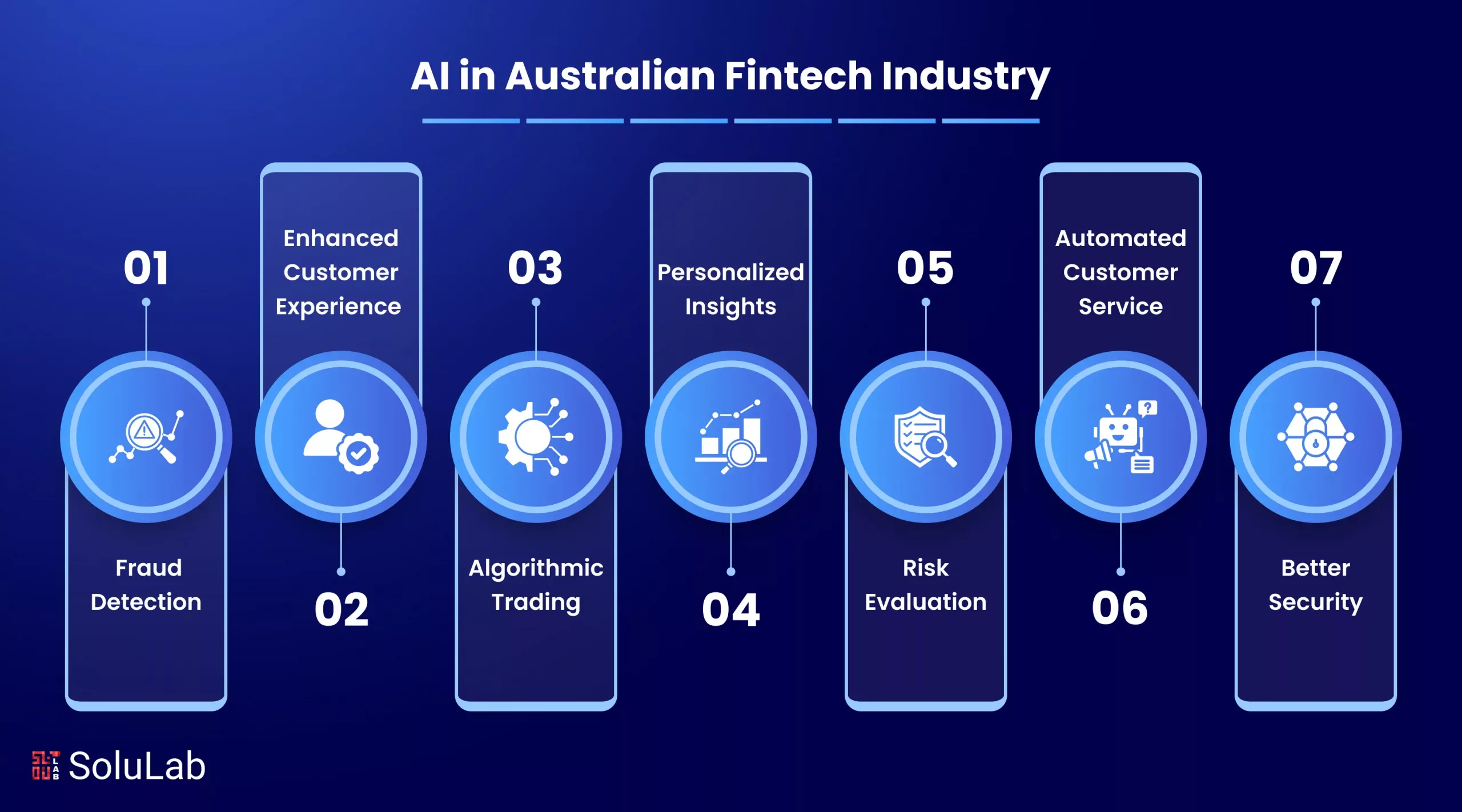
AI in the financial industry is improving the financial geography in Australia, offering consumers smarter, faster, and more secure services. Here are some of the benefits: 

1. Fraud Detection

By analyzing vast amounts of transaction data, AI systems can identify unusual patterns and flag potential fraudulent activities before they arise. For example, the Commonwealth Bank of Australia (CBA) has implemented AI-driven systems to detect and investigate financial crimes more efficiently and protect customers’ assets. 

2. Enhanced Customer Experience

Gone are the days of long wait times for customer support. Due to AI integration in financial solutions, AI-powered chatbots and virtual assistants now provide instant, 24/7 assistance. They handle routine inquiries and offer personalized financial advice. CBA’s virtual assistant, “Ceba,” is a prime example, assisting customers with various banking needs and improving overall satisfaction.

3. Algorithmic Trading

For investors, AI enables algorithmic trading by analyzing market trends, historical data, and even social media sentiment to execute trades. This technology enables faster, more efficient trading decisions, potentially maximizing returns and minimizing risks. 

4. Personalized Financial Recommendations

AI analyzes individual spending habits and financial goals to offer tailored advice. Robo-advisors, powered by AI, provide personalized investment strategies, making financial planning more accessible and affordable for a broader audience. This personalization enhances customer engagement and satisfaction. 

5. Risk Evaluation

Assessing creditworthiness has become more accurate with AI. By evaluating a wide range of data points, including transaction history and employment records, AI models can predict potential risks. This leads to more informed lending decisions and better risk management for financial institutions. 

6. Automated Customer Service

AI improves customer service by automating routine tasks such as account inquiries and transaction processing. This reduces operational cost, plus allows human agents to focus on more complex issues, overall efficiency, and the responsiveness of financial services. 

7. Better Security

Beyond fraud detection, AI enhances cybersecurity by monitoring for potential threats. It can detect anomalies in user behavior, flagging suspicious activities that may indicate security breaches. 

Use Cases of AI in the Fintech Industry

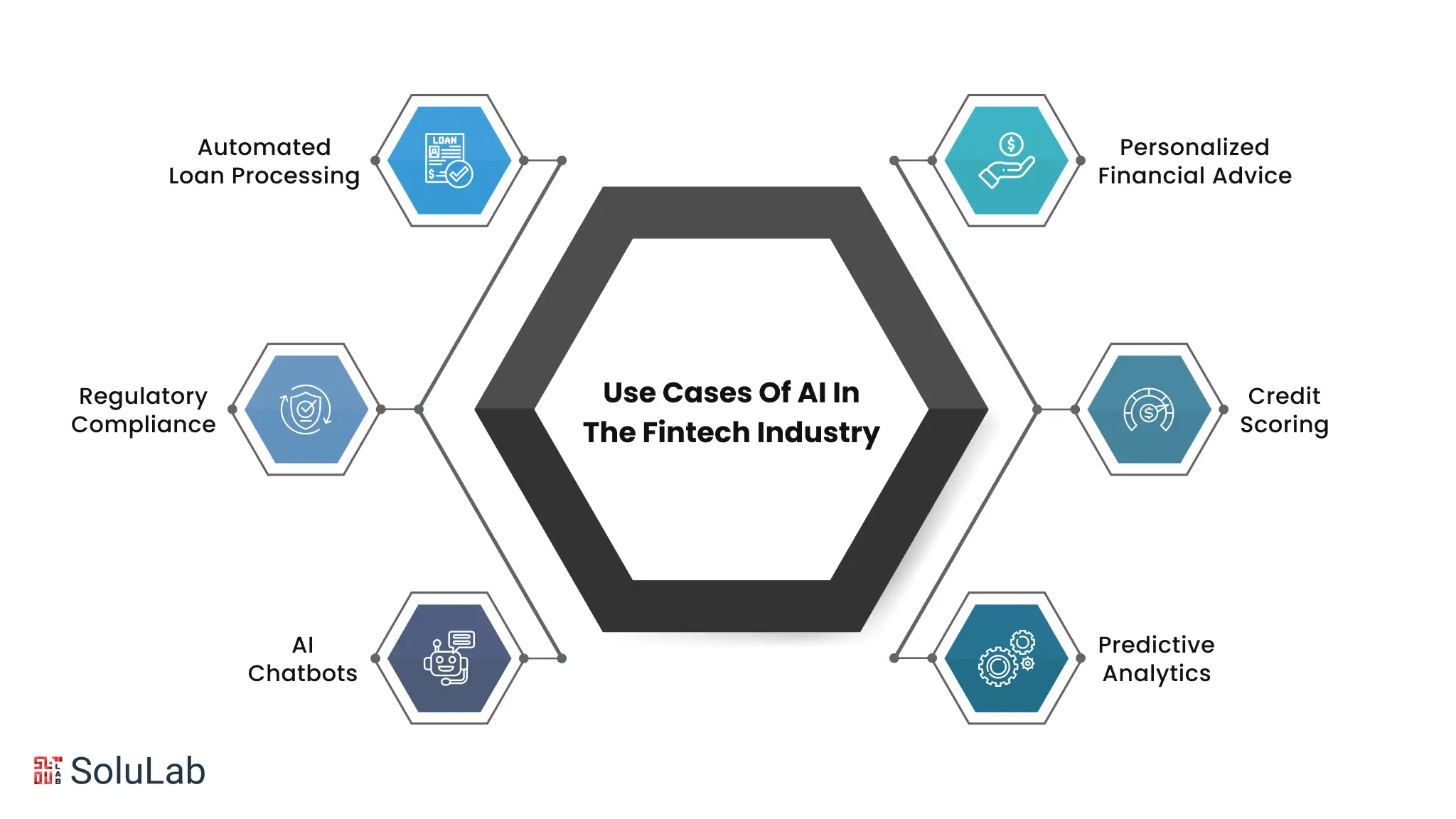
Use Cases of AI in the Fintech Industry

Artificial Intelligence (AI) is rapidly transforming the fintech space, offering innovative solutions across various sectors. From enhancing security to personalizing financial services, AI’s capabilities are vast and continue to expand. Here are some AI use cases in fintech you should know: 

  • Automated Loan Processing

The days of universal financial advice are long gone. These days, AI-powered platforms provide personalized suggestions based on user spending patterns, financial objectives, and risk tolerance. Users are empowered to make wise choices regarding saving, investing, and budgeting because of this customisation.

  • Personalized Financial Advice

By evaluating enormous statistics, such as credit history, income, and even social media activity, artificial intelligence is changing loan approvals. In addition to speeding up the approval process, this technology improves accuracy and equity, opening out credit to a wider range of people.

  • Regulatory Compliance

It can be difficult to figure out the complex web of financial regulations. By automating compliance checks, tracking transactions in real time, and identifying possible infractions, AI simplifies this process. This ensures prompt adherence to regulatory standards while simultaneously minimizing manual labor.

  • Credit Scoring

People without long credit histories are frequently overlooked by traditional credit rating techniques. AI modifies this by analyzing data from other sources, such as energy bills and social media posts, to provide a more thorough and inclusive evaluation of creditworthiness.

  • AI Chatbots

AI-powered chatbots have improved customer service in the financial industry. These virtual assistants improve customer experience while lowering operating expenses by answering common questions, responding instantly, and being available 24/7.

  • Predictive analytics

AI is used in predictive analytics to foresee consumer behavior, market trends, and possible hazards. Fintech businesses may optimize investment strategies, make proactive judgments, and customize services for each client by evaluating both historical and current data.

Read More: Asset Tokenization Regulations for Australia

The Future of AI in Australian Fintech

The Australian fintech sector is poised for significant disruption and growth fueled by advancements in Artificial Intelligence. Here are some future trends you’ll see in the upcoming years:

1. Highly Personalized Financial Planning

Consider AI would know your financial goals, risk tolerance, fears, and personality. This information could develop a flexible financial plan for your changing life.

Generative AI in the fintech industry might change your budget and savings goals. It may advise financial storm techniques if you’re unexpectedly laid off. This hyper-personalization, powered by advanced AI models, would be improving financial planning, making it more adaptive and responsive to individual needs.”

2. Emotionally Intelligent Chatbots

Ignore robot responses! AI chatbots will learn to read your mood and reply accordingly. Stressed about a low bank balance? This AI buddy would offer budgeting advice, encouragement, and income-boosting strategies with empathy. 

Suppose a chatbot that can answer financial questions and provide emotional assistance in difficult circumstances. A more holistic and supportive financial experience would result.

3. Lifestyle-specific AI-powered insurance

Insurance has been one-size-fits-all. AI could tailor an insurance policy to your lifestyle. This AI-powered health insurance plan might evaluate your fitness tracker data and reward healthy habits with lower premiums. 

Car insurance may also analyze your driving habits and commute traffic jams to determine your risk profile and change your coverage. Personalized insurance may be cheaper and more suited to your requirements.

4. Financial Product Predictive Maintenance

Financial goods require frequent upkeep, like autos. In predictive financial product maintenance, AI can spot issues before they happen. AI could analyze your investment portfolio and anticipate its performance in different market scenarios. 

It may then suggest portfolio tweaks to reduce risk and maximize profits. AI might also monitor your buying habits and identify cash flow gaps, helping you avoid financial stress. This preventive approach would protect your finances.

5. Debt Management with AI

AI could help manage debt and achieve financial freedom. Consider a system that analyzes your loans and credit cards and develops a customized payback schedule. 

The AI could negotiate reduced interest rates with lenders for you. Automation and support could make debt management easier and less stressful.

CTA2

Conclusion

To wrap it up, AI in finance is changing the game for Australia. From faster loan approvals to smarter fraud detection, it’s making financial services more efficient, secure, and user-friendly. With Australian startups leading the charge and strong government backing, the country is well on its way to becoming a global fintech hub. 

AI-Build partnered with SoluLab to develop a scalable, AI-powered CAD solution using generative models like GANs and CNNs. The result? Automated design generation, real-time error detection, and enhanced customization—reducing manual effort and boosting productivity. 

SoluLab, a top AI development company in Australia, can help you automate your business to scale faster and stay competitive through a practical AI solution. Contact us today to discuss further!

FAQs

1. What is AI in fintech?

AI in fintech refers to using artificial intelligence technologies like machine learning, natural language processing, and predictive analytics to improve financial services.

2. Why is AI important for fintech companies in Australia?

AI helps fintechs improve operations, reduce human error, deliver faster services, and offer personalized customer experiences—all crucial in a competitive market.

3. Is AI in fintech regulated in Australia?

Yes, AI applications must comply with financial regulations, privacy laws, and guidelines under frameworks like the Consumer Data Right (CDR).

4. How does AI improve credit scoring?

AI evaluates non-traditional data like utility payments or social behavior to offer a fairer and more inclusive assessment of creditworthiness.

5. Are AI chatbots replacing human agents in fintech?

Not entirely. AI chatbots handle routine queries, but human agents still manage complex or sensitive issues. It’s more about collaboration.