Talk to an Expert

How Can AI Help Businesses Cut Costs in 2026?

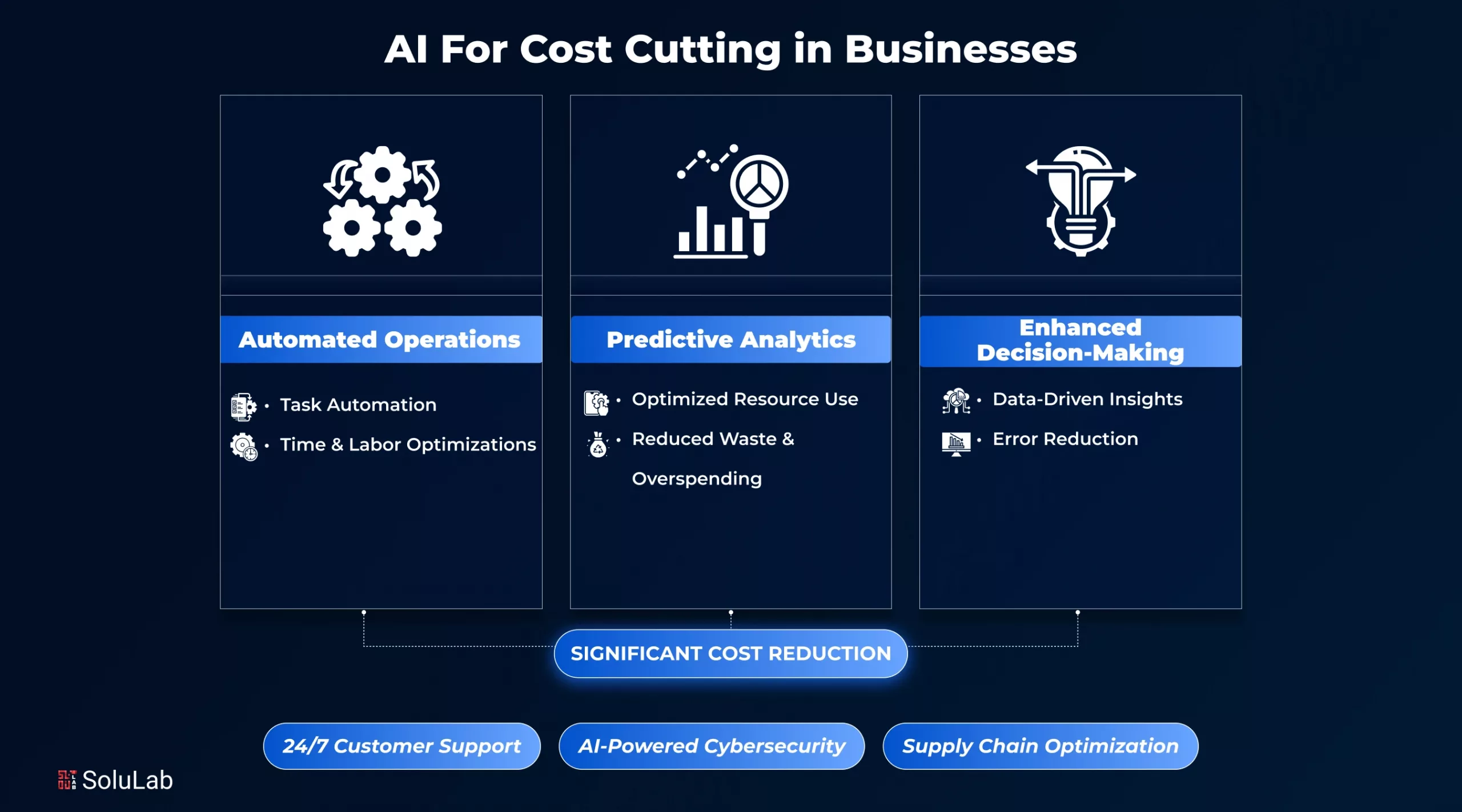
AI For Cost Cutting in Businesses

Artificial Intelligence is not just an idea; it is shaping the world economy. AI is not just about automating a few tasks; it’s about innovation, data usage, and learning algorithms. This helps your business grow efficiently. 

Today, over 90% of business executives expect AI to play a major role in AI-powered cost optimization. In the coming months, AI cost-saving solutions are going to take a new turn. And the proof is visible: enterprises are already reporting 5% to 20% savings, sometimes even more.

But before you dive into this technology, one question comes up: how much does it really cost to implement AI, and how fast does it pay back? Let’s find out.

Why Businesses Are Turning to AI for Cost Reduction?

AI doesn’t just cut costs, it changes how you manage them. From MNCs to enterprises using AI cost-saving solutions to speed up work and decision-making. 

The major reason why AI in business works well is its ability to process massive data in seconds. Either e-commerce or manufacturing AI is playing its role quite efficiently. AI keeps learning predictive maintenance and supply chain management. Hence, in the near future, AI cost savings solutions for enterprises are going to evolve. 

Another big advantage? Prevention. Instead of waiting for a problem to happen, Artificial Intelligence spots early warning signs, saving repair, rework, and penalty costs. Think of it as a smart assistant that helps you act before expenses spiral.

In short, AI cost reduction best practices focus on three things:

1. Automating repetitive work to save labor costs.

2. Predicting issues to avoid downtime and waste.

3. Using real-time data to make smarter financial decisions.

That’s why leading companies now see AI as a strategic investment, not just a technology upgrade.

CTA1

How Much Does It Cost to Implement AI in Your System?

Before expecting results, it’s important to understand the AI implementation cost. Prices can vary a lot depending on the size, complexity, and goals of your project.

  • Simple AI tools or APIs (like chatbots or analytics add-ons): $2,000 to $40,000
  • Custom enterprise AI systems (built for your business needs): $25,000 to $500,000+
  • Hybrid models (mix of both): ideal for most mid-sized companies looking for balance

Your industry also affects the cost. For example:

  • Healthcare and finance projects cost more due to strict data regulations and privacy requirements.
  • Retail, customer support, and logistics projects are faster and cheaper to deploy. However, they have large data sets to maintain, so upgrades are needed. 

Other key cost drivers include:

  • Data preparation: Cleaning and labeling data can consume up to 20 to 30% of the total cost.
  • Infrastructure: Cloud AI is flexible, but on-premises might be needed for compliance.
  • Talent: Hiring AI engineers or outsourcing impacts budgets heavily.
  • Maintenance: Retraining models and monitoring accuracy require ongoing investment.

Still, when you compare AI cost-benefit analysis, the numbers make sense. Most businesses see ROI of AI automation within 12–18 months, sometimes even faster.

For example, Deloitte found experienced adopters achieve an average 4.3% ROI in the first year, while Microsoft reports $3.70 return for every $1 spent on AI at scale. That’s proof that when planned right, AI pays for itself.

Which Business Areas Gain the Most Cost Savings from AI?
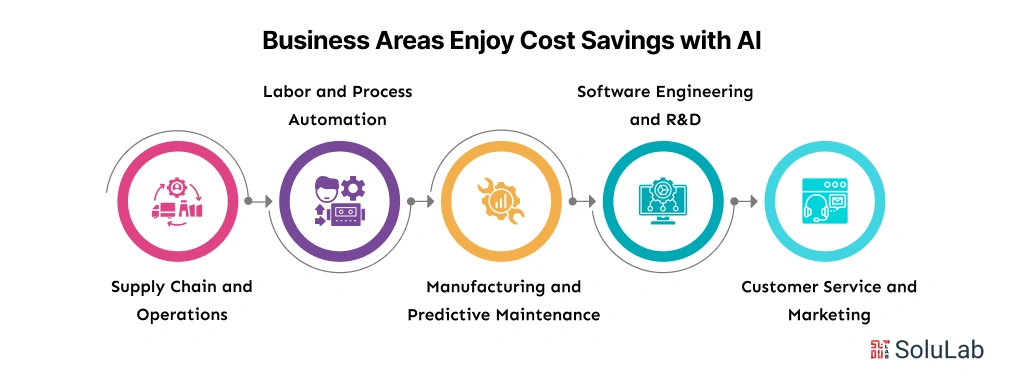
Business Areas Enjoy Cost Savings with AI

AI cost savings go beyond one industry and one department. Its impact is diverse from operations to finance and R&D. Let’s check where AI cost optimization is max. 

1. Supply Chain and Operations

Smart algorithms can reduce inventory waste, predict demand, and plan logistics better.

  • Predictive analytics can save 10-20% in logistics costs.
  • One global e-commerce company used AI to cut supply chain expenses by $500,000 annually.

2. Labor and Process Automation

AI-powered automation helps businesses save on labor by taking care of repetitive work.

For example, virtual assistants handling customer queries can cut support costs by 30–40%, while also improving customer satisfaction.

3. Manufacturing and Predictive Maintenance

AI-driven maintenance detects equipment faults before breakdowns.

  • Predictive maintenance can reduce repair costs by 30-40%.
  • One auto parts manufacturer saved $275,000 yearly using real-time AI monitoring.

4. Software Engineering and R&D

AI tools can write, test, and debug code faster, cutting human errors and development costs. However, human checking is needed, but it can improve the delivery speed and reduce the manpower. 

In R&D, AI scans large data sets to find promising ideas, helping teams bring new products to market up to 40% faster.

5. Customer Service and Marketing

AI chatbots and analytics reduce service center load. For instance, Australian insurer nib Group saved $22 million by automating 4 million customer interactions with AI.

When you add it all up, even a 10% cost drop or 5% revenue boost can create a six-figure impact in enterprise budgets.

Plan a Cost-Effective AI Implementation Service for Your Business
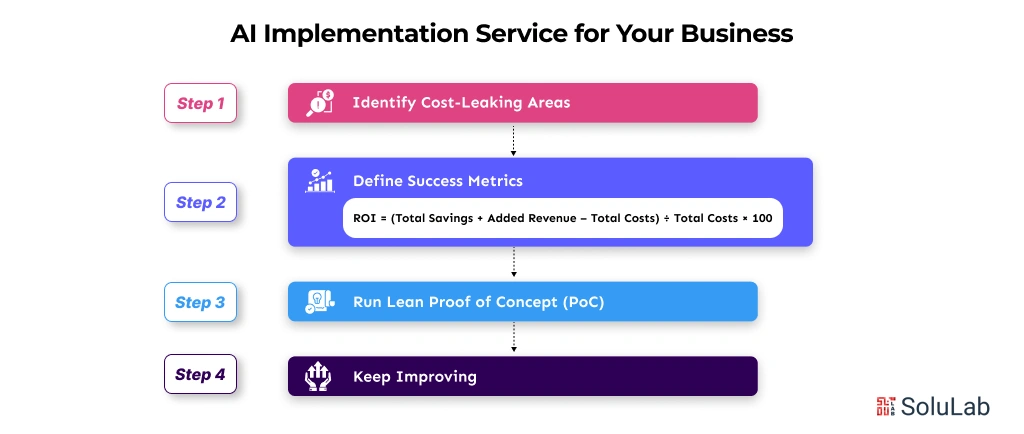
AI Implementation Service for Your Business

AI implementation services require expertise and, data-driven plan. Therefore, you can go for third-party AI development companies that provide maintenance and integrations. For now, let’s check the AI cost-effective implementation.

Step 1: Identify Cost-Leaking Areas

Start with your business audit. Ask: Where do we lose money or time most often? It might be in logistics delays, repetitive admin work, or manual data entry. Focus on areas with measurable KPIs like “cost per transaction” or “time per ticket.”

Step 2: Define Success Metrics

Without numbers, you can’t prove savings. Set clear goals: for example, “reduce support costs by 20%” or “save 1,000 labor hours per month.” This becomes your AI investment planning checklist before development begins.

Step 3: Run a Lean Proof of Concept (PoC)

Start small, one workflow, one use case. For example, automate refund approvals or ticket triaging. Once it delivers results, reuse the same AI components for other tasks. This keeps costs predictable and scalable.

A simple ROI formula to track:

ROI = (Total Savings + Added Revenue – Total Costs) ÷ Total Costs × 100

Example:
A chatbot automates 27,000 interactions in a quarter, saving $4 per case and earning $10,000 in extra sales.

Setup cost: $25,000. ROI = ((108,000 + 10,000 – 25,000) ÷ 25,000) × 100 = 372% ROI in three months.

Step 4: Keep Improving

AI is not a one-time project. Track performance monthly, refine models, and retrain as needed. Set feedback loops with your teams and ensure data quality stays high. This continuous improvement approach ensures sustainable AI cost savings solutions for enterprises.

CTA2

Conclusion 

Now you know how AI reduces costs for your business. There are different plans and strategies to cut your expenses; AI implementation solutions are the top-notch among them. So, if you are looking for AI cost savings solutions, SoluLab is here to offer them. 

SoluLab, a top AI development company, offers our future-ready AI solutions that can boost your business and reduce costs. We have been assisting organizations in using the most recent AI tools and technologies to accomplish exponential growth. 

If you set your goal to implement AI in your system, then contact us today and have a brief call with our consultant. 

FAQs

1. Can AI really think beyond automation and help my business make smarter money decisions?

Yes! AI goes beyond automation by identifying inefficiencies and predicting expenses, helping with AI for business cost optimization that supports smarter, data-driven financial decisions every day.

2. How do I know if AI is worth the investment for my company?

Do a simple AI cost-benefit analysis, compare your automation savings against implementation costs. If results show savings within 12-18 months, your AI investment is absolutely worth it.

3. What’s the best first step for companies new to AI?

Start small with one measurable AI use case. Test automation through AI implementation services or a short Proof of Concept (PoC) to see fast, low-risk cost savings.

4. Why should I choose SoluLab for my AI implementation?

SoluLab combines strategy, technology, and measurable results. Our experts design custom AI solutions that focus on ROI, scalability, and long-term savings for your business.

 

How AI in Business is Transforming Operations in 2026?

AI in Business 

AI is not an abstract distant vision but a real force altering the corporal structure of the business environment. Small, medium-scale, large-scale, new business entities and big business conglomerates are applying this latest creation of artificial intelligence (AI) to enhance expansion, productivity, and creativity. This revolutionary technology is rapidly displacing jobs, redesigning work, and generating new jobs. In this regard, it becomes quite clear that organizations must learn how to survive the advancement of AI in business or be left behind.

What is Artificial Intelligence?

AI use cases can be broadly described as the one whether it is an organized bloc or a system of mechanisms necessary to display intelligence and to obtain it in the same way as human beings gain their intelligence. It refers to developing smart entities which are defined as entities that can sense, learn, know, and act to accomplish certain tasks. When it comes to definition of the AI, this can be described as the synergy of multiple methods such as NLP, Machine learning, and deep learning.

Below are some of the real-life situations that have been implemented with the use of AI in the business world; Smart Personal Assistants such as GOOGLE Home, AMAZON Alexa, and Siri Apple. These are devices that use artificial intelligence whereby the devices are capable of recognizing voices and responding to them and even chitchatting. They can also let them call their friend, warn them, tell them something, manage the smart devices in their house, and even wake up their companions. The idea of virtual assistants presents the essence of what artificial intelligence is and how it can fundamentally change people’s experience of the relationship with technology and its language, as well as access to data.

Transforming Business With AI

 It can be stated that artificial intelligence is not only a concept of the future but a reality-shifting corporate reality. With more and more companies realizing the value of AI applications in business it is becoming an essential weapon in the businessmen’s arsenal ranging from a source of innovation to efficiency. 

There is no doubt, that the way artificial intelligence is altering businesses is through automating many processes. Many simple tasks that need not be handled by humans such as data entry, and answering common customer inquiries can be handled by AI systems, and this way, human employees can focus on complex and creative tasks. Use AI for business contours of relation causes improved production efficiency and ultimately cheaper costs.

Since decision-making is an important organizational structure, it is also developing with AI in business intelligence. AI systems are capable of identifying weaknesses that ordinary personnel might not be able to discern from large amounts of data. This is beneficial to firms in that they can make projections for future earnings, disperse their assets efficiently, and also make improved decisions. 

Machine learning in retail by Application of AI tools in business in analyzing client purchases is an excellent way of improving inventory control in the retail industry and recommending individual client items. The fourth area touched upon is customer experience; this area is also significantly influenced by the implementation of AI in business strategy. Virtual help services, automated with the benefits of AI in business, are available around the clock; they answer clients’ inquiries and correct issues swiftly. Consumers are also served through the personalization of goods and services through the identification of areas that need to be developed through the study of user input.

Be that as it may, there are many opportunities in today’s artificial intelligence; however, the utilization of this concept requires certain wisdom. Thus, people must invest in AI for startups, AI infrastructure has to be created, and ethical problems have to be addressed. Businesses that incorporate the best AI in business management shall stand to gain and reap big as the technology progresses during the new dispensation.

CTA1

How is Business Using AI Tools?

Nowadays, how to use AI in business is applied by tens of thousands of companies in various practical spheres to increase efficiency, reduce the number of failures, and gain a competitive advantage. The following are some important domains:

  • Improved Customer Experience: Consumers’ welfare has now begun experiencing positive changes through the creation of happiness and loyalty through recommendations, good chatbot services and anticipative customer services the AI uses in business.
  • Optimized Operations: Some of the specific benefits, that businesses are witnessing from the application of cooperative computing systems are; cost reduction through optimizing the application process through the use of AI for business intelligence, the supply systems through the use of the networks, the effectiveness of maintenance through the use of the networks in maintenance, quality of products through the application of networks in quality assurance.
  • Data-Driven Decision-Making: Thus, within the parameters of applying AI in the business world to the evaluation of big data, this approach provides the opportunity to make efficient decision-making within the scope of resources, threats, and strategy.
  • Accelerated Innovation: AI agent is the architectural and artistic ability to help a firm create new products, enhance the existing ones, and identify opportunities within the market.
  • Financial Performance Boost: In the area of algorithmic trading, credit scoring as well as credit risk assessment, fraud detection and analysis, and financial and business analysis AI use cases enhance the stake of finance.
  • Talent Management and HR Optimization: It applies the concept of talent management and improves the processes of recruitment, employee attraction, and satisfaction, as well as HR operations and practices.
  • Industry Transformation: Hence, artificial intelligence is a new business solution, the replacement of challenging problems’ resolver, and the general change in many industries.

Read More: How Can AI Help Businesses Cut Costs?

Examples of AI in Business 

AI is no longer something that belongs in the future. It is being integrated across a variety of corporate processes, inspiring innovation and productivity. Here are AI in business examples from real life:

Customer Support

  • Chatbots and Virtual Assistants: Generative AI for Enterprise has powered business applications such as chatbots and virtual assistants for companies like Amazon, Apple, and many more in providing quick, responsive customer service and answering frequently asked questions efficiently. This frees human agents to deal with complex issues.
  • Personalized Recommendations: AI is used in business algorithms to study consumer behavior and interests, enabling online retailers such as Amazon and Netflix to give incredibly personalized product recommendations or content. This is a personalized approach that increases sales and raises client satisfaction.

 Marketing and sales

  • Predictive analytics: AI in business management to assess customer data to be able to project what’s going to occur in the future, enabling them to run much more targeted ad campaigns and effective sales strategies. For example, retailers will be able to estimate demand for a product to prevent overstocking or stockouts.
  • Image Recognition: AI-powered image recognition analyzes pictures from social media, detecting customer preferences and trends, and creating new collections based on such analysis for fashion companies.

Supply Chain and Operations

  • Supply Chain Optimization: AI tools in business can be used to optimize the supply chain, anticipate demand, and manage inventory levels, which helps to smooth transportation routes. Companies like Walmart Use AI in business to cut down on costs and improve the productivity of their supply chains. 
  • Quality Control: Manufacturing companies apply AI-driven image recognition systems to inspect items for flaws to ensure that standards of quality are met.

These are just a few examples of AI in business. It is sure that shortly, much more interesting applications of AI in the business podcast will turn up as it matures and transforms the way organizations are run.

Benefits Of AI in Business

Benefits Of AI in Business

Artificial intelligence has several benefits of AI in business, regardless of the industry. Some of these significant advantages are:

1. Greater Productivity: Artificial intelligence frees humans from doing mundane tasks so that they concentrate their time on core goals. It, therefore, saves money and increases output. For example, AI for business analytics automation can ease supply chain-related processes, while chatbots can fulfill common customer queries.

2. Better Decision Making: Artificial intelligence analyzes huge amounts of data to find trends and patterns that human eyes would miss. Therefore, such an organization can reduce risks and cap on such opportunities, only if it uses data-driven decisions. For example, AI in Sports boosts performance by providing valuable insights and analysis, giving teams a competitive edge.

3. Better Customer Experience: AI applications in business helps businesses provide customers with personalized experiences. Through consumer data analysis, businesses can provide customized advice to customers, enhance customer service, and foster stronger relationships with customers.

4. Higher revenue: AI in business management provides an opportunity to generate higher revenue through the identification of untapped new markets, price plan optimization, and maximization of sales effectiveness. For example, recommendation systems powered by AI can increase sales by making relevant product recommendations to customers.

5. Competitive Advantage:Early adopters have a lot to benefit from the use of AI in business. Businesses can leverage AI for innovation and operational efficiency to set them apart from their rivals in businesses, thereby increasing their market share.

6. Innovation: AI in business intelligence can act as a booster for innovation, as companies may use it to test new ideas, develop new products, and research new areas. For example, AI can be applied to generate new material designs or creative content.

Read Also: How to Create an AI-Powered App like Doppl?

What Future Does AI in Business Holds?

The fact that technology is still under development foreshadows that actually, we should expect much more profound effects on operations and sectors. A very promising area of growth lies in the area of hyper-automation, where AI agent is combined with Robotic Process Automation (RPA) to drive the automation of corporate activities. This would mean never-seen-before levels of production and efficiency. Next up, generative AI for enterprises, capable of churning out vast content, will drastically disrupt marketing, content development, and customer support.

The role of will also be larger in decision-making. Due to its advanced analytics and predictive capabilities, AI applications in business will turn into a crucial tool for resource allocation, risk assessment, and strategy planning. Further progress in AI development will lead to its application combined with the Internet of Things in smart solutions able to enhance customer experience, predict maintenance, and optimize operations.

Even though some problems—data protection, ethical considerations, and talent recruitment—are yet to be solved, the general trend of AI in business is positive. It pictures a future with artificial intelligence that is seamless in every running of the corporation, breeding innovation, expansion, and competitiveness.

CTA2

The Bottom Line

 The AI development company is here to make you thrive within the digital marketplace and must now make integration within daily operations a necessity rather than an option. Artificial intelligence is capable of transforming businesses and creating new possibilities by just making the repetition of some process automatic and with innovation. If common in business, then the companies using AI would be well placed to have competitive advantages by improving consumer experiences and streamlining processes as the technology advances.

Effective AI implementation requires, however, careful planning, personnel hiring with qualification requirements, and knowledge of the different advantages and disadvantages. Organizations have to be very serious about security, ethics, and data privacy.

The power of AI will enable businesses to create new opportunities and build a better future. Are you ready to hire an AI developer? We at SoluLab are here as trustworthy partners in this transformation. With our years of expertise in AI and machine learning, we can help to empower business objectives with AI. Contact us today to discuss how we can help power up your AI use in business.

FAQs

1. What are some of the business benefits of AI Agents?

 Key benefits provided by AI agents include improved decision-making, productivity enhancement, heightened customer experience, increase in revenue, and competitive edge.

 2. What are common barriers to implementing AI? 

Common problems faced in that it requires heavy investments, lack of talent, ethical issues, and poor quality and accessibility of data. 

3. How can sales and marketing utilize AI Agent?

Applications of AI agent in Sales and Marketing include lead scoring, lead segmentation, personalized marketing, predictive analytics, and customer churn prediction.

4. Is AI replacing human jobs?

Even while AI is automating certain kinds of work, it is also creating new avenues as far as jobs are concerned. AI is intended to complement, not replace, human potential.

5. How do I implement AI in my business with SoluLab?

SoluLab provides a wide range of services related to artificial intelligence: strategy, development, and implementation. Our experts can help you identify prospective AI opportunities, develop unique AI solutions, and ensure the successful deployment of AI.


What Is AI Technology – Understanding Artificial Intelligence

Artificial Intelligence (AI)

The worldwide artificial intelligence market was valued at USD 196.63 billion in 2023 and is anticipated to expand at a CAGR of 36.6% between 2024 and 2030. The continuous research and innovation led by tech companies are driving the adoption of advanced technologies in various industries, including automotive, healthcare, retail, finance, and manufacturing.

For example, in December 2023, Google LLC introduced “Gemini,” a large language AI model available in three sizes: Gemini Nano, Gemini Pro, and Gemini Ultra. Gemini distinguishes itself from competitors with its inherent multimodal feature.

What Is AI?

Artificial intelligence (AI) encompasses a range of technologies that empower machines to perform tasks traditionally requiring human intelligence. AI systems use algorithms, data, and computational power to mimic human cognitive functions. They can learn and improve their performance over time by analyzing extensive datasets, enabling them to recognize patterns and make connections that might be missed by humans.

The Benefits of AI-Integrated Business Solutions

Benefits of Integrating AI in Business

Integrating artificial intelligence (AI) into business solutions offers a myriad of advantages, encompassing increased productivity, cost-effectiveness, and enhanced customer satisfaction. By leveraging the capabilities of AI, businesses can stimulate growth and innovation through the following channels:

1. Enhanced Decision Making: Artificial intelligence (AI) can analyze vast amounts of data, identify patterns, and make predictions, allowing businesses to make more informed decisions. This includes analyzing customer behavior, market trends, and financial data to gain insights that would be difficult or impossible for humans to uncover. AI can also help businesses assess risk, optimize pricing strategies, and make better hiring and resource allocation decisions. Understanding how artificial intelligence works enables organizations to leverage these insights effectively.

2. Improved Efficiency: AI-powered automation can streamline repetitive and time-consuming tasks, allowing employees to focus on higher-value activities. For example, AI can be used to automate data entry, customer service inquiries, and inventory management. AI can also help businesses reduce errors and improve accuracy by automating tasks that are prone to human error, such as data transcription and financial calculations. These efficiencies are vital in enhancing overall productivity.

3. Competitive Advantage: By using AI technology, businesses can differentiate themselves in the market and stay ahead of the competition. AI can be used to create new products and services, improve customer experiences, and optimize business operations. For example, AI can be used to develop personalized shopping recommendations, create chatbots that provide customer support 24/7, and optimize supply chain logistics. This adaptability helps companies to maintain a competitive edge.

4. Predictive Analytics: AI certifies businesses with predictive analytics by analyzing historical data and identifying trends. This allows companies to anticipate market shifts, customer preferences, and potential challenges before they arise, giving them a proactive edge in decision-making. Businesses can forecast inventory needs, optimize supply chains, and create personalized marketing strategies based on these predictions.

5. Enhanced Personalization: With AI’s ability to process vast amounts of data, businesses can deliver highly personalized experiences for customers. AI systems analyze customer behavior, preferences, and interactions to offer tailored recommendations and services. This personalized approach increases customer satisfaction, boosts brand loyalty, and fosters long-term relationships with clients.

How Software Companies Can Empower Your Business with AI?

2023 marked a pivotal year in technology history, as generative artificial intelligence made a significant debut. As AI continues its advancement, businesses are increasingly recognizing its potential to enhance productivity and introduce new products and services.

However, harnessing AI’s full potential requires careful consideration. Businesses must navigate ethical and technical challenges such as AI bias and hallucinations to maximize benefits while mitigating risks. Here are some recommendations to guide responsible and effective AI adoption:

  • Input Error Reduction

Through its error-reduction capabilities, AI enhances organizational productivity. Humans, prone to making mistakes due to their nature, often encounter data errors resulting from repetitive data handling. As people lose attention and focus over time, mistakes initially identified can go unnoticed. AI-powered systems, on the other hand, minimize errors in all processes, including critical tasks, offering a reliable and consistent approach to data management. This application of AI in business highlights how different types of AI can improve operational efficiency. As organizations explore the AI future, leveraging these technologies can lead to significant advancements in error reduction and overall productivity.

  • Cybersecurity

AI-powered cybersecurity solutions employ system activity monitoring and vulnerability identification to enable IT teams to prevent cyber-attacks. The integration of AI in informational technology has become prevalent, earning a dedicated term: AIOps. AI capabilities encompass task automation, data optimization, and the safeguarding of IT infrastructures. Contrary to popular depictions in 90s movies, the application of AI in the tech industry is not synonymous with impending doom but rather offers substantial benefits. This is similar to the way artificial intelligence in healthcare is revolutionizing patient care through various applications of AI. Just as AI enhances cybersecurity, it holds promise for numerous fields by improving efficiency and effectiveness.

Check our Blog Post: The Role of AI in Modern Cybersecurity

  • Human Performance

Undoubtedly, AI excels in specific tasks where efficiency and speed are paramount, such as multitasking and processing vast amounts of data. However, AI falls short when it comes to tasks that require intuition, empathy, creativity, and soft skills like leadership and conflict resolution. These tasks are inherently human and cannot be easily replicated by AI. Instead of viewing AI as a replacement for humans, firms should embrace it as a tool that enhances human intelligence. By combining the strengths of both AI and humans, organizations can achieve remarkable results. For instance, marketing companies can leverage AI’s analytical capabilities and NLP applications to predict consumer preferences accurately. Additionally, AI as a service allows businesses to integrate advanced technologies without extensive in-house expertise. However, it’s essential to remember that only humans can create marketing campaigns that resonate with customers on an emotional level. Similarly, doctors can use AI to stay updated on the latest medical research and treatment options. But ultimately, it’s the human doctor who can effectively prescribe a treatment plan that considers the patient’s emotional and physical well-being.

  • Customer Engagement

AI personalizes content to engage with new and existing customers, enhancing their experience, and promoting proactive service. This significantly boosts customer satisfaction and loyalty. AI-driven systems operate 24 hours a day, providing constant support to customers through advanced algorithms and natural language processing (NLP). This results in immediate responses and reduced wait times. These sophisticated systems analyze extensive customer data, comprehending individual behaviors and preferences, which enables AI as a service recommendations and proactive problem-solving.

AI Development Solutions

  • AI System

Humans play a vital role in continuously improving AI systems. They can address AI shortcomings such as bias and hallucinations by monitoring AI systems and identifying incidents of bias or hallucination. The University of California, Irvine, conducted research that demonstrated the effectiveness of a hybrid model. In this model, both humans and AI systems analyzed a diverse range of images, resulting in improved accuracy. Businesses should train employees to engage with AI to provide continuous improvement of algorithms. This can help prevent negative outcomes in the short term and the long term, train the technology to incorporate ethical considerations, and prevent future mistakes. Additionally, integrating Generative AI CRM into business processes can enhance customer relationships, while leveraging AI in finance can optimize financial operations and decision-making.

DO YOU KNOW?
“Brazil is expected to register the highest CAGR in the artificial intelligence market from 2024 to 2030.”

  • AI Automation

Artificial intelligence (AI) presents businesses with a powerful tool that offers multiple advantages, one of which is enhancing the efficiency of existing software tools. By automating repetitive tasks such as data entry and content generation, AI empowers teams to redirect their energy and attention toward more pressing matters. This automation not only boosts productivity but also facilitates better decision-making and optimizes economic growth for businesses. AI-powered tools can significantly enhance problem-solving capabilities. These tools provide automated suggestions for solutions, expediting the resolution process and enabling teams to address issues more efficiently. The role of Adaptive AI in this context is crucial, as it allows for dynamic adjustments based on real-time data. Moreover, partnering with leading AI development companies can further leverage these advancements to tailor solutions that meet specific business needs.

Read Blog: AI in Business Process Automation

  • Real-time AI

For AI to fully realize its potential, it must work with data in motion or in real time. Data serves as the nourishment for AI, fueling algorithms and training large language models. The quality of AI systems is directly proportional to the accuracy and freshness of their data. If an AI application is built on erroneous or outdated data, it becomes useless, potentially propagating social biases or amplifying the dissemination of false information. The concept of real-time AI is of paramount importance. These systems can process and respond to data as it streams in. Consider an AI agent conversing with customers; it must be aware if the last item of a product they’re interested in is sold out. In emergencies, real-time AI can accelerate response times, potentially saving lives. For banks, real-time AI can revolutionize fraud detection by analyzing transactions instantaneously and identifying suspicious patterns at unparalleled speeds. This real-time capability is transformative, and AI urges businesses to explore ways to integrate this technology. By doing so, you’ll have access to the most relevant information in the most suitable context, exactly when it’s needed.

  • Data Analysis

At the core of any successful business lies a crucial element: data. As a valuable resource, data demands a robust system to process its immense volumes. Artificial intelligence presents an ethical solution, enabling lightning-fast analysis of both current and historical data. Envision a business where every decision is grounded in data-driven insights. That’s the transformative potential of what is artificial intelligence. No more reliance on speculation and guesswork, as the artificial intelligence definition empowers your company to make informed decisions with confidence. Understanding what is AI artificial intelligence allows businesses to harness its full potential.

  • LLMs Usage

In artificial intelligence (AI), the saying “two brains are better than one” holds, and multiple brains are even more advantageous. Businesses should recognize the importance of adopting multiple Large Language Models (LLMs), the backbone of generative AI, rather than relying on a single LLM. A combination of LLMs enhances the accuracy and reliability of artificial intelligence systems. When one LLM encounters challenges, such as generating a specific type of text, another can step in to compensate. Utilizing specialized LLMs streamlines operations. One LLM might be dedicated to writing, while another focuses on information retrieval. Inexpensive LLMs can handle simple tasks, while more costly ones tackle sophisticated analysis. Alongside multiple LLMs, businesses should prioritize the use of private LLMs over public LLMs. Public LLMs pose significant risks due to their training on public data sets. If prompted skillfully, they can divulge sensitive information, potentially leading to fraud or theft. Private LLMs mitigate these risks by relying exclusively on an organization’s private data and limiting access to authorized stakeholders. Understanding AI artificial intelligence helps define how artificial intelligence works and its definition of artificial intelligence. The artificial intelligence meaning becomes clearer with the recognition of different types of AI and the future of AI.

The Future of AI: Trends to Watch

With new advancements and trends arising that promise to change industries in the coming years. Staying informed about these trends will help businesses use AI to its fullest potential. Here are some key trends shaping the future of AI:

1. AI Democratization: The development of AI platforms and tools is becoming more accessible to businesses of all sizes, allowing companies with limited technical expertise to implement AI solutions. This is achieved through AI as a Service (AIaaS), where pre-built models are available for integration into various operations.

2. Generative AI’s Growth: AI models capable of generating creative content, such as text, images, and even code, are gaining momentum. Applications like Generative AI CRM are enhancing customer relationships by automating personalized responses and predictive customer insights.

3. AI and Ethics: As AI systems become more embedded in decision-making processes, ethical considerations such as bias, fairness, and accountability will be critical. The focus on responsible AI development will drive businesses to adopt frameworks ensuring AI aligns with societal values.

4. Adaptive AI: AI systems are increasingly capable of adapting to new data in real time, enabling businesses to respond swiftly to changes. Adaptive AI applications can be highly valuable in dynamic industries like finance, healthcare, and e-commerce.

5. AI in Hyper-Automation: Businesses are exploring ways to combine AI with robotic process automation (RPA) to achieve hyper-automation, where AI-driven processes are used to automate more complex tasks. This trend will further enhance operational efficiency and reduce costs.

6. Collaborative AI: The future will see more collaboration between human workers and AI agents. AI will handle repetitive tasks while humans focus on creative and strategic activities, enabling teams to work smarter and more efficiently.

Hire AI Developers

How SoluLab Can Help For Businesses Using AI?

In exploring what is artificial intelligence and how it can enhance business operations, it becomes clear that AI artificial intelligence offers extensive potential to transform various industries. By understanding artificial intelligence definition and how artificial intelligence works, businesses can leverage AI in Business to achieve significant improvements in efficiency and decision-making. The artificial intelligence meaning extends beyond mere automation, encompassing a range of applications of AI such as AI in healthcare, AI in FinTech, and Generative AI CRM.

We developed an AI-powered chatbot for Digital Quest, a travel business aiming to improve user engagement and customer service. The chatbot, built using Generative AI, provides personalized travel recommendations and streamlines reservations by extracting relevant data from Digital Quest’s website.

Software companies specializing in AI development play a crucial role in guiding businesses through this technological landscape. SoluLab, with its expertise in AI agents and AI as a service, stands out as a valuable partner for companies looking to integrate artificial intelligence into their operations. By collaborating with AI development Company like SoluLab, businesses can harness the power of AI artificial intelligence to drive growth, optimize processes, and achieve their strategic goals.

FAQs

1. What is artificial intelligence?

Artificial intelligence (AI) refers to the field of computer science focused on creating systems capable of performing tasks that would typically require human intelligence. This includes tasks like learning, reasoning, problem-solving, and understanding natural language.

2. What is AI artificial intelligence?

AI artificial intelligence is a term that emphasizes the use of artificial intelligence technologies to replicate or enhance human capabilities in various applications. It encompasses the tools and methods used to create intelligent systems.

3. What is the definition of artificial intelligence?

The definition of artificial intelligence is the study and creation of computer systems that can perform tasks requiring human-like intelligence. These tasks include recognizing patterns, learning from data, and making decisions based on that information.

4. How does artificial intelligence work?

AI systems function by processing large amounts of data to identify patterns and make predictions or decisions. They use algorithms and machine learning models to analyze data and continuously improve their performance over time.

5. What are the different types of AI?

Different types of AI include various approaches and technologies such as NLP applications, Generative AI CRM, and Adaptive AI. These types range from simple rule-based systems to complex models that can learn and adapt from experience.