

- AI Development
- AI App Development
- AI Consulting
- AI Software Development
- ChatBot Development
- Enterprise AI ChatBot
- AI Chatbot Development
- LLM Development
- Machine Learning Development
- AI Copilot Development
- MLOps Consulting Services
- AI Agent Development
- Deep Learning Development
- AI Deployment Services
- Deep Learning Consulting
- AI Token Development
- AI Development Company
- AI Development Company in Saudi Arabia
- AI Integration Services
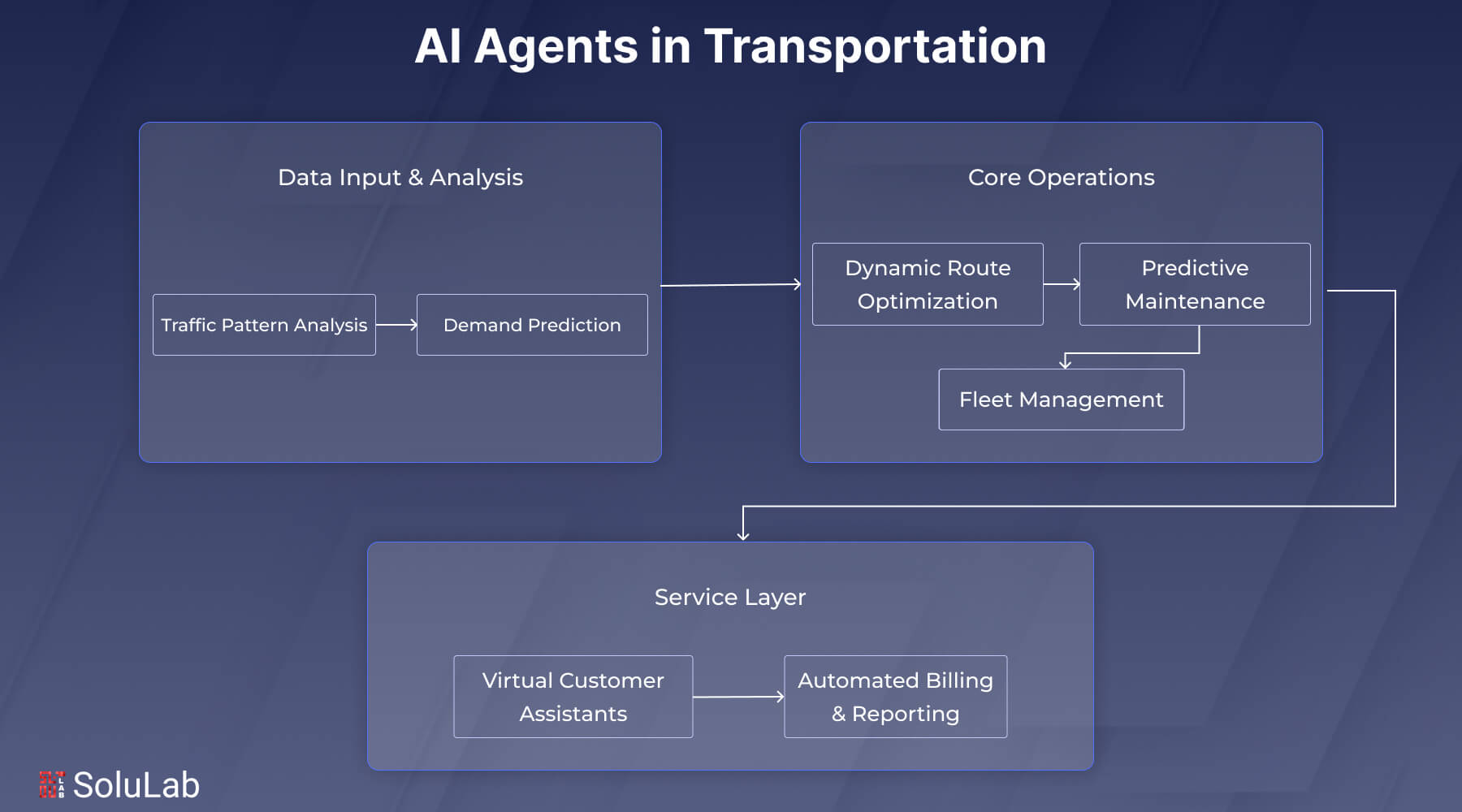
To what extent are the past trends in transportation shaping our perception of its future development? Looking back, progress has always been driven by technical progress, from the invention of the steam engine to the success of cars, to the emergence of air travel. The next significant advancement is being driven by AI agents today. Predictive demand forecasting, logistics optimization, and autonomous vehicles are just a few examples of how artificial intelligence (AI) in transportation is carrying on the legacy of innovation. As per recent sources, the North American AI in transportation market was estimated to be worth USD 1.80 billion in 2024 and is anticipated to expand at a compound annual growth rate (CAGR) of 22.83% throughout the forecast period.
With intelligent route optimization and individualized services, AI agents in transportation are leading the way in smart mobility solutions, improving customer happiness and public transportation efficiency. These AI agents for customer service greatly reduce operating expenses while promoting sustainable urban transportation practices by using real-time data analytics. Cities may use AI technology to build more flexible and effective transit systems.
In this article, we will examine how agentic AI is improving operational effectiveness and setting the stage for a more sustainable, connected, and effective transportation future.
What are AI Agents?
AI agents are self-regulating systems that communicate with humans and their surroundings to make choices and execute tasks. These agents use LLMs or other AI/ML models, as well as contextual knowledge, to carry out various functions, including customer service, data analysis, autonomous driving, smart home management, and more. Many AI agents may benefit from their experiences and adjust to new conditions, making them useful in various sectors for increasing productivity, effectiveness, and user experience.
Agentic AI accelerates your business operations. Agentic AI has an opportunity to change enterprises across sectors in the following ways:
- Automation of Difficult Tasks: AI agents for IT can undertake difficult jobs that require complex decision-making, strategy planning, and adaptability. AI-driven analysis, diagnostics, and autonomous operations are transforming industries, including banking, healthcare, and transportation.
- Better Efficiency: Agentic AI improves efficiency by automating regular and complicated operations, allowing human experts to concentrate on inventive strategic, higher-value activities, resulting in greater productivity and efficiency across industries.
- Increased User Experience: In customer service and user contact settings, agentic AI may give individualized, context-aware replies, increasing user happiness and engagement.
- Innovative Applications: AI agents may be used in various use cases, including smart homes, creative services, sophisticated robotics, and autonomous cars, and they can often drive imaginative new applications.
Understanding the Necessity for Agentic AI in Transportation
Transportation is an essential component of global trade, including freight logistics and public travel. Despite its crucial relevance, this business has challenges like as inefficiency, escalating prices, and environmental repercussions. Such issues are often exacerbated by difficulties in coordinating extensive activities across many networks and regions.
This is the role of AI agents in transportation. These agents offer a more intelligent, data-informed strategy for addressing these difficulties. They give you automated solutions that facilitate decision-making along with real-time information to enhance organizational operations. AI systems boost safety standards and optimize service delivery by using predictive analytics, autonomy, traffic scheduling, and research. As autonomous cars and intelligent traffic management gain prominence, agentic AI is transforming the transportation of commodities and people.

How Can Agentic AI Improve the Way Transportation Services Are Offered and Received?
AI has several uses in the transportation industry, and they all help customers and businesses alike. Agentic AI in transportation automates a variety of operational duties, enhances fleet management, and optimizes supply chains for service providers. Better service quality, quicker delivery times, and an improved overall experience are what customers can expect as a result of these advances.
For Transportation Companies:
- Operational Efficiency: Autonomous scheduling and dynamic route optimization allow service providers to enhance operational efficiency while reducing expenses. Vehicles are always there when and where they should be thanks to AI technologies, which improve services while cutting expenses.
- Reduced Costs: Transportation firms may save money by automating invoicing payment processing and predictive maintenance. This helps to reduce administrative costs and the risk of expensive repairs and service disruptions.
- Fleet Management: Autonomous fleet management systems enable AI agents to monitor and control the fleet’s operations, including but not limited to: vehicle location, speed, and fuel use.
For Consumers:
- Better Travel Experience: Whether it’s on-demand transit solutions or public transport predictions, consumers gain from more dependable, efficient, and responsive services, which improves their travel experience.
- Safe Journeys: Rides are safer than ever before because of advancements in driver safety monitoring and autonomous cars, which have reduced the number of accidents and delays experienced by users. Traffic flow and predictability are both enhanced by predictive signals and real-time rerouting.
- Improved Environmental Impact: Customers who care about the environment will reap the benefits of cleaner, greener transportation in the future thanks to transit solutions like optimizing fuel use, which reduce environmental impact.
How Do AI Agents for Transportation Work?
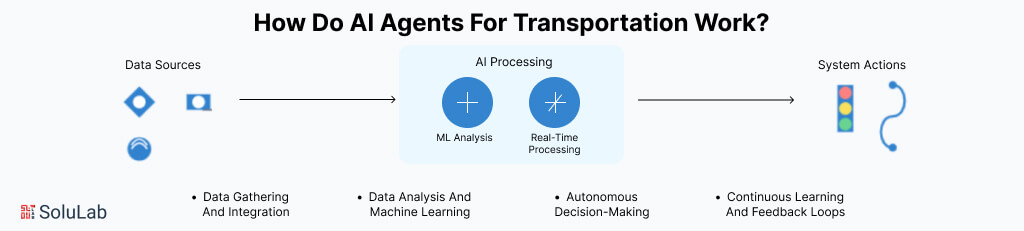
Fundamentally, intelligent systems built to carry out certain activities on their own utilizing machine learning and immediate analysis of data to improve procedures make up agentic AI. For the purpose of managing transport operations, these AI agents are incorporated into the infrastructure and work by using inputs from a variety of linked devices, sensors, GPS, and communication systems.
1. Data Gathering and Integration: These agents depend on constant streams of data from a variety of sources, including sensors, GPS units, traffic cameras, and linked cars. Because this data is gathered in real-time, the AI systems can monitor a variety of circumstances, including traffic and vehicle performance. These systems can generate accurate predictions and take appropriate action when this data is incorporated across platforms.
2. Data Analysis and Machine Learning: One of the main components of agentic AI systems is machine learning algorithms. In order to spot trends, forecast future developments, and improve decision-making, these algorithms examine both historical and current data. For instance, by examining past data gathered from automobiles, the machine learning model may determine when predictive maintenance would be necessary. It can also forecast the demand for public transportation by examining use history data.
3. Autonomous Decision-Making: AI systems are capable of making choices on their own in real-time once data has been collected and evaluated. This entails modifying routes in response to fluctuating traffic patterns, reallocating resources to satisfy demand, and giving operators or customers automatic feedback. While fleet management systems may modify schedules and routes to maximize efficiency, autonomous cars rely on agents to make driving choices.
4. Continuous Learning and Feedback Loops: AI agents are built to learn from their experiences via feedback loops and continuous learning. They collect information from every activity they do, which helps them make better decisions. Agentic AI systems may adjust to new difficulties and gradually improve performance thanks to this ongoing feedback loop.
Benefits of AI Agents in Transportation
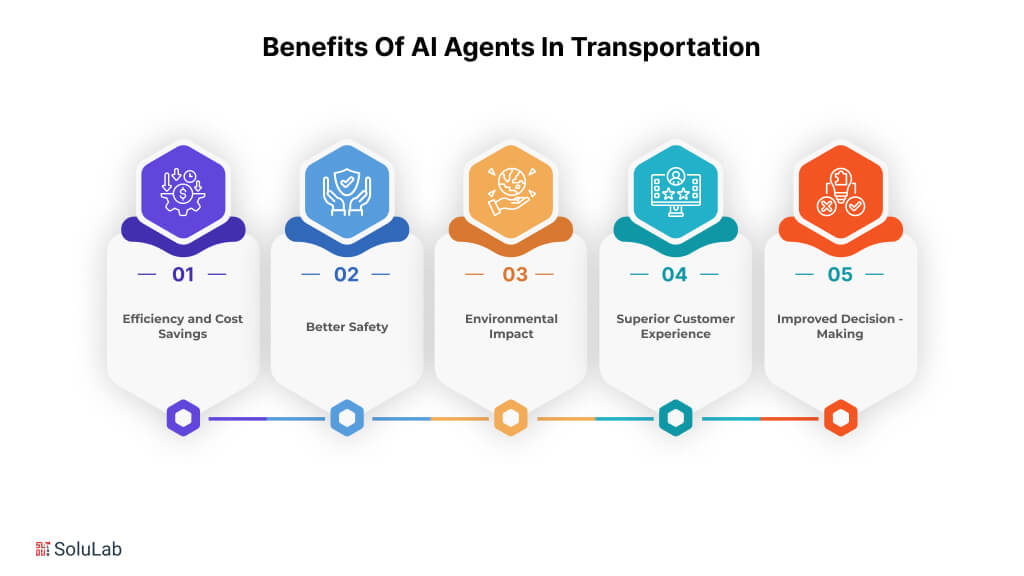
The transportation industry gains several innovative advantages from the use of AI, including:
- Efficiency and Cost Savings: Automation by transportation businesses would help with tasks like scheduling, invoicing, and creating compliance reports, among others. By identifying potential problems early on, predictive maintenance helps to minimize direct expenses and unexpected time loss. Businesses may also assess capacity and prevent waste by using predictive demand planning.
- Better Safety: AI agents are essential for improving safety. AI-powered safety features are making transportation safer for everyone, from autonomous cars that remove human mistakes to driver safety monitoring systems that examine driving behavior. Additionally, real-time traffic monitoring reduces and anticipates the likelihood of accidents.
- Environmental Impact: AI-powered sustainable transportation options are assisting in the reduction of emissions. Fleets are becoming more energy-efficient due to fuel consumption efficiency and autonomous cars, which helps to lower the transportation sector’s carbon footprint.
- Superior Customer Experience: Customers enjoy more convenience and pleasure because of AI-driven technologies that provide customized amenities, on-demand transportation options, and price changes. improved travel times and fewer disruptions result from upgraded routing and early flight delay prediction.
- Improved Decision-Making: AI agents provide decision-makers with up-to-date operational information. AI solutions assist transportation management in making well-informed choices to improve the efficacy and efficiency of their services, whether they are predicting demand for public transit or monitoring traffic patterns.
Traditional vs. AI-Powered Real-Time Cargo Tracking
| Aspect | Traditional Cargo Tracking | AI-Powered Cargo Tracking |
| Data Collection | Relies on manual updates or basic tools like barcodes. | Uses advanced tools like sensors, GPS, IoT devices, and live data. |
| Real-Time Visibility | Updates are periodic and may face delays, offering limited visibility. | Delivers live updates on cargo location and status, ensuring real-time tracking. |
| Predictive Capabilities | Focuses on reactive measures without predictive insights. | Uses AI to forecast potential delays and optimize routes for better outcomes. |
| Customer Communication | Notifications are manual and static, offering limited transparency. | Provides automated, real-time updates for seamless customer communication. |
| Efficiency | Inefficient due to manual processes and slow responses. | Enhances operations with AI-driven proactive decisions and faster responses. |
| Cost Management | Higher costs arise from inefficiencies and frequent delays. | Reduces expenses by optimizing routes and minimizing disruptions. |
| Customization | Limited in adapting to unique customer or cargo needs. | Personalizes solutions using AI to meet specific requirements efficiently. |
How Do AI Agents Help With Cargo Tracking?
AI agents are transforming cargo monitoring by providing real-time insights, predictive analytics, and automated operations that increase efficiency and transparency. Here’s how AI agents change freight tracking:
1. Real-Time Monitoring and Updates: AI-powered systems employ sensors, GPS, and IoT devices to offer real-time information on cargo location, status, and condition. AI Agents for IT minimizes the delays that result from manual updates and guarantees that stakeholders always receive updated information.
2. Predictive Analytics for Proactive Decisions: AI systems employ historical and real-time data to forecast future disruptions, including weather, traffic, or logistical bottlenecks. These predictive insights allow firms to take proactive steps, such as optimizing routes and assuring timely delivery.
Read Blog: How Vertical AI Agents Are Changing the Enterprise Game?
3. Optimized Customer Communication: AI automates customer alerts, delivering real-time shipment status information via email, SMS, or mobile applications. This openness promotes confidence and enhances the entire client experience.
4. Operational Efficiency: By automating manual procedures such as data input and route planning, AI decreases human error while increasing operational speed. AI agents may also detect bottlenecks in the supply chain and suggest fixes, resulting in better operations.
5. Cost Optimization: By improving route planning, reducing delays, and minimizing interruptions, AI drastically reduces operating expenses. It guarantees the effective use of resources, allowing firms to save money while boosting service quality.
6. Customization and Scalability: AI agents may adapt to specific cargo and business requirements, providing bespoke solutions across sectors. AI systems are capable of properly monitoring and managing temperature-sensitive commodities as well as high-value shipments.
Businesses that integrate AI agents into cargo monitoring may expedite operations, increase dependability, and gain a competitive advantage in the global supply chain.
Use Cases of AI Agents in Transportation
By offering innovative approaches suited to different operating requirements, agentic AI has transformed the transportation sector. Some significant use cases of agentic AI in transportation are listed below:
-
Optimization of Freight Loads
By improving volume use, decreasing trip lengths, and optimizing weight distribution, agentic AI increases the efficiency of freight loads. This results in increased operating efficiency, improved vehicle capacity utilization, and decreased fuel consumption.
-
Self-Scheduling
AI systems manage scheduling on their own by evaluating data to identify the best times for maintenance, delivery, and pick-ups. This increases overall operating efficiency and reduces the need for human involvement.
-
Automating the Processing of Bills and Payments
AI-powered solutions that compute charges in real-time simplify the billing and payment procedures. This increases accuracy and efficiency by streamlining interactions between clients and service providers.
-
Dynamic Route Optimization
To generate optimal route schedules, Agent AI leverages real-time data on weather, road conditions, and vehicle capacity. This saves time and money by guaranteeing on-time delivery and cutting down on needless travel.
-
Automated Reporting on Compliance
AI technologies automatically gather and analyze data to manage regulatory compliance. This guarantees that transportation operations comply with regulatory standards and minimizes administrative duties.
-
Demand Prediction Planning
Agentic AI builds quantitative models to predict demand for transportation services. This guarantees that supply and demand are balanced by facilitating effective resource allocation and cost reduction.
-
Customer Service Virtual Assistants
AI-driven virtual assistants handle reservations, complaints, and questions around the clock. In transportation services, this improves client happiness and facilitates communication.
-
Fuel Efficiency Improvement
AI agents for enterprises keep an eye on and modify driving habits, routes, and plans to reduce emissions and fuel consumption, which lowers costs and promotes environmental sustainability.
-
Automation of SLA Reporting
AI is used to evaluate performance data and automate SLA reporting. This guarantees that operators fulfill established criteria without the need for manual intervention.
-
Public Transportation Forecasting
By forecasting demand, Agent AI assists operators in creating effective timetables, cutting wait times, and improving urban mobility.
-
Analysis of Traffic Patterns and Real-Time Surveillance
Agentic AI helps cities better manage traffic and increase transportation efficiency by analyzing real-time traffic data and revealing patterns of congestion.
-
Cargo Tracking Solutions
AI-powered cargo tracking guarantees safe and prompt delivery of products by providing real-time updates on shipment location and status.
-
Smart Parking Management
By giving drivers real-time information, easing traffic, and efficiently using parking spots, artificial intelligence (AI) solutions improve parking management.
-
Predictive Vehicle Maintenance
Predictive maintenance systems powered by AI keep an eye on car conditions and anticipate problems, enabling prompt repairs and avoiding expensive downtime.
-
Fleet Management
AI ensures seamless operations with little human intervention by automating fleet management chores like vehicle scheduling and route planning.
-
Monitoring of Driver Safety
Artificial intelligence (AI) systems use sensor data from cars to monitor driver behavior and give feedback, lowering the chance of collisions.
How to Prepare for Agentic AI in Transportation?
Transportation businesses must implement a number of strategic measures in order to deploy agentic AI systems:
- Build Data Infrastructure: Building a relevant data architecture is necessary for enterprises to implement these systems to collect and compile real-time operational data for optimal functioning.
- Integrate AI Technology: Improving service delivery and streamlining processes need integrating AI technology into current transportation systems.
- Train Employees: The key to a seamless transition is training staff members so they can collaborate with AI agents and comprehend AI technology.
- Work with Experts: Businesses may create and execute AI solutions that are suited to their unique requirements by collaborating with AI consultants or startups in the transportation technology space.
How Can Agentic AI Improve Transportation?
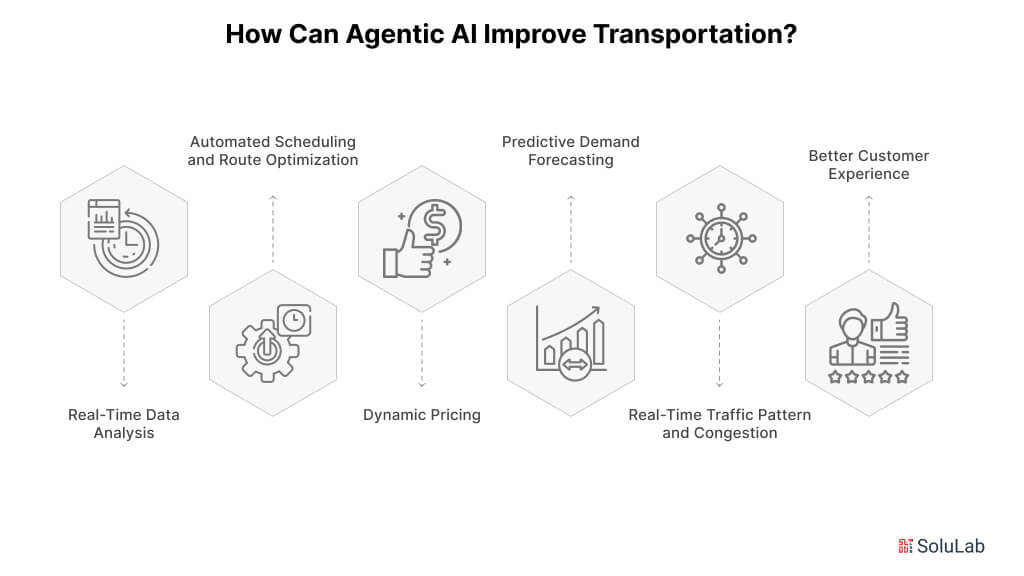
By using automation, real-time data, and predictive algorithms, autonomous AI agent systems assist transportation firms in streamlining their operations. It increases efficiency in operations, generates cost savings, and boosts service quality by enhancing dynamic pricing, demand forecasting, and traffic management.
1. Real-Time Data Analysis: To optimize timetables, routes, and operations, AI agents acquire real-time data from sensors and GPS. To keep things running smoothly and reduce delays, these bots study traffic patterns and car conditions.
2. Automated Scheduling and Route Optimization: This system optimizes routes and schedules cars automatically according to current circumstances. Reducing travel time and enhancing fleet efficiency, it adapts dynamically to variations in demand and traffic.
3. Dynamic Pricing: With the use of artificial intelligence, fares may be changed in response to factors like demand. Businesses may maximize profits while keeping prices low for customers by adopting this strategy.
4. Predictive Demand Forecasting: AI agents predict future demand for transportation services by analyzing both past and present data. That way, companies may make the most efficient use of their resources and provide the best possible service even during busy times.
5. Real-Time Traffic Pattern and Congestion: The use of autonomous agents to keep an eye on traffic conditions and redirect cars to prevent congestion is a real-time traffic pattern and congestion management tool. Delays are minimized, fuel consumption is reduced, and delivery times are improved.
6. Better Customer Experience: With AI agent’s real-time monitoring and proactive alerts, transportation customers have an improved experience. Clients are pleased with the enhanced communication and dependable service they get.
New Trends Influencing the Future of AI Agents in the Transportation Sector
Thanks to recent developments in connected cars, smart cities, and AI-powered transportation systems, the role of AI agents in the transportation industry is quickly changing. The transportation ecosystem will be more shaped by agentic AI as these technologies develop further, leading to greater efficiency, sustainability, and improved consumer experiences.
- Proliferation of Autonomous Vehicles: As AI agents in the automative industry improve the navigation and decision-making capabilities of autonomous cars, their use will increase. Both passenger and freight transport will be revolutionized by these autonomous vehicles, which will optimize routes, enhance safety, and decrease the likelihood of human mistakes.
- Improved Traffic Management: Systems that optimize traffic flow in real-time using artificial intelligence agents will reduce congestion and delays. These AI-powered technologies will improve the efficiency and sustainability of urban mobility by adapting traffic lights and routes in real time to suit current conditions.
- Collaborative Multiagent Systems: Numerous AI technologies will be able to operate together in transportation networks thanks to multiagent systems. For instance, logistical systems, traffic management, and autonomous cars will all collaborate to enhance service delivery, decrease operating costs, and optimize traffic flows.
- Personalized Mobility Solutions: By studying user tastes and habits, AI will provide on-demand transportation options that are more tailored to each person. As a result, customers will have access to more personalized transportation alternatives, which will boost their convenience, flexibility, and overall experience.
- Sustainable Transportation: In order to optimize energy utilization, reduce fuel consumption, and minimize emissions, these agents will be crucial in developing sustainable transportation solutions. Better, more efficient transportation networks that are easier on the environment may be built with the aid of AI-powered technologies.
- Predictive Analysis for Demand Supply: Artificial intelligence agents will improve resource allocation and utilize predictive analytics to foresee changes in demand. Transportation companies may make better use of their resources and cut down on operational waste by anticipating times of high demand and allocating them accordingly.
- Integration With Upcoming Technologies: To facilitate quicker data processing and smarter decision-making, agentic AI will progressively connect with emerging technologies such as 5G, the Internet of Things, and edge computing. Transportation systems that are more linked, responsive, and efficient will be built with this integration, improving passenger and freight transit experiences.

Conclusion
By making transportation more efficient, safer, and more convenient, AI agents are causing an uprising in the sector. These smart technologies allow for predictive analysis, real-time decision-making, and effortless interaction between infrastructure and cars, which is useful for controlling smart city traffic and improving fleet operations. In addition to automating some processes, they enable governments and corporations to make data-driven decisions that promote a sustainable and interdependent transportation system.
Here at SoluLab, as an AI agent development company, we focus on creating transportation-specific AI solutions. Gearnetics– our recently launched project exemplifies our competence and is one of our initiatives. Gearnetics is an intelligent transportation solution that uses modern AWS IoT technology to track and manage fleets of up to 10,000 cars. It ensures accuracy and scalability for current transportation demands by eliminating antiquated analog systems and offering real-time and historical fleet data. By taking a fresh perspective, our team makes sure that companies can use AI to their advantage and remain competitive.
Are you ready to transform your transportation company with the most advanced AI solutions? Contact us to develop smart, future-proof solutions that are customized to meet your specific requirements. Hire AI agent developers now to talk about your project and start building a more intelligent transportation system!
FAQs
1. What are AI agents in transportation?
AI agents are intelligent systems that use machine learning and data analytics to optimize transportation processes, including traffic management, route planning, and vehicle monitoring.
2. How do AI agents enhance traffic management?
AI agents analyze real-time traffic data to predict congestion, adjust traffic signals, and recommend alternate routes, improving overall traffic flow and reducing delays.
3. Can AI agents improve transportation safety?
Yes, AI agents enhance safety by monitoring vehicle performance, detecting potential hazards, and assisting drivers with real-time alerts and automated responses.
4. What are the cost benefits of using AI agents in transportation?
AI agents reduce costs by improving fuel efficiency, optimizing operations, minimizing maintenance expenses, and increasing productivity across transportation systems.
5. Who can benefit from AI agents in transportation?
Industries such as logistics, public transit, ride-hailing services, and delivery networks benefit significantly from AI agents by streamlining operations and enhancing efficiency.

