

- AI Development
- AI App Development
- AI Consulting
- AI Software Development
- ChatBot Development
- Enterprise AI ChatBot
- AI Chatbot Development
- LLM Development
- Machine Learning Development
- AI Copilot Development
- MLOps Consulting Services
- AI Agent Development
- Deep Learning Development
- AI Deployment Services
- Deep Learning Consulting
- AI Token Development
- AI Development Company
- AI Development Company in Saudi Arabia
- AI Integration Services
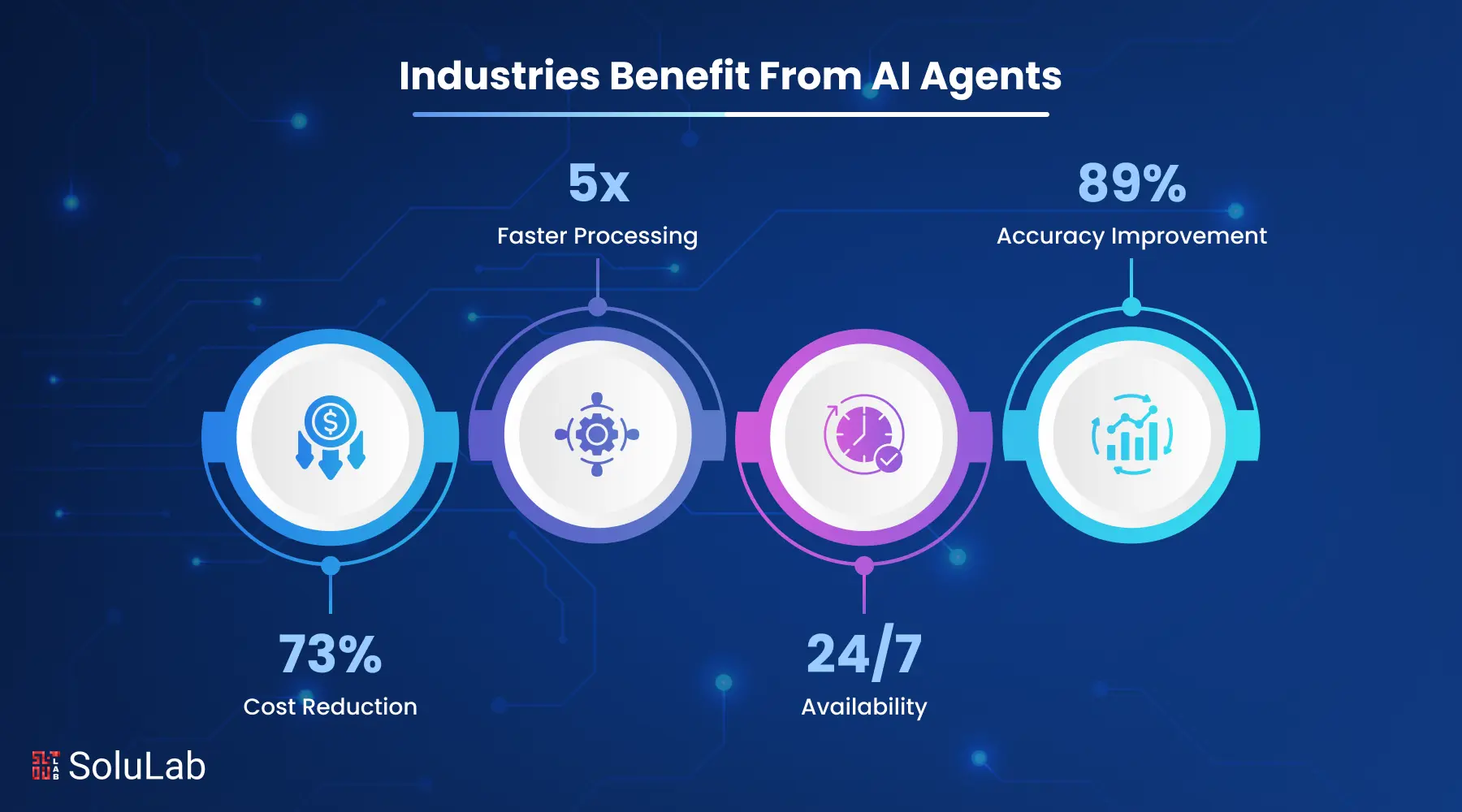
Managing business operations goes from handling customer queries to managing inventory and analyzing data, and businesses are juggling too much at once. Traditional methods are no longer enough. Teams waste hours on repetitive tasks, decision-making lags due to scattered data, and productivity suffers. That’s where AI agents for business can help. AI agents can automate tasks, offering real-time insights and helping teams focus on high-impact work.
Whether it’s support with chatbots, optimizing logistics, or enhancing marketing campaigns, AI agent applications are changing how industries operate. From healthcare and finance to education and retail, AI agents for business operations are becoming essential tools, not optional add-ons.
In this blog, we’ll explore how AI agents are being used across different industries and uncover real-world use cases.
Key Components of AI Agents
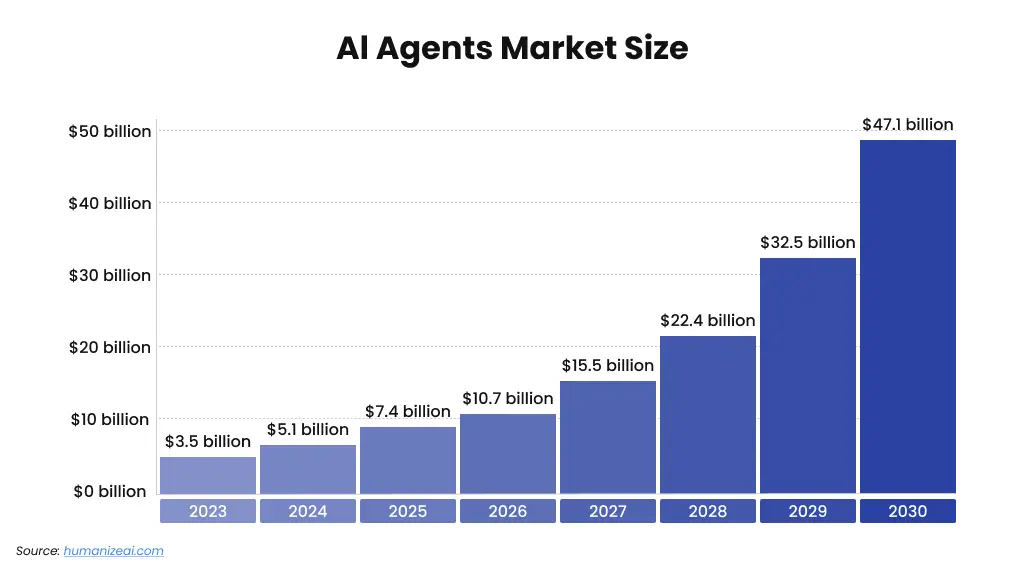
The ability to observe, make decisions, and respond to their surroundings is made possible by several essential components that AI agents possess. The market for AI agents was valued at approximately $3.52 billion in 2023. By the end of 2030, it is expected to have increased to $47.10 billion.
Some of the major components are mentioned below. The way these components interact is essential to the operation of an AI agent.
- Perception: The agent’s sensory system gathers information about its surroundings. Cameras, microphones, sensors, and even data feeds could be used for this. The basis for the agent’s comprehension of its environment is perception.
- Making decisions: An AI agent’s decision-making process is its fundamental component. The agent analyzes the information it receives and considers potential courses of action using algorithms. A collection of rules may serve as the foundation for this process (as in rule-based systems), while more complicated judgments may call for the application of more advanced methods like machine learning models.
- Action: The agent takes action after reaching a choice. This might include changing the surroundings in some way, such as repositioning a robot’s limbs, communicating, or modifying a thermostat or other environmental element.
Benefits of AI Agents for Modern Businesses
The use of AI agents is changing the way businesses operate, making teams more efficient, working better, and quickly. Here are the benefits of AI agents for businesses:
1. Enhance Employee Efficiency: AI agents solve repetitive tasks that provide more time to employees to perform strategic and creative tasks. This promotes efficiency in time management, lack of mistakes, and, in general, enhances performance within the various departments.
2. Improve Operations: The AI agents for automation can create a tightly integrated mechanism of working, observation, and improving operations, which ensures that companies work like well-oiled machines where delays are minimal and production is higher, requiring no new workforce.
3. Reduce Preservation: AI can perform the tasks 24/7, which means that companies spend less on labor, save up on human error, and minimize waste. It leads to cost savings in the long run without sacrificing quality and production.
4. Competitive Advantage: The possession of AI by organizations earlier is a technological advantage. Whether it is making decisions quicker or predicting smarter, the companies utilizing AI agents usually keep themselves above the rest that are still using traditional processes.
5. Enhanced Customer Service: Contextual chatbots and support agents provide personalized instant support. They positively affect the response time, decrease the time spent waiting, and make the customer feel heard and supported.
6. Bring in Data-Driven Insights: The huge amount of data is analyzed by AI agents in real-time, revealing patterns, trends, and actions. This assists the leaders in making informed decisions based on facts as compared to gut feeling.
10 Real-Life AI Agent Examples Across Industries
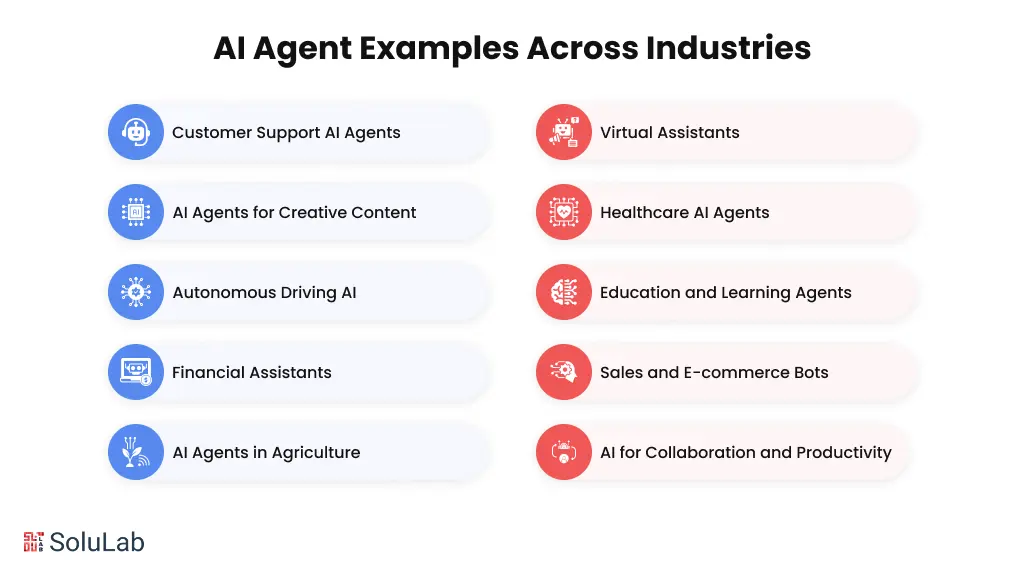
The AI agent use cases in business show how smart tools boost efficiency, tasks, and drive innovation across various sectors. Below, we’ve shared different types of AI agents with examples. Let’s know each one in detail:
1. Customer Support AI Agents
Customer support AI agents are changing how businesses interact with their customers. They handle queries instantly, offer 24/7 assistance, and reduce response times—all while improving customer satisfaction. These agents can resolve basic issues independently and escalate complex ones to human agents, creating a support experience.
Real-World Examples:
- HDFC Bank – EVA (Electronic Virtual Assistant): EVA answers banking-related queries in real time, handling millions of interactions and reducing the need for call center agents.
- Swiggy – Swiggy Genie Chatbot: This AI chatbot helps customers track orders, resolve delivery issues, and request refunds, speeding up response times and reducing ticket volumes.
2. Virtual Assistants
Virtual assistants like Alexa and Siri are prime examples of AI agents making daily life easier. They use natural language processing to understand voice commands, provide information, control smart devices, and automate tasks, bridging the gap between human intent and machine action.
Real-World Examples:
- Amazon Alexa – Used in smart homes to control lights, appliances, set reminders, or even shop online with simple voice commands.
- Apple Siri – Helps users send texts, get weather updates, schedule meetings, or navigate using voice on iPhones, iPads, and Macs.
3. AI Agents for Creative Content
AI agents are now key players in the creative world, helping writers, marketers, and designers generate high-quality content at lightning speed. From blog posts and ad copy to product descriptions and social media captions, these tools save time while boosting creativity across industries.
- Jasper AI- Jasper AI is a popular writing assistant used by marketers, content creators, and businesses to generate blog posts, ad copy, and emails. It uses GPT-based technology to understand context and tone, making it ideal for scaling content production without compromising quality.
- Writesonic- Writesonic helps users create SEO-friendly articles, product descriptions, landing pages, and even AI art prompts. Its user-friendly interface and wide range of templates make it a go-to tool for startups and digital agencies looking to improve their content marketing efforts.
4. Healthcare AI Agents
Healthcare AI agents are revolutionizing patient care by enabling faster diagnosis, remote consultations, and improved treatment outcomes. These agents assist doctors, reduce manual tasks, and offer accessible healthcare solutions, especially in areas with limited resources.
Real-World Examples:
- Babylon Health AI – Offers AI-driven health consultations by analyzing symptoms and medical history to provide real-time guidance and triage.
- PathAI – Uses AI to assist pathologists in detecting diseases like cancer more accurately and efficiently through advanced image analysis.
5. Autonomous Driving AI
Autonomous driving AI agents are reshaping the automotive industry by enabling vehicles to perceive their surroundings, make decisions, and drive with minimal human input. These systems rely on advanced sensors, machine learning, and real-time data to ensure safety, efficiency, and a smoother driving experience.
- Real-World Examples:
Tesla Autopilot – Tesla’s AI-powered driver-assist system enables lane keeping, adaptive cruise control, and automatic lane changes, with Full Self-Driving (FSD) pushing toward complete autonomy. - NVIDIA DRIVE – A scalable AI platform used by automakers worldwide to power autonomous vehicle systems, combining sensor fusion, deep learning, and HD mapping for real-time driving decisions.
6. Education and Learning Agents
In the education sector, AI agents are revolutionizing how students learn, making it more interactive, personalized, and accessible. These agents provide instant feedback, simplify complex topics, and adapt to each learner’s pace, creating a more engaging and effective learning experience.
- Duolingo Bots
Duolingo uses AI-powered bots to simulate real-life conversations, helping users practice languages in a fun and stress-free way. These bots adjust their responses based on the user’s input and learning level. - Socratic by Google
Socratic uses AI to help students solve homework problems by providing explanations, step-by-step solutions, and relevant learning resources across subjects like math, science, and history.
7. Financial Assistants
AI-powered financial assistants are making money management smarter and more accessible. These agents help users track expenses, analyze spending habits, and even offer budgeting advice in real time. They’re revolutionizing how both individuals and businesses interact with their finances.
Real-World Examples:
- Plaid AI – Enables apps to securely connect with users’ bank accounts and delivers financial insights through predictive analytics and categorization.
- Cleo AI – A chatbot-style assistant that offers budgeting tips, expense tracking, and even a bit of humor to help users manage their money more easily.
8. Sales and E-commerce Bots
Sales and e-commerce bots are reshaping how businesses interact with customers, automating everything from lead generation to product recommendations. When selecting tools, evaluating the best AI agents helps compare enrichment accuracy, orchestration, and ROI. These AI agents not only save time but also enhance personalization, improve conversion rates, and the entire buying journey for both businesses and customers.
Real-World Examples:
- ChatGPT Plugins for Shopify – Enables conversational shopping, automates customer queries, and assists in managing orders directly through a chatbot.
- HubSpot AI – Helps sales teams with smart email suggestions, lead scoring, and automated follow-ups, boosting efficiency and closing more deals.
9. AI Agents in Agriculture
AI agents are improving agriculture by enabling precision farming, crop monitoring, and data-driven decision-making. These tools help farmers increase yield, reduce waste, and make better use of resources like water, fertilizers, and land.
Real-World Examples:
- IBM Watson for Agriculture: Uses weather data, IoT sensors, and satellite imagery to provide actionable insights for crop planning and disease prevention.
- FarmBot: An open-source robotic farming system that uses AI to plant seeds, water crops, and monitor soil health—automating small-scale farming tasks with high precision.
10. AI for Collaboration and Productivity
AI agents are enhancing collaboration and boosting productivity by automating routine tasks, communication, and offering smart suggestions. From team coordination to content creation, these tools are reshaping how we work, making workflows faster, smoother, and more efficient across industries.
Real-Life Examples:
- Slack Workflow AI: Automates daily standups, manages approvals, and routes tasks to the right people, reducing manual coordination in teams.
- Notion AI: Assists in writing, summarizing, and generating ideas, speeding up documentation and planning while keeping everything in one place.
Future Outlook for AI Agents Across Industries
These smart assistants are stepping up to handle tasks that once needed hours of human effort. In healthcare, they’ll help doctors spot diseases early and keep tabs on patients around the clock.
In finance, you can detect fraud and provide smarter investment advice. Retail and e-commerce will get a major upgrade with AI-powered personal shopping assistants and real-time inventory management. In factories, AI agents will keep machines running smoothly with predictive maintenance.
Even in schools, students will have AI tutors guiding them through lessons. Logistics, HR, real estate, legal, no field is untouched. The AI development companies aren’t here to replace humans but to make work faster, smoother, and more intelligent. As AI keeps evolving, it’ll become a quiet but powerful force behind the scenes, helping industries work better than ever.
Conclusion
Many businesses today struggle to keep up with rising demands, inefficiencies, and outdated systems. That’s where artificial intelligence and intelligent agents come in—offering real-time decision-making, automation, and smarter workflows across industries.
Ignoring this shift could mean falling behind competitors who are already leveraging AI to cut costs and boost productivity. Utilize the power of an agent in artificial intelligence tailored to your industry needs. From healthcare to retail, these AI agents are not just tools—they’re digital teammates helping you work faster, smarter, and better.
SoluLab, a leading AI agent development company in the USA, can help you automate your business by building and integrating such AI agents into your business. Want to add systems to your business and reduce manual work? Contact us today to discuss further!
FAQS
1. What is an AI agent in artificial intelligence?
An AI agent is a software entity that perceives its environment, makes decisions, and performs tasks autonomously to achieve specific goals.
2. Are AI agents useful for small businesses?
Absolutely. AI tools for customer support, marketing automation, and inventory management are scalable and affordable for small businesses, too.
3. How does Notion AI help with productivity?
Notion AI helps users write, summarize, and brainstorm ideas—saving time and enhancing productivity, especially in content planning and team collaboration.
4. What is Slack Workflow AI used for?
It automates repetitive tasks like standups, approvals, and reminders, allowing teams to stay aligned and reduce manual work during collaboration.
5. Are AI agents replacing human jobs?
AI agents mostly handle repetitive or data-heavy tasks, allowing humans to focus on creative, strategic, or interpersonal roles rather than replacing them entirely.

