Talk to an Expert

AI Agents for Manufacturing: Boost Efficiency with Smart Automation

AI Agent in Manufacturing

Modern manufacturers are going through numerous problems including the need to optimize production workflows, reduce downtime, uphold strict quality, and effectively manage costs. Conventional methods frequently require assistance to meet these expectations, which results in inefficiencies, higher expenses, and lost growth potential. This is where Artificial intelligence (AI) agents come in and provide an unprecedented solution that expands manufacturing processes. 

Manufacturers can ensure excellent product quality, reach previously unheard-of levels of production, and react quickly to changes in the market by utilizing AI. AI agents in manufacturing integration are a strategic necessity in today’s competitive manufacturing dynamics, not just an option. The new era of effectiveness and imagination is ushered in by these sophisticated systems, enabling manufactures to manufacturers to meet changing industry demands and maintain their competitiveness. 

Around 35% of manufacturers ought to adopt AI for performing tasks in the manufacturing industry in the coming 5 yeras.  This article explores the main features of AI agents for manufacturing, including their types, benefits, top use cases, and major components. 

What is an AI Agent and Its Types?
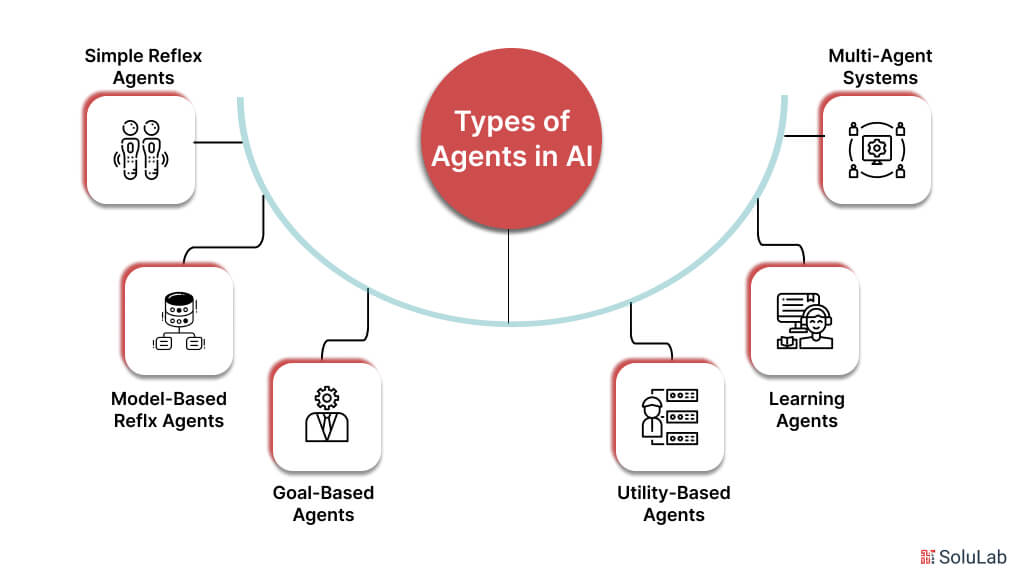
Types of Agents in AI

Business technology is evolving and AI agents are becoming the main component of this process. So let’s get to know what are AI agents. Artificial intelligence agents are electronic programs that can operate independently by making choices depending on their surroundings, inputs, and predetermined objectives. These agents are a significant advance above the typical automation because they are made to reason, adapt, and act on their own in addition to the following instructions.

Envision a digital entity that is constantly scanning its environment, gains knowledge via encounters, and makes decisions for accomplishing particular goals. This is what an AI agent is all about. It is similar to having a digital assistant who completes duties, recognizes context, modifies tactics, and even comes up with new ideas to accomplish goals. Manufacturers must comprehend these differences to choose the best AI agent for their unique requirements. Let’s examine AI agent types:

  • Simple Reflex Agents

The condition-action agent rules ideas underlie the operation of these agents. They do not have an internal representation of the world; instead, they react directly to their current perceptions. In circumstances where the agent’s next action is determined just by its current perception, simple reflex agents are easy to use and very effective. 

  • Model-Based Reflx Agents

As these agents have an internal representation of the world, they can easily monitor aspects of it that are not immediately apparent. By assuming incomplete data, this approach assists the agent in navigating partially visible settings. Compared to basic reflex agents, they are more flexible since they make decisions about what to do depending on their internal model and present perception. 

  • Goal-Based Agents 

Agents with gaols take things, a step further by thinking about how their actions will affect the future. They make decisions based on the likelihood that certain will lead to the achievement of their goals. They can plan to select actions that result in desired outcomes because of their foresight, which qualifies them for difficult decision-making duties. 

  • Utility-Based Agents

These agents use a utility function function to determine how desirable stats are. Based on specified utility measures, they aim to maximize their performance and accomplish a goal. This method works well in situations where there are several possible courses of action or results and the agent must choose the best one based on desire. 

  • Learning Agents

With time, these agents become more proficient because of their experience. They are especially in changing situations where they can modify and advance their tactics. For example, to maximize ad placements, a learning agent could constantly, improve its comprehension of consumer preferences. 

  • Multi-Agent Systems

Several agents collaborate and cooperate for shared personal objectives in MAS. When coordination is essential for complicated activities requiring numerous agents to work together, MAS is utilized. Supply chain management is one use of these systems, where numerous agents represent different supply chain components and collaborate to optimize the process as a whole. 

How Does AI Agents Work?

Techniques and information inputs are combined to power AI Agents. To understand and respond to their surroundings, they process information using machine learning models. Here is the breakdown of how AI agents work:

1. AI agents use data intake mechanisms or sensors for obtaining data. All processes that come after this data are built on it.

2. The agents look through the data and extract insights by using artificial intelligence and machine learning models for processing and analysis

3. They base their decisions on analysis, which may include the use of sophisticated algorithms, logic based on rules, or predictive models.

Following a choice, the agent carries out an action, which may involve anything from manipulating a physical robot to updating a database. 

Read Blog: Top 15 Use Cases Of AI Agents 2024

How do AI agents work if often organized as:

1. Receiving data: Getting new information from the sources or receiving data from the user 

2. Assess Data: Use AI models to contextualize and evaluate data.

3. Decision-Making: Choosing the best action. 

4. Act: Execute the decision by a response or some change in the environment. 

Major Components of AI Agents in Manufacturing

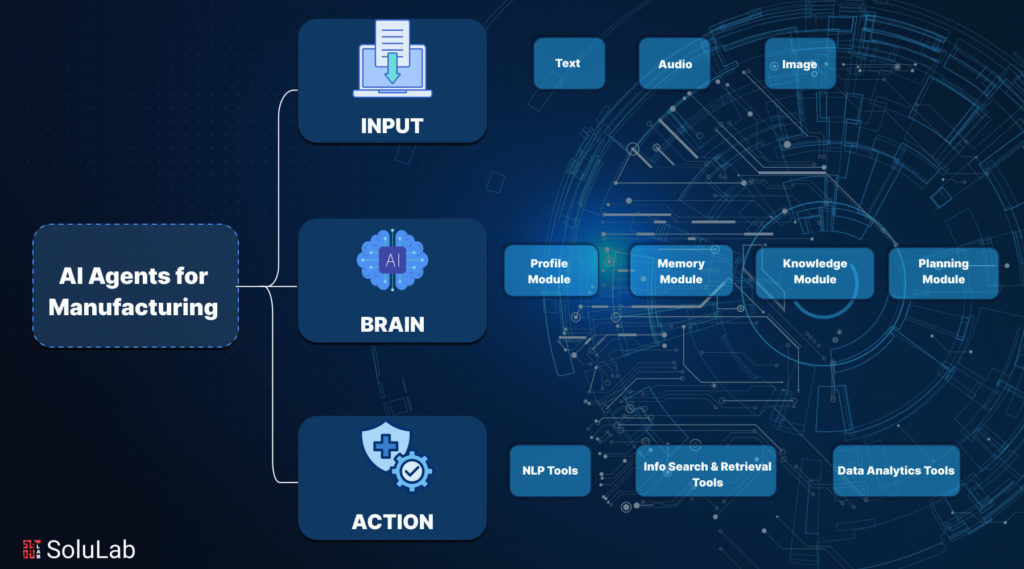
Input

The component is responsible for retrieving and managing several types of inputs into machines, sensors, and operators. This would include data but not limited to operational logs, production metrics, and sensor readings. These inputs drive the decisions and actions of the agent and provide real-time insights into the manufacturing process. The input can be anything such as: 

  • Text
  • Audio 
  • Image 

Brain

The brain is composed of many modules and is highly essential in the cognitive functions of manufacturing operations.

  • Profiling: This would define the role and objectives of the agent and its position within the production environment.
  • Memory: The ability to learn from previous production cycles and operation settings through stored history and interactions.
  • Knowledge: Domain-specific information for planning and decision-making comprising information on production processes, quality standards, equipment, and tool specifications.
  • Planning: Considering demand and stock on hand, the system should, based on current demand and stock level, come up with an optimum production schedule, resource investment, and process investment at the best time.

Action

To that note, this section implements planned activities by applying the modules of the brain in the automation and optimization of manufacturing processes. This ensures efficiency in the manufacturing functions since complex tasks will be subdivided into feasible stages.

With a sophisticated set of capabilities for analysis and decision-making, AI agents can help optimize production line results, prevent production line downtime, or enhance operational efficiency in the manufacturing industry. This step makes use of various tools that include: 

  • NLP Tools
  • Info Search and Retrieval Tools
  • Data Analytics Tools

Role of AI Agents in Manufacturing 

AI agents are bound to assume a very important role in contemporary manufacturing as competitiveness boosters, efficiency enhancers, and innovation promoters. AI agents can serve potential transformative roles in manufacturing processes, right from supply chain optimization to predictive maintenance.

1. Improving Predictive Upkeep

Equipped with proper advanced predictive analytics onboard, AI agents provide proactive maintenance solutions to manufacturers. AI agents can predict the problems in equipment in advance by analyzing the records of its maintenance and current data from sensors in real time. The predictive ability of AI agents enables optimized operational efficiency and lowered costs for maintenance by reducing wear and tear of machinery and minimizing unscheduled downtime.

2. Transforming Quality Assurance

Manufacturing gives a lot of importance to quality control, while AI agents raise this bar even higher by automating tasks and doing them with precision. AI agents for manufacturing use machine vision combined with deep learning algorithms to identify product flaws with unparalleled accuracy, while only top-notch products are forwarded to the market. The detection skills of AI agents are enhanced continuously through learning from inspection data.

3. Supply Chain Management Optimization

AI agents will not hesitate to optimize supply chain operations, making improvements in the sphere of resilience and efficiency with data-driven insights. That would imply assessing the efficiency of suppliers, levels of stock, and projections of market demand with the aim of logistics and inventory optimization. Lower lead times, stock-outs, and, in general, supply chain agility will permit changing market trends and consumer needs.

4. Energy Efficiency Promotion

Since energy consumption is one of the major components of costs, AI agents become necessary for improving energy utilization within manufacturing processes. It becomes quite easy for AI agents to detect areas where production operations can save energy, considering that it assists in real-time monitoring and predictive analytics. By optimizing equipment scheduling and utilization, Artificial Intelligence agents lower energy costs and environmental effects, coordinating industrial processes with sustainability objectives and legal requirements.

Key Benefits of AI Agents in Manufacturing
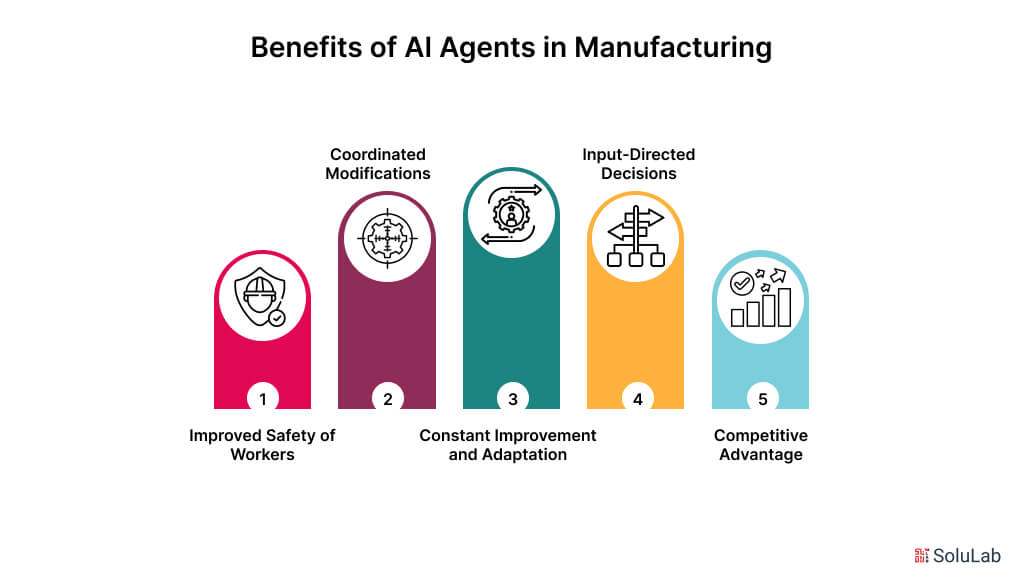
Benefits of AI Agents in Manufacturing

AI agents are bringing a revolution to every field, and manufacturing is an exception. The advantages of the AI applications in manufacturing are as follows:

  • Improved Safety of Workers

It would be with proper analysis of past safety data, spotting patterns in hazards, and compilation of knowledge strictly based on best practices. Agents of the language learning model assist initiatives in making workplaces even safer and more ergonomic through insightful analyses and dialogues about safety-related issues.

  • Coordinated Modifications

AI systems monitor the tastes of customers and make changes to the production process to efficiently place personalized requests. Considering such potential, the producers can offer customized items without compromising productivity and reasonable prices.

  • Constant Improvement and Adaptation

The agents undergo constant improvements over time as their algorithms are fine-tuned with new insights from continuous data feeds. Due to constant improvements, despite fluctuating market conditions and technological breakthroughs, truly effective and efficient processes for production can be achieved.

  • Input-Directed Decisions

These frequent data inputs are like learning and evolving the AI automation continuously, which helps in enhancing the algorithms and overall performance over some time. With continuous improvement in technologies and changing market conditions, manufacturing processes remain effective and efficient.

  • Competitive Advantage

With the integration of AI agents in manufacturing, manufacturers can realize greater operational efficiencies and quality of the product. A faster growth cycle and better market accountability result from this, which provides the company with a greater advantage against the competition. 

How Do AI Agents Improve Customer Experiences?

1. Tailored Customer Experiences

This is a one-to-one marketing tactic that not only provides each unique customer with highly relevant but also customized experiences by utilizing machine learning and intelligent artificial intelligence. Customers want manufacturers to be aware of their needs and preferences and the latest market trends.

AI can analyze customer data both past and present to produce a comprehensive picture of each individual, including social media activity browsing patterns, and past purchases.

For example, Netflix uses AI to adjust its suggestions as per each user depending on their past watch.

2. 24/7 Customer Support

Chatbots are now a necessary tool for companies trying to offer at all times, immediate customer service. These chatbots can respond to standard inquiries, offer pertinent responses, and point users in the direction of the right resources. They can also help by pointing clients in the direction of live agents for more complicated issues and queries Client queries are handled in much better ways when you leverage chatbots. 

Various customer inquiries even on the product, order status, and troubleshooting can all be handled quite easily by these AI-powered chatbots.

For example, H&M uses chatbots to answer questions about order monitoring and other relevant details of the order or products.

3. Anticipate the Needs of the Customers

Predictive analysis is used to improve customer satisfaction by anticipating the needs of the customers and boosting customer retention by providing meaningful insights into customer behavior, preferences, and purchasing patterns. Additionally, you can use this for spotting possible customer attrition. 

For instance, telecom firms use predictive analysis for the identification of clients who are more likely to discontinue the service and provide them with special offers to keep them hooked.

4. Understanding Customer Feedback

Sentiment analysis is the practice of analyzing customer evaluations and feedback with AI algorithms to learn about the attitudes, feelings, and opinions of the customers. This AI-driven feature can be used to examine consumer input from a variety of sources such as social media, online reviews, and customer surveys. You can find areas for development and take appropriate action to resolve consumer problems by examining this feedback. 

Top 5 Use Cases of AI Agents in Manufacturing 
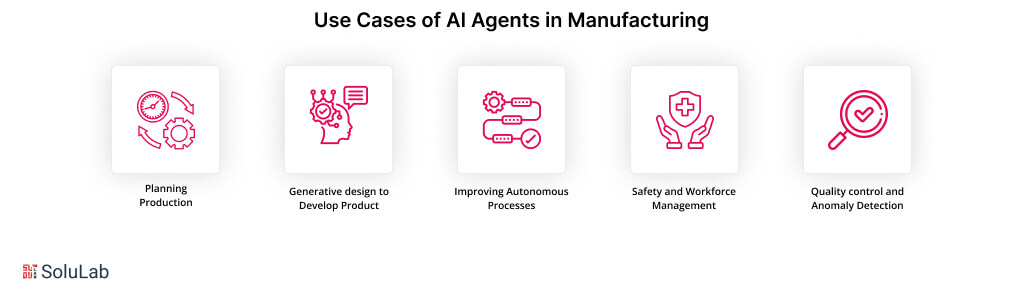
Use Cases of AI Agents in Manufacturing

Artificial intelligence (AI) agents are transforming with GenAI in manufacturing by improving productivity, precision, and creativity in a range of production-related areas. The following are the top 5 use cases of AI agents in manufacturing:

  • Planning Production 

Large volumes of production data like demand projects, level of stocks, and availability of machines are analyzed by LLM agents to find patterns and offer insightful analysis that helps with production planning decisions. 

  • Generative design to Develop Product

Based on generative design algorithms that employ AI, generative design produces numerous design propositions in line with certain specifications like cost, dimensions, weight, materials, and fabrication methods among others. This makes product innovation easier in terms of design and shortens the time taken in product development, especially when combined with access to a 3D printing service for fabricating complex shapes and structures.

  • Improving Autonomous Processes

Industrial processes are studied by artificial intelligence (AI) bots who look for the aspects that can be improved. It requires the use of machine learning algorithms to adjust temperature, pressure, and speed so that production is optimized, cost is reduced and the quality of the product is enhanced.

  • Safety and Workforce Management

 Mobile technologies and computer vision monitor workers’ movement and activities as well as allow the identification of risky behaviors and triggering of alarms together with indicating the necessary preventive actions. The use of AI in this area can be helpful to manufacturers in assessing the workload needed and avoid overloading the employees, and the duties to be assigned to specific employees for better performance and efficiency.

  • Quality control and Anomaly Detection 

Automated inspection systems powered by artificial intelligence (AI) technology analyze sensor data and visual inspection results in real-time mode to detect defective part features, anomalies, and other quality issues in the manufacturing process. Thus, producers can reduce wastages, detect faults at the initial stage, and ensure quality products are produced.

Future Trends in AI Agents

Trends Impact
Ethics-Based and Reliable With the increase in the strengths of AI agents, more focus will be given to establishing these AI agents in an ethical, open, and reliable way. There are plans to ensure that AI agents would not encroach on the privacy of human beings, they do not have any bias and act rightly like human beings.
Increased Physical Abilities There will be more and more instances of artificial intelligence agents being embodied as robots, drones, self-driving cars, and such other forms. This will allow people to further work within and interact with the real-world environment along with the virtual environments.
More Autonomy and Sophistication AI agents in the future will be capable of understanding language, reasoning ability as well as decision-making tendencies. However, with more autonomy the level of automation increases they will be capable of handling more complex tasks more practical and general, and less human intercession.
Seamless Integration Within Systems Each of, the bots, and software programs will have close ties with AI agents to be well-informed about our existence and more importantly, provide real value. It will be possible to switch from our telephones, automobiles, smart homes, and workplaces without any hitch.

How Can SoluLab Help in Building Customer Experience Using AI Agents?

SoluLab specializes in AI Agent development service provision and sets itself apart by implementing AI agents that bring impressive transformations in customer experience. SoluLab is a team of experts that gathers professionals in the field of AI and offers applicative solutions that are tailored to companies’ specifics of various industries. As AI is bound with the most up-to-date machine learning algorithms thus AI agents will be providing interaction as well as progressive learning that is likely to improve service standards at some point.

This is why working with SoluLab can become the beginning of new opportunities for growth and customer relations amid the growth of competition in the digital space. Why lose the chance to revolutionize the way your clients engage with your business; contact SoluLab today to learn how we can assist your business.

FAQs

1. How do AI Agents work?

AI agents work on various complex algorithms and constantly learn from the data provided within sources for making informed decisions and providing users with up-to-the-mark outcomes to their inputs. 

2. How can I use AI agents for my business?

Be the business in any field AI agents have the potential to perform several time-consuming tasks for you which include monitoring your sales, automating your processes, and even tailoring the outreach according to customer preferences and needs. 

3. What is the most common real-life AI agent example?

The most common and majorly equipped by businesses of all kinds by now real-life examples of AI agents are chatbots and voice assistance. Every business requires a 24/7 approach to solve customer inquiries which in turn improves their satisfaction. 

4. What is the manufacturing industry using AI agents for?

The major benefits AI agents are providing to the manufacturing industry are proactive monitoring of production, predicting possible failures of the equipment, and automation of repetitive tasks. 

5. Can SoluLab help with the integration of AI agents?

Yes, SoluLab can help with the integration of AI agents by thorough optimization of data flow making use of tactics such as API architecture. This integration will help you with your task automation, customer service, and complex workflows. 

15 Best AI Agent Use Cases for Enterprises & Real-World Applications

Use Cases Of AI Agents

AI agents are improving enterprise workflows by operating as a coordinated crew, with each agent specializing in different business functions. Just like a well-structured team, they collaborate to understand employee intents, route requests, retrieve information, and resolve issues. Whether it’s resetting passwords, processing time-off requests, or managing software access, these AI agents work together to deliver smooth and efficient support experiences.

According to Statista AI agents are poised to become the next step in the evolution of AI for businesses in our increasingly digital society, whether they are used to automate mundane tasks or optimize complex workflows. Their learning capacity, adapting, and making smart choices create novel possibilities for innovation and applications in various fields. 

If you are planning to adopt AI agents for your enterprise, this article is for you as it explores their key use cases across various business functions, including IT support, HR, finance, sales and marketing, and more.

Future of AI Agents in Business

1. Innovations and trends

AI agents in business have a bright future due to various trends and advancements. AI agents—AI-powered virtual assistants—are becoming smarter with advances in natural language processing, machine learning, and cognitive computing. AI agents can better comprehend and forecast consumer demands with these technologies, improving customer service and operational efficiency.

Integration of AI agents across corporate functions is a major trend. In addition to customer support, AI agents are employed in sales, marketing, and HR. This wide range of applications helps firms automate activities, analyze big data, and make quick decisions.  These platforms simplify the creation of sophisticated AI bots that can have complex conversations and do complex jobs. 

2. Estimates for the Next Decade

Technology is likely to impact healthcare and transportation in the coming decade. AI agents in the healthcare industry are improving and automating tasks assisting in diagnosis, and personalizing treatment plans, ultimately improving efficiency and patient outcomes. In artificial intelligence (AI), tremendous advancement is expected. Experts expect AI to improve its natural language processing and problem-solving skills, making human-machine interactions more natural. The adoption of driverless vehicles is a significant AI prediction over the next decade. 

Real-World Examples of AI Agents

Take a look at some AI agent applications in different industries:

1. E-Commerce AI Agents

AI agents are being used by e-commerce platforms to improve the buying experience. These agents can Place orders automatically. Even they can track and send out shipment updates and make image-based product searches easier. This AI agent can remind people about carts that are left behind. For example, 35 percent of Amazon’s revenue comes from its AI-powered recommendation system. 

2. Sales and Marketing AI Agents

Sales and marketing procedures are being improved by AI sales agents by creating lists of leads. They can customize messages. Plan and carry out advertising campaigns and analyze competitors.

One excellent illustration of an AI agent enhancing lead creation is Find AI. Find AI’s agents can identify and qualify leads with remarkable accuracy by letting users define extremely specific search parameters. By using AI, users can give more targeted results by understanding the user intent and going beyond basic keyword searches. 

3. Customer Support AI Agents

AI-driven customer service is progressing beyond basic chatbots. Chatbase and other contemporary AI customer service representatives perform tasks on behalf of users, such as processing refunds and changing passwords. Customers support AI agents can make product recommendations and address complicated technical support concerns.

Top AI Agents Use Cases in 2025

AI agents, with their ability to process vast amounts of data and make decisions, are transforming various industries. Here are 15 detailed use cases of AI agents across different sectors:

1. AI Agents in Healthcare

AI agents are revolutionizing the healthcare industry by enhancing patient care, streamlining administrative tasks, and aiding in medical research. Here are some specific use cases:

a. Patient Diagnosis and Treatment

AI healthcare agents analyze medical records, lab results, and imaging data to assist doctors in diagnosing diseases. For instance, IBM’s Watson can read millions of pages of medical literature and compare patient data to suggest potential diagnoses and treatment plans.

b. Predictive Analytics

AI agents in healthcare use predictive analytics to foresee patient outcomes. By examining historical data, these agents can predict the likelihood of readmissions, complications, or the progression of diseases, allowing for proactive intervention.

c. Virtual Health Assistants

Virtual health assistants, powered by AI, interact with patients through chatbots or voice assistants. They provide medical advice, answer health-related queries, and remind patients to take their medications, improving adherence and health outcomes.

d. Administrative Efficiency

AI agents streamline administrative tasks such as scheduling appointments, managing patient records, and handling billing. This reduces the workload on healthcare staff, allowing them to focus more on patient care.

e. Drug Discovery and Development

AI agents accelerate drug discovery by analyzing biological data and predicting the efficacy of new drugs. They identify potential drug candidates, optimize clinical trial designs, and reduce the time and cost involved in bringing new medications to market.

Read Also: Vertical AI Agents

2. AI Agents in Finance

The finance industry is leveraging AI agents to enhance security, improve customer service, and optimize investment strategies. Here are some prominent use cases:

a. Fraud Detection

AI agents detect fraudulent activities by analyzing transaction patterns and identifying anomalies. They can flag suspicious transactions in real time, helping financial institutions prevent fraud and protect customers.

b. Customer Service

AI-powered chatbots and virtual assistants provide 24/7 customer service, answering queries, resolving issues, and guiding customers through financial products and services. This agent in AI improves customer satisfaction and reduces operational costs.

c. Investment Management

AI agents analyze market trends, financial news, and economic indicators to provide personalized investment advice. Robo-advisors like Betterment and Wealthfront use AI to create and manage investment portfolios tailored to individual risk profiles and financial goals.

d. Risk Management

AI agents assess risk by analyzing vast amounts of financial data. They predict market fluctuations, identify potential risks, and suggest strategies to mitigate them, helping financial institutions make informed decisions.

e. Compliance and Regulation

AI helps financial institutions comply with regulatory requirements by monitoring transactions, ensuring adherence to rules, and generating compliance reports. This reduces the risk of non-compliance and associated penalties.

3. AI Agents in Retail

AI Agents in Retail: Retailers are using AI agents to enhance customer experiences, optimize supply chains, and increase sales. Here are some specific use cases:

a. Personalized Shopping Experiences

AI agents in retail industry analyze customer behavior, preferences, and purchase history to recommend products tailored to individual tastes. This personalization increases customer satisfaction and drives sales.

b. Inventory Management

AI agents predict demand for products by analyzing sales data, market trends, and seasonal patterns. This helps retailers manage inventory more effectively, reducing overstock and stockouts.

c. Pricing Optimization

AI agents dynamically adjust prices based on factors such as demand, competition, and market conditions. This ensures competitive pricing while maximizing profits.

d. Visual Search

AI-powered visual search allows customers to upload images of products they are interested in. The AI agent then finds similar products in the retailer’s catalog, enhancing the shopping experience.

Related: Generative AI In Retail Industry

e. Customer Support

AI chatbots provide instant customer support, answering queries, handling returns, and assisting with purchases. This reduces the workload on human staff and improves customer satisfaction.

CTA1

4. AI Agents in Insurance

 The insurance industry is harnessing the power of AI agents in insurance to improve processes, customer service, and risk assessment. Here are some key use cases:

a. Claims Processing

AI agents automate the claims processing workflow by verifying documents, assessing damages, and determining claim validity. This speeds up the process and reduces errors, leading to faster payouts and improved customer satisfaction.

b. Risk Assessment

AI agents analyze data from various sources, such as social media, sensors, and historical claims data, to assess risk more accurately. This helps insurers price policies appropriately and reduce fraudulent claims.

c. Underwriting

AI agents assist underwriters by analyzing applicant data and predicting the likelihood of claims. This enables more accurate risk evaluation and policy pricing, leading to better decision-making.

Read Also: Impact of AI on the Insurance Sector

d. Customer Service

AI chatbots and virtual assistants handle customer queries, provide policy information, and assist with claims. This AI agent use cases improve customer experience by providing quick and accurate responses.

e. Fraud Detection

AI agents detect fraudulent activities by analyzing patterns and anomalies in claims data. They identify suspicious claims and flag them for further investigation, reducing the incidence of fraud.

5. AI Agents in Hospitality

The hospitality industry is leveraging AI agents in hospitality to enhance guest experiences, streamline operations, and improve efficiency. Here are some notable use cases:

a. Personalized Guest Experiences

AI agents analyze guest preferences and behavior to offer personalized recommendations and services. This includes room preferences, dining options, and activity suggestions, enhancing the overall guest experience.

b. Automated Check-In and Check-Out

AI-powered kiosks and mobile apps allow guests to check in and check out seamlessly without human intervention. This reduces wait times and improves operational efficiency.

c. Virtual Concierges

AI virtual concierges provide guests with information about the hotel, local attractions, and services. They can also handle requests such as room service, reservations, and transportation, improving guest satisfaction.

d. Predictive Maintenance

AI agents monitor equipment and systems within the hotel to predict maintenance needs. This prevents breakdowns, reduces downtime, and ensures a smooth operation.

e. Revenue Management

AI agents analyze market trends, demand patterns, and competitor pricing to optimize room rates and maximize revenue. This helps hotels achieve higher occupancy and profitability.

6. AI Agents in Supply Chain Management

AI agents are changing supply chain management by enhancing visibility, optimizing logistics, and improving decision-making. AI agents for supply chain are used for demand forecasting, inventory management, and route optimization, helping businesses streamline operations and reduce costs. Here are some specific use cases:

a. Demand Forecasting

Artificial intelligence agents analyze historical sales data, market trends, and external factors to predict demand for products. This helps businesses plan their inventory and production more accurately.

b. Inventory Optimization

AI agents optimize inventory levels by predicting demand, monitoring stock levels, and suggesting replenishment orders. This reduces carrying costs and minimizes stockouts.

c. Route Optimization

AI agents optimize delivery routes by considering factors such as traffic conditions, weather, and delivery windows. This reduces transportation costs and improves delivery efficiency.

d. Supplier Management

AI agents evaluate supplier performance by analyzing data on delivery times, quality, and costs. This helps businesses choose the best suppliers and negotiate better terms.

Related: Generative AI for Supply Chain

e. Risk Management

AI agents identify potential risks in the supply chain, such as disruptions, delays, or quality issues. They suggest mitigation strategies to ensure smooth operations and minimize impact.

7. AI Agents in Legal Services

The logistics industry is making use of AI agent logistics to optimize supply chains, enhance efficiency, and improve decision-making. Here are some key use cases:

a. Legal Research

AI agents assist lawyers in legal research by analyzing vast amounts of legal documents, case law, and statutes. They provide relevant information and precedents, saving time and improving accuracy.

b. Contract Analysis

AI agent for law firms analyzes contracts to identify key terms, potential risks, and compliance issues. They can also automate contract generation, review, and management, improving efficiency and reducing errors.

c. Document Review

AI agents for the legal industry streamline document review processes by identifying relevant documents, categorizing information, and highlighting key points. This speeds up the review process and reduces the workload on legal professionals.

d. Predictive Analytics

AI agents predict case outcomes by analyzing historical data, case law, and judge rulings. This helps lawyers assess the strength of their cases and make informed decisions.

e. Client Management

AI agents enhance client management by automating tasks such as scheduling, billing, and communication. This improves client service and allows lawyers to focus on legal work.

Read Also: AI Agent in Legal Document Management

8. AI Agents in Automotive

The automotive industry is leveraging AI agents to improve vehicle safety, enhance user experiences, and optimize manufacturing processes. Here are some key use cases for AI agents in the automotive industry:

a. Autonomous Driving

AI agents power autonomous vehicles by processing data from sensors, cameras, and LIDAR systems to navigate and make driving decisions. This enhances safety and reduces the need for human intervention.

b. Predictive Maintenance

AI agents monitor vehicle performance and predict maintenance needs by analyzing data from sensors and onboard diagnostics. This prevents breakdowns, reduces downtime, and extends the lifespan of vehicles.

c. In-Vehicle Assistants

AI-powered in-vehicle assistants provide drivers with real-time information, navigation, and entertainment. They can also monitor driver behavior and suggest breaks or adjustments to improve safety.

Read Also: Future of Generative AI in Automotive Industry

d. Manufacturing Optimization

AI agents optimize manufacturing processes by analyzing production data, identifying inefficiencies, and suggesting improvements. This increases productivity and reduces costs.

e. Supply Chain Management

AI agents enhance supply chain management by predicting demand, optimizing inventory levels, and managing supplier relationships. This ensures timely delivery of parts and materials, reducing production delays.

9. AI Agents in Social Media

Social media platforms are utilizing AI agents to enhance user experiences, manage content, and improve security. Here are some notable use cases:

a. Content Moderation

AI agent in media monitor and moderate content to ensure it adheres to community guidelines. They detect and remove inappropriate, harmful, or spam content, creating a safer and more enjoyable user environment.

b. Personalized Recommendations

AI agents analyze user behavior, preferences, and interactions to provide personalized content recommendations. This includes suggesting friends, groups, pages, and posts that align with individual interests, increasing user engagement.

c. Sentiment Analysis

AI agents perform sentiment analysis on user posts and comments to gauge public opinion and sentiment toward brands, products, or topics. This helps companies understand their audience and tailor their marketing strategies accordingly.

d. Social Media Advertising

Social media AI agents optimize social media advertising campaigns by targeting specific demographics, analyzing ad performance, and suggesting adjustments. This maximizes ad effectiveness and return on investment.

e. Trend Analysis

AI agents analyze social media data to identify emerging trends, hashtags, and viral content. This provides valuable insights for businesses and marketers to stay ahead of the curve and engage with trending topics.

10. AI Agents in Telecommunications

The telecommunications industry is leveraging AI agents to enhance network management, improve customer service, and optimize operations. Here are some key use cases:

a. Network Optimization

AI agents monitor network performance and predict potential issues, such as congestion or outages. They optimize network traffic and resources to ensure smooth and reliable connectivity.

Related: Generative AI in Telecom

b. Customer Support

AI-powered virtual assistants handle customer inquiries, troubleshoot issues, and provide technical support. This reduces wait times and improves customer satisfaction by offering prompt and accurate assistance.

c. Fraud Detection

Agent in AI detects fraudulent activities, such as unauthorized access or identity theft, by analyzing patterns and anomalies in network usage. They help prevent fraud and protect customer data.

d. Predictive Maintenance

AI agents predict maintenance needs for network infrastructure by analyzing data from sensors and equipment. This prevents downtime, reduces maintenance costs, and extends the lifespan of network components.

e. Personalized Services

AI agents analyze customer data to offer personalized services and recommendations, such as tailored subscription plans or value-added services. This enhances customer loyalty and increases revenue.

11. AI Agents in Education

The education sector is utilizing AI agents to enhance learning experiences, personalize education, and streamline administrative tasks. Here are some key use cases:

a. Personalized Learning

AI agents analyze student performance and learning styles to create personalized learning plans. They provide tailored recommendations, resources, and exercises to help students learn more effectively.

b. Intelligent Tutoring Systems

AI-powered tutoring systems offer real-time feedback and support to students. They can explain complex concepts, provide additional practice, and adapt to the learner’s pace, enhancing understanding and retention.

c. Automated Grading

AI agents automate the grading process by assessing assignments, quizzes, and exams. This reduces the workload on educators, ensures consistent evaluation, and provides students with timely feedback.

d. Student Support

AI chatbots provide students with 24/7 support, answering questions about course material, deadlines, and administrative processes. This enhances student engagement and satisfaction.

e. Administrative Efficiency

AI agents streamline administrative tasks such as enrollment, scheduling, and record-keeping. This reduces the administrative burden on staff and ensures accurate and efficient operations.

12. AI Agents in Agriculture

The agricultural industry is leveraging AI agents to improve crop management, optimize resource use, and enhance productivity. Here are some notable use cases:

a. Precision Farming

AI agents analyze data from sensors, drones, and satellite imagery to monitor crop health, soil conditions, and weather patterns. This enables precise application of water, fertilizers, and pesticides, improving crop yields and reducing waste.

b. Predictive Analytics

AI agents predict crop yields and identify potential issues such as pest infestations or disease outbreaks. This allows farmers to take proactive measures and optimize their farming practices.

c. Autonomous Machinery

AI-powered autonomous machinery, such as tractors and harvesters, perform tasks such as planting, weeding, and harvesting with high precision and efficiency. This reduces labor costs and increases productivity.

d. Supply Chain Optimization

AI agents optimize the agricultural supply chain by predicting demand, managing inventory, and coordinating logistics. This ensures timely delivery of produce and reduces post-harvest losses.

e. Sustainable Farming

AI agents promote sustainable farming practices by analyzing environmental data and suggesting eco-friendly farming techniques. This helps farmers minimize their environmental impact and conserve resources.

13. AI Agents in Energy

The energy sector is adopting AI agents to optimize energy production, enhance grid management, and promote sustainability. Here are some key use cases:

a. Predictive Maintenance

AI agents monitor energy infrastructure, such as power plants and transmission lines, to predict maintenance needs and prevent failures. This ensures a reliable energy supply and reduces maintenance costs.

b. Energy Management

AI agents optimize energy consumption by analyzing usage patterns and adjusting settings in real time. This helps businesses and households reduce energy costs and improve efficiency.

c. Renewable Energy Optimization

AI agents manage renewable energy sources, such as solar and wind, by predicting energy production and optimizing integration with the grid. This maximizes the use of renewable energy and reduces reliance on fossil fuels.

d. Demand Response

AI agents enable demand response programs by predicting energy demand and adjusting supply accordingly. This helps balance the grid, reduce peak load, and prevent blackouts.

e. Smart Grids

AI agents enhance the operation of smart grids by analyzing data from sensors and meters to optimize energy distribution and detect issues. This improves grid reliability and efficiency.

Read Also: x402 Protocol for Building Next-Gen AI Agents

14. AI Agents in Real Estate

The real estate industry is adopting AI agents to enhance property management, improve customer service, and optimize transactions. Here are some key use cases:

a. Property Valuation

AI agents analyze market trends, property features, and historical data to provide accurate property valuations. This helps buyers, sellers, and investors make informed decisions.

b. Virtual Property Tours

AI-powered virtual assistants offer virtual property tours, providing potential buyers or renters with detailed information and answering questions in real time. This enhances the property viewing experience and saves time.

c. Tenant Screening

AI agents assist property managers in screening tenants by analyzing application data, credit scores, and rental history. This ensures a thorough and efficient screening process.

d. Predictive Maintenance

AI agents monitor building systems and infrastructure to predict maintenance needs and prevent issues. This ensures well-maintained properties and reduces maintenance costs.

e. Market Analysis

AI agents perform market analysis by analyzing data on property sales, rental rates, and market trends. This provides valuable insights for real estate professionals and investors to make strategic decisions.

15. AI Agents in Logistics

The logistics industry is harnessing AI agents to optimize supply chains, enhance efficiency, and improve decision-making. Here are some key use cases:

a. Route Optimization

AI agents optimize delivery routes by considering factors such as traffic conditions, weather, and delivery windows. This reduces transportation costs and improves delivery efficiency.

b. Warehouse Management

AI agents manage warehouse operations by analyzing inventory levels, predicting demand, and optimizing storage space. This reduces operational costs and improves efficiency.

c. Predictive Maintenance

AI agents monitor equipment and vehicles to predict maintenance needs and prevent breakdowns. This reduces downtime and maintenance costs, ensuring smooth operations.

d. Demand Forecasting

AI agents analyze historical sales data, market trends, and external factors to predict demand for products. This helps businesses plan their inventory and production more accurately.

e. Risk Management

AI agents identify potential risks in the supply chain, such as disruptions, delays, or quality issues. They suggest mitigation strategies to ensure smooth operations and minimize impact.

CTA2

Conclusion

From handling simple password resets to organizing complex workflows, AI agents are improving how enterprise teams operate. Whether you’re troubleshooting IT issues, processing leave requests, or preparing for customer calls, there’s an AI agent ready to streamline your workday.

As teams continue to explore new ways to leverage AI agents like Atom, the possibilities are limitless. The best part? This is only the beginning of how these intelligent assistants will improve workplace interactions and eliminate time-consuming tasks.

If you’re ready to identify the top AI agent use cases for your organization and start implementing them, keep reading. Sight Machine, a leading AI company in the digital manufacturing space, partnered with SoluLab to overcome resource constraints and enhance its product capabilities. SoluLab designed a scalable technical architecture, integrated generative AI models, and developed advanced analytics. Their collaboration improved Sight Machine’s digital twins’ platform, boosting performance, scalability, and user experience. SoluLab An AI agent development company has a team of experts to help you build AI agents across industries. Reach out to us today.

FAQs

1. What are the types of agents used in development?

There are 5 types of AI agents used– simple reflex agents, model-based reflex agents, goal-based agents, utility-based agents, and learning agents. Each type varies in complexity, from basic condition-response actions to advanced learning and decision-making capabilities.

2. What are the major use cases where AI is used?

AI is used in healthcare for diagnosis and drug discovery, finance for fraud detection and algorithmic trading, logistics for route optimization and inventory management, customer service for chatbots and virtual assistants, and marketing for personalized recommendations and ad targeting.

3. What is an example of a good AI agent?

A good AI agent is Google Assistant, which uses natural language processing (NLP) and machine learning to execute tasks, answer queries, and interact with users effectively, providing personalized and context-familiar assistance.

4. Are AI agents secure for business applications?

Yes, the majority of AI agents follow strict security protocols with data encryption and access controls. However, it is suggested that businesses must regularly update and monitor them to prevent any sort of vulnerabilities.

5. How do AI agents improve customer service?

AI agents automate responses, handle queries, and provide personalized support through chatbots and virtual assistants. They enhance customer experience by reducing wait times and offering 24/7 assistance.