The POC ran smoothly in the sandbox. Yield was attractive, settlement was near-instant, and the demo convinced the innovation team that tokenized assets and permissioned lending could unlock real alpha. Then the hand-off happened.
“Looks great in the lab, but how do we get this past our risk committee, treasury sign-off, and external audit without six months of red tape?”
That single question delivered calmly but with unmistakable urgency marks the moment most DeFi for institutions initiatives stall. The POC proved feasibility in a controlled environment. The MVP must prove viability in a live, regulated one: real capital at risk, observable controls, enforceable policy, and zero tolerance for “we’ll fix it in prod.”
Institutions do not approve concepts. They approve observable systems with clear evidence of compliance, resilience, and reversibility. Turning institutional DeFi POCs into MVPs is therefore less about adding features and more about hardening boundaries, instrumenting observability, and aligning internal stakeholders around a narrow, defensible scope.
This post lays out the pragmatic path to DeFi development that works when the stakes are institutional balance sheets.
What “MVP-Ready” Actually Means in Regulated DeFi?
Before you write another line of code, define success in terms that the risk committee will sign off on.
Enforceability at the Edges
The MVP must enforce policy where it matters most: at the point of capital movement and position opening. That means on-chain rules that cannot be circumvented by front-end changes or user behavior.
- Whitelist-only interactions with smart contracts (no open permissionless access)
- Real-time sanctions screening and Travel Rule compliance hooks
- Automated policy engine that halts transactions on risk signals (e.g., address clustering, velocity thresholds)
- Audit-log immutability that survives both on-chain and off-chain review
If the system allows even one bypass, the entire pilot is dead on arrival.
Observability and Evidence-Grade Logging
Risk and audit teams require more than dashboards—they require tamper-evident, queryable evidence that can be produced in a regulatory exam.
- Full transaction provenance from fiat on-ramp to on-chain position
- Real-time risk signals (Chainalysis, Elliptic, or TRM) integrated into decision logic
- Incident-response playbooks tied to specific on-chain events
- Exportable control matrices that map policy to code
Abstract “transparency” is not enough. Regulators want structured, reproducible proof.
Governance and Reversibility
Institutions demand the ability to pause, claw back, or upgrade under defined conditions without community vote or multisig drama.
- Upgradeable proxy patterns with timelock and multisig from institutional keys
- Emergency halt functions controlled by legal-entity signers
- Clear delineation between protocol governance and operational control
If governance is ambiguous, the treasury will not allocate capital.
Scar Tissue Insight: The “Feature Creep” Trap
The most common failure mode at this stage is treating the DeFi MVP development as a scaled-up POC. Teams add margin trading, flash loans, or exotic yield strategies because “the chain supports it.” Risk sees unbounded exposure and kills the project.
Reality: A successful institutional production-ready MVP is ruthlessly narrow. One asset class, one core primitive (e.g., over-collateralized lending), one compliance wrapper. Depth before breadth.
The 12–16 Week Roadmap That Survives Institutional Review
This timeline assumes you already have a working POC and a committed sponsor (CFO, CDO, or treasury head). If you are still educating the organization, add 8–12 weeks of pre-work.
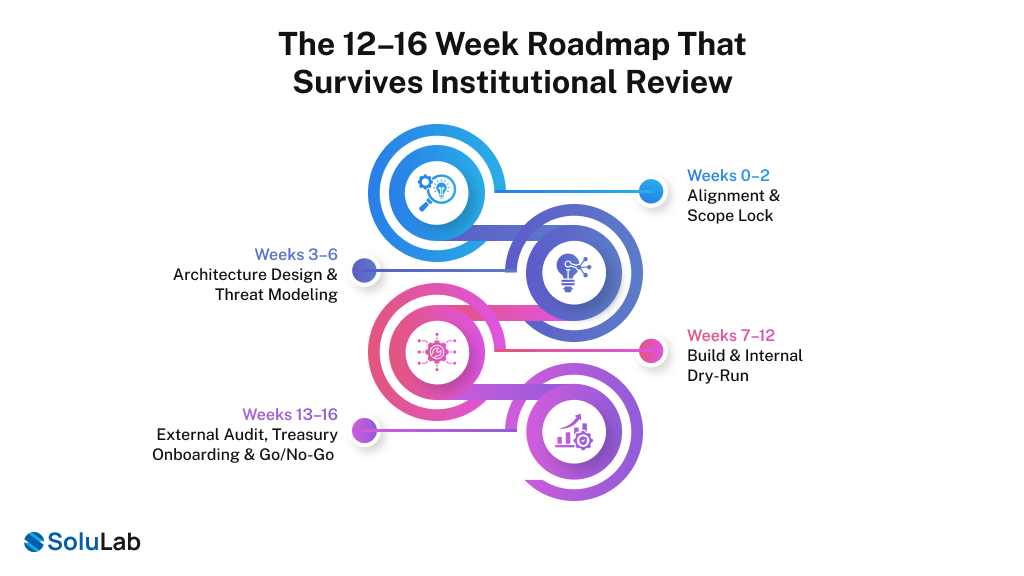
Weeks 0–2: Alignment & Scope Lock
Goal: Prevent downstream rework by locking a minimal, approvable scope.
Key decisions:
- Asset universe (e.g., USDC/USDT only, or select tokenized RWAs)
- Counterparty constraints (KYB’d institutions only)
- Risk boundaries (LTV caps, liquidation thresholds, sanctions lists)
Deliverables:
- One-page “MVP Charter” signed by risk, legal, treasury, and compliance
- Control matrix v0.1 mapping policy to enforcement point
- Stakeholder RACI matrix
Who must be in the room: Product owner, risk lead, legal counsel, treasury rep, external compliance advisor.
Weeks 3–6: Architecture Design & Threat Modeling
Goal: Design a system that passes external audit and survives red-team review.
Key decisions:
- Custody model (MPC vs. multi-sig vs. qualified custodian integration)
- Compliance layer (on-chain vs. off-chain oracle vs. hybrid)
- Observability stack (indexer + SIEM integration)
Deliverables:
- Architecture diagrams (C4 level 1 & 2)
- Threat model document with mitigation owner
- Gap analysis against internal policies (e.g., Basel-aligned capital treatment)
Scar tissue insight: Many teams skip formal threat modeling and assume “blockchain security” covers everything. The first external pentest then reveals oracle manipulation vectors or key rotation gaps that force a redesign.
Weeks 7–12: Build & Internal Dry-Run
Goal: Ship a hardened prototype that can run with test capital under real controls.
Key activities:
- Implement core contracts with upgradeability and policy hooks
- Integrate compliance APIs and observability feeds
- Run internal red-team exercises (simulated sanctions hits, liquidation failures)
Deliverables:
- Deployed staging environment with full audit logs
- End-to-end test suite covering happy path + failure modes
- Preliminary SOC 2 Type I readiness assessment
Who must be in the room: Engineering lead, security engineer, compliance ops, risk quant.
Weeks 13–16: External Audit, Treasury Onboarding & Go/No-Go
Goal: Obtain the green lights needed for live capital.
Key activities:
- Engage external smart-contract auditor (e.g., Trail of Bits, OpenZeppelin)
- Complete treasury dry-run with real (small) fiat-to-chain flow
- Present evidence package to risk committee
Deliverables:
- Audit report with remediations closed
- Operational runbook + incident response playbook
- Go/no-go recommendation memo
If audit or treasury flags material gaps, expect 4–8 weeks of remediation.
A Pragmatic Tech Stack for Institutional DeFi MVPs
No one-size-fits-all stack exists, but the patterns that survive institutional diligence share these components:
- Base Layer — Ethereum L2 (Arbitrum, Base, or Polygon CDK) with permissioned sequencer access or private chain (e.g., Hyperledger Besu). Avoid mainnet unless wrapped in a permissioned wrapper.
- Smart Contracts — OpenZeppelin upgradeable proxies + custom policy modules. Use the Diamond pattern only if extensibility is a hard requirement.
- Identity & KYC/KYB — DID-based identity (Veres One, Spruce) or off-chain KYC oracle (Sumsub, Persona) feeding allowlists.
- Compliance & Risk — Real-time screening (Chainalysis Reactor API, Elliptic Lens) + Travel Rule (Notabene, Sygna) + policy engine (e.g., custom Solidity or off-chain decision service).
- Custody — Institutional-grade MPC (Fireblocks, Copper, Qredo) or qualified custodian bridge (Anchorage, BitGo).
- Observability — The Graph or custom indexer + Datadog/Splunk for SIEM + Dune Analytics for ad-hoc queries.
- Governance — Timelock + multisig controlled by enterprise keys (Safe{Wallet} with hardware modules).
Prioritize off-chain compliance where latency and privacy matter (screening, Travel Rule). Keep on-chain enforcement simple and auditable.
Effort and Cost Bands: What Institutions Actually Spend
Lean MVP (single asset, basic lending, internal users only)
$800k–$1.5M | 12 weeks | Suitable for proof-of-viability with limited capital exposure. Risk appetite must be high.
Pilot-Grade MVP (multi-asset, external counterparties, full compliance stack)
$1.8M–$3.2M | 14–16 weeks | The realistic floor for most banks and large fintechs. Includes external audit and treasury integration.
Enterprise-Grade MVP (production volume, cross-border, Basel-aligned)
$4M+ | 20+ weeks | Required when real balance-sheet impact is expected. Includes ISO 27001 alignment and multiple external reviews.
Cheap experiments die quietly when risk sees real money move. Under-investing in compliance and audit early creates 3–6× rework later.
Why Institutions Choose Specialized Execution Partners at This Stage?
Most internal teams excel at POC innovation but hit walls when hardening for production. The difference is a partner who speaks both languages.
- Deep experience shipping regulated DeFi systems (not just DeFi, not just regulated—both)
- Pre-built compliance patterns and audit relationships that shave 4–8 weeks
- Ability to translate risk/legal feedback into concrete architecture changes
- End-to-end accountability: strategy, engineering, security, and compliance alignment under one roof
- Battle-tested threat models and control matrices that survive external scrutiny
- Focus on narrow scope delivery so the MVP lands before the sponsor’s patience expires
If You Are Past Education and Into Execution
This blueprint is not for teams still debating whether DeFi is real. It is for sponsors who have seen the POC yield and now need a credible path to live capital.
Next steps:
- 60-minute architecture review call to map your current POC against this pattern
- One-day scope-lock workshop with DeFi development company on risk, legal, and treasury
- Pilot planning engagement to produce the MVP charter and 12-week Gantt
FAQs
30–50% in practice. Core logic often survives, but wrappers, policy hooks, upgradeability, and observability require a near-complete rewrite.
Permissioned (or hybrid) for MVP. Full permissionless introduces governance and sanctions risk that most institutions cannot accept in year one.
Yes. Institutions treat unaudited code as uncontrolled risk. Budget for at least one full-scope audit; bug bounties come later.
US (NYDFS, SEC/CFTC), EU (MiCA), Singapore, UAE. Start with one anchor jurisdiction and design for portability.
Use qualified custodians or MPC providers with SOC 2 Type II and insurance. Avoid hot wallets for anything beyond test amounts.
Phase 2 planning begins immediately: scaling limits, additional asset classes, cross-chain bridges, and deeper treasury integration. Success creates its own momentum.
Possible for the most mature fintechs with existing blockchain teams. For banks and traditional finance, external execution partners reduce time-to-value by 40–60% and de-risk the first production deployment.
Stakeholder alignment cycles. Every week of delayed sign-off compounds. Lock scope early and keep the charter visible.