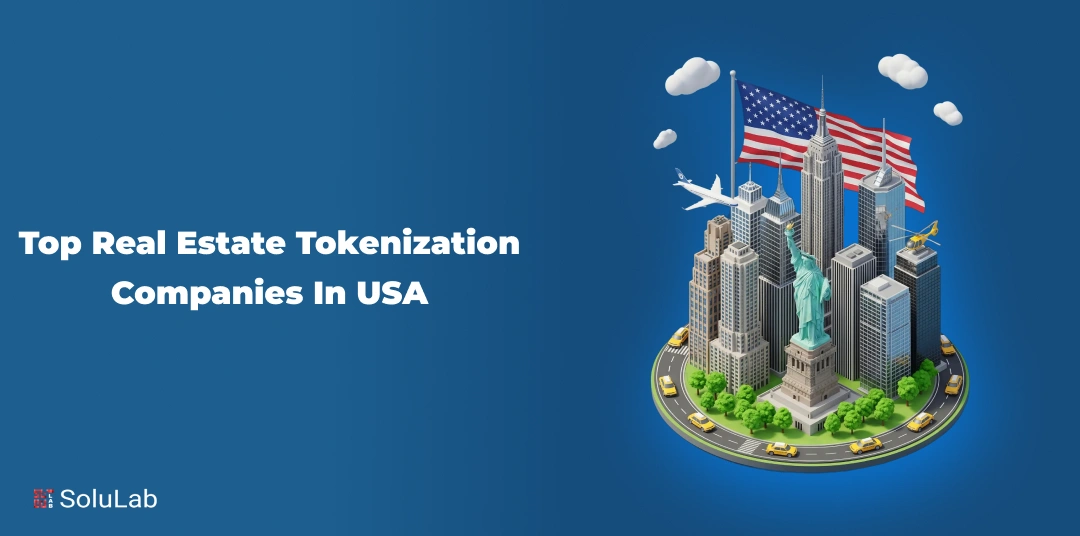
Real estate is entering a major shift as tokenization moves from early pilots to enterprise-scale adoption. Traditional property firms, developers, and financial institutions are now working with technology providers to tokenize equity, loans, and income-producing assets. This transition is driven by clear market signals: rising investor demand, accelerating regulatory support, and the rapid growth of tokenized real estate infrastructure across the U.S.
In this blog, we highlight the top real estate tokenization companies in the USA for 2026. This helps enterprises identify the right partners to support digital transformation, compliance, and scalable asset tokenization.
Key Takeaways
- The right real-estate tokenization company can cut operational costs by 30% and improve capital-raising efficiency significantly.
- Strong enterprise platforms enable scalable fractional ownership, wider investor access, and faster, more compliant real estate transactions.
Why is Real Estate Tokenization Accelerating in 2025-2030?
The shift toward tokenized real estate isn’t just a blockchain technology trend. It’s a structural change in how property is financed, sold, and accessed. Market data indicate a clear acceleration curve that real estate developers, asset managers, REITs, and financial institutions should take note of.
- According to ScienceSoft’s research, by 2030, the global market for tokenized real estate is expected to reach up to $3 trillion. This represents 15% of all real estate assets under management.
- Although still early, the demand signals in 2024-2025 show that real estate businesses are already preparing for this transition.
1. Market Traction Is Increasing Faster Than Expected
In June 2024, Deloitte found:
- 12% of global real estate firms had already implemented tokenization.
- 46% were actively piloting tokenization solutions.
This means 58% of the industry is already experimenting or adopting in a traditionally conservative market. Real estate sellers are fast realizing that tokenization:
- Reduces settlement costs,
- Enables fractional ownership, and
- Expands their investor base beyond local limits.
2. Tokenization Directly Solves Real Estate’s Biggest Structural Problems
For 10 consecutive years, U.S. investors have ranked real estate as the best long-term investment asset class. Yet the sector continues to battle long-standing issues:
- High minimum investment requirements,
- Low liquidity,
- Slow and expensive settlement cycles, and
- Multiple intermediaries in every transaction.
Tokenization addresses these friction points instantly.
Blockchain-backed tokens can represent any fractional percentage of a property. This makes it possible to sell fractional ownership units without restructuring the entire asset.
This appeals to:
- Investors seeking easier entry,
- Asset managers who want broader distribution, and
- Developers are looking to speed up capital raises.
3. Tokenization Enhances Liquidity
Historically, real estate market liquidity has been limited. However, tokenization changes this by enabling:
- Digital onboarding,
- Instant verification (KYC/AML),
- Programmable smart contracts, and
- Secondary trading through ATS-regulated partners.
This creates liquid pathways inside an otherwise illiquid asset class. It also begins to influence investor behavior. Looking ahead, increased liquidity may reshape:
- REIT demand,
- Mortgage product structures, and
- Traditional real estate portfolio architecture.
Higher liquidity typically increases short-term market volatility, which may alter how long-term investors evaluate risk, but it widens participation dramatically.
4. A Rapidly Growing Us Market Makes Early Adoption Strategic
As of 2025, the U.S. tokenized real estate market is experiencing significant growth due to:
- Strong investor demand,
- Institutional experimentation, and
- Rising interest from property sellers looking for operational efficiency.
Asset management firms are already investing in custom tokenization solutions and planning multi-year rollouts. With regulatory developments expected between 2025 and 2028, the U.S. is positioned to become the leading market for tokenized property trading.
Read Also: XRPL Blockchain for Real Estate Tokenization
Considerable factors for prepare the list:
Obtaining excellent outcomes in selecting the top real estate tokenization companies was no easy feat. However, we achieved this by thoroughly considering the following criteria.
- Experience and track record in the real estate industry
- Number of successful tokenization of real estate projects completed
- Reputation among industry peers
- Technology and infrastructure in place to support tokenization projects
- Security and reliability of the platform
- Ability to scale for larger projects
- Approach to compliance and regulatory issues
- Understanding of local laws and regulations
- Ability to navigate complex legal frameworks
- Level of support and guidance provided to clients throughout the tokenization process
- Availability of dedicated project managers and technical support
- An overall approach to customer service and satisfaction
List of Top 12 Real Estate Tokenization Companies in the USA

1. SoluLab
SoluLab provides an end-to-end real estate tokenization platform designed for enterprises, property developers, and financial institutions. Their platform can be integrated directly into existing real estate websites or deployed as a standalone white-label solution. The system supports multiple blockchains and features compliance-ready smart contracts.
SoluLab has worked with companies such as Waterton, The Corcoran Group, Freeman Webb, Global Switch, Lessen, Orchard, and Qualia. It has been recognized by GoodFirms, Clutch, and Gartner for excellence in blockchain development.

2. Harbour
Harbour is known for building one of the earliest compliance-centric tokenization frameworks. The firm focuses heavily on securities law, ensuring every deal is aligned with US regulatory requirements. Harbour supports fractional ownership through compliant digital securities, allowing investors to buy and sell equity shares of real estate assets.
Harbour has received investments from Pantera Capital, Coinbase Ventures, and Andreessen Horowitz. It has collaborated with groups like iCap Equity and Camber Creek.

$100-200

10-50

2017

San Francisco, CA

Morgan Stanley, Goldman Sachs, and Citigroup

3. Roofstock
Roofstock operates one of the most recognized single-family rental (SFR) marketplaces in the US. While not solely a tokenization platform, Roofstock has introduced blockchain-based property trading modules through Roofstock onChain.
Its core strength lies in its property inventory, underwriting, and turnkey rental management services. For B2B buyers, Roofstock brings deal volume, analytics, and real estate expertise, which complements tokenization workflows.
$50-100
50-100
2014
Atlanta, GA
Retail and accredited investors
4. RealT
RealT is a leading fractional ownership marketplace that tokenizes US rental properties. Their model allows global investors to buy small fractional shares and earn daily rental income.
RealT’s strength is liquidity. It allows peer-to-peer transfers and trading through integrated exchanges, making it attractive for investors seeking lower entry barriers and faster settlement cycles.
$50-100
5-10
2015
Austin, TX
Retail and accredited investors
5. Sandbox
Sandbox is included as a category-expanding example—focused not on physical real estate but on virtual land. The platform sells digital land parcels within a decentralized gaming ecosystem using the $SAND token.
This appeals primarily to companies exploring digital twins, virtual property, and metaverse-driven real estate models for future investor engagement.
$50-100
10-50
2019
San Francisco, CA
Global retail investors

6. Propy
Propy offers a blockchain-powered real estate transaction system and gained global attention after launching the first US-based NFT property sale in 2022. Their platform supports legal documentation, smart contracts, and transfer of ownership through tokenized structures.
They focus on simplifying cross-border transactions and enabling faster title verification with secure digital identities.
$50-100
10-50
2013
San Francisco, CA
Retail and institutional buyers

7. Republic
Republic provides regulated tokenization services and investment opportunities for commercial and residential real estate assets. Their platform handles fractional ownership, investor onboarding, and regulatory compliance.
Republic’s ecosystem includes broker-dealers, an ATS, and multiple fundraising frameworks, making it suitable for enterprises exploring compliant multi-asset tokenization.
$50-100
50-100
2016
New York, NY
Retail, accredited, and institutional investors

8. Vesta Equity
Vesta Equity specializes in home-equity tokenization. Property owners can tokenize equity and sell fractions to investors while retaining residency rights. The platform is built on Algorand and offers transparent ownership terms, investor dashboards, and appreciation-linked returns.
This model disrupts traditional HELOC and reverse mortgage structures.
$150-200
10-25
2017
San Francisco, CA
Retail and accredited investors
9. RealBlocks
RealBlocks focuses on institutional-grade real estate tokenization. Their platform supports global distribution through digital shares, automated compliance, and investor onboarding tools.
RealBlocks partners with major investment managers and provides strong back-office automation, making it attractive for funds and asset managers.
$100-150
50-100
2016
New York, NY
Institutions & accredited investors

10. Appdupe
Appdupe offers blockchain development and white-label real estate tokenization solutions aimed at startups and enterprises. Their tokenization system includes investor dashboards, token sale modules, property listing management, and multi-chain support.
They are known for fast deployment timelines and customizable interfaces.
$150
100+
2014
New York City, NY
Global retail & accredited investors
11. MartelTurnkey
MartelTurnkey provides turnkey rental properties and has expanded into fractional real estate investment using tokenized structures. Their focus is operational simplicity: investors can buy tokenized property shares with low minimums and access financial performance data easily.
This model appeals to buyers seeking passive real estate exposure with minimal involvement.
$50-100
10-25
2018
Miami, FL
Retail and accredited investors
12. Redswan
Redswan tokenizes large commercial real estate (CRE) assets, offering fractional ownership opportunities in multi-million-dollar properties. Their platform focuses on CRE liquidity and secondary market potential.
Redswan has already tokenized over $2.2 billion in commercial real estate and is targeting an additional $4 billion over the next few years.
$50-100
10-25
2019
San Francisco, CA
Accredited & global investors
Conclusion
Tokenization is reshaping real estate, and companies like Harbour, RealBlocks, Roofstock, and RealT are pushing the market forward. Still, businesses seeking security and long-term reliability need a real estate tokenization development company with proven execution. With 1500+ projects delivered, SoluLab offers an enterprise-ready white-label platform built for modern real estate workflows.
Our services include property detail verification, auto-scaling architecture and multi-lingual support. Additionally, rent and dividend automation, crypto/fiat custody, and a complete smart contract audit report to ensure trust and compliance.
For real estate firms, funds, and financial institutions looking to launch or expand tokenized asset offerings, SoluLab provides the technology, support, and stability to help you scale confidently into the future. Contact us today to make your business goals come true!
FAQs
1. Why should I consider a real estate tokenization company?
A real estate tokenization company helps convert physical properties into digital tokens, enabling liquidity, fractional ownership, and streamlined investment workflows.
2. How much does real estate tokenization cost?
Costs vary based on platform complexity, compliance needs, blockchain selection, and custom features. On average, enterprise-grade real estate tokenization solutions start from $15,000.
3. How long does it take to develop a tokenized real estate platform?
A standard real-estate tokenization platform requires 3-4 weeks. While fully customized, multi-chain, compliance-heavy solutions may take 2-4 months, depending on features and onboarding requirements.
4. What are the benefits of using a real estate tokenization platform?
A tokenization platform offers liquidity, lower transaction costs, transparent ownership records, and fractional investment options, making real estate more accessible and efficient.
5. Why should I choose SoluLab for real estate tokenization?
SoluLab offers multi-chain architecture, property verification, automated rent/dividend management and many more. Making it a full-stack real estate tokenization partner trusted by enterprises globally.