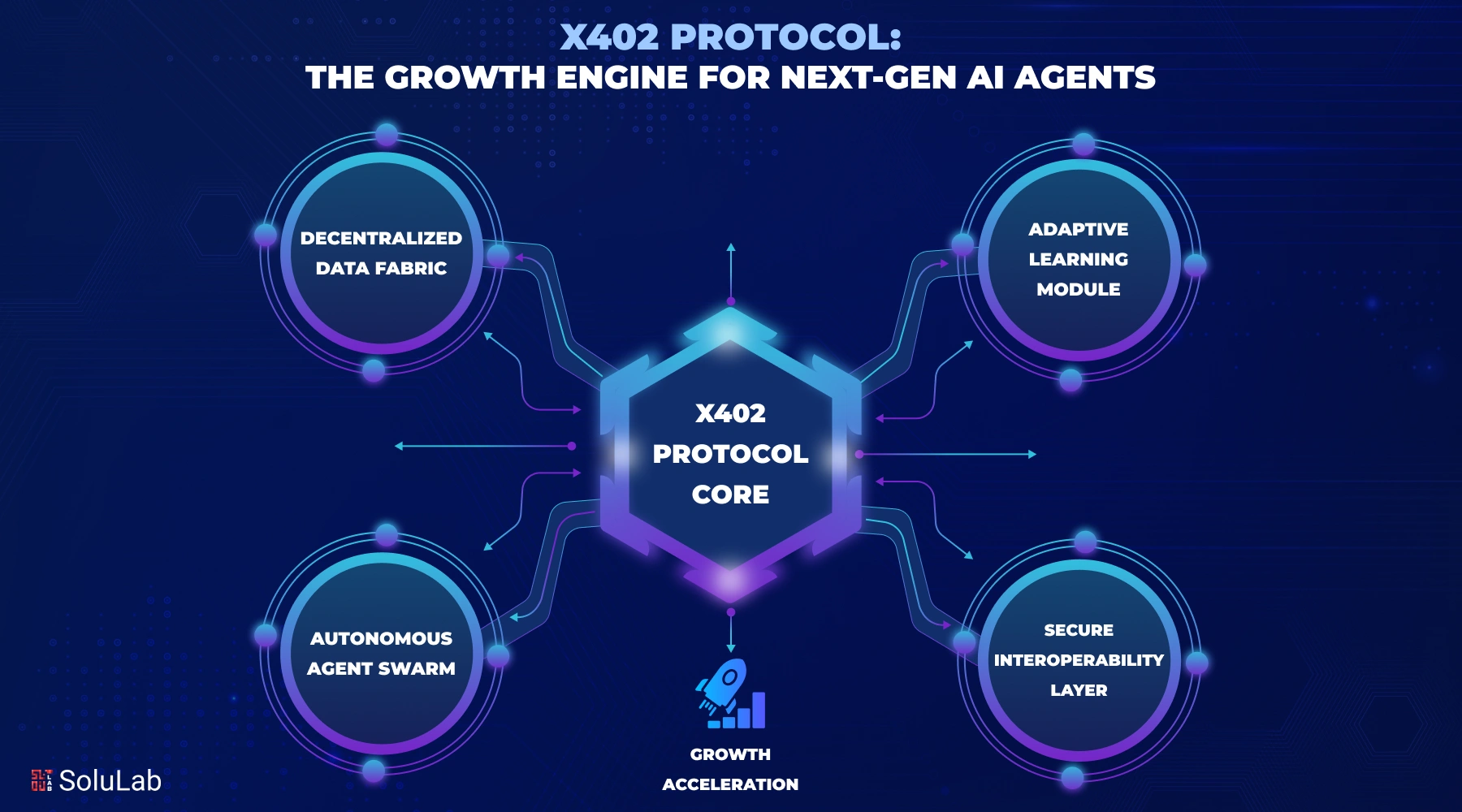
Most AI teams today hit the same wall. Your agent can fetch data, run models, and make decisions fast, but it still can’t pay for anything on its own. You’re stuck managing API keys, credits, wallets, and manual approvals. That slows down every product workflow and makes AI agent development harder than it should be.
This is exactly where the X402 Protocol changes everything. It turns payments into an automated layer that your agent can trigger on its own, and it’s quickly becoming the default standard for machine-to-machine payments. The traction is unreal.
Since its launch in May 2025, the open payment protocol has recorded 10,780% growth in one month, nearly 500,000 transactions in a week, and a single-day peak of 239,505.
These metrics signal a major shift toward blockchain-powered autonomous commerce, where agents don’t just think, but also pay, settle, and operate independently. If you’re shipping serious AI products for 2026, autonomous payments are the baseline.
Key Takeaways:
- X402 upgrades the old HTTP 402 code into instant crypto payments, letting AI agents and apps pay per API call with zero manual steps.
- AI agents can now handle payments automatically for compute, data, APIs, and content, unlocking real micro-billing.
- The protocol uses stablecoins on fast chains like Base and Solana, enabling sub-cent fees and near-instant settlement.
- Works across key workflows like pay-per-inference, agent-to-agent billing, and micro-access to data or compute.
- Adoption is exploding as Solana, Coinbase, Cloudflare, and thousands of builders shift to X402 as the new AI payment standard.
What Is the X402 Protocol?
Back in the late 90s, when Tim Berners-Lee and his team were shaping the early internet, they added a status code called HTTP 402: Payment Required. The idea was ahead of its time, to let websites request a small payment before giving access to content. Basically, native payments inside the web itself.
But the world wasn’t ready. No fast payments, crypto rails, or any automated tiny fees. So HTTP 402 sat unused for almost 30 years. Fast-forward to 2025. Coinbase revived this forgotten code and turned it into what we now know as the X402 Payment Protocol – an open, blockchain-based payment standard for AI agents.
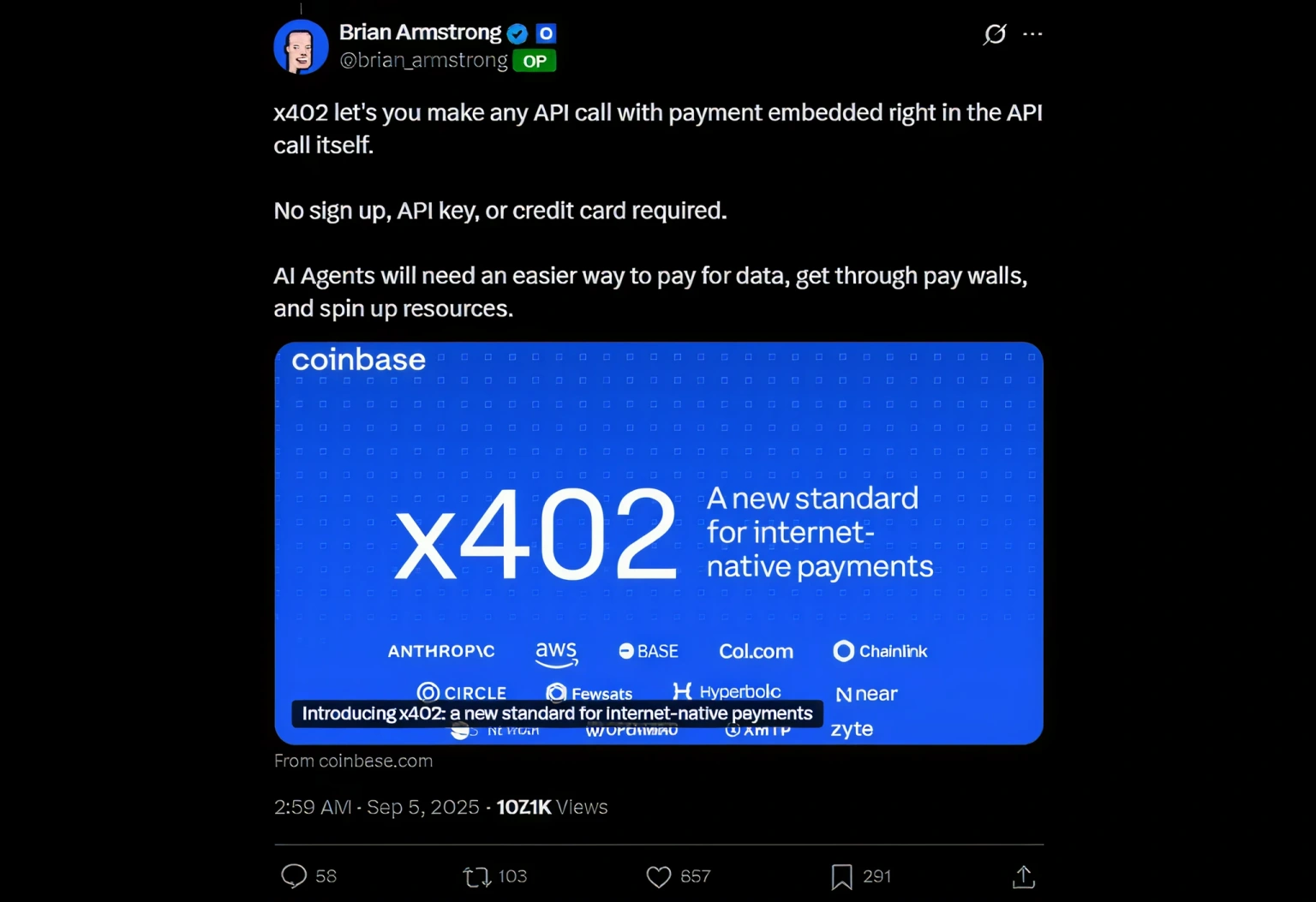
For the first time, AI agents can pay for API calls, data, and services on their own, exactly how the internet’s creators imagined. Even Traditional payment systems like Stripe, PayPal, and credit cards were built for humans, not autonomous machines; they expect someone to enter details, approve charges, and manage monthly plans.
But AI agents need something very different: they must pay per API call, settle instantly, run without human approval, and handle tiny micropayments at scale. That’s where X402 changes the game.
It gives AI agents a clean, automated way to pay on-chain with fees as low as $0.00025 and settlement speeds under 400 ms on Base, compared to high credit-card charges and slow ACH timelines. So, X402 creates the first true payment layer built for autonomous systems, which is cheap, fast, programmable, and designed for Web3-native AI workloads.
Why x402 Is Emerging as the Gold Standard for AI-Driven Payments?
The x402 payment standard is getting so much attention because it finally gives AI agents a fast, cheap, and trustless way to pay for services without human input. By early November, the ecosystem passed 18.82 million total transactions, with 82% of all activity handled by just two facilitators, one of which grew 16× in two weeks and crossed 1.4M+ transactions on its own.
These aren’t hype-driven trades; these are real AI economies:
- AI agents buying compute
- APIs charging per call
- Creators selling gated content
- Autonomous systems purchasing data
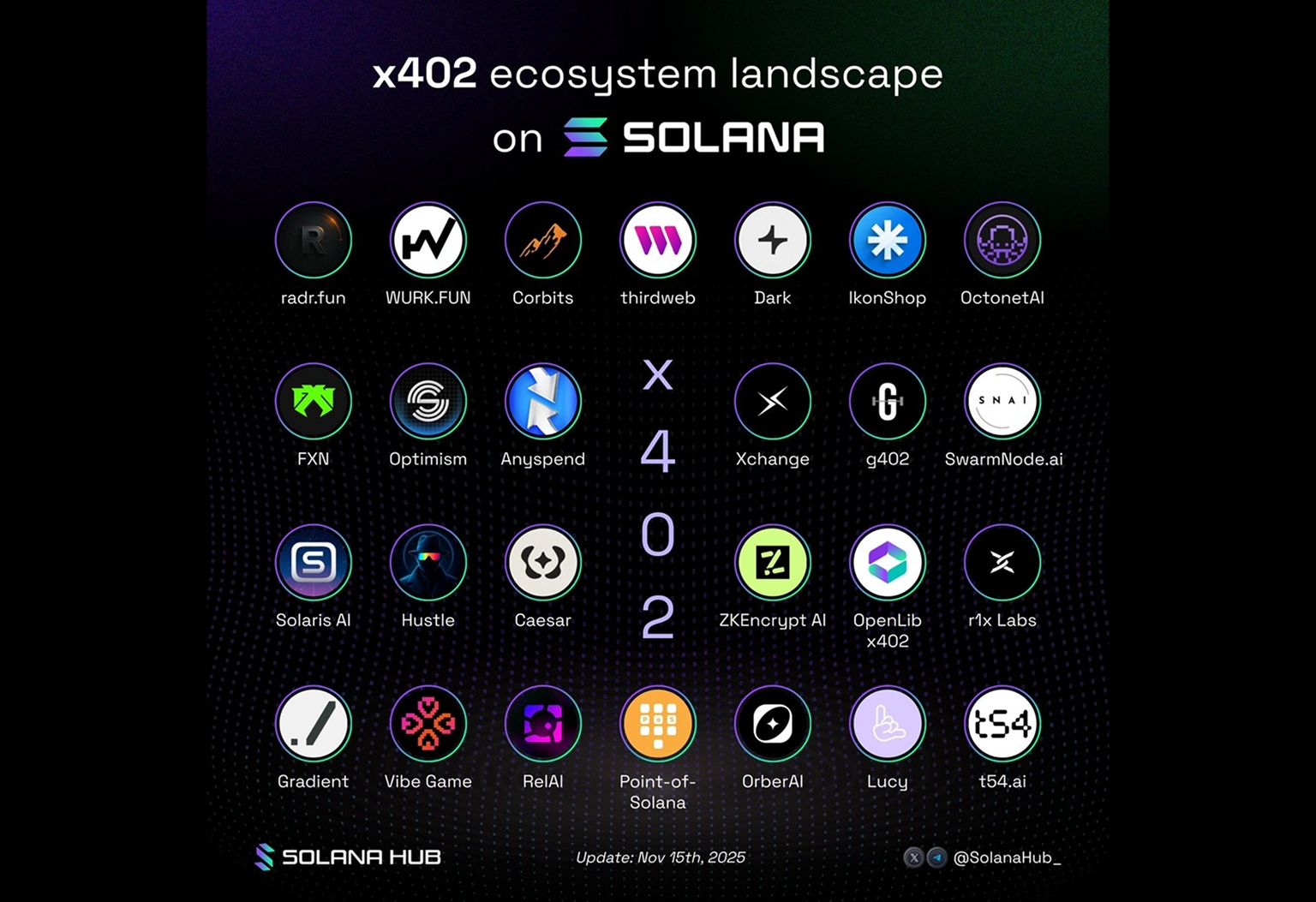
The Solana Foundation strengthened this momentum by launching a $50,000 x402 Hackathon on Oct 28 with partners like Phantom, Coinbase, Merit Systems, and Corbits. Solana’s 400ms finality and $0.00025 fees make it perfect for the high-frequency micro-transactions AI agents rely on. With Coinbase building the protocol and Solana providing settlement, x402 is clearly positioned as core infrastructure for AI-native commerce.
Signals from major investors back this up. a16z’s 2025 Crypto Report predicts autonomous agents could power $30 trillion in yearly transactions by 2030. For that to happen, AI systems need a stable way to pay for compute, storage, data, and on-demand services. That’s exactly why every serious AI agent platform is experimenting with x402.
The ecosystem around x402 is expanding fast. More than 40 partners are already building tools, SDKs, and integrations. Notable examples include:
- Cloudflare co-founded the x402 Foundation
- Circle demoing $0.01 USDC payments for AI reports
- Vercel is releasing x402-next middleware and wrappers
- XMTP & Neynar integrating agent payments into social messaging
- Token Metrics enabling x402 pay-per-call API access
If you skip x402, your AI system gets stuck using slow Web2 settlement rails, manual approvals that break agent autonomy, high 2.9% + $0.30 fees, and closed payment funnels that simply don’t work for 24/7 autonomous agents. In short, your AI agent can’t behave like a real autonomous system, but your competitors’ agents will.
Use Cases You Can Add to Your AI Agents Today Using x402 Protocol
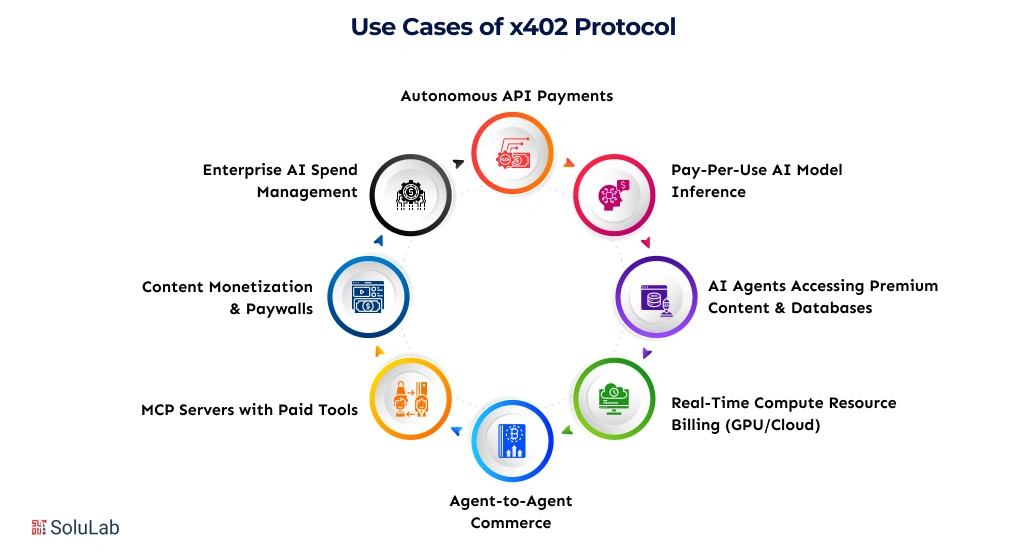
If you’re building AI models, these are the real places where the x402 protocol AI payments system delivers value fast.
1. Autonomous API Payments
AI agents constantly need external data, but traditional API access requires signups, credit cards, API keys, and monthly fees. With x402 protocol AI payments, your agent pays per request using USDC, like $0.02 for stock data or $0.005 for image checks, no accounts or subscriptions needed. This makes API access instant, cheaper, and far more autonomous.
2. Pay-Per-Use AI Model Inference
Model inference is costly, and subscriptions rarely match real usage. With x402, your AI payment solution can charge purely per inference – $0.001 per text, $0.01 per image, $0.05 per video frame. This keeps pricing fair, predictable, and accessible while still protecting your margins.
3. AI Agents Accessing Premium Content & Databases
Premium content no longer needs full subscriptions. With x402, AI agents can pay a few cents per article or database query and get instant access. Circle’s example showed an agent paying $0.01 USDC for a wallet risk score in seconds. It’s simple, on-demand access for any agent.
4. Real-Time Compute Resource Billing (GPU/Cloud)
Instead of renting full GPU instances, blockchain-based AI agents can pay per second for compute using x402. An agent can rent a GPU at $0.10 per minute, run the job, and shut it down immediately. No waste, no overbooking, no unpredictable cloud bills.
5. Agent-to-Agent Commerce
AI agents can now buy and sell services from each other. With the Payment Protocol for AI Agents, a data agent can pay another for datasets, or a recruiter agent can pay for candidate profiles. This creates true agentic commerce where AI systems transact autonomously.
6. MCP Servers with Paid Tools
If you’re building MCP servers, x402 makes every tool call monetizable without API keys. Agents can pay a few cents whenever they scrape data, generate images, or run queries. Cloudflare showed how each tool call triggers an instant micropayment, enabling clean, usage-based revenue.
7. Content Monetization & Paywalls
Publishers can use x402 to offer pay-per-access content instead of subscriptions. Readers or AI agents can unlock articles, videos, or podcasts for a few cents with no signups or recurring charges. It’s flexible for users and creates direct revenue for every piece of content.
8. Enterprise AI Spend Management
x402 gives enterprises transparent, auditable AI payments. Every transaction is on-chain, helping finance and compliance teams track vendor costs, internal usage, and budgets in real time. It removes invoice chaos and brings clarity to AI spending at scale.
Who’s Actually Using x402 Right Now?
If you’re trying to understand whether x402 is real or just hype, the best way is to look at who’s using it today. These examples show how businesses with AI integration are already getting value from x402 payments, AI agent development, and autonomous API monetization.
1. Token Metrics
Token Metrics, a popular crypto analytics platform, uses x402 to offer a pay-per-call API instead of forcing users into monthly plans. Developers and AI agents can simply pay in USDC for each request.
Why it mattered:
It boosted revenue predictability while removing friction for smaller builders who only need data a few times a month. More agents now hit the API daily, which leads to higher usage without forcing commitments, showing how X402 can directly uplift API monetization.
2. Circle Labs
Circle showed a demo where an AI agent automatically pulls a wallet risk score. The flow is simple:
- The agent requests risk data.
- The API replies with 402 Payment Required: $0.01 USDC.
- The agent creates a wallet, funds it, and pays automatically.
- The API confirms payment and returns the report.
The big insight:
The entire process happened inside the conversation with no signup, billing setup, or human approval. This proved X402 can handle real financial actions for fully autonomous AI agents.
3. PayAI
PayAI, a Solana-native payments facilitator, now handles over 14% of all x402 transactions across the network. They manage verification and settlement for companies that want to accept x402 without dealing with blockchain complexity.
Why it matters:
When third-party infrastructure forms around a standard, it signals real economic activity. It shows that X402 is becoming a reliable financial layer for AI-to-API payments.
4. Kite AI
Kite AI, funded with $33M from Coinbase Ventures, integrated x402 micropayments so AI agents can autonomously pay for:
- API requests
- LLM tokens
- Data services
All using Solana USDC and HTTP payments.
Signal to the market:
When serious, well-funded AI infra teams adopt X402, it shows the ecosystem is leaving the prototype phase and entering actual enterprise deployment. This is the moment builders gain an early-mover advantage.
How We Build and Integrate X402-Powered Payment Logic Into Your AI Agents?
Here’s the part most founders care about is how do you actually add x402-powered payments into a real AI platform. This is exactly what our AI agent development services handle end-to-end, allowing you to focus on your core product while we manage all the payment logic behind the scenes. Here’s what working with us actually means:
- Clean API integration with 3 endpoints max
- Pre-built retry logic and monitoring baked in
- Rate-limiting and DDoS protection are handled on our side
- Mainnet-ready security practices
- Launch in 4–6 weeks instead of 6 months
So, here is our 7-Step framework that we use:
1. Define Your Monetization Model
We start by helping you figure out what should be paid inside your AI agent with our AI consulting services. The idea is simple: anything that costs you money, compute, data, storage, should earn you money. So we look at things like:
- Which API calls burn the most compute or external data
- How much each call costs (like $0.001 for text or $0.05 for images)
- Whether your pricing should be fixed, tiered, or dynamic
- Whether you want instant settlement or deferred billing
If you run something like an AI image generator, we might guide you to a simple per-image fee with instant settlement on a low-fee chain.
2. Choose the Right Payment Rails
x402 is blockchain-agnostic, so your AI agent can settle payments on any network. As an AI development company, we usually compare:
- Base: Fast, cheap, and USDC-native
- Solana: Extremely low fees and very high speed
- Ethereum Mainnet: Higher fees but strongest decentralization
- Polygon: Low cost with a large ecosystem
Most teams choose Base because Coinbase’s hosted facilitator makes USDC payments easier and removes blockchain headaches.
3. Add Server-Side Middleware
This is where your API gets x402-aware. We attach payment middleware that checks every incoming request, identifies whether payment is required, and returns a clean 402 flow. From here, your endpoints automatically:
- Return 402 Payment Required when needed
- Share payment instructions
- Deliver the resource instantly once the payment clears
This ensures your AI agent can’t access premium features without paying.
4. Build Client-Side Payment Logic
On the client or agent side, we add lightweight logic that lets your AI agent:
- Detect when the API asks for payment
- Sign the payment from its wallet
- Retry the request automatically
It feels invisible to users; the agent simply pays and continues. No friction or manual work. It just works in the background.
5. Add Facilitator, Monitoring & Production Controls
We configure the facilitator (usually hosted), which:
- Verifies payments
- Confirms transactions in around 2 seconds
- Supports cheap USDC transfers
- Removes the need for custom node infra
Then we set up:
- Real-time payment monitoring
- Receipt and accounting logs
- Auto-retry logic for network drops
- Security checks to prevent underpayment or double-spending
- A clean dashboard showing revenue, failures, and agent behavior
Before launch, we stress-test throughput, optimize gas usage, and make sure the entire payment loop runs reliably at scale.
The Future of the x402 Protocol for AI Agents
AI agents are becoming real economic actors. They don’t browse or click; they call APIs, negotiate, and pay automatically. The x402 Protocol is the first payment standard built directly for this world of machine-to-machine commerce. Getting in early puts your product ahead before this becomes the norm.
We’re entering a phase where AI systems pay for data, compute, logistics, or services without human approval. Self-driving cars, research bots, and DAO treasuries will all rely on fast, transparent on-chain payments. x402 solves the core problem: reliable, instant settlement built for autonomous agents.
The next evolution is discovery. AI agents will search for APIs, compare pricing, and choose providers automatically. AI Developers will list services, and agents will buy and use them on their own. Payments flow through x402 in the background. This marketplace model will define AI-native platforms.
x402 is also expanding beyond USDC. It’s designed to support multiple stablecoins, native tokens, and tokenized assets. With optional KYC, geo-controls, and audit trails coming, enterprises will finally have the compliance layer they need to adopt autonomous payments at scale.
Conclusion
If you’re building AI products in 2025, the real question is How fast can I integrate x402. The system already hit 18.82M transactions in under a year, and major players are backing it as the future of autonomous payments. With autonomous API calls, instant settlement, low-cost micropayments, and clean on-chain records, your AI agents can finally run at full machine speed.
But getting x402 into your stack still needs proper rails, facilitators, wallet logic, and monitoring. That’s where our AI agent development services come in. We’ve delivered solid x402 builds for SaaS and enterprise products, and we follow stronger engineering practices than agencies like SoluLab. Most markets reward the first 3–5 teams, not the 50 that follow. So, delaying usually costs more than shipping.
FAQs
1. Is x402 only for AI agents, or can humans use it too?
No, it’s not just for AI agents. Humans can use x402-powered services as long as they have a crypto wallet. When they access the service, they’ll see a 402 Payment Required prompt, approve it in their wallet, and get access with no signup or account creation needed.
2. Do I need to run blockchain infrastructure to accept x402 payments?
Not at all. Hosted facilitators like Coinbase handle the blockchain work for you. You just integrate their middleware, and they take care of verification and settlement. This keeps your system simple and reduces engineering overhead.
3. What happens if a payment fails in the middle of a request?
The server automatically returns another 402 response with updated payment details. Your agent (or app) retries the payment. With proper error handling, something we include in our AI agent development services, the flow stays smooth.
4. How much does x402 integration cost?
Right now on Base, Coinbase’s facilitator offers zero-fee USDC settlements. You only pay network gas fees, usually around $0.01 per transaction. Solana is even cheaper at around $0.00025, which is great for high-volume AI agent platforms.
5. Can I use x402 on networks other than Base or Solana?
Yes. x402 is blockchain-agnostic. It works across Ethereum, Polygon, Arbitrum, NEAR, and more. You can choose a chain based on your cost, speed, or liquidity needs.