Why is blockchain technology being adopted today across several organizations, including NGOs? Previously, nonprofits were under pressure with the donors’ questions on where their funding was used and why the platform was causing a delay in showcasing the funds. This sometimes leads to high operational costs for the organization. But tokenization, blockchain systems, and crypto donations solve these problems in the snap of the fingers.
Blockchain-based donation platforms and tokenized crowdfunding systems can show the funds in moments and build trust. Additionally, web3 fundraising tools reduce the involvement of a third party (middleman). Through this, the charity organizations can involve more people around the world and help them run the operations smoothly. These are things we are going to discuss in the following sections; keep your tabs open to know how tokenization on blockchain is changing the funding methodology.
Key Takeaways
- Blockchain donation platforms provide up to 40% better transparency and reporting accuracy.
- Tokenized crowdfunding platforms can reduce operational overhead by 25–35%, through automation and smart contracts.
- Borderless, low-fee transactions allow nonprofits to engage supporters in regions beyond traditional banking infrastructure, improving contribution volume and diversity.
Why Tokenized Donation Platforms Are Becoming a Strategic Nonprofit Upgrade?
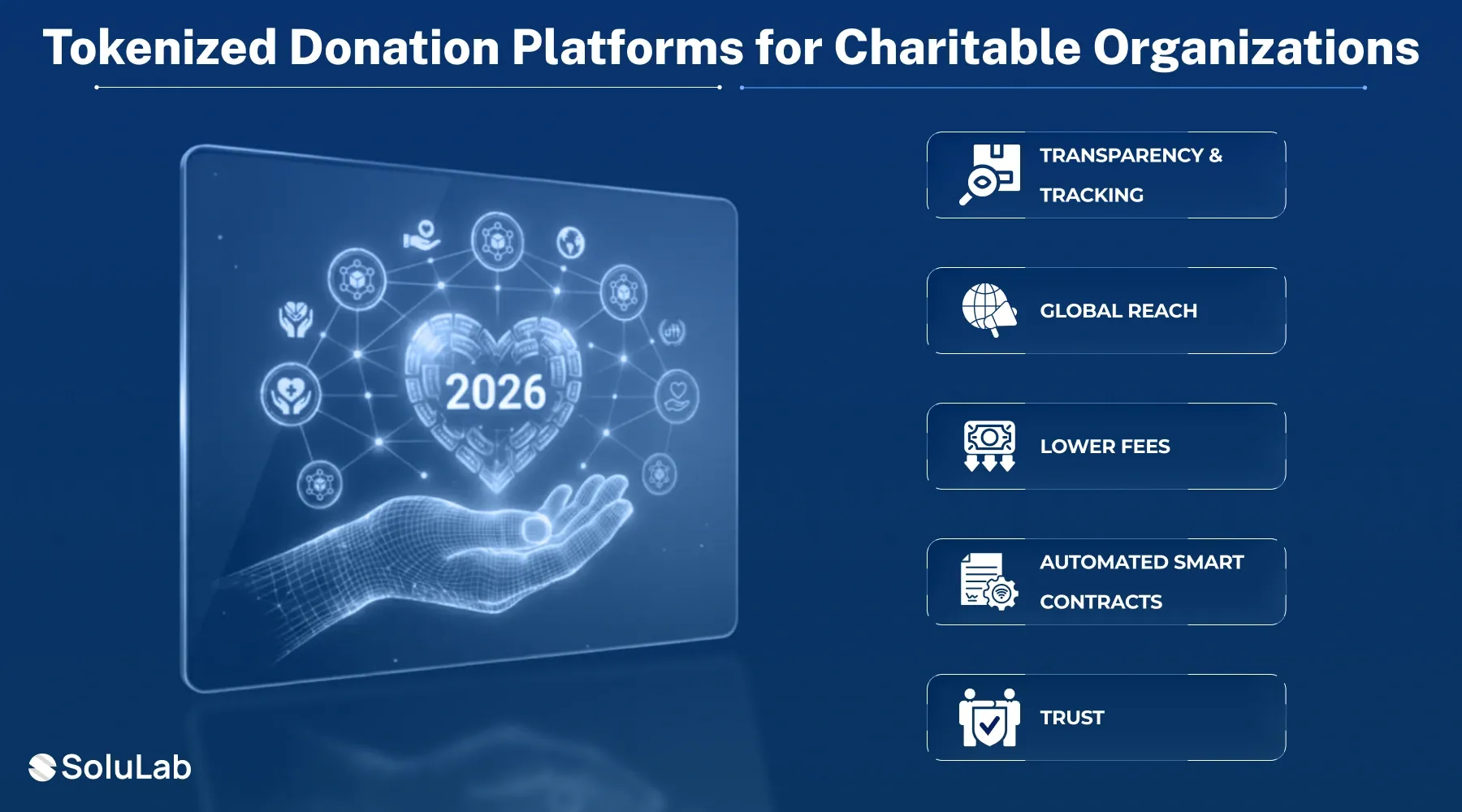
Tokenized donation platforms are better than traditional donation systems because they make the funding process more open, automated, and traceable. Nonprofits can use blockchain technology to speed up their core operations and show that they are responsible right away, instead of relying on manual reporting or third-party validation.
- Tokenization lets nonprofits turn donations or project stakes into digital tokens. While making sure that donors always know where their money is going, and keeping track of every step of the allocation process.
- Cryptocurrency donations make it easier to give money across borders. Also, it gets rid of banking delays and makes it easier for nonprofits to connect with donors around the world.
- Web3 fundraising tools make it easier for small donors to give to projects by letting them give smaller amounts.
Tokenized crowdfunding platforms open up new possibilities in many areas, such as sustainability, green energy, real estate, education, farming, and startups. This is in line with the growing interest of donors in giving based on impact.
Why nonprofits are prioritizing tokenization now?
- Rising donor demand for transparency and measurable results.
- Increased preference for digital, low-fee, real-time funding channels.
- The shift of philanthropists and impact investors toward blockchain-backed accountability.
Business Advantages Driving the Adoption of Blockchain-Enabled Charity Systems
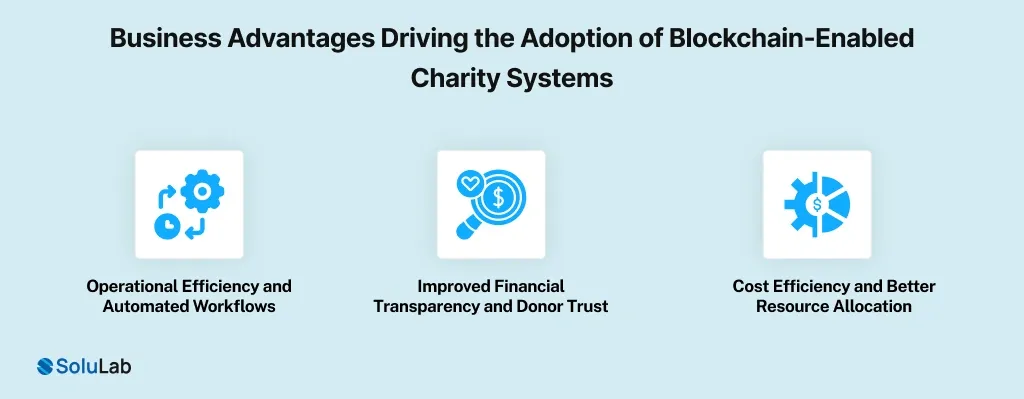
The blockchain adoption in charity is mainly to solve the long-standing issues like transparency, operational inefficiency, and management. With the rising AI the financial clarity, automation, and support for global fundraising are getting easier. So, let’s see how things are escalating with the latest technology innovations.
1. Operational Efficiency and Automated Workflows
By getting rid of middlemen and making things easier, blockchain makes it easier for nonprofits to get, keep track of, and spend money. Smart contract development makes it possible to pay out based on rules.
- When certain project conditions are met, money moves automatically, which cuts down on manual checks and delays.
- On-chain updates show allocation activity in real time, which helps teams work together better and make decisions faster.
- Automated processes make it easier for teams to focus on running programs by taking some of the work off of administrators.
- International contributions settle quickly, which helps with faster mobilization during urgent or time-sensitive projects.
- Nonprofits don’t have to pay high remittance fees, which means that more money can go to the people who need it.
- Borderless transfers make it easier for donors to give money in places where there aren’t many banks.
2. Improved Financial Transparency and Donor Trust
A big reason why institutions are using tokenization platforms is that they are open and honest. Every donation is stored on the blockchain forever.
- Donors can check transactions on their own without having to rely on internal reports.
- Immutable logs lower the chance of funds being misallocated or changes being made after the report is sent.
- Clear financial trails make it easier to follow the rules for audits, grant reviews, and stakeholder reporting.
- Nonprofits can share live dashboards that show how money is coming in, being spent, and being allocated.
- Donors can see right away how their gifts help specific projects.
- Continuous reporting helps keep donors and their long-term commitments to the fund.
3. Cost Efficiency and Better Resource Allocation
Tokenization removes several layers of cost in the donation pipeline. Crypto and on-chain payments lower operational expenses.
- Eliminating intermediaries reduces transaction charges, increasing the usable portion of each donation.
- Lower overhead improves program efficiency, especially for small and mid-sized nonprofits.
- Predictable settlement cycles help teams plan project budgets with greater accuracy.
Key Considerations Before Implementing a Tokenized Donation Platform
Even though tokenization and blockchain donation platforms offer significant benefits, nonprofits must consider other things. They are strategic, operational, and compliance factors based on the region.
- Regulatory landscape: Organizations must understand how crypto donations and tokenized crowdfunding platforms align with local laws, especially around taxation and reporting.
- Donor education: Many supporters may be new to blockchain or crypto concepts, so offering clear guidance and user-friendly tools is essential.
- Technical readiness: Nonprofits need a secure wallet setup, clear operational protocols, and staff awareness around handling digital assets.
- Platform selection: Choosing the right blockchain-based donation platform is critical. Factors include supported assets, fees, security certifications, and integration capabilities.
Before jumping into deployment, you must choose the best tokenization development company for smooth platform sailing. And then integrate with the CRM system, accounting tools, and automation workflows.
How Crypto-Powered Donation Infrastructure Strengthens Trust and Donor Retention?
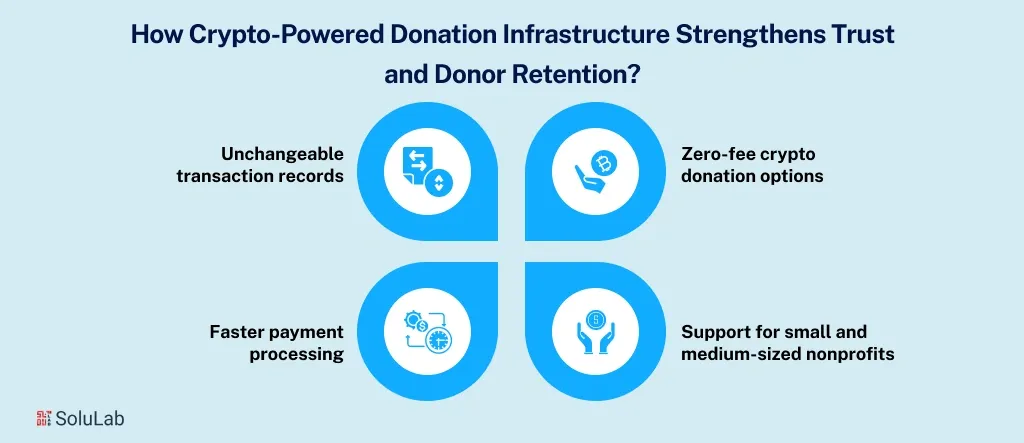
Business and charity are all about trust. Donors who contribute expect that their money or things will help the people in need and can bring real impact. Through blockchain technology, this trust is transparent. You can verify where your donation went. Additionally, the crypto-powered donation infrastructure leads to maintaining immutable records, as discussed below.
- Unchangeable transaction records: Every donation made on a blockchain is stored safely, so donors can check the distribution on their own.
- Faster payment processing: Crypto donations get rid of delays, so nonprofits get the money they need right away, like when they need it most for disaster relief.
- Zero-fee crypto donation options: Some platforms let people give without paying a fee, which helps them make the most difference with their donations.
- Support for small and medium-sized nonprofits: Tokenized giving helps smaller groups get donations from people all over the world, which makes them more visible and long-lasting.
Donors are much more likely to give again if they can see the direct results of their gifts through blockchain timestamps, smart contract audits, and allocation trails.
Compliance and Security Advantages Built Into Blockchain Donation Systems
No matter what organization it is, compliance and security determine the trust and growth. Therefore, blockchain donation platforms help you safeguard and reduce fraud and strengthen accountability.
- Automated audit trails: With a blockchain funding platform, organizations can trace the donations and simplify the reporting and compliance checks.
- Smart contract automation: Through smart contracts, you can release funds when certain milestones are met.
- KYC/AML compatibility: With donor verification, the tokenized crowdfunding platforms prevent illicit activity.
- Tamper-proof records: Unlike traditional databases, blockchain entries cannot be altered or deleted, guaranteeing data integrity.
Fact: Enterprise donors need consistent transparency, verifiable results, and automated systems. This helps them deliver efficient services.
The Future of Tokenized Donation Platforms Growth
In the above sections, it’s already mentioned how blockchain, tokenization, and crypto donations are shaping the charity. Here, we will explore what the future might hold, including potential innovations and integrations that may emerge.
The rise of impact tokens: Impact tokens enable donors to fund specific, quantifiable social outcomes while ensuring funding cycles are traceable. More than 60 countries host tokenized crowdfunding platforms across a whole range of sectors, from sustainability to real estate, art, health, and education.
Growth of decentralized autonomous organizations: DAO development will facilitate community-driven philanthropy through collective decision-making and transparency in fund allocation. Widespread use of blockchain donation platforms allows donors greater, easier access to trusted giving channels as more nonprofits head toward tokenization.
Tokenization donations will be part of CSR and affect investment portfolios and global strategies. Their transparency and operational efficiency will shift the way the world’s funding organizations work.
Conclusion
As mentioned in this blog, tokenized donation platforms are changing how non profits manage transparency, donor trust, and global participation. If your organization is exploring building a secure and scalable blockchain donation platform, then SoluLab is here to help you.
We at SoluLab, a top tokenization development company, specialize in end-to-end tokenization and Web3 infrastructure. Our experts help nonprofits and enterprises convert ideas into fully operational digital ecosystems.
Our 250+ expert developers are here to deliver secure and compliant tokenization solutions and the latest integrations.
How SoluLab Helps Funding Organizations?
- 3x faster asset monetization through optimized token models and automated workflows.
- 60% faster ROI with streamlined development and long-term scalability.
- 100% secure asset ownership using ERC-20, ERC-721, and ERC-1155 token standards.
If you are ready with your vision, then we are here to make it a reality. Contact us today and discuss the idea with our experts!
FAQs
Development costs vary by features and blockchain stack, but most tokenized donation platforms start from $10k, depending on complexity and integrations.
A standard blockchain platform developemnt takes 2–4 weeks, while advanced versions with tokenization, automation, and compliance modules may require 6–8 weeks.
Organizations can use ERC-20 for fungible tokens, ERC-721 for unique assets, ERC-1155 for hybrid models, and asset tokenization for fundraising or ownership.
You can reach SoluLab through direct inquiry, scheduled consultation, or business communication channels to discuss requirements and receive tailored technical guidance.
Yes, tokenized crowdfunding helps startups access global investors, offer fractional participation, improve transparency, and raise capital efficiently without traditional fundraising barriers.