Look, if you’re reading this, you’re probably sitting on a decision that could either save your company six figures in transaction costs or send you down a rabbit hole of technical debt that’ll haunt your quarterly reviews for years. I’ve seen both happen.
| As Binance Smart Chain (BSC) processed over 17 million daily transactions in Q3 2025, with TVL reaching $17.1 billion. |
It feels like BEP20 Token Development isn’t just for crypto natives anymore, as Traditional enterprises from healthcare to real estate are tokenizing assets on BNB Chain because the math finally makes sense. But nobody tells you that the difference between a successful BEP-20 deployment and a costly mistake is strategic.
This guide is a no-BS breakdown we wish we had when we first started advising companies on Binance Smart Chain BEP20 Tokens. We’re going to cover everything that separates the projects that ship from the ones that become case studies in what not to do.
Key Takeaways
- The Binance Smart Chain (BSC) now hosts over 4,000 active dApps with 58 million monthly active addresses.
- BEP-20 vs ERC-20 security models differ fundamentally.
- Cross-chain interoperability between BEP-20 tokens on BNB Chain and other networks now exceeds $2.1 billion in bridged assets.
What Is BEP-20?
BEP-20 is basically the rulebook for creating tokens on Binance Smart Chain. Think of it like the difference between writing a check versus wiring money; both move value, but they follow different protocols. BEP-20 is BSC’s version of Ethereum’s ERC-20, but it’s designed for speed and cost-efficiency from day one.
When someone asks what the BEP20 network is at a technical level, they’re really asking about a token standard that defines how tokens transfer, how you check balances, and how applications approve spending. The standard includes nine mandatory functions like transfer(), balanceOf(), and approve() – the same ones ERC-20 uses, and that’s intentional. Binance wanted BEP20 and ERC20 to be compatible so developers could copy-paste their Ethereum code and deploy on BSC in under an hour.But the magic happens in the implementation. Binance Smart Chain BEP20 Tokens run on a Proof of Staked Authority (PoSA) consensus, instead of thousands of anonymous miners competing to validate blocks like Ethereum, BSC uses 21 elected validators who stake BNB.
This makes BEP-20 Tokens incredibly fast, blocks every 3 seconds instead of 12, but it also means you’re trusting a smaller, more visible set of network operators. So, if you’re building a consumer app that needs microtransactions, BEP-20 Tokens on BSC are a no-brainer, and if you’re tokenizing $50M in real estate and need maximum censorship resistance, you might want to think twice.

BEP-20 vs ERC-20: Which Token Standard Scales Better for Enterprise and High-Volume Use Cases?
This is where most articles get it wrong. They give you a table and call it a day, but if you’re a decision-maker, you need to understand why these differences matter for your specific use case.
The Speed vs Decentralization Tradeoff
BEP-20 vs ERC-20 isn’t just about fees, it’s about philosophy. Ethereum’s PoS now has over 1 million validators, where BSC has 21. That means BEP-20 Tokens achieve finality in around 7.5 seconds while Ethereum takes 2-3 minutes during congestion. For a gaming company processing 10,000 daily microtransactions, that’s the difference between viable and bankruptcy.
But those 21 BSC validators are known entities. You can look them up, but most are institutional players like Binance itself, Ankr, and Coinbase Cloud. When you’re dealing with BEP20 and ERC20 from a compliance perspective, this is actually an advantage. You know who to subpoena if something goes wrong.
Real Cost Comparison Based on 2026 Data
Let me give you the actual numbers from last month’s deployments:
| Transaction Type | BEP-20 Tokens Cost | ERC-20 Cost | Speed Difference |
| Simple transfer | $0.08-$0.15 | $8-$25 | 5x faster |
| DEX swap | $0.20-$0.40 | $15-$40+ | 4x faster |
| Contract deployment | $50-$200 | $500-$5,000 | 10x cheaper |
These aren’t theoretical numbers– we pulled them from actual BEP20 Token Development projects we tracked in December 2025. One DeFi protocol saved $340K in gas fees in its first quarter by migrating from Ethereum to Binance Smart Chain.
The Technical Compatibility Lie
Everyone says BEP20 and ERC20 are fully compatible, which is technically true, but practically misleading. Yes, you can deploy the same Solidity code, but the economic assumptions break down. Ethereum’s base fee burning mechanism doesn’t exist on BSC. The way MEV works with completely different from validator economics. Even something as simple as block.timestamp behaves differently when blocks are 3 seconds apart versus 12.
If you’re porting an Ethereum dApp to BEP-20 Token on BNB Chain, you need to audit every line of code for timing assumptions. I’ve seen a lending protocol get exploited for $2M because they didn’t adjust their liquidation thresholds for faster block times.
What Should Founders Know Before Starting BEP20 Token Development On BNB Chain?
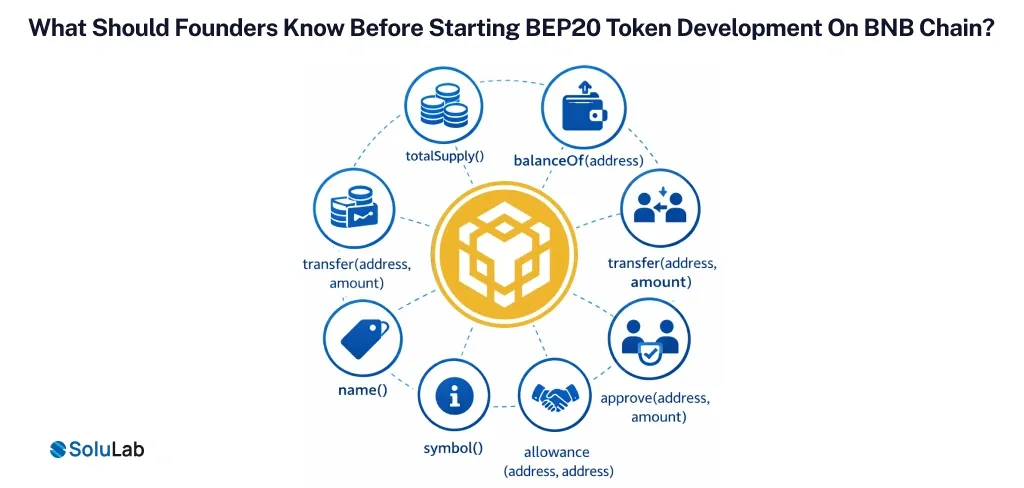
Alright, let’s get technical without putting you to sleep. When you create a BEP-20 Token, you’re deploying a smart contract that follows a specific interface. Think of it like a USB-C port, where any device that follows the spec can plug into any charger that follows the spec.
The Nine Functions That Matter
Every BEP-20 Token must implement these core functions:
- totalSupply() – How many tokens exist in total
- balanceOf(address) – How many tokens a specific address holds
- transfer(address, amount) – Move tokens from you to someone else
- transferFrom(address, address, amount) – Let someone else move tokens on your behalf (critical for DEXs)
- approve(address, amount) – Authorize someone to spend your tokens
- allowance(address, address) – Check how much someone can spend
- name() – Human-readable token name
- symbol() – Token ticker (like “BNB”)
- decimals() – How divisible the token is (usually 18)
Here’s what most guides miss: BEP-20 Tokens also include a getOwner() function that ERC-20 doesn’t have. This gives BSC-specific control mechanisms that can be a double-edged sword. It lets you recover from certain disasters, but it also means you’re not fully decentralized.
The Gas Mechanism That Saves You Money
When you interact with Binance Smart Chain BEP20 Tokens, you pay gas in BNB, but here’s the clever part – BSC uses a gas price oracle that keeps fees stable. While Ethereum’s base fee spikes to 200 gwei during NFT drops, BSC’s mechanism caps it around 5-10 gwei.
For a crypto token development company building enterprise solutions, this predictability is gold. You can budget your operational costs instead of praying gas doesn’t spike during your product launch.
The Validator Reality Check
Those 21 validators I mentioned are elected daily based on BNB stake. The top validator currently holds 1.2 million BNB, which is around $1.1B at current prices. This concentration worries decentralization purists, but for business leaders, it means you can actually talk to the network operators.
If you’re deploying a mission-critical BEP-20 Token system, you can reach out to validators directly, and some even offer priority transaction services for enterprise clients.
How Does a BEP-20 Token on BNB Chain Enable Enterprise-Grade Liquidity and Adoption?
Let’s talk benefits without the marketing fluff. I’ve seen companies waste months on the wrong chain because they didn’t understand the real advantages.
1. Speed That Actually Matters
BEP-20 Tokens confirm in 3 seconds. For context, that’s faster than most credit card authorizations. The secret isn’t just fast blocks, it’s the PoSA consensus. Validators take turns producing blocks, so there’s no competition. When it’s your turn, you produce the block which is Simple, Predictable and Fast.
2. Cost Structure That Scales
Here’s a real example – A remittance company sending $200 payments to Southeast Asia was paying $12 in Ethereum gas fees. They switched to BEP-20 Tokens and now pay $0.15. That’s a 98.75% cost reduction. Their CEO told me they were able to drop their minimum transfer from $100 to $10, opening up a completely new market segment.
But the real advantage isn’t just low fees,it’s stable fees. Binance Smart Chain BEP20 Tokens use a mechanism that prevents the wild spikes you see on Ethereum. For a token development company building financial products, this lets you offer fixed-fee services instead of passing variable costs to users.
3. The Ecosystem Moat
People underestimate network effects. BEP-20 Tokens plug into an ecosystem that includes:
- PancakeSwap: $2.5B TVL, $772B quarterly volume
- Venus: $2.34B TVL, dominant lending protocol
- 4,000+ dApps with 58M monthly active users
When you launch a BEP-20 Token, you’re not starting from scratch. You have immediate access to liquidity, users, and composable DeFi legos.
4. The Compliance Angle
Here’s the controversial take – BEP-20 Tokens are easier to build compliant products around. Because the validator set is known, you can implement KYC at the validator level. Also, you can create whitelisted BEP-20 Token contracts that only interact with verified addresses.
Is this less decentralized? Absolutely. But if you’re a fintech startup trying to get regulatory approval, this is the difference between shipping and shutting down.

BEP-20 vs BEP-2: Which Token Standard Scales Better for Businesses?
This confusion kills projects before they start. Let me clear it up once and for all.
The Simple Analogy
BEP-2 is like cash, which is simple, direct, no smart contracts. It runs on the BNB Beacon Chain (formerly Binance Chain). BEP-20 is like a programmable debit card, as it can do complex things automatically, and it runs on BNB Smart Chain.
BNB exists on both chains. You can move it between them using the Binance Bridge. But here’s where founders mess up, as they try to build a DeFi protocol using BEP-2 tokens and wonder why they can’t implement automated market makers.
When to Use Each?
| BEP-2 makes sense for: | BEP-20 is for: |
| Simple exchange listings | DeFi protocols, NFTs, or Anything requiring smart contracts |
| Basic transfers | Complex business logic |
| When you need maximum speed and don’t need programmability | Slightly slower but far more flexible |
In 2025 alone, bridge exploits cost the industry $1.4 billion. Binance Smart Chain (BSC)’s bridge has held up well, but it’s still a single point of failure you need to account for in your architecture.
The Bridge Reality
Moving between BEP-2 and BEP-20 Token on BNB Chain isn’t instant. It takes 2-3 minutes and costs about $0.50 in fees. For most use cases, that’s fine, but if you’re building a high-frequency trading system, that latency kills you, as the bridge itself is a smart contract that locks tokens on one chain.
How Are BEP-20 Tokens on BSC Used by Enterprises for Scalable On-Chain Operations?
Theory’s nice, but let’s talk about what’s actually shipping and making money.
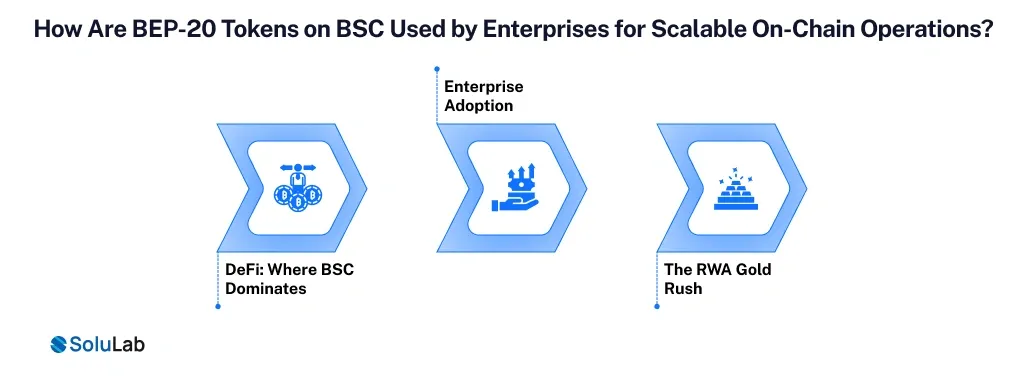
1. DeFi: Where BSC Dominates
PancakeSwap isn’t just a Uniswap clone, as it’s a $2.5B TVL behemoth that processed $772B in quarterly volume last year, and BEP-20 Tokens power the whole thing. The reason is that when you’re doing 100,000 trades per day, paying $0.20 instead of $20 per swap isn’t a nice-to-have; it’s survival.
Venus Protocol, BSC’s leading lending platform, holds $2.34B in deposits. They’re not there by accident. They chose Binance Smart Chain BEP20 Tokens because they could offer 15-second liquidations instead of Ethereum’s 2-minute finality. In a volatile market, that speed difference prevents bad debt accumulation.
2. Enterprise Adoption
Here’s what the crypto Twitter doesn’t talk about: – real companies are building on BEP-20 Tokens right now.
A major Southeast Asian e-commerce platform tokenized its loyalty points as BEP-20 Tokens. Why? They needed to process 500,000 micro-rewards daily at a cost that didn’t eat the reward value. Ethereum would have cost them $50K per day in gas, but on Binance Smart Chain (BSC), it’s $150.
For example, A supply chain company tracking pharmaceutical shipments uses BEP-20 Token on BNB Chain to automate payments when IoT sensors confirm temperature compliance. The 3-second block time means payments settle before the truck leaves the loading dock. Try that on Ethereum.
3. The RWA Gold Rush
Real-world asset tokenization is exploding, and BEP20 Token Development is leading the way with regulatory clarity. When you’re tokenizing $10M in real estate, you need to know who your validators are, and BSC’s known validator set makes auditors comfortable.
A Dubai-based property firm we advised tokenized $50M in commercial real estate as BEP-20 Tokens. They chose BSC specifically because they could implement KYC at the contract level and restrict transfers to whitelisted addresses. The European regulator who approved it cited the identifiable validator infrastructure as a key factor.
What Makes BEP-20 vs ERC-20 Faster And Cheaper For Token Launches?
Let’s talk about numbers that matter for your P&L.
The Real Cost Breakdown
We pulled data from 50 BEP20 Token Development projects launched in Q4 2025:
- Simple BEP-20 Token transfer: $0.08-$0.15, with an average of $0.11
- PancakeSwap token swap: $0.20-$0.40, with an average of $0.28
- Liquidity pool addition: $0.35-$0.60, with an average of $0.47
- Contract deployment: $50-$200, with an average of $85
- Complex DeFi interaction: $0.50-$1.20, with an average of $0.75
- Compare that to Ethereum’s current averages: $8-$25 for transfers, $15-$40+ for swaps, $500-$5,000 for deployment.
But here’s what most of the cost comparisons miss – predictability. Binance Smart Chain (BSC)’s gas price oracle keeps fees within a narrow band. In December 2025, BSC gas stayed between 5-8 gwei while Ethereum spiked from 20 to 200 gwei during an NFT mint. For a business processing 10,000 transactions daily, that’s the difference between a $1,100 daily cost and a $25,000 surprise.
Speed Metrics That Actually Matter
BEP-20 Tokens achieve finality in around 7.5 seconds. That means from the moment you send a transaction, you can be confident it’s irreversible in under 8 seconds, but for Ethereum, 2-3 minutes during normal times, up to 15 minutes during congestion.
Also, BEP20 Tokens use a rotating validator system where each validator gets a 3-second window to produce blocks, so there is no competition or MEV games, just orderly progression, and the tradeoff is usually worth it.
How do Enterprises Secure BEP-20 Tokens on BSC for Large-Scale Launches?
Now we need to talk about the elephant in the room. BEP-20 Tokens are secure, but secure in a different way than Ethereum.
1. The PoSA Tradeoff
Proof of Staked Authority means 21 validators control the network. As of January 2026, the top validator holds 1.2M BNB ($1.1B), and even the smallest holds 80K BNB ($72M). To attack the network, you’d need to compromise 11 validators.
Compare that to Ethereum’s 1M+ validators. Yes, BSC is more centralized. But here’s the business perspective: those validators are known entities. Binance, Ankr, Coinbase Cloud, CertiK, they’re not anonymous miners in Kazakhstan. They’re corporations with reputations to protect and insurance to maintain.
For enterprise BEP20 Token Development, this is actually an advantage. Your legal team can identify counterparties, and your risk assessment can name names. Try doing due diligence on an anonymous Ethereum mining pool.
2. The Audit Imperative
In 2025, Binance Smart Chain (BSC) saw 247 new token launches per day. Of those, only 12% had professional audits, but the unaudited ones suffered 34 major exploits totaling $287M in losses.
If you’re launching BEP-20 Tokens, a CertiK or PeckShield audit isn’t optional; it’s the cost of doing business. A proper audit for a standard token runs $5K-$15K. For a complex DeFi protocol, $50K-$150K. Yes, it’s expensive, but the project that skipped auditing to save $10K, they lost $4.2M in a reentrancy attack.
3. The Centralization Risk
Here’s the uncomfortable truth: Binance can theoretically pause Binance Smart Chain BEP20 Tokens transactions. They’ve never done it, but the capability exists. The governance mechanism allows for emergency stops.
For a DeFi degen, that’s anathema. For an enterprise building a supply chain payment system, that’s a feature. When their smart contract had a bug, they were able to coordinate with validators to pause and fix it before losing funds, but on Ethereum, they’d have been exploited for $10M with no recourse.
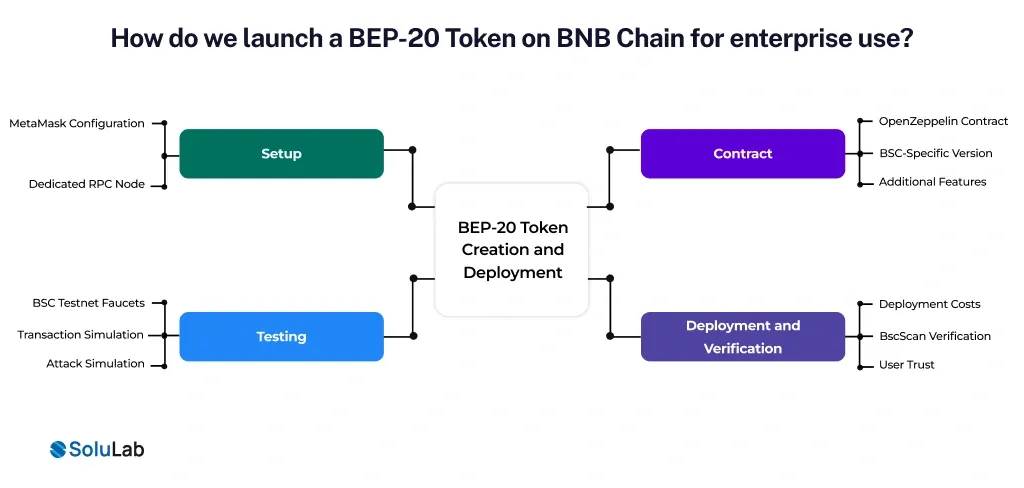
How We Launch a BEP-20 Token on BNB Chain for Enterprise Use?
Alright, let’s get practical. We are going to walk you through the actual process, not the sanitized version.
Step 1: Setup
First, you need MetaMask configured for Binance Smart Chain (BSC). Go to chainlist.org, search BSC, and add the network. But here’s the mistake I see constantly – people use the default RPC endpoints, and those get rate-limited during high traffic.
For production BEP20 Token Development, pay for a dedicated RPC node from Ankr or QuickNode. It’s $50/month and saves you from failed transactions during your launch. Failed transactions still cost gas, and during a hyped launch, you can burn $2K in failed txs with a rate-limited node.
Step 2: The Contract
Use OpenZeppelin’s BEP-20 contract. But this is critical, as we use the BSC-specific version. The standard ERC-20 contract has a getOwner() function missing, which breaks BSC tooling.
Here’s the skeleton every Token development company starts with:
| pragma solidity ^0.8.0; import “@openzeppelin/contracts/token/BEP20/BEP20.sol”; contract MyToken is BEP20 { constructor() BEP20(“MyToken”, “MTK”) { _mint(msg.sender, 1000000 * 10**decimals()); }} |
Seems simple, right, but then you need vesting, staking, governance, or liquidity locks. Each addition is a potential exploit vector.
Step 3: Testing
BSC Testnet faucets are a pain, as you need to beg for test BNB in Discord channels. But skipping this step is how you end up with a $1M mistake. So first deploy it to testnet, and run 100 transactions, simulate attacks, then do it again.
Step 4: Deployment and Verification
Deploying costs $50-$200 in real BNB and have at least 0.5 BNB in your wallet. After deployment, immediately verify the source code on BscScan. Users won’t trust unaudited, unverified contracts. It’s like a restaurant with a C health grade, technically legal, but nobody’s eating there.
What is The Safest Way to Store Binance Smart Chain BEP20 Tokens?
Your BEP-20 Tokens are only as secure as your wallet setup. We’ve seen founders lose everything because they used a hot wallet for their treasury. Here are a few we suggest to our clients –
1. Hardware Wallets
Ledger Nano X and Trezor Model T both support Binance Smart Chain BEP20 Tokens. But you need to manually add the BSC network. Use the BIP44 path m/44’/60’/0’/0/0, same as Ethereum.
For the best BEP20 wallet setup, use a multi-sig Gnosis Safe with 3 of 5 signatures. Use Hardware wallets for 3 founders, MetaMask for 2 operators. This way, no single person can drain the treasury.
2. Software Wallets
Trust Wallet is the native BEP-20 wallet and works seamlessly, whereas MetaMask is more flexible but requires manual BSC configuration. For mobile, SafePal offers hardware-level security with a software interface. BEP-20 Coinbase support is limited.
Coinbase Wallet can hold BEP-20 tokens, but you need to add BSC manually. Coinbase Exchange doesn’t support direct BEP-20 deposits; you’ll lose funds if you try. Always send to a BSC-compatible wallet first.
3. The Multi-Sig Requirement
If you’re managing more than $50K in BEP-20 Tokens, use Gnosis Safe. Period. Single-key wallets are ticking time bombs, and we’ve seen three projects lose their treasuries to phishing. Multi-sig would have prevented all of them.
Setup takes 30 minutes and costs ~$100 in gas. It’s the cheapest insurance you’ll ever buy. Configure it with 3 of 5 signatures, and make sure at least 2 keys are on hardware wallets stored in different physical locations.
What does Future Holds for BEP-20 Tokens in the the Ecosystem?
Let’s have a look at where adaptation is taking place, backed by data.
1. The Institutional Wave
2026 is the year BEP-20 Tokens go enterprise. BNB Chain’s 2026 roadmap focuses on RegFi (regulated finance). They’re introducing built-in KYC modules that let you launch a compliant BEP-20 Token without building from scratch.
A major Asian bank is piloting a trade finance system using Binance Smart Chain (BSC). They chose it specifically because they can implement regulatory requirements at the protocol level. This isn’t crypto-anarchy, this is blockchain for grown-ups.
2. The Technical Roadmap
BNB Chain is rolling out opBNB, a Layer 2 that will push TPS to 4,700 while maintaining BEP-20 Token compatibility. For BEP20 Token Development, this means you’ll soon have Ethereum-level decentralization with BSC-level costs.
They’re also introducing BEP-126, a new token standard for regulated assets. Think BEP-20 Tokens with built-in transfer restrictions and compliance hooks, which is perfect for security tokens and CBDC pilots.
3. The Competitive Pressure
Ethereum’s Layer 2s (Arbitrum, Optimism) are catching up on cost, but Binance Smart Chain BEP20 Tokens still have the ecosystem moat. PancakeSwap’s liquidity, Venus’s lending markets, and the 58M monthly active users create a network effect that’s hard to replicate.
The real threat isn’t Ethereum, it’s Solana and Avalanche. But BSC’s EVM compatibility means all the Ethereum tooling, talent, and codebases work out of the box. That’s a massive advantage that won’t disappear overnight.
Conclusion
Look, we’ve been in this space since 2014. We’ve seen chains come and go, watched projects die because they chose the wrong infrastructure, and seen $100K ideas become $100M protocols because they picked the right chain at the right time. BEP-20 Tokens aren’t perfect. They’re not as decentralized as Ethereum, or as shiny as Solana, but they work. They process millions of transactions daily at costs that make business sense. They have an ecosystem that actually has users, not just speculators.
If you’re building something real, something that needs to process payments, tokenize assets, or power a DeFi protocol, Binance Smart Chain (BSC) deserves your serious consideration. The math works. And when you’re ready to move from consideration to execution, you need partners who’ve been there before. SoluLab has guided 36+ projects through the Biannce Smart Chain Development company. We’ve seen what works, what fails, and what keeps you up at night.
So always build with something that lasts, and BEP-20 Tokens have been around since 2020 and are not going anywhere. The ecosystem keeps growing, the tooling keeps improving, and the real-world use cases keep multiplying.
FAQs
The cost to create a BEP-20 token typically ranges from $4,000 to $6,000 for a basic smart contract with standard transfer functionality. However, a production-ready BEP-20 token—including features like vesting schedules, staking, governance logic, compliance checks, and security audits—usually costs $15,000 to $50,000.
Technically yes, but it’s a headache, as bep20 coinbase support is limited. You can add BSC network manually to Coinbase Wallet, but Coinbase Exchange doesn’t support BEP-20 deposits. You’ll lose funds if you send Binance Smart Chain BEP20 Tokens directly to Coinbase Exchange.
Absolutely, as Ethereum L2s are catching up on cost, but BSC has the ecosystem moat. PancakeSwap’s $2.5B TVL, 58M monthly active users create network effects that L2s can’t match right now. Even today BEP20 Token Development remains 60-80% cheaper than Ethereum mainnet and 40% cheaper than most L2s when you factor in bridging costs.
The main security risks in BEP-20 tokens come from smart contract vulnerabilities, not the blockchain itself. Common issues include: reentrancy bugs. improper access control, faulty tokenomics logic. BSC uses a Proof-of-Staked Authority (PoSA) model, which is more centralized than Ethereum, but its validators are established entities with significant financial stakes. To reduce risks, BEP-20 tokens should always undergo professional smart contract audits before launch.
Yes, but it’s not a simple copy-paste. You need to deploy a new BEP-20 Token contract on Binance Smart Chain, then create a bridge or migration mechanism. The smart contract logic will transfer over, but you must audit for BSC-specific timing assumptions.
A basic token would take 1-2 weeks, but a production-ready token with vesting, staking, and audits would take 6-8 weeks, but the bottleneck is security reviews and tokenomics design. Rushing development increases the risk of exploits and post-launch failures, so careful planning is essential for long-term success.