Key Takeaways
- MPC wallet development services help businesses reduce single-point key risk and strengthen wallet security.
- MPC crypto wallet solutions support better governance, controlled approvals, and smoother operations.
- Both MPC vs. Multi-Sig has individual significance for enterprise decision-making.
- Choosing a reliable crypto wallet development company is crucial for scalable, secure, long-term wallet infrastructure.
Security has become a business requirement. With the rise in demand for custodians, fintech platforms, payment providers, and token-based businesses, the demand for strong wallet infrastructure to protect funds without slowing down operations has also become non-negotiable. That is why demand for MPC wallet development services is rising across the digital asset space.
Traditional wallet models often force businesses to choose between convenience and protection. A single private key creates a clear point of failure. Standard multi-signature models improve control, but they can still introduce operational friction, complicated recovery paths, and visible on-chain approval structures. Multi-party computation wallet development changes that equation by splitting the signing authority across multiple parties without exposing the full private key at any stage.
For companies managing treasury, client assets, partner payouts, or internal approvals, MPC offers a more practical path to secure wallet architecture. This guide explores what the MPC wallet is and how businesses can benefit from it.
Deciphering The MPC Wallet
An MPC wallet is a digital wallet that utilizes cryptographic computation to authorize transactions without requiring the full private key to be stored in a single location. Instead of storing one complete key, the wallet distributes key shares across multiple parties, devices, or systems. Those parties jointly sign a transaction through secure computation.
This architecture reduces the risk tied to device compromise, insider misuse, or operational mistakes. It also helps businesses enforce approval rules without exposing sensitive signing material.
For companies handling large-value crypto activity, this matters because wallet security must work at both the cryptographic layer and the operational layer. A secure crypto wallet must have access policies, auditability, role separation, and secure transaction workflows.
Understanding How MPC Wallet Works?
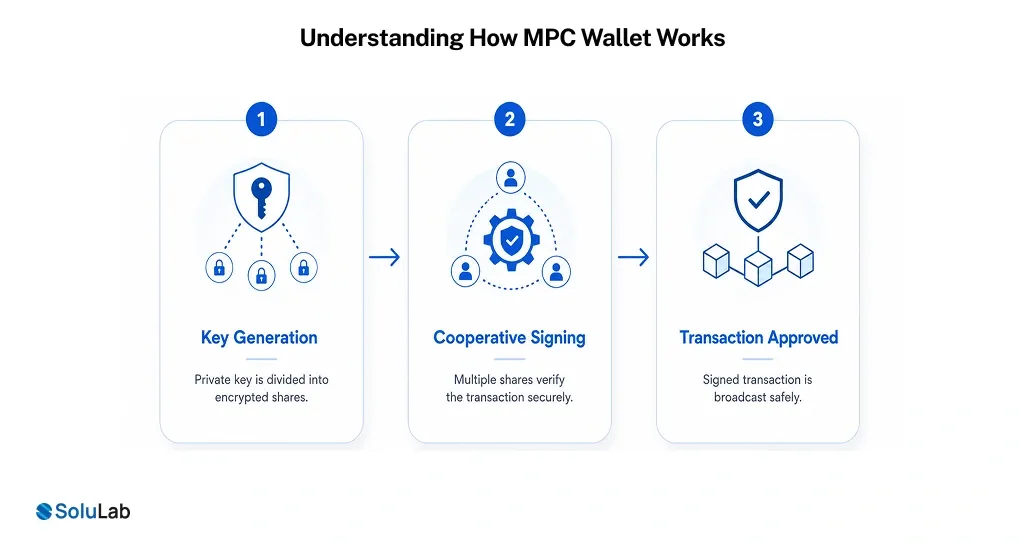
MPC, or multi-party computation, allows multiple independent parties to compute a result together while keeping their private inputs hidden. In wallet infrastructure, those private inputs are key shares. No single participant holds the entire private key. When a transaction needs approval, the signing process happens collaboratively. This means:
- A single stolen device does not expose the full signing key
- One employee cannot move funds alone without policy approval
- Businesses can distribute trust across teams, systems, or geographies
- Sensitive signing material stays fragmented throughout the process
The working of MPC wallet is cryptographic and operational. The cryptographic process protects the key. The operational design controls who can approve what, when, and under which conditions.

Why This Model Is Stronger for Business Use?
For enterprises, the value of MPC is not only about preventing hacks. It is also about reducing internal risk and improving wallet governance.
An MPC wallet can support:
- Role-based transaction approvals: Only the users with the right roles and permissions can approve these transactions.
- Department-level controls: They allow management to have wallet access and actions separately for different departments in an organization.
- Treasury workflows: They allow for moving the funds through structured approval and review steps designed for treasury operations.
- Time-based restrictions: These restrictions allow limits on certain wallet actions for specific time windows or business hours.
- Policy-driven transaction signing: Transactions are signed only when predefined business and security rules are met.
- Secure backup and recovery mechanisms: Wallet access can be safely restored through protected recovery methods if a device, share, or access point is lost.
Why Businesses Are Moving Toward MPC Crypto Wallet Solutions?
The shift toward MPC crypto wallet solutions is being driven by a mix of security, usability, and compliance needs.
- Better Security Without a Single Point of Failure
A traditional wallet depends too heavily on one secret. If that secret is stolen, leaked, or mishandled, the loss can be immediate. MPC removes that concentration of risk. This is one of the biggest benefits of MPC wallets for enterprise use.
- Stronger Internal Controls
Businesses need more than technical security. They need governance. MPC supports distributed approvals and controlled access without creating overly rigid workflows. That makes it suitable for treasury teams, custodial products, trading desks, fintech apps, and institutional platforms.
- Cleaner User Experience
Many organizations compare MPC and multi-signature (multi-sig) wallets because both improve control. However, MPC often creates a smoother signing flow. It does not always require the same visible, on-chain coordination that multi-sig setups do. This can reduce complexity for both admins and end users.
MPC vs. Multi-Sig: What Is the Difference?
The comparison between MPC vs. Multi-Sig comes up in nearly every wallet discussion. A multi-signature wallet requires multiple private keys to approve a transaction. This improves security compared to a single-key wallet, but it still depends on managing separate full keys. It can also create visible on-chain approval logic and add coordination overhead.

How MPC is Different from Multi-Signature Wallet?
MPC does not distribute full keys. It distributes cryptographic shares of a signing secret. Those shares are used collaboratively without reconstructing the complete private key. When evaluating MPC vs. Multi-Sig, businesses often look at:
- Security model: MPC reduces single-point key exposure, while multi-sig depends on managing multiple full keys securely.
- User experience: MPC often delivers a smoother approval flow with less visible signing complexity for users.
- Transaction policy design: MPC supports more flexible and layered approval rules based on business requirements.
- Recovery flexibility: MPC can offer more adaptable recovery options without relying on one complete key backup.
- Operational efficiency: MPC can simplify transaction execution and reduce coordination friction across teams.
- Suitability for enterprise-scale workflows: MPC is often better suited for large organizations that need secure, scalable, policy-based wallet operations.
For many modern platforms, enterprise MPC wallet solutions offer a stronger balance between control and usability. But that does not mean multi-sig has no place. It can still work for simpler governance setups. But businesses building institutional-grade crypto wallet infrastructure often find MPC more adaptable.
How to Use MPC Wallet in a Business Setting?
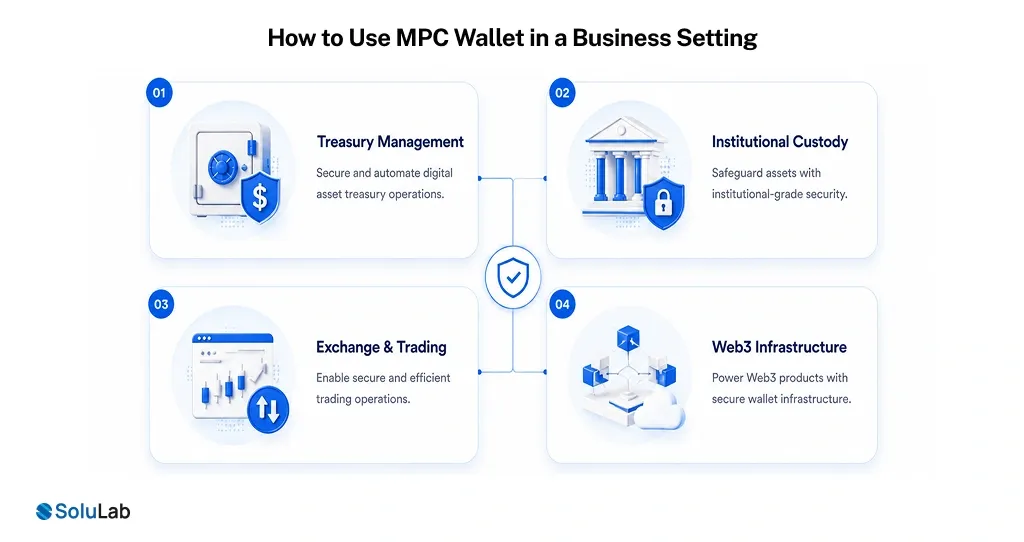
A business can use MPC wallets for several functions:
- Treasury Management
Finance and operations teams can use MPC wallets to manage reserves, vendor settlements, and internal transfers with approval logic.
- Institutional Custody
Crypto wallet platforms offering asset custody can use MPC to reduce key exposure while supporting secure transaction authorization.
- Exchange and Trading Operations
Trading platforms can use MPC wallets for hot wallet control, withdrawal approvals, and segmented access across teams.
- Web3 Product Infrastructure
Projects launching token products, gaming ecosystems, or DeFi-connected platforms can use MPC to secure backend wallet operations without depending on a single signing environment.
In each case, the business goal is the same: build a secure MPC wallet for business operations without creating friction that slows growth.
Cost to Develop MPC Wallet: What Shapes the Budget?
The cost to develop MPC wallet infrastructure depends on scope, risk level, and product depth. A simple wallet integration will cost far less than a full enterprise-grade platform with governance, recovery, analytics, and multi-chain support. Key drives include:
Product Scope
A basic wallet with send, receive, and approval functions is one level of effort. A smart crypto wallet platform with admin dashboards, workflow logic, notifications, compliance checkpoints, and API layers is another.
Blockchain Support
Supporting one blockchain is simpler than building for multiple networks with different transaction standards.
Security Requirements
Advanced authentication, policy engines, HSM integration, monitoring, and incident response features increase development effort.
User Roles and Workflow Logic
The more complex the approval chain, the more planning and engineering are required.
Integration Depth
A wallet that must connect with exchanges, custody layers, internal ledgers, or reporting systems will require more backend architecture.
This is why businesses often choose to hire MPC wallet developers with proven security and crypto infrastructure experience rather than relying on general app teams.
How To Choose the Right MPC Wallet Development Company?
The market includes many firms claiming blockchain capability, but not every team can deliver a secure wallet architecture.
A reliable crypto wallet development company should demonstrate:
- Experience with wallet security models
- Strong backend engineering capability
- Understanding of cryptographic signing flows
- Ability to build for scale and auditability
- Practical knowledge of enterprise transaction controls
- Clear delivery process from discovery to deployment
The right partner should be able to explain how an MPC wallet works in business terms, not only in technical language. Decision-makers need to know how the wallet will reduce risk, support approvals, and fit into product operations.
Conclusion
MPC wallet adoption is not only about stronger security. It reflects a larger shift in how businesses treat digital assets. Wallet infrastructure now affects customer trust, platform resilience, operational continuity, and commercial readiness.
The most successful crypto products are not built on feature count alone. They are built on systems that can scale safely. That is why Multi-party computation wallet development is becoming part of long-term product strategy for companies serious about digital asset operations.
For businesses entering crypto, upgrading legacy wallet systems, or launching institutional products, MPC offers a more resilient foundation. It supports control without overcomplicating execution. It strengthens security without returning to a single-point risk. And it gives teams a better framework for managing digital value in a commercial environment.
Partner With SoluLab for Smarter Online Payment Infrastructure!
Ready to strengthen online payment capabilities with a more secure and reliable foundation? Partner with SoluLab and get access to a team that understands how to build MPC wallet solutions focused on payment security, operational efficiency, and user trust.
We help organizations solve critical challenges around digital payments, transaction safety, and usability without adding unnecessary complexity. For businesses looking to make a meaningful impact in the digital payments space, this is the right time to start the conversation.
FAQs
Shipra Garg is a tech-focused content strategist and copywriter specializing in Web3, blockchain, and artificial intelligence. She has worked with startups and enterprise teams to craft high-conversion content that bridges deep tech with business impact. Her work translates complex innovations into clear, credible, and engaging narratives that drive growth and build trust in emerging tech markets.