As AI spending is set to hit $2.5 trillion in 2026, up sharply year-on-year, organizations worldwide are integrating AI across business functions to stay competitive.
According to recent data, 78 % of companies already use AI in at least one function, and executives rank AI integration as a top strategic priority for growth. Businesses that fail to automate workflows and adopt AI-driven systems risk falling behind or losing market share entirely.
This blog explores the top 10 AI trends in 2026 and beyond, offering practical insights for leaders who want to harness AI’s power for efficiency, innovation, and sustained business growth.
Key Takeaways
- AI is changing towards supporting technologies for autonomous systems.
- Workflow redesign and new business models will be the largest AI value.
- The governance, security, and compliance of AI will turn into a mandatory requirement.
- The collaboration between humans and AI will be essential, creating the need to seek AI-literate teams.
Top 10 AI Trends in 2026 for Businesses
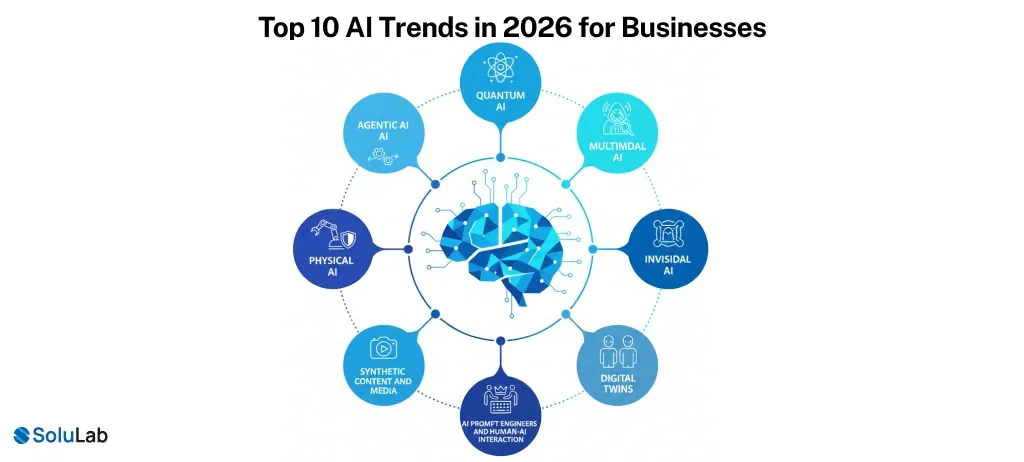
Below, we’ve shared the top 10 latest AI trends, including use cases and real-world examples.
1. Agentic AI
The concept of agentic AI is autonomous AI systems capable of planning, reasoning, acting, and achieving goals with little to no human intervention, not merely producing outputs.
Read Also: 5 Best Agentic AI Frameworks for 2026
These systems are further than the traditional generative AI (such as chatbots or copilots) as they are capable of making decisions and performing multi-step processes rather than merely responding to requests. The agentic AI is a combination of reasoning, memory, planning, and AI tool usage, which allows it to adjust and choose how to accomplish tasks according to the aims.
Key Business Use Cases:
The real use of agentic AI ways companies are using to drive value are as follows:
- Customer Support Automation: AI robots answer questions and sort support tickets in channels (chat, email, voice) with less human interference.
- Supply Chain Optimization: Real-time rerouting of inventory, demand forecasting, and real-time logistics optimization.
- Compliance Agents, Finance: AI checks compliance (checks compliance), detects fraud risks, uses AI to forecast cash flows, and recommends model changes.
Major forecasts of 2026 (According to Deloitte)
Extensive Proliferation: Organizations that deploy agentic AI pilot programs or demonstrations of concept should also increase as enterprises leave the experimental phase behind.
Multi-agent Systems: Businesses will integrate AI agents that will organize, plan, and execute work jointly to address the complex workflow.
Governance: Reviewing the growth of autonomy, firms will have to implement controls, ethics laws, and accountability systems to control agent work responsibly.
According to research by Deloitte, the agentic adoption increases, but the strong models of governance remain essential in many organisations.
2. Physical AI
Physical AI refers to artificial intelligence systems that sense, understand, and act within the physical world, not just in software or digital settings. Physical AI usually has sensors (cameras, lidar, touch, voice), AI brains (ML models, computer vision, reinforcement learning), and real-time decision-making.
Read Also: Physical AI: Role of AI Development and Integration
Examples:
– Robots that walk autonomously through the warehouse and optimize logistics.
– Surgical robots that are AI-controlled and respond to variables in real time.
– AI-based farms or inspection drones that scan the crops and infrastructure.
Key Industry Use Cases:
- Manufacturing Automation: Physical AI Robots are used to do adaptive work, such as vision-based quality control, high-precision assembly, and adaptive material handling. These systems are capable of reacting to variations in production and lowering defects and downtimes.
- Healthcare Robotics: Robots that are enhanced by AI are useful in hospital logistics, autonomous supply delivery, and patient-centric care. Robots in surgery and smart exoskeletons have better precision and responsiveness.
- Smart Logistics: The autonomous mobile robots and drones streamline the operations, routing, and movement of the warehouse, adjusting to changing circumstances.
3. Sovereign AI
Sovereign AI Systems and infrastructures that are run under the control and jurisdiction of a particular country, region, or organization can be described as sovereign AI. This is aimed at maintaining data, models, and compute resources that are either locally or enterprise-owned to comply with legal, security, and strategic demands.
Industries Most Impacted
- Government: AI systems are becoming more and more demanded by governments of countries because of the necessity to meet the legal regulations of the country and to keep the data of the citizens within the borders of the country. Sovereign AI gives governments an opportunity to utilize AI for government services to deliver without foreign control.
- Healthcare: Sovereign AI benefits hospitals and medical networks because it stores patient data and predictive models on local infrastructure, which promotes privacy, trust, and adherence to highly sensitive health regulations.
- Banking: Banks exist in highly controlled conditions, and the data protection of customers and their residency, as well as risk models, must follow strict regulations. Sovereign AI assists banks in maintaining control andcomplyingy with expectations.
Regional Artificial Intelligence Ecosystems: (Middle East, EU)
- European Union (EU): The EU is pushing towards more data and AI sovereignty to meet the EU AI Act and gain control over AI infrastructure. Lots of companies within such industries as banking and state services are already strategizing over investing in sovereign solutions.
- Middle East: Countries in the Middle East are investing heavily in sovereign AI capacity and governance frameworks, seeing it as a competitive advantage that builds trust, reduces reliance on external providers, and supports national digital transformation goals.

4. Synthetic Content and Media
Synthetic AI content is information like text, images, audio, and video content created, generated, or changed by artificial intelligence as opposed to being recorded or produced in a conventional way by humans. Large-language models, generative adversarial networks (GANs), and diffusion models are AI models that facilitate this automated generation on scale.
Use Cases
- Advertisements and Social Networks: This allows Brands to create marketing videos, custom messages, or innovative images in AI-generated advertisements without the need to spend money on production.
- Gaming & Entertainment: Synthetic media, which is used in entertainment, is used to achieve effects such as de-aging actors or making virtual characters. As an illustration, the film production industry has employed AI to use automated transformations of the appearance of actors to tell stories.
5. AI Prompt Engineers and Human-AI Interaction
Prompt engineering is a method that requires designing well-defined, systematic inputs to direct AI models to generate precise, relevant, and context-dependent outputs. It can assist a business in achieving a uniform output with AI systems in performing activities such as content creation, analysis, and automation.
Why is Prompt Engineering a Fundamental AI skill in 2026?
- Core Role: The process of designing accurate instructions (prompts) in such a way that generative AI systems can generate accurate, relevant, and controlled outputs.
- Salary & Demand: Experienced immediate engineers are now priced at a high wage rate over non-AI jobs, and roles usually pay more because of the influence on quality and ROI of AI.
- Accuracy & Quality: Prompts that are well-engineered decrease the incidence of hallucination and errors, such that the products of the AI can be acted upon and made business-ready rather than being ambiguous and deceptive.
- Ethics & Governance: Explicit guidelines reduce bias and enhance compliance- training AI to generate unsuitable or malicious output is essential to controlled sectors.
6. Multimodal AI
Multimodal models refer to artificial intelligence systems designed to process and understand multiple types of data simultaneously, such as text, images, video, and audio.
These systems integrate diverse data modalities into a unified model to interpret context and generate richer outputs that mimic human perception more closely than single-modality models.
Use Cases by Industry
- Healthcare Diagnostics: Improves clinical diagnosis by analyzing medical imaging (X-rays, MRIs) in conjunction with electronic health records and physician notes.
- Security & Surveillance: Enhances safety systems by combining multiple inputs such as video feeds, audio sensors, and behavioral metadata to identify anomalies or threats more accurately than single-modality approaches.
- Marketing Analytics: Helps marketers analyze customer engagement across formats, for example, combining video content performance, social media text reactions, and audio sentiment to generate deeper insights into audience behavior.
7. Invisible AI
Invisible AI is a type of artificial intelligence that does not present itself to the end user, but rather works so deeply ingrained into software and infrastructure that it is not perceived as an individual feature. These AI systems are not visible interfaces to users (such as chatbots), but they optimize, predict, and automate without any particular interaction.
Key AI applications:
1. Smart Cities: Traffic control systems, which change the light patterns on-the-fly to reduce traffic jams and increase the traffic flow. Smart devices, also known as urban sensors, detect the environment and control the use of a resource, such as water or electricity, automatically.
2. Voice Assistants: Virtual assistants built into an appliance can schedule meetings, reminders, and perform more routine tasks that do not require a special request.
3. Energy Optimization: AI systems in homes and industries that optimize the heating, cooling, and lighting according to real-time use and occupancy.
8. Shadow AI
Shadow AI is a type of application that is developed by the use of artificial intelligence applications to which IT or security teams have not officially approved or supervised. This frequently involves employees utilizing public generative AI or other AI applications to get tasks achieved quicker, yet not within a set-up governance system.
This is important since the use of AI without the permission of the organization is associated with the risks of data breach, non-compliance with regulations, exposure of the intellectual property, and fragmented data governance, and in many cases, the organization is not even aware of that.
Use Cases
- Informal content generation: Employees use unapproved enterprise tools to write internal reports or marketing copy using public chatbots, which could result in confidential information leaving the organisation.
- Ad-hoc analytics: Analytics teams apply AI analytics tools to datasets without security verification, resulting in inconsistent results or lapses in compliance.
- Automated task support: Employees use AI browser extensions or APIs to automate mundane work, such as scheduling or summarizing, without supervision to improve productivity, but circumvent controls and audits.
9. Quantum AI
Quantum AI defines quantum computing alongside artificial intelligence, in which quantum systems assist in performing or speeding up AI computations that are extremely difficult or impractical on classical computers.
The significance of this trend is that quantum-accelerated AI can help radically improve the performance of optimization, simulation, and machine learning on complex, data-intensive problems, which provides a strategic benefit to businesses in the fields of research, logistics, finance, and others.
Use Cases
- Optimization Problems: Quantum-enhanced AI models are more efficient in solving optimization problems than the classical approach: logistics, supply chain routing, and portfolio optimization.
- Molecular Simulation: Quantum-powered AI has the potential to be used to speed up the process of discovery in drug design and materials science by simulating complex molecular structures at speeds that are an order of magnitude faster than classical algorithms.
- Quantum Machine Learning: Hybrid quantum algorithms combined with classical AI: Hybrid models can significantly accelerate the training of machine learning models with pattern recognition computationally expensive.
10. Digital Twins
A Digital Twin is a virtual representation of a real-life object, system, process, or even whole organisation that replicates and recreates real-life behaviour and performance with real-time data.
To businesses, digital twins are important in the sense that they allow making predictions, testing things, making operations more efficient, and managing risks without disrupting actual operations, significantly improving decision-making and saving expensive trial-and-error modifications.
Use Cases
- Manufacturing optimization: Digital twins allow companies to simulate production lines and equipment performance to reduce downtime, improve efficiency, and lower operational costs.
- Process optimization in enterprises: Virtual replicas of business processes (Digital Twins of Organizations) let leaders simulate workflow changes before real implementation, enhancing outcomes and reducing risk.
- Predictive maintenance: Digital twins fed by IoT sensors can forecast equipment failures and recommend proactive maintenance, saving downtime and extending asset life.
How Businesses Can Prepare for AI in 2026?
With AI adoption increasing exponentially in 2026, companies will no longer need to experiment but rather be organized in their approach. With a focus on infrastructure, alliances, and scalable strategies of implementation.
1. Invest in AI-enabled systems: Establish an effective database, containing clean, controlled data, scalable cloud services, anda safe API to enhance AI models, automation processes, and instantaneous choices across staff.
2. Collaborate with Artificial Intelligence Development Firms: Working with established AI development Companies can get specialized talent, less risk of implementation, quicker delivery, and ensure that the solutions are industry-conformant and meet compliance requirements.
3. Start with POCs: Start by initiating targeted AI proof-of-concept projects to confirm that it works and returns sufficient ROI, and slowly roll out successful AI projects in departments to reduce risk and maximize business impact over the long term.

Conclusion
Agents AI, multimodal systems, digital twins, and AI-oriented governance are emerging trends that are changing the way organizations operate, compete, and scale.
Companies that make early investments in the appropriate skills, infrastructure, and implementation strategies would be in a better position to adjust to the fast changes in the market and expectations of their customers.
The main point is not to follow all the trends, but to match AI implementation with actual business results. SoluLab is an AI development company that assists businesses in automating the workflow, creating AI solutions that are scalable, and remaining competitive by transforming the latest AI trends into actionable and results-oriented applications. Book a free discovery call today!
FAQs
Rather than just automating tasks, AI will become autonomous in its decision-making, allowing organizations to operate more quickly, wiser, and with new business models, such as in healthcare, finance, manufacturing, etc.
AI-driven automation, predictive analytics, and real-time decision support will have the greatest effect on healthcare, BFSI, manufacturing, retail, logistics, and SaaS.
AI will allow early diagnosis of diseases, individual care plans, predictive patient care, and better hospital services, resulting in better outcomes at a lower cost.
SoluLab assists companies with AI development services to implement the trends of AI into practical and revenue-generating solutions, not into experiments. Through agentic AI, multimodal AI, and automation, SoluLab develops scalable systems that enhance efficiency, decision-making processes, and customer experience.
The integration of AI with IoT, blockchain, and AR offers intelligent, secure, and immersive systems that enable businesses to be more innovative and achieve cost reduction and completely new approaches to digital business.