Talk to an Expert

Tokenizing TradFi: Real-World Assets & Smart Bonds

Tokenizing TradFi Real-World Assets

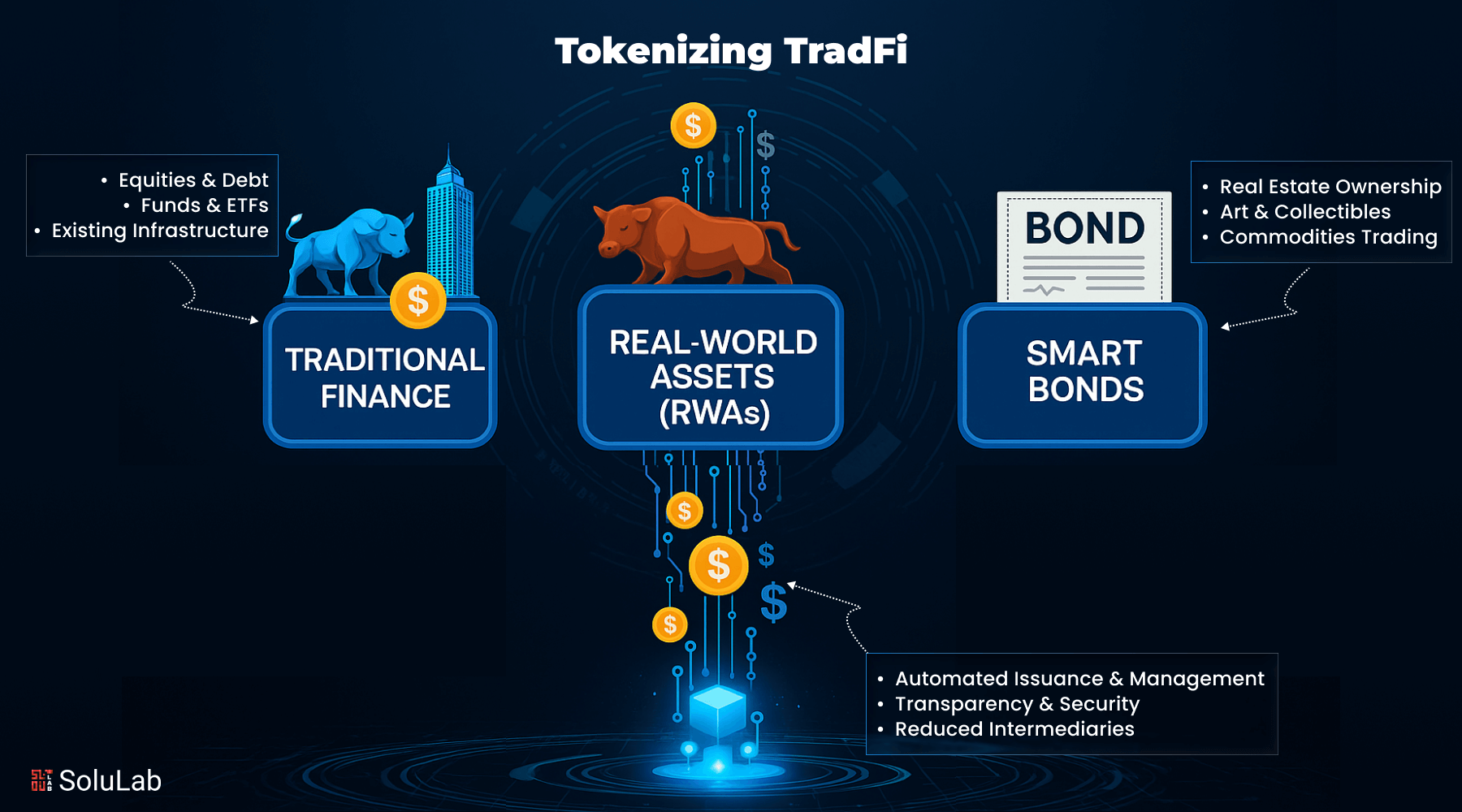
Have you ever thought that buying a piece of real estate or a government bond is as easy as a digital token? Maybe you should experience it now. The development of tokenized real-world assets and smart bonds is transforming the global financial system. Tokenization aims to bridge traditional finance (TradFi) and decentralized finance (DeFi).

Real estate, bonds, and private equity are now getting digitized into tokens. Isn’t it amusing and simple? This move’s main focus is quick transactions, transparency, and broader access. This blog provides information on the tokenization process and its impact on the real world. 

How DeFi and TradFi Support Each Other?

DeFi and TradFi bring unique strengths to the financial world. When combined, they create a powerful system that is faster, safer, and more open. DeFi uses smart contracts and blockchain to cut out middlemen, while TradFi offers regulation, investor trust, and global financial backing.

  • DeFi Strengths: Trustless, Transparent, 24/7

DeFi runs on blockchain protocols. It works without banks or brokers, offering global access around the clock. Users can track transactions in real-time, making the system fully transparent and auditable. Anyone with an internet connection can join.

  • TradFi Strengths: Regulation, Capital, Reach

Traditional finance brings regulation, stability, and deep capital pools. It protects users through laws, KYC checks, and trusted financial systems. Over 75% of people worldwide already rely on banks, giving TradFi unmatched reach and credibility.

  • Convergence Over Conflict: The Combinational Future

The future is not about DeFi replacing TradFi. It’s about working together. Hybrid models will power secure, fast, and accessible financial systems for everyone, combining DeFi innovation with TradFi reliability.

The Rise of Hybrid Finance and Tokenized RWAs

Hybrid finance uses blockchain to upgrade how financial institutions work. Tokenized real-world assets (RWAs) are leading this change, making assets more accessible and programmable.

1. How Tokenized Assets Bridge DeFi and TradFi?

Tokenized RWAs bring the speed of DeFi and the safety of TradFi into one system. They automate KYC, allow fractional ownership, and use smart contracts for real-time transactions.

2. Key Examples: Bonds, PE, Real Estate, Stablecoins

Let’s check out how tokenized RWAs are enhancing bonds, private equity, real estate, and stablecoins. 

  • Banks tokenize bonds for faster settlement and programmable interest payments.
  • Private equity firms automate cap tables and dividend flows using smart contracts.
  • Real estate developers sell property shares globally through fractional tokens.
  • Stablecoins help settle transactions instantly across borders.

3. Regulatory Catalysts Like MiCA Driving Change

The European MiCA regulation sets clear rules for digital assets. It boosts trust in tokenization. More countries are now creating similar legal frameworks to support this shift.
CTA1

Core Use Cases of Real-World Asset Tokenization

Tokenizing real-world assets helps many sectors. It improves access, efficiency, and transparency across various investment classes.

  • Real Estate and Private Equity

Property and fund shares can now be divided into tokens. This opens access for small investors and increases market liquidity.

  • Fixed-Income Instruments and Alternative Assets

Banks issue tokenized bonds that settle instantly. Even rare assets like art, wine, and music rights are entering the token market.

  • Stablecoins Powering Cross-Border Settlement

Stablecoins are known for being simple and quick global payment assets. These help in trade settlements across borders with their well-built-in compliance. 

Read Also: RWA-backed Stablecoins

The Tokenization Process: From Asset to Blockchain
Tokenization Process From Asset to Blockchain

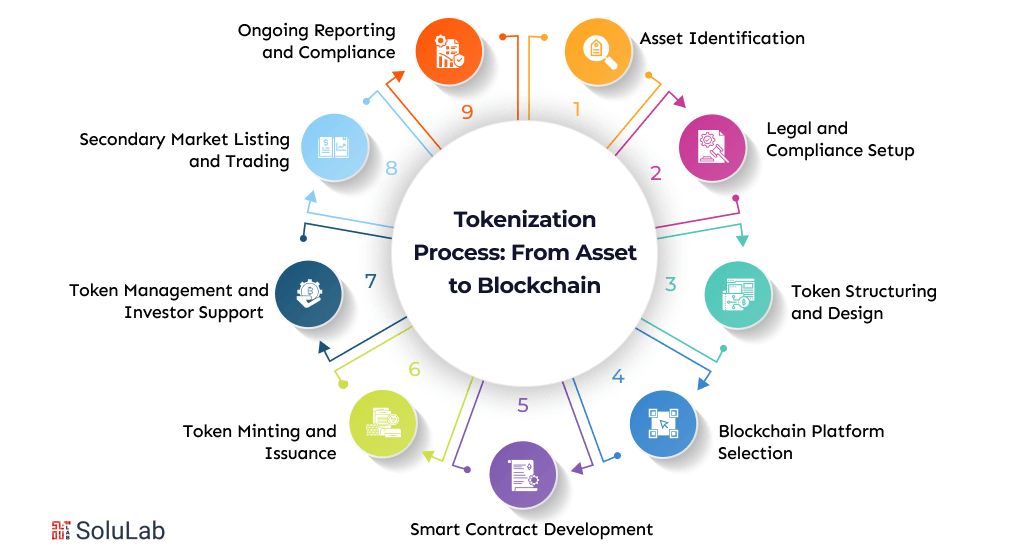
Tokenizing a real-world asset is not a one-step task. It requires a secure, structured approach that balances blockchain benefits with real-world rules. Each stage ensures the asset is legally sound, technically secure, and ready for digital trading. 

Here’s a simple breakdown of the full process:

1. Asset Identification

The process begins by identifying the asset. It could be real estate, artwork, a bond, or intellectual property. Owners must confirm legal title, clear any disputes, and validate the asset’s value through expert appraisal. Without proper identification, tokenization can’t move forward.

2. Legal and Compliance Setup 

Once the asset is verified, legal compliance comes next. This step ensures the tokenization process follows local laws, including KYC (Know Your Customer), AML (Anti-Money Laundering), and securities regulations. Legal experts help structure the token according to investor rights and jurisdiction-specific rules.

3. Token Structuring and Design

In this stage, developers decide how the token will function. They define the type, whether equity, debt, or utility, and set the total supply. Each token may represent a fraction of ownership or a debt claim. The team also defines rules for transfers, dividends, or voting rights.

4. Blockchain Platform Selection 

Not every blockchain fits every asset. The team chooses a platform like Ethereum, Polygon, or a private chain. The selection depends on asset size, transaction needs, security requirements, and gas fees. The right platform ensures scalability and smooth token operations.

5. Smart Contract Development 

Smart contracts automate the asset’s behavior. They enforce ownership, track transfers, distribute payouts, and execute rules without human intervention. Developers write and test these contracts carefully to match legal terms and prevent bugs or breaches.

6. Token Minting and Issuance 

After development, the digital tokens are created or minted, on the selected blockchain. Tokens are distributed to investors or asset owners, either through a public offering or private placement. This step marks the official entry of the asset into the digital space.

Read Also: RWA Tokenization In Traditional Banking

7. Token Management and Investor Support 

Token ownership needs ongoing oversight. Platforms or service providers help manage token records, update investors, and offer dashboards for tracking value or receiving returns. They also support audits and ensure reporting stays transparent.

8. Secondary Market Listing and Trading 

Once the token is live, it can be listed on approved exchanges or digital marketplaces. This enables buyers and sellers to trade freely, bringing much-needed liquidity to assets that were once hard to move. Compliance controls remain in place during trading.

9. Ongoing Reporting and Compliance 

Even after launch, reporting continues. Asset issuers must provide regular updates, track performance, and maintain full legal compliance. All activities, payouts, transfers, and audits are logged on-chain, offering unmatched transparency to both investors and regulators.

Positive Impact of Asset Tokenization

Tokenized assets bring powerful benefits to investors, asset owners, and markets. This technology is changing how financial systems work.

  • Retail investors could gain access to VIP markets without large capital funding or middleman involvement. 
  • Fractional ownership over the assets boosts liquidity. This allows easy buying and selling of assets. 
  • Also each an every transaction is noted on-chain and maintains the database. This gives regulators and auditors complete authority.  
  • Smart contracts cut costs by automating compliance, reporting, and dividend payouts.
  • New industries like energy, IP, and carbon credits use tokenization to streamline funding and ownership.

Read More: Asset Tokenization Regulations for Australia

The Future of Tokenized Real World Assets

Tokenized real-world assets are moving beyond pilot tests. This trend is building a new financial foundation across the globe. Central banks are testing CBDCs to improve settlements. Artificial Intelligence is now used for risk scoring and asset pricing. RWA ETFs and index tokens are making diversified portfolios more accessible to all. Governments and banks are joining the tokenization movement. They are creating legal standards and scaling platforms to manage large assets efficiently.
CTA2

Conclusion

Tokenization is changing how the world sees and trades real assets. It unlocks access, boosts liquidity, and brings trust through blockchain. At SoluLab, a top asset tokenization development company, we help businesses turn real estate, gold, and company shares into digital tokens. Our team studies your goals and builds the right token structure and technology to match.

Whether it’s improving transparency or reaching global investors, we ensure your assets are future-ready. With our end-to-end asset tokenization services, you gain more control, more value, and more opportunity. 

Contact SoluLab today to explore how digital tokens can reshape your financial future.

FAQs

1. What are tokenized real-world assets (RWAs)? 

Tokenized RWAs are digital versions of physical assets like real estate or bonds. These tokens represent ownership and can be traded easily on blockchain platforms.

2. How do DeFi and TradFi work together in asset tokenization?

DeFi brings speed and automation, while TradFi adds trust and regulation. Together, they create a balanced system that is secure, efficient, and accessible for all kinds of investors.

3. What types of assets can be tokenized today? 

Real estate, private equity, bonds, art, and even music rights can be tokenized. Anything valuable in the real world can become a digital asset with blockchain technology.

4. Why is tokenization considered a game-changer for retail investors?

Tokenization lowers entry barriers. Small investors can now buy fractional shares in premium assets that were once accessible only to high-net-worth individuals or institutions.

5. Can tokenized assets be insured or used for loans like traditional ones? 

Yes, tokenized assets are gaining recognition. Many platforms now support insurance and collateralization, allowing these tokens to function similarly to traditional assets in lending and risk management.

 

How to Launch Your RWA Tokenization in 7 Days With SoluLab?

How to Launch Your RWA Tokenization

The market value of within the chain RWAs has increased by over $12 billion, according to a recent binance research analysis. The tokenized assets market might soar to an incredible $16 trillion by 2030. Real-world asset tokens have been accumulating momentum over the last few months, indicating a significant change in market attitude.

Want to start with RWA tokenization? It is not as difficult as it sounds, SoluLab is an expert in simplifying the process. Among others, SoluLab can arrange things such as that you could maybe start your real-world assets tokenization project in only 7 days, that too successfully. This article will cover all the necessary details about what is RWA tokenization, why is it beneficial, how to launch RWA tokenization with SoluLab within 7 days, and what the major issues that need to be addressed properly.

What is RWA Tokenization?

Tokenized Real-World Assets are digital tokens based on blockchain technology that stand in for conventional and tangible financial assets like cash, commodities, stocks, loans, artwork, and property rights. The ability to access, trade, and manage RWAs has altered significantly with their tokenization.  RWA tokenization is still in its early days, it is expanding outside the realms of bonds, stocks, and real estate. Other businesses including playing games, power, collectibles, and could be more affected.

With the introduction of Tether (USDT) in 2014, stablecoins that are supported by monetary currencies are among the first types of RWAs. The US-dollar-denominated Tether cryptocurrency, which is intended to constantly value at $1, opened the door for the development of the stablecoin market which is now worth over $150 billion

The tokenization of real-world assets comprises a certain procedure. Here is the breakdown of ways to help you better understand how to tokenize a real-world asset:

1. Selecting the actual RWA tokens that need to be tokenized in the real world.

2. Establishing the kind of token be it fungible or non-fungible, and the type of token standard to be applied such as ERC20 or ERC721 with other essential details of the token. 

3. Selecting an open or personal tokenization blockchain system to issue the tokens. The tokenized RWA can be accessed on any blockchain by integrating CCIP.

4. The majority of tokenized assets need exceptional off-chain data from dependable and safe Chainlink oracles. To provide user transparency, the assets supporting RWA tokens must be verified by a verification service. 

Why Should You Tokenize?

This tokenization of assets provides a response based on efficiency and accessibility. Fractional ownership is made possible by the tokenization of assets, allowing investors to buy tiny interests in valuable assets. This makes investing within real-world assets crypto opportunities that would reach for the typical investor. Furthermore transactions using blockchain technology will be quick, transparent, and safe without the usual paperwork and bureaucracy involved in asset trading.

With the utilization of chainlink CCIP’s cross-chain capabilities in the blockchain ecosystem, tokenized assets enhance market liquidity for assets that are often illiquid by providing globally accessible liquidity conditions. Furthermore, by providing a more precise evaluation of leverage and risks across the system, the on-chain representation of such assets guarantees transparency and makes auditable asset management easier. These major reasons contribute to the reduction of systematic risks. Also by having access to applications that are blockchain-based, RWAs increase the possible user base for a variety of asset types. 

Asset Tokenization Solutions

How To Start With SoluLab?

When it comes to the fast-moving world of banking, speed does matter. We’ve mastered the art of initiating RWA tokenization initiatives and how to launch RWA tokenization within 7 days here at Solulab:

Day 1: Identifying Assets and Objectives

Establishing your objectives and deciding which assets to tokenize is the first and foremost important stage in starting the RWA tokenization project. This includes deciding on the kind of assets you will have, the token structure, and your long-term goals. 

1. Determine Which Asset Should Be Tokenized

The first step that would define the whole tokenization process is the RWA tokenization is the selection of the target asset. The following assets are perfect for tokenization.

  • Home and office, or any type of property.
  • Silver and gold that come under precious metals.
  • Art (statues, pictures, and so forth).
  • Commodities, these unit exports often include gas, oil, or other such tradeable items, it is perhaps better suited to simply list the ten countries with the highest exports of such units.
  • Involvement in private business, or other forms of monetary investment

Check the documentation of ownership history to be certain that your asset is not encumbered and that is well documented. In certain situations, a proper appraisal may be necessary to ascertain the present market value of the said asset.

 2. Specify Your Goals

It is essential to set your broad goals before going deep into the tokenization procedure. Are you trying to try to take a ‘portion sale’ of your asset ownership to get money? Some of the questions that can help you choose the best tokenization strategy are; Are you trying to make your asset more liquid and attract more investors?

3. Legal and Regulatory Considerations

There are several tendencies concerning the tokenization of RWA through current legal and regulatory regimes depending on the type of the asset and the jurisdiction. Ideally, you should contact lawyers specializing in securities and blockchain on the very first day. It is, therefore, important to be able to follow rules like securities laws and anti-money laundering rules. 

Read Blog: RWA Tokenization in Investment

Day 2: Choosing the Right Tokenization Protocol

Once you know what asset to tokenize and what you want to achieve, the next thing is to choose an appropriate blockchain platform for your tokenization. The many different forms of tokenization systems have unique benefits, features, and technical specifications.

1. Evaluate Established Blockchain Platforms

Various digital tokenization blockchain networks support asset tokenization in different ways. Some of the popular platforms for tokenizing physical assets include;

  • Ethereum: The most common crypto tokenization blockchains used by developers and is good for any project that requires a smart contract.
  • Polkadot: Known for its interoperability, Polkadot has the potential to connect on-chain solutions to build entire cross-chain mechanisms which might be useful when dealing with complexity surrounding Tokenization implementations.
  • Tezos: This proof-of-stake blockchain is ideal for tokenization projects that want to stick around for the long haul and leverage cost-efficient transaction fees along with governance tools. 
  • Solana: This chain is perfect for faster, more scalable solutions and it is one of the most well-known in this category. Select a Standard for Tokens Deciding on your blockchain platform is the first step in this process. The ERC-1400 and in particular the ERC-1155 standards are designed more for security tokens and hybrid tokens for fractional ownership of real-world assets.

2. Write a Smart Contract 

The heart of your tokenized asset will be its smart contract. It defines how your token can be created, transferred, or redeemed. Wavemaker Genesis — Tokenization Platform is a tokenization-as-a-service solution, which requires no coding knowledge yet only needs to import a smart contract template pre-build by our platform or work with any blockchain developer. Be sure to include things such as :

  • Token Distribution and Issuance Mechanics
  • Ownership rights and management practices
  • Dividend/revenue sharing models (if applicable)

Day 3 Organize Your Tokens And Launch Plan

1. Supply and Distribution of Tokens 

Select the number of tokens you want to issue and how they will be allocated amongst investors. Will you be tokenizing the whole asset or a fraction of it? Are your tokens going to represent partial or complete ownership? If you answer these questions clearly, the model of supply and distribution of your token will be effectively shaped. Consider the following options for token distribution:

  • Public Sale: Where do you put your tokens out for Crowdfunding or a DEX?
  • Private sale: Selling your tokens to a few accredited investors
  • Institutional: Coins distributed In partnerships with asset managers, or institutional investors.

2. Price Model and Token Value Creation

Identify the initial value of each token. For example, you will assign a $1,000 value for each token if you want to tokenize an asset worth $1 million and create 1,000 tokens. You should also check if the longer-term increase or decrease in these cryptocurrencies’ price will be caused by market adjustment.

3. Investor Relations & Marketing Strategy

When you launch your RWA token on a chain, one of the keys to success at that moment is spreading knowledge and demand for this brand-new token. Line up marketing efforts like content marketers, influencers in the cryptocurrency forex trading space, and social media campaigns. Engage with potential investors via email campaigns, forums on the internet as well as webinars. Articulate the special value proposition of your product well to attract the right audience.

Day 4: Smart contracts should be evaluated and verified.

Before launching your tokenized asset, your smart contract has to be tested and audited. By Day 4 your focus should be on ensuring that your contract meets security requirements and operates as expected.

1. Carry out Internal Testing

Run your smart contract inside the test environment so that you have confidence that you got it right. Make sure the processes for token issuance, transfer and redemption are running the way they are supposed to. To make sure you test the scalability of the contract, test that the volume of transactions you expect to get can be handled by the contract.

2. External Audit

Ask a third-party security firm to run your smart contract audit for security and compliance. In this process, we try and find possible flaws or weaknesses in the code that allow hackers and attackers to get access to the system. Auditors will check your contract for typical problems like:

  • Reentrancy integer overflow and underflow attacks
  • Without authorization entry to confidential operations.

The tokenization project is going to be audited, thoroughly, ensuring the project meets legal guidelines to reduce the risk of unexpected legal complications in the future.

Read More: Why Is Real-World Asset Tokenization Gaining Global Popularity?

Day 5: Providing Tokens to the Public

On Day 5, after the smart contract has been audited and then approved, is to issue and distribute the tokens. This includes token creation, writing of smart contracts on the blockchain platform, and token and transaction sales.

1. Keep Your Coins Mint

Create the required number of tokens in this crowd sale using your smart contract based on the supply number that you previously agreed upon. It must be ensured that the minting process is done right on the blockchain to make your investors trust the process.

2. Give Investors Their Tokens

We need to distribute the tokens based on the rule of whether investors had been attracted through Private or Pre-sale transactions. Take your tokens and list them for sale on decentralized platforms or token sales and issuance services for P2P offers. To ensure that the system is clear, all transactions must be recorded on the blockchain.

3. Establishment of Wallet and Custodial Services

Establish correct wallet solutions to let your investors securely store their tokens with you. When referring to the best cryptocurrency wallets, you can use your own branded wallet or some popular wallets, among which are MetaMask, Trust Wallet, and Ledger.

Contact us

Day 6: Start your Tokenization Project and take it to the public.

It is also important to note that from the sixth day, your RWA tokenization project will already be formally underway. These include the following; making public announcements, engaging the media, and boosting traffic to your exchange listing or token sale.

1. Public Relations and Announcements

Taking notice of the above factors, the following communication channels should be used to announce the RWA tokenization program: Email newsletters, Industry forums, and Social media. To boost the token sale, one should issue press releases to the relevant media outlets and cooperate with Shouters in the crypto sphere.

2. Hold a Token Sale (If Needed)

To do this, make sure that your token is available on the exchange platform of your intended choice if you are to launch a public token sale. However, ensure that the purchasing process is smooth for the customers; apply promotion techniques to lead people to the sale.

Related: Top RWA Tokenization Companies in 2025

3. Track Reactions in the Market

If your tokens are already ERC20 tokens for sale, then monitor the response of the market closely. Monitor the following key performance indicators (KPIs):

  • Token holders’ count
  • Token trade volume
  • Total amount of money raised:

This will help you to determine the effectiveness of your launch and also inform you on how to manage tokens in the future.

Day 7: Management After Launch and Future Scheduling

Your RWA tokenization project is up and running by Day 7, but that doesn’t mean you are done here. Post-issue management: The success of your tokenized asset largely depends on activities that follow the launch. There is a day you’ll be focusing on investor relations, making decisions about where to sell your tokens shortly, and bringing the efficiency of your project to the maximum – this day is the seventh one.

1. Get Ready for the Next Token Sales and Growth

If indeed the first token sale is successful, you might consider more token sales or take the tokenization to cover more assets. Evaluate the demand for your services in the market and turn to partnerships with institutional investors to increase your business.

2. Enhance The Token’s Liquidity

For the sake of ensuring that your tokens are easily sellable in the market or have market value then partner with liquidity providers and decentralized exchange platforms (DEXs). If you decide to get more tokens and people to use them it is rather logical to list them on several platforms.

The Benefits of RWA Tokenization With SoluLab

These are the several advantages of working with SoluLab for your RWA tokenization projects some of which are as follows: 

  • Faster Entry in The Market: Launch your project in less than a week 
  • Expert Advice: You will receive assistance from our blockchain experts at every stage. 
  • Legal Assurance: We work to reduce the legal risk associated with your tokens while ensuring compliance with legislation. 
  • Increased Investment Reach:  Your asset will be visible to a worldwide investment base. 

Top RWA Tokenization Projects

Top RWA Tokenization Projects

  • RealIT

RealT is an organization that has embraced the tokenization of other hard assets, specifically RWAs, including real estate. It liberates real estate by diversifying the investor base through equity investment in blockchain that allows fractional ownership. RealT helps investors generate income from other tokenized assets by using it to produce tokens representing residential real estate, especially in countries like the United States and cities like Detroit. 

  • Securitize 

However, it is crucial to note that Securitize is a one-of-its-kind compliance platform for tokenized securities since it manages various types of tokenized assets from across sectors, including Real Estate and Equities. It ensures that institutional investors advise it and invest in such accounts, hence it is fully registered with the SEC. It also has elements of conformity with automated aspects to boost the confidence of the investors, and the flexibility is enhanced by the factor of multiple-chain organization.

  • TZero

Additionally, through its trading platform, tZERO enhances market liquidity for digital securities and enables the secondary market for tokenized assets. Blockchain within the firm ensures that the transactions are safe, and it uses innovative trading instruments in investment.

  • Centrifuge

Through tokenizing invoices and receivables, Centrifuge progresses and offers businesses new forms of decentralized financing options. By connecting it with DeFi platforms, businesses can leverage new sources of financing due to the use of tokenized assets as security.

  • Token

Tokeny takes regulatory requirements as a guide in the issuance of digital assets using its T-REX technology. It enhances security due to its enhanced identity verification solutions and flexibility because it is connected to multiple blockchains.

Get Started

Before starting your journey with SoluLab as your asset tokenization development company understand these asset tokenization initiatives we took and succeeded.

With the proper utilization of blockchain technology, Borrowland is transforming the leading borrowing and lending environment for cryptocurrencies. Enabling customers to easily participate in cryptocurrency transactions. This platform improves financial services accessibility and effectiveness. 

Another example is DLCC, which is leading the craft liquor industry’s shift from conventional financing to decentralized finance or DeFi. Tokenizing these advanced liquor assets, DLCC eliminates intermediaries and decreases expenses while giving a streamlined experience for investing and trading globally. 

This is your chance to join us and explore these creative developments that are constantly redefining financial opportunities and asset ownership. 

FAQs

1. What is the example tokenization of real-world assets?

USDT, a stablecoin based on the UD dollar, was the first real-world asset that was successfully tokenized. Also since then, it has been one of the most reliable USD substitutes in the blockchain industry. 

2. What does asset tokenization mean? 

The process of leveraging blockchain technology to transform an item’s value from tangible into an intangible token.

3. Why are digital tokens required?

Digital tokens enable you to easily bypass the inconvenience of carrying around a physical token because it substitute SMS, OTPs, and authentication.

4. What is the role of an asset tokenization platform?

An asset tokenization platform tokenizes real estate assets via blockchain technology, these platforms make it easier for an investor to access the market and diversify their holdings.

5. Can I make money with tokenization? 

Tokenized assets can be traded across many platforms and take advantage of price fluctuations while purchasing or buying a token for a higher price are some strategies to trade for profit.