

- AI Development
- AI App Development
- AI Consulting
- AI Software Development
- ChatBot Development
- Enterprise AI ChatBot
- AI Chatbot Development
- LLM Development
- Machine Learning Development
- AI Copilot Development
- MLOps Consulting Services
- AI Agent Development
- Deep Learning Development
- AI Deployment Services
- Deep Learning Consulting
- AI Token Development
- AI Development Company
- AI Development Company in Saudi Arabia
- AI Integration Services
Do you know, that buyers now expect quick replies, personalized service, and hassle-free experiences? This leaves agents juggling many tasks while trying to close deals smoothly.
AI tools can automate tasks like scheduling, virtual property tours, managing transactions, and qualifying leads. This means agents save time, reduce errors, and provide better service.
According to a recent McKinsey analysis, real estate can generate up to $180 billion value for the real estate industry. This implies that as professionals use new methods of working and learn to enhance their skills using new, generative technologies, their positions will inevitably alter. Let’s examine some of the changes that we might expect in light of this.
In this blog, we’ll explore how AI is transforming real estate. Could these tools boost your efficiency and sales? Let’s find out!
What are AI agents in Real Estate?
Digital assistants that use artificial intelligence to help clients and real estate professionals are known as AI agents in the industry. Appointment scheduling, listing management, market data analysis, and even the creation of suggestions are among the things they can automate.
These brokers employ algorithms to learn about the tastes of their clients, find homes that meet their requirements, and offer insightful information to make transactions move more smoothly. They simplify the real estate process and make it more customer-focused, data-driven, and efficient by acting as astute middlemen.
How Virtual Assistants Transform Real Estate Workflows?
Here’s how virtual assistants transform real estate workflows:
1. Property Visit Scheduling: Real estate agents’ virtual assistants simplify the coordination of site visits, removing scheduling issues.
2. Follow-Ups Made Simple: AI-powered virtual assistants tailor follow-up messages according to the interests and preferences of the customer and the property.
3. 24/7 Client Support: AI virtual assistants answer client questions and make sure no lead is left unanswered.
By automating administrative procedures, agents can concentrate on establishing connections and closing agreements. Convin’s AI Phone Calls increase efficiency by improving follow-up procedures and client communication even more.
Key Features and Impact of AI Agents in Real Estate
Here are the key features and impact of AI in real estate:
1. Efficiency Gain: Artificial intelligence virtual assistants speed up responses and lessen the need for human involvement.
2. Personalization: By offering tailored interactions, these assistants raise client happiness and encourage more conversions.
3. Cost Reduction: Recent studies have shown that AI solutions, such as virtual assistants for real estate brokers, can reduce operating expenses by as much as 60%.
By using virtual assistants and AI, real estate brokers may assign routine work to their virtual assistants and concentrate on closing deals.
Benefits of AI Agents in Real Estate
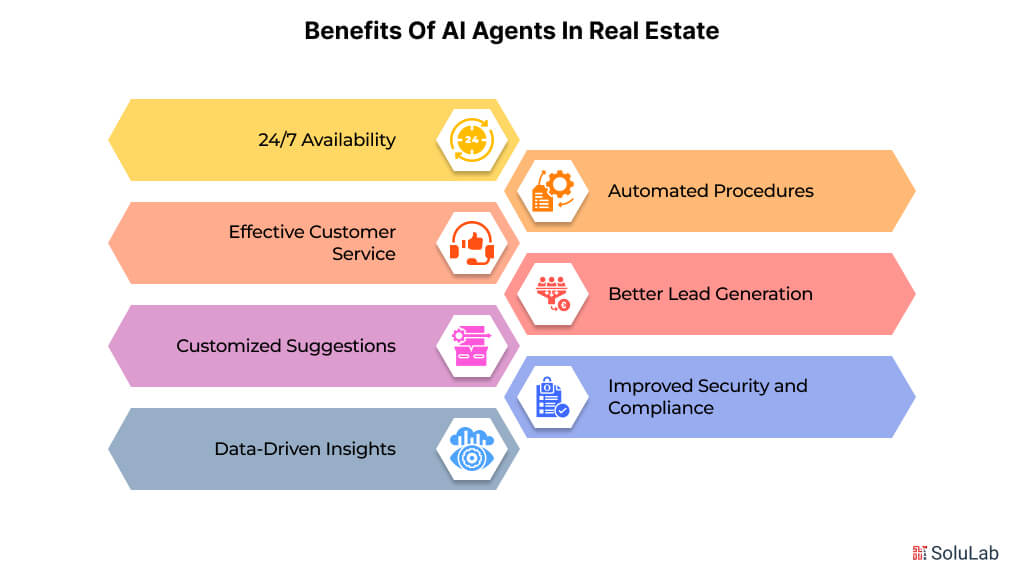
AI agents are intelligent systems that perceive their environment, take actions, and learn to achieve their goals. In the real estate sector, AI agents provide several significant advantages:
1. 24/7 Availability: AI agents are always available and may respond to questions right away, regardless of time zones or business hours. This increases client satisfaction and engagement by guaranteeing that prospective tenants or buyers may obtain information whenever they need it.
2. Effective Customer Service: AI agents can manage many questions simultaneously without making mistakes or delays. They free up human agents to work on more difficult duties by offering prompt responses to frequently asked questions regarding availability, cost, and property specifics, among other things.
3. Customized Suggestions: AI agents can use machine learning algorithms to examine user preferences and behavior and provide tailored property recommendations. This customized approach increases the likelihood that purchasers or renters will find residences that meet their particular requirements.
4. Data-Driven Insights: Artificial intelligence (AI) agents can analyze enormous volumes of data to produce insightful information about investment opportunities, market trends, and real estate prices. Real estate agents can optimize their tactics and make well-informed judgments with the aid of this data-driven method.
5. Automated Procedures: AI agents do administrative duties like setting up property tours, reminding people, and keeping track of paperwork much easier. Real estate agents have less work to do because of this automation, which also improves operational effectiveness.
6. Better Lead Generation: AI systems can recognize and qualify leads according to parameters like spending limit, preferred location, and intention to buy. Real estate agents can increase sales efficiency by concentrating their efforts on prospects who are more likely to convert by giving priority to high-quality leads.
7. Improved Security and Compliance: By safely managing sensitive data and Security Token Offerings, AI agents can guarantee adherence to legal requirements and data protection statutes. This increases client confidence in the real estate transaction process and lowers the possibility of human error.
All things considered, AI agents improve the real estate sector by improving client satisfaction, streamlining processes, and offering insightful data that propels company expansion.
Applications and Use Cases of AI Agents in Real Estate
AI is changing how people buy, sell, and manage houses. It’s like having a helper to think, predict, and solve problems. Let’s check out how AI is making real estate better!
1. Property Valuation and Pricing
-
Automated Valuation Models (AVMs)
AI uses special tools called Automated Valuation Models (AVMs) to find out how much a house is worth. It looks at things like house size, nearby sales, and trends in the area. With its smart learning, it gives fast and accurate price updates—better than old-school methods!
-
Predicting Future Trends
AI studies past data and today’s market to guess what might happen next. Will house prices go up? Will renting get more popular? AI helps investors and real estate experts plan better by giving them smart predictions.
2. Enhanced Customer Service
-
Virtual Assistants and Chatbots
Imagine asking questions about a house at night and getting answers right away. That’s what AI-powered chatbot development does! They can book house tours, answer questions, and work all day and night to help buyers and renters.
-
Personalized Property
AI can learn what you like—your budget, favorite neighborhoods, or must-have features—and suggest homes that match perfectly. It’s like having a friend who knows exactly what you want in a dream home.
3. Efficient Property Management
-
Fixing Things Before They Break
AI can tell when something in a building might stop working. It reads data from sensors (like tiny detectives!) and predicts when repairs are needed. This saves time, money, and hassle.
-
Picking the Best Tenants
AI helps landlords choose good tenants by looking at their rental history and credit scores. It quickly spots any warning signs and helps landlords decide faster and smarter.
-
Easy Lease Management
AI can manage lease details like rent changes, renewals, and rules. It keeps everything in order and makes life easier for landlords and tenants.
4. Marketing and Sales Optimization
-
Smarter Ads
AI finds people who might want to buy or rent a home and shows them ads they’ll love. It checks websites, social media, and search habits to target the right people, saving time and money on advertising.
-
Amazing Content Creation
Need a great property description or a cool video tour? AI can do that! It creates catchy descriptions and visuals that make homes look their best.
Read Also: Voice AI Agents In Conversions and Sales
5. Risk Assessment and Fraud Detection
-
Smart Risk Checks
AI can spot learning in real estate investments by studying market trends and property details. It helps investors make safer choices and avoid big losses.
-
Catching Fraud
AI is like a detective who finds fake listings or false mortgage applications. It protects people from scams and makes buying or renting safer.
6. Smart Contract Management
AI teams up with blockchain (a secure digital ledger) to manage contracts. These make sure rules are followed before money changes hands. This makes deals faster and easier with fewer mistakes.
7. Environmental and Sustainability Analysis
-
Saving Energy
AI helps buildings use less energy by studying how much electricity or heating they need. It gives tips like turning off unused lights or fixing air conditioners.
-
Planning Green Buildings
Want to build an eco-friendly house? AI can help! It picks materials that are good for the planet and suggests how to use sunlight to save energy.

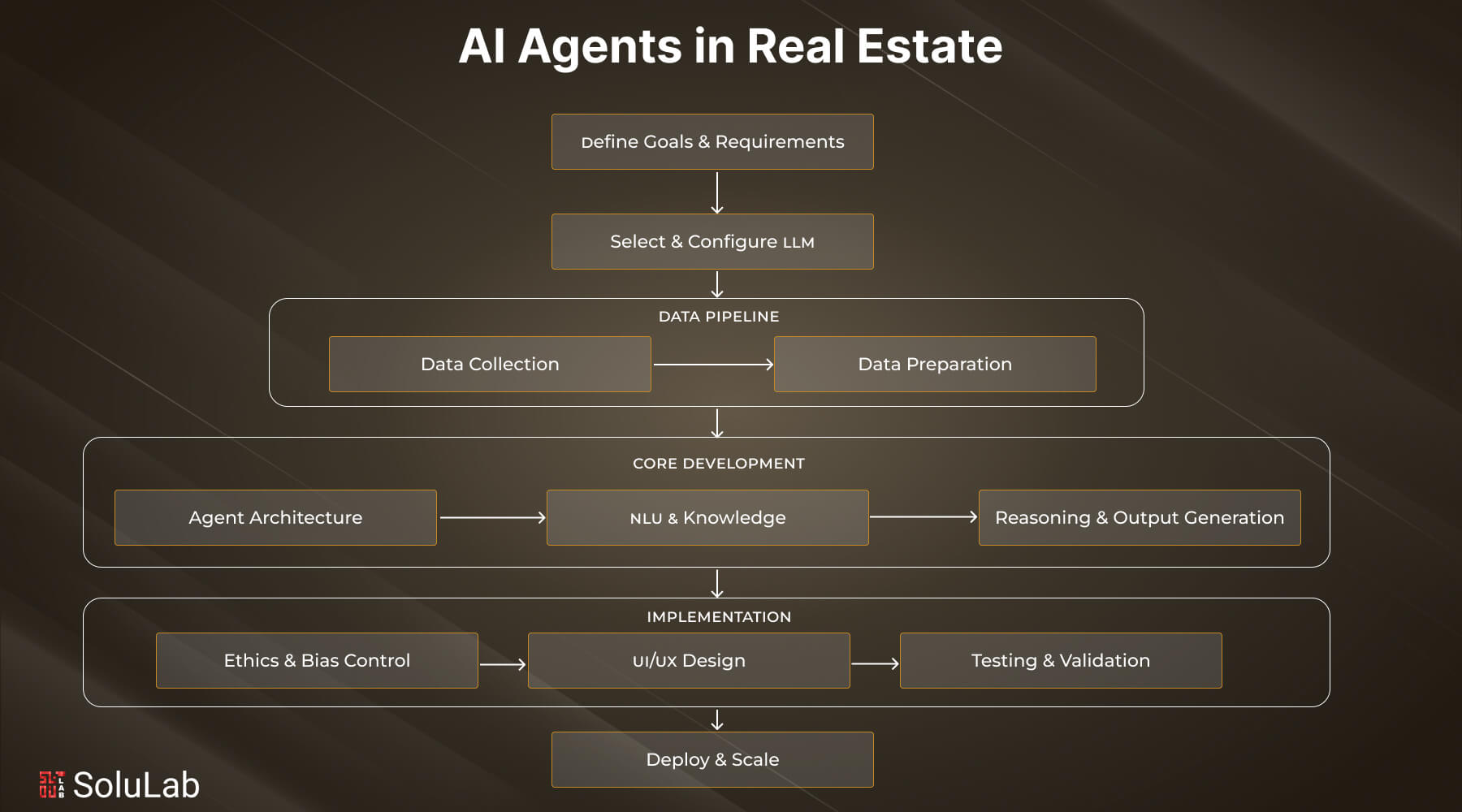
How to Build an AI Agent for Real Estate?
Big robots like Large Language Models (LLMs) are changing the way we do real estate. They can think like smart assistants. By teaming them up with AI helpers, real estate tokenization agents can save time, solve problems faster, and work better. Let’s see how you can make your very own real estate!
1. Define your Real Estate Goals
First, decide what you want the AI to do for your business. Be clear and specific!
- Pick your Focus: Is it helping with property management, talking to clients, or keeping track of market trends?
Choose tasks for the AI:
- Market Trends: Teach the AI to study house prices and the best places to invest.
- Talking to Clients: Let it answer common questions and book meetings.
- Property Lists: Help manage and update homes for sale.
- Paperwork: Make contracts easier to prepare and check.
2. Choose the Right LLM
Not all robots are the same! Pick one that fits your needs.
- Some Smart Choices:
- OpenAI (GPT): Great for talking to clients and writing reports.
- Google’s PaLM 2: smart for tricky tasks and different languages.
- Meta’s LLaMA: Flexible and good for custom jobs.
- Hugging Face Transformers: There are lots of options to test and choose from.
What to check before picking:
- Size: Big models are powerful but need more energy to work.
- Skills: Make sure it’s good at real estate tasks.
- Cost: Some are free, and others charge money.
3. Data Collection and Preparation
Gathering good data is important! Collecting all the right information to build something amazing. Here’s what you need to do:
- Market Data: This is information about how much houses cost and how the market changes.
- Client Data: Details about what people like, what they’ve asked about, and the deals they’ve made.
- Property Listings: A big list of houses and buildings, with descriptions, prices, and where they are.
Now, please clean up the data so it’s easy to use!
- Cleaning: Remove stuff you don’t need and fix any mistakes.
- Formatting: File everything neatly, such as charts or tables, and ensure that dates, numbers, and words look the same.
4. Train the LLM (for the specific domain/task)
Once you have all the data, it’s time to teach the AI about real estate!
- Domain Adaptation is like teaching AI a lesson on real estate so it knows what to do.
- Prompt Engineering: Try asking the AI questions in different ways to see what works best. It’s like practicing how to ask for help nicely!
5. Develop the AI Agent Architecture
Now it’s time to build the AI’s “brain” and “body.” Consider it as a putting together a robot with parts!
- Input Processing: This part listens to what you ask or type.
- LLM Interaction: Here, the AI uses what it learned to develop smart answers.
- Output Generation: The AI shares its answers in a way that’s easy to understand.
- Memory and Context: This helps the AI remember what you discussed before, so it doesn’t forget during a long chat.
6. Implement Natural Language Understanding (NLU)
Time to make the AI smart at understanding questions!
- Interpreting Queries: Teach it to figure out exactly what you’re asking.
- Intent Recognition: It learns what you want, like finding a house or comparing prices.
- Entity Extraction: The AI will pick out important details, like house types, locations, or what people like.
7. Create Knowledge Integration Systems
- Add Outside Knowledge: Give your AI agent access to large information libraries. This will make it knowledgeable about the world!
- Check Facts: Make sure the AI double-checks info from trusted sources so it doesn’t make mistakes.
- Keep Learning: Let the AI keep getting smarter by updating what it knows constantly.
8. Develop Reasoning and Analysis Capabilities
- Understand Markets: Teach the AI to study property prices and what’s trending in real estate.
- Spot Deals: Help the AI find great opportunities to invest in real estate.
- Think Logically: Make sure the AI knows how to think through problems and develop smart answers.
9. Design Output Generation And Summarization
- Write Like A Human: Teach the AI to create reports that people can easily read and understand.
- Summarize Info: Let the AI turn big chunks of data into simple, short summaries.
- Show Graphs And Charts: Help the AI make pretty pictures like charts to explain things clearly.
10. Implement Ethical And Bias Mitigation Measures
- Find and Fix Biases: Make sure the AI isn’t unfair or one-sided in its answers.
- Be clear: Show how the AI makes decisions so people can trust it.
- Follow the rules: Teach the AI to stick to rules about privacy and fairness.
11. Create User Interface And Interaction Design
- Make It Easy To Use: Design the AI so it’s simple and fun to interact with.
- Help Users Refine Questions: Add features so users can adjust their questions to get better answers.
- Work As A Team: Let the AI work alongside people to solve problems together.
12. Testing and validation
- Test a lot: Check how the AI performs in different real estate scenarios to ensure it works well.
- Compare results: Match the AI’s answers with expert opinions to determine their accuracy.
- Keep An Eye On It: Monitor the AI regularly to ensure it stays on track.
13. Deployment and Scaling
- Build A Strong Setup: Get all the computer power needed for the AI to run smoothly.
- Protect Data: Keep sensitive information safe with strong security measures.
- Be Ready To Grow: Plan so the AI can handle more tasks and users as it gets popular.
Challenges and Limitations of AI Agents in Real Estate

These AI agents in insurance enable real-time data analysis, providing deep insights into market trends, pricing dynamics, and investment opportunities. Investing can be exciting, but it comes with hurdles that you need to know about. Let’s discuss five big challenges you should watch out for when planning investments.
1. Market Volatility
Sometimes, market prices go up and down like a rollercoaster. This can lead to big losses. It’s important to be ready for these sudden changes and plan to deal with risks when they happen.
2. Regulatory Changes
Rules about investing can change, like when new laws are introduced. These changes can affect how investments work. Staying updated on the rules helps you follow them and make smart plans.
3. Economic Uncertainty
Things like rising prices, changing interest rates, or even global events can make the economy unpredictable. Being flexible and ready to adjust your plans is key to handling these surprises.
4. Information Overload
There’s so much information out there that it can feel overwhelming. To make good choices, you need to focus on the most important facts and ignore things that don’t matter.
5. Behavioral Biases
Sometimes emotions take over, and people make choices they regret later. Spotting and managing your feelings can help you stay focused and make better decisions.
Components of AI Agents for Real Estate
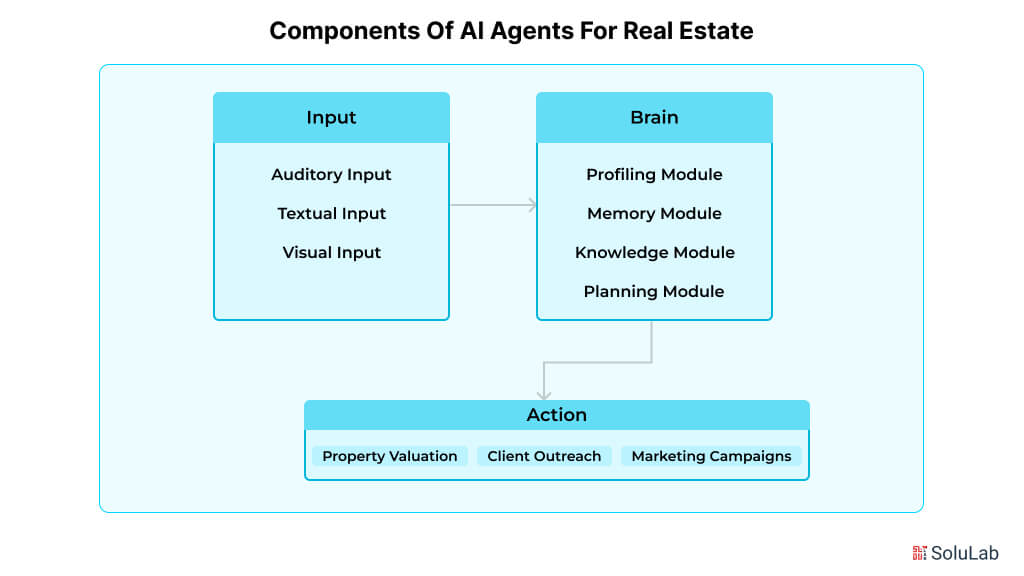
Several essential elements are included in the architecture of AI agents created for the real estate industry. These elements make it easier to process input data, reason, plan actions, and carry them out. AI agents help you make real estate work easier and faster. These agents have different parts, like a team with special jobs, all working together to make smart decisions. Let’s break it down!
1. Input
This part is like the agent’s eyes, ears, and hands. It takes in information to understand what’s going on. In real estate, the agent gets three main types of input:
- Auditory Input: It listens to voice commands, such as “Find houses near the park!” or questions from agents or clients.
- Textual Input: It reads emails, messages, property details, and even customer reviews.
- Visual Input: It looks at photos of homes, floor plans, and even virtual tours.
These inputs guide the agent in making smart decisions and keeping clients happy.
2. Brain
This is where all the thinking happens! The brain has many parts, each with a special job:
- Profiling Module: It decides the agent’s role. For example, it might focus on matching buyers with houses or finding market trends.
- Memory Module: This is like the agent’s notebook. It remembers past chats or tasks to give better advice later.
- Knowledge Module: This part stores important facts, like house prices, rules for selling, and details about neighborhoods.
- Planning Module: It makes a step-by-step plan to do tasks like pricing a home or organizing a marketing campaign.
3. Action
The action part is where the agent gets things done! It takes all the planning from the brain and puts it to work. Here are some examples of what it can do:
- Property Valuation: It looks at market data and house details to determine the right home price.
- Client Outreach: It sends personalized messages to buyers and sellers to keep them interested.
- Marketing Campaigns: It helps create cool ads and content to attract people to the property.
Ethical Considerations of AI Agents in Real Estate
In any professional context, ethical issues are crucial. They serve as a guide for decision-making and guarantee that deeds are consistent with moral standards. Credibility and trust can be increased by comprehending and putting ethical practices into effect, especially in blockchain and artificial intelligence.
1. Define Ethical Standards: Clearly defining ethical norms helps individuals and organizations navigate challenging circumstances. The standards should reflect the entity’s mission and values.
2. Encourage Openness: Stakeholder trust is increased by open communication regarding decisions and procedures. Stronger bonds and fewer misunderstandings can result from transparency. To increase stakeholder confidence, we stress the significance of transparency in Blockchain transactions and AI algorithms.
3. Promote Moral Behavior: Ethics-focused training courses can help staff members realize the value of ethical decision-making. Regular conversations about moral conundrums can strengthen a culture of integrity.
The Future of AI Agents In Real Estate
AI agents are like smart helpers, becoming a big deal in real estate. In the future, they’ll do even cooler stuff! Let’s explore how they might help:
- Negotiation Agents: Imagine having an AI that helps with deals! It could check market trends, understand what buyers and sellers want, and suggest the best ways to make everyone happy.
- Property Management Agents: These AI helpers could handle property tasks such as planning repairs, tracking utility use, and chatting with tenants. They’d ensure everything runs smoothly and adjust to changes.
- Virtual Staging Agents: Picture an AI that can show how a home might look with different furniture! Using smart tools like 3D pictures, it would help buyers imagine their dream spaces.
- Legal and Compliance Agents: These agents would be like AI lawyers for real estate. They’d check if everything follows the rules, review contracts, and identify risks.
- Smart Building Agents: What if buildings could think? AI agents could manage energy use, keep the place secure, and make sure maintenance gets done, all while learning what people in the building like.
- Investment Advisory Agents: Are you looking to invest? AI agents could study a lot of data, such as market trends and property details, and give smart advice based on what investors want.
- Virtual Tour Agents: Imagine an AI guiding you through a house online. It could answer questions, show off cool features, and even focus on what you care about most.
- Tenant Screening Agents: Finding the right renters is tricky, but AI can help by checking things like credit history and other details to pick the best tenants and avoid problems.

Conclusion
AI agents make real estate work faster and smarter. They handle tasks like pricing properties, predicting maintenance needs, and providing personalized customer service. They also improve security and help save energy by planning eco-friendly developments.
Using AI makes real estate processes like property sales and management more efficient and sustainable. Agents can improve their operations and client engagements using tools like virtual assistants, transaction coordinators, and AI-powered sales training.
SoluLab helped AI-Build, a construction tech company, utilize generative AI and machine learning for advanced product development in the CAD space. They aimed to automate design processes, improve productivity, and enhance accuracy. The challenge was creating a system that could generate optimized designs while reducing manual tasks and ensuring scalability. SoluLab’s an AI Agent Development Company expertise enabled AI integration, improving efficiency and performance. SoluLab has a team of experts ready to solve your business queries—contact us today!
FAQs
1. Can AI agents predict property prices?
Yes! AI agents analyze market trends, property features, and historical data to estimate accurate property values.
2. How do AI agents improve customer service in real estate?
They can AI Agent use cases answer common questions, schedule appointments, and provide personalized recommendations based on client preferences.
3. Are AI agents expensive to implement in real estate?
The cost depends on the complexity of the AI agent. Some tools are affordable and scalable, while advanced systems may require a bigger investment.
4. Do AI agents help with real estate marketing?
Absolutely! AI agents create targeted marketing campaigns, analyze audience behavior, and optimize advertisements to attract buyers and sellers.
5. Are AI agents secure to use in real estate?
Yes, most AI tools include security measures for real estate services to protect sensitive data like client information and property details.

