Talk to an Expert

What Makes Solana Wallets the Go-To Option for Meme Coin Investors in 2026?

Solana Wallets for Meme Coin Investors

The world of crypto has always been fast, but in 2026, things feel even more explosive. Solana has become one of the most exciting blockchains, with its market cap crossing $129 billion. Alongside, meme tokens are stealing the spotlight with their own booming ecosystem worth over $12.9 billion. Add to this more than 11.4 million active Solana wallets, and you have a recipe for rapid adoption.

Low fees, lightning-fast speed, and nonstop innovation have made Solana the go-to playground for meme coin traders and communities. For enterprises, this is the right time to look at wallet development, as it combines infrastructure strength with massive community energy.

How Solana Wallets Drive Meme Coin Market Growth?

Solana Meme Coin Wallet adoption sits at the center of the meme coin wave. They are no longer just tools to hold tokens. Instead, crypto wallet solutions have become discovery engines, trading dashboards, and even social hubs. Most meme coin transactions start and end with a wallet. This makes wallets a powerful gateway for both retail traders and enterprises.

Wallet adoption is also driving higher liquidity for Solana meme coins. As more users transact through apps like Phantom or Backpack, projects see faster growth and tighter communities. A strong wallet ecosystem is now one of the biggest reasons Solana meme coins continue to thrive.

Current Crypto, Solana, Meme Coins Market Trends

2026 has brought together three big trends:

  • Crypto market maturity: With Bitcoin steady at the top, investors are more open to altcoins and meme coins.
  • Solana momentum: High trading volumes, $12.1 billion in TVL, and fast confirmations put Solana ahead of rivals.
  • Solana Wallet 2025: Over 2.2 million daily active wallets are transacting on the Solana network in Q1 2025.
  • Meme coin culture: BONK, PENGU, and others attract millions of traders, making meme coins a daily trend topic.

This mix of serious infrastructure and playful speculation is unusual. That’s why enterprises are now rushing to build wallet solutions on Solana.

Why Are Enterprises Turning to Solana Wallet Development?

Enterprises see crypto wallet development as more than apps. They see them as business opportunities. A well-designed wallet can become the default choice for millions of meme coin traders. With such huge active communities, the potential for user retention and monetization is massive.

Three reasons enterprises are focusing on Solana wallet development in 2026:

  • High user demand: Millions of new NFT wallets are being downloaded every month across the globe.
  • Network effects: The more wallets integrate Solana meme coins, the stronger the ecosystem grows.
  • Business credibility: Early movers in Web3 wallet development can gain trust before the market becomes saturated.

Wallets can be built as consumer apps or as licensed enterprise products. Either way, the market is large and ready.

Key Business Use Cases of Solana Wallets in 2026

Enterprises are exploring Solana crypto wallets not just for storage, but for multiple revenue-driven use cases. Here are the most relevant ones:

1. Airdrop distribution: Simplifying airdrops makes wallets sticky and boosts community loyalty.

2. Trading tools: Meme coin traders rely on wallets for quick swaps, P&L tracking, and whale alerts.

3. NFT access: Many meme coins link with NFTs for rewards and gated communities. Wallets enable seamless access.

4. Risk control: Scam detection and rug-pull prevention protect users and build trust.

5. Cross-chain activity: Multi-chain support makes wallets flexible for meme coin development across Solana, Ethereum, and BSC.

By supporting these use cases, enterprises can turn wallets into long-term growth engines.

Core Solana Wallet Features That Businesses Must Prioritize
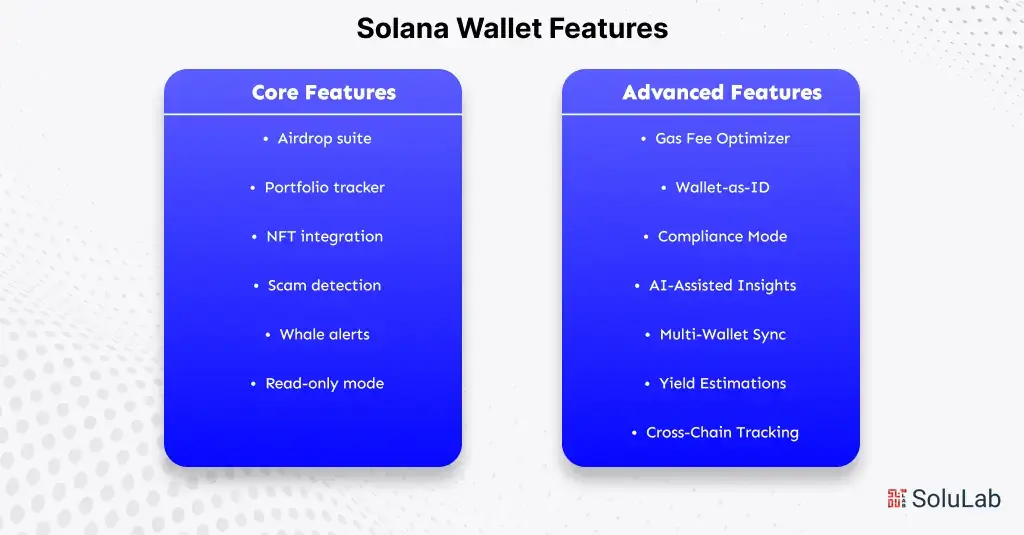
Solana Wallet Features

Every wallet starts with the basics. These core features build trust and retention. Without them, no wallet can compete.

  • Airdrop suite: Automatic scanning, one-click claiming, and history logs make airdrops safe and engaging.
  • Portfolio tracker: Real-time P&L and holder concentration charts help users manage risks in volatile meme markets.
  • NFT integration: Combined NFT and token views allow smooth interaction with hybrid meme projects.
  • Scam detection: Token risk scores based on liquidity, ownership, and mint rights protect users from rug-pulls.
  • Whale alerts: Real-time notifications for big trades keep users engaged and active.
  • Read-only mode: Allows wallet research without key connections, increasing privacy and onboarding ease.

These features are non-negotiable for any Solana meme coin wallet today.

Differentiators That Help Your Solana Wallet Win Market Share

Beyond the basics, differentiators give wallets their competitive edge. They help a wallet become the go-to app for communities.

  • On-Chain Meme Coin Analytics

With this, you can see token age, liquidity health, and trading pressure in one view. It helps users move from guesswork to smarter decisions, giving your wallet real credibility in meme coin markets.

  • Liquidity Lock Visibility

This shows how much liquidity is locked and for what. Clear LP data builds trust instantly, helping users feel safer while boosting confidence in the projects they invest in.

  • Social Sentiment Tracking

You can combine Telegram, Discord, and X chat into one hype score. It gives users an early pulse on meme coin buzz, helping them react before the market shifts.

  • Smart Alerts

Not just price pings, smart alerts merge trading volume and social activity. Users get fewer false alarms and faster insights, making your wallet feel like a real trading companion.

  • Community Gamification

Leaderboards, referral rewards, and fun airdrop perks turn wallets into communities. This makes trading engaging, sticky, and social, keeping users coming back daily.

Wallets that offer these differentiators often grow fastest through word-of-mouth.

Crypto Wallet Development Company

Advanced Solana Wallet Features For Startups and Enterprises

Advanced modules take wallets from consumer apps to enterprise platforms. These features target professional traders and funds.

  • Gas Fee Optimizer

A gas fee optimizer manages priority fees and timing, ensuring smooth execution during heavy traffic. This feature helps traders gain an advantage in high-volume meme coin drops.

  • Wallet-as-ID

A wallet-as-ID framework attaches loyalty badges and reputation layers. It transforms wallets into identity hubs that strengthen community belonging and long-term user engagement.

  • Compliance Mode

A compliance mode includes tax-ready exports, whitelist tools, and risk classifications. These functions make meme coin investing safer and more reliable for institutional players.

  • AI-Assisted Insights

AI-assisted insights combine on-chain signals with social sentiment data. This feature provides traders with non-financial indicators that support sharper and more confident decisions.

  • Multi-Wallet Sync

A multi-wallet sync function consolidates holdings across multiple addresses. It provides enterprise-grade visibility with unified portfolio analysis and P&L reporting.

  • Yield Estimations

A yield estimation tool projects APRs for staking and farming meme coins. It helps users make better-informed decisions before locking capital.

  • Cross-Chain Tracking

A cross-chain tracking module manages meme coin positions across Solana, Ethereum, and Base. It offers traders a single, unified view of all holdings.

These advanced features are optional for casual users, but critical for businesses and serious traders.

The Future of Solana Meme Coin Wallets

The future of Solana wallets is more than storage. They will evolve into full-stack community engines. Wallets will merge social engagement, AI insights, compliance, and yield farming into one seamless user experience.

We can expect three big shifts:

1. Deeper integration with communities: Solana meme coin wallets will embed GenAI-driven chatbots, NFT community hubs, and on-chain social scoring systems, making wallets function as decentralized social platforms.

2. Cross-chain dominance: AI-powered bridges will enable unified meme coin trading across Ethereum, BNB Chain, Solana, and Layer-2 rollups, reducing latency and slippage.

3. Smart compliance and security: Wallets will feature automated KYC modules, AI-driven fraud detection, and zero-knowledge proof (ZKP) verification, balancing privacy with regulation.

In 2026 and beyond, wallets are the key to unlocking Solana’s full potential. Enterprises that build now will not just capture users; they will define how the next wave of meme coin culture evolves.

Solana Development Company

Conclusion

You may already have a clear ideology on the Solana wallet and what factors make it a key solution in the meme and crypto tokens space. If you are also looking for a reliable partner to make your idea come true, then SoluLab is here to aid you in every step. 

We at SoluLab, a top crypto wallet development company, help you to build secure, stable and and scalable payment integration solutions. This makes your business reliable and user-friendly. Our expert team specializes in crafting ultra-secure cryptocurrency wallets, empowering you to earn, transfer, and monitor virtual currencies with confidence. 

Contact us today to uplift your crypto or meme platform to new heights!

FAQs

1. Can Solana meme coin wallets integrate AI for smarter trading?

Yes, modern Solana crypto wallets use AI for sentiment tracking, predictive trading, and fraud detection, giving meme coin investors smarter tools beyond simple storage and transfers.

2. How do Solana wallets help businesses stand out in 2026?

By offering unique features like NFT access, cross-chain swaps, and social engagement tools, Solana Wallet development allows businesses to attract, retain, and monetize engaged crypto communities.

3. What features of crypto wallets are most important for enterprises today?

Enterprises prioritize security, scalability, compliance, and community-driven tools. Advanced cryptocurrency wallet solutions must balance trading performance with features like airdrop support, whale alerts, and cross-chain activity tracking.

4. Why should businesses choose SoluLab for Solana Wallet development?

SoluLab offers end-to-end crypto wallet development with advanced features, enterprise security, and user-friendly design, making it a trusted partner for businesses entering meme coin development and Web3 solutions.

5. Could Solana wallets eventually replace standalone meme coin exchanges?

Possibly. With Web3 wallet development evolving into trading dashboards, analytics hubs, and community platforms, wallets might reduce reliance on centralized exchanges for meme coin investors and enterprises alike.

How to Create an AI-Integrated Smart Crypto Wallet?

AI integrated Crypto Wallet

Have you ever thought about a cryptocurrency wallet that offers features beyond the storage of your digital assets? The rise of AI crypto wallets has made this possible. These wallets have been designed to help users make informed choices, identify suspicious activities, and provide valuable recommendations based on their app usage.

As more people get into cryptocurrency, the tools they use must become smarter and more user-friendly. AI contributes by providing features such as automated suggestions, smart notifications, and voice control. It’s similar to having a helpful assistant built into your wallet, directing you along the way.

In this article, we will look at how to build your own AI-enabled crypto wallets. Whether you’re a developer or simply interested, we’ll make things easy and walk you through the stages, tools, and suggestions to get started!

The Journey of Crypto Wallets

Back when Bitcoin first came around in 2009, crypto wallets were pretty basic software that helped you store your private keys and maybe send or receive a few coins. Just enough to interact with the blockchain and keep your assets safe. But as more people started getting into crypto, wallets had to level up. Developers began building wallets that could handle multiple tokens and feel easier to use.

TRC20 wallets were then upgraded with the TRON blockchain, and some of them have started using AI to make transactions smoother and boost security. These wallets are learning, adjusting, and reacting in real time. It’s the start of the AI-integrated smart crypto wallets era. Security has also become a bigger deal lately. Features like multi-signature approvals and HD wallets started showing up. These additions give users a lot more control.

Now, wallets aren’t just storage tools anymore. They are evolving into full-blown financial dashboards. Some can track spending habits, spot suspicious activity, and even automate routine tasks. And they’re doing all this while keeping your crypto safe in the background. Not bad for something that started as a simple keyholder.

Market Statistics for Smart Crypto Wallets in 2025

The AI-integrated smart cryptocurrency wallet industry is predicted to develop rapidly through 2025 and beyond. This is due to the growing acceptance of blockchain technology across businesses, as well as increased demand for safe cryptocurrency transactions and developments in AI integration for improved functionality and security.

Key Statistics and Trends:

  • According to a Grand View Research report, the worldwide AI crypto wallet industry is anticipated to be worth USD 8.42 billion in 2022, with a compound annual growth rate (CAGR) of 24.8% from 2023 to 2030.
  • In 2023, the worldwide smart wallet market was estimated to be worth USD 289.16 million. Additionally, it is expected to reach USD 519.22 million by 2032. It will grow at a CAGR of 6.72% from 2024 to 2032. As a result, market expansion is ascribed to digital transformation and increased e-commerce growth.

US Crypto Wallet Market Analysis

Key Features of a Next-Level Smart Crypto Wallet

Today’s smart wallets aren’t just about storing coins anymore. They’ve got to be secure, easy to use, and flexible enough to keep up with how people actually use crypto. If you’re thinking of building one, here’s what needs to be on your checklist.

1. Handles Different Coins in One Place

A good wallet should support a bunch of cryptocurrencies, not just Bitcoin or Ethereum. You want to be able to manage everything—from top-tier coins to up-and-coming tokens—without juggling multiple apps. That’s what makes an AI-integrated smart crypto wallet feel truly “smart.”

2. Works Across Devices

People don’t stick to one device anymore. Your wallet should work on a phone, laptop, or tablet, and sync across all of them. Whether you’re on Android at work or checking from a Mac at home, your info should be up to date no matter where you log in.

3. Security That Doesn’t Get in the Way

Strong security is non-negotiable. Things like biometric logins, 2FA, and solid encryption need to be built in. But they shouldn’t make the app feel clunky or slow. Ideally, security should feel invisible, working in the background while keeping your assets safe.

4. Stores Keys With the User

A proper wallet doesn’t store your private keys on some central server. It keeps them on your own device. That way, you control your funds, and if something goes wrong with a central system, you’re not at risk.

Related: Build an AI-Integrated Crypto Wallet on Aptos from Scratch

5. Multi-Sig for Shared Access

If the wallet is being used by a group—say, a team or DAO—it should allow multiple approvals for transactions. That’s where multi-signature support comes in handy. It adds a layer of trust and reduces the risk of unauthorized transfers.

6. Built-In Swap Feature

Being able to exchange tokens without leaving the wallet? That’s a big win. It saves time, reduces fees, and just feels seamless. This is one of the features that separates a good user experience from a frustrating one.

7. QR Code Transfers

Ever tried typing a wallet address? It’s a nightmare. QR codes simplify this. Scan to send, scan to receive—it should be that easy. Especially useful in retail or face-to-face payments.

Mobyii Case Study

Why Integrating AI Can Transform Your Crypto Wallet?

Ever found yourself wondering whether it’s really worth building your own AI-based crypto wallet when there are already so many options on the app stores? Here’s a look at why developing one yourself can actually make a big difference—and offer some real advantages.

  • More Control Over Security

When you build your own crypto wallet, you’re not stuck depending on someone else’s framework or hoping a third-party backend is secure. You’re in full control. That gives you the flexibility to design your own security protocols, tailored to your exact needs. What’s more, integrating AI agents for finance into the system adds a powerful layer of protection. These agents can keep an eye on real-time activity, spot red flags early, and help prevent issues before they turn into serious problems.

Read Our Blog Post: Custodial vs. Non-Custodial Wallets

  • Personalized Features and Automation

One of the biggest plus points of AI is how it can tailor the wallet to your personal needs. Whether it’s letting the system handle transaction approvals or helping manage your crypto portfolio more smoothly, AI makes everyday tasks simpler. It can even help with automatically running smart contracts based on predefined triggers.

  • Helping You Make Better Calls

An AI-supported wallet doesn’t just sit there—it learns. It can pull live data from the market, check past transactions, and even spot trends. So, if you’re unsure when to buy or sell, it can offer suggestions based on what’s actually happening, not just guesswork.

  • A Chance to Learn While You Build

Starting from scratch with an AI-driven crypto wallet isn’t just about having something custom. It’s a hands-on opportunity to understand how blockchain systems work, explore AI applications, and get familiar with security practices that actually hold up. It’s a smart way to learn how these technologies connect in the real world.

When it comes to the role of AI in crypto wallets, it’s not just about features—it’s about building smarter, more responsive tools that adapt to how people actually use crypto. And if you’re building it yourself, that wallet works exactly the way you need it to.

Step-by-Step Breakdown to Build Your Own AI-Powered Crypto Wallet

Build AI integrated Smart Crypto Wallet

Building a crypto wallet that smartly blends AI capabilities with blockchain features takes more than just coding—it’s a thoughtful process. From laying out the concept to rolling out the final product, here’s a walkthrough of how to create a wallet that’s secure, intelligent, and user-first.

1. Research and Planning

Before you begin development, it’s essential to dive deep into research. Take time to understand the current crypto wallet market—what’s working, what’s not, and where users struggle. Then look at where AI can offer real value. Think beyond buzzwords—maybe smarter alerts, stronger fraud protection, or auto-generated suggestions for trading timing.

2. Select the Technology Stack

The tools you choose will shape how well your wallet performs and scales. For the blockchain layer, many developers go with platforms like Ethereum, Solana, or Binance Smart Chain. On the AI side, it makes sense to explore frameworks like PyTorch or TensorFlow—each offers solid support for training and integrating models. The blend depends on what your wallet is meant to do.

3. Design the User Interface

For any app to gain traction, design matters. And in crypto, that’s even more true. Focus on a layout that feels simple, even to someone who isn’t deeply technical. Users should be able to check their balances, send tokens, and get insights powered by AI without having to dig through menus or manuals. A well-thought-out UI can make or break adoption.

4. AI Integration for Smart Features

Artificial intelligence can do a lot—but only if it’s used wisely. A crypto wallet can offer things like customized financial advice, automatic portfolio adjustments, or even warnings about shady-looking activity. Machine learning models can track user behavior and market trends to offer meaningful, real-time suggestions, not just surface-level alerts.

5. Security and Encryption

With crypto, safety isn’t optional—it’s a must. That means using encryption standards to protect private keys and sensitive data, and including two-factor logins to verify identities. AI plays a part here, too—it can analyze user behavior to spot anomalies or flag risky access attempts before any damage is done.

6. Smart Contract Development

A wallet that supports decentralized finance needs to connect with smart contracts. These aren’t just about transactions—they can handle staking, swaps, or lending protocols directly from the wallet. With the help of top AI cryptocurrency wallet development, you can bake in automation that moves assets based on triggers without requiring manual input or outside middlemen.

Read Also: Why AI Smart Contracts Are the Future of Business?

7. Testing and Quality Assurance

You don’t want bugs in production, especially when money’s involved. Thorough testing, including both feature checks and security validation, is a must. Stress testing for high-traffic use, edge cases, and verifying that your AI modules behave accurately should all be part of the process before go-live.

8. Launch and Improvement

Once you’re confident everything works, it’s time to launch—whether through mobile stores or web platforms. But it doesn’t stop there. Gather feedback, observe how users interact with the wallet, and make improvements. Regular updates can introduce fresh AI features, better UX, and stronger security protocols over time.

Read Also: How to Create a Wallet like Phantom?

What Does It Cost to Build an AI-Powered Crypto Wallet?

If you’re thinking about building an AI-integrated smart crypto wallet, you’re probably asking the big question: what’s the cost? Well, there’s no fixed number. The total budget can vary a lot depending on the scope of the project, what features you want, and even where your development team is based.

Different regions charge differently, and of course, more complex features (like real-time AI analytics or DeFi integration) will push the cost higher. For anyone planning to enter this space—or even wants to start a cryptocurrency exchange with a custom wallet solution—it helps to have a rough idea of what goes into the budget.

Below is a general estimate of what each stage in the crypto wallet development process might cost you:

Development Phase Estimated Cost (USD)
Market & User Research $5,000 – $15,000
Interface & Experience Design $10,000 – $30,000
Backend Architecture $20,000 – $50,000
AI Feature Integration $15,000 – $40,000
Security Layers & Encryption $10,000 – $25,000
QA & Final Testing $5,000 – $15,000
Product Launch & Promotion $10,000 – $30,000

Popular AI-Integrated Crypto Wallets You Should Know About

Over the past couple of years, a few crypto wallets have quietly stepped up their game by blending AI into their core functionality, not as a gimmick, but as a real value add for users. These wallets don’t just hold tokens; they help manage them smarter, track patterns, flag risks, and sometimes even suggest the best time to move assets. If you’re curious about what’s out there already, here are a few worth mentioning.

1. Frontier Wallet

Frontier is known for supporting a wide range of DeFi protocols and asset-backed cryptocurrencies, but it’s also been making strides by adding AI-driven tools to simplify investment tracking. While its AI features aren’t always front and center, they assist with things like transaction categorization and identifying potential risks in DeFi positions, especially useful for users juggling multiple protocols.

2. ELLIPAL Titan

This one’s a hardware wallet, but it’s paired with a smart app that uses AI for transaction monitoring and anomaly detection. The AI component flags anything that looks out of the ordinary, giving users a heads-up before something potentially harmful happens. It’s a solid pick for those who want both cold storage and active AI support.

3. YouHodler

YouHodler blends lending, trading, and wallet functions all in one place. The wallet part benefits from machine learning models that offer real-time price analysis and smart alerts based on user behavior. It’s more than a passive wallet—it helps users make choices with better timing and data.

4. Klever Wallet

While Klever started as a simple mobile wallet, newer versions have begun using AI in subtle ways, like optimizing gas fees, flagging abnormal sending behavior, and offering suggestions based on previous transaction patterns. It’s a good example of how AI doesn’t have to be flashy to be useful.

These wallets show that the shift toward smarter, data-aware crypto tools is already happening. For businesses or developers exploring crypto wallet development, looking at how these platforms quietly integrate AI can offer some real inspiration. The goal isn’t to overcomplicate things—it’s to make crypto safer, easier, and a little more intuitive for everyday users.

Read Also: Why Every Business Should Integrate POS Crypto Wallets?

The Future of Crypto Wallets and AI

The way people use crypto wallets is changing fast. What started as simple tools to store private keys is now evolving into full-service financial platforms. As user expectations grow, wallets are being built to do more—track spending, simplify cross-chain transfers, and even guide users on the best time to make a move. The future? It’s not just about holding crypto; it’s about managing digital wealth in smarter, safer ways.

This is where AI trends are starting to shape what’s possible. We’re already seeing wallets that adapt to user habits, flag irregular activity, and even offer smart recommendations based on real-time market shifts. As these technologies continue to mature, AI won’t just be a nice-to-have—it’ll be at the core of how next-gen wallets operate, bringing everyday users closer to a more intuitive and secure crypto experience.

AI Integration Services

The Bottom Line

As the world of digital finance grows more complex, the role of smart crypto wallets continues to expand. We’re moving beyond basic storage into a new era where AI and blockchain work hand in hand, bringing better insights, stronger security, and more control to everyday users.

At SoluLab, a leading cryptocurrency development company, we’ve been helping companies navigate this space with end-to-end blockchain solutions. We recently worked for a platform focused on advanced digital marketing and web traffic analytics. We developed a native crypto wallet tailored to their ecosystem, enabling secure asset management alongside unique features like call tracking and multi-source traffic monitoring. With this wallet integrated into their blockchain-powered platform, Clicktool users can now track ROI, manage campaigns, and analyze markets with more precision than ever before.

If you’re exploring new ways to bring AI and blockchain into your next wallet or digital platform, now is the time. Whether you’re just getting started or looking to upgrade an existing product, our team’s here to guide you every step of the way. Contact Now!

FAQs

1. Why build own AI-integrated crypto wallet instead of using an existing one?

Building your own wallet gives you full control over its features, security standards, and data management. Unlike third-party apps, where you’re relying on someone else’s code, your own wallet lets you decide exactly how it works—plus you can tailor the AI features to your users’ specific needs, from smarter analytics to fraud detection.

2. What are some real benefits of using AI in a crypto wallet?

AI helps a wallet do more than just store and send crypto. It can offer smart alerts, track unusual activity, give market insights, and even help automate decisions like when to buy, sell, or hold. It turns the wallet into more of an assistant than a simple storage tool.

3. How does AI improve security in a crypto wallet?

AI can monitor transaction patterns and detect behaviors that seem out of the ordinary. If something unusual is going on—like a login from a new device or an unusual withdrawal—it can send alerts or even trigger preventive measures before things go south.

4. Is AI only for large-scale or enterprise-level wallets?

Not at all. While big companies may invest more in advanced AI tools, smaller projects and startups can still benefit. Even basic AI features like predictive analytics or anomaly detection can improve user experience and add value without needing a massive budget.

5. Are AI wallets safe to use if someone is not very tech-savvy?

Yes, most modern AI wallets are built with user experience in mind. You don’t need to be a developer or trader to use them. In fact, the AI does much of the heavy lifting in the background, so you can focus on managing your assets with confidence.

A Comprehensive Guide on Crypto Wallet App on Blockchain

Guide on Crypto Wallet App on Blockchain

In the world of cryptocurrencies, accessibility and security are the pillars that support prosperous businesses. Reliable storage solutions are in high demand as digital assets continue to grow in prominence. A key component of blockchain technology, the cryptocurrency wallet software is at the center of this digital revolution. This thorough book will take you on a tour through the world of cryptocurrency wallets, revealing its nuances, exploring the many kinds that are out there, and illuminating the fundamentals of developing an app for one.

Let’s start by defining what crypto wallet actually are. These virtual tools essentially serve as digital vaults, protecting private keys, which are the entry points for accessing and handling Bitcoin assets. Modern encryption techniques are used by these wallets to safeguard users’ money from

What is a Crypto Wallet?

A crypto wallet aids users in storing, sending, and receiving Bitcoin much like any other digital wallet. It is a piece of software that records cryptocurrency transactions (buying, selling, and lending) and saves the virtual currency safely. A crypto wallet is simple to download and set up on a smartphone or other suitable device.

The cryptocurrency wallets work as follows:

To deal with cryptocurrency, you need two things: your private key and your wallet address, which is sometimes referred to as your public key. An analog of a public key would be your bank account number. To transfer or receive money, you can give out your bank account number to other individuals or organizations. In a similar vein, you may obtain the cryptocurrency by sharing your public key, which is the address of your wallet. Like your debit card PIN or bank account password, your crypto wallet’s private key is private and protected. Sharing your PIN with random people would allow them to access your bank account directly, therefore you wouldn’t want to do that. The password that grants access to your cryptocurrency is called a private key.

Types of Crypto Wallets

Types of Crypto Wallets

1. Hardware Wallets: These are actual gadgets that store your cryptographic money disconnected, giving an additional layer of safety. Models incorporate Record Nano S and Trezor.

2. Software Wallets: Programming wallets come in different structures, including work area, versatile, and online wallets. They are available through applications or web interfaces and can be additionally arranged as:

  • Desktop Wallets: Installed on a desktop or laptop computer, examples include Exodus and Electrum.
  • Mobile Wallets: Designed for smartphones, offering convenience and accessibility on the go. Popular options include Trust Wallet and Coinbase Wallet.
  • Online Wallets: Web-based wallets are accessible via internet browsers. While convenient, they may be more susceptible to hacking. Examples include MyEtherWallet and MetaMask.

3. Paper Wallets: A paper wallet includes printing your private and public keys on a piece of paper, giving a disconnected stockpiling choice. It’s viewed as perhaps the most reliable strategy whenever put away appropriately.

4. Multisignature Wallets: These wallets require numerous confidential keys to approve an exchange, upgrading security by circulating control among different gatherings.

Crypto Wallet App Development

Creating a crypto wallet application is a painstaking process that combines user-centered design with sophisticated technological aspects. Let’s examine each phase in further depth:

  • Recognize cryptocurrencies and blockchain

The development of cryptocurrency apps heavily relies on blockchain technology. You must first learn about blockchain technology applications and cryptocurrencies if you want to develop an app for a crypto wallet. The Internet makes e-mails feasible, and blockchain is a breakthrough and exciting technology that makes digital currency (cryptocurrencies) function. A blockchain, as its name implies, is a series of blocks that are connected by a cryptographic concept. The blocks in the chain contain digital information or data. Allowing the safe sharing of important data is the main goal of utilizing it.

  • Employ Conventional Cryptocurrency 

Since most cryptocurrencies are transparent, developers may use open-source tools and frameworks. The cross-platform Java library Coinbase SDK is compatible with Python, Java, and Ruby and allows the building of Bitcoin wallets for iOS and Android. With the help of the well-known BitcoinJ SDK and its extensive documentation, developers may work with JVM languages like Python, C++, JavaScript, and Ruby. Developers may avoid starting from scratch and gain from pre-built functionality and community assistance by using these existing libraries.

  • Make Use of APIs

Building a feature-rich Bitcoin wallet software is made possible by using APIs. You may simply synchronize your cryptocurrency wallet with the blockchain ecosystem by using a distributed ledger API. The most well-known APIs available to you are Factom, SimpleSwap, Bitcore, and Coinbase. Your development team may expedite the app development process by using the APIs to accomplish the required processes quickly. Additionally,

  • Utilise Cloud

You need to choose the appropriate cloud platforms for your application at this point. If you decide to pursue web development, PaaS (Platform-as-a-service) is an option. However, in order to design an app for a cryptocurrency wallet, you must find a BaaS (Blockchain as a Service) provider and include their cloud service into your program. Businesses like Microsoft, Amazon, and Azure provide BaaS products. You may create a safe Bitcoin wallet app using either of them, depending on your needs and preferences.

  • Choose the Appropriate Technology Stack

Your app will achieve the necessary success with the correct technological stack. For instance, you may use HTML5, CSS3, and either Node.js or Angular.js to create a web application. You can build a scalable crypto web application with the aid of this. You have two options when creating a native Android app: Kotlin or Java. Additionally, Objective-C or Swift may be utilized for iOS apps.

  • Stress Security

When developing an app for a Bitcoin wallet, security is crucial. For this reason, you should make sure that the security of your cryptocurrency app is excellent. You may think about including hardware authentication, face ID, and fingerprint authentication in the crypto wallet app in addition to 2FA. Continued security upgrades must be made guaranteed of by the developers. If there are any problems, they need to find them fast and use the newest tech to address them along with any other security concerns.

  • Look Into Your Rivals

You obviously want your cryptocurrency wallet software to stand out from the competition. For this reason, it’s critical to monitor your rivals. Recognize their actions and the technology they have used. To find out what special features you may incorporate into your app, go through the features. Recall that in order to get a competitive advantage over others, you need to be aware of what’s going on in your surroundings.

  • Start Working on Your App Development

Thus, when you’re ready to begin developing the crypto wallet app, be sure to perform the following: 

  • Choose every feature your app will have.
  • After writing the application code, connect it to your database.
  • Create an intuitive and basic user interface.
  • Make sure you test your wallet thoroughly before releasing it.

Essential Components for Your Cryptocurrency Wallet App

Essential Components for Cryptocurrency Wallet App

You need to integrate your business logic needs with improved functionality in your Bitcoin wallet software. These are the qualities that your cryptocurrency wallet software has to include.

1. Authorization of Users

Wallet applications are vulnerable to numerous security breaches due to the widespread use and high value of cryptocurrencies. That is why it is always preferable to utilize two-factor or multi-factor authentication (2FA or MFA) to improve user authentication of your crypto wallet app. Many traditional non-crypto apps lack the extra degree of protection that 2FA or MFA gives. This is done to further strengthen the security of wallet access in addition to your login and password.

2. Scanner for QR Codes

Your crypto wallet app transactions will be faster, more convenient, simpler, and more secure with the help of a QR Code Scanner tool. The automated scanning of the public keys and wallet address can be facilitated by your crypto wallet app if it has a QR code scanner integrated. With only one click, it thereby improves Bitcoin transfers. Therefore, the app user may scan the QR code and the information is retrieved through the scanner, saving them the trouble of inputting all the lengthy characters of the public keys one at a time. It is a secure and safe method of transacting with cryptocurrencies. This functionality is recommended because, without it, app users would have to write lengthy wallet address characters, increasing the likelihood that they may miss anything.

Related: How AI and Blockchain are Shaping the Future of QR Codes?

3. A Variety of Cryptocurrencies

Multi-cryptocurrency support is required for your wallet. The reason behind this is that several currencies are periodically added, and their values are always fluctuating. Thus, you shouldn’t retain a lot of different wallets to hold your cryptocurrency. Would you agree? Thus, you should be able to easily transact with multiple currencies using your Bitcoin wallet app.

4. Importing Paper Wallets

Users of your app must be able to transfer and receive cryptocurrency by scanning a paper wallet with a QR code.

5. Push Alerts

The ability for consumers to get push alerts is crucial for keeping them informed about cryptocurrency transactions at all times. Users of your cryptocurrency application will receive notifications on the value of their digital currency, successful and unsuccessful transactions, and other related information using this feature. This function may guarantee that you receive real-time notifications for any transaction made on your account.

6. Most Recent Conversion Rates

Without access to and the ability to calculate transaction fees based on constantly fluctuating exchange rates, no Bitcoin wallet app is complete. This is so that the user of the crypto wallet software may trade money in a variety of ways, such as between fiat and digital currencies or even between the same and other digital currencies. They will definitely need to be informed of the most recent currency value in real time for this to happen.

7. Transactions Based on Blockchain

Blockchain technology is revolutionary and should be the foundation of your crypto wallet development companies. It will enable your users to send and receive virtual currency quickly and completely tamper-proof through your crypto application. They can also see the whole transaction history and their available balance. This is so because the blockchain network receives a transmission of every completed transaction.

8. Taking Care of Known Addresses

This feature gives your users a way to manage all of their regularly used addresses, which should make the transaction process a whole lot faster, smoother, and more comfortable.

9. Gateways for Payment

Your app’s integrated payment gateway can make it easier for users to acquire or trade digital assets.

10. Optional Logout for Sessions

This is a great addition to your app’s security features. With this setup, users who are not using the app for an extended period of time will automatically be logged out and will need to re-login.

Crypto Wallet Development Services

Conclusion

In summary, a combination of technological expertise, caution, and understanding is needed to successfully navigate the world of cryptocurrencies. It is impossible to overestimate the significance of safe and intuitive crypto wallet software as digital assets continue to change the financial environment. Protecting your digital fortune requires that you comprehend the principles of cryptocurrency wallet construction, regardless of your level of experience as a trader or investor.

Working with a trustworthy crypto development company like SoluLab might make all the difference when starting your path into cryptocurrency wallet development. With a team of knowledgeable crypto wallet developers and state-of-the-art services, SoluLab enables both people and companies to fully use blockchain technology. SoluLab’s experience guarantees the development of custom crypto wallet solutions catered to your particular requirements, from conception to implementation.

You can rely on SoluLab to be your lighthouse when it comes to developing cryptocurrency wallets in a quickly changing world where security and innovation are paramount. Let’s work together to create a future where digital assets are precisely and carefully protected, not merely stored. With SoluLab at your side, embrace the potential of cryptocurrency wallets and set out on a path to financial independence.

FAQs

1. What is a crypto wallet?

A crypto wallet is a digital tool that allows users to store, send, and receive cryptocurrencies securely. It consists of a pair of cryptographic keys: a public key for receiving funds and a private key for accessing and managing those funds.

2. What are the different types of crypto wallets?

There are several types of crypto wallets, including hardware wallets (e.g., Ledger Nano S), software wallets (e.g., Trust Wallet), paper wallets, and multi-signature wallets. Each type offers varying levels of security and accessibility to suit different user preferences.

3. How does crypto wallet development ensure security?

Crypto wallet development involves implementing robust security measures such as encryption, two-factor authentication (2FA), biometric authentication, and secure key storage. Additionally, adherence to industry best practices and regular security audits help mitigate risks and safeguard users’ funds.

4. What factors should I consider when choosing a crypto wallet development company?

When selecting a crypto wallet development company, consider factors such as their expertise in blockchain technology, track record of successful projects, adherence to security standards, and ability to deliver customized solutions tailored to your specific requirements.

5. Can I use the same crypto wallet for different cryptocurrencies?

Some crypto wallets support multiple cryptocurrencies, while others are designed for specific digital assets. It’s essential to choose a wallet that is compatible with the cryptocurrencies you intend to store or transact with.

6. How long does it take to develop a custom crypto wallet app?

The timeline for developing a custom crypto wallet app depends on various factors, including the complexity of the project, desired features, platform(s) for development (e.g., iOS, Android, Web), and the development company’s resources and expertise. Typically, development timelines can range from several weeks to a few months.

7. What ongoing maintenance and support services are offered for crypto wallet apps?

A reputable crypto wallet development company should provide ongoing maintenance and support services to ensure the continued functionality, security, and performance of the wallet app. This may include regular updates to address security vulnerabilities, bug fixes, feature enhancements, and technical support for users.


Top 10 Crypto Wallet Development Companies 2026

Cryptocurrency wallets are essential tools for anyone engaged in the world of digital currencies. They act as secure storage solutions, allowing users to safely send, receive, and manage their crypto assets. However, not all crypto wallets are built the same. Choosing the right development company to create a wallet tailored to your specific requirements is critical for ensuring security, usability, and performance.

In this blog, we’ll explore the Top 10 Crypto Wallet Development Companies in 2026, helping you make an informed decision about who to trust with your next crypto wallet project.

Criteria for Evaluating the Best Crypto Wallet Development Companies

As the cryptocurrency ecosystem continues to expand, choosing the right crypto wallet development company in 2026 requires a forward-thinking approach. Here are the key criteria to consider:

1. Seamless User Experience (UX) & Accessibility: In 2026, users expect wallets that are not only intuitive but also accessible across devices and platforms. Evaluate how the company integrates voice commands, biometric security, and multilingual support to enhance user experience.

2. Multi-currency and Asset Support: Beyond Bitcoin and Ethereum, decentralized finance (DeFi) tokens, NFTs, and emerging digital assets are now mainstream. Ensure the company supports a diverse portfolio of cryptocurrencies, tokens, and cross-chain integrations to meet future needs.

3. Scalable Customization & White-Label Solutions: With personalized financial services becoming the norm, check if the company offers modular and scalable solutions. This includes white-label wallets, branded experiences, API integrations, and flexible architecture to accommodate future upgrades.

4. Trust, Compliance & Security Audits: Reputation now extends to regulatory compliance and security credentials. Look for companies with third-party security audits, GDPR and AML compliance, robust encryption protocols, and transparent data protection practices.

5. Innovation & Blockchain Expertise: The best development companies stay ahead of trends, incorporating Layer 2 solutions, AI-powered transaction monitoring, and decentralized identity management. Assess their experience in cutting-edge blockchain technologies and their ability to adapt to future advancements.

Top Crypto Wallet Development Companies to Consider [2026]

1. SoluLab

SoluLab is a leading blockchain development company specializing in enterprise-grade crypto wallet solutions. Their wallets support multi-currency transactions and seamless integration with decentralized applications (dApps), making them suitable for startups and established businesses alike.

Security is a core focus at SoluLab, with advanced encryption and authentication protocols ensuring robust protection against cyber threats. Their wallets are scalable, highly reliable, and customizable, allowing businesses to tailor features and branding to meet specific needs.


$35-$60


50-249


2014


Los Angeles, CA, USA


NFTY, Crypto Mining

Webisoft

2. Webisoft

Webisoft specializes in cryptocurrency and blockchain wallet development for web, mobile, and DeFi platforms. Their wallets support Bitcoin, Ethereum, NFTs, TRX, and multichain assets, providing versatile solutions for crypto users.

Security is paramount, with MPC wallets and centralized structures fortified by encryption and multi-layered authentication protocols. Webisoft also offers tailored solutions with cross-platform functionality and seamless integration, enhancing user experience and operational efficiency.


$30-$55


50-100


2016


Montreal, Quebec, Canada

Synodus

3. Synodus

Synodus provides crypto wallet development services to startups and enterprises, offering robust and secure wallet solutions tailored to market needs. Their focus on scalability and security allows for high transaction volumes and efficient asset management across multiple blockchains.

Businesses can customize functionalities and branding to align with strategic goals and customer preferences, creating wallet solutions that meet diverse operational requirements.


$25-$45


20-99


2017


Hanoi, Vietnam

Hyperlocal Cloud

4. Hyperlocal Cloud

Hyperlocal Cloud delivers cryptocurrency wallet development services aimed at businesses seeking fast deployment and flexible digital asset management solutions. Their wallets emphasize security with encryption, secure APIs, and compliance with blockchain standards, ensuring safe and efficient operations.

The company offers customization services, allowing enterprises to adapt wallets to unique workflows and enhance user experience while maintaining quick-to-market deployment.


$40-65


100-200


2015


Wilmington, Delaware, USA

ScienceSoft

5. ScienceSoft

ScienceSoft is renowned for its expertise in crypto wallet development, offering secure and scalable solutions for businesses integrating blockchain technology across various sectors. Their wallet solutions incorporate layered encryption, cold storage, and regulatory compliance to protect users’ assets.

With customization services, businesses can tailor wallets to specific project needs, ensuring seamless integration with existing platforms and interfaces for efficient asset management.


$50-80


500-999


1989


McKinney, Texas, USA

Cubix

6. Cubix

Cubix specializes in developing cryptocurrency wallet solutions designed for digital asset management. Their wallets support multiple cryptocurrencies and feature intuitive interfaces that cater to users of all experience levels.

Security measures such as two-factor authentication (2FA), encryption, and secure transaction processing ensure users’ funds remain protected. Customization options allow businesses to build branded wallets aligned with platform needs, enhancing user trust and reliability.


$30-55


50-200


2008


West Palm Beach, Florida, USA

Peiko

7. Peiko

Peiko develops custodial and non-custodial wallet solutions focused on advanced security features for businesses handling large volumes of digital assets. Their wallets feature multi-signature authentication and secure storage, ensuring tight control over asset access.

Security protocols include multi-layer authentication and private key management, enhancing safety and compliance. Customization services allow enterprises to design interfaces that reflect their brand identity while providing seamless access to digital assets.


$35-60


20 -99


2016


Kyiv, Ukraine

Coinsclone

8. Coinsclone

Coinsclone offers Web3 wallet solutions compatible with multiple platforms, providing cross-platform functionality and multi-signature authentication. Their wallets are scalable, cost-effective, and customizable to meet diverse blockchain business needs.

Security is maintained through encrypted communication channels, authentication layers, and robust access protocols, ensuring user assets are well-protected. Customization services allow businesses to create wallets that mirror their brand while supporting features like NFT management and transaction tracking.


$25-$45


50 – 200


2017


Madurai, Tamil Nadu, India

HashCash Consultants

9. HashCash Consultants

HashCash Consultants provides enterprise-grade crypto wallet development services with a focus on scalability, operational efficiency, and security. Their wallets integrate seamlessly into corporate blockchain strategies, offering end-to-end encryption, cold storage, and compliance with industry standards.

Customization services enable businesses to design branded wallets that align with operational goals while ensuring asset protection and user trust.


$35-$65


200 – 500


2013


India

RichestSoft

10. RichestSoft

RichestSoft is a recognized crypto wallet development company offering intuitive interfaces, multi-currency support, and seamless blockchain integration. Their wallets are designed for ease of use, helping users navigate complex crypto ecosystems while ensuring asset protection through encryption and authentication measures.

Customization options allow businesses to create branded interfaces that meet specific functionality needs, enhancing usability and customer confidence.


$25-$45


10 -49


2016


Warsaw (Warszawa)

Cryptocurrency Wallet Development Services

Conclusion

The cryptocurrency wallet development landscape in 2026 is rapidly evolving, with innovative companies driving secure, scalable, and user-friendly solutions. Selecting the right development partner is essential to ensure your wallet meets the demands of modern users, regulatory compliance, and emerging technologies like DeFi, NFTs, and cross-chain integrations.

By evaluating factors such as security protocols, customization capabilities, scalability, and industry expertise, you can align your project with a company that matches your goals and budget. While the top 10 companies listed here are leaders in the space, the dynamic nature of the crypto industry means staying updated and conducting thorough research is key to making informed choices.

Contact us to get a customized quote!

FAQs

1. What services do crypto wallet development companies typically offer?

The name itself represents the work function of these modern AIs; generative here means nothing but the AI that can generate data, mainly in the form of text, images, audio or video files, or any other media. 

2. What Are Generative AI Examples?

To assess the security of a crypto wallet, look for features like encryption, two-factor authentication (2FA), multi-signature support, and cold storage. Additionally, check if the company conducts security audits and has a track record of safeguarding users’ digital assets.

3. What is the average cost of hiring a crypto wallet development company?

The cost of hiring a crypto wallet development company can vary widely based on factors like the complexity of the project, customization requirements, and the reputation of the company. Hourly rates can range from a few hundred to several thousand dollars per hour.

4. Can these companies create wallets for specific blockchain platforms?

Yes, many crypto wallet development companies have the expertise to create wallets for specific blockchain platforms, such as Ethereum, Bitcoin, or Binance Smart Chain. They can tailor the wallet to the chosen blockchain’s features and functionality.

Why Invest in Cryptocurrency Wallet Development [2025 Guide]

Rise of Crypto Wallet

At this stage of technology, cryptocurrency wallets have changed traditional traditional financial transactions and processes, which makes them a disruptive force. The increased demand for digital currencies has led to significant demand for crypto wallets and other digital secure and meaningful means for solutions. Businesses in the Bitcoin sector also enjoy the benefits offered by digital assets to grow using cryptocurrency wallets.

The global community of cryptocurrencies has experienced cryptocurrency wallet app development and growth in the previous few years. Consequently, there has been a notable increase in the requirement for secure and safe storage options. The most recent trends of cryptocurrencies will be discussed in this article, including the meaning of cryptocurrency wallets and its working. They are safe havens that safeguard users’ private keys for controlling and giving them access. Earlier cryptocurrency market size was marked at $6.75 billion and reached up to $8.42 billion in 2023 and is projected to grow to $61.87 billion by 2031 growing at a CAGR of 24.8%.

What Exactly are Cryptocurrency Wallets?

Cryptocurrency wallets are made to keep your private keys safe so that you can always easily access your funds. They allow you to transmit, acquire, and make use of your cryptocurrencies in a way you can with Bitcoin and Ethereum. You can transmit and receive cryptocurrencies at the same time protect and keep your private keys secure.

Along with private keys, you also get a password that grants you access to cryptocurrency holdings. Since cryptocurrency lacks a physical token such as coins, cash, and bills it still is a very abstract value to store. On a bigger blockchain, it is nothing further than a single piece of code. 

What is it that you possess when you buy a Bitcoin? A public key and a private key, but if you lose your private key you can lose your grant to access cryptocurrency. Likewise, the complete privilege of the crypto is granted to the owner of a private key. The most essential feature of cryptocurrency wallets is to keep your private keys safe.

How does Cryptocurrency Wallets Work?

How does Cryptocurrency Wallets Work?

Applications for PCs and mobile devices such as tablets, phones, etc are known as cryptocurrency wallets. To connect to the blockchain system for the cryptocurrency you are using an internet connection. Cryptocurrencies are fragments of data scattered over a database; they are not stored anyplace, the wallets locate all the pieces linked to your public address and compute within the app’s user interface for you.  

Coins that are held by users are not technically stored in a crypto wallet. Rather it is the secret to their money, which is kept on open blockchain systems. A user must utilize a private key provided with a collection of unique numbers to validate their wallet address before they can carry out any kind of transaction. The type of wallet a user possesses can have an impact on both speed and security. In general, crypto wallets give a user the ability to start, sign, and then publish the transaction to the network. Here is a simple step-by-step breakdown of how crypto wallets work in practice:

  • Through the wallet interface, a transaction is initialized
  • The interface shows you the facts of any possible transaction or the “intent” of a digital proposition. 
  • Click Confirm, on the wallet interface
  • Your private key is used by the wallet to sign the transaction
  • Once the transaction is signed, it is later transmitted to the network but only possible with an internet connection. 

Top 4 Types of Cryptocurrency Wallets 

The top wallets for cryptocurrency are categorized into two categories, hot wallets which are based on the internet, and cold wallets which can work offline and come in the form of physical devices. Here are the types of best cryptocurrency wallets:

1. Smartphone Wallets

Mobile wallets are a type of hot wallet, which helps users to send and receive cryptocurrency anywhere they have access to a phone number and the internet connection, smoothly, and securely. With the benefits, mobile wallets do hold drawbacks which include of course losing your device and fraud, malware, and hacking.

2. Web Wallets

Web wallets save your private keys on a server that is run by a third party, like a cryptocurrency exchange that is consistently online. Web wallets can be particularly convenient because they allow users to gain their funds from anywhere as long as they have an internet connection. Due to this third-party involvement, it can make your ID and passwords prone to hacking.  

3. Paper Wallets

A paper wallet is a type of cold wallet. As the name suggests, paper wallets are an offline wallet solution in which private keys are printed, written down, and kept safe as it becomes unable to hack them. No third party can hand over your private keys, as well as QR codes make it easier to access. Apart from all these benefits, paper wallets take more time and work. 

4. Hardware Wallets

Hardware wallets are yet another popular kind of cold wallet. These wallets are beneficial for people who prefer a more high-tech solution providing a more secure placement for private keys. This is also known as the safest way to store cryptocurrency, these private keys are used to sign transactions offline and they can only be uploaded online to the blockchain and are easily accessible at electronics stores. 

Crypto-Wallet-Market-Size

Rise of Non-Custodial Wallets

Non-custodial wallets are an excellent option for cryptocurrency pursuits who wish to break free from the control of centralized entities since they provide unmatched individual control. If for any reason one component of any entity fails, it will not have any impact on non-custodial wallets, as they are not vulnerable to a single point of failure. In addition, money in a self-custodial wallet cannot be frozen or taken by a centralized organization. 

Anyone with an internet connection, and anyone in the world can easily set up a wallet without any KYC restrictions, this promotes accessibility and inclusivity, hence, making the smooth movement of bitcoin funds possible. They provide you with exclusive access to the growing decentralized finance Defi ecosystem thanks to direct engagement, which is an advantage not provided in custodial wallets. 

Read Also: Hot vs Cold Crypto Wallets

Impact of Cryptocurrency Wallet Development Services 

Since the acceptance of cryptocurrencies is still in its early stages, crypto wallet development services have gained more significance in recent years. More people are investing in cryptocurrencies, which in return has increased the demand for cryptocurrency wallets. Here are some of the major impacts of cryptocurrency wallet development and a reason why you should be interested in it:

1. For starters, it provides customers with a useful and very secure method to manage their digital portfolio. It is getting harder for individuals to maintain their investments among several platforms as the cryptocurrencies rise.

2. Secondly, the security offered by cryptocurrency wallets is superior to other traditional banking systems. Traditional system holders are prone to the danger of being victims of security lapses, fraud, and hacking. Also, crypto users access full control over their digital assets and can make use of multiple-factor authentication.

3. Another major impact is the power of completely transforming the financial sector. Crypto wallets allow its users to access and manage these digital assets. Cryptocurrencies present a decentralized alternative for establishing financial institutions. The more companies use cryptocurrencies, the more development it will offer to the crypto wallets. 

4. Lastly, business owners, developers, and investors can find business potential in developing cryptocurrency wallets. Creating cryptocurrency wallets can also benefit businesses since it allows them to broaden their product offerings and penetrate new markets.

Read Also: How to Create a Wallet like Phantom?

Why is Artificial Intelligence Required for Wallet Development?

The development of Bitcoin wallets has significantly advanced with the incorporation of artificial intelligence. Users can step into a safer future for transactions, efficient workflow, and personalized experiences with AI-powered solutions. These digital wallets are constantly developing thanks to AI. Here is the breakdown of roles played by AI for wallet development:

1. Wise Transaction Monitoring

Cryptocurrency wallet development solutions with AI abilities can track payments in real time and offer relevant data. By making use of transactional data and proper analysis of recent market trends, these wallets can provide personalized recommendations, minimize transaction costs, and forecast future market movements. It gives people the potential to wisely decide and make the most out of their cryptocurrencies. 

2. Fraud Detection and Risk Management

AI systems are quite good at managing risks and looking out for potential fraud and threats in cryptocurrency wallets. Artificial intelligence is capable of analyzing market situations, behavioral trends, and historical data. Assisting in identifying possible weak points of fraudulent activity is another important role played by AI this helps in shielding users from monetary loss. To ensure safe transactions, AI-powered systems might check counterparties’ legitimacy and reputation. 

3. Multi-Factor Verification

In many situations, biometrics can also be faked, this is where multi-factor verification comes in and turns out to be very useful. Robust MFA systems require a special code that will be sent to your phone or email in addition to password and fingerprint verification and can be powered by AI. Once this extra step of precaution is done, it can lower the possibility of unwanted access and guarantee that only legitimate users can use it for cryptocurrency holdings. 

4. Simplifying User Experience

Capabilities of facial and voice recognition, biometrics of behavior, and natural language processing within artificial intelligence make the identification process simpler and user-friendly. Biometric identifiers allow users to safely access their wallets, doing away the need for complex passwords and increasing ease. 

What are the Factors Affecting Cryptocurrency Wallet App Cost?

Factors Affecting Cryptocurrency Wallet App Cost

The basic price of developing a cryptocurrency wallet app based on blockchain starts from $15,000, for a wallet with additional sophisticated features it might cost you $200,000. However, the criteria of the costs of a wallet depend upon the following factors:

1. Size of the App: Generally there are three sizes that businesses are offered when it comes to designing a cryptocurrency wallet. The small size nearly costs $15,000-$30,00 as it only compromises 10 to 30 experts. Whereas the mid-scale wallets would cost you around $30,000-$70,000 because they are a good team of 50+ employees. Lastly, the large-scale wallets would cost you a good $60,000-$150,000 as it is a huge team of 500+ employees working together.

2. App Type: The finest decentralized cryptocurrency wallet is essential for any crypto business to be operational. Before starting the process of building the wallet, the business needs to choose the type of software. These software are divided into two categories one is cryptocurrency-based solutions such as ICOs, wallets, and Dapps, while another is non-cryptocurrency-based solutions such as logistics and banking. 

3. App Complexity: You need to make sure your blockchain app is explicit about the issues customers are facing, and the solutions you can provide along with the resources it might require. This will assist you in locating the best cryptocurrency wallet development solutions. These are some of the major variables that affect the complexity of an app:

  • Platform
  • Information Technology 
  • Integration of APIs
  • UI/UX Design

4. Team Size: The number of team members working on your project is something you should always take into account while planning the construction of a Bitcoin wallet. If you require more workers, the cost is more likely to increase. That is why it becomes important to hire internal specialists, make use of independent contractors, and use a knowledgeable cryptocurrency wallet. Your choice will affect the price.

Read Also: Why Every Business Should Integrate POS Crypto Wallets?

Best Crypto Wallets and Trends of 2025 

Even though crypto wallet development solutions perform differently than stuffing cash into billfold, they offer a secure location to keep the cryptocurrency safe and secure. For this, the first step becomes determining several possibilities that fit best for you and your requirements. Here is a breakdown of the best crypto wallets in 2025 be they hot or cold that will help you make a more informed decision:

A. Hot Wallets 

  • Coinbase Wallet Web3
  • MetaMask
  • Exodus Wallet

B. Cold Wallets

  • Ledger Crypto Wallet
  • Elliptical Wallet
  • Safe Pal Crypto Wallet

Major Benefits of Cryptocurrency Wallets

India is trading cryptocurrencies regularly, which is why the expected growth rate (CAGR) is expected to reach 54.11% from 2024 to 2032. This growth is not alone driven by growing recognition but many other factors like investment choice, the development of the Indian economy, and government initiatives also play a role in this along with the rise of cryptocurrency wallets. Apart from top wallets and the rise of cryptocurrency here are some major trends taking place in 2025:

  • Improved Security Features

Developers are giving top priority to advanced safety measures in 2025 so that they can safeguard the digital assets of users from potential attacks online. Utilization of physical verification procedures such as fingerprints and face recognition along with multi-signature wallets authentication which requires several authorizations before transitioning.

  • Decentralized Payment Systems

 The shift towards decentralization has become quite significant in 2025. Decentralized wallets are becoming popular due to their ability to provide users with complete control over their money and private keys. This development is in line with the larger push for greater autonomy and transparency in financial operations as well as the movements towards Decentralized Finance (DeFi)

  • Development of Mobile Wallets

The year 2025 has seen and continues to see a major trend in the development of mobile wallets due to the ever-growing popularity of smartphones. Blockchain mobile wallets allow users to conveniently manage their digital assets while on the go. Wallets are being optimized by developers for mobile devices, making sure they are responsive, lightweight, and rich in features. 

  • Integration of Traditional Systems

 Another development in 2025 to the eye is the merging of conventional financial services with blockchain technology. To facilitate the integration between blockchain technology and conventional financial systems, users can link their wallets to credit cards, bank accounts, and other financial services

  • Reciprocal Cooperartion

In 2025, cross-chain compatible blockchain wallets have come out as an advancement of wallets, that allow users to manage various cryptocurrencies from various blockchains under one wallet. This feature also encourages higher acceptance and utilization of digital assets with a streamlined user experience and offers smooth transactions across every top blockchain platform.

Crypto Wallet Services

Why You Should Choose SoluLab as Your Wallet Development Company?

Cryptocurrency wallets have now become necessary tools for people and companies that wish to store, manage, and transact digital assets securely and quickly in the transforming digital ecosystem today. What are you waiting for them? Partnering up with SoluLab a blockchain development company can help you fully utilize the potential of cryptocurrencies through cryptocurrency wallet app development.

With our proficiency in AI-driven solutions, customized development, and steadfast dedication to security, we can be your best choice when it comes to assisting you in creating a reliable and user-friendly wallet application that will satisfy your tailored requirements.

Contact us today to discuss how you can be a part of the cryptocurrency development journey and make good use of it!

FAQs

1. What are Cryptocurrency Wallets?

A digital platform that allows safe and secure storage, sharing, receiving, and maintenance of digital assets. This in a way provides a gateway to the bitcoin realm which in return enhances the transactions seamlessly. 

2.  Why Do I Need a Crypto Wallet?

If you are willing to invest and become a part of popular bitcoins and cryptocurrencies you are going to need a crypto wallet. It allows for safe administration and provides a user-friendly interface making it convenient to assess your assets digitally. 

3. Which is Considered the best wallet for cryptocurrency in India?

A hot wallet, Exodus is being considered the best type of cryptocurrency wallet in India as of recent demand and trends as it provides users with a stacking option which makes it easier to earn a passive income.

4. If I Want A Secure Wallet Out of All Which One Should I Go For?

Ledger Live, a cold non-custodial wallet is considered the safest of all because of the secure hardware wallet design, offline storage of private keys, and regular security audits promising protection for your digital assets. 

5. Does Cryptocurrency Wallets Only Store Bitcoins?

No, cryptocurrency wallets can also store multiple cryptocurrencies apart from bitcoin. Some of the wallets let you store various digital assets, like Litecoin, Ethereum, and other popular tokens.

The Future of User Experience (UX) in Cryptocurrency Wallets: Trends and Innovations


The Future of User Experience (UX) in Cryptocurrency Wallets: Trends and Innovations

Cryptocurrencies are establishing themselves as a disruptive force in the financial environment due to the availability of secure, decentralized digital assets with a chance to totally transform a number of sectors. At the heart of this digital revolution are the crypto wallets, a piece of software that allows users to securely store, manage, and spend their cryptocurrency in transactions.

As the use of cryptocurrencies grows, new and intriguing advancements in crypto wallets that will enhance security, and user experience, and bring up fresh opportunities are on the horizon. In this blog, we’ll look at the trends and innovations that will influence the rise of crypto wallet development in the future.

So, let’s get started!

Have a Look at Our Blog: How to Buy Real Estate Using Cryptocurrency?

What are Cryptocurrency Wallets?

A cryptocurrency wallet is a digital tool or software application that allows individuals to securely store, manage, and interact with their cryptocurrencies. It stores the private keys necessary to access and control one’s digital assets on a blockchain network. Cryptocurrency wallets enable users to send, receive, and monitor their cryptocurrency holdings, providing a user-friendly interface to interact with the decentralized blockchain technology underlying cryptocurrencies. These wallets come in various forms, including software wallets (online, desktop, or mobile), hardware wallets (physical devices), and paper wallets (physical documents with key information). The choice of wallet type depends on factors such as security preferences and ease of use for the individual user.

Importance of UX in Cryptocurrency Wallets

Importance of UX in Cryptocurrency Wallets

User Experience (UX) in cryptocurrency wallets plays a pivotal role in the success and adoption of these digital tools. As the crypto landscape continues to expand, the importance of providing a seamless and intuitive user interface (UI) becomes increasingly evident. Let’s explore why UX improvement is paramount in the world of crypto.

  • Enhanced Security Awareness: One of the critical aspects of using cryptocurrency wallets is security. Users need to feel confident that their digital assets are safe from theft or hacking. An intuitive UI with clear security features not only helps users understand the safety measures in place but also encourages them to take necessary precautions. Improved UX in crypto wallets ensures that users can easily manage security settings and feel in control of their assets.
  • Complexity Reduction: The world of cryptocurrency can be intimidating for newcomers. A user-friendly UI simplifies the complexities associated with crypto, making it accessible to a wider audience. When users can navigate a wallet without confusion, they are more likely to engage with cryptocurrencies, contributing to broader adoption.
  • Efficient Transactions: Smooth and efficient user experiences in crypto wallets are pivotal for transaction execution. A well-designed UI streamlines the process of sending, receiving, and monitoring cryptocurrency transactions. This efficiency not only saves users time but also reduces the likelihood of errors.

CTA1

  • Market Data Accessibility: Many cryptocurrency wallets provide users with real-time market data, including price charts and portfolio performance. A good UX ensures that users can access and interpret this data effortlessly. This empowers them to make informed decisions regarding their crypto investments.
  • User Retention: In the highly competitive crypto wallet landscape, user retention is crucial. A positive UX encourages users to stick with a particular wallet, fostering loyalty and trust. It’s not just about attracting new users but also about keeping existing ones satisfied.
  • Cross-Platform Consistency: As users engage with cryptocurrency across various devices, a consistent UX is essential. Whether using a mobile app, a web-based wallet, or a desktop client, users should find familiar and coherent interfaces. Cross-platform consistency enhances the overall user experience.

Read Also: 4 Big Problems to Solve in Crypto

  • Adoption Among Diverse Audiences: Cryptocurrency is no longer the domain of tech-savvy individuals. To achieve mainstream adoption, wallets must cater to diverse audiences, including those who may not be well-versed in blockchain technology. A user-friendly UI accommodates a wide range of users, from beginners to experts.
  • Positive Brand Image: Finally, the user interface and overall UX of a cryptocurrency wallet contribute to the wallet provider’s brand image. A well-designed and user-centric wallet can enhance the reputation of the provider, fostering trust and credibility in the crypto community.

Overall, the User Experience (UX) and user interface are more than just aesthetics; they are a critical factor that determines the success and widespread adoption of cryptocurrency wallets. As the crypto space continues to evolve, wallet providers must prioritize UX improvement to simplify the user journey, enhance security, and make cryptocurrency accessible to a global audience. A positive and intuitive user interface not only attracts users but also keeps them engaged, ultimately contributing to the growth of the crypto ecosystem.

Building a Secure Future with Crypto Wallet Development

Building a Secure Future with Crypto Wallet Development

The necessity of safe and user-friendly cryptocurrency wallets in the ever-expanding world of cryptocurrency cannot be emphasized. Developers are working relentlessly to improve cryptocurrency wallet security, usability, and usefulness in crypto wallets, which has become an important element of the business. Let’s take a deeper look at the trends and innovations influencing the future of the crypto community.

Decentralized Finance (DeFi) Integration

Decentralized Finance, or DeFi, has been a transformative force in cryptocurrency investment, offering users the ability to participate in various financial activities, such as lending, borrowing, yield farming, and decentralized exchange, without relying on traditional financial intermediaries. Wallet providers are recognizing the growing popularity of DeFi and are integrating these functionalities into their platforms to enhance the cryptocurrency investment experience.

  • DeFi Dashboards: Cryptocurrency wallets with DeFi integration often feature dedicated DeFi dashboards. These dashboards provide users with a consolidated view of their DeFi holdings, including assets deposited in liquidity pools, yield farming strategies, and decentralized loans.
  • Staking and Governance: Many wallets now allow users to stake their crypto assets directly within the wallet’s interface. Users can also participate in on-chain governance processes, such as voting on proposals for DeFi protocols, making cryptocurrency investment more interactive.
  • DeFi Yield Tracking: Wallets with DeFi integration offer users real-time information on their DeFi investments’ performance, including current yields and historical data. This feature empowers users to make informed decisions about managing their cryptocurrency investments within the DeFi ecosystem.

Multi-Platform Compatibility

Multi-platform compatibility is essential for users who want to access their cryptocurrency investments and engage in cryptocurrency exchanges across various devices and interfaces. Wallet providers are striving to offer a consistent and seamless user experience, regardless of the platform or device being used.

  • Cross-Device Synchronization: Wallets are implementing synchronization features that ensure users can access their cryptocurrency holdings and transaction history from their mobile phones, tablets, desktop computers, and web browsers. This synchronization keeps users updated on their investments, no matter where they are.
  • Browser Extensions: Some wallet providers are offering browser extensions that seamlessly integrate with popular web browsers. These extensions enable users to interact with cryptocurrency exchanges, DeFi platforms, and wallet functions directly from their web browsers, simplifying cryptocurrency investment activities.
  • Smartwatch Integration: Forward-thinking wallet providers are exploring integration with smartwatches. This integration allows users to check their cryptocurrency balances, receive transaction notifications, and even authorize transactions directly from their wrist, providing a new level of accessibility and convenience to cryptocurrency investors. It aligns with the trend of wearable technology and the desire for quick, on-the-go access to financial information and assets.

Know More: Top 10 Decentralized Crypto Exchanges to Consider in 2023

Enhanced Security Measures

Security is paramount in the world of cryptocurrency wallet development. Wallet providers are continually innovating to enhance security measures and protect users’ digital assets from potential threats.

  • Hardware Wallet Integration: To bolster security, wallets are now offering compatibility with hardware wallets. Hardware wallets, which are physical devices designed solely for storing cryptocurrencies, provide an extra layer of protection by keeping private keys offline and away from potential online threats.
  • Biometric Authentication: Some wallets are incorporating biometric authentication methods, such as fingerprint recognition or facial recognition, to ensure that only authorized users can access their cryptocurrency investments. Biometric authentication adds a convenient yet secure layer of access control.
  • Multi-Signature Transactions: Multi-signature (multi-sig) support is becoming more prevalent in wallets. With multi-sig transactions, multiple private keys are required to authorize a cryptocurrency transfer, making it significantly harder for unauthorized access to occur.

Non-Fungible Token (NFT) Integration

NFTs have emerged as a prominent asset class within the cryptocurrency ecosystem, representing unique and indivisible digital assets. The integration of NFT support into cryptocurrency wallets enhances the overall user experience and caters to the growing demand for NFT management.

  • NFT Wallets: Wallets are evolving to include dedicated sections or tabs for NFT management. Users can view their NFT collections, including art, collectibles, virtual real estate, and more, all within their cryptocurrency wallet.
  • Seamless NFT Transactions: Wallets are streamlining the process of buying, selling, and transferring NFTs. A user-friendly interface simplifies the often complex procedures associated with NFT trading, making it accessible to a broader audience.
  • Enhanced Display and Metadata: To improve the user experience, NFT integration includes rich displays of NFTs with associated metadata, such as descriptions, provenance, and historical ownership. This enhances the enjoyment and understanding of NFT assets.

Read Blog Also: The Ultimate Guide for Asset Tokenization on Blockchain

Enhanced User Experience (UX)

A user-friendly and intuitive interface is at the core of the Future of User Experience (UX) in Cryptocurrency Wallets. Improvements in UX contribute to increased user satisfaction, engagement, and adoption of cryptocurrency wallets.

  • Simplified Onboarding: Wallets are implementing streamlined onboarding processes, reducing barriers to entry for new users. Clear and user-friendly steps guide users through the setup and security measures, making it easier for beginners to get started.
  • Intuitive Navigation: Improved wallet designs prioritize intuitive navigation, ensuring users can easily access critical functions such as sending, receiving, and managing their crypto assets. A well-structured UI minimizes the learning curve.
  • Customization Options: Some wallets now offer customization features, allowing users to personalize their wallet interface. This includes selecting themes, layouts, and widgets, and creating a tailored and visually appealing user experience.

Interoperability

Interoperability is a key consideration in the development of cryptocurrency wallets. It ensures that users can easily access and manage their assets across different platforms, services, and blockchains.

  • Multi-Blockchain Support: To cater to the diverse range of cryptocurrencies and blockchain networks, wallets are incorporating support for multiple blockchains. Users can manage assets on various chains within a single wallet interface.
  • Cross-Platform Compatibility: Cryptocurrency wallets are designed to function seamlessly across different platforms, including mobile apps, web-based applications, and desktop clients. Users experience consistency in functionality and design.
  • Interoperable Wallet Standards: Industry-wide efforts are underway to establish wallet standards that promote interoperability between different wallet providers and services. This simplifies the process of transferring assets and interacting with various crypto ecosystems.

Read Our Blog Also: 8 Best NFT Wallets for 2023

Privacy Features

Privacy is a paramount concern for many cryptocurrency users, and wallet providers are increasingly prioritizing privacy features to safeguard user data and transaction information:

  • Coin Mixing: Some wallets are incorporating coin mixing services that anonymize transactions by pooling user funds and mixing them with those of other users, making it challenging to trace the origins of a specific transaction.
  • Confidential Transactions: Wallets are exploring the integration of confidential transaction protocols, which hide transaction amounts and sender/receiver information on the blockchain, thus enhancing privacy.
  • User Data Control: Privacy-centric wallets empower users with more control over their data. Users can choose to store transaction history and other sensitive data locally, ensuring that it doesn’t leave their device.

Cross-Chain Swaps

Cross-chain swaps are becoming a vital component of cryptocurrency wallets, enabling users to trade assets across different blockchain networks directly within their wallet interface:

  • Asset Diversification: Wallets are allowing users to diversify their cryptocurrency portfolios by easily swapping tokens between different blockchains, reducing the need to use centralized exchanges.
  • Interoperability: Cross-chain swaps promote interoperability in the crypto ecosystem, breaking down silos between various blockchain networks and enhancing user accessibility to a wider range of digital assets.
  • User-Friendly Interface: The user experience for cross-chain swaps is being improved with intuitive interfaces that guide users through the process, making it accessible to both novice and experienced cryptocurrency investors.

Accessibility and Inclusion

To cater to a broader audience and foster cryptocurrency development services adoption, wallet providers are focusing on making their products more accessible and inclusive:

  • Multi-Language Support: Cryptocurrency wallets are offering support for multiple languages, ensuring that users worldwide can access and use their services comfortably.
  • Accessibility Features: Some wallets are incorporating accessibility features such as screen readers, voice commands, and larger font sizes to accommodate users with disabilities.
  • Educational Resources: To empower newcomers, wallets are providing educational resources within the interface, including tutorials, FAQs, and articles, helping users understand cryptocurrency basics and wallet functionality.

Read Also: What are the Benefits of Using Digital Identity with Blockchain in the Future?

Sustainability Initiatives

Sustainability is gaining importance in the cryptocurrency space, and wallet providers are adopting sustainable practices:

  • Green Blockchain Selection: Some wallets allow users to choose environmentally friendly blockchain networks for their transactions, minimizing the carbon footprint associated with cryptocurrency activities.
  • Reduced Energy Consumption: Wallet providers are optimizing their applications to consume less energy, contributing to the overall reduction of energy usage in the blockchain industry.
  • Transparent Reporting: Wallets may include features that provide users with information about the energy consumption and carbon emissions associated with their crypto transactions, promoting transparency and awareness.

CTA2

Conclusion

In conclusion, the future of user experience (UX) in cryptocurrency wallets is poised to revolutionize the way individuals interact with digital assets. As the crypto landscape continues to expand, wallet providers are at the forefront of innovation, catering to the diverse needs and expectations of users. With the integration of trends like DeFi support, enhanced security measures, NFT integration, and sustainability initiatives, cryptocurrency wallets are evolving into multifunctional hubs that offer not only secure storage but also seamless access to the entire crypto ecosystem. These user-centric enhancements aim to simplify cryptocurrency investment, boost accessibility, and foster greater trust in digital assets, ultimately paving the way for broader cryptocurrency adoption.

As cryptocurrency wallets continue to refine their interfaces, prioritize user-friendly designs, and embrace privacy-conscious features, users can look forward to an era where managing and investing in digital assets becomes as intuitive and secure as traditional financial transactions. With the ongoing commitment to innovation, cross-chain interoperability, and user inclusivity, the future of UX in cryptocurrency wallets is set to democratize access to cryptocurrencies, making them an integral part of the global financial landscape for users of all backgrounds and preferences.

SoluLab, as a leading crypto wallet app development company, is well-equipped to play a pivotal role in enhancing User Experience (UX) in cryptocurrency wallets. It excels in elevating User Experience (UX) in cryptocurrency wallets through its expertise in custom development, security, DeFi and NFT integration, cross-platform compatibility, accessibility, sustainability, and continuous improvement. With our tailored solutions and commitment to enhancing wallet usability, we empower cryptocurrency wallet providers to deliver a seamless, secure, and user-friendly experience for their clients. Partner with SoluLab to transform your cryptocurrency wallet into an intuitive and accessible platform that truly engages and empowers users in the world of digital assets. 

FAQs

1. What is the significance of user experience (UX) in cryptocurrency wallets?

UX in cryptocurrency wallets is crucial as it determines the ease of use, security, and accessibility of digital asset management. A positive UX encourages broader cryptocurrency adoption and fosters user trust.

2. How do cryptocurrency wallets ensure security while improving UX?

Cryptocurrency wallets enhance security through features like biometric authentication and hardware wallet integration. These measures protect user assets while maintaining an intuitive and user-friendly interface.

3. What is the role of Decentralized Finance (DeFi) in cryptocurrency wallet UX?

DeFi integration in wallets simplifies access to decentralized financial services like lending and trading, providing users with a comprehensive experience within their wallets.

4. How can cryptocurrency wallets ensure cross-platform compatibility for users?

Wallets achieve cross-platform compatibility by offering consistent functionality and design across mobile apps, web browsers, and desktop clients, ensuring users have access to their assets from any device.

5. What sustainability initiatives are cryptocurrency wallets adopting to promote eco-friendliness?

Some wallets are selecting green blockchain networks and optimizing energy consumption to reduce their carbon footprint. They may also offer carbon offset options to users concerned about the environmental impact of their crypto activities.

6. How can SoluLab assist in enhancing the accessibility and inclusivity of cryptocurrency wallets?

SoluLab focuses on making cryptocurrency wallet applications accessible to a wide range of users. By offering multi-language support, accessibility features for users with disabilities, and user-friendly educational resources, SoluLab ensures that cryptocurrency wallets are inclusive and user-centric.


Enhancing Security in Cryptocurrency Wallets: Best Practices and Emerging Technologies

Enhancing Security in Cryptocurrency Wallets: Best Practices and Emerging Technologies

Cryptocurrencies have witnessed an explosive global surge in popularity, attracting over 300 million users in nearly 150 countries. The rapid adoption can be attributed to their convenience compared to traditional banks, cost-saving benefits by avoiding transaction fees, and accessibility for prospective investors.

However, like any financial system, cryptocurrencies are not without their imperfections. There exist security threats within the cryptocurrency realm that pose risks when dealing with digital assets. This cryptocurrency security blog serves as a valuable resource to enhance your safety in the crypto space. We’ve delved into crypto wallet security, prevalent crypto scams, and the pros and cons of digital currencies, and outlined essential security measures to safeguard your cryptocurrency wallets.

So, let’s dive in!

What Exactly is a Cryptocurrency?

Cryptocurrency is a form of digital currency that employs advanced encryption techniques, making it extremely difficult to counterfeit. Unlike conventional currencies, cryptocurrencies operate on a blockchain, which can be thought of as a virtual ledger that operates independently, beyond the control of governments and traditional banks.

Starting with the emergence of Bitcoin (BTC) in 2009, the term “cryptocurrency” stems from its utilization of encryption for transaction verification. Since then, the world has witnessed the ascent of other cryptocurrencies like Ether (ETH), Binance Coin (BNB), Tether (USDT), and many more, igniting heightened interest in these novel digital assets.

Read Our Blog Also: Top 10 Decentralized Crypto Exchanges to Consider

Cryptocurrency Theft Is Almost Always Avoidable

Cryptocurrency wallet thefts can usually be avoided through proactive measures and cautious practices. Investors in cryptocurrencies have the means to protect themselves from frequent security breaches. By implementing specific security protocols and exercising vigilance to steer clear of risky situations, they can participate in one of the world’s most rapidly expanding industries without the constant fear of losing their hard-earned digital assets.

While cybercriminals continually seek opportunities to exploit weaknesses, many times, it’s the straightforward actions that hold the most significance for the typical investor. These actions encompass securing their cryptocurrencies in a personal and highly secure wallet and, importantly, refraining from connecting their wallets to precarious platforms.

9 Cryptocurrency Security Measures You Should Know About!

9 Cryptocurrency Security Measures You Should Know About!

Consider using these cryptocurrency security procedures to help keep your crypto wallets safe from various sorts of hackers.

Research Trustworthy Cryptocurrency Exchanges

When selecting a cryptocurrency exchange, research is your best defense against potential risks. Here’s what you should do:

  • Start by checking the exchange’s reputation. 
  • Look for user reviews, testimonials, and feedback on social media and forums. Investigate whether the exchange complies with relevant regulations in your country or region, as regulatory oversight can enhance security.
  • Additionally, assess the exchange’s security measures. 
  • Reputable exchanges employ cold storage solutions to keep most user funds offline, safeguarding them from online threats. They also do frequent security audits in order to detect vulnerabilities.
  • Moreover, inquire if the exchange offers insurance coverage for digital assets in case of theft or hacking incidents.

Be cautious of new or unregulated exchanges, as they may lack a proven track record of security. Remember that the security of your investments largely depends on the exchange you choose, so take the time to make an informed decision.

CTA1

Create Complex Passwords

Passwords are your first line of defense in protecting your cryptographic operations. Follow these steps to generate a strong password:

  • Uppercase and lowercase letters, numerals, and special characters should all be combined.
  • Avoid easily guessable information like names, birthdays, or common phrases.
  • Make your passwords lengthy and unique for each online account.
  • To develop and securely store complicated passwords, consider utilizing a trustworthy open-source team password manager.

Frequent password changes are also recommended and never use the same password across multiple accounts. Adhering to these practices can significantly reduce the risk of unauthorized access to your cryptocurrency accounts.

Read Also: The Ultimate Guide for Asset Tokenization on Blockchain

Diversify Your Crypto Assets

Diversification is a risk management approach that spreads your assets among other cryptocurrencies. This approach aims to reduce the impact of a poor-performing asset on your overall portfolio. Here’s how it works:

  • Invest in a mix of well-established cryptocurrencies like Bitcoin (BTC) and Ethereum (ETH), along with promising but less-known projects.
  • Divide your assets according to your risk level and long-term goals.
  • Regularly review your portfolio and make adjustments as appropriate.

Diversifying your crypto assets can help you mitigate the inherent volatility of the cryptocurrency market and minimize potential losses.

Keep Your Keys Private and Store Them Securely

Your keyphrase, also known as your private key or recovery phrase, is the ultimate access to your cryptocurrency wallet development. Guarding it is paramount. Follow these key security practices:

  • Never share your key phrase with anyone. It should remain confidential.
  • Store your keyphrase offline in a secure location, such as a physical safe or a hidden, tamper-proof container.
  • Consider using hardware wallets or paper wallets, both of which keep your keyphrase offline and out of reach of online threats.
  • Avoid storing digital copies of your keyphrase on cloud services, email accounts, or unsecured devices.

Losing your keyphrase can result in permanent loss of access to your cryptocurrency holdings, so take utmost care in safeguarding it.

Avoid Public Wi-Fi

Public Wi-Fi networks are notorious for their lack of security, making them vulnerable to hackers who can intercept your online activities. To protect your cryptocurrency holdings:

  • Refrain from accessing your crypto accounts or making transactions while connected to public Wi-Fi.
  • If you need to access your crypto holdings on the go, consider using your mobile data connection or setting up a personal hotspot for a secure internet connection.
  • Use a VPN (Virtual Private Network) when connecting to public Wi-Fi networks to encrypt your online traffic and enhance your privacy.

By avoiding public Wi-Fi, you reduce the risk of unauthorized access to your cryptocurrency accounts and transactions.

Check Out Our Blog: Binance Business Model and Revenue Sources Explained

Installing a VPN (Virtual Private Network)

A VPN is a potent tool for bolstering your online security and privacy, particularly when engaging with cryptocurrencies. Here’s a thorough summary of its features:

  • A VPN employs advanced encryption techniques to secure your internet connection. This encryption makes it exceptionally challenging for malicious actors to intercept or decipher your data. 
  • By using a VPN, you obscure your real IP address with that of the VPN server you connect to. This not only enhances your privacy but also adds an extra layer of anonymity, making it difficult for prying eyes to trace your online actions back to you.
  • VPNs enable you to choose servers in different locations worldwide. This feature is invaluable when dealing with cryptocurrency services that may have geographical restrictions. 
  • When selecting a VPN provider, opt for a reputable one that offers robust encryption and a no-logs policy. Using a VPN while managing your cryptocurrencies can protect your transactions and communications from potential threats.

Enable Two-Factor Authentication (2FA)

Two-factor authentication (2FA) adds an extra layer of security to your cryptocurrency accounts by requiring two forms of verification to access them. Here’s how to set up and use 2FA effectively: 

  • Enable 2FA on all your cryptocurrency exchange accounts and wallets that offer this feature. Typically, 2FA involves receiving a one-time code on your mobile device or a hardware token, which you must enter along with your password. 
  • Ensure that your 2FA method is secure and not easily accessible to others. With 2FA in place, even if someone manages to obtain your password, they won’t be able to access your accounts without the secondary verification code. 
  • This security feature uses cryptographic keys and time-sensitive codes to validate your identity, adding an extra layer of protection to your cryptocurrency holdings.

Beware of Cryptocurrency Scams

Cryptocurrency scams come in various forms, and recognizing them is crucial to safeguarding your investments. Common types of scams include:

  • Phishing Scams: Scammers send deceptive emails or messages that appear legitimate, enticing you to click on links that lead to fake websites designed to steal your login information.
  • Ponzi Schemes: Fraudulent investment schemes promise unrealistically high returns and rely on funds from new investors to pay previous ones.
  • Impersonation Scams: Scammers impersonate influential figures or projects in the crypto space, asking for contributions or investments.

To avoid falling victim to scams:

  • Verify the legitimacy of investment opportunities and double-check URLs and sender email addresses.
  • Be skeptical of unsolicited offers and deals that seem too good to be true.
  • Seek advice from trusted sources within the crypto community when in doubt.

Read Also: What are the Benefits of Using Digital Identity with Blockchain in the Future?

Regularly Update Software and Wallets

Keeping your software and wallets up to date is essential for maintaining security. Developers continually release updates to address vulnerabilities and enhance security features. Here’s why you should prioritize updates:

  • Security patches: Updates often include patches to fix known vulnerabilities, reducing the risk of exploitation.
  • Improved features: Updates may introduce additional security layers or user-friendly security settings.
  • Compatibility: Ensuring your software is up to date helps it work seamlessly with the latest security protocols.

Emerging Technologies in Enhancing Security in Cryptocurrency Wallets

Emerging Technologies in Enhancing Security in Cryptocurrency Wallets

Emergent technologies are continually playing a significant role in enhancing the security of cryptocurrency wallets. These advancements aim to protect users from various threats and vulnerabilities. Here are some emerging technologies and trends in cryptocurrency wallet security:

Read Our Blog: 8 Best NFT Wallets

  • Multi-Signature Wallets (Multisig)

Multisig wallets require multiple cryptographic signatures to authorize a transaction, typically involving several private keys held by different parties. This approach adds an extra layer of security by preventing a single point of failure.

  • Hardware Security Modules (HSMs)

HSMs are specialized hardware devices designed to secure and manage cryptographic keys. They are becoming increasingly popular for securing private keys in both hot and cold wallets. HSMs provide tamper-resistant protection for keys and cryptographic operations.

  • Biometric Authentication

Biometric authentication methods, such as fingerprint recognition, facial recognition, and iris scanning, are being integrated into cryptocurrency wallets for secure user authentication. These methods enhance the security of accessing wallets on mobile devices.

Know more: Blockchain Verification Process: Explained

  • Quantum-Resistant Cryptography

With the rise of quantum computing, which poses a potential threat to existing cryptographic algorithms, quantum-resistant cryptography is gaining importance. Wallets are exploring post-quantum cryptographic techniques to safeguard against future quantum attacks.

  • Zero-Knowledge Proofs (ZKPs)

ZKPs enable the verification of data without revealing the data itself. This technology is used in privacy-focused cryptocurrencies and wallets to enhance transaction privacy while maintaining security.

  • Secure Enclaves and Trusted Execution Environments (TEEs)

Secure enclaves, like Intel’s SGX and ARM TrustZone, provide isolated execution environments within a device’s CPU. They are used to store and protect cryptographic keys, ensuring that even if the device is compromised, the keys remain secure.

  • Decentralized Identity and Self-Sovereign Identity (SSI)

These emerging concepts empower users to have full control over their digital identities and the associated cryptographic keys. SSI technologies aim to reduce reliance on centralized identity providers, enhancing user privacy and security.

  • Blockchain-Based Authentication

Some wallets are exploring blockchain-based authentication methods, where a user’s identity is linked to their wallet address on a blockchain. This reduces the risk of phishing attacks and unauthorized access.

  • AI-Powered Threat Detection

Artificial intelligence and machine learning are being employed to detect suspicious activities and potential threats in cryptocurrency wallets. These technologies can identify anomalies and alert users to unusual behavior.

  • Biometric Multisig

Combining biometric authentication with multisig wallets adds an extra layer of security. Users can authorize transactions with their biometric data, making it difficult for malicious actors to compromise wallets.

  • Recovery Protocols

Emerging wallet recovery protocols, such as social recovery or threshold schemes, allow users to regain access to their wallets in case of loss or theft. These methods involve trusted contacts or multiple key holders.

  • Delegated Proof of Stake (DPoS) and Consensus Mechanisms+

DPoS and alternative consensus mechanisms are designed to improve blockchain network security, which indirectly enhances the security of wallets operating on these networks.

CTA2

Final Words

In conclusion, the world of cryptocurrency offers immense potential, but it also presents unique challenges, particularly in the realm of security. As evidenced by recent statistics, the threat of cyberattacks and scams targeting cryptocurrency holders remains ever-present. However, armed with knowledge and adopting best practices, investors can navigate this landscape with confidence.

Implementing robust security measures, such as choosing reputable exchanges, creating strong passwords, enabling two-factor authentication, safeguarding private keys, and staying vigilant against scams, can significantly mitigate risks. Furthermore, emerging technologies like multi-signature wallets, hardware security modules, biometric authentication, and quantum-resistant cryptography are paving the way for enhanced wallet security. 

As the cryptocurrency ecosystem evolves, the collective efforts of users, developers, and security experts continue to fortify the foundations of a more secure and prosperous digital financial future. By adhering to these best practices and staying informed about the latest security trends, cryptocurrency enthusiasts can enjoy the benefits of this transformative technology while safeguarding their digital assets from potential threats.

SoluLab, one of the leading cryptocurrency companies, stands as a trusted partner in the ever-evolving world of cryptocurrency, offering cryptocurrency wallet development services that are second to none. With an unwavering commitment to ensuring the best cryptocurrency key security, SoluLab specializes in crafting robust and secure cryptocurrency wallet applications. Our expert team combines cutting-edge technology with a deep understanding of the intricate nuances of cryptocurrency to deliver tailor-made solutions that meet the highest standards of security and user experience. Whether you are looking for a new cryptocurrency wallet app development from the ground up or enhancing the security of an existing one, SoluLab’s expertise and dedication are your keys to success in the cryptocurrency arena. Contact SoluLab today to embark on your cryptocurrency journey with confidence.

FAQs

1. What is a cryptocurrency wallet, and why is security crucial for it?

A cryptocurrency wallet is a digital tool that allows users to store, send, and receive cryptocurrencies. Security is paramount for cryptocurrency wallets because they hold valuable digital assets. Without proper security, users risk losing their funds to hackers or scams.

2. What types of cryptocurrency wallets are there, and which one is the most secure?

There are various types of cryptocurrency wallets, including hardware wallets, software wallets, paper wallets, and mobile wallets. Among these, hardware wallets are generally considered the most secure as they store private keys offline, making them immune to online threats.

3. What are the key security measures I should take to protect my cryptocurrency wallet?

Essential security measures include using strong and unique passwords, enabling two-factor authentication (2FA), keeping private keys offline, avoiding public Wi-Fi for wallet access, and staying vigilant against phishing scams.

4. What emerging technologies are shaping the future of cryptocurrency wallet security?

Emerging technologies like multi-signature wallets, hardware security modules (HSMs), biometric authentication, quantum-resistant cryptography, and secure enclaves are advancing wallet security, making it more robust and resilient against evolving threats.

5. Is diversifying my crypto assets a security measure?

Yes, diversifying your cryptocurrency holdings across different assets can be a security measure. It helps mitigate risk by reducing the impact of poor-performing assets and adds a layer of protection against market volatility.

6. How can SoluLab help enhance the security of my cryptocurrency wallet?

SoluLab specializes in cryptocurrency wallet development services and cryptocurrency wallet app development. We can create highly secure and user-friendly wallet solutions tailored to your needs, ensuring the best cryptocurrency key security.