Talk to an Expert

How to Select the Best Crypto Development Company in the UAE?

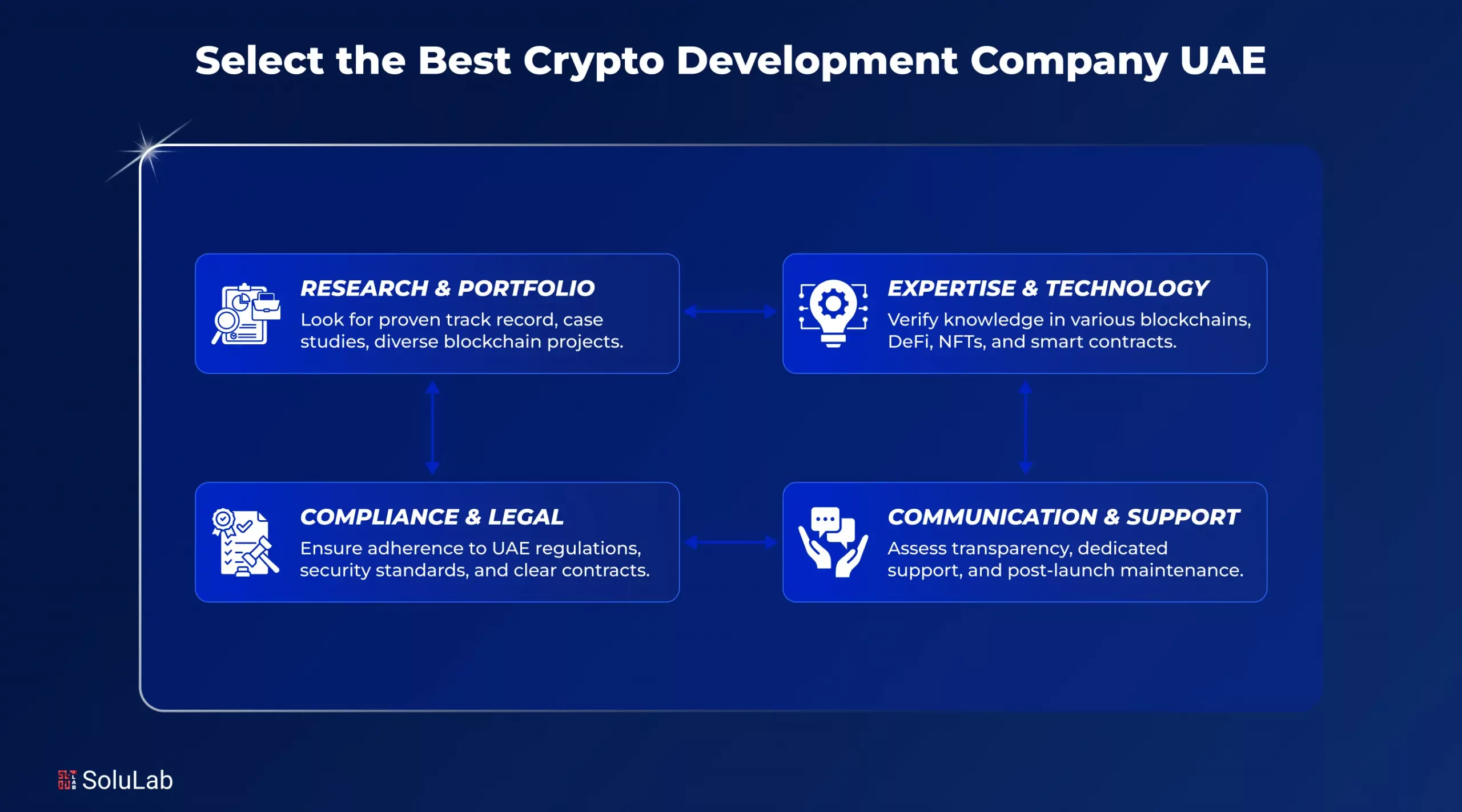
Select Best Crypto Development Company UAE

With countless crypto projects being launched daily, businesses are eager to tap into this growth. But choosing the right crypto development company in the UAE can be overwhelming. 

Many companies claim expertise, yet they often lack the technical knowledge, regulatory understanding, or proven track record necessary to deliver secure and scalable solutions.

This is why in this guide, we have listed factors to consider when selecting a cryptocurrency development company in the UAE, helping you identify a reliable partner that understands both technology and the local market, ensuring your crypto project succeeds.

Why Is The UAE Becoming A Global Cryptocurrency Hub?

The United Arab Emirates (UAE) is establishing itself as a leading destination for cryptocurrency innovation and investment. These changes are driven by government policies, the development of blockchain-friendly ecosystems, and a growing demand for crypto solutions.

1. Government Support and Regulations

The UAE has implemented a clear legal framework for digital assets, including the establishment of the Virtual Assets Regulatory Authority (VARA) in Dubai and the Securities and Commodities Authority (SCA) at the federal level. These bodies ensure compliance with Anti-Money Laundering (AML) and Counter Financing of Terrorism (CFT) regulations, fostering a secure environment for crypto businesses. 

2. Presence of Blockchain-Friendly Ecosystems (Dubai, Abu Dhabi)

Dubai and Abu Dhabi have developed specialized free zones such as the Dubai Multi Commodities Centre (DMCC) and the Abu Dhabi Global Market (ADGM), which offer tax incentives and regulatory support for crypto ventures. These hubs attract global blockchain startups and investors, positioning the UAE as a strategic location for digital asset development. 

3. Rising Demand for Crypto Solutions

The UAE has seen a substantial rise in bitcoin usage, with around 25.3% of the population owning crypto assets. It is accompanied by an increase in demand for services such as cryptocurrency token production, crypto wallet development, and blockchain development, which indicates a strong market for digital financial solutions.

Factors to Consider When Choosing a Crypto Development Company in UAE
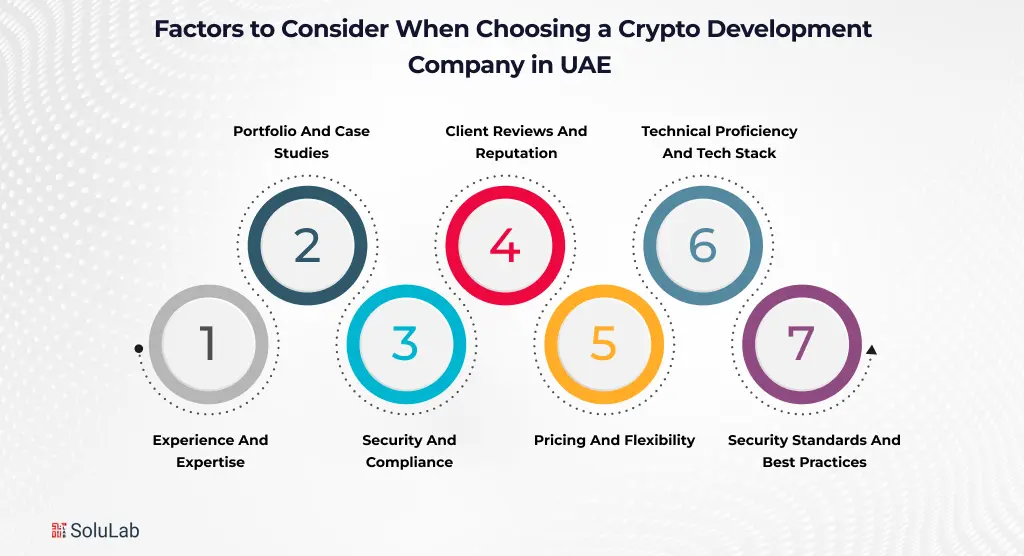
Crypto Development Company in UAE Factors

Choosing the right crypto exchange development company in the UAE is crucial for building a secure, reliable, and scalable platform. Here are the key factors you must evaluate before finalizing your partner.

  • Experience and Expertise: A company’s experience reflects its ability to handle complex blockchain projects. Look for teams with proven success in crypto exchange development and verified educational background, as expertise ensures faster delivery, fewer errors, and better long-term performance.
  • Portfolio and Case Studies: Reviewing portfolios and case studies helps you understand the company’s past work. It gives insights into industries served, project complexity handled, and real-world results achieved, helping you gauge their reliability and innovation.
  • Security and Compliance: Crypto exchanges deal with sensitive financial data. The company must follow the UAE’s regulatory guidelines and integrate features like KYC, AML, and multi-layer security to prevent fraud, ensuring full compliance and trust.
  • Client Reviews and Reputation: Testimonials and third-party ratings reveal how the company treats its clients. Positive reviews and strong reputations on platforms like Clutch or GoodFirms show credibility, professionalism, and quality service delivery.
  • Pricing and Flexibility: Transparent pricing is essential to avoid hidden costs. Choose a firm offering flexible packages tailored to your requirements, ensuring you get the right balance between cost-effectiveness and premium service quality.
  • Technical Proficiency and Tech Stack: The right company should master modern blockchain technologies like Ethereum, Binance Smart Chain, or Hyperledger. Their tech stack and development approach should support scalability, high performance, and advanced features for your exchange.
  • Security Standards and Best Practices: Cybersecurity is non-negotiable. Ensure the company uses encryption, cold wallet integration, multi-signature authentication, and regular audits. Following best practices builds a secure environment, safeguarding your platform from hacks and vulnerabilities.

Read Also: How Founders and Businesses Can Leverage Digital Asset Treasury in UAE?

Top Crypto Development Trends in the UAE to Watch

The UAE is becoming a worldwide cryptocurrency leader due to progressive regulations and an expanding digital economy. Central Bank Digital Currencies (CBDCs), the rise of DeFi and NFTs, and the advent of Web3 businesses are among the key trends affecting the market.

1. CBDC Initiative: The Digital Dirham

The UAE is preparing to launch the “Digital Dirham,” a Central Bank Digital Currency (CBDC) aimed at modernizing the financial system and improving payment efficiency. This project establishes the UAE as a leader in the adoption of digital currency. 

2. The Development of DeFi and NFTs

The UAE’s crypto industry is seeing substantial growth in decentralized finance (DeFi) and non-fungible tokens (NFTs). Innovative platforms are emerging, presenting new investment options and digital asset ownership structures. 

3. Growth of Web3 Startups

Abu Dhabi’s  Hub71+ Digital Assets program encourages the establishment of Web3 startups by offering assistance, incentives, and access to a network of investors and partners. This effort intends to speed up the development of decentralized applications and blockchain solutions

CTA2

Conclusion

If you’re considering launching a cryptocurrency enterprise in the UAE, now is the time to do so. The region is rapidly becoming a major focus for blockchain innovation, and the appropriate crypto development partner can make all the difference.  

It’s all about collaborating with a company that understands rules, knows how to build across chains, and can future-proof your product with tangible financial benefits.

SoluLab, a Crypto development company in the UAE, can help you launch a crypto project in the UAE. Get in touch with us today!

FAQs

1. Why is hiring a cryptocurrency development company in the UAE important?

A professional company ensures secure, compliant, and scalable crypto solutions, helping your project succeed while avoiding regulatory, technical, and operational risks in the UAE market.

2. What services does a crypto exchange development company UAE provide?

They develop secure, fully functional exchanges with features like multi-currency support, KYC/AML compliance, wallet integration, liquidity management, and ongoing technical support.

3. How long does it take to launch a crypto project in the UAE?

Development timelines vary but generally take 4–12 weeks, depending on project complexity, blockchain type, and whether it involves exchanges, wallets, or token creation.

4. How does cryptocurrency token development work?

Companies create custom tokens using blockchain platforms like Ethereum or Binance Smart Chain, ensuring security, scalability, and smart contract integration for diverse use cases.

5. How secure are the services offered by crypto companies in the UAE?

Top companies follow best practices, including smart contract audits, secure coding, KYC/AML compliance, and regular vulnerability testing to protect client assets.

Top 7 Smart Contract Platforms to Consider in 2026

Top Smart Contract Platforms

Struggling to choose the right smart contract platform? With so many blockchains claiming to be the fastest, cheapest, or most secure, it’s easy to get overwhelmed. Whether you’re building a DeFi app, launching a token, or creating a game, picking the wrong platform can lead to high gas fees, slow transactions, or limited developer support. 

However, not all smart contract platforms are created equal. Some are perfect for enterprise-grade apps, while others shine in speed or scalability. In 2026, the competition is fiercer than ever, new players are entering the space, while existing ones are upgrading their ecosystems.

In 2025, the global smart contracts market is projected to expand from $2.63 billion in 2024 to $3.21 billion, marking a CAGR of 22%. 

To save you hours of research, we’ve listed the Top 7 Smart Contract Platforms worth your attention in 2026. This guide breaks down what makes each one unique, covering everything from security and scalability to developer tools and ecosystem growth. 

What Are Smart Contracts?

To put it simply, smart contracts are electronic contracts that take automated action when certain criteria are met. The main distinction between them and regular contracts is that they are encoded and kept on a blockchain.

In essence, a smart contract is a computer program that, under specific circumstances, automatically regulates the transfer of digital assets between parties. They make agreements unchangeable and impenetrable by automating communication between the sender and the recipient.

Types of Smart Contracts

In the realm of blockchain technology, smart contracts are becoming more and more widespread and are altering the way we conduct transactions. However, did you realize that there are several types of smart contracts?

The following is a list of several types of smart contracts that may be made with various Smart Contract platforms:

1. Smart Legal Contracts

Smart legal contracts are the first item on our list. These are basically standard legal contracts with additional smart contract features.

They comprise certain terms and conditions that, upon fulfillment of predetermined criteria, are automatically carried out. This can greatly expedite judicial proceedings and lower the possibility of misunderstandings or human mistakes.

2. Decentralized Autonomous Organizations (DAO)

One kind of smart contract that makes it possible to create leaderless groups is called a Decentralized Autonomous Organization, or DAO.

These companies are fully decentralized on blockchain technology and are administered by computer programs that provide regulations.

Because DAOs do away with the necessity for a centralized authority, decision-making procedures may be more fair and transparent.

3. Application Logic Contracts (ALC)

The Application Logic Contract (ALC) is a different smart contract. The logic of decentralized apps (dApps) is managed by these contracts.

For example, they can oversee the voting procedure in a DAO or set the rules for a game that runs on the blockchain.

Developers may now create intricate apps on top of blockchain networks because of ALCs.

4. Token Contracts

One kind of smart contract that controls the production and distribution of digital tokens is the token contract. From cryptocurrencies like Bitcoin or Ethereum to distinct digital assets like Non-Fungible Tokens (NFTs), these tokens may represent a wide range of assets.

Token contracts guarantee a safe, regulated environment for the creation, transfer, and destruction of tokens.

5. Marketplace Contracts

Finally, we have marketplace contracts. Decentralized markets employ these smart contracts to make transactions easier. They are capable of managing reputation management systems, handling escrow services, and automating the purchasing and selling process. Decentralized e-commerce is made possible in part via marketplace contracts.

To put it briefly, there are several variations of smart contracts, each with specific uses and advantages. Digital contracts have the potential to revolutionize our interactions with the digital environment by facilitating decentralized organizations and expediting legal processes.

Things to Consider to Select the Best Smart Contract Platforms

When evaluating the best smart contract platforms, there are a few key criteria to consider. These include:

1. Scalability: The platform must be able to handle a large number of transactions without sacrificing performance.

2. Security features: The platform must have strong security features to protect against attacks, especially when using infrastructures such as bsc rpc that require consistent and secure connectivity.

3. Developer-friendliness: The platform must be easy for developers to use so that they can quickly and easily build decentralized applications.

4. Decentralized Applications: The platform must be able to support a variety of decentralized applications, including those with different requirements in terms of scalability, security, and functionality.

These criteria are important because they ensure that the platform is capable of supporting the needs of decentralized applications. A platform that is not scalable, secure, or developer-friendly will not be able to support the most demanding decentralized applications.

In addition to these criteria, it is also important to consider the overall ecosystem of the platform. This includes the availability of tools, documentation, and support. A platform with a strong ecosystem will make it easier for developers to build decentralized applications.

By considering all of these factors, you can choose the best smart contract platform for your needs.

Top 7 Smart Contract Platforms to Consider in 2026

1. Ethereum

Ethereum is the smart contract platform and remains the most used in 2026. It offers a mature ecosystem, a strong developer community, and high security. Key features include EVM compatibility, extensive DApp support, Layer 2 scalability solutions, and decentralized governance.

With billions in Total Value Locked (TVL), it’s a go-to choice for DeFi projects and NFT platforms. Best suited for developers, startups, and enterprises seeking a robust, battle-tested foundation for building decentralized applications.

2. Binance Smart Chain (BSC)

Binance Smart Chain (BSC) is a high-performance blockchain developed by Binance to support smart contracts and decentralized apps (dApps). It offers fast transactions, low fees, and compatibility with Ethereum through the EVM (Ethereum Virtual Machine). Key features include a dual-chain architecture, strong community support, and high scalability.

BSC is ideal for developers and users looking for affordable DeFi solutions, NFT platforms, and quick dApp deployment. It’s best suited for startups, retail users, and developers wanting to scale fast without high gas fees.

3. Cardano

Cardano is a research-driven smart contract platform known for its focus on security, scalability, and sustainability. Built on peer-reviewed academic research, it uses a unique proof-of-stake consensus called Ouroboros.

Key features include low energy usage, formal verification for smart contracts, and high interoperability. It’s suited for long-term projects in education, healthcare, and government sectors that value stability and precision.

4. Solana

Solana is a high-performance smart contract platform known for its fast transaction speeds and low fees. Designed for scalability, it can process over 65,000 transactions per second, making it ideal for DeFi apps and NFT projects.

Key features include its Proof of History consensus, low gas fees, growing developer ecosystem, and high throughput. Solana is best suited for developers building large-scale dApps, traders looking for speed, and creators launching NFT marketplaces that need efficiency without sacrificing performance.

5. Polkadot

Polkadot is a next-generation smart contract platform designed to enable multiple blockchains to operate together. Known for its unique parachain architecture, Polkadot ensures scalability, speed, and flexibility. Key features include interoperability, shared security, customizable blockchain development, and low fees.

It’s ideal for developers building cross-chain applications, startups seeking scalability, and enterprises focused on security. With its growing ecosystem and strong community support, Polkadot is a top choice for anyone looking to build powerful decentralized solutions in 2026.

6. Avalanche

Avalanche is a high-performance smart contract platform known for its speed, low fees, and eco-friendly approach. It supports custom blockchains and decentralized applications (dApps) with near-instant finality. Key features include subnets for scalability, Ethereum compatibility via the C-Chain, and low energy consumption.

Avalanche is ideal for developers building DeFi apps, enterprises looking for customizable blockchain networks, and users seeking fast, cost-effective transactions. Its flexible architecture makes it a strong choice for both startups and large-scale Web3 projects in 2026.

7. Tezos

Tezos is a self-upgradable smart contract platform known for its energy efficiency and strong governance model. Unlike many blockchains, Tezos allows seamless upgrades without hard forks, ensuring long-term adaptability. It supports formal verification for secure smart contracts, making it ideal for high-stakes industries.

With low transaction fees and eco-friendly proof-of-stake consensus, it’s a top choice for developers, enterprises, and environmentally conscious projects. Tezos is best suited for those prioritizing sustainability, on-chain governance, and security in smart contract development.

Smart Contract Development Company

Conclusion

In 2026, smart contract platforms will play a crucial role in the future of decentralized applications, finance, and innovation. Whether you’re a developer, investor, or tech enthusiast, choosing the right platform can make all the difference. From Ethereum’s ecosystem to Solana’s blazing speed and Cardano’s academic approach, each platform offers unique strengths. 

By staying informed and aligned with your goals, you can leverage the power of smart contracts to build, invest in, or support the next wave of blockchain innovation. SoluLab, a smart contract development company, can help you select the best platform as per your business requirements. Contact us today! 

FAQs

1. Why is Ethereum often considered the pioneer in smart contract platforms?

Ethereum, launched in 2015, introduced the concept of smart contracts in blockchain development. Its robust and versatile platform has been the foundation for countless decentralized applications. Despite challenges like scalability, Ethereum remains a pioneer due to its vast developer community, rich ecosystem, and ongoing improvements, such as Ethereum 2.0.

2. How do Binance Smart Chain and its BNB token play a role in the smart contract landscape?

Binance Smart Chain (BSC) is a blockchain network closely associated with Binance, one of the largest cryptocurrency exchanges. BSC enables faster and cheaper transactions compared to Ethereum. However, concerns have been raised about its centralization. The BNB token is the native cryptocurrency of Binance and is integral to the BSC ecosystem.

3. What makes Solana stand out among smart contract platforms?

Solana distinguishes itself with its high-performance blockchain, capable of processing thousands of transactions per second. Its unique consensus mechanism, Proof of History (PoH), contributes to its exceptional speed. Solana aims to address scalability issues, making it an attractive choice for decentralized applications requiring rapid and cost-effective transactions.

4. How does Polkadot’s interoperability feature impact the smart contract landscape?

Polkadot focuses on interoperability, allowing different blockchains to connect and share information seamlessly. Its relay chain serves as a bridge between blockchains, fostering a more interconnected and collaborative blockchain ecosystem. This interoperability can enhance scalability, security, and overall functionality.

5. What role do Smart Contracts Development Services play in the blockchain industry?

Smart Contracts Development Services, offered by companies like Solulab, are essential for creating, auditing, and deploying smart contracts. These services provide expertise in coding secure and efficient contracts tailored to the needs of decentralized applications. Collaborating with a reliable development service ensures the successful implementation of smart contracts.

6. How can one choose the right smart contract platform for a specific project?

Choosing the right smart contract platform involves assessing factors such as scalability, security, transaction speed, and the specific requirements of the project. Developers and businesses should consider the strengths and weaknesses of each platform, keeping in mind the goals and functionalities of their decentralized applications.

Blockchain: The Defining Technology of Our Future

Blockchain: The Defining Technology of Our Future

In an age where technological innovation continues to shape and redefine the way we live, work, and interact, one technology has emerged as a frontrunner in transforming industries and ushering in a new era of privacy, speed, and efficiency. Blockchain technology, with its decentralized  and immutable ledger system, stands as a game-changer that is reshaping industries across the spectrum.

This article explores the evolution of blockchain technology, its current applications, the top blockchain platforms, emerging trends, and the transformative potential it holds, with a particular focus on its applications in healthcare.

Understanding Blockchain Technology

Blockchain technology is often described as a distributed ledger system that records transactions in a secure, transparent, and immutable way. At its core, blockchain consists of a chain of blocks, each containing a list of transactions. These blocks are linked together, forming a chronological and unchangeable chain. Key characteristics that define blockchain technology include:

  • Decentralization: Unlike traditional centralized systems, blockchain operates on a decentralized network of nodes, ensuring that no single entity has control over the network.
  • Immutability: Once a transaction is recorded on the blockchain, it cannot be altered or deleted, making it an incorruptible and secure system.
  • Transparency: All participants in the blockchain network have access to the same data, ensuring transparency and trust among participants.
  • Security: Cryptography and consensus algorithms make blockchain extremely secure, reducing the risk of fraud and data breaches.

What Makes Blockchain Technology the Future?

Blockchain Technology the Future

Blockchain technology is often regarded as the future for several compelling reasons. Its potential to revolutionize various industries, its intrinsic features, and its ability to address some of the fundamental challenges of the digital age make it a technology with a promising outlook:

  • Security and Immutability: The foundation of blockchain technology is its ability to create secure, immutable, and tamper-proof records of transactions. This feature is essential in a world where data breaches and cyber threats are ever-present concerns.
  • Decentralization: Blockchain operates on a decentralized network of nodes, eliminating the need for intermediaries like banks or central authorities. This reduces the risk of single points of failure and enhances trust among participants.
  • Transparency: The transparent nature of blockchain means that all participants in the network can access the same data. This promotes trust and accountability, as anyone can verify the authenticity of transactions.
  • Trust and Authenticity: The use of cryptographic techniques ensures that transactions and data are secure and authentic. This is especially valuable in industries where trust is paramount, such as supply chain management, healthcare, and finance.
  • Reduction of Fraud: Blockchain’s transparency and security measures make it exceedingly difficult for malicious actors to engage in fraudulent activities, whether in financial transactions or document verification.
  • Efficiency and Speed: Blockchain can significantly streamline processes by automating tasks through smart contracts. These self-executing contracts remove the need for intermediaries and reduce the time and costs associated with manual processes.
  • Reduced Costs: By eliminating intermediaries and streamlining processes, blockchain has the potential to reduce costs in various industries, making it an appealing technology for businesses seeking efficiency and cost savings.
  • Global Reach: Blockchain technology is accessible on a global scale. It can facilitate cross-border transactions, making it an excellent solution for industries such as international finance, trade, and remittances.
  • Innovation and Disruption: Blockchain has spurred innovation and entrepreneurship, leading to the creation of new applications, business models, and industries. It has already disrupted traditional financial systems, and its potential to disrupt other sectors, such as healthcare, real estate, and supply chain management, is substantial.
  • Tokenization of Assets: Blockchain enables the tokenization of real-world assets, from real estate to art. This allows for fractional ownership, increased liquidity, and democratized access to asset classes that were previously reserved for a select few.
  • Social Impact: Blockchain can be a powerful tool for addressing social and environmental challenges. It has been used for identity verification, improving access to financial services, and tracking the provenance of goods, which can help combat fraud and support ethical business practices.
  • Interoperability: Efforts are underway to make different blockchains interoperable, allowing for seamless data transfer and transactions between networks. This opens up new possibilities for combining the strengths of different blockchain platforms.
  • Emerging Technologies: Blockchain is often seen as a complementary technology to other emerging technologies like the Internet of Things (IoT) and artificial intelligence (AI). It can enhance the security and trustworthiness of IoT networks and AI algorithms by providing verifiable data sources and execution of smart contracts.
  • Environmental Considerations: While blockchain’s energy consumption has been a concern, ongoing research and the development of more energy-efficient consensus algorithms aim to make blockchain technology more sustainable.

In brief, the future of blockchain technology is promising due to its potential to reshape industries, enhance security, reduce fraud, and promote transparency. As it continues to evolve and find new applications, blockchain is likely to play an increasingly significant role in our digital world, making it a defining technology of the future.

Applications of Blockchain 

Applications of Blockchain

Have a look at some of the Use cases of blockchain that are changing the world of technology: 

  • Global Supply Chain Management

Blockchain will enable end-to-end transparency in supply chains, tracking products and verifying their authenticity. By 2025, the blockchain supply chain market is projected to reach $9.85 billion, growing at a CAGR of 50.6%. (Source: MarketsandMarkets)

  • Healthcare Data Security

Blockchain can secure Electronic Health Records (EHRs) and patient data, enhancing privacy and accessibility. The global blockchain in healthcare market is estimated to reach $1.6 billion by 2025, at a CAGR of 65.5%. (Source: Grand View Research)

  • Decentralized Finance (DeFi)

DeFi platforms offer decentralized lending, borrowing, and trading of cryptocurrencies, disrupting traditional finance. DeFi’s Total Value Locked (TVL) exceeded $100 billion in 2021, showcasing rapid growth in the sector. (Source: DeFi Pulse)

  • Cross-Border Payments

Blockchain technology can streamline cross-border transactions, making them faster and more cost-effective. The global blockchain remittances market is expected to reach $1.35 billion by 2026, growing at a CAGR of 24.8%. (Source: Mordor Intelligence)

  • Smart Contracts in Legal

Smart contracts automate legal processes, such as contract execution and dispute resolution. The global smart contract market is anticipated to reach $345 million by 2026, with a CAGR of 32.5%. (Source: MarketsandMarkets)

  • Digital Identity Verification

Blockchain can securely manage digital identities, reducing identity theft and ensuring user privacy. The global digital identity solutions market is projected to be worth $49.5 billion by 2025, growing at a CAGR of 17.3%. (Source: MarketsandMarkets)

  • Real Estate Transactions

Blockchain simplifies property transactions and enhances property title records. The global blockchain in real estate market is estimated to reach $1.66 billion by 2026, growing at a CAGR of 67.3%. (Source: Allied Market Research)

Read More: Blockchain Technology as a Platform for Digitization

  • Renewable Energy Trading

Blockchain facilitates peer-to-peer energy trading, promoting the adoption of renewable energy sources. Global blockchain-based renewable energy trading is estimated to reach 87.5 GW capacity by 2025, with 460 projects in development. (Source: IRENA)

  • Intellectual Property Protection

Content creators use blockchain to protect intellectual property rights. By 2026, the blockchain for intellectual property market is estimated to reach $5.5 billion, growing at a CAGR of 40.1%. (Source: ResearchAndMarkets)

  • Government Services and Transparency

Governments use blockchain to enhance transparency and efficiency in services, such as land registry and taxation. By 2025, the global blockchain in government market is estimated to reach $30.7 billion, growing at a CAGR of 69.4%. (Source: MarketsandMarkets)

Read More: Top 10 Real World Applications of Blockchain Technology

These applications represent just a fraction of the potential use cases for blockchain technology in the future. As adoption continues to grow, the impact on these industries will become more pronounced, and blockchain will play a pivotal role in reshaping various sectors of the economy.

Blockchain in HealthcareBlockchain in Healthcare

Blockchain technology has the potential to transform the healthcare industry in numerous ways by addressing issues related to data security, interoperability, and patient privacy. Here’s an in-depth look at how blockchain is being applied in healthcare:

Secure Health Records Management

Application: Blockchain can be used to securely store and manage Electronic Health Records (EHRs) and patient data.

Benefits: 

  • Improved data security: Patient data is encrypted and stored in a tamper-proof manner, reducing the risk of data breaches.
  • Data accessibility and control: Patients can grant access to their data as needed, enhancing privacy and control.

Use Case: Estonia, through its e-Health Authority, uses blockchain to secure the health records of its citizens. This has reduced data breaches and increased patient control over their health data.

Clinical Trial Management

Application: Blockchain smart contracts can automate and streamline the management of clinical trial data.

Benefits:

  • Improved transparency: Trial data is stored in an immutable and transparent way, reducing fraud.
  • Faster and more efficient trials: Smart contracts automate tasks like consent management and data sharing, reducing the time and costs associated with clinical trials.

Use Case: Mediledger is a blockchain platform that verifies the authenticity of pharmaceuticals in clinical trials, ensuring drug safety and reducing fraud.

Drug Traceability

Application: Blockchain can track the production and distribution of drugs, ensuring the authenticity and provenance of pharmaceuticals.

Benefits:

  • Reduced counterfeit drugs: Blockchain’s transparency can help verify the legitimacy of drugs, reducing health risks.
  • Enhanced drug recalls: Blockchain can quickly identify the source of contaminated or recalled drugs.

Use Case: The U.S. FDA is exploring blockchain for tracking and tracing prescription medications to combat counterfeit drugs in the pharmaceutical supply chain.

Health Insurance and Claims Processing:

Application: Blockchain can streamline health insurance claims processing by automating verification and payments through smart contracts.

Benefits:

  • Reduced fraud: The transparent and secure nature of blockchain can reduce fraudulent claims.
  • Faster and more efficient claims processing: Automation reduces administrative costs and processing times.

Use Case: Several insurance companies, such as Aetna and Humana, are exploring blockchain for claims processing and fraud prevention.

Secure Telemedicine and Telehealth:

Application: Blockchain enhances the security of telemedicine platforms, protecting sensitive patient data.

Benefits:

  • Secure data sharing: Patient information is encrypted and shared securely, ensuring confidentiality.
  • Trust in remote healthcare: Patients and healthcare providers can have confidence in the security of telehealth interactions.

Use Case: The Solve.Care platform combines blockchain and telehealth to provide secure and efficient remote healthcare services.

CTA_2

Conclusion

Blockchain technology is not just a buzzword but a transformative force that is reshaping industries and redefining the way we interact with data, value, and trust. Its applications in healthcare and various other sectors hold the promise of greater security, transparency, and efficiency. As the technology continues to evolve, it is crucial for businesses and individuals to stay informed and leverage the potential of blockchain for a better future. With its growing ecosystem, blockchain is set to remain the defining technology of our future, and its impact will only continue to expand.

SoluLab stands as a leading blockchain development company with cutting-edge blockchain development services, offering businesses the means to propel themselves into the future. Their team, comprised of top-tier blockchain developers, demonstrates exceptional proficiency in crafting and implementing tailored blockchain solutions that cater to real-world applications.

Collaborating with SoluLab affords businesses the opportunity to tap into a reservoir of seasoned Hire blockchain developers well-versed in the intricacies of blockchain ecosystems and protocols. These experts adeptly shepherd clients through the entire journey, commencing from the initial ideation stage and culminating in the seamless integration of blockchain technology into their operations. Whether one is in the process of exploring blockchain’s potential or seeking to enhance existing blockchain applications, SoluLab emerges as one of the best  blockchain development companies poised to bring these aspirations to fruition.

FAQs

1. What is Blockchain technology, and how does it work?

Blockchain is a new age technology that records transactions across a network of systems. It works by creating a chain of data blocks, where each block contains a set of transactions. Once added, these blocks are cryptographically linked, forming a secure and unchangeable record. This decentralized nature ensures that no single entity has control, enhancing security and transparency.

2. What are the key benefits of Blockchain technology?

The main advantages of Blockchain technology include enhanced security due to its tamper-proof nature, increased transparency through open access to data, decentralization, which reduces the risk of central authority manipulation, and the ability to streamline processes and reduce intermediaries, resulting in cost savings and increased efficiency.

3. Is Blockchain technology only for cryptocurrencies like Bitcoin?

No, Blockchain technology has a broader range of applications beyond cryptocurrencies. While Bitcoin is one application of blockchain, the technology can be used in various industries such as supply chain management, healthcare, finance, voting systems, and more, where secure, transparent, and tamper-proof data management is required.

4. How does Blockchain impact data security and privacy?

Blockchain improves data security by encrypting and decentralizing data of the users. Once data is recorded, it is extremely challenging to alter, ensuring its integrity. It also offers selective data sharing, where users have control over who can access their data, thus promoting privacy.

5. Are there any climatic concerns related to Blockchain technology?

Blockchain technology, particularly Proof of Work (PoW) systems like Bitcoin, has faced criticism for its energy consumption. However, newer consensus algorithms, like Proof of Stake (PoS), are more energy-efficient. Additionally, efforts are being made to mitigate environmental impacts through eco-friendly blockchain solutions.

The Core Concept of Blockchain Development

The Core Concept of Blockchain Development

In the ever-evolving landscape of technology, blockchain has emerged as a transformative force, revolutionizing the way businesses operate and ensuring secure, transparent, and decentralized data management. With its potential to enhance security, streamline operations, and foster trust among stakeholders, blockchain development has become a crucial element in reshaping various industries. This blog delves into the core concepts of blockchain development, explores its applications across diverse sectors, and highlights the key trends shaping the future of this groundbreaking technology.

Blockchain Development: A Comprehensive Overview

Delve into a comprehensive overview of blockchain development, understanding its intricacies and exploring its various applications.

Understanding Blockchain Development Concepts

Blockchain development is a multifaceted process that revolves around various crucial concepts pivotal to comprehending the underlying technology. A distributed ledger forms the foundational structure of blockchain, facilitating the transparent and secure recording of data transactions across a network of computers. The implementation of consensus mechanisms ensures the validation and agreement of data entries among network participants. Smart contracts, an integral component of blockchain development, enable self-executing and autonomous agreements, ensuring trust and transparency in various business interactions. Additionally, the application of robust cryptographic security measures guarantees the integrity and immutability of data stored within the blockchain.

CTA_1

Exploring the Blockchain Development Process

The intricate process of blockchain development involves several stages, each crucial for the successful deployment of blockchain solutions. The initial phase typically involves ideation and conceptualization, where developers collaborate with domain experts to identify the specific business requirements that blockchain technology can address. Subsequently, the design phase focuses on creating a comprehensive architecture that aligns with the identified objectives. Development follows, where developers leverage programming languages such as Solidity and languages compatible with blockchain frameworks like Ethereum. Rigorous testing is paramount to ensure the reliability and security of the developed blockchain solutions before deployment. The final stage involves the deployment of blockchain solutions into the target environment, ensuring seamless integration and operational efficiency.

Top Blockchain Trends Shaping the Industry

Top Blockchain Trends Shaping the Industry

Explore the top blockchain trends that are currently shaping the industry and driving innovation across various sectors.

  • Emergence of Decentralized Finance (DeFi) on Blockchain

The recent surge in decentralized finance (DeFi) has significantly impacted the blockchain landscape, introducing a range of financial services that operate without the need for traditional financial intermediaries. DeFi platforms provide an array of services, including decentralized lending, borrowing, and trading, all made possible through the utilization of blockchain technology. The integration of DeFi protocols has broadened the utility of blockchain beyond its initial scope of facilitating secure cryptocurrency transactions. With the advent of DeFi, users can engage in a variety of financial activities, including yield farming, liquidity provision, and decentralized exchanges, enabling greater accessibility and inclusivity within the financial ecosystem.

  • Interoperability Solutions Enhancing Blockchain Adoption

Interoperability solutions are rapidly gaining traction within the blockchain ecosystem, addressing the critical need for seamless communication and data transfer between disparate blockchain networks. In response to the challenges posed by isolated blockchain networks, numerous projects are actively pursuing cross-chain interoperability, aiming to establish a cohesive framework that enables the seamless exchange of assets and information across various blockchain protocols. These interoperability solutions seek to bridge the gap between different blockchain platforms, fostering an environment conducive to the frictionless and efficient transfer of data and assets. With interoperability becoming an increasingly essential feature, the blockchain industry is witnessing a shift toward collaborative and interconnected ecosystems that promote the free flow of value and information across diverse blockchain networks.

Read more : The Role of Blockchain in Web 3 Development

Blockchain Platforms: Revolutionizing Data Management

Uncover the ways in which blockchain platforms are revolutionizing data management, ensuring security, and enhancing transparency in digital transactions.

  • Decentralized Storage Solutions on Blockchain Platforms

Blockchain platforms have paved the way for the development of decentralized storage solutions, addressing the need for secure and efficient data management. By leveraging blockchain’s inherent features, decentralized storage solutions ensure data integrity and security, mitigating the risks associated with centralized data repositories. These platforms utilize distributed networks to store data across multiple nodes, eliminating the vulnerabilities typically associated with single-point data storage systems. The utilization of blockchain-based storage solutions also contributes to enhanced data accessibility, enabling users to securely access and manage their information without relying on intermediaries.

  • Enhancing Supply Chain Management through Blockchain

The integration of blockchain technology has brought about a transformation in the supply chain management landscape, enabling streamlined and transparent processes throughout the entire supply chain. With blockchain, stakeholders gain access to a decentralized and immutable ledger that records every transaction and movement of goods, thereby enhancing traceability and accountability. The implementation of smart contracts within supply chain management systems automates various contractual agreements, ensuring the seamless execution of predefined conditions. Additionally, blockchain’s transparent and secure nature allows for increased visibility and trust among supply chain participants, fostering efficient collaboration and reducing the risk of fraud and counterfeiting.

Blockchain Technology Companies: Driving Innovation and Adoption

Learn about the pioneering efforts of blockchain technology companies in driving innovation and fostering widespread adoption in the digital landscape.

  • Pioneering Innovations by Leading Blockchain Technology Companies

Several prominent blockchain technology companies have emerged as key contributors to the ongoing evolution of the blockchain landscape. These companies play a crucial role in driving innovation and fostering the adoption of blockchain technology across various industries. Through the development of cutting-edge solutions and platforms, these companies have significantly contributed to the advancement of blockchain applications, spanning areas such as finance, supply chain, healthcare, and more. Notable companies in the blockchain technology space have been instrumental in introducing novel use cases and addressing critical challenges, thereby establishing themselves as essential catalysts for the widespread adoption of blockchain technology globally.

  • Collaborative Initiatives and Partnerships Among Blockchain Technology Companies

The blockchain industry has witnessed an increasing number of collaborative initiatives and partnerships between various technology companies. These collaborations aim to leverage the collective expertise and resources of multiple entities to drive innovation, develop new solutions, and expand the scope of blockchain technology applications. Through strategic partnerships, blockchain technology companies seek to address industry-specific challenges, foster interoperability between different blockchain platforms, and promote the adoption of standardized protocols and frameworks. Collaborative efforts have also been instrumental in establishing unified standards for data sharing, security, and governance, paving the way for the development of a more interconnected and robust blockchain ecosystem.

Blockchain Technology Applications: Transforming Industries and Processes

Blockchain Technology Applications

Witness the transformative impact of blockchain technology applications on diverse industries and the processes they undertake.

  • Revolutionizing Supply Chain Management with Blockchain Technology

Blockchain technology has introduced a paradigm shift in supply chain management, enabling businesses to streamline processes, enhance transparency, and optimize logistics operations. By leveraging blockchain platforms, companies can effectively track and trace products throughout the supply chain, ensuring authenticity and minimizing the risk of counterfeiting and fraud. The implementation of blockchain-based solutions has facilitated real-time monitoring of inventory, improved supplier management, and enhanced visibility across the supply chain network. As a result, businesses can achieve greater efficiency, reduce operational costs, and build trust among stakeholders, ultimately leading to a more robust and resilient supply chain ecosystem.

  • Enhancing Financial Services through Blockchain Innovations

The financial services sector has embraced blockchain technology to revolutionize traditional banking and payment systems, offering secure, efficient, and decentralized solutions for various financial transactions. Blockchain platforms enable seamless peer-to-peer transactions, eliminating the need for intermediaries and reducing transaction costs. With the integration of smart contracts, financial institutions can automate complex financial processes, such as loan approvals, insurance claims, and trade settlements, leading to faster and more reliable service delivery. Furthermore, the use of blockchain technology in the financial services industry ensures data integrity, enhances customer trust, and provides greater transparency, fostering a more inclusive and accessible financial ecosystem for businesses and consumers alike.

Enterprise Blockchain Platforms: Optimizing Business Operations and Security

Discover how enterprise blockchain platforms are optimizing business operations, enhancing security, and fostering efficiency in various organizational processes.

  • Leveraging Top Enterprise Blockchain Platforms for Secure Transactions

Enterprise blockchain platforms have emerged as essential tools for businesses seeking to enhance security, efficiency, and transparency in their operations. By leveraging top enterprise blockchain platforms, organizations can facilitate secure transactions, streamline complex processes, and mitigate the risk of data breaches and fraudulent activities. These platforms offer robust security features, including encryption and decentralized storage, ensuring the integrity and confidentiality of sensitive business data. Furthermore, enterprise blockchain platforms enable seamless collaboration and data sharing among stakeholders, fostering a more interconnected and resilient business environment.

  • Exploring the Benefits of Blockchain Technology in Business Ecosystems

The integration of blockchain technology in business ecosystems offers numerous benefits, including improved data integrity, enhanced operational efficiency, and increased trust among partners and customers. By implementing blockchain-based solutions, enterprises can establish tamper-proof records, automate compliance procedures, and streamline supply chain management processes. Moreover, blockchain technology applications enable seamless cross-border transactions, eliminating barriers to international trade and fostering greater collaboration among global business networks. As a result, businesses can achieve greater resilience, agility, and competitiveness in the ever-evolving digital landscape.

Check Our Case Study: OborTech

Blockchain in Healthcare: Transforming Patient Care and Data Security

Explore the transformative role of blockchain in healthcare, ensuring enhanced patient care and bolstering data security and privacy.

  • Enhancing Data Security and Privacy in Healthcare with Blockchain

Blockchain technology has revolutionized data security and privacy in the healthcare industry, offering robust solutions for protecting sensitive patient information and maintaining the integrity of medical records. By implementing blockchain-based data storage and encryption, healthcare providers can ensure the confidentiality and accessibility of patient data, mitigating the risk of unauthorized access and data breaches. Furthermore, blockchain technology applications enable secure sharing of medical records among authorized entities, facilitating seamless collaboration and information exchange in the healthcare ecosystem. With the integration of blockchain in healthcare, patients can have greater control over their health data, leading to improved care coordination and personalized treatment plans.

  • Leveraging Blockchain Development Companies for Healthcare Innovations

The collaboration with blockchain development companies has enabled healthcare organizations to leverage cutting-edge technologies and develop innovative solutions for addressing critical challenges in patient care and data management. These development companies offer expertise in blockchain integration, smart contract development, and decentralized application deployment, empowering healthcare providers to build secure and scalable platforms for managing medical records, clinical trials, and telemedicine services. By partnering with leading blockchain development companies, healthcare organizations can drive digital transformation, accelerate innovation, and improve patient outcomes, ultimately shaping the future of healthcare delivery and data security.

Investing in Blockchain Development: Driving Innovation and Market Growth

Understand the dynamics of investing in blockchain development, its role in driving innovation, and its contribution to market growth and expansion.

  • Seizing Opportunities in Blockchain Development for Sustainable Growth

Investing in blockchain development presents lucrative opportunities for businesses and investors seeking to capitalize on the growing demand for decentralized and secure technologies. By allocating resources to blockchain research and development, companies can foster innovation, enhance operational efficiency, and create competitive advantages in the dynamic market landscape. Moreover, investing in blockchain technology applications enables businesses to explore new revenue streams, expand their market presence, and cultivate a culture of technological resilience and adaptability. As blockchain continues to disrupt traditional business models, strategic investments in blockchain development can position organizations for long-term growth and success.

  • Evaluating the Potential of Blockchain Technology Companies for Investment

Blockchain technology companies have become key players in the global market, offering diverse solutions and services that cater to the growing demand for secure and efficient digital transactions. By evaluating the potential of blockchain technology companies for investment, stakeholders can identify promising opportunities, assess market trends, and diversify their portfolios with innovative and forward-thinking ventures. These companies often specialize in blockchain integration, smart contract development, and decentralized application deployment, providing comprehensive solutions for businesses across various industries. By strategically investing in reputable and visionary blockchain technology companies, investors can contribute to the advancement of cutting-edge technologies and shape the future of digital innovation and transformation.

Blockchain in Healthcare: Transforming Patient Care and Data Security

Witness the transformative impact of blockchain in healthcare, ensuring enhanced patient care and bolstering data security and privacy.

  • Leveraging Blockchain for Enhanced Data Security and Privacy in Healthcare

Blockchain technology has revolutionized data security and privacy in the healthcare industry, offering robust solutions for protecting sensitive patient information and maintaining the integrity of medical records. By implementing blockchain-based data storage and encryption, healthcare providers can ensure the confidentiality and accessibility of patient data, mitigating the risk of unauthorized access and data breaches. Furthermore, blockchain technology applications enable secure sharing of medical records among authorized entities, facilitating seamless collaboration and information exchange in the healthcare ecosystem. With the integration of blockchain in healthcare, patients can have greater control over their health data, leading to improved care coordination and personalized treatment plans.

  • Accelerating Innovations in Patient Care and Management with Blockchain Development Companies

The collaboration with blockchain development companies has enabled healthcare organizations to leverage cutting-edge technologies and develop innovative solutions for addressing critical challenges in patient care and data management. These development companies offer expertise in blockchain integration, smart contract development, and decentralized application deployment, empowering healthcare providers to build secure and scalable platforms for managing medical records, clinical trials, and telemedicine services. By partnering with leading blockchain development companies, healthcare organizations can drive digital transformation, accelerate innovation, and improve patient outcomes, ultimately shaping the future of healthcare delivery and data security.

Enterprise Blockchain Platforms: Enhancing Security and Transparency in Business Operations

Learn how enterprise blockchain platforms are enhancing security and transparency, facilitating seamless and secure business operations.

  • Leveraging Enterprise Blockchain Platforms for Secure and Transparent Transactions

Enterprise blockchain platforms have emerged as essential tools for businesses seeking to enhance security, transparency, and efficiency in their operations. By adopting blockchain technology, enterprises can streamline their supply chain management, financial transactions, and data-sharing processes, ensuring secure and tamper-proof records of all transactions and interactions. These platforms facilitate seamless collaboration among stakeholders, enabling real-time visibility into business processes and fostering trust and accountability within the organization. With the integration of enterprise blockchain platforms, businesses can revolutionize their operations, improve data management, and drive innovation across various industry verticals.

  • Exploring the Role of Top Enterprise Blockchain Platforms in Industry Transformation

Top enterprise blockchain platforms play a pivotal role in driving industry transformation and innovation, offering comprehensive solutions for businesses to optimize their operations and enhance their competitive edge. These platforms often provide secure and scalable infrastructure for deploying decentralized applications, smart contracts, and digital asset management systems, enabling enterprises to harness the power of blockchain technology for improved data security and streamlined business processes. By leveraging top enterprise blockchain platforms, organizations can automate complex workflows, reduce operational costs, and create new business models that align with the evolving market trends and customer demands.

Top Blockchain Trends: Shaping the Future of Digital Innovation and Transformation

Explore the top blockchain trends that are shaping the future of digital innovation and transformation across industries and sectors.

  • Analyzing the Latest Blockchain Trends and Their Impact on Various Industries

Top blockchain trends have been instrumental in shaping the future of digital innovation and transformation, driving the adoption of decentralized technologies across diverse industries. From the rise of non-fungible tokens (NFTs) to the integration of blockchain in supply chain management, these trends have redefined the way businesses operate, interact, and transact in the digital landscape. Additionally, the emergence of blockchain ecosystems and protocols has paved the way for enhanced security, interoperability, and scalability in blockchain-based applications, fostering a dynamic and inclusive environment for developers and entrepreneurs to explore new opportunities and develop groundbreaking solutions.

  • Embracing Blockchain Technology Applications for Sustainable Growth and Development

Blockchain technology applications have gained significant traction in recent years, empowering businesses to innovate, collaborate, and create value-driven solutions for their customers and stakeholders. These applications span various sectors, including finance, healthcare, supply chain, and entertainment, offering a wide array of use cases that cater to the evolving needs and preferences of modern consumers. By embracing blockchain technology applications, businesses can streamline their operations, improve data management, and foster trust and transparency in their interactions, ultimately contributing to sustainable growth and development in the digital era.

Exploring the Evolving Landscape of Blockchain Development Companies

Delve into the evolving landscape of blockchain development companies, understanding their roles in driving technological advancements and breakthroughs.

  • Understanding the Role of Blockchain Development Companies in Driving Innovation and Growth

Blockchain development companies have played a crucial role in driving innovation and growth in the digital landscape, offering comprehensive solutions and services to businesses looking to harness the potential of blockchain technology. These companies specialize in developing secure and scalable blockchain-based applications, smart contracts, and decentralized protocols, catering to the diverse needs of enterprises and startups across various industries. By collaborating with blockchain development companies, businesses can leverage cutting-edge solutions, streamline their operations, and unlock new opportunities for growth and expansion in the dynamic and competitive market.

  • Investing in Blockchain Development: Navigating the Opportunities and Challenges

Investing in blockchain development has become increasingly essential for businesses seeking to stay ahead of the curve and capitalize on the transformative power of decentralized technologies. As the demand for blockchain-based solutions continues to rise, businesses and investors are exploring new avenues to allocate resources and funds to blockchain development projects and initiatives. By strategically investing in blockchain development, businesses can foster innovation, drive efficiency, and create long-term value for their customers and stakeholders, ultimately contributing to the sustainable growth and success of their ventures in the digital economy.

Blockchain in Healthcare: Revolutionizing Data Management and Patient Care

Experience the revolutionary impact of blockchain in healthcare, revolutionizing data management and enhancing patient care and treatment.

  • Harnessing the Potential of Blockchain in Healthcare for Secure and Interoperable Data Sharing

Blockchain in healthcare has revolutionized data management and patient care, offering a secure and interoperable framework for storing, managing, and sharing sensitive medical information. With blockchain technology, healthcare providers can ensure the integrity and privacy of patient data, streamline administrative processes, and facilitate seamless communication among different stakeholders in the healthcare ecosystem. By adopting blockchain solutions, the healthcare industry can address critical challenges related to data security, interoperability, and transparency, fostering a patient-centric approach to healthcare delivery and enhancing overall health outcomes for individuals and communities.

  • Embracing the Advantages of Blockchain Technology for Improved Healthcare Services and Outcomes

Embracing the advantages of blockchain technology in healthcare has paved the way for improved healthcare services and outcomes, empowering patients and providers with secure and transparent access to critical medical data and resources. From enhancing medical record management to facilitating secure telemedicine services, blockchain technology has enabled healthcare organizations to optimize their operations, reduce costs, and deliver personalized care to patients in a timely and efficient manner. By leveraging blockchain in healthcare, organizations can drive innovation, promote data interoperability, and create a patient-centric healthcare ecosystem that prioritizes quality, accessibility, and affordability.

Leveraging Enterprise Blockchain Platforms: Driving Efficiency and Scalability

Explore how businesses leverage enterprise blockchain platforms to enhance efficiency and achieve scalability in their operations.

  • Exploring the Potential of Enterprise Blockchain Platforms for Streamlined Operations and Enhanced Security

Enterprise blockchain platforms have emerged as powerful tools for driving efficiency and scalability in businesses, enabling secure and transparent data management, streamlined supply chain processes, and seamless collaboration among stakeholders. By leveraging enterprise blockchain platforms, organizations can establish robust and tamper-proof systems that facilitate real-time transaction processing, data sharing, and asset management, ultimately leading to improved operational efficiency, enhanced security, and increased trust among business partners and customers.

  • Top Enterprise Blockchain Platforms: Navigating the Leading Solutions for Business Growth and Innovation

The market for enterprise blockchain platforms has witnessed significant growth, with various companies offering cutting-edge solutions and services tailored to the specific needs of businesses across diverse industries. Leading enterprise blockchain platforms such as Hyperledger Fabric, Corda, and Quorum have gained prominence for their robust features, scalability, and adaptability, empowering organizations to build and deploy customized blockchain solutions that address critical business challenges and drive digital transformation initiatives. By evaluating the top enterprise blockchain platforms, businesses can make informed decisions and choose the most suitable solution that aligns with their strategic objectives and long-term goals.

Blockchain Technology Companies: Pioneering Innovation and Disruption in the Digital Landscape

Discover the trailblazing efforts of blockchain technology companies in driving innovation and disrupting the digital landscape.

  • Unveiling the Pioneering Role of Blockchain Technology Companies in Driving Innovation and Disruption

Blockchain technology companies have played a pivotal role in pioneering innovation and disruption in the digital landscape, introducing groundbreaking solutions and applications that have transformed the way businesses operate and interact with their customers. These companies have been instrumental in advancing the adoption of blockchain technology across various sectors, fostering new business models, and redefining traditional processes to meet the demands of the modern digital economy. By collaborating with blockchain technology companies, businesses can leverage their expertise and experience to stay ahead of the competition and unlock new opportunities for growth and development in the ever-evolving market.

  • Driving Transformation with Blockchain Technology Applications: Enhancing Security and Transparency

Blockchain technology applications have revolutionized the way businesses approach security and transparency, offering a decentralized and immutable framework for managing digital assets, verifying transactions, and protecting sensitive data from unauthorized access and manipulation. With blockchain technology applications, businesses can ensure the integrity of their operations, mitigate risks, and build trust among their customers and partners, fostering a secure and reliable environment for conducting business transactions and exchanging valuable information. By integrating blockchain technology applications, organizations can drive transformation, improve their competitive advantage, and establish a solid foundation for sustainable growth and success in the digital era.

Investing in Blockchain Development: Navigating Opportunities for Growth and Innovation

Navigate the opportunities and challenges associated with investing in blockchain development, fostering growth, and encouraging innovation.

  • Understanding the Potential of Investing in Blockchain Development for Long-Term Value Creation

Investing in blockchain development presents a unique opportunity for individuals and businesses to capitalize on the growing demand for secure and efficient digital solutions fostered by the widespread adoption of blockchain technology across various industries. By strategically allocating resources and capital towards blockchain development initiatives, investors can participate in the transformative journey of technology-driven innovation, diversify their investment portfolios, and position themselves for long-term value creation and sustainable growth in the dynamic and rapidly evolving market landscape.

  • Blockchain in Healthcare: Transforming the Future of Medical Data Management and Patient Care

Blockchain’s integration into the healthcare sector has revolutionized the way medical data is managed, stored, and shared, ensuring data security, privacy, and interoperability while enhancing patient care and facilitating seamless collaboration between healthcare providers. The adoption of blockchain technology in healthcare has facilitated secure and transparent data exchange, improved patient outcomes, and streamlined administrative processes, leading to a more efficient and patient-centric healthcare ecosystem. By embracing blockchain technology in healthcare, medical institutions and stakeholders can unlock new opportunities for innovation, improve operational efficiency, and deliver better healthcare services to their patients, ultimately contributing to the advancement of the global healthcare industry.

Blockchain Ecosystem Protocols: Building a Sustainable and Interconnected Digital Infrastructure

Explore the foundational protocols and structures that contribute to a sustainable and interconnected blockchain ecosystem.

  • Analyzing the Role of Blockchain Ecosystem Protocols in Establishing a Sustainable and Interconnected Digital Infrastructure

Blockchain ecosystem protocols play a crucial role in building a sustainable and interconnected digital infrastructure, providing the necessary framework and guidelines for the development and deployment of decentralized applications, smart contracts, and digital assets across the blockchain network. These protocols enable seamless communication and interaction between different blockchain platforms, fostering interoperability, scalability, and cross-chain functionality, which are essential for creating a robust and reliable ecosystem that supports the diverse needs and requirements of the global digital economy. By embracing blockchain ecosystem protocols, businesses can unlock new opportunities for collaboration, innovation, and growth and contribute to the advancement of the blockchain technology landscape.

  • Top Blockchain Trends: Embracing Innovation and Digital Transformation in the Modern Era

The dynamic and ever-evolving nature of the blockchain industry has given rise to various trends that are shaping the future of digital innovation and transformation. Top blockchain trends such as decentralized finance (DeFi), non-fungible tokens (NFTs), and blockchain-as-a-service (BaaS) have gained significant traction, demonstrating the potential of blockchain technology to revolutionize traditional business models and drive unprecedented levels of efficiency, security, and transparency across different sectors. By staying updated with the latest blockchain trends, businesses and investors can make informed decisions, capitalize on emerging opportunities, and stay ahead of the curve in the fast-paced and competitive digital landscape.

Blockchain Technology Companies: Driving Innovation and Transforming the Digital Landscape

Learn how blockchain technology companies are driving innovation and transforming the digital landscape with their cutting-edge solutions.

  • Exploring the Impact of Blockchain Technology Companies on Innovation and Digital Transformation

Blockchain technology companies have played a pivotal role in driving innovation and transforming the digital landscape, offering a wide array of solutions and services that leverage the power of blockchain technology to address various industry challenges and meet the evolving needs of businesses and consumers. These companies are at the forefront of developing cutting-edge blockchain solutions, including decentralized applications, digital wallets, and blockchain-based platforms, and are actively contributing to the advancement of the global digital economy by fostering transparency, security, and efficiency in data management and transaction processing. By collaborating with blockchain technology companies, businesses can harness the potential of blockchain technology, streamline their operations, and create new opportunities for growth and success in the digital era.

  • Enterprise Blockchain Platforms: Enhancing Security and Efficiency in Business Operations

Enterprise blockchain platforms have emerged as a vital tool for businesses seeking to enhance security and efficiency in their day-to-day operations, enabling secure data management, transparent transaction processing, and streamlined supply chain management. These platforms offer a robust and scalable infrastructure that supports the diverse needs and requirements of modern businesses, facilitating seamless communication and collaboration between different stakeholders and ensuring the integrity and authenticity of digital assets and transactions. By leveraging enterprise blockchain platforms, organizations can optimize their business processes, improve data security, and build trust and credibility among their customers and partners, leading to improved business performance and long-term sustainability in the competitive global market.

Read Also: Decentralized Physical Infrastructure Networks (DePIN)

Blockchain in Healthcare: Transforming the Industry through Enhanced Data Security and Interoperability

Discover how blockchain is transforming the healthcare industry by enhancing data security and enabling seamless interoperability.

  • Leveraging Blockchain in Healthcare for Improved Data Management and Patient Care

Blockchain in healthcare has emerged as a transformative force, offering innovative solutions for improved data management, enhanced security, and streamlined interoperability among different healthcare stakeholders. By leveraging blockchain technology, healthcare providers and institutions can create secure and transparent data ecosystems that enable efficient and seamless sharing of patient information, leading to improved care coordination, reduced administrative burdens, and enhanced patient outcomes. Additionally, blockchain technology can facilitate the secure management of sensitive health data, ensuring data integrity and confidentiality while allowing patients to have greater control over their health information, leading to increased trust and confidence in the healthcare system.

  • Investing in Blockchain Development: Unveiling New Opportunities for Growth and Innovation

Investing in blockchain development presents unique opportunities for businesses and organizations to unlock new potentials for growth and innovation, leveraging the power of blockchain technology to streamline their operations, enhance data security, and foster trust and transparency in their business processes. By allocating resources and efforts toward blockchain development, companies can stay ahead of the curve, embrace digital transformation, and create new value propositions for their customers and stakeholders. Investing in blockchain development allows businesses to explore new use cases, optimize their operations, and drive sustainable growth in an increasingly competitive and dynamic business environment, paving the way for long-term success and resilience in the digital age.

CTA2

Conclusion

In conclusion, the rapid evolution of blockchain technology has paved the way for transformative changes across various industries, offering unprecedented opportunities for businesses to enhance their operations, secure their data, and drive innovation. By harnessing the expertise and solutions provided by the top 10 blockchain development companies, businesses can unlock the full potential of blockchain technology, enabling secure and efficient transactions while ensuring data integrity and privacy. The role of enterprise blockchain platforms in optimizing business operations and data security is crucial in fostering trust among stakeholders and streamlining complex business processes.

Companies seeking to integrate blockchain technology into their operations can benefit significantly from the expertise of leading blockchain development companies, which offer tailored solutions, consulting services, and comprehensive development capabilities. With the increasing demand for blockchain technology in diverse sectors, including healthcare, finance, and supply chain management, investing in blockchain development has become essential for businesses looking to stay ahead in the digital era.

SoluLab, a prominent blockchain development company, has been at the forefront of driving innovation and delivering cutting-edge blockchain solutions for businesses worldwide. With a team of seasoned blockchain developers and consultants, SoluLab offers comprehensive blockchain development and consulting services, empowering businesses to embrace the future of blockchain technology and achieve sustainable growth and success in the digital landscape. Through its commitment to excellence and innovation, SoluLab continues to be a leading player in the blockchain development industry, delivering top-notch solutions and services that cater to the evolving needs of businesses in an ever-changing digital world.

FAQs

1. What are the key benefits of implementing blockchain technology in businesses?

Blockchain technology offers enhanced security, transparency, and efficiency in data management and transactions. It facilitates decentralized and secure record-keeping, reduces the risk of fraud, and ensures trust among stakeholders.

2. How can businesses choose the right blockchain development company for their specific needs?

Businesses should consider factors such as the company’s experience, expertise, portfolio, and client testimonials. Assessing the company’s ability to deliver tailored solutions and its understanding of the latest blockchain trends is also crucial.

3. What are some of the top blockchain trends to watch out for in the coming years?

Some key blockchain trends include the rise of decentralized finance (DeFi) platforms, the integration of blockchain in supply chain management, the adoption of non-fungible tokens (NFTs), and the increasing use of blockchain in healthcare for secure data management.

4. How does blockchain technology contribute to enhancing data security and privacy?

Blockchain employs cryptographic techniques and decentralized data storage, making it difficult for unauthorized parties to tamper with data. Its transparency and immutability ensure data integrity, and its distributed ledger system enhances the security and privacy of sensitive information.

5.  What are the potential challenges businesses may face when integrating blockchain technology?

Some common challenges include scalability issues, regulatory uncertainties, the complexity of implementation, interoperability concerns, and the need for skilled professionals. Addressing these challenges requires careful planning and a thorough understanding of the technology.

6. How can blockchain development revolutionize the healthcare industry?

Blockchain in healthcare can improve data interoperability, enhance patient data security, enable efficient tracking of pharmaceutical supply chains, and facilitate streamlined medical record management, leading to improved patient care and overall operational efficiency.


Investing in Blockchain Development: A Strategic Guide for Businesses

Investing in Blockchain Development: A Strategic Guide for Businesses

Blockchain technology is a decentralized and immutable digital ledger system that records transactions across a network of computers in a secure and transparent manner. It consists of a chain of blocks, each containing a set of transactions. What sets blockchain apart is its cryptographic security and consensus mechanism, which ensures that once information is recorded, it cannot be altered or deleted without the consensus of the network participants. This technology was originally created as the underlying framework for cryptocurrencies like Bitcoin, but its potential applications have since expanded far beyond digital currencies.

Each block in a blockchain contains a group of transactions, and these blocks are linked together in chronological order, forming a chain. The unique feature of blockchain is its cryptographic validation mechanism, which ensures that once data is added to the chain, it cannot be altered or tampered with without consensus from the majority of network participants. This inherent security makes blockchain technology a trustworthy and tamper-resistant solution for various applications.

Read Our Blog Post: Top Blockchain Technology Companies in 2023

What is the Importance of Blockchain for Businesses?

Importance of Blockchain for Businesses

The importance of blockchain for businesses cannot be overstated, as it has the potential to transform traditional business operations, enhance security, and drive efficiency in a multitude of ways. Blockchain technology offers several key advantages:

  • Enhanced Security

Blockchain’s cryptographic nature makes it highly secure, reducing the risk of fraud and unauthorized access to data. This is especially critical in industries where data integrity is paramount, such as finance and healthcare.

  • Transparency and Trust

Blockchain’s transparent and immutable ledger fosters trust among participants. Businesses can verify the authenticity of transactions and data, reducing disputes and the need for intermediaries.

  • Efficiency and Cost Savings

Smart contracts, a feature of blockchain, automate contract execution and enforce terms without the need for intermediaries. This leads to reduced administrative costs and faster transaction processing times.

CTA1

  • Supply Chain Management

Blockchain enables end-to-end visibility in supply chains, reducing fraud, errors, and delays. Businesses can track products from origin to destination with greater accuracy.

Check Out the Blog Post: Top 10 Real World Applications of Blockchain Technology

  • Cross-Border Transactions

Blockchain facilitates cross-border transactions by eliminating the need for multiple intermediaries and reducing transaction fees. This is particularly beneficial for international trade.

  • Innovation

Blockchain is a catalyst for innovation, driving the development of new business models and revenue streams. Companies can explore blockchain applications that were previously unthinkable.

How does Blockchain work?

How does Blockchain work

Understanding how blockchain operates is crucial for businesses looking to leverage this technology effectively:

  • Transaction Submission

Users initiate transactions by creating a request to add data to the blockchain. This data can represent various actions, such as transferring assets, verifying identities, or recording ownership changes.

  • Validation

Transactions are sent to the network’s nodes, where they undergo verification. In public blockchains, this verification is typically done through a consensus mechanism like PoW.

  • Adding to the Ledger

Once a transaction is validated, it is added to a new block. This block is then linked to the previous one, forming a continuous chain.

  • Decentralized Verification

Multiple nodes on the network must reach a consensus before a transaction is considered valid. This decentralized verification ensures trust and security.

What are the Types of Blockchains?

Types of Blockchains

Blockchains come in various forms, each suitable for different business needs:

  • Public Blockchains

Public blockchains, like Bitcoin and Ethereum, are open to anyone and offer complete transparency. They are ideal for businesses looking to create blockchain-based applications with widespread accessibility.

  • Private Blockchains

Private blockchains are restricted to a specific group of participants, making them suitable for businesses that require control over access and data privacy. They are often used for internal processes and collaborations.

  • Consortium Blockchains

Consortium blockchains are a hybrid of public and private blockchains. They are governed by a group of organizations rather than a single entity. This type is beneficial for industries with multiple stakeholders, such as blockchain in supply chains.

How Can Businesses Leverage Blockchain Technology to Identify and Address Their Specific Needs?

In today’s fast-paced and ever-evolving business landscape, staying competitive requires constant innovation and the ability to leverage cutting-edge technologies. Blockchain technology has emerged as a transformative force, offering a wide array of applications for businesses across various industries. To embark on this journey, it’s crucial to start with the right blockchain business idea. In this guide, we’ll delve into the essential steps of blockchain business idea generation.

 Identifying Business Needs

  • Businesses must begin by identifying their specific needs and challenges. This introspective process involves examining existing inefficiencies, security concerns, or operational bottlenecks. 
  • For example, a company might struggle with supply chain transparency, financial fraud, or data privacy issues. Identifying these pain points is the first step in determining how blockchain can provide a solution.

Exploring Blockchain Applications

  • Once the business needs are clear, the next step is to explore the myriad blockchain applications available. Blockchain has proven its versatility, and it can be applied to various domains. 
  • Some popular blockchain use cases for businesses include supply chain management, smart contracts, identity verification, and decentralized finance (DeFi). Businesses should thoroughly research these applications to understand how they can address their specific challenges.

Assessing Market Demand

  • While blockchain technology holds immense potential, it’s essential to assess the market demand for your proposed blockchain solution. 
  • Market research is critical to determine whether there’s a demand for your idea. It involves analyzing your target audience, competitors, and potential partners. Understanding market trends, such as the increasing adoption of blockchain in various sectors, can help validate your business concept.

Formulating a Unique Blockchain Business Idea

  • To stand out in a competitive landscape, it’s crucial to formulate a unique blockchain business idea that aligns with your identified needs, blockchain applications, and market demand. This idea should address a specific pain point effectively and provide a clear value proposition.
  • For instance, if you’re in the logistics industry and have identified supply chain inefficiencies, your unique blockchain business idea could involve creating a blockchain-based platform that offers real-time visibility and traceability of goods. This solution could utilize smart contracts to automate and optimize processes, reducing costs and enhancing transparency

What are Some Key Emerging Trends and Innovations in Blockchain Technology?

Emerging Trends and Innovations in Blockchain Technology

Current State of Blockchain Adoption

Blockchain technology has made significant strides in recent years, with a growing number of businesses recognizing its potential to revolutionize various industries. The current state of blockchain adoption reflects a dynamic landscape of innovation and transformation.

  • Pilot Projects

Many businesses have moved beyond the initial experimentation phase and are now actively implementing blockchain solutions. Pilot projects are being conducted across diverse sectors, from supply chain management to healthcare.

Read Also: Top 10 Blockchain Development Companies in 2023

  • Mainstream Recognition

Blockchain is no longer a niche concept. It has gained recognition and support from major tech companies, financial institutions, and governments worldwide, showcasing its mainstream appeal.

  • Blockchain in Finance

In the financial sector, blockchain is being used for cross-border payments, remittances, and even central bank digital currencies (CBDCs). This adoption has the potential to disrupt traditional banking systems.

  • Supply Chain Optimization

Blockchain’s traceability and transparency features are driving its adoption in supply chain management. Businesses are utilizing blockchain to track and authenticate the origin of products, improving trust and reducing fraud.

Emerging Trends and Innovations

The blockchain landscape is continuously evolving, with several emerging trends and innovations shaping the future of business applications.

  • DeFi (Decentralized Finance)

DeFi projects are growing rapidly, offering decentralized lending, borrowing, and trading platforms. These innovations challenge traditional financial intermediaries and offer greater financial inclusion.

  • NFTs (Non-Fungible Tokens)

NFTs have gained immense popularity, particularly in the art, entertainment, and gaming industries. These digital assets are revolutionizing ownership and provenance verification.

  • Interoperability

Cross-chain compatibility and interoperability solutions are emerging, allowing different blockchains to communicate and share data seamlessly. This will enhance the flexibility and utility of blockchain networks.

  • Scalability Solutions

The challenge of blockchain scalability is being addressed through various solutions, such as Layer 2 solutions and sharding, enabling faster and more cost-effective transactions.

Read Our Blog: Best Companies to Hire Blockchain Developers in 2023

Regulatory Developments

Blockchain technology has prompted regulatory bodies to respond with new frameworks and guidelines.

  • Regulatory Clarity

Governments are increasingly providing regulatory clarity, which is essential for businesses to navigate the blockchain space confidently. This includes defining the status of cryptocurrencies and tokens.

  • AML/KYC Compliance

Regulations regarding Anti-Money Laundering (AML) and Know Your Customer (KYC) procedures are being strengthened to mitigate risks associated with blockchain-based financial transactions.

  • Taxation and Reporting

Tax authorities are developing guidelines for cryptocurrency taxation, ensuring that businesses and individuals are compliant with tax obligations related to blockchain assets.

Industry-specific Trends

Blockchain’s impact is felt differently across various industries, each with its unique trends and opportunities.

  • Finance

In finance, blockchain is leading to the tokenization of assets, making it easier to trade and transfer ownership of real estate, stocks, and other assets.

Read Our Blog: Blockchain Security: Best Practices Every Developer Should Know

  • Healthcare

In healthcare, blockchain is improving data security and interoperability, facilitating the secure sharing of patient records among healthcare providers.

  • Supply Chain

The supply chain industry is witnessing blockchain adoption to enhance traceability and reduce fraud, addressing consumer demands for transparency.

  • Energy

Blockchain is being used to create decentralized energy grids, allowing peer-to-peer energy trading and optimizing resource allocation.

What are the Key Components and Benefits of Blockchain Development Services?

Key Components and Benefits of Blockchain Development Services

Blockchain development services play a pivotal role in enabling businesses to harness the power of blockchain technology for their growth and innovation. These services encompass a wide range of solutions tailored to meet the specific needs of businesses seeking to leverage blockchain’s potential. Let’s delve into the essential aspects of blockchain development services, their significance, and how to make the right choice for your business.

Choosing a Reliable Development Partner

Selecting the right development partner for your blockchain project is a critical decision that can significantly impact its success. When considering blockchain development services, businesses should look for reliability, expertise, and a track record of delivering high-quality solutions. Here are key factors to consider when choosing a development partner:

  • Experience

Evaluate the development partner’s experience in blockchain technology. Have they worked on similar projects or blockchain use cases relevant to your business idea?

  • Portfolio

Examine their portfolio to gauge the quality of their previous work. Look for successful implementations of blockchain applications with businesses.

  • Expertise

Assess the team’s expertise in various blockchain platforms and technologies. Are they well-versed in blockchain trends and best practices?

  • Client References

Request client references and testimonials to gain insights into the partner’s reputation and the satisfaction of past clients.

  • Scalability

Ensure that the development partner can accommodate your project’s scalability requirements as your blockchain application grows.

Services Offered by Blockchain Development Firms

Blockchain development firms offer a comprehensive range of services to cater to diverse business needs. These services typically include:

  • Blockchain Consulting

Identifying viable blockchain use cases for your business, helping define blockchain business strategies, and assessing the feasibility of blockchain adoption.

  • Custom Blockchain Development

Creating tailor-made blockchain solutions to meet specific business requirements, whether it’s developing decentralized applications (DApps), smart contracts, or private blockchains.

  • Integration Services

Integrating blockchain technology seamlessly with existing business systems and processes to ensure smooth operations.

  • Security Audits

Conducting security audits and implementing robust security measures to protect blockchain assets and data.

  • Tokenization

Developing and launching tokens for fundraising or asset management purposes, such as initial coin offerings (ICOs) or security token offerings (STOs).

  • Smart Contract Development

Designing and coding smart contracts to automate business processes, enforce agreements, and enhance transparency.

Evaluating Development Solutions

When considering SoluLab for blockchain development services, businesses benefit from a reputable and experienced partner. SoluLab offers a wide array of blockchain services, including:

  • Blockchain Ideation

Assisting businesses in identifying blockchain use cases and crafting innovative blockchain business ideas.

  • Development on Multiple Platforms

Expertise in developing various blockchain platforms, such as Ethereum, Hyperledger, and Corda.

  • Comprehensive Blockchain Solutions

Providing end-to-end solutions, from consulting and development to deployment and maintenance.

  • Blockchain Consulting

Offering strategic guidance and insights to help businesses align their blockchain strategy with their goals.

  • Top Blockchain Developers

Access to a talented team of blockchain developers who are proficient in the latest blockchain technologies and trends.

By collaborating with SoluLab, businesses can leverage their blockchain expertise and commitment to delivering reliable, scalable, and secure blockchain solutions.

Blockchain development services are indispensable for businesses looking to harness the potential of blockchain technology. Choosing a reliable development partner and assessing the services offered are crucial steps in ensuring the success of your blockchain project. SoluLab stands as a reputable option for businesses seeking blockchain development solutions that align with their objectives and aspirations.

CTA2

Conclusion

In conclusion, SoluLab’s comprehensive Blockchain Business Strategy Guide offers invaluable insights into the dynamic world of blockchain development for businesses. As the landscape of technology evolves, it’s evident that blockchain is more than just a buzzword; it’s a transformative force with numerous blockchain use cases that can revolutionize your business. From enhancing security to streamlining operations and fostering trust among stakeholders, the potential of blockchain technology is boundless.

By investing in blockchain development services from SoluLab, you are not only staying ahead of blockchain trends but also positioning your business to thrive in an increasingly digital and decentralized world. Our expert blockchain developers can tailor blockchain solutions to match your unique needs, whether you’re exploring blockchain applications with business processes, considering new blockchain business ideas, or seeking to optimize your existing operations through blockchain technology.

With SoluLab’s blockchain consulting services, you gain a trusted partner who can guide you through the intricacies of blockchain technology, helping you make informed decisions and seize opportunities in this rapidly evolving space. Our commitment to delivering top-notch blockchain development solutions ensures that your business stays at the forefront of innovation and maintains a competitive edge. SoluLab’s blockchain consulting services provide expert guidance in the ever-evolving blockchain landscape. Trust us to lead your way to innovation and success. Contact SoluLab today for a brighter future.

FAQs

1. What is Blockchain Development, and why should businesses consider it?

Blockchain development involves creating decentralized, secure, and transparent digital ledgers. Businesses should consider it to streamline operations, enhance security, and explore innovative opportunities like blockchain applications with business.

2. What are some blockchain use cases for businesses?

Blockchain has numerous applications in businesses, including supply chain management, smart contracts, identity verification, and tokenization of assets. These use cases can improve efficiency and reduce costs.

3. What are the latest blockchain trends businesses should be aware of?

Blockchain trends evolve rapidly. Stay updated on trends like DeFi (Decentralized Finance), NFTs (Non-Fungible Tokens), and interoperability solutions to make informed investment decisions.

4. How can blockchain development benefit my business strategy?

Blockchain development can offer competitive advantages by increasing transparency, reducing fraud, and enhancing trust among stakeholders. It can also open up new revenue streams with blockchain platforms and innovative solutions.

5. What should you look for in blockchain development services?

When seeking blockchain development services, consider their expertise, track record, and ability to align blockchain technology with your business goals. Look for providers offering comprehensive blockchain solutions.

Creating the Next Decentralized Application: A Step-by-Step Blockchain Development Guide

Creating the Next Decentralized Application: A Step-by-Step Blockchain Development Guide

The technological landscape has witnessed a paradigm shift in the way applications are developed and deployed, thanks to the rise of decentralized applications (DApps) and blockchain technology. This transformative fusion has paved the way for innovative solutions that challenge the conventional models of centralized systems. 

In this blog, we embark on a comprehensive exploration of decentralized applications and the underlying blockchain technology, delving into the key steps involved in the blockchain/dapp development processes and highlighting their potential to reshape the technological landscape across various sectors.

Understanding Decentralized Applications (DApps)

At its core, a decentralized application, commonly referred to as a DApp, is a software application that operates on a decentralized network, utilizing the principles of blockchain technology. Unlike traditional applications, which rely on a central authority to manage data and processes, DApps operate on a distributed network of computers, providing enhanced transparency, security, and autonomy. DApps are characterized by their open-source nature, cryptographic security, and peer-to-peer interactions, making them a formidable alternative to centralized counterparts.

Read Blog Post: Top 10 dApp Development Companies

DApps can encompass a wide array of functionalities, ranging from finance and supply chain management to social networking and gaming. What sets them apart is their ability to function autonomously, free from the control of any single entity. Users of DApps become participants in a collective network, contributing to consensus mechanisms that validate transactions and ensure the integrity of the application. This unique architecture not only empowers users but also reduces the risk of data breaches and censorship.

Understanding Blockchain Technology

Central to the development and operation of DApps is the revolutionary concept of blockchain technology. At its core, a blockchain is a distributed, immutable ledger that records transactions across a network of computers in chronological order. This ledger is secured through advanced cryptographic techniques, ensuring that once data is recorded, it cannot be altered or tampered with, bolstering the authenticity and integrity of the information.

The blockchain’s structure comprises a series of blocks, each containing a batch of transactions. These blocks are linked together in a chain, forming an unbroken record of historical transactions. Decentralization is achieved by the network of participants, often referred to as nodes, who maintain copies of the entire blockchain. To reach a consensus on the validity of transactions, various consensus mechanisms, such as Proof of Work (PoW) and Proof of Stake (PoS), are employed, ensuring a trustworthy and transparent environment.

Blockchain technology serves as the backbone of DApps, providing the infrastructure for secure and efficient transaction processing, data storage, and execution of smart contracts. Smart contracts, self-executing agreements with predefined conditions, automate processes within DApps, eliminating the need for intermediaries and streamlining operations.

Step-by-Step Guide to Creating a Decentralized Application (DApp)

The process of creating a decentralized application involves a meticulous and multifaceted journey. Each step, from idea conceptualization to continuous improvement, plays a crucial role in shaping the success and impact of your DApp. By immersing yourself in the intricacies of each phase, collaborating with experts, and maintaining a user-centric approach, you can navigate the complexities of DApp development and contribute to the transformative potential of blockchain technology.

Step-by-Step Guide to Creating a Decentralized Application (DApp)

  •  Idea and Conceptualization

In the initial phase of developing a decentralized application (DApp), it’s crucial to lay a solid foundation through comprehensive idea conceptualization. This involves identifying a real-world challenge or inefficiency that can be effectively addressed through the unique capabilities of blockchain technology. Engage in thorough market research to pinpoint existing gaps and shortcomings in the target industry. By conducting a detailed analysis of current solutions and their limitations, you can craft a DApp concept that not only stands out but also delivers substantial value.

Outline the purpose and core functionalities of your DApp, aligning them with the identified problem. Consider creating a detailed project scope that encompasses various use cases and user personas. This scope will serve as a guiding document throughout the development process, ensuring that your DApp remains focused on its intended objectives.

  • Choosing the Right Blockchain Platform

Selecting the most suitable blockchain platform for your DApp is a pivotal decision that can significantly impact its success. Delve into a comprehensive assessment of various blockchain platforms, considering aspects such as consensus mechanisms, scalability, transaction speeds, interoperability, and developer community support.

Ethereum, for instance, is renowned for its robust smart contract capabilities, making it an ideal choice for complex decentralized applications. Conversely, Binance Smart Chain offers lower transaction fees, making it more suitable for applications that require frequent microtransactions. By thoroughly evaluating the pros and cons of each platform, you can make an informed decision that aligns with your DApp’s technical requirements and long-term vision.

CTA1

  • Designing Smart Contracts

Smart contracts are the backbone of any DApp, as they define the rules and logic governing interactions within the application. This step involves detailed planning and designing of these self-executing agreements, ensuring that they accurately reflect the intended functionalities of your DApp.

Detail the specific functions and interactions that each smart contract will facilitate. Consider outlining conditions that trigger these contracts, specifying the data they need to process and store. To expedite this process, leverage the capabilities of programming languages like Solidity (for Ethereum) that offer libraries and frameworks designed to simplify smart contract development. Thorough documentation of these contracts is essential to ensure transparency and effective collaboration among developers.

  • User Interface (UI) and User Experience (UX) Design

User experience (UX) design takes center stage as you embark on designing the user interface (UI) of your DApp. The goal here is to craft an intuitive and visually appealing interface that resonates with your target audience. This phase involves meticulous attention to detail to ensure seamless user interactions and navigation.

Lay out user flows and navigation paths that guide users through the various features of the DApp. Consider the placement of buttons, menus, and interactive elements to minimize user friction. Responsive design is paramount, ensuring that the DApp functions seamlessly across different devices and screen sizes. Collaborate with designers and UI/UX experts to create prototypes and wireframes that provide a tangible visualization of the DApp’s design and functionality.

Check Blog Post: Top Blockchain Technology Companies

  • Development and Testing

With a well-defined design in place, it’s time to roll up your sleeves and delve into the actual development of the DApp. This step encompasses both backend and frontend development, requiring proficiency in programming languages, frameworks, and development tools.

Write clean and efficient code for the backend, implementing the smart contract interactions and business logic. Simultaneously, I worked on the front end, bringing the design elements to life. Adhere to Software Development best practices, version control systems, and coding standards to ensure code quality, readability, and maintainability.

Testing plays a critical role in this phase. Set up testing environments, such as testes (sandbox environments), to simulate real-world interactions with the DApp. Perform rigorous testing, including unit tests that examine individual components, and integration tests that validate the interactions between different parts of the DApp. Security audits and vulnerability assessments are paramount to identify potential threats and weaknesses that could compromise the integrity of the DApp.

  • Deployment and Launch

The deployment of your DApp marks a significant milestone in the development process. Deploying smart contracts involves interacting with deployment tools provided by the chosen blockchain platform. This step requires meticulous attention to detail to ensure the accurate and secure uploading of your code onto the blockchain network.

Craft a comprehensive deployment plan that outlines the steps, tools, and configurations required for a successful deployment. After deployment, your DApp becomes accessible to users through their Crypto Wallets. Plan a comprehensive launch strategy that includes promotional activities, press releases, and user onboarding materials. Effectively communicate how users can access and interact with your DApp, providing them with a seamless entry point into the decentralized world you’ve created.

  • Security Measures

Security considerations are paramount in DApp development due to the sensitive nature of blockchain-based applications. Ensuring the integrity of your DApp involves a combination of proactive measures, audits, and continuous vigilance.

Conduct thorough code audits to identify vulnerabilities and potential attack vectors. Implement security best practices such as input validation, secure coding patterns, and access controls. As blockchain technology evolves, so do potential security threats. Stay updated on the latest security advisories and patches for your chosen blockchain platform, implementing updates promptly to mitigate risks.

Consider engaging third-party security auditing services to provide an independent assessment of your DApp’s security posture. This external review can offer valuable insights and help identify potential blind spots that may have been overlooked during development.

  • User Adoption and Marketing

The success of your DApp hinges on its adoption by users. Crafting a robust marketing strategy is essential to generate awareness, attract users, and foster engagement within the DApp’s ecosystem.

Utilize social media platforms, content creation, and influencer collaborations to spread the word about your DApp. Develop informative and engaging content that showcases the features and benefits of your DApp. Consider creating a dedicated website or landing page that serves as a central hub for information and user resources.

Community engagement is key in the blockchain space. Host webinars, Ask Me Anything (AMA) sessions, and online forums to interact with potential users, address their queries, and gather feedback. By actively participating in conversations and demonstrating your commitment to user satisfaction, you can build a loyal user base that becomes an integral part of your DApp’s growth journey.

Read Our Blog Post: 4 Big Problems to Solve in Crypto

  • Continuous Improvement and Updates

Even after the successful launch of your DApp, the journey is far from over. The landscape of blockchain technology is dynamic and ever-evolving, requiring constant vigilance and adaptation to remain competitive and relevant.

Monitor user engagement and gather feedback to identify areas for improvement. Regularly release updates that address bug fixes, enhance features, and incorporate user-requested changes. Stay informed about emerging trends and advancements in blockchain technology, considering how these developments can be integrated into your DApp’s roadmap.

Exploring partnerships and collaborations within the blockchain community can open up new avenues for growth and innovation. By staying proactive and receptive to user needs and technological advancements, you can position your DApp as a leading solution within its niche.

CTA2

Concluding Remarks

In conclusion, the amalgamation of decentralized applications and blockchain technology has ushered in a new era of innovation and disruption. DApps offer a novel approach to application development, leveraging blockchain’s inherent characteristics to provide trust, security, and empowerment to users. By embracing these advancements, industries stand to reshape their operations, unlocking unprecedented opportunities while addressing long-standing challenges.

SoluLab excels in decentralized application (DApp) development services, aligning seamlessly with the guide’s steps. Their strengths lie in ideation, blockchain selection, user-centric design, security, user engagement, and technological innovation. As pioneers in blockchain solutions, SoluLab exemplifies the transformative potential of DApps.

In the fast-paced world of blockchain development solutions, innovation knows no bounds. With dedication, creativity, and a commitment to the principles of decentralization, your dApp could be the next groundbreaking solution that changes the way we interact with the digital world. So, go forth, dream big, and build the future of decentralized applications! For expert guidance and support, contact SoluLab today.

FAQs

1. What is a DApp and how does it differ from a traditional app?

 A decentralized application (DApp) is a software application that operates on a decentralized network of computers, utilizing blockchain technology. Unlike traditional apps, DApps eliminate the need for intermediaries and offer greater transparency, security, and autonomy.

2. How does blockchain technology ensure the security of DApps?

Blockchain technology secures DApps through its decentralized and immutable ledger. Transactions are recorded in blocks, cryptographically linked to form a chain. This prevents unauthorized alterations, ensuring data integrity. Additionally, the consensus mechanism ensures that transactions are validated by a network of participants, reducing the risk of fraudulent activities.

3. What role do smart contracts play in DApps?

Smart contracts are self-executing agreements that automate processes within DApps. They facilitate, verify, or enforce the negotiation or performance of a contract, eliminating the need for intermediaries. Smart contracts enhance transparency, efficiency, and accuracy in various applications, from financial transactions to supply chain management.

4. How does the cost of developing a DApp compare to traditional application development?

The cost of developing a DApp can vary widely depending on factors like the complexity of the project, the blockchain platform chosen, and the desired features. While the initial investment in blockchain technology can be higher, DApps can lead to long-term cost savings by reducing intermediary fees and enhancing operational efficiency.

5. Can DApps be integrated with existing systems or applications?

Yes, DApps can be integrated with existing systems or applications through APIs (Application Programming Interfaces) or other interoperability solutions. This allows organizations to harness the benefits of blockchain technology without completely overhauling their infrastructure, making adoption more seamless and efficient.

Top 10 Real World Applications of Blockchain Technology

Top 10 Real World Applications of Blockchain Technology

In today’s rapidly evolving digital landscape, blockchain technology has emerged as a transformative force, reshaping the way we approach data management, security, and transparency. Originally conceived as the underlying technology for cryptocurrencies like Bitcoin, blockchain has evolved far beyond its initial application. This decentralized, immutable, and secure system has paved the way for a multitude of practical use cases across various industries. In this blog, we will delve into the top 10 real-world applications of blockchain technology, showcasing its versatility and potential to revolutionize the way we conduct business and secure information.

What is Blockchain Technology?

Before we dive into its applications, it’s crucial to grasp the fundamental concept of blockchain technology. At its core, a blockchain solution is a distributed ledger system that records transactions across a network of computers in a secure and immutable way. It operates within a blockchain ecosystem of protocols, networks, and platforms, providing a tamper-proof system for data management and exchange.

The blockchain network consists of nodes (computers) that validate and store transactions in a decentralized manner, ensuring no single entity has complete control. Transactions are grouped into blocks, and each new block is linked to the previous one, forming a chain of data blocks – hence the name “blockchain.” This architecture ensures data integrity, security, and transparency, making blockchain technology suitable for a wide range of applications.

Is Blockchain Safe to Use?

In a number of ways, blockchain technology allows decentralized security and trust. To begin, new blocks are constantly added in a chronological and linear order. They are always appended to the blockchain’s “end”.

Unless a significant part of the network agrees to do so, changing what is inside of a block after it has been appended to the end of the blockchain is extremely difficult. This is due to the fact that each block will include its own hash, as well as the hash of the prior one and the previously determined date.

A mathematical function converts digital information into a sequence of numbers and characters to generate hash codes. If that data is changed in any manner, the hash code will be changed as well. This makes blockchain development solutions safe to use.

Read Also: Top Blockchain Trends in 2025

How Does it Work?

Blockchain transactions are both anonymous and safe. Peer-to-peer transactions on the blockchain are immediate and transparent.

Trust is distributed from strong middlemen to a wide global network via blockchain. This worldwide network uses vast cooperation, coding, and encryption to create a public record of every transaction that occurs on the network.

A block is a piece of data or a transaction that is recorded in a blockchain. When a transaction or data storage is completed, the data block is added to the Blockchain as a permanent database. 

When a block is finished, a new block is created to hold fresh data. Every block is linked in a chain in chronological sequence, with each block having a connection to the previous block.

CTA2

Benefits of Using Blockchain Technology

Blockchain technology has gained widespread recognition for its potential to revolutionize various industries. From financial services to supply chain management, the benefits of utilizing blockchain technology are numerous and far-reaching. In this section, we will explore some of the key benefits of incorporating blockchain into your business processes with a focus on the role of blockchain development services and blockchain developers.

Benefits of Using Blockchain Technology

1. Enhanced Security: One of the foremost benefits of blockchain technology is its exceptional security features. Data stored on a blockchain is cryptographically secured, making it highly resistant to hacking and fraud. Each block of data is linked to the previous one, creating an unbreakable chain. Blockchain development services ensure that robust security protocols are implemented to protect sensitive information.

2. Transparency and Traceability: Blockchain’s transparent and immutable nature allows for real-time tracking and auditing of transactions and data. This transparency is especially valuable in supply chain management, where it can be used to trace the origin and journey of products, ensuring authenticity and quality. Blockchain services can help businesses set up such systems efficiently.

3. Reduced Costs: Implementing blockchain technology can significantly reduce operational costs by eliminating intermediaries and streamlining processes. Smart contracts, for example, automate agreements and transactions, reducing the need for intermediaries like lawyers and brokers. Blockchain developers can customize smart contracts to fit specific business needs.

4. Efficiency and Speed: Blockchain technology enables faster and more efficient transactions, particularly in cross-border payments and remittances. Transactions that typically take days or weeks can be completed in minutes or even seconds. Blockchain development services play a crucial role in optimizing the performance of blockchain networks.

Top 10 Real-World Applications of Blockchain Technology

Blockchain technology, once primarily associated with cryptocurrencies, has evolved into a versatile solution with a wide range of real-world applications. The ability of blockchain platforms to provide security, transparency, and decentralization makes it a game-changer across various industries. In this article, we’ll explore the top 10 real-world applications of blockchain technology.

Real-World Applications of Blockchain Technology

  • Smart Contracts

Smart contracts are self-executing agreements with terms encoded in code. They automate and enforce contract execution, reducing the need for intermediaries in legal and financial transactions. Blockchain ensures their security and immutability, making them reliable tools for various applications, from insurance payouts to real estate transactions.

These contracts execute automatically when predefined conditions are met, minimizing the risk of disputes and fraud. Smart contracts enhance efficiency, reduce costs, and increase transparency in a wide range of industries.

  • Healthcare

Healthcare will be regarded as among the most competitive industries in the world, and blockchain technology is likely to be utilized or pushed by it. It may be viewed as the development of Blockchain Technology. The whole healthcare value chain can use blockchain, which is the supply chain’s potential business model.

Blockchain technology applications in healthcare will basically automate and change everything, from payments and health records to data collection and analytics, to the benefit of all parties involved, including patients and consumers as well as clinicians, administrators, and healthcare organizations.

  • Real Estate

Blockchain technology and applications have the ability to completely transform the real estate industry. Smart contracts are being developed by stakeholders to allow real estate agreements, escrows, and property documentation to be completed without the use of title firms or attorneys. In the future, a buyer may be able to purchase a property and finalize the transaction by simply clicking on a shopping cart on a website.

The blockchain solution will make sure that the buyer receives the title and that the seller is compensated in cryptocurrency. Money and transaction processing will undoubtedly alter, and that shift is already beginning. To prosper in the blockchain era, brokers will need to adjust their business models in order to comprehend smart transactions.

Read Also: Top 5 Enterprise Blockchain Platforms of 2025

  • IoT

Blockchain enables all Internet of Things devices to improve transparency and safety in their interconnected ecosystems. One significant example of blockchain implementation in IoT is around smart homes. Although IoT allows home security systems to be handled remotely from mobile devices, the typical centralized way to transmit data created by IoT devices fails security standards as well as data ownership. Blockchain has the ability to take smart homes to the next level by addressing security concerns and eliminating centralized infrastructure.

Telstra, an Australian telecommunications and media business, for example, offers smart home solutions. To ensure that data gathered by smart devices is not tampered with, the firm employs blockchain and biometric authentication—the blockchain stores sensitive user data such as fingerprints, voice recognition, and facial recognition. When data is recorded on the blockchain, it becomes unchangeable, and access is restricted to a small group of people.

  • Supply Chain

Companies are seeking methods that will not only streamline supply chain management but also figure out various business processes that comprise supply chains in an era where supply chains have grown increasingly complicated due to the developing demands of the consumer and other stakeholders. Many supply chain providers feel that blockchain technology may be used to successfully handle their problems because of its numerous and diverse uses.

The applications of blockchain in the supply chain vertical may improve a variety of operations, from streamlining supplier payments, cold chain tracking, and performing RFID-driven contract bids to gathering product status at the point of production and utilizing smart contracts for transferring excess power from solar panels. Ethereum will be used to tokenize the shipping sector in a future enterprise.

  • Government Sector

While blockchain applications are increasingly diminishing the requirement for centralized government organizations, the conflict between governments and cryptocurrencies is expected to reach a climax in the coming years. Governments, on the other hand, are aware of the potential that blockchains may unlock and are thus always on the lookout for ways to apply blockchain services to enhance and overhaul operational procedures. Many governments have used blockchains for a number of purposes.

Countries such as Venezuela and Russia are implementing their own national cryptocurrencies in order to increase transparency and reduce corruption. Furthermore, blockchains may be utilized to create immutable voting systems that eliminate forgeries and fraud as myths. Additionally, blockchains may be used to enhance identity management and tax administration.

  • Cybersecurity

As firms become increasingly reliant on the Internet and technologies to generate money and articulate business models, the opportunity for hackers to attack enterprises has grown enormously. The demand for effective cybersecurity solutions is at a record high in this state of amazement. What solution is more effective than blockchains’ decentralized structure? Blockchain development, with its distributed ledger technology, may fundamentally improve cyber protection.

 Based on the fundamental qualities of operating resilience, data encryption, auditability, transparency, and immutability, blockchain systems can prevent fraudulent actions and identify data tampering. Because blockchains are distributed, they do not allow for a single point of failure and hence provide better security than database-driven transactional systems.

  • Social Media

Not long ago, social media platforms absorbed humanity from all sides. However, due to various transgressions, such as personal data breaches and inadequate recompense for consumers, these platforms are losing appeal. The social media is losing its edge’ is not incorrect.

Blockchain enters the picture to transform the social media landscape. Technology improves social media systems to a whole new level. Blockchain technology, with its decentralized and distributed ledger structure, presents a system through which individuals may exert more control over the protection of personal information while possibly receiving monetary rewards for the viral material they select and share. Blockchain technology has the potential to elevate traditional social media to new heights. 

  • AI

AI built on top of blockchains is frequently referred to as an accounting technology disruptor and has the potential to be one of the most potent and hazardous inventions ever. Decentralized Autonomous Organizations (DAOs) might be created by decentralizing AI.

DAOs are businesses that can function independently and decentralizedly thanks to smart contracts, without a single entity controlling everything and making all the choices. When carried out properly, an AI DAO may eventually replace human design by learning from data to optimize itself far more effectively than was possible. Together, blockchains and AI, or what we may refer to as a “decentralized AI,” might open up new avenues for data security, data monetization, and intelligent algorithms.

  • Food Safety

Blockchain enables the tracking of food items from farm to table, ensuring food safety and traceability. In the event of contamination outbreaks, authorities can quickly identify affected products and minimize health risks. Consumers can also verify the authenticity of organic or locally sourced foods.

This technology builds trust in the food supply chain, reduces waste through better inventory management, and facilitates compliance with food safety regulations.

CTA1

Final Words

Blockchain technology is growing, from powering cryptocurrencies to impacting various real-world industries. From improving supply chain transparency to securing digital identities, blockchain’s decentralized, transparent, and immutable nature is transforming how businesses operate. These real-world applications of blockchain showcase its potential to drive innovation across finance, healthcare, logistics, real estate, and more. By leveraging blockchain, businesses can achieve higher levels of security, efficiency, and trust while reducing costs and complexity.

However, implementing blockchain solutions requires specialized expertise and a strategic approach. Partnering with an experienced Blockchain Consulting Company like SoluLab can help you unlock the full potential of this technology. SoluLab offers end-to-end blockchain development services, designed to your business needs. Whether you want to streamline processes, secure data, or introduce smart contracts, SoluLab has the technical expertise and industry experience to make it happen.

When you Hire Blockchain Developer from SoluLab, you gain access to a dedicated team of professionals skilled in building secure, scalable, and compliant blockchain applications. SoluLab helps businesses navigate the complexities of blockchain implementation, ensuring that their solution is robust and future-proof. From consultation and development to deployment and maintenance, SoluLab guides you at every step, ensuring a seamless transition to blockchain technology that drives growth and success.

If you’re ready to explore how blockchain can benefit your business, SoluLab is here to help you turn your ideas into reality.

FAQs

1. What is blockchain technology, and how does it work?

Blockchain is a decentralized digital ledger that records transactions across multiple computers securely and transparently. It works by organizing data into blocks, which are linked in a chain, making the information immutable and tamper-resistant.

2. What are the main benefits of using blockchain technology in real-world applications?

Blockchain technology offers benefits like enhanced security, transparency, decentralization, and immutability. It can reduce fraud, streamline processes, and provide a higher level of trust in transactions.

3. Which industries are currently adopting blockchain technology?

Blockchain is being adopted in industries such as finance, healthcare, logistics, real estate, supply chain management, government, and entertainment, among others. It is used to improve security, transparency, and efficiency in these sectors.

4. Can blockchain technology improve supply chain management?

Yes, blockchain can significantly improve supply chain management by providing real-time tracking, ensuring transparency, and reducing inefficiencies. It enables stakeholders to trace products and verify authenticity throughout the supply chain.

5. How can blockchain improve the security of digital identity systems?

Blockchain ensures that digital identity systems are more secure by creating decentralized, immutable records that cannot be tampered with. This prevents fraud, unauthorized access, and identity theft.

6. How can businesses get started with blockchain technology?

Businesses can start by consulting with a Blockchain Development Company to assess their needs, identify areas for blockchain implementation, and develop a custom blockchain solution. Hiring expert blockchain developers can help ensure a smooth adoption process and successful project execution.

Top 14 Blockchain-Based Automotive Startups

Top 14 Blockchain-Based Automotive Startups

The use of blockchain technology has spread into industries of all niches & genres, and the automotive industry is not an exception. The automotive industry has embraced blockchain technology to leverage its potential to the fullest and enjoy the benefits it offers. The integration of blockchain technology offers multiple benefits to the automotive industry starting from payments and easy-to-track operations to tamper-proof transactions, along with a number of others. This is precisely the reason why we see an increasing demand for blockchain development services in the automotive industry.

The rising rate of adoption of blockchain technology in the automotive industry has resulted in increasing the demand for blockchain services. To cope with the increasing demand for the same. A huge number of blockchain-based startups have formed to serve the automotive industry with great zeal.

CTA1

Top Blockchain-Based Automotive Startups

To help you gain a better idea about the startups, here we have prepared a list of the top 14 members.

1. PARKGENE

PARKGENE purports to make the parking experience easier and more affordable. It uses the blockchain to circumnavigate fee-sucking centralized services — the owner of a parking space and the driver alike can make out with more cash in their pockets. They aim to do this by utilizing short-term and long-term parking spot rental contracts that automatically pay out using smart contracts.

2. CarVertical

CarVertical is attempting to make CARFAX a thing of the past by building a more detailed, trustworthy vehicle registry on blockchain technology. They acquire information from private and national registries, as well as from onboard diagnostic devices to ensure that information is abundant and trusted.

3. Helbiz

Helbiz began by deploying their electric shared service – made up of e-scooters, e-bikes, and e-mopeds – worldwide, solving the problem of the first and last mile in town. Helbiz is a car rental service built with ease of access in mind. You can browse their fleet of electric vehicles on their platform, which informs users of vehicles available in their area. The app then lets users unlock the car, and the push-to-start feature of Helbiz’s vehicles means users can simply get in and go. The blockchain automatically handles payments when the trip is complete.

4. AMO

AMO Labs is the team behind the car data blockchain infrastructure project, AMO is a blockchain-connected database that curates and optimizes vehicle data while simultaneously granting the user control of which information they provide to the platform. This concept is a way for individuals to make money from all the driving they’re going to be doing anyway. Data provided with owner consent can be traded or purchased by anyone who wants it.

5. VINchain

VINchain is a decentralized marketplace for trustworthy vehicle data. Their global database is centered on data authenticity and transparency, two aspects that are made more possible by blockchain. Users can implement vehicle tracking data to put more accurate information in the database and be rewarded via VINchain tokens. The goal of VINchain is to eliminate falsified, incomplete data from the process of buying a used car.

6. Mass Vehicle Ledger (MVL)

MVL is a new incentive-based blockchain mobility ecosystem. It records key data such as transactions, movements, accidents, and maintenance of people and vehicles in many fields, connecting them together in a single ecosystem. Participants in the MVL ecosystem will be able to enjoy various benefits according to their MVL point level and be able to exchange MVL points for MVL coins as well.

7. SHIFT Mobility Inc.

SHIFTMobility’s Automotive Blockchain Platform offers connected services to seamlessly integrate data from vehicles, repair shops, parts suppliers, and manufacturers into innovative mobile solutions and communication hubs.

8. Gluon

Gluon brings the entire automotive and mobility ecosystem to your fingertips. Gluon’s technology platform brings the power of Cloud, IoT, and Advanced Analytics to establish an interconnected network of vehicles, fuel stations, and auto parts where individuals and businesses can monitor, track, and diagnose their vehicles, and understand and buy cost-effective parts all using their mobile devices.

9. ARxIUM

ARxIUM delivers best-in-class technology and unparalleled expertise focused on helping pharmacies of all sizes and types improve safety, productivity, and efficiency. It provides comprehensive and scalable pharmacy solutions for every segment of the pharmacy market – health systems, long-term care, retail, and central fill – designed with category-leading automation hardware and workflow software, and supported by unmatched industry knowledge.

10. Cube Intelligence

CUBE is an autonomous Vehicles Security Platform based on Blockchain. Autonomous cars rely heavily on wireless communication techniques, such as vehicle-to-vehicle, navigation route information, GPS, and other driving data. Autonomous cars continuously communicate with various sites to remotely monitor their internal and outside states. These various network accesses increase the risk of malicious attacks on autonomous vehicles. Cube solves the problem of these autonomous vehicles’ security by using blockchain technologies, AI-based deep learning, and quantum hash cryptography.

11. BigchainDB

BigChainDB – Develops an ownership transfer service called CarPass in an effort to centralize all information about a vehicle to fight fraud. The pass includes title, service providers, prior damage, maintenance, and inspection history.

12. DAV

DAV is building a decentralized infrastructure to revolutionize the transportation industry on the blockchain. DAV’s protocol allows anyone to utilize transportation services or put their own manned or autonomous vehicles on the network, creating a decentralized peer-to-peer transportation ecosystem.

13. Second State

Second State builds the next-generation open source “operating system” for the cloud, automobiles, and the decentralized web. The WasmEdge is a high-performance universal runtime for edge computing. It allows 3rd party serverless functions to run on automobiles, SaaS, and the edge cloud.

14. Elocity

Elocity is transforming the transportation electrification journey for electric utilities, cities, and businesses. With their smart and intuitive technology, we provide tools to our customers for managed EV charging while supporting national and local ambitions for cleaner and sustainable energy systems and helping in decarbonizing the grid.

Final Words

After going through the list, the picture becomes much clearer about the top-performing blockchain-based startups in the automotive industry. The integration of blockchain technology can have far-reaching effects in the industry and overcome a lot of challenges previously existing. However, the fullest potential of blockchain technology has not yet been utilized, but it is certainly expected in the time to come. With the evolution or advancement of blockchain technology over time, it is quite certain to transform the automotive industry to a great extent.

SoluLab, a prominent blockchain development agency, offers a comprehensive range of blockchain solutions to empower startups, businesses, and enterprises. They begin by conducting a thorough assessment of how blockchain technology can enhance organizational trust and transparency, ensuring secure and decentralized operations. Clients can embark on their journey in the blockchain development industry, leveraging SoluLab’s expertise in creating tailored decentralized applications for various blockchain protocols, including Ethereum, Polygon, Binance, Hyperledger, Solana, Polkadot, and more. To stand out in this competitive field, organizations can hire top blockchain developers from SoluLab, known for their agile development approach and commitment to delivering exceptional business results. For a trusted partner in blockchain development, contact SoluLab today.

CTA2

FAQs

1. What are blockchain-based automotive startups?

Blockchain-based automotive startups are companies that leverage blockchain technology to innovate and disrupt various aspects of the automotive industry, such as supply chain management, vehicle data security, and mobility services. These startups aim to enhance transparency, security, and efficiency within the automotive ecosystem.

2. What advantages do blockchain-based solutions offer to the automotive sector?

Blockchain technology offers several advantages to the automotive industry, including improved data security, streamlined supply chain management, enhanced traceability of vehicle parts, and the potential for decentralized mobility services. These benefits can lead to cost savings and increased trust among stakeholders.

3. What role does blockchain play in autonomous vehicle development?

Blockchain technology can play a crucial role in the development of autonomous vehicles by enabling secure data sharing among vehicles and infrastructure. This enhances the safety and efficiency of self-driving cars by facilitating real-time communication and data validation.

4. Are blockchain-based automotive startups working on sustainable initiatives?

Many blockchain-based startups in the automotive sector focus on sustainability by using blockchain to track and verify the origin of raw materials, reduce waste in the supply chain, and enable carbon credit trading for eco-friendly vehicles.

5. Why should I choose SoluLab for blockchain development services?

SoluLab is a trusted blockchain development company with a proven track record in delivering innovative and secure blockchain solutions. Our team of experienced developers and consultants can help you navigate the complexities of blockchain technology.

Top 10 Blockchain Ecosystem Protocols of 2026

In the era of blockchain technology, the development of strong ecosystem protocols is increasingly important. These protocols serve as the foundation for a variety of decentralized apps (dApps), providing developers and users with a safe, transparent, and fast way to connect with blockchain networks. In this blog, we look at the Top 10 Blockchain Ecosystem Protocols that are influencing the development of decentralized finance (DeFi), non-fungible tokens (NFTs), gaming, and more.

The significance of choosing the best crypto ecosystem cannot be emphasized, as blockchain technology continues to upend established markets and open the door for creative solutions. Every protocol has its own distinct collection of characteristics and capabilities, ranging from sustainability and governance to scalability and interoperability. Regardless of your level of experience with blockchain technology or your interest in decentralized platforms, this curated blockchain ecosystem list will provide you with valuable information on the top protocols propelling the subsequent stage of blockchain development and advancement.

So, without any further ado, let’s get started!

What is the Role of Blockchain Platforms and Protocols in Fostering Innovation?

Blockchain platforms and protocols play a dual role in fostering innovation within the blockchain ecosystem.

1. Enabling Diverse Applications

By offering a standardized infrastructure, these platforms and protocols empower developers to focus on creating innovative applications and services without having to reinvent the underlying blockchain technology. This encourages experimentation and creativity in various sectors, ranging from finance and supply chain to healthcare and gaming.

2. Cross-Platform Collaboration

Interoperability between different blockchains is vital for achieving the full potential of blockchain technology. Blockchain platforms and protocols that prioritize interoperability allow data and assets to move seamlessly between distinct blockchain networks. This opens doors for collaborative efforts and the creation of complex, decentralized ecosystems that span multiple platforms.

3. Efficiency and Scalability

Innovative blockchain protocols are continuously working to address scalability and efficiency challenges that have been associated with earlier blockchain versions. By implementing novel consensus mechanisms, sharding techniques, and off-chain solutions, these protocols are paving the way for blockchain systems that can handle a higher volume of transactions without compromising speed or security.

Why Do Top Blockchain Protocols Hold Immense Significance in the Year 2026?

In 2026, top blockchain protocols hold immense significance for the industry due to their transformative impact on various sectors. These protocols not only facilitate efficient and secure transactions but also enable the development of complex decentralized applications, fostering innovation in industries such as finance, supply chain, healthcare, and more. Top blockchain protocols provide:

  • Security: Leading protocols integrate advanced cryptographic techniques to ensure data integrity and protect against unauthorized access. This level of security is crucial for applications that deal with sensitive data or valuable digital assets.
  • Scalability: Many contemporary protocols focus on scalability solutions to address the bottleneck issues that early blockchain networks faced. By optimizing consensus mechanisms and introducing techniques like sharding and layer-2 solutions, these protocols aim to accommodate a high volume of transactions without sacrificing speed or security.
  • Interoperability: Recognizing the importance of collaboration between different blockchain networks, top protocols emphasize interoperability. They enable seamless data and asset transfer between diverse platforms, contributing to the development of cross-chain applications and services.
  • Decentralization: Blockchain protocols prioritize decentralization, ensuring that no single entity has excessive control over the network. This democratic nature enhances trust, transparency, and resilience in the ecosystem.

Top 10 Blockchain Ecosystem Protocols of 2026

1. Stellar

In the era of blockchain ecosystem protocols, Stellar has emerged as a formidable player, offering groundbreaking solutions that revolutionize cross-border transactions and financial services. Recognized as one of the best crypto ecosystems of 2026, Stellar’s significance is underscored by its remarkable features and substantial contributions to the field.

Stellar stands as an open-source blockchain protocol meticulously crafted to streamline cross-border transactions and asset issuance with unparalleled speed, security, and affordability. Rooted in the ethos of inclusivity and financial accessibility, Stellar seeks to bridge the gap between conventional financial frameworks and the realm of blockchain innovation. Its unique ability to facilitate instant transactions across various currencies and networks distinguishes it from traditional approaches, which often involve protracted processes and intermediary entities.

2. Ethereum

Ethereum has long been hailed in blockchain technology, primarily celebrated for its innovative smart contract capabilities. Now, with the transition to Ethereum 2.0, the platform has honed its focus on bolstering scalability and energy efficiency, effectively tackling previous scalability challenges. This upgrade positions Ethereum as a frontrunner in the crypto ecosystem list, poised to offer enhanced performance and sustainability, thus attracting both developers and users seeking advanced blockchain solutions.

Moreover, Ethereum’s ecosystem stands out for its versatility and support for a vast array of decentralized applications (dApps). Notably, Ethereum has emerged as a leader in the burgeoning non-fungible token (NFT) space, providing a robust infrastructure for the creation, exchange, and management of digital assets. This solid foundation cements Ethereum’s position as one of the top crypto ecosystems, offering unparalleled opportunities for innovation and development across various sectors. As Ethereum continues to evolve and innovate, its ecosystem remains a cornerstone of the blockchain industry, driving forward the adoption and integration of decentralized technologies.

3. Tezos

Tezos distinguishes itself with its modular architecture and unique self-amendment protocol, setting it apart from other contenders in the list of top blockchain ecosystem protocols. This innovative approach enables Tezos to implement protocol upgrades seamlessly, eliminating the need for contentious hard forks that can disrupt the network. Moreover, Tezos’s commitment to formal verification methods ensures the utmost security and accuracy of smart contracts, providing developers with a reliable and trustworthy platform to build upon.

Another key aspect that elevates Tezos within the blockchain ecosystems is its governance model. Tezos embraces a democratic approach to network upgrades and changes, empowering stakeholders to participate in decision-making processes. This inclusive governance structure fosters community engagement and consensus-building, further solidifying Tezos’s position as one of the top blockchain ecosystem protocols. Through its modular architecture, self-amendment protocol, and democratic governance model, Tezos continues to pave the way for innovation and advancement in the blockchain space, offering a robust foundation for developers and users alike.

4. Polkadot

A key player in the blockchain ecosystem, Polkadot stands out for its unique scalability and interoperability strategies. Founded on the premise of a heterogeneous multi-chain framework, Polkadot enables seamless communication and data sharing between diverse blockchains. This interoperability empowers developers to create specialized parachains tailored to specific use cases while maintaining compatibility with the broader Polkadot network, fostering a cohesive and interconnected ecosystem of decentralized applications (dApps).

Moreover, Polkadot’s innovative consensus mechanism, known as Nominated Proof-of-Stake (NPoS), ensures a secure and efficient network operation. Through NPoS, token holders can nominate validators to secure the network, enhancing decentralization and resilience against potential attacks. With its focus on interoperability, scalability, and robust security, Polkadot continues to shape the blockchain landscape, offering a platform that facilitates the development of scalable and interoperable decentralized applications across various industries.

5. Hedera Hashgraph

Hedera Hashgraph takes security to a new level with its innovative use of asynchronous Byzantine fault tolerance (aBFT). This means that it can maintain network integrity even in the presence of malicious actors or network partitions. By creating a system where consensus is reached based on the order of events, Hedera Hashgraph achieves an unprecedented level of fairness and tamper resistance, making it highly attractive for applications requiring the utmost security and trust.

Hedera Hashgraph’s design emphasizes interoperability, allowing it to seamlessly integrate with existing systems and platforms. This makes it an attractive option for businesses and developers looking to leverage blockchain technology without disrupting their current operations. Its ability to support smart contracts and decentralized applications (DApps) further extends its utility across diverse industries, including finance, supply chain, healthcare, and more.

6. Klaytn

Klaytn is a blockchain protocol that combines the strengths of both public and private blockchains, offering a hybrid design that optimizes for both transparency and scalability. Developed by Ground X, a subsidiary of South Korea’s internet giant Kakao, Klaytn aims to streamline blockchain adoption by providing an accessible platform for businesses and developers to create and deploy applications.

Klaytn is designed for high throughput and low latency, enabling it to handle a significant number of transactions per second. This scalability is a crucial factor for applications that require fast and efficient processing of data and transactions. Klaytn’s strategic partnerships with various real-world businesses have helped bridge the gap between traditional industries and the blockchain ecosystem. These partnerships provide practical use cases and foster innovation in sectors such as finance, gaming, and more.

7. Tron

Tron has made a significant mark in the entertainment sector by offering a decentralized ecosystem for content creators and consumers. Its blockchain-based infrastructure facilitates direct connections between content producers and their audiences, bypassing intermediaries and empowering creators with a fairer revenue distribution model.

Recognizing the scalability challenges faced by many blockchain protocols, Tron has invested in innovative solutions. Its delegated proof-of-stake (DPoS) consensus mechanism and dynamic bandwidth allocation allow for higher throughput and faster transactions, making it more practical for real-time applications like gaming and streaming. Tron’s support for smart contracts has enabled the creation of decentralized applications, expanding its utility beyond financial transactions. DApps built on Tron’s platform span domains such as finance, entertainment, and social networking, enhancing user experiences and driving broader adoption of blockchain technology.

8. Dogetti

Dogetti’s innovative decentralization strategy makes it stand out in the world of crypto ecosystems. In contrast to conventional distributed ledgers, Dogetti employs a multifaceted approach that prioritizes governance and decision-making in addition to data decentralization. This all-encompassing strategy fosters inclusion and transparency by creating a fully democratic blockchain environment in which users actively participate in protocol updates and modifications.

Dogetti’s Adaptive Proof-of-Cooperation (APoC) consensus mechanism is the heart of its invention and the main factor of its success. To match the demands of the network, APoC dynamically modifies the consensus process, improving scalability during periods of high transaction volume and bolstering security during crucial processes. Applauded for its capacity to achieve a nuanced equilibrium between robustness and speed, APoC confirms Dogetti’s position as a blockchain pioneer.

9. Cardano

Cardano’s journey began with a vision to address the limitations of existing blockchain protocols, particularly in terms of scalability, interoperability, and governance. This vision has translated into tangible achievements, propelling Cardano into the ranks of the top 10 blockchain ecosystem protocols of 2026.

Unlike many blockchain projects that emphasize speed to market, Cardano took a meticulous approach by involving a global network of researchers and experts. This rigorous academic input has led to peer-reviewed research and a solid foundation for technological advancements. Cardano utilizes the Ouroboros consensus algorithm, which is a proof-of-stake (PoS) protocol designed for scalability and security. Cardano has been designed to facilitate seamless communication between different blockchains. This feature enables the creation of multi-chain applications and opens avenues for collaborative development across blockchain networks.

10. EOS

In the top blockchain ecosystem protocols, EOS stands out as a dynamic and influential platform that continues to shape the landscape in 2026. EOS, short for “Enterprise Operating System,” has established itself as a prominent player in the blockchain space, offering a range of innovative features and capabilities that contribute to its status as a top 10 blockchain ecosystem protocol.

EOS is characterized by its commitment to scalability, speed, and usability, all of which are critical factors in driving the adoption of blockchain technology across industries. Its unique approach to consensus and governance has garnered attention and admiration from developers and businesses alike. One of the standout features of EOS is its Delegated Proof of Stake (DPoS) consensus mechanism. Unlike traditional Proof of Work (PoW) mechanisms that consume substantial energy, EOS’s DPoS enhances energy efficiency while maintaining security and decentralization. Through DPoS, EOS achieves remarkable transaction speeds, making it suitable for applications that require high throughput.

Conclusion

In the ever-evolving landscape of blockchain technology, the significance of robust blockchain ecosystem protocols cannot be overstated. As 2026 unfolds, it becomes evident that these protocols form the backbone of innovation, driving the development of groundbreaking blockchain platforms.

Solulab has positioned itself at the forefront of this transformative era, solidifying its reputation as a premier blockchain development company. With an array of top blockchain ecosystem protocols under its belt, Solulab continues to redefine the parameters of possibility. Their team of adept blockchain developers handpicked to harness the potential of these protocols, is a testament to their commitment to excellence.

In a realm where staying ahead of the curve is imperative, Solulab’s proficiency in crafting bespoke blockchain solutions sets them apart. Organizations seeking to harness the power of blockchain can confidently turn to Solulab to access cutting-edge blockchain development services. The option to hire blockchain developers through Solulab ensures a journey guided by expertise and innovation. For unparalleled blockchain solutions, contact SoluLab today.

FAQs

1. What are blockchain ecosystem protocols?

Blockchain ecosystem protocols refer to a set of rules, standards, and technologies governing the functioning and development of blockchain platforms. These protocols determine how transactions are verified, data is stored, and consensus is reached within a blockchain network.

2. How do blockchain ecosystem protocols contribute to blockchain development?

Blockchain ecosystem protocols provide a foundation for developers to build and deploy decentralized applications (DApps) on various top blockchain platforms. They offer predefined structures that developers can leverage to create innovative solutions while ensuring compatibility with the underlying blockchain technology.

3. Can you name some of the top blockchain ecosystem protocols in 2026?

Certainly! Some of the top blockchain ecosystem protocols of 2026 include Ethereum 2.0, Binance Smart Chain, Solana, Cardano, Polkadot, Avalanche, Tezos, Cosmos, Algorand, and Flow.

4. How can businesses benefit from these top blockchain ecosystem protocols?

Businesses can leverage these protocols to build decentralized applications, streamline processes, enhance transparency, and create new revenue streams. They can tap into the capabilities of these protocols to develop solutions that cater to their specific industry needs.

5. Are there specialized blockchain development services for these protocols?

Yes, many blockchain development companies offer specialized services tailored to each of these protocols. They provide expertise in developing DApps, smart contracts, and other solutions that utilize the unique features of the chosen protocol.

15 Blockchain Companies Shaping the Real Estate Industry

15 Blockchain Companies Shaping the Real Estate Industry

Properties for vacation rentals. parking areas even ideal residences They will all soon be bought on a blockchain. Indeed, the use of real estate crypto tokens to connect buyers, sellers, and investors as well as learn about properties is growing in popularity. But why is the real estate industry expected to benefit so significantly from blockchain? First and foremost, it fosters trust by enhancing transparency by utilizing distributed ledger technology (DLT). Trust is crucial in real estate, whether it be in a listing, an agent, or a website. Blockchain technology for real estate also streamlines contract procedures, saves time, and lowers expenses.

Blockchain in the Real Estate Industry

Blockchain is the leading technology in real estate since it has a built-in system of trust. Global real estate firms use blockchain in real estate through its ledger and smart contract features to transparently and effectively make renting, purchasing, investing, and even financing possible.

A unified database of leases and acquisitions is more important than ever because of the enormous daily rate of real estate crypto tokens. Blockchain is able to do that. Brokers and agents would be able to access the whole transaction history of a property if the traditional Multiple Listing Service database was upgraded to a blockchain-based one.

Blockchain is being embraced by the expanding property-sharing business in addition to assisting the traditional real estate industry. The 15 blockchain real estate tokenization companies listed below leverage the booming technology to expand their clientele.

CTA1

15 Blockchain Real Estate Companies Shaping the Real Estate Industry

1. SoluLab

One of the best blockchain development businesses with over 50 million active app users and a 97% customer success rate that rivals the competition. The Fortune 500 companies and high-growth startups SoluLab has collaborated with include Walt Disney, Goldman Sachs, Mercedez Benz, the University of Cambridge, Georgia Tech, and others.

SoluLab, led by management executives from Goldman Sachs & Citrix, aims to reduce costs by over 50% for the client with a faster hiring process than other market participants. Through cutting-edge technologies like the cloud, chatbots, blockchain, the internet of things, artificial intelligence, augmented and virtual reality, machine learning, and more, SoluLab’s award-winning enterprise software solutions offer full-spectrum, 360-degree services to startups, small businesses, and large corporations.

2. SafeWire

The expanding problem of wire fraud that real estate companies, agents, clients, and other industries confront as a result of hacker activity has a solution in SafeWire, which ClosingLock recently bought. The SafeWire platform uses a blockchain network to assure security for risky transactions from the time they are sent until the moment they are received & processed, decreasing the amount of money, clients, and time lost as a result of wire fraud.

3. Vairt

With the aid of Vairt, customers can create and diversify a worldwide real estate network and generate side income. When investing in fractional real estate, the robust platform provides several tools and resources to ensure the greatest results. This includes neighborhood and property insights, market overviews, real estate analysis, and long-term assistance, all of which operate on a blockchain network for the highest level of security.

4. RealT

Through a completely compliant, token-based blockchain network, the RealT fractional real estate investing platform enables investors from all over the world to invest in the American real estate market. With permissionless Ethereum & RealTokens, the platform enables investors to purchase tokenized real estate and preserve access to cash flows as well as low maintenance ownership. It provides landlords access to weekly rent payments through the xDai, Ethereum, or US-Dollar stablecoin.

5. PropertyClub

A real estate network called PropertyClub uses blockchain to improve how people advertise, look for, purchase, sell, & invest in properties. Via cryptocurrencies like Bitcoin or the company’s own PropertyClub Coin, the organization transacts real estate digitally using smart contracts.

6. ManageGo

For landlords, ManageGo uses blockchain technology. Property managers and owners may handle payments, fully conduct credit background checks, and manage maintenance tickets with the aid of ledger-backed software.

7. RealBlocks

RealBlocks leverages blockchain real estate companies to open up new real estate investment opportunities. Instead of purchasing complete portfolios or assets, investors can purchase fractional stakes on its platform. RealBlocks assists in lowering costs, accelerating procedures, and offering liquidity choices through tokenization that is implemented utilizing blockchain technology.

8. SMARTRealty

Smart real estate contracts are used by SMARTRealty to create and uphold agreements for the purchase and renting of real estate. The business’s smart contracts assist in setting rules that, if not followed, automatically dissolve a contract, whether it be for paying rent, establishing mortgages, or buying a home.

9. Propy Inc

Smart contracts are used by the real estate marketplace Propy to carry out property deals. Using a series of smart contracts, the company’s platform enables buyers, sellers, and agents to move the real estate market forward more quickly.

10. ShelterZoom

The entire real estate offer & acceptance process is managed by Docuwalk, the document management system provided by ShelterZoom, using blockchain technology. To provide an unchangeable financial record, the safe online platform logs each step taken to close a real estate deal.

11. StreetWire

Through an encrypted ledger that is under the control of the data supplier, StreetWire develops secure and trustworthy solutions for the real estate sector. Its platform makes real estate transactions speedier and more transparent.

12. CPROP

Building blockchain data applications with an emphasis on finding new opportunities, lowering risk, and discovering problems in the real estate sector are what CryptoProperties, also known as CPROP, do. The technology developed by CPROP is used in a variety of real estate fields, such as brokerage deals, investment management, property development, finance, and insurance.

13. The Crypto Realty Group

The Crypto Realty Group is a consultancy firm that collaborates with financial consulting and crypto escrow businesses to assist clients in purchasing and reselling local, national, and worldwide residential, and commercial using local real estate crypto tokens.

14. Blocksquare

While its white-label platform may be used to establish investment platforms, Blocksquare is among the real estate tokenization companies. Their protocol can be applied to digitize the value of real estate assets. The business claims that businesses of all sizes can benefit from its blockchain infrastructure.

15. RealtyBits

RealtyBits makes it easier to invest in real-world assets like real estate using blockchain technology. A user’s account can be created for free and validated in under a minute. Following their initial investment, RealtyBits offers a dashboard that enables them to keep an eye on their assets. One of the company’s investors is Coinbase.

How is Blockchain Technology Changing the Real Estate Industry?

More blockchain use in commercial real estate could have a favorable impact on the sector. Quite a few real estate companies employ blockchain because it is a relatively young technology. But when people become aware of its potential advantages, it can gain popularity. The following are possible uses of blockchain in real estate, particularly within the commercial real estate industry.

  • Faster, More Secure Transactions: Numerous characteristics of blockchain in real estate can result in speedier, more secure transactions. You don’t need to wait for financial institutions to file paperwork because every activity is recorded on a public ledger. Additionally, the use of blockchain in commercial real estate makes it impossible for records to be altered. Consumers currently depend on financial organizations to safeguard their private information, but blockchain in real estate could provide an additional layer of protection. Financial institutions are often targets for data breaches, but with blockchain, property records and ownership data would be less vulnerable to such attacks.
  • Smart Contracts: By minimizing paperwork and the stages required to purchase property, using blockchains in commercial real estate to expedite processes instantly creates chances to cut expenses. Smart contracts built on the blockchain are utilized in the process to help automate it. If/then statements that advance real estate blockchain projects at the proper point can be used in blocks of a ledger. For instance, the smart contract might stipulate that the buyer won’t get a formal price offer until the property has been thoroughly inspected and assessed by an expert.
  • Lower Costs: Another significant benefit of blockchain in real estate is the reduction of transaction costs. By minimizing paperwork and reducing the complexity of purchasing property, blockchain can lower expenses in commercial real estate deals. You can even purchase property tokens on some platforms that use blockchain in real estate, allowing investors to buy a portion of a property with cryptocurrencies, bypassing traditional brokers and their fees.
  • Asset Tokenization: Blockchain technology has the potential to revolutionize how real estate investments are crowdfunded. Currently, ownership of properties funded by crowdfunding is distributed among the investors. A real estate company, for instance, might offer 100 shares. Once fully funded, they use the investor’s funds to buy or construct an asset that will produce income.
  • Tracking Asset Ownership: The structure would be slightly changed by asset tokenization to provide investors & developers more flexibility. You could buy a token that is recorded in a public ledger rather than a portion of the real estate. You now have a fully transparent record of when and how much you spent on the token. You have evidence that you made an investment and the tokens are yours, in case your ownership is ever questioned.
  • Selling Your Real Estate Investment Tokens: Asset tokenization will also make it simpler for you to sell your investment to a third party. Investment agreements currently allow other owners to restrict you from selling your stake without their consent. Even if you are allowed to sell your share without permission, you will still need to complete a tonne of paperwork in order to transfer your ownership to another investor.

CTA2

Final Words

The real estate blockchain, tokenization, as well as cryptocurrency businesses, are all still in their infancy, as are the majority of other blockchain and tokenization integrations into the real world. Although the future seems promising, several obstacles must yet be overcome before the technology can be widely used. As was already said, tokenized real estate, which is arguably the most significant prospective utilization of real estate blockchain projects, is plagued by an extremely unliquid market, a near-total lack of asset trading between platforms, as well as a lack of institutional adoption.

Software wallets like Exodus Wallet and Trust Wallet impress with their user-friendly interfaces and elegant designs. These wallets prioritize security without sacrificing user convenience, making them popular choices for crypto enthusiasts of all levels.

Finally, it should be emphasized that the metaverse’s real estate market is booming. It’s difficult to say whether this is a short-lived trend or a wise investment, similar to real estate crypto tokens. Real-world & metaverse real estate have not yet been connected, but in the future, it’s conceivable that things will start to converge in manners we can only begin to fathom between the “meatspace” real world and the metaverse.

SoluLab, a prominent blockchain development company, specializes in empowering businesses of all sizes, from startups to enterprises, with secure and decentralized blockchain solutions. With a comprehensive range of blockchain development services, SoluLab meticulously assesses each organization’s potential for harnessing blockchain technology to bolster trust and transparency. The company’s expertise extends to the realm of real estate tokenization, offering a gateway to novel opportunities in development and investment. Whether one is a property owner aiming to raise capital through tokenization or an investor seeking portfolio diversification, SoluLab guides the way. As a leading advocate of real estate tokenization development services, SoluLab’s adept professionals are dedicated to delivering top-tier services, enabling clients to unlock the full value of their real estate assets. For a seamless transition into fractional ownership and heightened liquidity, connect with SoluLab today.

FAQs

1. What is the role of blockchain companies in the real estate industry?

Blockchain companies in the real estate industry play a pivotal role by leveraging blockchain technology to enhance transparency, security, and efficiency in property transactions. They provide solutions that streamline processes like property title verification, smart contracts, and secure data sharing among stakeholders.

2. How do blockchain companies simplify property ownership transfers?

Blockchain companies use smart contracts to automate and facilitate property ownership transfers. These self-executing contracts automatically process transactions once predefined conditions are met, reducing the need for intermediaries and expediting the transfer process.

3. What benefits do blockchain companies bring to real estate professionals?

Blockchain companies introduce efficiency gains for real estate professionals by reducing paperwork, minimizing the risk of errors, and expediting transactions. This enables professionals like agents, brokers, and lawyers to focus more on strategic tasks rather than administrative burdens.

4. What future trends can we expect from blockchain companies in real estate?

In the future, we can anticipate further integration of blockchain technology with artificial intelligence, enabling predictive analytics for property market trends. Additionally, increased regulatory support for blockchain-based property transactions and wider adoption of tokenization could reshape the way real estate is bought and sold.

5. What is SoluLab’s expertise in the blockchain industry?

SoluLab is a leading blockchain development company with extensive experience in creating cutting-edge solutions for various industries, including real estate. Their team of experts specializes in developing custom blockchain applications, smart contracts, decentralized apps (DApps), and more, providing innovative solutions that transform the real estate landscape.

6. How does SoluLab contribute to the real estate industry’s digital transformation?

SoluLab empowers the real estate sector by leveraging blockchain technology for enhanced transparency, security, and efficiency. Through their tailored solutions, they enable seamless property transactions, secure data sharing, and automated processes that streamline operations and improve customer experiences.

7. Can SoluLab assist in tokenizing real estate assets?

Absolutely! SoluLab excels in real estate tokenization development. They can create digital tokens backed by physical real estate assets, enabling fractional ownership, liquidity, and broader investment opportunities. This innovative approach enhances accessibility to real estate investments and opens doors for a wider range of investors.