Talk to an Expert

Enterprise Blockchain Implementation Cost: From PoC to Production

Enterprise Blockchain Implementation Cost From PoC to Production

Are you looking to develop a blockchain from PoC to full-scale production? Do you need clear guidance and insights? Before jumping into the project, entrepreneurs must know the costs and plan accordingly. Blockchain technology is emerging as a game-changer in finance, healthcare, supply chain, and many other industries. 

If you are starting with a Proof of Concept (PoC) or planning a production-ready solution, you must know the process. This blog guides you from the PoC definition to implementation, costs, tools, and its benefits. Let’s check out how to develop a proof of concept​!

What is Blockchain PoC?

Blockchain PoC is a model created to test a blockchain idea without launching a full product. This test proves whether the blockchain solution works as intended. It also helps stakeholders check how it fits with current systems.

The purpose is simple. Avoid large investments before validating performance and security. Proof of concept development gives enterprises confidence by showing what’s possible with blockchain. This is where businesses partner with blockchain consulting and proof of concept development services to avoid technical surprises.

Understanding Blockchain Proof of Concept for Enterprises

Proof of Concept (PoC) in blockchain helps businesses test if the technology fits their real-world goals. It is a small-scale project designed to evaluate whether blockchain can solve a specific enterprise problem. Before going full-scale, companies use PoC to assess practicality, technical compatibility, and overall value.

PoCs help reduce risk by revealing gaps early. For many enterprises, it acts like a controlled sandbox. This method allows leadership to make data-driven decisions before committing major investments. Blockchain proof of concept development often begins at this stage to validate the direction.

Key Objectives Behind Enterprise Blockchain PoCs

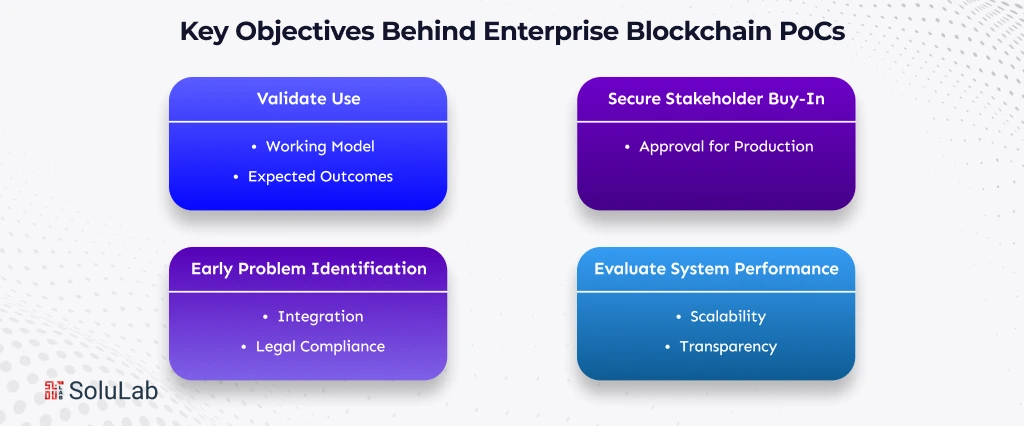
The primary goal of blockchain PoC is to validate a use case through a working model. It checks for feasibility and expected outcomes. Startup businesses generally use PoC to evaluate their system scalability, transparency, and immunity. Not only do these PoC also identify potential problems early, including integration challenges or legal compliance issues. At last, it aids in securing buy-in from makers, and the transparency decides the approval of production.
Key Objectives Behind Enterprise Blockchain PoCs

Step-by-Step Process of Blockchain Implementation

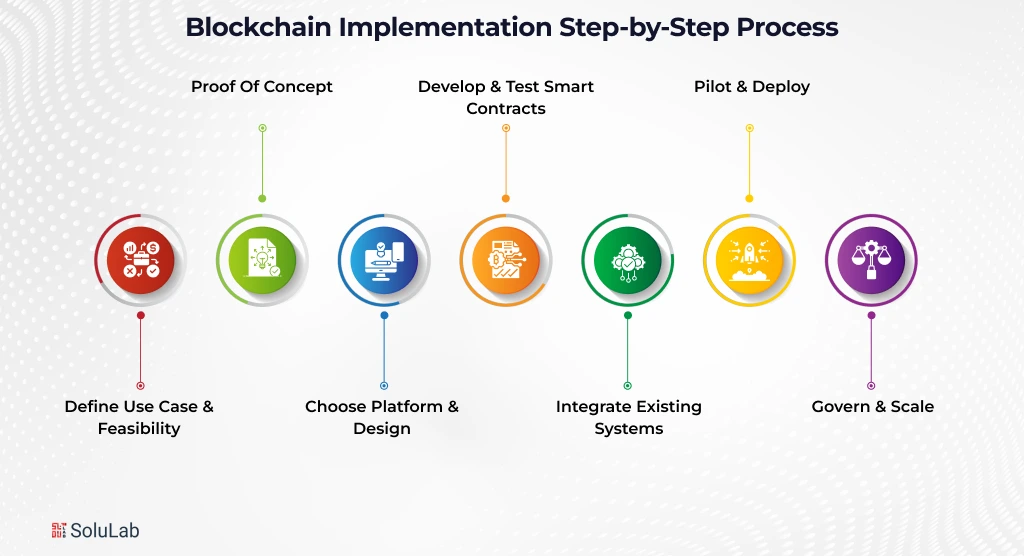
Implementing blockchain in an enterprise isn’t just about adopting new technology—it’s about transforming processes, enhancing trust, and unlocking new business models. The journey typically moves like this:

1. Defining Business Goals and Technology Requirements

Blockchain PoCs begin with identifying what the enterprise wants to achieve. Is it about tracking supply chain items or automating contracts? Once the goal is clear, teams outline key technical needs. These could include data privacy, smart contract use, or permissioned access.

At this point, clarity is essential. The better defined the requirements, the smoother the development. Proof of Concepts in Blockchains work best when aligned with core business goals and constraints.

  • Aligning Blockchain Use Cases with Enterprise Needs

Not all problems need blockchain. That’s why it’s important to match real use cases with the technology’s strengths. Enterprises must ask if the problem involves trust, transparency, or decentralization.

If the answer is yes, blockchain could help. A use case like cross-border payments or digital identity fits naturally. A blockchain proof of concept development ensures the use case isn’t forced but strategically chosen.

  • Determining Technical, Legal, and Operational Scope

Enterprises must plan for more than just coding. PoC projects also consider legal compliance and regulatory policies. For example, if the project handles personal data, GDPR guidelines may apply.

Technical scope covers API integration, node setup, and blockchain architecture. Operational scope includes team roles, timelines, and internal testing plans. All these pieces must align before development begins.

2. Stages Involved in Blockchain PoC Development

PoC development unfolds in distinct, manageable stages. Each step reduces uncertainty and sharpens the solution.

  • Theoretical Framework and Functional Mapping

This stage defines the problem, solution hypothesis, and expected blockchain behavior. It includes logic flows, data structures, and performance expectations. Teams map out how blockchain will process inputs and deliver outputs. Diagrams help everyone visualize how the concept fits together.

  • Product Planning and Feasibility Validation

Next comes the plan for building the working model. Developers check available resources and validate technical feasibility. Can the system handle transaction speed? Does it need a public or private blockchain? The answers shape the actual development timeline.

3. Blockchain Platform Selection and Integration Assessment

Enterprises choose between platforms like Ethereum, Hyperledger Fabric, or Polygon based on the use case. Each option comes with trade-offs in terms of speed, cost, and flexibility. Integration with legacy systems is also evaluated. Smooth integration reduces friction and future costs.
Blockchain Implementation Step-by-Step Process

Major Cost-Influencing Factors in PoC Development

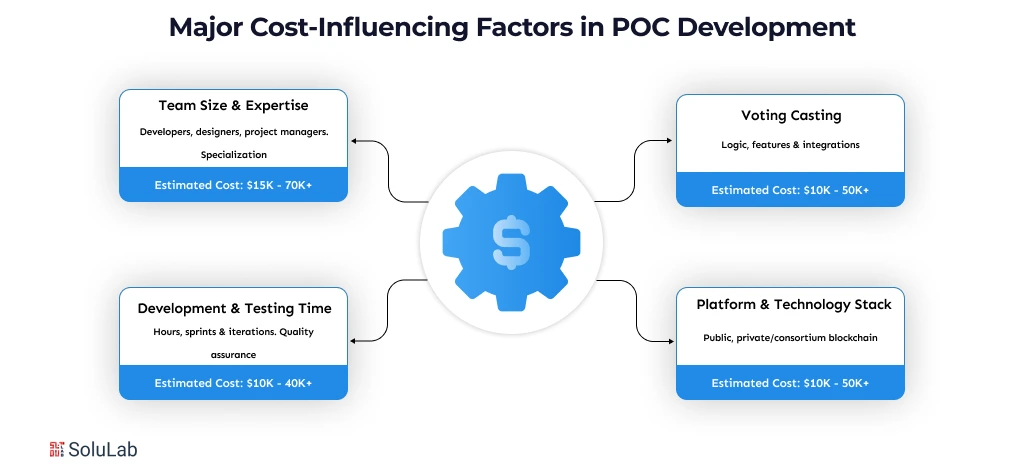
Costs vary based on features, complexity, and team structure. However, a few elements consistently impact total spend.

  • Resource Allocation and Man-Hour Calculations

PoC development requires blockchain architects, backend developers, frontend teams, and QA testers. Depending on the project scope, even a small team may log hundreds of hours. Time spent equals money. Hourly rates vary based on location, experience, and project urgency. A basic blockchain PoC typically requires 2-4 blockchain developers, 1 product manager, and 1 QA tester.

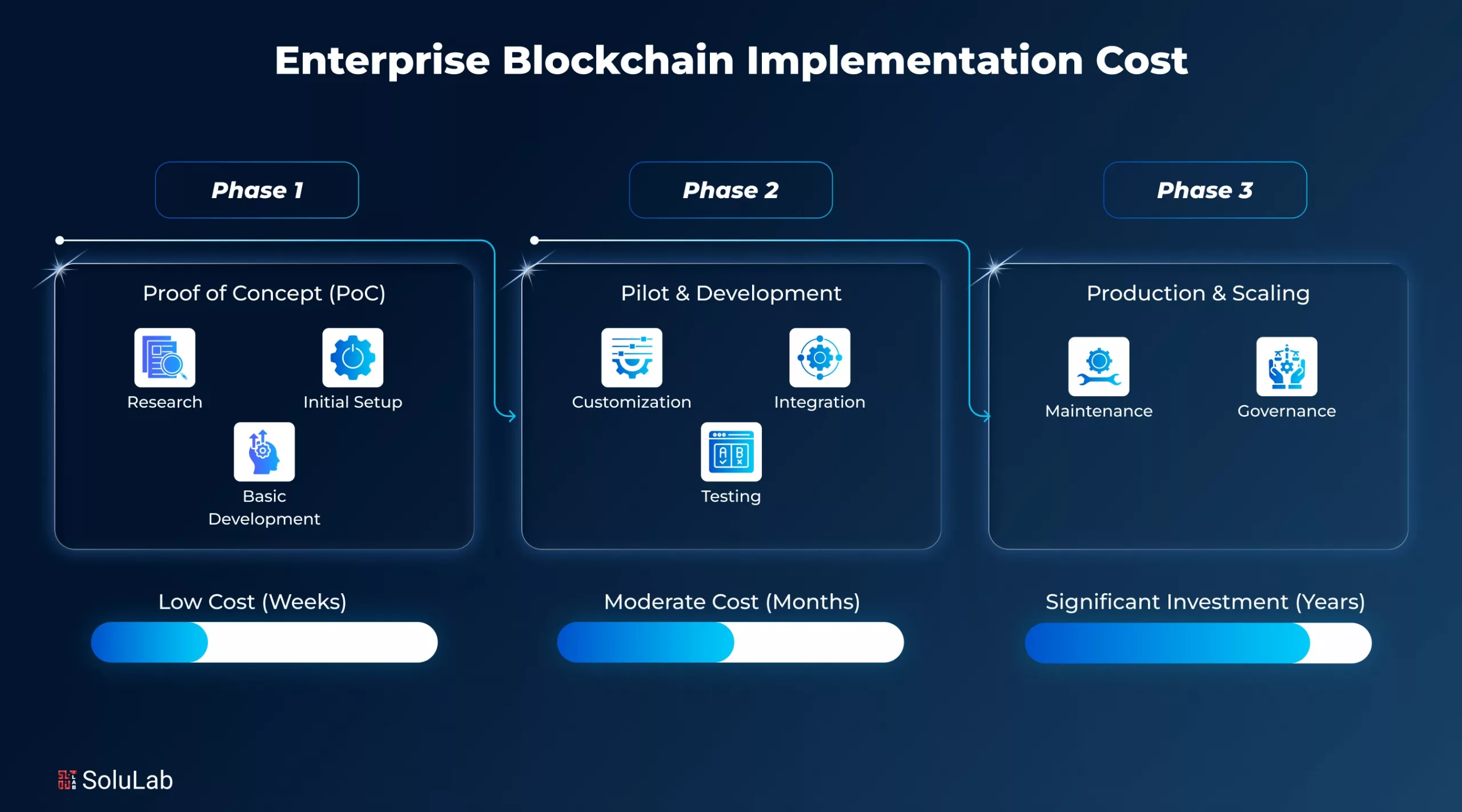
Standard developer rates range from $40 to $150 per hour, depending on the location and expertise. A 3-month PoC project with a lean team may cost between $30,000 and $70,000.

  • Tooling, Infrastructure, and Third-Party Licensing Costs

Tooling includes blockchain SDKs, APIs, and development environments. Infrastructure covers hosting, node deployment, and cloud usage. If third-party tools are used, licensing costs apply. While open-source platforms reduce this burden, enterprises often choose commercial tools for security and reliability. 

  • Cloud infrastructure (AWS, Azure, etc.) and developer tools may cost $1,000 to $5,000 monthly.
  • Third-party APIs, SDKs, or blockchain platform fees can add another $2,000 to $8,000.
  • Expect a typical tooling budget of $5,000 to $15,000 for a PoC stage.
  • Hidden Costs and Risk Buffer Estimations

Unexpected costs arise from system bugs, scope changes, or legal hurdles. Smart enterprises build a 10-20% risk buffer in budgets $5,000 to $10,000. Also, stakeholder coordination, documentation, and internal approvals consume time. These must be included in total PoC cost estimates.
Major Cost-Influencing Factors in POC Development

Evaluating PoC Results Before Scaling Further

Once the PoC is done, it’s time to analyze the outcomes. Did it perform as expected? Were all test cases successful?

  • Technical Validation and Use Case Suitability

Teams evaluate if the blockchain model handled data as expected. If it failed under load or missed conditions, the use case might need revision. Scalability tests are run, especially for enterprise-level applications. Security audits are also conducted.

  • Stakeholder Feedback and Data-Driven Insights

Results are shared with business and technical leadership. Stakeholders check if KPIs were met. They assess the business value created by the PoC. Feedback shapes the final decision—whether to move ahead, revise, or stop entirely.

Transitioning from Blockchain PoC to Production

Moving from PoC to production requires scaling the architecture and tightening the workflows. This is not a copy-paste job. Real-world traffic, regulations, and risks make it more complex.

  • Designing Scalable Architecture and Network Setup

Developers design an architecture that supports production-scale usage. This includes selecting between public, private, or hybrid blockchains. Network design includes nodes, consensus methods, and API access layers. Scalability becomes a key concern, especially for global or high-traffic applications.

  • Governance, Compliance, and Performance Monitoring

Enterprises implement governance models defining who controls nodes, permissions, and updates. Compliance frameworks ensure that the production blockchain meets legal standards. Real-time monitoring tools are integrated to catch performance issues early. This includes alerts, analytics dashboards, and incident reports.

Full-Scale Production Cost Considerations for Enterprises

Production deployment is a long-term investment. It involves both fixed and recurring costs. These need planning and periodic review.

1. Maintenance, Support, and Upgradation Requirements: Blockchain systems require regular updates. Smart contracts may need patches. Network components may need scaling. Dedicated support teams are formed. Maintenance contracts with vendors or consulting teams add to recurring costs. These services ensure uninterrupted operations.

2. Long-Term ROI and Cost-to-Value Optimization: Enterprises must compare long-term returns against initial investments. Metrics like reduced fraud, improved transparency, or automated workflows show value. ROI may take months to years. But well-implemented solutions often reduce operational costs and improve efficiency. 

Enterprise Blockchain Development Company

Conclusion

Adopting blockchain isn’t just a technology upgrade—it’s a strategic move that can redefine how your enterprise operates. The journey from PoC to full-scale production demands the right expertise, tailored strategies, and seamless integration with existing systems.

As a trusted blockchain development company, SoluLab empowers enterprises to navigate every stage of their blockchain journey—right from identifying high-impact use cases to building scalable, secure, and cost-effective production-grade solutions. With proven expertise across platforms like Hyperledger, Ethereum, Polygon, Avalanche, and Solana, we ensure your blockchain implementation is future-ready, compliant, and delivers measurable ROI.

Contact us today to transform your business with leading-edge blockchain solutions!

FAQs

1. How much does it cost to develop a blockchain PoC?

Blockchain proof of concept development usually costs $5,000 to $10,000 for basic. And specific charges depending on team size, tech stack, and timeline. Proof of Concepts in Blockchains help avoid larger future costs.

2. Why do enterprises need a blockchain PoC before full production? 

PoCs help test technical feasibility and business value. Proof of concept development gives clarity before large investments, reducing risk and aligning use cases with enterprise goals.

3. What services are included in blockchain consulting and PoC development? 

They include use case validation, tech stack selection, development planning, and stakeholder alignment. Blockchain consulting and proof of concept development services guide early stages with expert insights.

4. Can you skip PoC and go straight to production? 

Skipping PoC is risky. Without it, you might miss key integration issues or cost surprises. Proof of Concepts in Blockchains ensure you build smarter, not just faster.

5. Is blockchain PoC really worth it… or just trendy tech theater? 

That’s a fair question. But real-world PoCs uncover flaws early. They’re not just buzzwords; they offer honest validation, especially when backed by strong blockchain consulting and proof of concept development services.

How to Build a Crypto-Friendly Bank Like JP Morgan in 2025?

Build Crypto-Friendly Bank Like JP Morgan

Gone are the days when banks only dealt in cash and cheques. In today’s fast-moving financial world, even traditional giants like JP Morgan are stepping into crypto — not by becoming crypto exchanges, but by building crypto-friendly services into their banking model.

And here’s the thing: you don’t need to be a global giant to enter this space. Whether you’re a founder, a fintech company, or an infrastructure provider, now is the time to build a crypto-friendly bank that’s actually built for this decade.

In this guide, we’ll break down what makes these banks different, how to build your own in 2025, and why they’re more than just a trend; they’re the future of banking.

Why is There a Need for Crypto-Friendly Banks?

Despite the rapid advancement of blockchain and digital assets, most traditional banks remain cautious or entirely resistant to crypto. They continue to freeze transactions, block access to exchanges, and often treat blockchain-based finance as an operational risk rather than an opportunity.

Meanwhile, demand for regulated crypto banking is increasing across markets. Today’s users, whether individuals, businesses, or institutions, are looking for banking platforms that support both fiat and digital assets in one secure and compliant environment.

Crypto-friendly banks meet this demand by bridging traditional finance and blockchain. They enable users to manage crypto the same way they manage dollars or euros, within the safety of a licensed, professional banking framework. This growing need is why crypto banks are expanding rapidly in jurisdictions such as the USA, Switzerland, and Singapore.

If your goal is to build a crypto-friendly bank, your opportunity lies in addressing the gap that traditional banks have not yet closed.

What Makes a Bank Truly Crypto-Friendly?

What Makes a Bank Truly Crypto-Friendly

Creating a crypto-friendly bank requires more than just adding digital assets to a wallet. It involves building a regulated, trusted institution designed to operate in both traditional and blockchain-native environments. 

These are the key features that define a successful crypto bank in 2025:

1. Clear Compliance

A crypto bank cannot afford to treat compliance as an afterthought. Regulatory clarity is essential.

Whether you’re operating in the US, Europe, or any other region, you’ll likely need to secure licenses such as an EMI, trust charter, or VASP registration. A fully integrated compliance stack covering KYC, AML, and transaction monitoring should be part of the infrastructure from the very beginning. This is non-negotiable if you aim to operate as a legally recognized and regulated crypto bank.

2. Secure and Auditable Custody

Protecting user funds is the foundation of trust.

You’ll need secure custody infrastructure, including hot wallets for instant transactions and cold storage for long-term asset protection. Proven third-party solutions like Fireblocks or BitGo are often leveraged for this layer. Additionally, insurance coverage for digital assets is essential, particularly when serving high-net-worth clients or institutions.

3. Frictionless Fiat–Crypto Transfers

A key requirement for users is the ability to move between fiat and crypto assets seamlessly.

This means integrating reliable on-ramps and off-ramps, supporting major stablecoins, and ensuring access to local currency rails. Whether a user is converting ETH to USD or sending USDC to a supplier, your system should support fast, low-friction transactions.

4. Native Blockchain Integration

A modern crypto bank should do more than just store digital assets. It should use blockchain technology as part of its core functionality.

This includes programmable payments, tokenized deposits, smart contracts for lending, and secure real-world asset custody. Blockchain should not be an add-on feature but a core component of your banking architecture.

CTA1

How JP Morgan Is Building a Crypto-Friendly Bank?

JP Morgan provides a real-world example of what it looks like when a traditional financial institution embraces crypto strategically.

Through its Onyx platform, the bank has developed a live blockchain-based system for institutional payments. Onyx enables real-time, programmable money movement between large clients.

JP Morgan also launched JPM Coin, a private, permissioned stablecoin that facilitates daily settlements for billions in transactions. What makes their approach effective is their decision not to abandon traditional banking, but to enhance it by embedding blockchain into their existing systems and creating a compliant and secure hybrid model.

For institutions or startups looking to build a crypto bank, JP Morgan’s execution demonstrates that it is possible to modernize finance without undermining trust or compliance.

Key Steps to Build a Crypto-Friendly Bank Like JP Morgan in 2025

Building a crypto-friendly bank today requires more than just offering digital assets—it demands full integration of blockchain infrastructure, strong compliance, and customer trust. Here’s how to get started:

1. Define Your Business Model & Services

Decide whether you’ll act as a full-fledged digital bank, a neobank, or a traditional bank offering crypto services. Choose the mix of services: crypto wallets, trading, lending, DeFi access, or fiat-crypto conversion.

2. Integrate a Secure Crypto Infrastructure

Adopt enterprise-grade blockchain infrastructure, including:

  • Multi-chain support (e.g., Ethereum, Solana, Bitcoin)
  • Built-in wallet systems
  • Cold/hot wallet integrations (e.g., Fireblocks)
  • Smart contract automation for transactions and compliance

3. Ensure Regulatory Compliance

Stay aligned with local and global crypto regulations. Set up:

  • KYC/AML verification systems
  • Licenses (e.g., VASP, e-money)
  • Legal consultation for ongoing compliance updates

4. Partner with Technology Providers

Collaborate with fintech or blockchain development experts to build:

  • A seamless Web3-ready UI/UX
  • Secure APIs for real-time trading
  • AI-powered risk and fraud detection tools

5. Focus on Trust & User Experience

Offer high transparency, insured custody services, 24/7 customer support, and educational tools to build user confidence—just like JP Morgan does with Onyx and blockchain-backed settlement.

Real Use Cases of Crypto-Friendly Banks

Crypto-friendly banks are not theoretical. They serve real users with very real financial needs. Here are some of the most relevant use cases:

  • Personal Accounts That Support Both Fiat and Crypto

Users expect the convenience of managing all their assets, fiat and digital, in a single account. A crypto bank enables seamless payments, conversions, and transfers in both worlds.

  • Crypto Payment Solutions for Businesses

Web3 companies, DAOs, and digital-first startups need to pay employees, vendors, and contractors, often in stablecoins or native tokens. A crypto bank simplifies this with built-in compliance and reporting.

  • Institutional Custody and Asset Management

From NFTs to tokenized real estate, users are holding a wider variety of digital assets. A crypto bank must be able to securely custody all of these, backed by proper insurance and compliance.

  • Crypto-Backed Lending

Allowing users to borrow against crypto holdings without liquidating their assets is a high-demand service. Additionally, banks can offer stablecoin-based interest accounts and staking options under a regulated umbrella.

  • Treasury Management for Protocols and Funds

DAOs, investment funds and large crypto-native organizations require sophisticated tools to manage their hybrid treasuries. This includes fiat and crypto conversion, reporting, tax documentation and more.

Benefits of Starting a Crypto Bank in 2025

There is a convergence of opportunity and readiness in the current financial landscape.

Regulatory frameworks are becoming more defined. MiCA in the EU, SEC updates in the US, and more jurisdictions are now issuing digital asset licenses. This gives founders and institutions a much clearer path to launch a regulated crypto bank with confidence.

At the same time, demand is accelerating. Individuals want digital-first, crypto-native financial services. Businesses want compliant solutions they can trust. And institutions are looking for partners who understand both traditional finance and blockchain.

Meanwhile, the market remains relatively open. Most legacy banks have yet to adapt, and competition is still low compared to traditional fintech. If you enter now, you’ll not only be early, you’ll be ahead.

Types of Crypto Banks You Can Launch

Types of Crypto Banks You Can Launch

You don’t need to be a financial giant to build something valuable. Several practical models depend on your goals and market. Here’s a breakdown:

1. Full-Service Crypto Bank

Offers everything crypto and fiat accounts, trading, lending, on-ramps, and custody.

Best for:
Founders who want to build the full stack or partner with a blockchain development company to create a complete ecosystem.

Why it works:
You become the all-in-one platform for retail and business users who want it all under one login.

2. Business-Focused Digital Bank

Tailored for Web3 startups, DAOs, and crypto-native businesses. Helps them manage treasury, payroll, payments, and compliance.

Best for:
B2B fintechs, agencies, or consultants offering white label crypto solutions for startups.

Why it works:
Web3 companies often struggle to get even basic banking access. You’ll be solving a real, persistent pain point.

3. Custody-Only Crypto Bank

Focuses solely on storing and protecting digital assets Bitcoin, stablecoins, NFTs, tokenized real estate, etc.

Best for:
Teams with deep cybersecurity expertise or targeting institutional clients.

Why it works:
As more real-world assets go on-chain, demand for secure, compliant custody is rising fast.

4. Neo-Bank with Crypto Add-ons

Looks and feels like a regular fintech app but lets users hold, swap, and send crypto alongside fiat.

Best for:
Startups looking to serve mainstream users dipping their toes into crypto.

Why it works:
You lower the barrier to entry by offering familiar banking, with optional crypto on top.

Each model has its own licensing needs, tech stack, and user base, but all are solid paths. Choose one based on your vision, resources, and regulatory strategy. And if you’re not sure where to start, this is where blockchain consulting services can help you map the right path forward.

CTA2

Conclusion

Building a crypto-friendly bank in 2025 isn’t some distant idea; it’s a real, tangible opportunity. With regulations getting clearer, user demand climbing, and traditional banks still lagging, the space is wide open for innovation. Whether you’re launching a full-service platform, a custody-only solution, or a business-focused digital bank, success comes down to getting the fundamentals right: compliance, security, blockchain integration, and user-first features.

At SoluLab, we help visionaries bring crypto banking ideas to life. Whether you’re looking for white label crypto banking solutions, full-scale product development, or strategic blockchain consulting services, we’ve built it all. From licensing guidance to wallet infrastructure, we’re the technical team behind the next wave of crypto banks.

Ready to launch your own digital bank? Let’s build it together!

FAQs

1. What is a crypto-friendly bank?

It’s a bank that supports both fiat and cryptocurrencies for storage, transfers, and payments. It bridges traditional banking with blockchain technology.

2. How do I start a crypto-friendly bank in the USA?

You’ll need proper licensing, compliance systems, and a solid tech stack. Partnering with a blockchain development company can speed up the process.

3. What are the main features of a crypto bank?

Secure custody, fiat-crypto conversion, KYC/AML compliance, and blockchain integration. All built into a user-friendly banking platform.

4. Can I use white label crypto banking solutions to launch faster?

Yes, they offer ready-made infrastructure so you can go live quickly. Ideal if you want to skip custom development.

5. What are the benefits of starting a crypto bank in 2025?

Clearer regulations, rising demand, and low competition make it the right time. The market is wide open for new players.


A Business Lens on Blockchain Stack: From Layer 0 to Layer 3

Blockchain Layer 0, L1, L2 and L3

Blockchain technology is growing fast to meet the rising need for better speed, security, and decentralization. As per the World Economic Forum, the total value of crypto assets has passed $1.7 trillion, with more than 3,000 decentralized apps (dApps) live on various blockchain platforms.

As more people and businesses adopt this tech, it’s important to understand how different layers in blockchain work together. From the base infrastructure of Layer 0 to the user-facing apps in Layer 3, each layer plays a key role in making the system faster, safer, and easier to use.

This blog will break down each of the different layers in blockchain​ in simple terms, so you can clearly see how they work and what role they play in building powerful, scalable Web3 and AI products.

What Are The Layers Of Blockchain? 

A blockchain isn’t just one system or a single line of code, it’s made up of multiple blockchain architecture layers, each playing a unique role. These layers of blockchain technology​ work together to make blockchains more secure, faster, and easier to use. 

This structure also helps solve the well-known blockchain trilemma: balancing security, scalability, and decentralization. 

Here they are:

  • Layer 0: This is the base. It includes all the behind-the-scenes parts like networking, data transfer, and how different blockchain platforms connect and talk to each other.
  • Layer 1: The core layer of the system. It runs the main blockchain protocol like Ethereum, Bitcoin, or Solana. It handles things like data validation and transaction recording.
  • Layer 2: This layer sits on top of Layer 1. It improves the speed and reduces the costs of using the blockchain. Tools like Polygon and Arbitrum are popular here.
  • Layer 3: This is what users see. It includes apps like wallets, games, or any tool that lets people interact with the blockchain. These apps are built using the foundation and upgrades of the other layers.

Why Use a Layered Blockchain Structure?

Using layers in blockchain technology makes the system more organized and flexible. It lets developers upgrade certain features without changing everything. For example:

  • Layers can improve speed with tools like rollups or sidechains.
  • Platforms can scale more easily without giving up security.
  • Services like Blockchain-as-a-Service help businesses use blockchain tech without building from scratch.

It also supports more complex systems like cross-chain multi-asset management platforms, which let users interact with different blockchains all in one place, improving blockchain interoperability.

What is Layer 0?

Layer 0 is the base layer of a blockchain network. It includes all the core systems like networking, hardware infrastructure, consensus protocols, and peer discovery mechanisms. It is the operating system of a blockchain.

Key Roles of Layer 0

  • Provides the base network for all other blockchain layers to build on
  • Manages consensus and communication between blockchains
  • Enables security and scalability at the foundational level

Interoperability & Cross-Chain Communication

Layer 0 allows different blockchains to talk to each other using technologies like Cosmos’ IBC and Polkadot’s Relay Chain. This enables multi-chain vs. cross-chain transactions and boosts blockchain interoperability.

Examples of Layer 0 Projects

  • Polkadot: Uses parachains to connect multiple blockchains
  • Cosmos: Enables communication between chains with IBC
  • Avalanche: Offers high throughput and fast finality

These are widely used blockchain platforms for building scalable and secure ecosystems.

CTA1

What is Layer 1?

Layer 1 is where the actual blockchain protocol lives. It defines how the network operates, how consensus is reached, and how transactions are verified.

Core Features

  • Implements consensus methods like PoW and PoS
  • Handles transaction validation and security
  • Hosts the native tokens of the blockchain

Popular Layer 1 Blockchains

  • Bitcoin – Uses Proof-of-Work for secure transactions
  • Ethereum – Powers smart contracts and DeFi apps
  • Solana – Known for high-speed, low-cost transactions

These are strong examples of layer 1 blockchains and are among the top blockchain development companies by adoption.

What is Layer 2?

Layer 1 can get slow and expensive. Layer 2 helps by processing transactions faster and more cheaply, then reporting back to Layer 1.

Main Techniques

  • Rollups: Bundle multiple transactions into one
  • Sidechains: Operate independently but report to Layer 1
  • State Channels: Enable instant payments between users

Key Projects

  • PolygonLayer 2 scaling for Ethereum
  • Arbitrum – Optimistic Rollup for speed and low gas
  • Optimism – Simple scaling using Rollups

This is where the Layer 1 vs Layer 2 vs Layer 3  trade-off becomes important for businesses looking to optimize cost and speed.

What is Layer 3?

Layer 3 is the user-facing part of the blockchain. It includes apps, interfaces, and APIs that connect users to the blockchain.

Key Uses

Examples

  • Metamask – A wallet extension for Ethereum
  • Chainlink Oracles – Connect real-world data to smart contracts
  • Web3 Games – On-chain games that reward players with tokens

With more demand for intelligent systems, AI agents and AI development companies are being integrated into layer 3 blockchain platforms to enhance automation and personalization.

Differences Between Layer 0, Layer 1, Layer 2, and Layer 3

The blockchain ecosystem is made up of multiple layers, each playing a unique role in how decentralized networks function, scale, and interact. Here’s a simple breakdown of Layer 0 to Layer 3 and how they differ:

Layer Main Function Key Technologies Examples Who It’s For
Layer 0 Base infrastructure for blockchains; handles networking and consensus IBC (Cosmos), Relay Chain (Polkadot), Avalanche consensus Polkadot, Cosmos, Avalanche Developers building interoperable or multi-chain ecosystems
Layer 1 Core blockchain protocol manages transactions and consensus PoW, PoS, Smart Contracts Bitcoin, Ethereum, Solana Startups & enterprises launching tokens, smart contracts, or DeFi apps
Layer 2 Offloads transaction load to scale Layer 1; enhances speed and reduces cost Rollups, Sidechains, State Channels Polygon, Optimism, Arbitrum Projects needing faster, cheaper transactions for scalability
Layer 3 Application layer that connects users with the blockchain dApps, APIs, Wallets, Oracles, AI agents Metamask, Chainlink, Web3 Games Businesses focusing on UI/UX, user growth, or integrating AI with Web3

How do Blockchain Layers Work Together?

Blockchain Layers

Blockchain layers aren’t isolated; they’re designed to work together as a stack, each serving a unique purpose while enhancing the overall functionality, scalability, and user experience of blockchain networks.

Here’s how these layers interact:

Vertical and Horizontal Interactions

Blockchain layers stack vertically. Layer 2 builds on Layer 1, which runs on Layer 0. They also connect horizontally through chain abstraction for blockchain interoperability.

Building a Modular and Scalable Web3

Each of the different layers of blockchain can evolve independently. This modular setup supports better upgrades and innovations, vital for blockchain in healthcare and blockchain in trade finance.

Key Responsibilities by Layers

  • Layers 0 & 1 ensure core security and network integrity.
  • Layer 2 offers scalability through efficient processing.
  • Layer 3 enhances user interaction and usability.

Choosing the right combination depends on your application’s goal, whether performance, decentralization, or user experience is the priority.

What Is Scalability in Blockchain?

Scalability in blockchain refers to a network’s ability to handle a growing number of transactions, users, and applications efficiently, without slowing down or becoming too expensive to use.

In simple terms, a blockchain is scalable if it can grow and serve more people without sacrificing speed, cost, or security.

The Blockchain Trilemma

Scalability, decentralization, and security by achieving all three is challenging. Layers of blockchain solve this by dividing responsibilities across layers.

How Layers Solve Scalability Challenges?

  • Layers 0 & 1 maintain decentralization and trust
  • Layers 2 & 3 improve performance and user experience

Real-World Use Cases

  • Gaming: Smooth gameplay with Layer 2 scaling
  • Logistics: Faster, cheaper tracking with decentralized ledgers
  • Finance: Secure trading with reduced latency

These highlight the importance of blockchain use cases in designing performant applications.

Performance Metrics and Tradeoffs

  • TPS (Transactions Per Second)
  • Gas fees (cost per transaction)
  • Latency (speed to finalize transactions)

Layer 2 can deliver 100x throughput over Layer 1 alone.

CTA2

Conclusion

The future of decentralized tech lies in how we leverage each of the blockchain layers. Whether you’re building a DeFi protocol or a retail app powered by AI, understanding this layered model helps you make smarter blockchain architecture layers decisions.

If you’re looking to scale or optimize your blockchain strategy, SoluLab is a trusted blockchain development company in the USA with real-world experience in implementing multi-layer systems. The team is well-versed in rendering top-notch solutions powered by a next-gen tech stack. Recently, SoluLab enabled OBORTECH to utilize Blockchain-as-a-Service (BaaS) to launch scalable blockchain applications without backend complexity, showcasing our expertise in enterprise blockchain development.

Whether you are planning to integrate blockchain or have a unique idea to build, we can cater to all your needs with the best solutions. Contact us!

FAQs

1. Which layer is best for developers to build on?

It depends on the project. Layer 1 is ideal for building secure and decentralized protocols. Layer 2 offers speed and cost-efficiency for apps that need scalability. Layer 3 is great for building user-friendly front-end experiences.

2. Can a blockchain work without Layer 0 or 3?

No, Layer 0 is the base. Layer 3 isn’t required for technical function but is essential for real-world usability.

3. Can a blockchain project operate across multiple layers?

Yes! Many modern blockchain projects use a combination of layers. For example, a DApp (Layer 3) might run on a Layer 2 solution like Arbitrum, which itself is secured by a Layer 1 blockchain like Ethereum, all connected via a Layer 0 protocol like Cosmos.

4. How do these layers benefit enterprise blockchain projects?

Enterprises can use Layer 0 for cross-chain operations, Layer 1 for secure data storage, Layer 2 for scaling high-volume use cases, and Layer 3 for creating user-friendly apps, making the tech stack modular, scalable, and enterprise-ready.


Top 5 Enterprise Blockchain Platforms to Consider [2026]

Enterprises are under immense pressure to stay competitive, efficient, and transparent. But with rising data, slow transactions, and outdated legacy systems, many businesses are facing troubles in scaling their operations securely.

The enterprise blockchain market is expected to reach USD 145.9 billion by 2030, growing at a CAGR of 47.4% from 2024 to 2030.

This lack of trust, especially in sectors like finance, supply chain, and healthcare, is costing companies not just money but credibility. And while everyone’s talking about blockchain, the real challenge is figuring out which platforms are enterprise-ready, scalable, and future-proof in 2026.

In this blog, we’ll explore the top 5 enterprise blockchain platforms, the criteria to select the best platform, and more. Let’s get started!

How Blockchain Is Transforming Enterprises? 

Here’s how blockchain is impacting enterprises across industries:

1. Trust Without Middlemen: Blockchain enables secure, verifiable transactions without intermediaries. That means faster processes and fewer costs. 

2. Supply Chain Transparency: Every step can be tracked from farm to fork. Enterprises can now trace product origins, reduce fraud, and ensure compliance. This is perfect for FMCG, pharma, and agriculture.

3. Smart Contracts: No more manual checks. Smart contracts automate tasks when conditions are met. Great for legal, finance, and logistics.

4. Better Payments & Settlements: Faster cross-border payments with reduced transaction fees. Especially useful for export-import businesses in India.

5. Audit & Compliance Made Easy: Audits become simpler since every change is recorded. Blockchain makes financial data tamper-proof and regulator-friendly.

Criteria for Selecting the Top Enterprise Blockchain Platforms

With the proliferation of blockchain platforms catering to enterprise needs, it’s essential to establish a set of criteria to evaluate and select the most suitable options. Each platform comes with its strengths and weaknesses, making the selection process a nuanced task. Here are the key criteria to consider when selecting the top enterprise blockchain platforms of 2026:

  • Scalability and Performance: Scalability is crucial for enterprise applications that demand high transaction throughput. Platforms must demonstrate the ability to handle a large number of transactions per second while maintaining low latency. Considerations include the platform’s consensus mechanism, sharding techniques, and approaches to optimizing network performance as the user base expands.
  • Security and Data Privacy: Enterprises handle sensitive data, and security is paramount. Blockchain platforms must employ robust encryption, hashing, and access control mechanisms to safeguard data from unauthorized access. Privacy features, such as zero-knowledge proofs and private transactions, allow enterprises to share information selectively while preserving confidentiality.
  • Interoperability and Integration: In an ecosystem with multiple blockchain networks and existing IT infrastructure, interoperability is essential. Platforms should support seamless integration with legacy systems and other blockchain networks. Standards like cross-chain communication protocols enhance interoperability and facilitate data exchange between different platforms.
  • Smart Contract Capabilities: Smart contracts automate business processes, but their complexity varies between platforms. Evaluate the programming languages supported, the ease of writing and deploying smart contracts, and the platform’s support for oracles (external data sources).
  • Community and Support: A vibrant and active community indicates a platform’s vitality and ongoing development. Robust community support ensures quick issue resolution and a wealth of resources for developers. Platform documentation, developer tools, and user-friendly interfaces contribute to a positive user experience.

Top 5 Enterprise Blockchain Platforms

Ethereum

1. Ethereum

Ethereum, founded in 2015, is one of the most widely adopted blockchain platforms, known for its smart contract functionality, decentralized applications (dApps), and a robust developer community.

While originally public, Ethereum also offers enterprise-grade solutions through frameworks like the Enterprise Ethereum Alliance (EEA). It’s ideal for businesses looking to build transparent and automated systems.

2. R3 Corda

R3 Corda, launched in 2016, is a blockchain platform designed for regulated industries like finance, healthcare, and supply chain. Unlike public blockchains, Corda focuses on privacy, scalability, and interoperability by enabling only the involved parties to access transaction data.

It supports smart contracts and offers robust identity management, making it ideal for enterprise use cases. Its unique architecture ensures compliance and efficiency for complex workflows.

3. Hyperledger Fabric

Hyperledger Fabric, launched in 2015 by the Linux Foundation, is a modular and permissioned blockchain platform designed for enterprise use. It supports pluggable consensus mechanisms, private channels for confidential transactions, and chaincode (smart contracts) written in general-purpose programming languages like Go and Java.

Its architecture is ideal for businesses needing secure, scalable, and customizable solutions across sectors like supply chain, finance, and healthcare.

4. Hedera Hashgraph

Hedera Hashgraph, founded in 2018, is a high-performance public distributed ledger designed for enterprises. Unlike traditional blockchains, it uses a unique hashgraph consensus algorithm, making it faster and more energy-efficient.

Key features include fair transaction ordering, low fees, and high throughput, making it ideal for use cases like supply chain, identity management, and payments. Its governing council includes global giants like Google and IBM, ensuring robust governance.

IBM Blockchain

5. IBM Blockchain

IBM Blockchain (launched in 2017) is a robust enterprise-ready platform built on Hyperledger Fabric, designed to help businesses securely share data and streamline workflows. Known for its modular architecture, it supports permissioned networks, ensuring high privacy and scalability.

It also integrates with existing systems, making it ideal for sectors like supply chain, finance, and healthcare. IBM offers tools, templates, and support to help enterprises build and scale blockchain solutions efficiently.

Enterprise Blockchain Development Company

Conclusion

In 2026, enterprise blockchain platforms will no longer be optional — they’re a strategic necessity. Whether it’s improving operations, security, or transparency. Platforms like Hyperledger Fabric, Ethereum Enterprise, and others are redefining how businesses function. 

Each offers unique features tailored to different enterprise needs, from smart contracts to permissioned networks. As businesses continue to grow, choosing the right blockchain platform and hiring a blockchain developer can provide a competitive edge in the market. The key is to align technology with business goals.

Token World, a crypto launchpad platform, partnered with SoluLab to enhance smart contract security, scalability, and regulatory compliance. We built robust tokenomics, investor dashboards, and multilingual support. Our blockchain integration and community strategies empowered Token World to deliver secure, user-friendly token launches and drive global investor engagement.

SoluLab, a blockchain development company, can help you pick the best platform as per your business requirements.

FAQs

1. How is enterprise blockchain different from public blockchain?

Enterprise blockchains are usually permissioned, meaning only authorized participants can access or validate transactions, ensuring privacy and control. Public blockchains like Bitcoin and Ethereum are open to everyone, and transactions are fully transparent.

2. Is it expensive to build on an enterprise blockchain platform?

Costs vary depending on the platform, complexity of the solution, development time, and compliance needs. While some platforms are open-source and free to use, enterprise-level support or custom integrations can increase expenses. However, the long-term ROI often outweighs the initial investment.

3. Can enterprise blockchains support AI and IoT integrations?

Yes, many modern enterprise blockchain platforms support integration with AI, IoT, and cloud computing. This allows for powerful use cases like predictive maintenance, smart manufacturing, automated logistics, and real-time asset tracking with secure data layers.

4. Which industries are adopting enterprise blockchain platforms the most?

Major industries using enterprise blockchain solutions include finance and banking, supply chain and logistics, healthcare, insurance, government, energy, and real estate. These sectors benefit from enhanced transparency, data integrity, and automation.

5. How long does it take to build an enterprise blockchain solution with SoluLab?

Timelines vary based on complexity, but SoluLab typically delivers MVPs within a few weeks and full-scale enterprise-grade platforms in a few months. Their agile development process ensures fast iterations and transparent progress tracking.

Defi : The Influensive Trend in Blockchain- A Complete Guide

Defi The Influensive Trend in Blockchain- A Complete Guide

Decentralized Finance, often referred to as DeFi, has emerged as one of the most influential trends in the blockchain space. This revolutionary concept leverages blockchain technology to create a decentralized financial ecosystem that operates without traditional intermediaries like banks. In this comprehensive guide, we will delve into the world of DeFi, exploring its platforms, protocols, development companies, lending platforms, trading platforms, and how it all ties into the broader blockchain landscape.

What is DeFi?

Decentralized Finance, commonly known as DeFi, is a revolutionary movement within the blockchain ecosystem protocols that seeks to recreate traditional financial systems using blockchain technology. Unlike traditional finance, which relies on centralized intermediaries like banks and financial institutions, DeFi operates on decentralized platforms and smart contracts. 

It encompasses a wide range of financial services and applications, including lending, borrowing, trading, asset management, and more, all built on blockchain networks. DeFi platforms, protocols, and development companies play a pivotal role in enabling this ecosystem, while blockchain technology provides the foundation for its transparency and security. 

Furthermore, DeFi is closely intertwined with blockchain trends, as it leverages blockchain’s potential to disrupt traditional finance and expand into other industries beyond the financial sector. This transformative trend is redefining the way we think about and interact with financial services, offering users greater control and accessibility to their financial assets and transactions.

How Does DeFi Work?

DeFi applications are built on blockchain technology, which is a distributed ledger system that records transactions in a secure and transparent manner. Blockchain technology allows DeFi applications to operate without the need for a central intermediary.  Top DeFi protocols use smart contracts to automate transactions and interactions between users. 

Benefits of DeFi

Benefits of DeFi

Decentralized Finance (DeFi) is transforming the financial landscape in numerous ways, offering a wide array of benefits to users, developers, and the global economy. 

  • Financial Inclusion

DeFi opens up financial services to anyone with internet access, enabling global financial inclusion. This is especially significant in regions with limited access to traditional banking. According to the World Bank, around 1.7 billion adults worldwide remain unbanked. DeFi can bridge this gap and empower individuals to access and manage their finances.

  • Accessibility

Unlike traditional financial markets with set trading hours, DeFi operates 24/7, allowing users to trade, lend, and borrow at their convenience. This accessibility provides flexibility and empowers users to make real-time financial decisions.

  • Reduced Intermediaries

Traditional financial systems rely on intermediaries like banks, brokers, and clearinghouses, which charge fees for their services. DeFi minimizes or eliminates these intermediaries, reducing costs for users. Smart contracts execute transactions automatically, bypassing the need for intermediaries and their associated fees.

  • Transparency

DeFi leverages blockchain technology to ensure transparent and immutable record-keeping. Every transaction is recorded on a public ledger, providing users with complete transparency. This transparency enhances trust, as users can independently verify all transactions.

  • Security

DeFi benefits from the security features of blockchain technology. Smart contracts, once deployed, are immutable, reducing the risk of tampering or fraud. The security of blockchain has contributed to a significant decrease in successful attacks on DeFi platforms.

  • Global Reach

Cross-border payments are a significant part of the global economy. DeFi enables seamless cross-border transactions, allowing users to send and receive funds globally without the delays and high fees associated with traditional cross-border banking services.

CTA1

  • Programmability

DeFi platforms are highly programmable, allowing developers to create customized financial solutions. This programmability has led to the development of a diverse range of applications, including yield farming, decentralized exchanges, automated trading bots, and more. Users can participate in these innovative financial services.

  • Yield Opportunities

DeFi platforms like Compound and Aave offer users the opportunity to earn interest on their assets. Users can participate in lending or liquidity provision, often earning yields that surpass traditional savings account rates by a significant margin. This opens up new avenues for passive income and wealth creation.

  • Innovation and Rapid Development

DeFi is characterized by its rapid pace of innovation. New projects, tokens, and protocols continually emerge, offering new financial products and services. The open-source nature of DeFi fosters competition and innovation, driving the development of cutting-edge solutions.

  • Economic Empowerment

DeFi can empower individuals to take control of their finances. Users are not reliant on centralized institutions; they have custody of their assets and can engage in financial activities autonomously. This increased agency can lead to greater financial empowerment and self-reliance.

  • Risk Management

DeFi platforms often allow users to set their own risk parameters. For example, users can choose the level of collateral required for loans, mitigating risk to some extent. Additionally, DeFi insurance projects offer coverage against smart contract vulnerabilities and hacks, further enhancing risk management.

  • Community Governance

Many DeFi projects employ decentralized governance mechanisms. Token holders have a say in protocol upgrades and decision-making. This approach promotes a more democratic and community-driven ecosystem.

  • Reduced Barriers to Entry

In traditional finance, launching financial products and services can be highly regulated and costly. DeFi reduces these barriers to entry for entrepreneurs and developers, making it easier to create and launch financial innovations.

Applications of Defi

Applications of Defi

Decentralized Finance (DeFi) has a wide range of applications that are transforming the traditional financial landscape. These applications leverage blockchain technology to provide innovative and decentralized solutions to various financial services. Here are some key applications of DeFi:

  • Lending and Borrowing

DeFi lending platforms allow users to lend their crypto assets to earn interest, while borrowers can use their crypto holdings as collateral to secure loans. These platforms often offer more attractive interest rates than traditional banks.

Examples: Compound Finance, Aave, MakerDAO

  • Decentralized Exchanges (DEXs)

DEXs enable users to trade cryptocurrencies directly without the need for a centralized intermediary. They provide liquidity and allow for trustless and transparent trading.

Examples: Uniswap, SushiSwap, Balancer

  • Stablecoins

Stablecoins are digital currencies crafted with the intention of preserving a fixed value, frequently linked to a traditional currency such as the US dollar. They serve as a stable medium of exchange and a store of value within the volatile crypto market.

Examples: USDC, USDT, DAI

  • Yield Farming and Liquidity Provision

Yield farming encompasses the act of supplying liquidity to DeFi protocols in return for incentives. Users can earn tokens and interest by locking up their assets in liquidity pools.

Examples: Yearn.finance, Curve Finance, Balancer

  • Asset Management and Index Funds

DeFi allows users to create, manage, and invest in tokenized portfolios, enabling automated trading and diversification of assets.

Examples: Set Protocol, PieDAO

  • Insurance

DeFi insurance platforms provide coverage against smart contract vulnerabilities and hacks in the DeFi ecosystem, offering protection to users.

Examples: Nexus Mutual, Cover Protocol

  • Decentralized Identity

DeFi can be used to establish decentralized identity systems, giving users more control over their personal information.

Examples: uPort, SelfKey

  • Cross-Border Payments

DeFi facilitates cost-effective and rapid cross-border transactions, reducing the fees and delays associated with traditional international transfers.

Examples: Stablecoin-based remittance services

  • Prediction Markets

DeFi prediction markets enable users to create and participate in markets for predicting real-world events, offering a decentralized way to speculate on outcomes.

Examples: Augur, Gnosis

  • Blockchain Gaming and NFTs

DeFi and blockchain technology are integrated into the gaming industry, allowing players to buy, sell, and trade in-game assets and NFTs.

Examples: Axie Infinity, Decentraland

  • Decentralized Autonomous Organizations (DAOs)

DAOs are organizations governed by smart contracts and token holders, enabling decentralized decision-making and governance.

Examples: Yearn Governance, Compound Governance

  • Real Estate and Tokenization

DeFi can be used to tokenize real estate assets, making it easier for users to invest in properties and participate in real estate markets.

Examples: RealT, Propy

Blockchain and its Role in DeFi

Blockchain and its Role in DeFi

Blockchain technology plays a pivotal role in the success and functionality of Decentralized Finance (DeFi). It underpins the entire DeFi ecosystem, providing the infrastructure and key features necessary for its operation. Here’s how blockchain contributes to DeFi:

  • Trust and Transparency

Blockchain is a decentralized and distributed ledger technology. It records transactions in a secure and transparent manner across a network of nodes. This transparency ensures that all DeFi transactions are publicly verifiable, and participants can audit the transaction history. Users can trust that the information on the blockchain is accurate and tamper-proof.

  • Smart Contracts

DeFi relies heavily on smart contracts to automate and execute financial agreements without the need for intermediaries. These contracts are immutable and executed according to predefined rules, enhancing the security and reliability of financial transactions.

  • Decentralization

Blockchain networks, such as Ethereum, are decentralized, meaning there is no central authority or intermediary controlling the system. DeFi applications leverage this decentralization, eliminating the need for trusted third parties like banks. Users retain control of their assets and transactions, reducing counterparty risk.

  • Permissionless Access

DeFi platforms built on blockchain technology are generally permissionless, meaning anyone with an internet connection and the required assets can access and use these services. This inclusivity opens financial services to a global audience without regard for geographical location, background, or identity.

  • Immutable Records

Once a transaction has been added to a blockchain, it becomes immutable, i.e. it cannot be altered or deleted. This immutability enhances the security of financial transactions, making it difficult for fraudulent or unauthorized changes to occur.

  • Interoperability

Blockchain networks and protocols are often designed to be interoperable, allowing DeFi platforms to communicate and interact seamlessly. This interoperability enables various DeFi applications to work together and create a more interconnected financial ecosystem.

  • Decentralized Identifiers

Blockchain can provide a foundation for decentralized identity solutions, allowing users to control and manage their personal data and identity. This is particularly important in DeFi, where privacy and identity verification are essential.

  • Data Feeds and Oracles

To provide real-world data to smart contracts, DeFi projects often rely on oracles. These oracles are external data sources that feed information from the real world into the blockchain. They play a critical role in enabling smart contracts to respond to real-world events and conditions.

CTA2

Conclusion

Decentralized Finance (DeFi) is reshaping the financial landscape, offering a more inclusive and transparent way of managing assets and accessing financial services. As blockchain technology continues to advance, we can expect even greater innovation and adoption in both the DeFi space and across various industries. 

Bear in mind that the DeFi arena is ever-changing, and new entrants may come into play. Hence, it’s crucial to engage in comprehensive research and due diligence when deciding on a DeFi development company. With the right team and a forward-looking vision, your DeFi project has the potential to become a game-changing force in the financial realm.

If you’re still in search of the ideal DeFi development company, get in touch with Solulab without delay. Solulab boasts extensive experience in DeFi development services, a strong technical acumen, and a commitment to fostering innovation, making them an excellent option for businesses and entrepreneurs looking to embark on DeFi endeavors or enhance their existing DeFi solutions.

FAQs

1. What is DeFi, and how does it differ from traditional finance?

DeFi, short for Decentralized Finance, is a blockchain-based financial ecosystem that offers decentralized alternatives to traditional financial services like lending, borrowing, and trading. Unlike traditional finance, DeFi operates on blockchain technology, removing the need for intermediaries, providing transparency, and enabling users to have full control over their assets.

2. How do I get started with DeFi?

To start with DeFi, you need a crypto wallet, usually compatible with the Ethereum blockchain, as many DeFi projects are built on Ethereum. You can fund your wallet with cryptocurrencies, connect to a DeFi platform, and then explore and use various DeFi applications, such as lending, borrowing, or trading.

3. Are DeFi platforms safe and secure?

DeFi platforms prioritize security, but they are not immune to risks. Users should conduct thorough research, use reputable platforms, and follow best practices such as enabling two-factor authentication and using hardware wallets. Additionally, smart contract vulnerabilities and exploits have occurred, so it’s crucial to assess the risk before participating.

4. What is yield farming in DeFi?

Yield farming is a DeFi strategy where users provide liquidity to decentralized exchanges or lending platforms in exchange for rewards or interest. It involves staking assets in liquidity pools and earning tokens or a percentage of transaction fees. Yield farming can offer attractive returns but carries risks and should be approached with caution.

5. Can I earn passive income with DeFi?

Yes, DeFi offers opportunities for passive income. Staking assets in DeFi platforms, providing liquidity to DEXs, or participating in yield farming can all generate passive income. However, these strategies come with varying degrees of risk, so it’s essential to research and understand the potential rewards and risks associated with each method.

The Core Concept of Blockchain Development

The Core Concept of Blockchain Development

In the ever-evolving landscape of technology, blockchain has emerged as a transformative force, revolutionizing the way businesses operate and ensuring secure, transparent, and decentralized data management. With its potential to enhance security, streamline operations, and foster trust among stakeholders, blockchain development has become a crucial element in reshaping various industries. This blog delves into the core concepts of blockchain development, explores its applications across diverse sectors, and highlights the key trends shaping the future of this groundbreaking technology.

Blockchain Development: A Comprehensive Overview

Delve into a comprehensive overview of blockchain development, understanding its intricacies and exploring its various applications.

Understanding Blockchain Development Concepts

Blockchain development is a multifaceted process that revolves around various crucial concepts pivotal to comprehending the underlying technology. A distributed ledger forms the foundational structure of blockchain, facilitating the transparent and secure recording of data transactions across a network of computers. The implementation of consensus mechanisms ensures the validation and agreement of data entries among network participants. Smart contracts, an integral component of blockchain development, enable self-executing and autonomous agreements, ensuring trust and transparency in various business interactions. Additionally, the application of robust cryptographic security measures guarantees the integrity and immutability of data stored within the blockchain.

CTA_1

Exploring the Blockchain Development Process

The intricate process of blockchain development involves several stages, each crucial for the successful deployment of blockchain solutions. The initial phase typically involves ideation and conceptualization, where developers collaborate with domain experts to identify the specific business requirements that blockchain technology can address. Subsequently, the design phase focuses on creating a comprehensive architecture that aligns with the identified objectives. Development follows, where developers leverage programming languages such as Solidity and languages compatible with blockchain frameworks like Ethereum. Rigorous testing is paramount to ensure the reliability and security of the developed blockchain solutions before deployment. The final stage involves the deployment of blockchain solutions into the target environment, ensuring seamless integration and operational efficiency.

Top Blockchain Trends Shaping the Industry

Top Blockchain Trends Shaping the Industry

Explore the top blockchain trends that are currently shaping the industry and driving innovation across various sectors.

  • Emergence of Decentralized Finance (DeFi) on Blockchain

The recent surge in decentralized finance (DeFi) has significantly impacted the blockchain landscape, introducing a range of financial services that operate without the need for traditional financial intermediaries. DeFi platforms provide an array of services, including decentralized lending, borrowing, and trading, all made possible through the utilization of blockchain technology. The integration of DeFi protocols has broadened the utility of blockchain beyond its initial scope of facilitating secure cryptocurrency transactions. With the advent of DeFi, users can engage in a variety of financial activities, including yield farming, liquidity provision, and decentralized exchanges, enabling greater accessibility and inclusivity within the financial ecosystem.

  • Interoperability Solutions Enhancing Blockchain Adoption

Interoperability solutions are rapidly gaining traction within the blockchain ecosystem, addressing the critical need for seamless communication and data transfer between disparate blockchain networks. In response to the challenges posed by isolated blockchain networks, numerous projects are actively pursuing cross-chain interoperability, aiming to establish a cohesive framework that enables the seamless exchange of assets and information across various blockchain protocols. These interoperability solutions seek to bridge the gap between different blockchain platforms, fostering an environment conducive to the frictionless and efficient transfer of data and assets. With interoperability becoming an increasingly essential feature, the blockchain industry is witnessing a shift toward collaborative and interconnected ecosystems that promote the free flow of value and information across diverse blockchain networks.

Read more : The Role of Blockchain in Web 3 Development

Blockchain Platforms: Revolutionizing Data Management

Uncover the ways in which blockchain platforms are revolutionizing data management, ensuring security, and enhancing transparency in digital transactions.

  • Decentralized Storage Solutions on Blockchain Platforms

Blockchain platforms have paved the way for the development of decentralized storage solutions, addressing the need for secure and efficient data management. By leveraging blockchain’s inherent features, decentralized storage solutions ensure data integrity and security, mitigating the risks associated with centralized data repositories. These platforms utilize distributed networks to store data across multiple nodes, eliminating the vulnerabilities typically associated with single-point data storage systems. The utilization of blockchain-based storage solutions also contributes to enhanced data accessibility, enabling users to securely access and manage their information without relying on intermediaries.

  • Enhancing Supply Chain Management through Blockchain

The integration of blockchain technology has brought about a transformation in the supply chain management landscape, enabling streamlined and transparent processes throughout the entire supply chain. With blockchain, stakeholders gain access to a decentralized and immutable ledger that records every transaction and movement of goods, thereby enhancing traceability and accountability. The implementation of smart contracts within supply chain management systems automates various contractual agreements, ensuring the seamless execution of predefined conditions. Additionally, blockchain’s transparent and secure nature allows for increased visibility and trust among supply chain participants, fostering efficient collaboration and reducing the risk of fraud and counterfeiting.

Blockchain Technology Companies: Driving Innovation and Adoption

Learn about the pioneering efforts of blockchain technology companies in driving innovation and fostering widespread adoption in the digital landscape.

  • Pioneering Innovations by Leading Blockchain Technology Companies

Several prominent blockchain technology companies have emerged as key contributors to the ongoing evolution of the blockchain landscape. These companies play a crucial role in driving innovation and fostering the adoption of blockchain technology across various industries. Through the development of cutting-edge solutions and platforms, these companies have significantly contributed to the advancement of blockchain applications, spanning areas such as finance, supply chain, healthcare, and more. Notable companies in the blockchain technology space have been instrumental in introducing novel use cases and addressing critical challenges, thereby establishing themselves as essential catalysts for the widespread adoption of blockchain technology globally.

  • Collaborative Initiatives and Partnerships Among Blockchain Technology Companies

The blockchain industry has witnessed an increasing number of collaborative initiatives and partnerships between various technology companies. These collaborations aim to leverage the collective expertise and resources of multiple entities to drive innovation, develop new solutions, and expand the scope of blockchain technology applications. Through strategic partnerships, blockchain technology companies seek to address industry-specific challenges, foster interoperability between different blockchain platforms, and promote the adoption of standardized protocols and frameworks. Collaborative efforts have also been instrumental in establishing unified standards for data sharing, security, and governance, paving the way for the development of a more interconnected and robust blockchain ecosystem.

Blockchain Technology Applications: Transforming Industries and Processes

Blockchain Technology Applications

Witness the transformative impact of blockchain technology applications on diverse industries and the processes they undertake.

  • Revolutionizing Supply Chain Management with Blockchain Technology

Blockchain technology has introduced a paradigm shift in supply chain management, enabling businesses to streamline processes, enhance transparency, and optimize logistics operations. By leveraging blockchain platforms, companies can effectively track and trace products throughout the supply chain, ensuring authenticity and minimizing the risk of counterfeiting and fraud. The implementation of blockchain-based solutions has facilitated real-time monitoring of inventory, improved supplier management, and enhanced visibility across the supply chain network. As a result, businesses can achieve greater efficiency, reduce operational costs, and build trust among stakeholders, ultimately leading to a more robust and resilient supply chain ecosystem.

  • Enhancing Financial Services through Blockchain Innovations

The financial services sector has embraced blockchain technology to revolutionize traditional banking and payment systems, offering secure, efficient, and decentralized solutions for various financial transactions. Blockchain platforms enable seamless peer-to-peer transactions, eliminating the need for intermediaries and reducing transaction costs. With the integration of smart contracts, financial institutions can automate complex financial processes, such as loan approvals, insurance claims, and trade settlements, leading to faster and more reliable service delivery. Furthermore, the use of blockchain technology in the financial services industry ensures data integrity, enhances customer trust, and provides greater transparency, fostering a more inclusive and accessible financial ecosystem for businesses and consumers alike.

Enterprise Blockchain Platforms: Optimizing Business Operations and Security

Discover how enterprise blockchain platforms are optimizing business operations, enhancing security, and fostering efficiency in various organizational processes.

  • Leveraging Top Enterprise Blockchain Platforms for Secure Transactions

Enterprise blockchain platforms have emerged as essential tools for businesses seeking to enhance security, efficiency, and transparency in their operations. By leveraging top enterprise blockchain platforms, organizations can facilitate secure transactions, streamline complex processes, and mitigate the risk of data breaches and fraudulent activities. These platforms offer robust security features, including encryption and decentralized storage, ensuring the integrity and confidentiality of sensitive business data. Furthermore, enterprise blockchain platforms enable seamless collaboration and data sharing among stakeholders, fostering a more interconnected and resilient business environment.

  • Exploring the Benefits of Blockchain Technology in Business Ecosystems

The integration of blockchain technology in business ecosystems offers numerous benefits, including improved data integrity, enhanced operational efficiency, and increased trust among partners and customers. By implementing blockchain-based solutions, enterprises can establish tamper-proof records, automate compliance procedures, and streamline supply chain management processes. Moreover, blockchain technology applications enable seamless cross-border transactions, eliminating barriers to international trade and fostering greater collaboration among global business networks. As a result, businesses can achieve greater resilience, agility, and competitiveness in the ever-evolving digital landscape.

Check Our Case Study: OborTech

Blockchain in Healthcare: Transforming Patient Care and Data Security

Explore the transformative role of blockchain in healthcare, ensuring enhanced patient care and bolstering data security and privacy.

  • Enhancing Data Security and Privacy in Healthcare with Blockchain

Blockchain technology has revolutionized data security and privacy in the healthcare industry, offering robust solutions for protecting sensitive patient information and maintaining the integrity of medical records. By implementing blockchain-based data storage and encryption, healthcare providers can ensure the confidentiality and accessibility of patient data, mitigating the risk of unauthorized access and data breaches. Furthermore, blockchain technology applications enable secure sharing of medical records among authorized entities, facilitating seamless collaboration and information exchange in the healthcare ecosystem. With the integration of blockchain in healthcare, patients can have greater control over their health data, leading to improved care coordination and personalized treatment plans.

  • Leveraging Blockchain Development Companies for Healthcare Innovations

The collaboration with blockchain development companies has enabled healthcare organizations to leverage cutting-edge technologies and develop innovative solutions for addressing critical challenges in patient care and data management. These development companies offer expertise in blockchain integration, smart contract development, and decentralized application deployment, empowering healthcare providers to build secure and scalable platforms for managing medical records, clinical trials, and telemedicine services. By partnering with leading blockchain development companies, healthcare organizations can drive digital transformation, accelerate innovation, and improve patient outcomes, ultimately shaping the future of healthcare delivery and data security.

Investing in Blockchain Development: Driving Innovation and Market Growth

Understand the dynamics of investing in blockchain development, its role in driving innovation, and its contribution to market growth and expansion.

  • Seizing Opportunities in Blockchain Development for Sustainable Growth

Investing in blockchain development presents lucrative opportunities for businesses and investors seeking to capitalize on the growing demand for decentralized and secure technologies. By allocating resources to blockchain research and development, companies can foster innovation, enhance operational efficiency, and create competitive advantages in the dynamic market landscape. Moreover, investing in blockchain technology applications enables businesses to explore new revenue streams, expand their market presence, and cultivate a culture of technological resilience and adaptability. As blockchain continues to disrupt traditional business models, strategic investments in blockchain development can position organizations for long-term growth and success.

  • Evaluating the Potential of Blockchain Technology Companies for Investment

Blockchain technology companies have become key players in the global market, offering diverse solutions and services that cater to the growing demand for secure and efficient digital transactions. By evaluating the potential of blockchain technology companies for investment, stakeholders can identify promising opportunities, assess market trends, and diversify their portfolios with innovative and forward-thinking ventures. These companies often specialize in blockchain integration, smart contract development, and decentralized application deployment, providing comprehensive solutions for businesses across various industries. By strategically investing in reputable and visionary blockchain technology companies, investors can contribute to the advancement of cutting-edge technologies and shape the future of digital innovation and transformation.

Blockchain in Healthcare: Transforming Patient Care and Data Security

Witness the transformative impact of blockchain in healthcare, ensuring enhanced patient care and bolstering data security and privacy.

  • Leveraging Blockchain for Enhanced Data Security and Privacy in Healthcare

Blockchain technology has revolutionized data security and privacy in the healthcare industry, offering robust solutions for protecting sensitive patient information and maintaining the integrity of medical records. By implementing blockchain-based data storage and encryption, healthcare providers can ensure the confidentiality and accessibility of patient data, mitigating the risk of unauthorized access and data breaches. Furthermore, blockchain technology applications enable secure sharing of medical records among authorized entities, facilitating seamless collaboration and information exchange in the healthcare ecosystem. With the integration of blockchain in healthcare, patients can have greater control over their health data, leading to improved care coordination and personalized treatment plans.

  • Accelerating Innovations in Patient Care and Management with Blockchain Development Companies

The collaboration with blockchain development companies has enabled healthcare organizations to leverage cutting-edge technologies and develop innovative solutions for addressing critical challenges in patient care and data management. These development companies offer expertise in blockchain integration, smart contract development, and decentralized application deployment, empowering healthcare providers to build secure and scalable platforms for managing medical records, clinical trials, and telemedicine services. By partnering with leading blockchain development companies, healthcare organizations can drive digital transformation, accelerate innovation, and improve patient outcomes, ultimately shaping the future of healthcare delivery and data security.

Enterprise Blockchain Platforms: Enhancing Security and Transparency in Business Operations

Learn how enterprise blockchain platforms are enhancing security and transparency, facilitating seamless and secure business operations.

  • Leveraging Enterprise Blockchain Platforms for Secure and Transparent Transactions

Enterprise blockchain platforms have emerged as essential tools for businesses seeking to enhance security, transparency, and efficiency in their operations. By adopting blockchain technology, enterprises can streamline their supply chain management, financial transactions, and data-sharing processes, ensuring secure and tamper-proof records of all transactions and interactions. These platforms facilitate seamless collaboration among stakeholders, enabling real-time visibility into business processes and fostering trust and accountability within the organization. With the integration of enterprise blockchain platforms, businesses can revolutionize their operations, improve data management, and drive innovation across various industry verticals.

  • Exploring the Role of Top Enterprise Blockchain Platforms in Industry Transformation

Top enterprise blockchain platforms play a pivotal role in driving industry transformation and innovation, offering comprehensive solutions for businesses to optimize their operations and enhance their competitive edge. These platforms often provide secure and scalable infrastructure for deploying decentralized applications, smart contracts, and digital asset management systems, enabling enterprises to harness the power of blockchain technology for improved data security and streamlined business processes. By leveraging top enterprise blockchain platforms, organizations can automate complex workflows, reduce operational costs, and create new business models that align with the evolving market trends and customer demands.

Top Blockchain Trends: Shaping the Future of Digital Innovation and Transformation

Explore the top blockchain trends that are shaping the future of digital innovation and transformation across industries and sectors.

  • Analyzing the Latest Blockchain Trends and Their Impact on Various Industries

Top blockchain trends have been instrumental in shaping the future of digital innovation and transformation, driving the adoption of decentralized technologies across diverse industries. From the rise of non-fungible tokens (NFTs) to the integration of blockchain in supply chain management, these trends have redefined the way businesses operate, interact, and transact in the digital landscape. Additionally, the emergence of blockchain ecosystems and protocols has paved the way for enhanced security, interoperability, and scalability in blockchain-based applications, fostering a dynamic and inclusive environment for developers and entrepreneurs to explore new opportunities and develop groundbreaking solutions.

  • Embracing Blockchain Technology Applications for Sustainable Growth and Development

Blockchain technology applications have gained significant traction in recent years, empowering businesses to innovate, collaborate, and create value-driven solutions for their customers and stakeholders. These applications span various sectors, including finance, healthcare, supply chain, and entertainment, offering a wide array of use cases that cater to the evolving needs and preferences of modern consumers. By embracing blockchain technology applications, businesses can streamline their operations, improve data management, and foster trust and transparency in their interactions, ultimately contributing to sustainable growth and development in the digital era.

Exploring the Evolving Landscape of Blockchain Development Companies

Delve into the evolving landscape of blockchain development companies, understanding their roles in driving technological advancements and breakthroughs.

  • Understanding the Role of Blockchain Development Companies in Driving Innovation and Growth

Blockchain development companies have played a crucial role in driving innovation and growth in the digital landscape, offering comprehensive solutions and services to businesses looking to harness the potential of blockchain technology. These companies specialize in developing secure and scalable blockchain-based applications, smart contracts, and decentralized protocols, catering to the diverse needs of enterprises and startups across various industries. By collaborating with blockchain development companies, businesses can leverage cutting-edge solutions, streamline their operations, and unlock new opportunities for growth and expansion in the dynamic and competitive market.

  • Investing in Blockchain Development: Navigating the Opportunities and Challenges

Investing in blockchain development has become increasingly essential for businesses seeking to stay ahead of the curve and capitalize on the transformative power of decentralized technologies. As the demand for blockchain-based solutions continues to rise, businesses and investors are exploring new avenues to allocate resources and funds to blockchain development projects and initiatives. By strategically investing in blockchain development, businesses can foster innovation, drive efficiency, and create long-term value for their customers and stakeholders, ultimately contributing to the sustainable growth and success of their ventures in the digital economy.

Blockchain in Healthcare: Revolutionizing Data Management and Patient Care

Experience the revolutionary impact of blockchain in healthcare, revolutionizing data management and enhancing patient care and treatment.

  • Harnessing the Potential of Blockchain in Healthcare for Secure and Interoperable Data Sharing

Blockchain in healthcare has revolutionized data management and patient care, offering a secure and interoperable framework for storing, managing, and sharing sensitive medical information. With blockchain technology, healthcare providers can ensure the integrity and privacy of patient data, streamline administrative processes, and facilitate seamless communication among different stakeholders in the healthcare ecosystem. By adopting blockchain solutions, the healthcare industry can address critical challenges related to data security, interoperability, and transparency, fostering a patient-centric approach to healthcare delivery and enhancing overall health outcomes for individuals and communities.

  • Embracing the Advantages of Blockchain Technology for Improved Healthcare Services and Outcomes

Embracing the advantages of blockchain technology in healthcare has paved the way for improved healthcare services and outcomes, empowering patients and providers with secure and transparent access to critical medical data and resources. From enhancing medical record management to facilitating secure telemedicine services, blockchain technology has enabled healthcare organizations to optimize their operations, reduce costs, and deliver personalized care to patients in a timely and efficient manner. By leveraging blockchain in healthcare, organizations can drive innovation, promote data interoperability, and create a patient-centric healthcare ecosystem that prioritizes quality, accessibility, and affordability.

Leveraging Enterprise Blockchain Platforms: Driving Efficiency and Scalability

Explore how businesses leverage enterprise blockchain platforms to enhance efficiency and achieve scalability in their operations.

  • Exploring the Potential of Enterprise Blockchain Platforms for Streamlined Operations and Enhanced Security

Enterprise blockchain platforms have emerged as powerful tools for driving efficiency and scalability in businesses, enabling secure and transparent data management, streamlined supply chain processes, and seamless collaboration among stakeholders. By leveraging enterprise blockchain platforms, organizations can establish robust and tamper-proof systems that facilitate real-time transaction processing, data sharing, and asset management, ultimately leading to improved operational efficiency, enhanced security, and increased trust among business partners and customers.

  • Top Enterprise Blockchain Platforms: Navigating the Leading Solutions for Business Growth and Innovation

The market for enterprise blockchain platforms has witnessed significant growth, with various companies offering cutting-edge solutions and services tailored to the specific needs of businesses across diverse industries. Leading enterprise blockchain platforms such as Hyperledger Fabric, Corda, and Quorum have gained prominence for their robust features, scalability, and adaptability, empowering organizations to build and deploy customized blockchain solutions that address critical business challenges and drive digital transformation initiatives. By evaluating the top enterprise blockchain platforms, businesses can make informed decisions and choose the most suitable solution that aligns with their strategic objectives and long-term goals.

Blockchain Technology Companies: Pioneering Innovation and Disruption in the Digital Landscape

Discover the trailblazing efforts of blockchain technology companies in driving innovation and disrupting the digital landscape.

  • Unveiling the Pioneering Role of Blockchain Technology Companies in Driving Innovation and Disruption

Blockchain technology companies have played a pivotal role in pioneering innovation and disruption in the digital landscape, introducing groundbreaking solutions and applications that have transformed the way businesses operate and interact with their customers. These companies have been instrumental in advancing the adoption of blockchain technology across various sectors, fostering new business models, and redefining traditional processes to meet the demands of the modern digital economy. By collaborating with blockchain technology companies, businesses can leverage their expertise and experience to stay ahead of the competition and unlock new opportunities for growth and development in the ever-evolving market.

  • Driving Transformation with Blockchain Technology Applications: Enhancing Security and Transparency

Blockchain technology applications have revolutionized the way businesses approach security and transparency, offering a decentralized and immutable framework for managing digital assets, verifying transactions, and protecting sensitive data from unauthorized access and manipulation. With blockchain technology applications, businesses can ensure the integrity of their operations, mitigate risks, and build trust among their customers and partners, fostering a secure and reliable environment for conducting business transactions and exchanging valuable information. By integrating blockchain technology applications, organizations can drive transformation, improve their competitive advantage, and establish a solid foundation for sustainable growth and success in the digital era.

Investing in Blockchain Development: Navigating Opportunities for Growth and Innovation

Navigate the opportunities and challenges associated with investing in blockchain development, fostering growth, and encouraging innovation.

  • Understanding the Potential of Investing in Blockchain Development for Long-Term Value Creation

Investing in blockchain development presents a unique opportunity for individuals and businesses to capitalize on the growing demand for secure and efficient digital solutions fostered by the widespread adoption of blockchain technology across various industries. By strategically allocating resources and capital towards blockchain development initiatives, investors can participate in the transformative journey of technology-driven innovation, diversify their investment portfolios, and position themselves for long-term value creation and sustainable growth in the dynamic and rapidly evolving market landscape.

  • Blockchain in Healthcare: Transforming the Future of Medical Data Management and Patient Care

Blockchain’s integration into the healthcare sector has revolutionized the way medical data is managed, stored, and shared, ensuring data security, privacy, and interoperability while enhancing patient care and facilitating seamless collaboration between healthcare providers. The adoption of blockchain technology in healthcare has facilitated secure and transparent data exchange, improved patient outcomes, and streamlined administrative processes, leading to a more efficient and patient-centric healthcare ecosystem. By embracing blockchain technology in healthcare, medical institutions and stakeholders can unlock new opportunities for innovation, improve operational efficiency, and deliver better healthcare services to their patients, ultimately contributing to the advancement of the global healthcare industry.

Blockchain Ecosystem Protocols: Building a Sustainable and Interconnected Digital Infrastructure

Explore the foundational protocols and structures that contribute to a sustainable and interconnected blockchain ecosystem.

  • Analyzing the Role of Blockchain Ecosystem Protocols in Establishing a Sustainable and Interconnected Digital Infrastructure

Blockchain ecosystem protocols play a crucial role in building a sustainable and interconnected digital infrastructure, providing the necessary framework and guidelines for the development and deployment of decentralized applications, smart contracts, and digital assets across the blockchain network. These protocols enable seamless communication and interaction between different blockchain platforms, fostering interoperability, scalability, and cross-chain functionality, which are essential for creating a robust and reliable ecosystem that supports the diverse needs and requirements of the global digital economy. By embracing blockchain ecosystem protocols, businesses can unlock new opportunities for collaboration, innovation, and growth and contribute to the advancement of the blockchain technology landscape.

  • Top Blockchain Trends: Embracing Innovation and Digital Transformation in the Modern Era

The dynamic and ever-evolving nature of the blockchain industry has given rise to various trends that are shaping the future of digital innovation and transformation. Top blockchain trends such as decentralized finance (DeFi), non-fungible tokens (NFTs), and blockchain-as-a-service (BaaS) have gained significant traction, demonstrating the potential of blockchain technology to revolutionize traditional business models and drive unprecedented levels of efficiency, security, and transparency across different sectors. By staying updated with the latest blockchain trends, businesses and investors can make informed decisions, capitalize on emerging opportunities, and stay ahead of the curve in the fast-paced and competitive digital landscape.

Blockchain Technology Companies: Driving Innovation and Transforming the Digital Landscape

Learn how blockchain technology companies are driving innovation and transforming the digital landscape with their cutting-edge solutions.

  • Exploring the Impact of Blockchain Technology Companies on Innovation and Digital Transformation

Blockchain technology companies have played a pivotal role in driving innovation and transforming the digital landscape, offering a wide array of solutions and services that leverage the power of blockchain technology to address various industry challenges and meet the evolving needs of businesses and consumers. These companies are at the forefront of developing cutting-edge blockchain solutions, including decentralized applications, digital wallets, and blockchain-based platforms, and are actively contributing to the advancement of the global digital economy by fostering transparency, security, and efficiency in data management and transaction processing. By collaborating with blockchain technology companies, businesses can harness the potential of blockchain technology, streamline their operations, and create new opportunities for growth and success in the digital era.

  • Enterprise Blockchain Platforms: Enhancing Security and Efficiency in Business Operations

Enterprise blockchain platforms have emerged as a vital tool for businesses seeking to enhance security and efficiency in their day-to-day operations, enabling secure data management, transparent transaction processing, and streamlined supply chain management. These platforms offer a robust and scalable infrastructure that supports the diverse needs and requirements of modern businesses, facilitating seamless communication and collaboration between different stakeholders and ensuring the integrity and authenticity of digital assets and transactions. By leveraging enterprise blockchain platforms, organizations can optimize their business processes, improve data security, and build trust and credibility among their customers and partners, leading to improved business performance and long-term sustainability in the competitive global market.

Read Also: Decentralized Physical Infrastructure Networks (DePIN)

Blockchain in Healthcare: Transforming the Industry through Enhanced Data Security and Interoperability

Discover how blockchain is transforming the healthcare industry by enhancing data security and enabling seamless interoperability.

  • Leveraging Blockchain in Healthcare for Improved Data Management and Patient Care

Blockchain in healthcare has emerged as a transformative force, offering innovative solutions for improved data management, enhanced security, and streamlined interoperability among different healthcare stakeholders. By leveraging blockchain technology, healthcare providers and institutions can create secure and transparent data ecosystems that enable efficient and seamless sharing of patient information, leading to improved care coordination, reduced administrative burdens, and enhanced patient outcomes. Additionally, blockchain technology can facilitate the secure management of sensitive health data, ensuring data integrity and confidentiality while allowing patients to have greater control over their health information, leading to increased trust and confidence in the healthcare system.

  • Investing in Blockchain Development: Unveiling New Opportunities for Growth and Innovation

Investing in blockchain development presents unique opportunities for businesses and organizations to unlock new potentials for growth and innovation, leveraging the power of blockchain technology to streamline their operations, enhance data security, and foster trust and transparency in their business processes. By allocating resources and efforts toward blockchain development, companies can stay ahead of the curve, embrace digital transformation, and create new value propositions for their customers and stakeholders. Investing in blockchain development allows businesses to explore new use cases, optimize their operations, and drive sustainable growth in an increasingly competitive and dynamic business environment, paving the way for long-term success and resilience in the digital age.

CTA2

Conclusion

In conclusion, the rapid evolution of blockchain technology has paved the way for transformative changes across various industries, offering unprecedented opportunities for businesses to enhance their operations, secure their data, and drive innovation. By harnessing the expertise and solutions provided by the top 10 blockchain development companies, businesses can unlock the full potential of blockchain technology, enabling secure and efficient transactions while ensuring data integrity and privacy. The role of enterprise blockchain platforms in optimizing business operations and data security is crucial in fostering trust among stakeholders and streamlining complex business processes.

Companies seeking to integrate blockchain technology into their operations can benefit significantly from the expertise of leading blockchain development companies, which offer tailored solutions, consulting services, and comprehensive development capabilities. With the increasing demand for blockchain technology in diverse sectors, including healthcare, finance, and supply chain management, investing in blockchain development has become essential for businesses looking to stay ahead in the digital era.

SoluLab, a prominent blockchain development company, has been at the forefront of driving innovation and delivering cutting-edge blockchain solutions for businesses worldwide. With a team of seasoned blockchain developers and consultants, SoluLab offers comprehensive blockchain development and consulting services, empowering businesses to embrace the future of blockchain technology and achieve sustainable growth and success in the digital landscape. Through its commitment to excellence and innovation, SoluLab continues to be a leading player in the blockchain development industry, delivering top-notch solutions and services that cater to the evolving needs of businesses in an ever-changing digital world.

FAQs

1. What are the key benefits of implementing blockchain technology in businesses?

Blockchain technology offers enhanced security, transparency, and efficiency in data management and transactions. It facilitates decentralized and secure record-keeping, reduces the risk of fraud, and ensures trust among stakeholders.

2. How can businesses choose the right blockchain development company for their specific needs?

Businesses should consider factors such as the company’s experience, expertise, portfolio, and client testimonials. Assessing the company’s ability to deliver tailored solutions and its understanding of the latest blockchain trends is also crucial.

3. What are some of the top blockchain trends to watch out for in the coming years?

Some key blockchain trends include the rise of decentralized finance (DeFi) platforms, the integration of blockchain in supply chain management, the adoption of non-fungible tokens (NFTs), and the increasing use of blockchain in healthcare for secure data management.

4. How does blockchain technology contribute to enhancing data security and privacy?

Blockchain employs cryptographic techniques and decentralized data storage, making it difficult for unauthorized parties to tamper with data. Its transparency and immutability ensure data integrity, and its distributed ledger system enhances the security and privacy of sensitive information.

5.  What are the potential challenges businesses may face when integrating blockchain technology?

Some common challenges include scalability issues, regulatory uncertainties, the complexity of implementation, interoperability concerns, and the need for skilled professionals. Addressing these challenges requires careful planning and a thorough understanding of the technology.

6. How can blockchain development revolutionize the healthcare industry?

Blockchain in healthcare can improve data interoperability, enhance patient data security, enable efficient tracking of pharmaceutical supply chains, and facilitate streamlined medical record management, leading to improved patient care and overall operational efficiency.


Blockchain Technology as a Platform for Digitization

Blockchain Technology as a Platform for Digitization

Blockchain technology has emerged as a groundbreaking innovation, reshaping the way we manage digital transactions and data. In this introduction, we’ll explore the fundamentals of blockchain technology, its inner workings, and its far-reaching applications in the modern digital landscape.

At its core, a blockchain is a decentralized and distributed digital ledger. It comprises a chain of blocks, with each block containing a record of multiple transactions. This technology is characterized by its transparency, security, and immutability. Unlike centralized databases, blockchain operates on a network of computers (nodes), enabling every participant to view and validate transactions. Once data is recorded in a block and added to the chain, it becomes exceedingly challenging to alter, ensuring the integrity of the information.

In the digital age, blockchain technology has emerged as a game-changer, offering transparency, security, and efficiency in various domains. From blockchain platforms to development services and consulting, the blockchain ecosystem continues to expand, presenting abundant opportunities for businesses and developers alike. Blockchain technology has given rise to a plethora of companies specializing in various aspects of this revolutionary tech. These companies range from blockchain platform developers to blockchain development service providers. 

How Does Blockchain Work?

How Does Blockchain Work?

Blockchain technology has garnered significant attention for its potential to revolutionize various industries, from finance to supply chain management. Understanding how blockchain works is essential to grasp its transformative power. This article delves into the key components of blockchain, cryptography’s role, decentralization, and consensus mechanisms.

Key Components of Blockchain

At its core, a blockchain is a distributed and immutable ledger in blockchain that records transactions across a network of computers. Its key components include:

  • Blocks

These are containers that store data about transactions. Each block contains a group of transactions and has a unique identifier called a “hash.”

  • Chain

Blocks are linked together in chronological order, forming a chain. The previous block’s hash is included in each subsequent block, creating a secure connection.

  • Decentralization

Blockchain operates on a decentralized network of computers (nodes). Each node has a copy of the entire blockchain, ensuring redundancy and security.

Cryptography in Blockchain

Blockchain relies heavily on cryptographic techniques to secure data and ensure privacy. Key cryptographic aspects include:

Read Our Blog: Top Blockchain Technology Companies in 2024

  • Public and Private Keys

Users have a pair of cryptographic keys—a public key for identification and a private key for digital signatures. Transactions are signed with the private key and verified with the public key.

  • Hash Functions

Transactions and blocks are transformed into fixed-length alphanumeric strings using cryptographic hash functions. Even minor changes in data result in significantly different hash values, enhancing security.

Decentralization and Distributed Ledger

Decentralization is a fundamental principle of blockchain technology. Unlike traditional centralized systems, blockchain operates on a distributed ledger:

  • Network Consensus

Transactions are validated through a consensus mechanism, typically requiring a majority of nodes to agree on their validity.

  • Immutable Ledger

Once a block is added to the blockchain, it becomes virtually impossible to alter past transactions due to cryptographic integrity and the consensus mechanism.

Read Also: Top 10 Blockchain Development Companies in 2024

Consensus Mechanisms (e.g., Proof of Work, Proof of Stake)

Consensus mechanisms are pivotal to blockchain’s functionality. They ensure agreement among network participants regarding transaction validity. Two prominent mechanisms are:

  • Proof of Work (PoW)

PoW requires miners to solve complex mathematical puzzles to add new blocks to the chain. This process demands significant computational power and energy but is highly secure.

  • Proof of Stake (PoS)

PoS relies on validators who are chosen to create new blocks based on the number of coins they hold and are willing to “stake” as collateral. PoS is more energy-efficient than PoW.

What are the Fundamental Components and Characteristics of a Blockchain Network?

What are the Fundamental Components and Characteristics of a Blockchain Network

Blockchain technology is at the forefront of digital innovation, offering a secure and transparent way to record transactions and data. To comprehend blockchain fully, it’s essential to delve into the intricacies of its network. In this discussion, we will explore the various facets of a blockchain network, including nodes and participants, peer-to-peer communication, the role of miners/validators, and the distinction between public and private blockchains.

Nodes and Participants

  • At the core of a blockchain network are its nodes and participants. Nodes are individual computers or devices connected to the network. They play a crucial role in maintaining the decentralized nature of the blockchain. 
  • Participants can be individuals, organizations, or entities that engage with the blockchain by creating, validating, or storing transactions. These participants collectively form the network’s ecosystem.

Read Our Blog Post: Best Companies to Hire Blockchain Developers in 2024

Peer-to-Peer Communication

  • Blockchain operates on a peer-to-peer (P2P) network, where nodes communicate directly with each other without the need for intermediaries. This decentralized structure enhances security and eliminates single points of failure. 
  • When a participant initiates a transaction or updates the blockchain, the information is broadcast to all nodes in the network. This ensures that all nodes have a consistent and up-to-date copy of the blockchain.

The Role of Miners/Validators

  • In public blockchain networks, miners or validators play a critical role in maintaining the integrity of the blockchain. Miners validate transactions by solving complex mathematical puzzles through a process known as consensus (e.g., Proof of Work or Proof of Stake).
  • Once a transaction is verified, it is added to a new block, which is then appended to the existing blockchain. Miners are incentivized with rewards, such as cryptocurrencies, for their computational efforts.

Public vs. Private Blockchains

Blockchain networks can be categorized as either public or private, each with distinct characteristics:

  • Public Blockchains

These are open and permissionless networks accessible to anyone. They are decentralized, transparent, and often used for cryptocurrencies like Bitcoin and Ethereum. Public blockchains are maintained by a global network of miners.

Read Also: What Are The Benefits of Hiring a Blockchain Developer?

  • Private Blockchains

In contrast, private blockchains are restricted to specific participants or organizations. They are permissions, meaning that only authorized entities can validate transactions and access the blockchain. Private blockchains are commonly used for enterprise applications, supply chain management, and consortiums.

Understanding the blockchain network’s structure, participants, and communication mechanisms is crucial for grasping how blockchain technology works. It forms the foundation for various applications, including secure digital transactions, supply chain traceability, and even the creation of decentralized applications (DApps). As blockchain technology continues to evolve, it opens up new avenues for innovation, leading to exciting developments and trends in the field. 

Companies and developers are actively engaged in blockchain development, offering services and solutions to harness the full potential of this transformative technology. Blockchain consulting services can assist businesses in navigating the complexities of blockchain adoption and integration, ensuring they remain at the forefront of digital transformation.

What are the Applications of Blockchain Technology?

What are the Applications of Blockchain Technology?

Blockchain technology, often referred to as the backbone of cryptocurrencies like Bitcoin and Ethereum, is a revolutionary innovation that has found applications far beyond the realm of digital currencies. It is a distributed ledger system that provides transparency, security, and immutability to transactions. Let’s explore various applications of blockchain technology:

  • Cryptocurrencies (e.g., Bitcoin, Ethereum)

Blockchain’s most well-known application is in the creation and management of cryptocurrencies. It serves as a decentralized ledger that records all transactions. Users can conduct peer-to-peer transactions without the need for intermediaries like banks.

  • Supply Chain Management

Blockchain technology is transforming supply chain management by providing end-to-end visibility and transparency. It allows tracking of products from their origin through every touchpoint in the supply chain. This reduces fraud, ensures the authenticity of products, and enhances efficiency.

Read Our Blog: What Are The Top 10 Companies To Hire Blockchain Developers from

  • Smart Contracts

Smart contracts are self-executing contracts with the terms of the agreement directly written into code. They automatically execute when predefined conditions are met. Blockchain’s security and trustworthiness make it an ideal platform for deploying smart contracts, which find applications in legal agreements, insurance, and more.

  • Identity Verification

Blockchain can be used for secure and tamper-proof identity verification. Individuals can have control over their data and selectively share it with trusted entities, reducing the risk of identity theft and fraud.

  • Healthcare and Medical Records

Blockchain ensures the integrity and confidentiality of medical records. It enables patients to grant access to their medical data securely, streamlining the sharing of information among healthcare providers while maintaining privacy.

  • Voting Systems

Blockchain-based voting systems offer secure and transparent elections. Each vote is recorded as a transaction, making it nearly impossible to tamper with results. This application enhances trust in the democratic process.

Read Also: Investing in Blockchain Development: A Strategic Guide for Businesses

  • Intellectual Property Rights

Blockchain can be used to prove ownership and protect intellectual property rights. Artists, writers, and creators can timestamp their work on the blockchain, providing undeniable proof of creation and ownership.

As blockchain technology continues to evolve, it opens up new possibilities across various industries. Companies and organizations are exploring innovative ways to leverage blockchain for increased efficiency, security, and transparency in their operations. The trends in blockchain point to a future where blockchain’s impact will be even more significant, ushering in a new era of digital transformation.

What are the Latest Trends in Blockchain Technology?

What are the Latest Trends in Blockchain Technology?

Blockchain technology, initially introduced as the underlying technology for cryptocurrencies, has evolved significantly in recent years. Today, it extends far beyond digital currencies, with various trends shaping its trajectory.

NFTs (Non-Fungible Tokens)

  • Non-Fungible Tokens, or NFTs, have taken the digital art and collectibles world by storm. NFTs are unique digital assets that represent ownership of digital or physical items. They utilize blockchain technology to establish ownership and provenance, making them highly valuable in the world of art, music, gaming, and even virtual real estate.
  • NFTs have introduced a new paradigm for ownership and authenticity verification, challenging traditional copyright and intellectual property norms. Artists, musicians, and creators are leveraging NFTs to monetize their digital works directly, eliminating intermediaries.

DeFi (Decentralized Finance)

  • Decentralized Finance, or DeFi, is revolutionizing the traditional financial sector. Built on blockchain networks, DeFi applications provide open and permissionless access to financial services like lending, borrowing, trading, and yield farming. DeFi platforms eliminate intermediaries like banks, enabling users to have more control over their assets.
  • The DeFi trend has seen exponential growth, attracting both users and developers. However, it also comes with challenges, such as security vulnerabilities and regulatory concerns, that need to be addressed for long-term sustainability.

Central Bank Digital Currencies (CBDCs)

  • Central Bank Digital Currencies are digital versions of fiat currencies issued by central banks. These CBDCs aim to combine the advantages of blockchain technology with the stability of traditional currencies. Governments and central banks worldwide are exploring the potential of CBDCs to modernize payment systems, enhance financial inclusion, and combat illicit activities.
  • CBDCs represent a significant shift in the financial landscape and could impact the adoption and use of cryptocurrencies like Bitcoin and stablecoins.

Read Our Blog Post: Top 20 Supply Chain Startups That Are Using Blockchain Technology

Sustainability and Green Blockchain

  • Sustainability is a growing concern in the blockchain space. The energy-intensive nature of some blockchain networks, particularly Proof of Work (PoW), has raised environmental concerns. As a result, there’s a growing trend towards developing and adopting more eco-friendly consensus mechanisms, such as Proof of Stake (PoS).
  • Green blockchain initiatives aim to reduce the carbon footprint of blockchain technology while maintaining its security and decentralization benefits. These efforts align with broader global sustainability goals.

Interoperability Solutions

  • Interoperability is a critical challenge in the blockchain industry. Different blockchain networks often operate in isolation, limiting the flow of assets and data between them. Interoperability solutions seek to bridge these gaps, enabling seamless communication and value transfer between disparate blockchain networks.
  • Projects and protocols dedicated to interoperability, like Polkadot and Cosmos, are gaining traction. They facilitate cross-chain communication and the creation of interconnected blockchain ecosystems.

How is SoluLab Pioneering the Digital Revolution Through its Blockchain Development Expertise?

Blockchain technology, often referred to as the backbone of cryptocurrencies like Bitcoin, has transcended its initial purpose. It is now a transformative force driving innovation across various industries. In this era of digitalization, understanding how blockchain works, its applications, and leveraging it effectively are paramount. SoluLab, a leader in blockchain development and consulting, is at the forefront of this revolution.

At its core, a blockchain is a decentralized and immutable digital ledger that records transactions across a network of computers. It operates on a peer-to-peer basis, utilizing complex cryptography to secure data. Each “block” in the chain contains a set of transactions, and they are linked in chronological order, ensuring transparency and security.

Blockchain Development with SoluLab

  • Blockchain Platforms

SoluLab leverages leading blockchain platforms like Ethereum and Hyperledger to create scalable and secure solutions. These platforms provide the foundation for building decentralized applications (DApps) and enterprise-grade blockchain networks.

  • Role of Blockchain Development Companies

SoluLab plays a pivotal role in guiding organizations through their blockchain journey. They offer consultation, development, and implementation services to ensure seamless integration into existing systems.

  • Blockchain Development Services

SoluLab offers end-to-end blockchain development services, including smart contract development, decentralized application development, blockchain consulting, and blockchain integration into existing systems.

In conclusion, blockchain technology is reshaping industries, and SoluLab is your trusted partner in harnessing its power. With their expertise in blockchain development and consulting services, they pave the way for organizations to unlock the full potential of this transformative technology.

Conclusion

In conclusion, SoluLab stands as a beacon of innovation and expertise in the realm of blockchain technology. As we’ve explored the intricacies of what blockchain is and how it works, it becomes evident that this revolutionary technology has become the cornerstone of digital transformation. SoluLab’s commitment to excellence and its status among leading blockchain companies are testament to its prowess in developing blockchain solutions.

With an in-depth understanding of blockchain technology, SoluLab not only explains the nuances of this groundbreaking technology but also empowers businesses with cutting-edge blockchain development services. In a landscape where blockchain trends continue to evolve, SoluLab remains at the forefront, ready to adapt and harness blockchain’s potential to drive digital transformation.

For those seeking to harness the power of blockchain, SoluLab is the go-to blockchain development company. The ability to hire top blockchain developers and access comprehensive blockchain consulting services sets SoluLab apart. In an era where blockchain is more than just a buzzword, SoluLab paves the way for businesses to unlock the full spectrum of opportunities presented by blockchain technology, ushering in a new era of innovation and efficiency.

FAQs

1. What is a Blockchain?

A blockchain is a distributed and decentralized digital ledger technology that securely records transactions across multiple computers. It consists of a chain of blocks, each containing a batch of transactions, and is designed to be transparent, immutable, and resistant to tampering.

2. How Does Blockchain Work?

Blockchain works through a network of nodes (computers) that validate and record transactions into blocks. Once verified, these blocks are linked in chronological order, forming a chain. Consensus algorithms ensure agreement among nodes, and cryptographic techniques secure the data.

3. What Are Some Applications for Blockchain Technology?

Blockchain technology has diverse applications, including cryptocurrency transactions (e.g., Bitcoin), supply chain management, identity verification, voting systems, healthcare record management, and smart contracts in various industries.

4. What Are the Key Trends in Blockchain Technology?

Current trends in blockchain technology include the rise of decentralized finance (DeFi) platforms, non-fungible tokens (NFTs), central bank digital currencies (CBDCs), and sustainability efforts to reduce blockchain’s energy consumption.

5. How Can I Develop Blockchain Solutions?

To develop blockchain solutions, you can either hire top blockchain developers or engage with blockchain development companies. It involves designing and implementing smart contracts, choosing the right blockchain platform, and ensuring security and scalability.

Investing in Blockchain Development: A Strategic Guide for Businesses

Investing in Blockchain Development: A Strategic Guide for Businesses

Blockchain technology is a decentralized and immutable digital ledger system that records transactions across a network of computers in a secure and transparent manner. It consists of a chain of blocks, each containing a set of transactions. What sets blockchain apart is its cryptographic security and consensus mechanism, which ensures that once information is recorded, it cannot be altered or deleted without the consensus of the network participants. This technology was originally created as the underlying framework for cryptocurrencies like Bitcoin, but its potential applications have since expanded far beyond digital currencies.

Each block in a blockchain contains a group of transactions, and these blocks are linked together in chronological order, forming a chain. The unique feature of blockchain is its cryptographic validation mechanism, which ensures that once data is added to the chain, it cannot be altered or tampered with without consensus from the majority of network participants. This inherent security makes blockchain technology a trustworthy and tamper-resistant solution for various applications.

Read Our Blog Post: Top Blockchain Technology Companies in 2023

What is the Importance of Blockchain for Businesses?

Importance of Blockchain for Businesses

The importance of blockchain for businesses cannot be overstated, as it has the potential to transform traditional business operations, enhance security, and drive efficiency in a multitude of ways. Blockchain technology offers several key advantages:

  • Enhanced Security

Blockchain’s cryptographic nature makes it highly secure, reducing the risk of fraud and unauthorized access to data. This is especially critical in industries where data integrity is paramount, such as finance and healthcare.

  • Transparency and Trust

Blockchain’s transparent and immutable ledger fosters trust among participants. Businesses can verify the authenticity of transactions and data, reducing disputes and the need for intermediaries.

  • Efficiency and Cost Savings

Smart contracts, a feature of blockchain, automate contract execution and enforce terms without the need for intermediaries. This leads to reduced administrative costs and faster transaction processing times.

CTA1

  • Supply Chain Management

Blockchain enables end-to-end visibility in supply chains, reducing fraud, errors, and delays. Businesses can track products from origin to destination with greater accuracy.

Check Out the Blog Post: Top 10 Real World Applications of Blockchain Technology

  • Cross-Border Transactions

Blockchain facilitates cross-border transactions by eliminating the need for multiple intermediaries and reducing transaction fees. This is particularly beneficial for international trade.

  • Innovation

Blockchain is a catalyst for innovation, driving the development of new business models and revenue streams. Companies can explore blockchain applications that were previously unthinkable.

How does Blockchain work?

How does Blockchain work

Understanding how blockchain operates is crucial for businesses looking to leverage this technology effectively:

  • Transaction Submission

Users initiate transactions by creating a request to add data to the blockchain. This data can represent various actions, such as transferring assets, verifying identities, or recording ownership changes.

  • Validation

Transactions are sent to the network’s nodes, where they undergo verification. In public blockchains, this verification is typically done through a consensus mechanism like PoW.

  • Adding to the Ledger

Once a transaction is validated, it is added to a new block. This block is then linked to the previous one, forming a continuous chain.

  • Decentralized Verification

Multiple nodes on the network must reach a consensus before a transaction is considered valid. This decentralized verification ensures trust and security.

What are the Types of Blockchains?

Types of Blockchains

Blockchains come in various forms, each suitable for different business needs:

  • Public Blockchains

Public blockchains, like Bitcoin and Ethereum, are open to anyone and offer complete transparency. They are ideal for businesses looking to create blockchain-based applications with widespread accessibility.

  • Private Blockchains

Private blockchains are restricted to a specific group of participants, making them suitable for businesses that require control over access and data privacy. They are often used for internal processes and collaborations.

  • Consortium Blockchains

Consortium blockchains are a hybrid of public and private blockchains. They are governed by a group of organizations rather than a single entity. This type is beneficial for industries with multiple stakeholders, such as blockchain in supply chains.

How Can Businesses Leverage Blockchain Technology to Identify and Address Their Specific Needs?

In today’s fast-paced and ever-evolving business landscape, staying competitive requires constant innovation and the ability to leverage cutting-edge technologies. Blockchain technology has emerged as a transformative force, offering a wide array of applications for businesses across various industries. To embark on this journey, it’s crucial to start with the right blockchain business idea. In this guide, we’ll delve into the essential steps of blockchain business idea generation.

 Identifying Business Needs

  • Businesses must begin by identifying their specific needs and challenges. This introspective process involves examining existing inefficiencies, security concerns, or operational bottlenecks. 
  • For example, a company might struggle with supply chain transparency, financial fraud, or data privacy issues. Identifying these pain points is the first step in determining how blockchain can provide a solution.

Exploring Blockchain Applications

  • Once the business needs are clear, the next step is to explore the myriad blockchain applications available. Blockchain has proven its versatility, and it can be applied to various domains. 
  • Some popular blockchain use cases for businesses include supply chain management, smart contracts, identity verification, and decentralized finance (DeFi). Businesses should thoroughly research these applications to understand how they can address their specific challenges.

Assessing Market Demand

  • While blockchain technology holds immense potential, it’s essential to assess the market demand for your proposed blockchain solution. 
  • Market research is critical to determine whether there’s a demand for your idea. It involves analyzing your target audience, competitors, and potential partners. Understanding market trends, such as the increasing adoption of blockchain in various sectors, can help validate your business concept.

Formulating a Unique Blockchain Business Idea

  • To stand out in a competitive landscape, it’s crucial to formulate a unique blockchain business idea that aligns with your identified needs, blockchain applications, and market demand. This idea should address a specific pain point effectively and provide a clear value proposition.
  • For instance, if you’re in the logistics industry and have identified supply chain inefficiencies, your unique blockchain business idea could involve creating a blockchain-based platform that offers real-time visibility and traceability of goods. This solution could utilize smart contracts to automate and optimize processes, reducing costs and enhancing transparency

What are Some Key Emerging Trends and Innovations in Blockchain Technology?

Emerging Trends and Innovations in Blockchain Technology

Current State of Blockchain Adoption

Blockchain technology has made significant strides in recent years, with a growing number of businesses recognizing its potential to revolutionize various industries. The current state of blockchain adoption reflects a dynamic landscape of innovation and transformation.

  • Pilot Projects

Many businesses have moved beyond the initial experimentation phase and are now actively implementing blockchain solutions. Pilot projects are being conducted across diverse sectors, from supply chain management to healthcare.

Read Also: Top 10 Blockchain Development Companies in 2023

  • Mainstream Recognition

Blockchain is no longer a niche concept. It has gained recognition and support from major tech companies, financial institutions, and governments worldwide, showcasing its mainstream appeal.

  • Blockchain in Finance

In the financial sector, blockchain is being used for cross-border payments, remittances, and even central bank digital currencies (CBDCs). This adoption has the potential to disrupt traditional banking systems.

  • Supply Chain Optimization

Blockchain’s traceability and transparency features are driving its adoption in supply chain management. Businesses are utilizing blockchain to track and authenticate the origin of products, improving trust and reducing fraud.

Emerging Trends and Innovations

The blockchain landscape is continuously evolving, with several emerging trends and innovations shaping the future of business applications.

  • DeFi (Decentralized Finance)

DeFi projects are growing rapidly, offering decentralized lending, borrowing, and trading platforms. These innovations challenge traditional financial intermediaries and offer greater financial inclusion.

  • NFTs (Non-Fungible Tokens)

NFTs have gained immense popularity, particularly in the art, entertainment, and gaming industries. These digital assets are revolutionizing ownership and provenance verification.

  • Interoperability

Cross-chain compatibility and interoperability solutions are emerging, allowing different blockchains to communicate and share data seamlessly. This will enhance the flexibility and utility of blockchain networks.

  • Scalability Solutions

The challenge of blockchain scalability is being addressed through various solutions, such as Layer 2 solutions and sharding, enabling faster and more cost-effective transactions.

Read Our Blog: Best Companies to Hire Blockchain Developers in 2023

Regulatory Developments

Blockchain technology has prompted regulatory bodies to respond with new frameworks and guidelines.

  • Regulatory Clarity

Governments are increasingly providing regulatory clarity, which is essential for businesses to navigate the blockchain space confidently. This includes defining the status of cryptocurrencies and tokens.

  • AML/KYC Compliance

Regulations regarding Anti-Money Laundering (AML) and Know Your Customer (KYC) procedures are being strengthened to mitigate risks associated with blockchain-based financial transactions.

  • Taxation and Reporting

Tax authorities are developing guidelines for cryptocurrency taxation, ensuring that businesses and individuals are compliant with tax obligations related to blockchain assets.

Industry-specific Trends

Blockchain’s impact is felt differently across various industries, each with its unique trends and opportunities.

  • Finance

In finance, blockchain is leading to the tokenization of assets, making it easier to trade and transfer ownership of real estate, stocks, and other assets.

Read Our Blog: Blockchain Security: Best Practices Every Developer Should Know

  • Healthcare

In healthcare, blockchain is improving data security and interoperability, facilitating the secure sharing of patient records among healthcare providers.

  • Supply Chain

The supply chain industry is witnessing blockchain adoption to enhance traceability and reduce fraud, addressing consumer demands for transparency.

  • Energy

Blockchain is being used to create decentralized energy grids, allowing peer-to-peer energy trading and optimizing resource allocation.

What are the Key Components and Benefits of Blockchain Development Services?

Key Components and Benefits of Blockchain Development Services

Blockchain development services play a pivotal role in enabling businesses to harness the power of blockchain technology for their growth and innovation. These services encompass a wide range of solutions tailored to meet the specific needs of businesses seeking to leverage blockchain’s potential. Let’s delve into the essential aspects of blockchain development services, their significance, and how to make the right choice for your business.

Choosing a Reliable Development Partner

Selecting the right development partner for your blockchain project is a critical decision that can significantly impact its success. When considering blockchain development services, businesses should look for reliability, expertise, and a track record of delivering high-quality solutions. Here are key factors to consider when choosing a development partner:

  • Experience

Evaluate the development partner’s experience in blockchain technology. Have they worked on similar projects or blockchain use cases relevant to your business idea?

  • Portfolio

Examine their portfolio to gauge the quality of their previous work. Look for successful implementations of blockchain applications with businesses.

  • Expertise

Assess the team’s expertise in various blockchain platforms and technologies. Are they well-versed in blockchain trends and best practices?

  • Client References

Request client references and testimonials to gain insights into the partner’s reputation and the satisfaction of past clients.

  • Scalability

Ensure that the development partner can accommodate your project’s scalability requirements as your blockchain application grows.

Services Offered by Blockchain Development Firms

Blockchain development firms offer a comprehensive range of services to cater to diverse business needs. These services typically include:

  • Blockchain Consulting

Identifying viable blockchain use cases for your business, helping define blockchain business strategies, and assessing the feasibility of blockchain adoption.

  • Custom Blockchain Development

Creating tailor-made blockchain solutions to meet specific business requirements, whether it’s developing decentralized applications (DApps), smart contracts, or private blockchains.

  • Integration Services

Integrating blockchain technology seamlessly with existing business systems and processes to ensure smooth operations.

  • Security Audits

Conducting security audits and implementing robust security measures to protect blockchain assets and data.

  • Tokenization

Developing and launching tokens for fundraising or asset management purposes, such as initial coin offerings (ICOs) or security token offerings (STOs).

  • Smart Contract Development

Designing and coding smart contracts to automate business processes, enforce agreements, and enhance transparency.

Evaluating Development Solutions

When considering SoluLab for blockchain development services, businesses benefit from a reputable and experienced partner. SoluLab offers a wide array of blockchain services, including:

  • Blockchain Ideation

Assisting businesses in identifying blockchain use cases and crafting innovative blockchain business ideas.

  • Development on Multiple Platforms

Expertise in developing various blockchain platforms, such as Ethereum, Hyperledger, and Corda.

  • Comprehensive Blockchain Solutions

Providing end-to-end solutions, from consulting and development to deployment and maintenance.

  • Blockchain Consulting

Offering strategic guidance and insights to help businesses align their blockchain strategy with their goals.

  • Top Blockchain Developers

Access to a talented team of blockchain developers who are proficient in the latest blockchain technologies and trends.

By collaborating with SoluLab, businesses can leverage their blockchain expertise and commitment to delivering reliable, scalable, and secure blockchain solutions.

Blockchain development services are indispensable for businesses looking to harness the potential of blockchain technology. Choosing a reliable development partner and assessing the services offered are crucial steps in ensuring the success of your blockchain project. SoluLab stands as a reputable option for businesses seeking blockchain development solutions that align with their objectives and aspirations.

CTA2

Conclusion

In conclusion, SoluLab’s comprehensive Blockchain Business Strategy Guide offers invaluable insights into the dynamic world of blockchain development for businesses. As the landscape of technology evolves, it’s evident that blockchain is more than just a buzzword; it’s a transformative force with numerous blockchain use cases that can revolutionize your business. From enhancing security to streamlining operations and fostering trust among stakeholders, the potential of blockchain technology is boundless.

By investing in blockchain development services from SoluLab, you are not only staying ahead of blockchain trends but also positioning your business to thrive in an increasingly digital and decentralized world. Our expert blockchain developers can tailor blockchain solutions to match your unique needs, whether you’re exploring blockchain applications with business processes, considering new blockchain business ideas, or seeking to optimize your existing operations through blockchain technology.

With SoluLab’s blockchain consulting services, you gain a trusted partner who can guide you through the intricacies of blockchain technology, helping you make informed decisions and seize opportunities in this rapidly evolving space. Our commitment to delivering top-notch blockchain development solutions ensures that your business stays at the forefront of innovation and maintains a competitive edge. SoluLab’s blockchain consulting services provide expert guidance in the ever-evolving blockchain landscape. Trust us to lead your way to innovation and success. Contact SoluLab today for a brighter future.

FAQs

1. What is Blockchain Development, and why should businesses consider it?

Blockchain development involves creating decentralized, secure, and transparent digital ledgers. Businesses should consider it to streamline operations, enhance security, and explore innovative opportunities like blockchain applications with business.

2. What are some blockchain use cases for businesses?

Blockchain has numerous applications in businesses, including supply chain management, smart contracts, identity verification, and tokenization of assets. These use cases can improve efficiency and reduce costs.

3. What are the latest blockchain trends businesses should be aware of?

Blockchain trends evolve rapidly. Stay updated on trends like DeFi (Decentralized Finance), NFTs (Non-Fungible Tokens), and interoperability solutions to make informed investment decisions.

4. How can blockchain development benefit my business strategy?

Blockchain development can offer competitive advantages by increasing transparency, reducing fraud, and enhancing trust among stakeholders. It can also open up new revenue streams with blockchain platforms and innovative solutions.

5. What should you look for in blockchain development services?

When seeking blockchain development services, consider their expertise, track record, and ability to align blockchain technology with your business goals. Look for providers offering comprehensive blockchain solutions.

What are the Benefits of Using Digital Identity with Blockchain in 2025?

Benefits of Using Digital Identity with Blockchain

Blockchain digital identity has transformed the verification of our identities—securely, confidentially, and universally. By 2026, over 5.2 million digital ID wallets are anticipated, indicating a transition from conventional IDs to more intelligent, decentralized alternatives.

With digital identity verification in blockchain, users gain full ownership of their data and can share only what’s necessary, when it’s required. This shift is not just about convenience; it’s about building trust and transparency in digital interactions.

This article will examine the primary benefits of utilizing digital identification through blockchain, including improved privacy and expedited cross-border access. So let’s get started!

What is Blockchain Digital Identity, and Why is it Essential?

Before addressing fresh uses of identity management in blockchain, it is essential to determine the importance and benefits of digital identity. Why is the use of blockchain technology in digital identification causing concern? The concept of digital identity has grown extremely broad, resulting in the assumption that it only refers to publicly accessible personal information online. You’d be incorrect if you thought your digital identity was limited to your social media profiles, email addresses, and home address.

Digital identity displays a person’s finest actual and online personas. Your online presence, which includes images, purchase decisions, website usage trends, and bank account information, forms a part of your digital identity. However, discrepancies exist in how digital identity is displayed across numerous platforms, such as banking systems, social networking sites, and telecom networks.

The relevance of digital identity would be the basis for answering the question, “What is digital identity management in blockchain?” The customer onboarding process must be sped up while accuracy is guaranteed. Digital identity is also necessary for combating fraud and money laundering, which are inextricably linked. With digital identity management, government services to people may be streamlined and standardized.

The capability of social transformation projects and the assurance of economic advantages for diverse communities by citizen welfare measures highlight the need for blockchain and identity management. One such digital identification application example is Singapore’s Smart Nation plan’s National Digital Identification, or NDI, system. The NDI system would make citizens’ involvement in e-government services more secure.

Issues With the Current Identity Management System

The issue of digital identity remains significant. If it’s paper-based, like birth certificates stored in a town hall basement, it might be lost, subject to identity theft, or vulnerable to fraud. Digital identity management reduces bureaucracy and expedites business processes within enterprises by enabling improved interoperability between departments and other organizations. However, if this digital identity is stored in a centralized institution, it remains a target for hacking. Since 2017, almost 600 million pieces of personally identifiable data, including addresses and credit card details, have been stolen from companies.

The vast majority of current digital identity management solutions require improvement and modernization. Identity portability and verification are now feasible anywhere, at any time, thanks to digitization. But being digital alone is insufficient; identity needs to be secure and private. A comparison between Multi-Chain vs. Cross-Chain solutions can be crucial in determining the future of secure identity management, as both approaches offer different methods of data sharing and verification across multiple blockchain networks. Numerous sectors face challenges due to current digital identity management techniques, signaling a strong need for more advanced, decentralized solutions.

  • Government

The requirement for interoperability between departments and levels of governmental services leads to excessive bureaucracy. Overall process durations and costs lengthen as a result.

  • Healthcare

The majority of people on the planet do not have access to quality healthcare. The lack of interoperability across healthcare providers (hospitals, clinics, insurance firms, doctors, pharmacies, etc.) results in ineffective healthcare, delayed care, and unhappy patients.

Related: AI Agents in Healthcare

  • Education

It’s estimated that 200,000 fake academic degrees are peddled each year in the United States. Unqualified candidates are employed as a result of the challenges in verifying the validity of these credentials, which damages institutions’ and hiring companies’ reputations.

Read Our Blog: Role of AI in Education Industry

  • Banking

Users’ access to their bank accounts is less secure when login details like passwords are required.

  • Businesses in General

The requirement to preserve client and employee personal data breaches is a cause of corporate liability. Due to GDPR infringements, as in the British Airways case, or just as a result of a loss of customer confidence and associated brand harm, personal data breaches may result in significant penalties.

CTA1

How Blockchain Digital Identity Acts As A Problem Solver?

Blockchain technology is demonstrating efficacy as a robust solution to worldwide identity issues. Blockchain for digital identity is revolutionizing the management and verification of identities for individuals and businesses through a decentralized, secure, and user-controlled framework.

  • Eradicates Centralized Vulnerabilities: Conventional identification methods depend on central databases frequently targeted by cybercriminals. Blockchain and digital identity together mitigate this risk by disseminating data throughout a secure network, therefore diminishing single points of failure.
  • Helps Users to Manage Their Data: Blockchain enables consumers to control access to their personal data, rather than having third parties own their identifying information. This guarantees confidentiality and selective dissemination.
  • Provides Data Integrity: Each ID record maintained on a blockchain is time-stamped and impervious to tampering. Upon verification, it cannot be modified without consensus, hence maintaining elevated levels of confidence.
  • Facilitates Cross-Border Verification: Decentralized systems enable universal identity verification across institutions and boundaries, making them suitable for global travel, finance, and digital services.
  • Increases Access to Legal Identification: Millions lacking formal documentation may now establish digital identities on the blockchain, therefore addressing the worldwide identity disparity.

How Does Blockchain for Digital Identity Verification Work?

For an understanding of the benefits of blockchain-based identification systems, it is essential to understand their underlying mechanisms. The integration of cryptographic techniques, key management, and decentralized consensus guarantees the security, privacy, and tamper-resistance of digital identification.

  • Immutable Records Using Hashing

Blockchain safeguards identification information using cryptographic hashes, which serve as unique digital identifiers for each data entry. Upon the addition of a user’s identification information to the network, it is converted into a static hash. Any alteration to this data modifies the hash, rendering illegal changes easily identifiable. This assures that digital identity verification in blockchain is reliable and impervious to manipulation.

  • Secure Access Utilizing Public-Private Key Pairs

Every individual is allocated a distinct pair of keys: a public key (serving as a digital address) and a private key (used for access authorization). Access to identity data is restricted to individuals with the appropriate private key, hence guaranteeing safe and user-governed verification procedures.

  • Decentralized Trust via Consensus

Blockchain networks utilize consensus techniques such as Proof of Stake or Proof of Authority to authenticate new entries. Upon submission of identification credentials, they are verified by many separate nodes. This decentralized approval mechanism obviates the necessity for central authority and secures the integrity of identification data throughout the network.

  • Privacy by Design

Blockchain systems provide selective disclosure, allowing individuals to reveal only particular aspects of their identities. This mitigates data exposure, augments privacy, and facilitates adherence to data protection rules.

  • Global Interoperability

In contrast to isolated conventional identity systems, blockchain IDs are transferable. Individuals may authenticate their credentials across several platforms and jurisdictions without redundant manual procedures, optimizing processes from onboarding to KYC.

Benefits of Using Digital Identity With Blockchain 

Benefits of Using Digital Identity With Blockchain 

With the advent of Bitcoin in 2008, blockchain technology arose, giving an efficient, transparent, and decentralized system distributed across a network of computers with the help of a blockchain development company. Have you ever imagined gaining complete control of your personal data and deciding how it is used? Managing and safeguarding your online identity is now a reality thanks to blockchain services. It has already altered areas such as finance, banking, healthcare, and insurance, and it is now set to redefine digital identity management.

Several significant benefits of using blockchain in identity management are listed below:

  • User-Owned Identity

Blockchain digital identity enables individuals to be independent of centralized entities for the issuance or management of their personal credentials. Users dictate the timing, location, and recipients of their information, facilitating genuine data ownership.

  • Tamper-Proof Verification

Identity data recorded on the blockchain is unalterable. Once included, it cannot be modified or removed without agreement, so rendering identity fraud, document tampering, and impersonation far more challenging to perpetrate.

  • Faster and Frictionless Access

Blockchain-based IDs expedite verification processes for onboarding to banking applications, age verification for digital services, and applications for public benefits while removing delays associated with paperwork.

  • Selective Disclosure for Privacy

Users may disclose just the essential data necessary for verification—such as validating age without disclosing a birthdate—thereby augmenting privacy and mitigating data leakage threats.

  • Cross-Platform and Borderless Use

Digital identity on blockchain is transferable. It operates flawlessly across applications, platforms, and nations—perfect for travelers, expatriates, and international professionals requiring universal acknowledgment.

DO YOU KNOW?
The global blockchain market, valued at $3 billion in 2020, is projected to witness remarkable growth in the coming years. This market is anticipated to reach a staggering $39.7 billion by 2025.

  • Cost Savings for Institutions

Organizations also get advantages by decreasing compliance expenses, removing middlemen, and automating verification procedures using smart contracts.

  • Built-in Compliance Support

Blockchain identifiers may be structured to comply with KYC/AML rules, GDPR, and other international standards, facilitating audits and enhancing regulatory transparency.

How Blockchain Works in Online Verifiable Identity?

How Blockchain Works in Online Verifiable Identity?

Blockchain technology has the potential to revolutionize online verifiable identity by providing a secure, transparent, and decentralized platform for managing digital identities. Here’s a step-by-step explanation of how blockchain works in online verifiable identity:

  • Decentralized Identifiers

Decentralized identifiers (DIDs) are used by blockchain-based identification systems to validate and securely share identities with verified parties. By ensuring openness, effectiveness, and tamper-proof administration of digital identities, these cryptographic keys do away with the need for several identity papers.

  • Distributed Ledger Technology

Each component of a blockchain has a significant function. DLT, or distributed ledger technology, offers security and openness. It serves as an impenetrable database that keeps track of all transactions and updates identification data.

  • Tokens

Tokens serve as identity representations in the digital realm. Without divulging all of your personal information, you may authenticate your identity using tokens. However, the capacity of the blockchain to encrypt and retain data immutably is a prerequisite for all of this.

  • Encryption

You are the only one with access to the data kept on a block since you are a registered user. Unless you add to the encrypted data, it will remain untouched. By doing so, you deter identity thieves and safeguard your personal information.

  • Immutability

A crucial characteristic of blockchain technology is immutability, where finished transactions are time-stamped, cryptographically signed, and consecutively added to the ledger. Without the consent of all parties involved, the records kept on the blockchain cannot be changed or distorted.

Blockchain systems are an effective tool because of the integration of DIDs and other crucial components. They assist in enhancing the blockchain ecosystem’s safety and confidentiality.

CTA2

Conclusion

The future of identification is in decentralized, granting individuals total ownership over their data while ensuring that verification is rapid, safe, and impenetrable. Blockchain-based digital identification facilitates a revolutionary transition from antiquated, centralized systems to dynamic, user-centric frameworks that are global and designed for the digital era. This technology is establishing a more intelligent identity infrastructure for the future, encompassing safe onboarding, real-time verification, and privacy-centric sharing.

SoluLab specializes in developing scalable and secure identification systems customized for diverse sectors. As a reputable blockchain development company, we have enabled international clients with custom blockchain ecosystems that enhance identity management and regulatory compliance. Morpheus Network is a blockchain-based SaaS platform transforming the logistics sector through the integration of blockchain technology, IoT, and real-time communication technologies. 

Ready to explore how blockchain can transform your identity systems or business infrastructure? Let us collaborate to create something exceptional!

FAQs

1. How does blockchain improve the security of digital identities?

Blockchain ensures that digital identity data is encrypted, time-stamped, and stored across a decentralized network. This structure makes it nearly impossible for unauthorized parties to alter or tamper with identity information, significantly reducing the risk of fraud or data breaches.

2. Can blockchain digital identities be used across different platforms and countries?

Yes, one of the major benefits of digital identity on blockchain is its portability. A verified blockchain ID can be used globally across various platforms, industries, and borders, making it ideal for cross-border transactions, digital services, and travel.

3. Is it possible to control what information I share through a blockchain-based identity?

Absolutely. Blockchain-based identity systems support selective disclosure, allowing users to share only the necessary information (e.g., verifying age without revealing full birthdate), enhancing privacy while still meeting verification requirements.

4. How does digital identity verification in blockchain help organizations?

Organizations can streamline onboarding, reduce verification costs, comply with regulatory requirements, and prevent identity fraud more effectively. Blockchain also automates trust through smart contracts, reducing the need for manual checks.

5. What industries benefit most from blockchain digital identity solutions?

While blockchain identity benefits nearly every sector, industries like finance, healthcare, logistics, education, and government services see the greatest impact due to their high demand for secure, efficient, and compliant identity management.