

- AI Development
- AI App Development
- AI Consulting
- AI Software Development
- ChatBot Development
- Enterprise AI ChatBot
- AI Chatbot Development
- LLM Development
- Machine Learning Development
- AI Copilot Development
- MLOps Consulting Services
- AI Agent Development
- Deep Learning Development
- AI Deployment Services
- Deep Learning Consulting
- AI Token Development
- AI Development Company
- AI Development Company in Saudi Arabia
- AI Integration Services
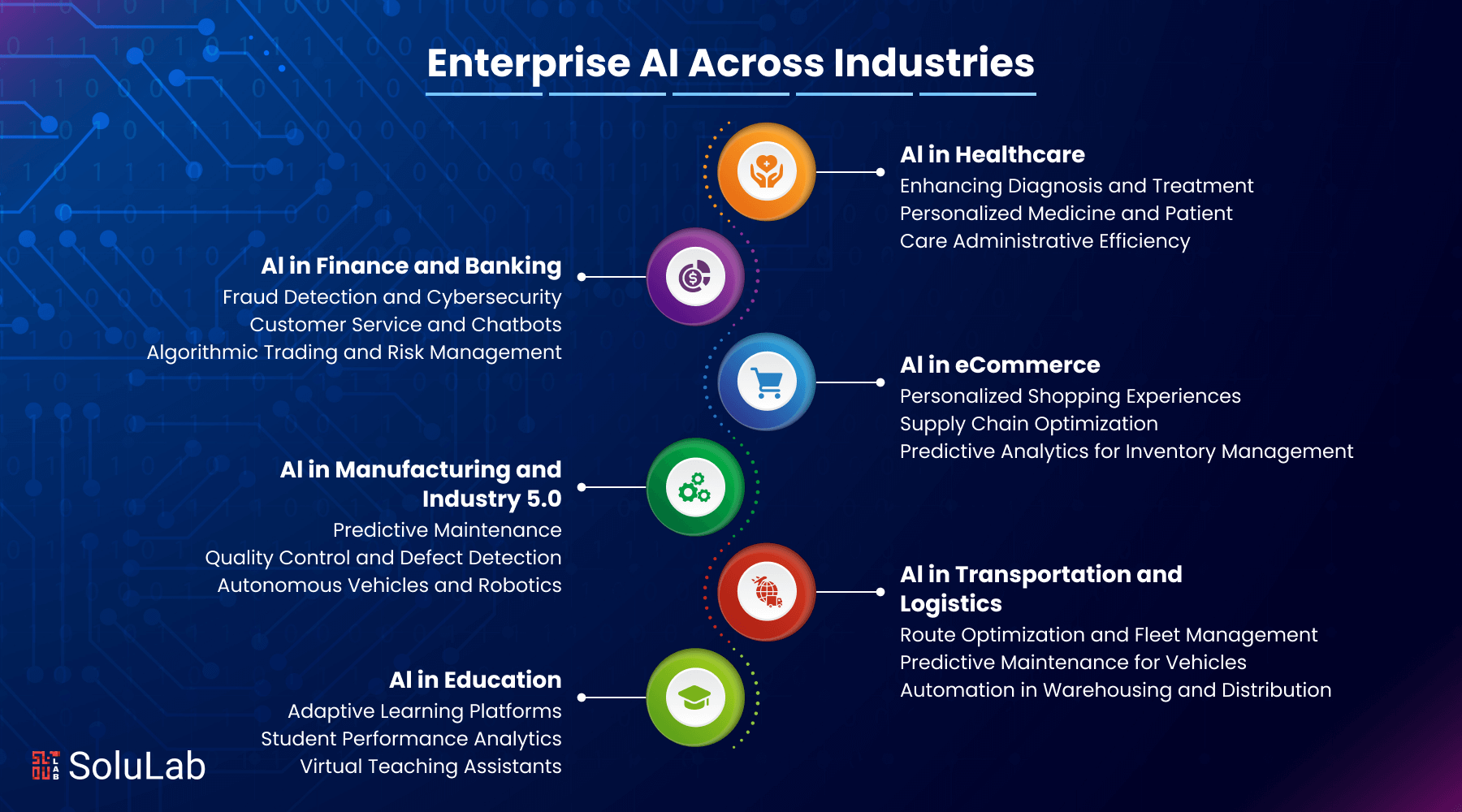
Suppose you still rely on traditional systems to grow your business. In that case, you might struggle to keep up with rising customer expectations, massive data volumes, and the need for faster decision-making.
Even banks are overwhelmed by fraud cases, hospitals are drowning in patient data, and retailers are unable to predict customer behavior. Without smarter solutions, businesses risk falling behind, losing efficiency, and missing growth opportunities. However, by integrating enterprise AI into core operations, organizations can get new levels of efficiency and personalization.
Global Enterprise AI market size is expected to hit USD 97.2 billion in 2025, to USD 229.3 billion by 2030 at a CAGR of 18.9%
In this blog, we’ll explore what enterprise AI is, its benefits, and more. Let’s get started!
What Is Enterprise AI?
AI for Enterprise business is one of the best uses of AI (machine learning, natural language processing, computer vision, generative AI, etc.) within an organization’s workflows, systems, and products. To automate processes, extract insights from big data, personalize customer interactions, and drive smarter, faster business decisions.
A big part of this process is reducing human error and automating as many tasks as possible, and focusing on what matters. Here are a few examples of enterprise AI solutions:
- Predicting customer behavior in retail.
- Automating financial fraud detection in banking.
- Optimizing supply chains in manufacturing.
- Enhancing drug discovery in healthcare.
Key Elements Behind the Rise of Enterprise AI
Here are a few reasons behind the rise of enterprise AI:
- Cultural Shift and AI Awareness: Organizations are becoming more open to adopting AI, with leaders and employees recognizing its potential. This cultural acceptance creates fertile ground for AI integration across departments and processes.
- Massive Investment and Innovation Ecosystem: Governments, enterprises, and venture capitalists are pouring funds into AI research and startups. This steady investment is building a robust innovation ecosystem and enterprise-level AI adoption.
- Competitive Advantage and Business Value: Companies leverage AI to gain an edge—through predictive analytics, personalization, and process optimization. The ability to deliver measurable business value makes AI a strategic priority.
- Cloud Computing and AI-as-a-Service: Cloud platforms make AI more accessible by providing scalable and affordable solutions. Even smaller businesses can now use strong tools without having to spend heavily on infrastructure due to AI-as-a-Service, leveling the playing field.
- Automation and Efficiency: AI improves repetitive tasks, cuts costs, and improves speed. From chatbots handling customer queries to algorithms optimizing logistics, automation is a central driver of enterprise AI adoption.
Benefits of Enterprise AI for Organizations
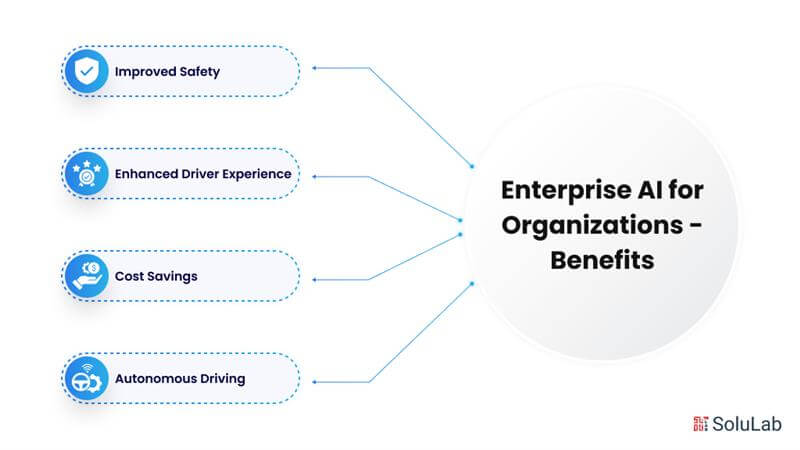
Enterprise AI helps companies grow by combining advanced technologies with business strategy, enabling automation, smarter decision-making, personalized customer experiences, and operational excellence to drive growth. Here are a few benefits of enterprise AI for small businesses:
- Enhanced Decision-Making: AI analyzes massive datasets in real-time, helping leaders identify trends, risks, and opportunities faster. Governance tools like Diligent Boards, for example, enable more accurate, data-driven decisions that improve business outcomes and reduce costly guesswork.
- Operational Efficiency: By automating repetitive tasks and workflows, AI reduces human errors and operational delays. This frees up employees’ time to focus on strategic, value-driven tasks instead of routine work.
- Cost Savings: AI reduces overhead costs by optimizing resource allocation, minimizing waste, and predicting maintenance needs. This proactive approach helps organizations save money while maintaining productivity and performance.
- Improved Customer Experience: From chatbots to personalized recommendations, AI helps businesses understand customer needs better. This creates more engaging, tailored experiences that boost satisfaction, loyalty, and long-term customer relationships.
- Innovation and Growth: AI fosters new product development, market expansion, and smarter business models. By unlocking insights and automating research, organizations can stay ahead of competitors and drive sustained growth.
Use cases of Enterprise AI Being Used to Support Business Needs
AI works as our virtual assistant if used in the right manner. Here are a few use cases businesses should use to grow their business:
1. Customer Relationship Management (CRM)
CRM powered by AI uses customer behavior analysis, anticipates needs, and tailors interactions. This enhances sales projections, automated repetitive processes, and aids businesses in developing stronger and meaningful relationships with their customers.
2. AI for Employee Upskilling
Artificial intelligence-based learning systems identify the gaps in employee skills and prescribe custom training programs. This guarantees sustained growth, increased participation, and a workforce that remains future-fit in fast-changing industries.
3. AI for Market Research
AI tools analyze large volumes of data to reveal patterns, user preferences, and competitor data. This saves time on conducting research, makes them more accurate, and allows businesses to make data-driven decisions with confidence.
4. AI for Creativity
AI will help in coming up with design ideas, content writing, and images. Through the fusion of human creativity, it assists businesses in accelerating innovation, testing ideas, and introducing new ideas to the market.
5. AI in Talent acquisition and management.
The use of AI reduces the process of hiring through filtering resumes, candidate profiling, and employee forecasting. It is also aided in workforce planning, which minimizes bias and aids the HR teams in better managing the talent.
Read More: Global AI Market Outlook 2026 – 2030
Industries That Are Using Enterprise AI with Real Examples
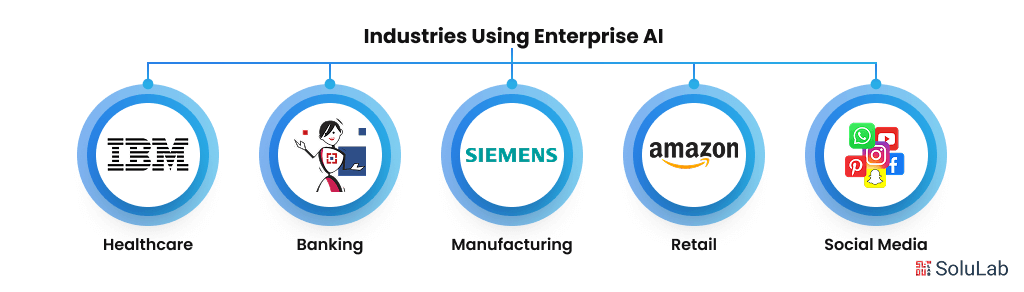
Usage of enterprise AI is not limited to a specific industry. Here are a few industries using enterprise AI applications with examples:
1. Healthcare
Artificial intelligence in healthcare is changing the way physicians diagnose, care, and follow up on patients. It assists in the analysis of medical data, disease prediction, and quicker and more precise decision-making.
Example – IBM Watson Health is an AI that is applied to huge medical datasets, research papers, and patient records. It helps physicians plan cancer treatment, find possible therapies, and give evidence-based recommendations, resulting in improved patient outcomes.
2. Banking
In banking, AI is applied to fraud detection and risk management, as well as to personalized financial services. It improves security as well as makes banking customer-friendly.
Example – HDFC Bank in India has anAI chatbot (EVA) that responds to millions of customer inquiries in real time, trimming down wait time and enhancing customer satisfaction.
3. Manufacturing
AI is used to enhance predictive maintenance, quality control, and efficiency of the supply chain in manufacturing. It saves time and increases efficiency with intelligent automation.
Example: A case in point is Siemens, which deploys AI-based technologies to keep tabs on the machinery on-site, whereby failures can be anticipated and prevented, as well as production lines maintained without interruptions.
4. Retail
Artificial intelligence can help retailers forecast demand, make shopping more tailored, or price their products to increase sales. It also fuels sales, driving recommendation engines.
Example– Amazon is applying AI algorithms to help customers in product recommendations, personalized advertising, and price dynamics, which combine to build a customer experience and boost revenue.
5. Social Media
AI examines the behavior of users, filters out harmful content, and provides personal feeds. It assists platforms to boost engagement and keep communities safe.
Example – Instagram relies on AI to provide content recommendations, spam, and removal of abusive posts, to ensure users see more relevant and safe content.
Conclusion
AI is enabling smarter decisions, reducing costs, and creating personalized experiences for customers. The adoption of AI is helping companies improve how they deliver products and services. Enterprise AI is not optional; now it is necessary to use across industries.
Digital Quest, a travel business, partnered with SoluLab to develop an AI-powered chatbot using Generative AI. The chatbot enhanced customer engagement by offering real-time, personalized travel recommendations and hassle-free reservations. It also integrated user feedback and multi-language support, resulting in improved user experience and high ROI.
SoluLab, an enterprise AI development company, can help you integrate Enterprise AI into your business to reduce human error and add systems. Get in touch with us today!
FAQs
1. Can an Enterprise AI Chatbot Development Company help my business?
Yes, an Enterprise AI Chatbot Development Company is an AI-based chatbot developer that focuses on creating scalable and personalized chatbots to simplify customer relations.
2. Why should companies consider AI consulting services?
AI consulting helps companies identify opportunities, select the most suitable AI approach, and implement solutions tailored to industry requirements.
3. How are AI models for business applied in real life?
The AI models can be used to identify fraud in the banking industry, demand in the retail sector, predictive maintenance in the manufacturing industry, and individual treatment planning in the health sector.
4. What is Enterprise AI going to be like?
The future will be further integration of AI into daily business systems to gain innovation, efficiency, and competitive advantage in all businesses.
5. What is the difference between Enterprise AI and consumer AI?
Enterprise AI is created to be utilized in large organizations, and consumer AI is created to be used by individuals, such as voice assistants or mobile applications.

