Talk to an Expert

Top 5 AI Developments of 2025 You Can’t Ignore for 2026

Top AI Developments You Can't Ignore

What if I told you that the way we use AI today will look completely outdated just a year from now?

Yes… You read that right!

Artificial Intelligence is evolving so rapidly that what was leading-edge in 2025 is already laying the groundwork for even bigger breakthroughs in 2026. From smarter AI agents and creative content generation to enterprise-scale automation and ethical frameworks, the shift is not just technological—it’s transformational.

In this blog, we’ll dive into the top 5 AI developments of 2025 that you absolutely can’t afford to ignore if you want to stay ahead in 2026. Whether you’re a business leader, a developer, or just curious about the future, these trends will give you a clear roadmap of where AI is heading next. Let’s get started!

Why 2025 is a turning point for AI?

2025: the year AI ceases to be a pilot project and becomes the default layer in products, workflows, and customer experiences. Several changes are converging:

  • Agentic AI is moving beyond chat to take actions across enterprise apps.
  • On-device & hybrid AI keep sensitive data local while tapping the cloud for heavy lifting—improving privacy, resilience, and latency.
  • Infrastructure jumps (e.g., next‑gen GPUs and application‑specific accelerators) are reducing training/inference expense while enabling multi‑model deployments.
  • AI‑native search and discovery are revolutionizing the way customers discover information and how marketers perform SEO.
  • Regulation and governance are coming of age, with firm deadlines that businesses have to comply with.

Why AI Developments of 2025 Matter for 2026?

AI is evolving at an exceptional pace. Innovations that emerged in 2025 are not just incremental improvements; they’re laying the foundation for transformative change in 2026.
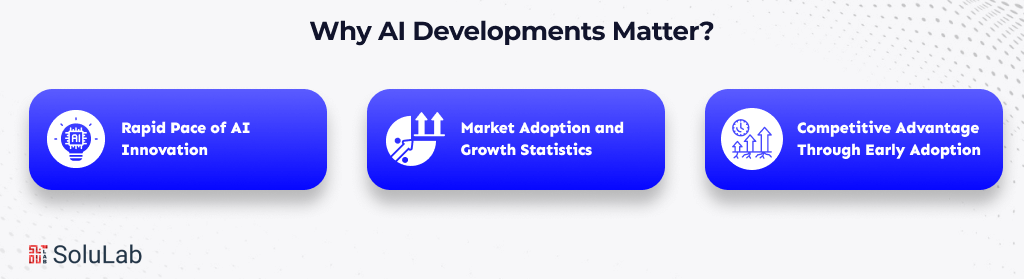
Why AI Developments Matter

1. Rapid Pace of AI Innovation

Every year, AI technologies become faster, smarter, and more capable. In 2025, we’ve seen breakthroughs in generative AI, AI-powered automation, and advanced predictive models that are already redefining industries. Staying updated with these trends ensures you’re prepared to leverage the next wave of innovation.

2. Market Adoption and Growth Statistics

The numbers speak for themselves: the AI market is projected to surpass $78 billion by 2030, with millions of active users adopting AI-driven solutions across sectors. Investments in AI startups reached $15 billion, reflecting the high confidence of investors and the rapid commercialization of AI technologies.

3. Competitive Advantage Through Early Adoption

Businesses that implement AI early gain a significant edge—from optimizing operations and reducing costs to creating innovative products and enhancing customer experiences. Understanding the trends of 2025 gives you the roadmap to leap ahead in 2026, rather than playing catch-up.

Top 5 AI Developments Every Business Should Know for 2026

#1. Agentic AI & Copilots

Agentic AI systems are goal‑driven AIs that are capable of planning, calling tools/APIs, and running multi‑step workflows with human approval. Suppose a “copilot” that doesn’t simply respond but accomplishes: writing content, submitting tickets, updating CRM, reconciling invoices, or choreographing a multi‑app workflow.

Example: GitHub Copilot and AI content copilots are becoming integral to workflows, saving time and boosting efficiency.

  • Enterprise copilots (e.g., in productivity suites and dev environments) are becoming the norm in addition to knowledge work and software delivery.
  • Domain-specific agents (finance, legal, HR, support, supply chain) support high-leverage, repeatable processes with well‑defined guardrails.
  • Human‑in‑the‑loop checkpoints and policy‑aware prompts maintain actions auditable and compliant.

Automation & productivity benefits

  • Time gain on repetitive activities (document preparation, QA, tagging, ticket triage).
  • Increased throughput in sales ops, customer success, and back‑office processing.
  • Decision support through retrieval‑augmented generation (RAG) and tool utilization.
  • Quality & consistency through templates, style guides, and action policies built into the agent.

Quick win concepts: Agentic knowledge base that responds with citations; auto‑triage and resolution through service‑desk bots; meeting‑to‑task pipelines; code review bots; finance close checklists.

#2. On‑Device & Hybrid AI

On-device AI delivers contextual intelligence to phones, laptops, and IoT endpoints—less network dependence and more privacy‑sensitive use cases unlocked. Hybrid AI solutions blend edge models for real‑time workloads with cloud models for more intensive reasoning, fine‑tuning, or batch analytics.

Example: AI-powered cameras, smart home devices, and personal assistants.

Why enterprises care:

  • Privacy & residency: Sensitive data never leaves the device (PII, PHI, financial).
  • Latency: Millisecond‑level responses for assistive UX, industrial control, or AR.
  • Cost control: Push frequent, lightweight inference to devices to save cloud expense.
  • Resilience: Applications remain functional while the network is interrupted.

Design pattern: Localize small, efficient models for summarization, intent detection, speech, and classification; escalate to more expansive cloud models for challenging reasoning or cross‑org retrieval; selectively sync with policy‑based data pipelines.

#3. AI Infrastructure Expansion

Training frontier models and serving multi‑tenant inference demand require massively parallel computers. The 2025 stack includes next‑gen GPUs and domain‑specific accelerators, increased memory bandwidth, reduced‑latency interconnects, and inference‑optimized instances.

Example: Healthcare diagnostics, real-time recommendation engines, and enterprise automation.

Business implications:

  • Faster, less expensive training & fine‑tuning—executable even for mid‑sized companies through managed services.
  • Larger context windows & multi‑modal capabilities become feasible at scale.
  • Multi‑model routing (pick the best model per task) reduces cost without sacrificing quality.

Enterprise takeaway: When the cost curve turns, projects that were “too costly” in 2024 tend to work in 2025—particularly with mixture-of-models and caching.

AI Development Company

#4. AI‑Native Search

Search is evolving from ten blue links to AI-generated answers, multi-turn refinement, and contextual shopping. For businesses, that implies SEO tactics will need to change to supply structured, high-trust content to AI overviews and other aggregators.

Example: AI search engines and platforms are making it easier to sift through massive datasets in real time

Effect on SEO & customer discovery:

  • E‑E‑A‑T signals (expertise, experience, author identity, citations) are paramount.
  • Structured data (schema.org, product feeds, FAQs) makes eligibility for AI summaries.
  • Content for question answering and task fulfillment attracts higher visibility.
  • First‑party data & communities become more important as organic traffic trends shift.

Practical actions today: Aggregate topical authority pages, have strong FAQs with citations, include product & review schema, post concise how‑to workflows, and measure attribution beyond last‑click.

#5. Model Ecosystem & Open Source

Model variety is plentiful, with proprietary frontier models for high‑end reasoning and open‑source models for economically priced, private use cases. Multi‑modal is the norm (text, code, image, audio, sometimes video). Long context + tool application + function invocation are table stakes.

Examples: Frameworks like Hugging Face Transformers, open-source diffusion models, and collaborative AI toolkits

How to select for business purposes:

  • Task complexity: For high‑stakes reasoning or complicated planning, go with top‑end proprietary models; for ordinary classification/summarization, open models are usually good enough.
  • Data sensitivity & residency: Favor on‑prem or VPC‑hosted open models where data should not exit your environment.
  • Latency & cost: Small, concentrated models are best for high‑volume, low‑complexity tasks.
  • Ecosystem fit: Verify SDKs, connectors, and MLOps support.
  • Benchmark on your data: Conduct head‑to‑head tests on representative tasks before committing.

Emerging Technologies Complementing AI Solutions

AI no longer operates in isolation. Its full potential is revealed when combined with other emerging technologies that provide data, speed, security, and connectivity. How the integration works:

1. Internet of Things (IoT) for Smart Environments

  • IoT devices generate vast amounts of real-time data from homes, offices, factories, and cities.
  • When AI analyzes this data, it enables smart automation, predictive maintenance, energy optimization, and personalized experiences.

Example: Smart factories using AI + IoT can predict equipment failures, optimize production, and reduce downtime, driving operational efficiency.

2. Blockchain for Secure & Transparent Data Handling

  • Blockchain provides immutable, decentralized, and tamper-proof data storage, which is critical for AI systems that rely on accurate and trustworthy datasets.
  • Combining AI with blockchain ensures secure decision-making, transparent audit trails, and enhanced trust across industries like finance, supply chain, and healthcare.

Example: AI-driven financial platforms use blockchain to validate transactions and detect fraud in real time.

3. 5G & Edge Computing for Faster, Decentralized Processing

  • 5G networks drastically reduce latency, enabling AI systems to process massive data streams in real time.
  • Edge computing moves AI processing closer to the data source (IoT devices, sensors), reducing dependency on centralized servers and cloud networks.

Example: Autonomous vehicles leverage AI + 5G + edge computing to make split-second decisions for safety and navigation.

Contact Us

Conclusion

The AI developments of 2025—Agentic AI, On‑Device & Hybrid AI, AI Infrastructure Expansion, AI‑Native Search, and Open-Source Model Ecosystems—are more than just technological trends. They are shaping the future of business, innovation, and everyday life.

To stay ahead in 2026, businesses need to embrace these innovations strategically, integrating AI into workflows, products, and services before competitors do. SoluLab, a leading AI development company, helps businesses build custom AI solutions tailored to their industry and goals.

Whether you’re a startup, SME, or enterprise, SoluLab ensures your business is ready for the AI-driven future of 2026 and beyond. Contact us to start now!

FAQs 

1. How does AI infrastructure expansion impact businesses?

Improved AI infrastructure—including cloud platforms, specialized GPUs, and scalable hardware—enables businesses to deploy larger, faster, and more efficient AI models, driving innovation across industries.

2. What industries can benefit most from these AI developments?

These AI trends impact healthcare, finance, manufacturing, education, marketing, and logistics, among others, helping companies innovate, automate, and optimize processes.

3. Why is it critical for businesses to adopt AI now for 2026?

AI is evolving rapidly, and early adoption allows businesses to gain a competitive edge. It optimizes operations and enhances customer experiences.

4. How long does it take to implement AI solutions in a business?

Implementation timelines vary based on complexity, but with a structured roadmap, AI solutions can be deployed in weeks to a few months, depending on the scope and integrations required.

5. How can SoluLab help businesses leverage AI trends?

SoluLab provides end-to-end AI development services, including consulting, custom solution development, integration with IoT/blockchain/5G, and post-deployment support. We help businesses adopt AI efficiently and stay competitive in 2026.

Top 10 AI Development Companies Changing the Future of Finance

AI has become an important factor in changing the way financial services are provided as the sector develops further. Financial institutions can provide more personalized services, improved data utilization, and simplified operations, among other advantages, using AI-powered solutions.

Every business utilizes AI to change the financial services industry, from international financial institutions to fintech startups. The idea is to increase customer satisfaction, reduce risk, and automate manual operations through computer vision, natural language processing, and machine learning (ML) algorithms.

The AI in the finance market was valued at $38.36 billion in 2024 and is projected to reach $190.33 billion by 2030, growing at a 30.6% CAGR. 

These businesses are leading the use of AI in finance, whether it is through chatbots or AI-powered robo-advisors. In this blog, we’ll explore the top 10 AI development companies in finance, focusing on how AI is used in finance, and more. Let’s get started!

How Is Artificial Intelligence Used In Finance?

Five broad areas are where artificial intelligence (AI) in finance might be helpful: automate processes and cut costs; control risk and fraud; create opportunities; personalize services and products; and enable transparency and compliance.

Here’s how artificial intelligence is used in finance in AI companies, explained in simple pointers:

  • Fraud Detection: AI systems analyze transactions in real-time to spot unusual behavior and flag potential fraud.
  • Risk Management: AI models predict market risks and help financial institutions make smarter, data-driven decisions.
  • Algorithmic Trading: AI is used to develop trading bots that analyze market data and execute trades at high speeds for better profits.
  •  Customer Service: AI chatbots handle customer queries 24/7, reducing the load on human support teams.
  • Credit Scoring: Lenders use AI to evaluate loan applications by analyzing financial history and behavior patterns beyond traditional credit scores.
  • Financial Forecasting: AI helps predict market trends, company performance, and economic shifts with better accuracy.
  • Automating Back-Office Tasks: AI handles repetitive tasks like invoice processing, data entry, and compliance checks, saving time and reducing errors.

Top 10 AI Development Companies for the Finance Sector

AI-based solutions are being used by businesses to handle all or some of their financial requirements. To manage all of their requirements, including accounting, bookkeeping, invoicing, inventory management, and forecasting, some people are opting for comprehensive cloud-based systems. 

Others already have financial procedures in place; they only need to add a few more parts to finish the jigsaw. Here, we examine a few best finance AI companies that provide AI solutions:

solulab

1. SoluLab

SoluLab is a leading AI development company changing the financial sector with intelligent automation, predictive analytics, and secure blockchain integration. Known for delivering scalable fintech solutions. Trusted by startups and enterprises alike, SoluLab blends cutting-edge technology with business strategy to drive real results. Their client-centric approach and agile development process make them a go-to partner for financial institutions aiming to stay ahead.

SoluLab helps banks, startups, and enterprises improve operations, enhance decision-making, and improve customer experiences through innovative AI technologies tailored to the ever-evolving demands of AI in finance companies.


$25 – $49/ hr


50 – 249


2014


USA

Sapphire Software Solutions

2. Sapphire Software Solutions

Sapphire Software Solutions is an AI development company revolutionizing the finance sector. They specialize in AI-powered financial services, offering tools like real-time fraud detection, predictive risk analysis, and automated trading systems. Their expertise extends to AI-driven financial forecasting, portfolio optimization, and compliance monitoring, enabling financial institutions to make data-driven decisions and enhance operational efficiency.

By integrating advanced technologies such as machine learning and predictive analytics, Sapphire helps clients navigate the complexities. Their commitment to delivering AI solutions positions them as a trusted partner for organizations seeking help in financial operations.


NA


~200


2022


India

Markovate

3. Markovate

Markovate is a leading AI development company specializing in financial technology solutions. Their services include AI-powered risk assessment, fraud detection, financial forecasting, and personalized customer engagement tools. By using advanced technologies like machine learning and natural language processing, Markovate helps financial institutions enhance operational efficiency, ensure regulatory compliance, and deliver tailored financial services.

Notably, their AI-driven solutions have achieved significant outcomes, such as reducing fraud by 80% and improving customer retention rates. With a commitment to innovation and client-centric approaches.


$26-$50/ hr


11-50


2015


Canada

Osiz Technologies

4. Osiz Technologies

Osiz Technologies is an AI development company specializing in solutions for the financial sector. With over 16 years of experience, Osiz offers advanced AI services that enhance decision-making, automate operations, and ensure regulatory compliance. Their AI solutions in finance include real-time analytics, fraud detection, risk management, personalized financial services, and algorithmic trading.

By using technologies like machine learning and natural language processing, Osiz helps financial institutions streamline processes and improve customer experiences. Their commitment to delivering tailored AI solutions makes them a trusted partner for financial organizations seeking digital transformation.


NA


350


2009


India

goml

5. GoML

GoML is a leading Gen AI development company head quartered in NY, USA with a strong track record of enterprise-grade gen AI solution delivery and implementation. GoML is the only gen AI native company globally selected as a Launch Partner for AWS’s Gen AI Competency program.

GoML offers battle-tested LLM boilerplates and accelerators that have already proved their merit, for highly regulated industries like Finance and insurance. With a portfolio of 6 production-grade LLM boilerplates and a track record with leading startups and enterprises, GoML is a preferred AI development company for financial services.


$30-$50/ hr


120+


2023


NY, USA

Addepto

6. Addepto

Addepto is a leading AI and Big Data consultancy, specializing in delivering tailored solutions that empower financial institutions to navigate complex challenges and enhance operational efficiency. Founded in 2018 and headquartered in Warsaw, Poland, Addepto has rapidly expanded its global presence, serving clients across various industries, including finance, automotive, and retail.

Recognized for its innovative approach, the company has been featured in prestigious rankings such as Deloitte Fast 50 and Financial Times 1000. With a team of over 50 employees, Addepto continues to drive digital transformation in the financial sector through advanced AI solutions.


$32/ hr


50 – 99


2018


Poland

CrossML

7. CrossML

CrossML is an AI product engineering company specializing in developing tailored solutions for the finance sector. Their services encompass loan process automation, real-time pre-approval systems, fraud detection, and regulatory compliance automation. By using advanced AI technologies, CrossML improves operational efficiency, reduces costs, and accelerates decision-making processes for financial institutions.

Their commitment to data security and compliance ensures that all solutions adhere to industry standards, providing clients with trustworthy and scalable financial technologies.


$25/ hr


40+


2019


India

Nadcab Labs

8. Nadcab Labs

Nadcab Labs is an AI development company that specializes in delivering artificial intelligence solutions tailored to the financial sector. Their expertise includes a wide range of AI applications, including intelligent chatbots, predictive analytics, machine learning models, and data-driven insights, all designed to enhance decision-making, operations, and improve customer experiences in the finance industry.

By integrating AI technologies into financial services, Nadcab Labs helps businesses to achieve greater efficiency, security, and scalability, positioning them at the forefront of digital transformation in finance.


$51 – $100/ hr


51 – 200


2017


India

Devox Software

9. Devox Software

Devox Software is an IT solutions provider specializing in AI-driven innovations for the finance sector. Established in 2017 and headquartered in Warsaw, Poland, the company offers a comprehensive suite of services, including fraud detection, credit scoring, and regulatory compliance solutions. Using machine learning, natural language processing, and blockchain integration, Devox enhances financial operations by improving decision-making, reducing risks, and ensuring compliance.

Their expertise spans various financial domains, such as lending, payment systems, and investment platforms, delivering tailored solutions that align with industry standards and client needs.


$30-$70/ hr


100 – 249


2017


Poland

Master of Code

10. Master of Code

Master of Code is a custom AI development company, empowering financial institutions to innovate and streamline operations. Their AI-powered FinTech services encompass fraud detection, automated loan processing, algorithmic trading, dynamic pricing, personalized financial planning, and regulatory compliance.

With numerous successful projects and a notable client retention rate, Master of Code has established itself as a trusted partner for enterprises seeking to enhance efficiency and profitability through advanced AI solutions.


$50-$99/ hr


250+


2004


USA

What Is The Future Of AI And Automation In Financial Services?

AI will contribute to the expansion of financial services. Since becoming digital, many businesses have discovered new methods for increasing sales, simplifying procedures, and concentrating on their data. They will have to scale relationship-based customer interaction in the future. 

Customized customer answers, safer and more responsible product and service recommendations, and gaining trust by expanding service options that are accessible when clients need them most are all made possible by artificial intelligence (AI).

Financial organizations must also create strong and unique permission-based digital client profiles, but the information they require could be spread across several platforms. AI consulting companies can assist financial institutions in developing experiences that cater to the particular requirements of their clients while expanding effectively by dismantling these barriers, implementing an AI layer, and effortlessly utilizing human interaction.

AI Development Company

Conclusion

The introduction of AI into the financial services sector is changing how businesses handle their finances, communicate with clients, and make strategic decisions. AI technology is predicted to have an even greater impact on the finance industry as it develops further, providing new avenues for increasing productivity, cutting expenses, and improving financial results.

As AI continues to evolve, partnering with the right development company could be the competitive edge that sets financial leaders apart in the years to come. SoluLab helped InfuseNet launch a secure, AI-powered platform that simplifies data integration and model fine-tuning. With intuitive flow design, API connectivity, and real-time insights, businesses now improve workflows, decision-making while keeping sensitive data private and protected across self-hosted or cloud deployments.

SoluLab, a top AI development company, has its team of experts to help you solve your business queries. Contact us today to discuss further.  

FAQs

1. What is the role of AI in the finance industry?

AI helps automate tasks, improve fraud detection, personalize customer service, and enhance decision-making through predictive analytics in finance. The best AI development companies play a crucial role in implementing these technologies effectively.

2. How are AI development companies transforming finance?

These AI consulting companies build advanced AI tools and platforms that improve operations like credit scoring, wealth management, algorithmic trading, and regulatory compliance.

3. Are AI solutions in finance secure?

Yes, top AI development firms follow strict compliance and cybersecurity protocols to ensure secure data handling and risk mitigation.

4. What technologies are commonly used in AI finance solutions?

Popular technologies include machine learning, natural language processing (NLP), robotic process automation (RPA), and predictive analytics.

5. Can AI help reduce costs for financial institutions?

Absolutely. AI reduces manual work, improves efficiency, and minimizes errors, leading to significant cost savings over time.

How to Create an AI-Integrated Smart Crypto Wallet?

AI integrated Crypto Wallet

Have you ever thought about a cryptocurrency wallet that offers features beyond the storage of your digital assets? The rise of AI crypto wallets has made this possible. These wallets have been designed to help users make informed choices, identify suspicious activities, and provide valuable recommendations based on their app usage.

As more people get into cryptocurrency, the tools they use must become smarter and more user-friendly. AI contributes by providing features such as automated suggestions, smart notifications, and voice control. It’s similar to having a helpful assistant built into your wallet, directing you along the way.

In this article, we will look at how to build your own AI-enabled crypto wallets. Whether you’re a developer or simply interested, we’ll make things easy and walk you through the stages, tools, and suggestions to get started!

The Journey of Crypto Wallets

Back when Bitcoin first came around in 2009, crypto wallets were pretty basic software that helped you store your private keys and maybe send or receive a few coins. Just enough to interact with the blockchain and keep your assets safe. But as more people started getting into crypto, wallets had to level up. Developers began building wallets that could handle multiple tokens and feel easier to use.

TRC20 wallets were then upgraded with the TRON blockchain, and some of them have started using AI to make transactions smoother and boost security. These wallets are learning, adjusting, and reacting in real time. It’s the start of the AI-integrated smart crypto wallets era. Security has also become a bigger deal lately. Features like multi-signature approvals and HD wallets started showing up. These additions give users a lot more control.

Now, wallets aren’t just storage tools anymore. They are evolving into full-blown financial dashboards. Some can track spending habits, spot suspicious activity, and even automate routine tasks. And they’re doing all this while keeping your crypto safe in the background. Not bad for something that started as a simple keyholder.

Market Statistics for Smart Crypto Wallets in 2025

The AI-integrated smart cryptocurrency wallet industry is predicted to develop rapidly through 2025 and beyond. This is due to the growing acceptance of blockchain technology across businesses, as well as increased demand for safe cryptocurrency transactions and developments in AI integration for improved functionality and security.

Key Statistics and Trends:

  • According to a Grand View Research report, the worldwide AI crypto wallet industry is anticipated to be worth USD 8.42 billion in 2022, with a compound annual growth rate (CAGR) of 24.8% from 2023 to 2030.
  • In 2023, the worldwide smart wallet market was estimated to be worth USD 289.16 million. Additionally, it is expected to reach USD 519.22 million by 2032. It will grow at a CAGR of 6.72% from 2024 to 2032. As a result, market expansion is ascribed to digital transformation and increased e-commerce growth.

US Crypto Wallet Market Analysis

Key Features of a Next-Level Smart Crypto Wallet

Today’s smart wallets aren’t just about storing coins anymore. They’ve got to be secure, easy to use, and flexible enough to keep up with how people actually use crypto. If you’re thinking of building one, here’s what needs to be on your checklist.

1. Handles Different Coins in One Place

A good wallet should support a bunch of cryptocurrencies, not just Bitcoin or Ethereum. You want to be able to manage everything—from top-tier coins to up-and-coming tokens—without juggling multiple apps. That’s what makes an AI-integrated smart crypto wallet feel truly “smart.”

2. Works Across Devices

People don’t stick to one device anymore. Your wallet should work on a phone, laptop, or tablet, and sync across all of them. Whether you’re on Android at work or checking from a Mac at home, your info should be up to date no matter where you log in.

3. Security That Doesn’t Get in the Way

Strong security is non-negotiable. Things like biometric logins, 2FA, and solid encryption need to be built in. But they shouldn’t make the app feel clunky or slow. Ideally, security should feel invisible, working in the background while keeping your assets safe.

4. Stores Keys With the User

A proper wallet doesn’t store your private keys on some central server. It keeps them on your own device. That way, you control your funds, and if something goes wrong with a central system, you’re not at risk.

Related: Build an AI-Integrated Crypto Wallet on Aptos from Scratch

5. Multi-Sig for Shared Access

If the wallet is being used by a group—say, a team or DAO—it should allow multiple approvals for transactions. That’s where multi-signature support comes in handy. It adds a layer of trust and reduces the risk of unauthorized transfers.

6. Built-In Swap Feature

Being able to exchange tokens without leaving the wallet? That’s a big win. It saves time, reduces fees, and just feels seamless. This is one of the features that separates a good user experience from a frustrating one.

7. QR Code Transfers

Ever tried typing a wallet address? It’s a nightmare. QR codes simplify this. Scan to send, scan to receive—it should be that easy. Especially useful in retail or face-to-face payments.

Mobyii Case Study

Why Integrating AI Can Transform Your Crypto Wallet?

Ever found yourself wondering whether it’s really worth building your own AI-based crypto wallet when there are already so many options on the app stores? Here’s a look at why developing one yourself can actually make a big difference—and offer some real advantages.

  • More Control Over Security

When you build your own crypto wallet, you’re not stuck depending on someone else’s framework or hoping a third-party backend is secure. You’re in full control. That gives you the flexibility to design your own security protocols, tailored to your exact needs. What’s more, integrating AI agents for finance into the system adds a powerful layer of protection. These agents can keep an eye on real-time activity, spot red flags early, and help prevent issues before they turn into serious problems.

Read Our Blog Post: Custodial vs. Non-Custodial Wallets

  • Personalized Features and Automation

One of the biggest plus points of AI is how it can tailor the wallet to your personal needs. Whether it’s letting the system handle transaction approvals or helping manage your crypto portfolio more smoothly, AI makes everyday tasks simpler. It can even help with automatically running smart contracts based on predefined triggers.

  • Helping You Make Better Calls

An AI-supported wallet doesn’t just sit there—it learns. It can pull live data from the market, check past transactions, and even spot trends. So, if you’re unsure when to buy or sell, it can offer suggestions based on what’s actually happening, not just guesswork.

  • A Chance to Learn While You Build

Starting from scratch with an AI-driven crypto wallet isn’t just about having something custom. It’s a hands-on opportunity to understand how blockchain systems work, explore AI applications, and get familiar with security practices that actually hold up. It’s a smart way to learn how these technologies connect in the real world.

When it comes to the role of AI in crypto wallets, it’s not just about features—it’s about building smarter, more responsive tools that adapt to how people actually use crypto. And if you’re building it yourself, that wallet works exactly the way you need it to.

Step-by-Step Breakdown to Build Your Own AI-Powered Crypto Wallet

Build AI integrated Smart Crypto Wallet

Building a crypto wallet that smartly blends AI capabilities with blockchain features takes more than just coding—it’s a thoughtful process. From laying out the concept to rolling out the final product, here’s a walkthrough of how to create a wallet that’s secure, intelligent, and user-first.

1. Research and Planning

Before you begin development, it’s essential to dive deep into research. Take time to understand the current crypto wallet market—what’s working, what’s not, and where users struggle. Then look at where AI can offer real value. Think beyond buzzwords—maybe smarter alerts, stronger fraud protection, or auto-generated suggestions for trading timing.

2. Select the Technology Stack

The tools you choose will shape how well your wallet performs and scales. For the blockchain layer, many developers go with platforms like Ethereum, Solana, or Binance Smart Chain. On the AI side, it makes sense to explore frameworks like PyTorch or TensorFlow—each offers solid support for training and integrating models. The blend depends on what your wallet is meant to do.

3. Design the User Interface

For any app to gain traction, design matters. And in crypto, that’s even more true. Focus on a layout that feels simple, even to someone who isn’t deeply technical. Users should be able to check their balances, send tokens, and get insights powered by AI without having to dig through menus or manuals. A well-thought-out UI can make or break adoption.

4. AI Integration for Smart Features

Artificial intelligence can do a lot—but only if it’s used wisely. A crypto wallet can offer things like customized financial advice, automatic portfolio adjustments, or even warnings about shady-looking activity. Machine learning models can track user behavior and market trends to offer meaningful, real-time suggestions, not just surface-level alerts.

5. Security and Encryption

With crypto, safety isn’t optional—it’s a must. That means using encryption standards to protect private keys and sensitive data, and including two-factor logins to verify identities. AI plays a part here, too—it can analyze user behavior to spot anomalies or flag risky access attempts before any damage is done.

6. Smart Contract Development

A wallet that supports decentralized finance needs to connect with smart contracts. These aren’t just about transactions—they can handle staking, swaps, or lending protocols directly from the wallet. With the help of top AI cryptocurrency wallet development, you can bake in automation that moves assets based on triggers without requiring manual input or outside middlemen.

Read Also: Why AI Smart Contracts Are the Future of Business?

7. Testing and Quality Assurance

You don’t want bugs in production, especially when money’s involved. Thorough testing, including both feature checks and security validation, is a must. Stress testing for high-traffic use, edge cases, and verifying that your AI modules behave accurately should all be part of the process before go-live.

8. Launch and Improvement

Once you’re confident everything works, it’s time to launch—whether through mobile stores or web platforms. But it doesn’t stop there. Gather feedback, observe how users interact with the wallet, and make improvements. Regular updates can introduce fresh AI features, better UX, and stronger security protocols over time.

Read Also: How to Create a Wallet like Phantom?

What Does It Cost to Build an AI-Powered Crypto Wallet?

If you’re thinking about building an AI-integrated smart crypto wallet, you’re probably asking the big question: what’s the cost? Well, there’s no fixed number. The total budget can vary a lot depending on the scope of the project, what features you want, and even where your development team is based.

Different regions charge differently, and of course, more complex features (like real-time AI analytics or DeFi integration) will push the cost higher. For anyone planning to enter this space—or even wants to start a cryptocurrency exchange with a custom wallet solution—it helps to have a rough idea of what goes into the budget.

Below is a general estimate of what each stage in the crypto wallet development process might cost you:

Development Phase Estimated Cost (USD)
Market & User Research $5,000 – $15,000
Interface & Experience Design $10,000 – $30,000
Backend Architecture $20,000 – $50,000
AI Feature Integration $15,000 – $40,000
Security Layers & Encryption $10,000 – $25,000
QA & Final Testing $5,000 – $15,000
Product Launch & Promotion $10,000 – $30,000

Popular AI-Integrated Crypto Wallets You Should Know About

Over the past couple of years, a few crypto wallets have quietly stepped up their game by blending AI into their core functionality, not as a gimmick, but as a real value add for users. These wallets don’t just hold tokens; they help manage them smarter, track patterns, flag risks, and sometimes even suggest the best time to move assets. If you’re curious about what’s out there already, here are a few worth mentioning.

1. Frontier Wallet

Frontier is known for supporting a wide range of DeFi protocols and asset-backed cryptocurrencies, but it’s also been making strides by adding AI-driven tools to simplify investment tracking. While its AI features aren’t always front and center, they assist with things like transaction categorization and identifying potential risks in DeFi positions, especially useful for users juggling multiple protocols.

2. ELLIPAL Titan

This one’s a hardware wallet, but it’s paired with a smart app that uses AI for transaction monitoring and anomaly detection. The AI component flags anything that looks out of the ordinary, giving users a heads-up before something potentially harmful happens. It’s a solid pick for those who want both cold storage and active AI support.

3. YouHodler

YouHodler blends lending, trading, and wallet functions all in one place. The wallet part benefits from machine learning models that offer real-time price analysis and smart alerts based on user behavior. It’s more than a passive wallet—it helps users make choices with better timing and data.

4. Klever Wallet

While Klever started as a simple mobile wallet, newer versions have begun using AI in subtle ways, like optimizing gas fees, flagging abnormal sending behavior, and offering suggestions based on previous transaction patterns. It’s a good example of how AI doesn’t have to be flashy to be useful.

These wallets show that the shift toward smarter, data-aware crypto tools is already happening. For businesses or developers exploring crypto wallet development, looking at how these platforms quietly integrate AI can offer some real inspiration. The goal isn’t to overcomplicate things—it’s to make crypto safer, easier, and a little more intuitive for everyday users.

Read Also: Why Every Business Should Integrate POS Crypto Wallets?

The Future of Crypto Wallets and AI

The way people use crypto wallets is changing fast. What started as simple tools to store private keys is now evolving into full-service financial platforms. As user expectations grow, wallets are being built to do more—track spending, simplify cross-chain transfers, and even guide users on the best time to make a move. The future? It’s not just about holding crypto; it’s about managing digital wealth in smarter, safer ways.

This is where AI trends are starting to shape what’s possible. We’re already seeing wallets that adapt to user habits, flag irregular activity, and even offer smart recommendations based on real-time market shifts. As these technologies continue to mature, AI won’t just be a nice-to-have—it’ll be at the core of how next-gen wallets operate, bringing everyday users closer to a more intuitive and secure crypto experience.

AI Integration Services

The Bottom Line

As the world of digital finance grows more complex, the role of smart crypto wallets continues to expand. We’re moving beyond basic storage into a new era where AI and blockchain work hand in hand, bringing better insights, stronger security, and more control to everyday users.

At SoluLab, a leading cryptocurrency development company, we’ve been helping companies navigate this space with end-to-end blockchain solutions. We recently worked for a platform focused on advanced digital marketing and web traffic analytics. We developed a native crypto wallet tailored to their ecosystem, enabling secure asset management alongside unique features like call tracking and multi-source traffic monitoring. With this wallet integrated into their blockchain-powered platform, Clicktool users can now track ROI, manage campaigns, and analyze markets with more precision than ever before.

If you’re exploring new ways to bring AI and blockchain into your next wallet or digital platform, now is the time. Whether you’re just getting started or looking to upgrade an existing product, our team’s here to guide you every step of the way. Contact Now!

FAQs

1. Why build own AI-integrated crypto wallet instead of using an existing one?

Building your own wallet gives you full control over its features, security standards, and data management. Unlike third-party apps, where you’re relying on someone else’s code, your own wallet lets you decide exactly how it works—plus you can tailor the AI features to your users’ specific needs, from smarter analytics to fraud detection.

2. What are some real benefits of using AI in a crypto wallet?

AI helps a wallet do more than just store and send crypto. It can offer smart alerts, track unusual activity, give market insights, and even help automate decisions like when to buy, sell, or hold. It turns the wallet into more of an assistant than a simple storage tool.

3. How does AI improve security in a crypto wallet?

AI can monitor transaction patterns and detect behaviors that seem out of the ordinary. If something unusual is going on—like a login from a new device or an unusual withdrawal—it can send alerts or even trigger preventive measures before things go south.

4. Is AI only for large-scale or enterprise-level wallets?

Not at all. While big companies may invest more in advanced AI tools, smaller projects and startups can still benefit. Even basic AI features like predictive analytics or anomaly detection can improve user experience and add value without needing a massive budget.

5. Are AI wallets safe to use if someone is not very tech-savvy?

Yes, most modern AI wallets are built with user experience in mind. You don’t need to be a developer or trader to use them. In fact, the AI does much of the heavy lifting in the background, so you can focus on managing your assets with confidence.

Top 10 AI Consulting Companies 2026

AI intelligence has advanced from specialized technology to a new and generally acknowledged business requirement. To increase company agility, data-driven strategies need to be properly matched with technological maturity.

However, expert guidance is required for the successful implementation of industry-specific AI technologies such as chatbots, AI agents, and conversational AI. As a result, the need for AI consulting firms is rising.

Through product discovery and idea feasibility assessments, these consulting services assist companies that aren’t sure if implementing AI is necessary. Additionally, they suggest the top platforms, frameworks, and tech stacks for modernizing legacy systems. In this blog, we’ll explore the top 10 AI consulting companies, future trends, and more. Let’s get started!

Key Features of an AI Consulting Company

AI consulting is a specialist service where professionals help businesses use AI technologies to boost productivity, enhance decision-making, and spur innovation. These experts pinpoint areas where AI might be helpful, such as improving customer experiences, automating tedious processes, or extracting valuable insights from massive databases. Here are some of the features of an AI consulting company you should be aware of:

  • Expertise in Data Analytics and AI: These businesses may advise other businesses on how to employ data analytics and artificial intelligence technology because they have more knowledge of these fields.
  • Custom Solutions: They offer AI solutions that are specifically designed to assist businesses in overcoming obstacles or achieving their objectives.
  • Innovation and Growth: Here is where leading AI consultants can help with creating creative business plans that aim to eventually achieve operational excellence.

Top 10 AI Consulting Companies 2026

The top ten international AI consulting firms, acknowledged for their expertise, innovative thinking, and impact on various industries, are listed below:

solulab

1. SoluLab

SoluLab is a decentralized development service provider and leading AI consulting company renowned for delivering innovative solutions to businesses across various industries. With a team of highly skilled AI consultants, SoluLab offers comprehensive services, including expertise in machine learning, natural language processing, and computer vision.

Notable projects by SoluLab include implementing AI-driven personalization algorithms for an e-commerce company, resulting in increased conversion rates and customer satisfaction. With a customer-centric approach and a focus on delivering tangible business outcomes, SoluLab will be a trusted AI consulting partner in 2026. Their expertise and dedication to innovation position them as a go-to choice for businesses seeking to harness the power of AI successfully.


$25 – $49


250+


2014


USA

Boston Consulting Group

2. Boston Consulting Group

Boston Consulting Group is a global management consulting firm that has expanded its expertise to include robust AI consulting capabilities. With a focus on leveraging AI to drive value and competitive advantage, BCG combines deep industry knowledge with AI technologies to deliver tailored solutions to its clients.

BCG has achieved notable success in AI consulting by helping organizations optimize operations, enhance customer experiences, and drive innovation through data-driven decision-making.


$99+ / hr


10,000+


1963


MA, Boston, USA

3. SparxIT

SparxIT is a leading AI consulting company headquartered in Noida, India. The firm has expertise in data-backed AI model development, generative AI, and agent AI. The company has a skilled team with comprehensive machine learning, natural language processing, model training, and an understanding of predictive analytics. They offer actionable business intelligence with future-proof Solutions that drive growth.

SparxIT developers solve intricate challenges utilizing AI technology consulting. The company has a prominent clientele base, including HP, Huawei, Intel, Hisense, etc. They provide custom AI automation solutions for various industries, such as Healthcare, BFSI, Supply chain, manufacturing, etc., and set high standards.


$25 – $49 / hr


250+


2007


Noida, India

Kyndryl

4. Kyndryl

Kyndryl is an American multinational IT infrastructure services provider based in New York City. It was spun off from IBM’s infrastructure services division and has extensive experience in data and AI transformation.

The company offers AI development services using modern data architecture to help scale digital businesses. With global expertise in hyperscalers, Kyndryl makes businesses AI-ready by combining modular frameworks with robust AI governance to secure applications and enhance data fabric. Their client portfolio includes Grupo Romero, Japan Airlines Co., Ltd., Canadian Malartic, and Arab National Bank.


$100 — $150 / hr


1000+


2001


New York, USA

Cambridge Consultants

5. Cambridge Consultants

Cambridge Consultants is one of the leading AI consulting companies. Cambridge Consultants, a distinguished product development and AI consulting firm, excels in providing cutting-edge technological innovations and comprehensive AI consulting services. Their multidisciplinary approach integrates AI with emerging technologies like IoT and robotics, delivering groundbreaking solutions that prioritize user-friendly experiences.

Through a holistic strategy, they analyze clients’ needs, develop tailored AI strategies, and employ an agile methodology for iterative development, resulting in scalable solutions adaptable to evolving business requirements.


$99+ /hr


900+


1960


Cambridge, United Kingdom

IBM

6. IBM

The organization was founded in 1911 in New York and provides specialized consulting services for artificial intelligence. They use next-generation AI tools that map the future of your business to speed up cloud transformation. IBM improves your company’s operations with cloud solutions and value-driven AI services.

They provide safe AI solutions that boost resilience in collaboration with AWS, Microsoft, and SAP. American Airlines, Humana, VitalProbe Inc., Sensis, and other companies are among the firm’s many clients.


$150 — $199 / hr


250,000+


1911


New York, USA

Addepto

7. Addepto

Addepto is a data engineering and AI consulting company that stands out for delivering impactful, data-driven AI solutions through its team of specialists in AI, data science, and engineering. With deep expertise in advanced analytics and machine learning, Addepto collaborates closely with organizations to develop customized AI strategies, driving tangible business outcomes.

Their proven track record in successful AI implementations has positioned them as a reliable consulting partner, helping businesses optimize operations, enhance customer experiences, and unlock new revenue streams.


$50 – $99 / hr


10 – 49


2017


Warszawa, Poland

Accenture

8. Accenture

Accenture offers a wide range of AI and data analytics services worldwide, making it one of the top international companies for AI consulting. It understands the nuances of different industries better than anybody else because it is present in more than 120 countries worldwide. This business focuses on using state-of-the-art artificial intelligence technology to facilitate digital transformation.

Accenture’s customized AI consulting service benefits businesses by helping them create and implement projects that align with their unique objectives. Because they involve their customers in identifying potential issues that the companies may face, their model is highly consultative.


$150 – $199 / hr


500,000+


1960


Dublin, Ireland

BlueLabel

9. BlueLabel

One prominent AI consulting company that specializes in using AI technologies to address challenging business issues is BlueLabel. They develop and deploy scalable AI solutions with an expert team of data scientists and AI specialists, emphasizing automation, predictive analytics, and data-driven insights.

The strategy used by BlueLabel helps companies simplify operations, cut expenses, and spur ongoing innovation. The end effect is innovative, improving overall corporate performance and agility in cutthroat marketplaces. BlueLabel has collaborated with renowned institutions like iHeartMedia, the Mayo Clinic, and the MLB Players Association.


$100 — $149 / hr


200+


2009


New York, USA

Coherent Solutions

10. Coherent Solutions

Leading AI consulting firm Coherent Solutions is renowned for providing cutting-edge, AI-powered solutions that enable companies to innovate. Their proficiency in natural language processing, machine learning, and deep learning allows them to assist clients in incorporating AI into their business processes, enhancing customer satisfaction, productivity, and decision-making.

Coherent Solutions collaborates with businesses in various industries to develop customized AI strategies, guaranteeing maximized company expansion and a competitive advantage in a quickly changing digital environment. Notable customers like WEX Health, Carbonite, Carlson, and others have partnered with the business.


$50 — $99 / hr


1,000+


1995


Minneapolis, USA

CTA1

The Future of AI Consulting Companies

AI consultancy is projected to develop significantly in the future. As companies realize the value of AI, they will demand more from top AI consultants. AI consulting will be shaped by many factors:

1. Increased Industry AI Adoption: These firms will help employers integrate AI into their systems in many areas.

2. AI Consulting Services: As AI technologies change, these organizations will provide more specialized and advanced options. 

3. Focus on Data Analytics: Data analytics consulting businesses are still important in AI consulting.

4. Collaboration and Partnerships: Such organizations may collaborate with tech suppliers or stakeholders like research institutes to provide top-notch solutions.

5. AI in SMEs: AI provides low-cost, scalable AI solutions to SMEs to help them compete with large enterprises.

6. Customization: AI consulting firms create AI solutions for every organization.

7. AI Integration with Technologies: Leading AI consulting firms prioritize AI integration with blockchain and IoT. 

Conclusion

When choosing an AI consulting partner, clearly define the objectives of digital transformation that could impact your company. While this list of the top 10 AI consulting firms for 2026 is a good starting point, it is essential to conduct thorough research aligned with your business needs. 

Carefully evaluate key factors and have open discussions with potential partners to ensure they meet your goals. This approach will help you maximize AI’s potential and drive meaningful growth for your company.

AI-Build, a construction tech company, partnered with SoluLab to enhance CAD product development using generative AI and ML models. SoluLab’s solution automated design processes, improved accuracy, and reduced manual intervention. Their scalable architecture and interactive features enabled AI-Build to boost productivity, enhance customization, and scale operations efficiently.

SoluLab, an AI consulting company with its team of experts, can help you solve your business queries. Get in touch with us Today!

FAQs

1. What criteria were used to select the top AI consulting companies in 2026?

The companies were evaluated based on their expertise in AI technologies, successful project implementations, client reviews, innovation in AI solutions, and overall impact on the industry.

2. How can AI consulting companies help businesses improve their operations?

AI consulting companies assist businesses by providing tailored AI solutions that enhance efficiency, automate processes, improve decision-making, and drive innovation through advanced data analytics, machine learning, and predictive modeling.

3. What industries benefit the most from AI consulting services?

Industries such as healthcare, finance, retail, manufacturing, logistics, and telecommunications benefit significantly from AI consulting services due to their data-intensive nature and the potential for automation and advanced analytics to improve outcomes.

4. What should businesses look for when choosing an AI consulting company?

Businesses should consider the company’s expertise in relevant AI technologies, track record of successful projects, client testimonials, the ability to customize solutions to meet specific needs, and their approach to data security and ethical AI practices.

5. How do AI consulting companies ensure the ethical use of AI in their projects?

Reputable AI consulting companies implement robust ethical guidelines, ensure transparency in AI models, prioritize data privacy, and adhere to industry standards and regulations to prevent biases and ensure fair and responsible use of AI.

6. Can AI consulting companies assist with integrating AI into existing business systems?

Yes, AI consulting companies specialize in seamlessly integrating AI solutions into existing business infrastructures, ensuring compatibility and enhancing the functionality of current systems without disrupting operations.

7. What are some examples of successful AI projects implemented by top consulting companies?

Examples include predictive analytics for financial forecasting, AI-powered customer service chatbots, automated medical diagnostics, personalized marketing campaigns, supply chain optimization, and intelligent automation in manufacturing processes.