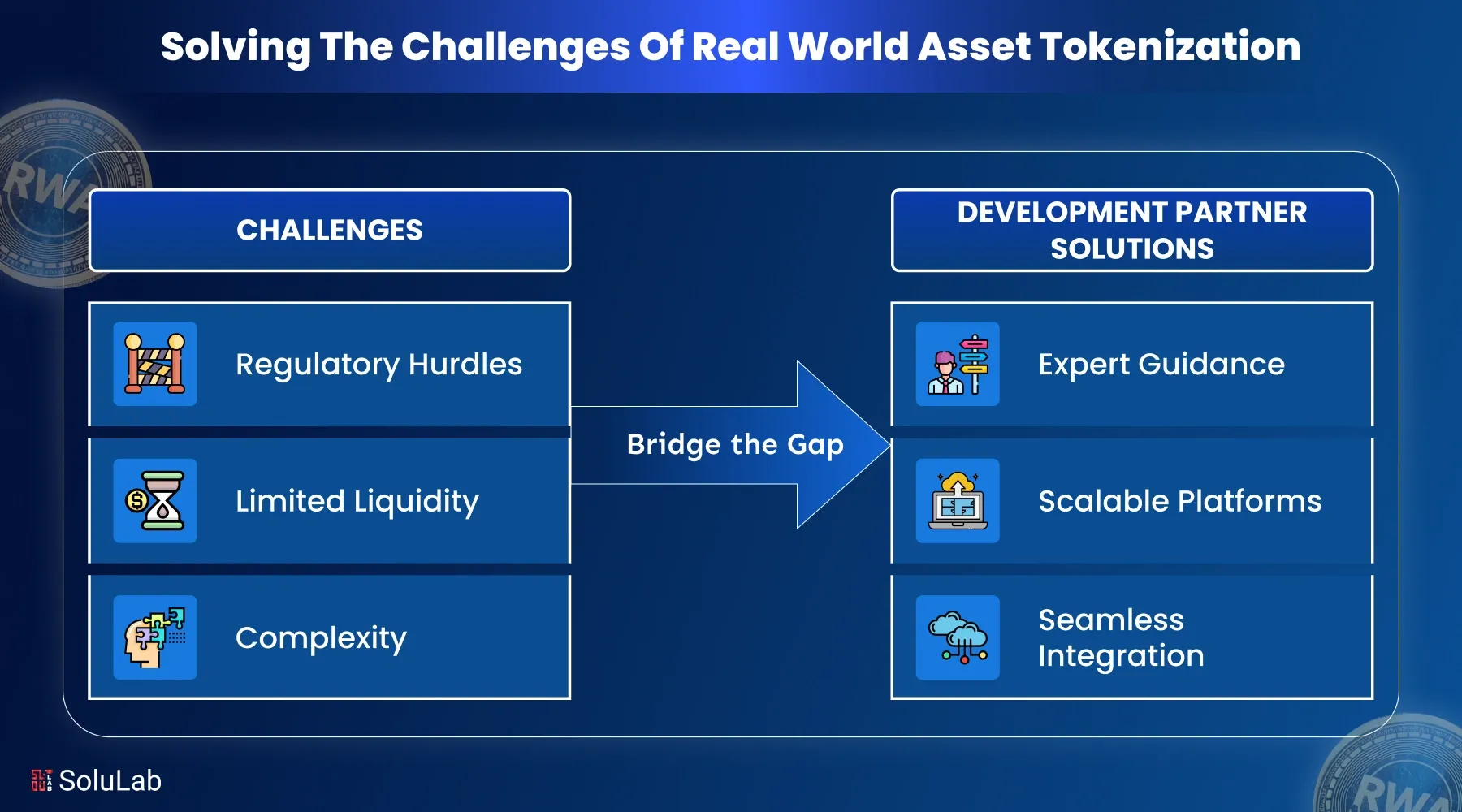
Challenges with real-world asset tokenization are not just technical – they are emotional, expensive, and exhausting for teams that go in with high hopes and come out with stalled pilots and regulatory pushback. A strong asset tokenization development partner with skilled engineers and a compliance-first consulting team can be the difference between yet another failed experiment and a scalable on-chain product that actually clears audits, attracts institutions, and moves real volume.
Key Takeaways
- Real-world asset tokenization is not just a technical task– it requires strong alignment between technology, compliance, and business models.
- The biggest challenges include regulatory complexity, asset custody, scalability, and integration with legacy systems.
- Without the right architecture, tokenization projects often face security risks, low liquidity, and limited adoption.
- An experienced development partner helps embed compliance, governance, and auditability directly into the platform.
- The right partner accelerates time-to-market while reducing long-term operational and regulatory risk.
The RWA Tokenization Promise and Heartbreak
Real-world asset (RWA) tokenization aims to turn everything from real estate and private credit to treasuries and carbon credits into programmable, fractionalized tokens that trade 24/7 across borders. When it works, it promises deeper liquidity, lower frictions, faster settlement, and new investor access – but the current reality is uneven adoption, stalled pilots, and a lot of “we’ll revisit this next year.”
Many institutions discover that tokenizing the asset is the easy part; making that token legally sound, interoperable, secure, and liquid is where things hurt. That is exactly where a seasoned development partner with a compliance-grade mindset starts to matter more than the underlying chain or tech stack.
Core Challenges in RWA Tokenization Today
1. Regulatory Uncertainty and Fragmented Legal Regimes
RWA tokenization lives at the uncomfortable intersection of securities law, payments regulation, data privacy, and cross-border capital controls. Regulations remain largely national while token rails are global, which means marketing or transferring a tokenized security across borders can trigger multiple, sometimes conflicting, regulatory regimes in parallel.
Key pain points include:
- Unclear legal status of tokenized claims and enforceability of on-chain records in courts.
- Capital adequacy questions for venues that become “source of truth” for tokenized securities, raising capital requirements and systemic risk concerns.
- Divergent KYC/AML, investor qualification, and marketing rules between the US, EU, APAC, and emerging markets.
Without deep legal-tech alignment, projects get stuck in “legal review hell” for months, burning budget long before a single compliant token transfers on mainnet.
2. Legal Ownership and Investor Protection
Even when a token is minted, many jurisdictions still lack clear frameworks mapping that token to legally enforceable ownership rights over the underlying asset. Questions like “Who really owns the real estate if the smart contract is hacked?” or “Can a court recognize the on-chain ledger as the golden record?” are not fully resolved in many markets.
This legal ambiguity undermines:
- Investor confidence and institutional allocation into tokenized products.
- Structuring of security tokens, SPVs, and trusts that sit behind the token.
These issues require a careful structuring of issuance entities, trust arrangements, and custodial models- not just solidity code.
3. Technology Risk and Smart Contract Vulnerabilities
Tokenizing RWAs introduces a new class of operational risk: smart contract vulnerabilities, oracle manipulation, and cross-chain bridge exploits that do not exist in traditional centralized infrastructure. A bug in an ERC-20 contract that represents a meme token is painful; a bug in a contract representing regulated debt, treasuries, or real estate can become a legal and reputational nightmare.
Common technical risks include:
- Poorly audited token and compliance logic.
- Insecure or centralised oracles that can be manipulated or go offline.
- Bridges and cross-chain messaging layers with weak security assumptions.
Institutions expect bank-grade resilience, not “move fast and break things,” which means protocol selection, audit processes, and runtime monitoring need to be hardened from day one.
4. Interoperability and Legacy Integration
The blockchain is only one leg of the journey; RWA platforms must integrate with custodians, KYC providers, banking rails, fund administrators, and sometimes legacy core banking systems. At the same time, tokens often need to move across L1s and L2s to reach liquidity and DeFi integrations.
The World Economic Forum highlights limited interoperability between blockchain networks and existing financial infrastructure as a major brake on RWA scale-up. Without robust interoperability, issuers face:
- Fragmented liquidity across multiple chains.
- Operational overhead in running the same product in several environments.
- Difficulty maintaining a single “golden record” that everyone trusts.
5. Liquidity and Secondary Markets
“Tokenize everything” sounds great – until no one wants to buy what you’ve tokenized. Multiple analyses show that while the technology to tokenize assets has advanced rapidly, liquidity remains the enduring bottleneck. Many RWA tokens, especially those backed by illiquid assets, suffer from:
- Minimal secondary trading activity.
- Wide bid-ask spreads and shallow order books.
- Structural lockups are tied to regulatory constraints or buyer concentration.
This gap between the promise of liquidity and the reality of illiquid tokens is where many treasuries, real estate funds, and private credit experiments stall out.
6. Scalability, Cost, and Operational Complexity
RWA platforms must handle KYC/AML checks, on-chain compliance checks, lifecycle events (coupon payments, corporate actions), oracle updates, and cross-chain messaging at scale. Doing all of this on L1s can be costly and slow, while moving to L2s or appchains introduces additional design complexity and security considerations.
Operational challenges include:
- Designing flows that balance user experience, gas cost, and compliance checks.
- Building scalable infrastructure – often with rollups, sidechains, or modular architectures – to support institutional volumes.
7. Compliance-by-Design, Not Compliance-as-an-Afterthought
Perhaps the biggest structural challenge: many teams still try to “bolt compliance on” after they’ve built a tokenization prototype. This leads to rework, blocked launches, or products that can never leave a sandbox because compliance cannot be guaranteed at scale.
Compliance needs to be embedded at the token standard, identity, and policy layers from day zero- which is exactly what modern RWA standards and oracle networks are beginning to make possible.
How Modern Standards and Infrastructure Help (ERC‑3643, Chainlink, etc.)
1. Compliance-First Token Standards: ERC‑3643
ERC‑3643 (T‑REX) has emerged as a leading open standard for regulated RWAs, embedding identity, KYC/AML, and transfer restrictions directly into the token’s logic. Instead of a generic ERC‑20 token plus off-chain spreadsheets and legal agreements, ERC‑3643 provides:
- Onchain identity and claims through ONCHAINID-style identity registries.
- Permissioned transfers, allowing only verified, authorized investors to hold or receive tokens.
- Modular compliance, so rules can evolve alongside regulation without reissuing the asset.
This design moves the “compliance brain” into the token itself, making it far easier to prove, adjust, and audit compliance over the asset’s lifecycle.
2. Secure Data and Cross-Chain Connectivity: Chainlink and CCIP
Most RWAs need high-quality off-chain data – NAVs, reserve attestations, price feeds – and often need to live across multiple chains for liquidity and integration reasons. Chainlink provides:
- Data Feeds and Proof of Reserve for transparent backing checks.
- Functions and Data Streams for ongoing offchain computation and updates.
- CCIP is a cross-chain interoperability protocol that powers the secure movement of RWAs and instructions between chains.
Major capital markets players like DTCC and banks like ANZ have already used Chainlink services, including CCIP, in tokenization pilots, precisely because it meets institutional security standards. For an RWA issuer, this means less bespoke plumbing and more reliance on hardened, widely adopted infrastructure.
Where a Strong Development Partner Changes the Story?
Behind every successful RWA initiative, there is almost always a multidisciplinary team that blends protocol-level expertise with regulatory, structuring, and operations know-how. A development partner with highly skilled developers and compliance-focused consultants can de‑risk the journey in ways an internal team rarely can on its own.
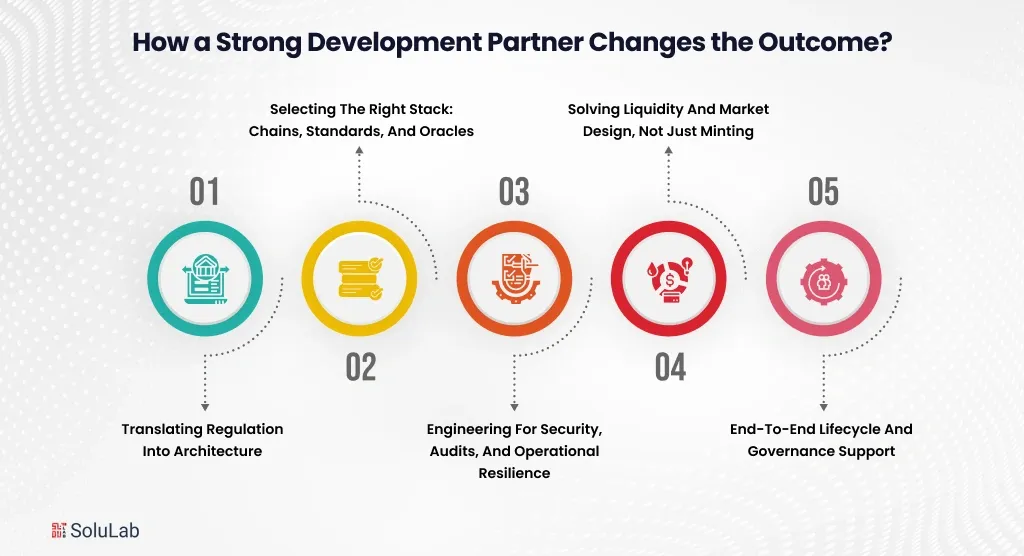
1. Translating Regulation into Architecture
Specialized partners have already lived through the friction of mapping MiFID, SEC rules, FATF standards, and local securities law into concrete technical patterns. They can:
- Propose the right issuance structure (SPV, trust, fund vehicle) aligned with jurisdictional rules.
- Design workflows where every on-chain transfer maps cleanly to off-chain obligations and investor rights.
- Choose standards like ERC-3643 for tokenization and configure identity registries, claim topics, and modular compliance to reflect specific regimes.
This turns a maze of regulation into a set of implementable rules rather than a perpetual blocker.
2. Selecting the Right Stack: Chains, Standards, and Oracles
A seasoned partner will not treat the underlying chain as an afterthought or a fashion choice. Instead, they will:
- Evaluate which L1/L2s have the right combination of security, ecosystem, institutional support, and jurisdictional comfort for the asset class.
- Recommend compliance-friendly token standards (ERC‑3643, permissioned ERC‑20 variants) instead of generic fungible tokens.
- Architect oracle and cross-chain layers using platforms like Chainlink CCIP to ensure reliable data, interoperability, and auditability.
The result is a stack that is not only technically sound but also aligned with where regulators and large institutions are clearly moving.
3. Engineering for Security, Audits, and Operational Resilience
Leading RWA tokenization firms treat every contract as if it will sit under a microscope for regulators, auditors, and large institutional clients. This typically includes:
- Secure smart contract design patterns and formal reviews before code ever hits mainnet.
- Integration with enterprise-grade custody providers and key management – Fireblocks, MPC wallets, or bank custodians – rather than ad hoc setups.
- Observability and incident response are baked in: logging, alerting, and rollback workflows for off-chain components tied to on-chain actions.
When you are dealing with tokenized treasuries, real estate, or funds, this level of rigor is no longer optional.
4. Solving Liquidity and Market Design, Not Just Minting
Skilled partners understand that a token without a market is just a database entry with extra steps. They can help you:
- Design appropriate market venues, such as permissioned DEXs, RFQ systems, or integrations with existing ATS/MTF platforms, rather than relying on generic DeFi liquidity.
- Structure incentive programs, market-making relationships, and listing strategies that are realistic for the asset type and investor base.
- Integrate with DeFi or CeFi venues that are already building infrastructure for RWAs (e.g., tokenized treasuries and funds).
This is where product strategy, economics, and technology merge, and it is difficult to improvise without prior experience in similar launches.
5. End-to-End Lifecycle and Governance Support
RWA tokenization does not end at issuance; it continues across coupon payments, redemptions, corporate actions, governance upgrades, and regulatory changes. To launch your RWA tokenization platform, a capable development partner with compliance consulting can:
- Build admin tools and dashboards for issuers, compliance teams, and regulators to monitor and intervene when needed.
- Design upgradeable governance processes for tokens and protocols that remain compliant as rules evolve.
- Provide training and documentation for internal teams so that operations become sustainable, not vendor‑locked.
This enables your organization to run a living platform, not a one‑off proof of concept.
What a “Right‑Fit” RWA Development Partner Looks Like?
When evaluating potential partners, teams that succeed typically look beyond decks and logos and dig into concrete RWA experience. Signals of a strong partner include:
- Demonstrated delivery of RWA projects across at least two asset classes (e.g., treasuries and real estate) and multiple jurisdictions.
- Hands‑on use of ERC‑3643 or similar compliance‑first standards in production environments.
- Proven integrations with Chainlink services (Proof of Reserve, Data Feeds, CCIP) for on – chain integrity and cross-chain flows.
- A dedicated compliance and legal liaison team that can sit in the same room (or call) as your counsel and speak both languages.
These are the teams that have scars from previous cycles and can help you skip the painful parts.
Looking Ahead: From Experiments to Infrastructure
Despite uneven adoption, leading institutions, policymakers, and infrastructure providers are increasingly aligned on making tokenization safe to scale. Major banks, central institutions, and regulators are working on standardization and coordinated frameworks, while technology providers harden standards like ERC‑3643 and interoperability layers like CCIP.
Analysts now see tokenization as a structural shift rather than a passing trend, especially in areas like on – chain treasuries, private credit, and funds. The projects that will define this next phase are not the ones chasing headlines—they are the ones that quietly solve the messy reality of law, data, liquidity, and operations with the right partners at their side.
For teams serious about RWA tokenization, that means treating partner selection as a strategic decision on par with asset selection and jurisdiction – not an afterthought. With a top tokenization development company like SoluLab, that blends deep engineering expertise and compliance-native thinking, the gap between “tokenize everything” and “can we actually sell it?” finally starts to close.
FAQs
Most projects fail due to weak compliance planning, poor smart contract design, lack of scalability, or choosing technology without considering real market use. Tokenization needs strong infrastructure, not just blockchain deployment.
An experienced partner designs compliant smart contracts, selects the right blockchain for tokenization, integrates KYC/AML, and ensures secure asset representation- reducing technical, regulatory, and operational risk.
Regulation defines who can invest, how assets are transferred, and how records must be maintained. Navigating multi-jurisdictional compliance is complex, making regulatory-ready design a critical challenge in RWA tokenization.
No. Blockchain technology is just one layer. Successful RWA tokenization requires legal structuring, compliance workflows, asset verification, governance frameworks, and user-friendly platforms—all working together.
Depending on complexity, most enterprise-grade platforms take 6–10 weeks. White-label solutions can shorten timelines, while fully custom platforms may take longer.