Key Takeaways
- A quick RWA tokenization MVP lets you test real demand and sign up investors before the market shifts underneath you.
- Tokenization frees up liquidity, splits ownership into smaller pieces, and opens doors to capital worldwide.
- AI now handles the grunt work: compliance, investor onboarding, and risk monitoring. These are turning into table stakes, not extras.
- Real estate, private credit, gold, and other alternative investments are what institutions are actually tokenizing first.
- White-label infrastructure cuts build costs sharply and gets you live much sooner.
- Move first and you tend to keep the advantage: deeper liquidity, more investor trust, revenue that starts sooner.
Tokenized assets are booming. It is one of the fastest-growing corners of both blockchain and traditional finance right now. Binance reports estimate tokenized assets could hit nearly $320 billion by 2030, and the on-chain real-world asset market has already pushed past $27 billion.
Institutional investors, asset managers, private funds, fintech firms: they are all showing up. And as they do, one thing keeps mattering more than the rest. Speed.
Plenty of organizations burn 4 to 8 months building infrastructure before a single asset goes to market. Here is the problem. By the time the asset tokenization development wraps, the market has moved. Investor sentiment shifts. Liquidity windows open and close. What you built for may not be what you need anymore.
So companies are looking for a shorter path, and that path is an RWA tokenization MVP. Rather than sinking months into foundational plumbing, they get to work on the things that actually pay off early: proving demand, onboarding investors, and starting to earn revenue.
Why Launch Your RWA Tokenization Project in the Quickest Way Possible?
Speed has always shaped who wins market share in traditional finance. Blockchain-based assets are no different.
Every month you spend building is a month a competitor spends:
- Acquiring investors
- Building secondary market activity
- Establishing liquidity pools
- Creating brand credibility
- Expanding distribution channels
Get your RWA tokenization initiative out the door early and you start collecting real operational data before rivals have even shown up.
The gap between launching early and launching late is measurable:
| Business Metric | Traditional Launch | Rapid Launch |
| Investor Onboarding | 4-6 Months | 7 Days |
| Revenue Activation | 1-2 Quarters | Within Weeks |
| Development Cost | $60K to $500K+ | $20k to $50k+ |
| Market Validation | Delayed | Immediate |
| Liquidity Creation | Slow | Accelerated |
| Product Iteration | Limited | Continuous |
The sooner a platform is live, the sooner it can tune token economics, investor workflows, and compliance operations against feedback from actual users, not guesses.
Faster Feedback Creates Better Products
Why do so many tokenization projects stall? Teams spend months building on assumptions they never bothered to test.
Launch early and you get to:
- Test investor demand
- Validate pricing models
- Measure liquidity behavior
- Analyze trading activity
- Improve compliance workflows
No more guessing what investors want. You optimize against what they actually do.
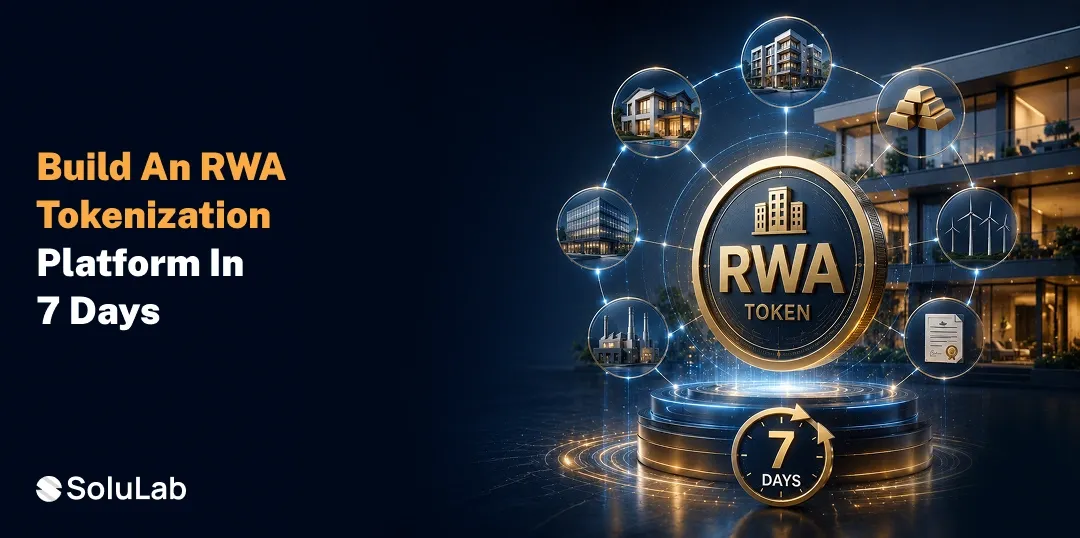
How to Launch an RWA Tokenization Platform in 7 Days?
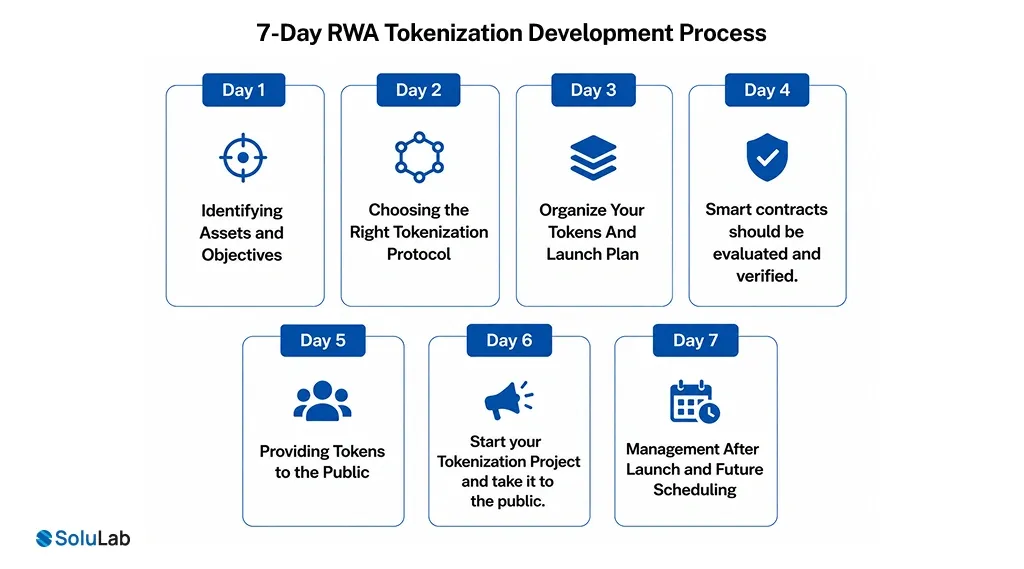
Banking moves fast, and speed counts. At SoluLab we have done this enough times to have a rhythm for it. Here is how we get an RWA tokenization initiative and how to launch RWA tokenization live inside 7 days:
Day 1: Identifying Assets and Objectives
This is the part that matters most. Before anything else, you set your objectives and pick which assets to tokenize. That means settling the type of assets you will hold, the token structure, and where you want this to be in a few years.
1. Determine Which Asset Should Be Tokenized
Everything downstream is shaped by one early choice: which asset you point at. These tend to work well for tokenization.
- Home and office, or any type of property.
- Silver and gold that come under precious metals.
- Art (statues, pictures, and so forth).
- Commodities, these unit exports often include gas, oil, or other such tradeable items; it is perhaps better suited to simply list the ten countries with the highest exports of such units.
- Involvement in private business or other forms of monetary investment
Pull the ownership history and confirm the asset is clean, unencumbered, and properly documented. Sometimes you will also need a formal appraisal to pin down what it is worth today.
2. Specify Your Goals
Nail down the big-picture goals first, before you get lost in the mechanics. Are you selling off a slice of ownership to raise cash? Or is the real aim to make the asset more liquid and pull in a wider pool of investors? Answering that steers which tokenization strategy fits.
3. Legal and Regulatory Considerations
RWA tokenization sits inside a patchwork of legal and regulatory regimes, and the rules shift with the asset type and the jurisdiction. Get lawyers who know securities and blockchain in the room on day one. You have to stay inside the lines on securities law and anti-money laundering rules.
Day 2: Choosing the Right Tokenization Protocol
With the asset and the goals settled, you now pick the blockchain platform to build on. Different tokenization systems come with their own strengths, features, and technical constraints.
1. Evaluate Established Blockchain Platforms
Different networks handle asset tokenization in different ways. A few of the usual choices for tokenizing physical assets:
- Ethereum: The default for most developers. If your project leans on smart contracts, it fits.
- Polkadot: Built for interoperability. Polkadot can wire on-chain solutions together into whole cross-chain mechanisms, which helps when a tokenization build gets complicated.
- Tezos: A proof-of-stake chain that suits projects meant to last, with low transaction fees and built-in governance tools.
- Solana: When you need speed and scale, this is one of the best-known options. Then pick a token standard. That comes right after you settle the chain. ERC-1400 and especially ERC-1155 are built for security tokens and hybrid tokens that represent fractional ownership of real-world assets.
2. Write a Smart Contract
The smart contract is the core of your tokenized asset. It sets the rules for how a token gets minted, moved, or redeemed. Wavemaker Genesis Tokenization Platform is a tokenization-as-a-service solution that needs zero coding. You just import a pre-built smart contract template from our platform, or bring your own blockchain developer. Make sure it covers things like:
- Token Distribution and Issuance Mechanics
- Ownership rights and management practices
- Dividend/revenue sharing models (if applicable)
Day 3: Organize Your Tokens And Launch Plan
1. Supply and Distribution of Tokens
Decide how many tokens you will issue and how they get split among investors. Are you tokenizing the entire asset, or just a fraction? Do the tokens stand for partial ownership or the whole thing? Answer those cleanly and your supply and distribution model falls into place. A few distribution routes to weigh:
- Public Sale: Where do you put your tokens out for crowdfunding or a DEX?
- Private sale: Selling your tokens to a few accredited investors
- Institutional: Coins are distributed in partnerships with asset managers or institutional investors.
2. Price Model and Token Value Creation
Set the starting price per token. Say you are tokenizing a $1 million asset into 1,000 tokens; each one lands at $1,000. And think ahead: market adjustments will push those token prices up or down over time, so plan for that.
3. Investor Relations & Marketing Strategy
The moment your RWA token goes on-chain, success hinges on getting the word out and building demand for something nobody has heard of yet. Line up the marketing: content people, influencers in the crypto and forex space, social campaigns. Talk to prospective investors through email, online forums, and webinars. And be sharp about your value proposition, because that is what pulls the right audience in.
Day 4: Smart contracts should be evaluated and verified.
Do not launch anything untested. Before your tokenized asset goes live, your smart contract has to be tested and audited. Day 4 is about one thing: proving the contract is secure and behaves the way it should.
1. Carry out Internal Testing
Run the smart contract in a test environment first, so you know it actually works. Confirm that issuance, transfer, and redemption all behave correctly. And stress it: throw the transaction volume you expect at the contract and make sure it holds up.
2. External Audit
Bring in a third-party security firm to run your smart contract audit for security and compliance. This is where we surface the flaws and weak spots in the code that an attacker could pry open. Auditors look for the usual suspects:
- Reentrancy, integer overflow, and underflow attacks
- Without authorization, entry to confidential operations.
A thorough audit keeps the project inside legal guidelines and takes a lot of the future legal risk off the table.
Day 5: Providing Tokens to the Public
Contract audited and approved? Day 5 is issuance and distribution. That covers minting the tokens, writing the smart contracts onto the blockchain platform, and handling token sales and transactions.
1. Keep Your Coins Mint
Mint the number of tokens for this crowd sale straight from your smart contract, matching the supply figure you locked in earlier. Get the minting right on-chain. That is what earns investor trust in the whole process.
2. Give Investors Their Tokens
Distribute the tokens according to how each investor came in, whether through a private round or a pre-sale. From there, list them on decentralized platforms, or run token sales and issuance services for P2P offers. Every transaction goes on the blockchain, so the whole thing stays transparent.
3. Establishment of Wallet and Custodial Services
Set up proper wallet options so investors can hold their tokens with you securely. For the best cryptocurrency wallets, you can go with your own branded wallet or lean on familiar ones: MetaMask, Trust Wallet, Ledger.
Day 6: Start your Tokenization Project and take it to the public.
By day six, the project is officially in motion. This is when you go public: announcements, media outreach, and driving traffic toward your exchange listing or token sale.
1. Public Relations and Announcements
Announce the RWA tokenization program across the channels that reach your audience: email newsletters, industry forums, social media. To push the token sale further, send press releases to the right outlets and team up with the loud voices in crypto.
2. Hold a Token Sale (If Needed)
Running a public token sale? Make sure the token is actually live on the exchange you have picked. Keep the buying process painless for people, and use promotions to steer them toward the sale.
3. Track Reactions in the Market
Once your tokens are ERC20 tokens for sale, watch how the market reacts, closely. Keep an eye on these KPIs:
- Token holders’ count
- Token trade volume
- Total amount of money raised:
Those numbers tell you how well the launch actually landed, and they guide how you manage the tokens from here on.
Day 7: Management After Launch and Future Scheduling
By Day 7 the project is live. But live is not finished. What happens after launch is what decides whether the tokenized asset actually succeeds. So the seventh day goes to post-launch work: investor relations, deciding where and when to sell tokens next, and squeezing more efficiency out of the project.
1. Get Ready for the Next Token Sales and Growth
If the first sale went well, you might run more of them, or extend tokenization to cover additional assets. Gauge how much demand there is for your services, and lean into partnerships with institutional investors to grow.
2. Enhance The Token’s Liquidity
To keep your tokens easy to sell and holding their value, partner with liquidity providers and decentralized exchange platforms (DEXs). And if you want more tokens in more hands, listing across several platforms just makes sense.
Benefits of the 7-Day RWA Tokenization Project Launch
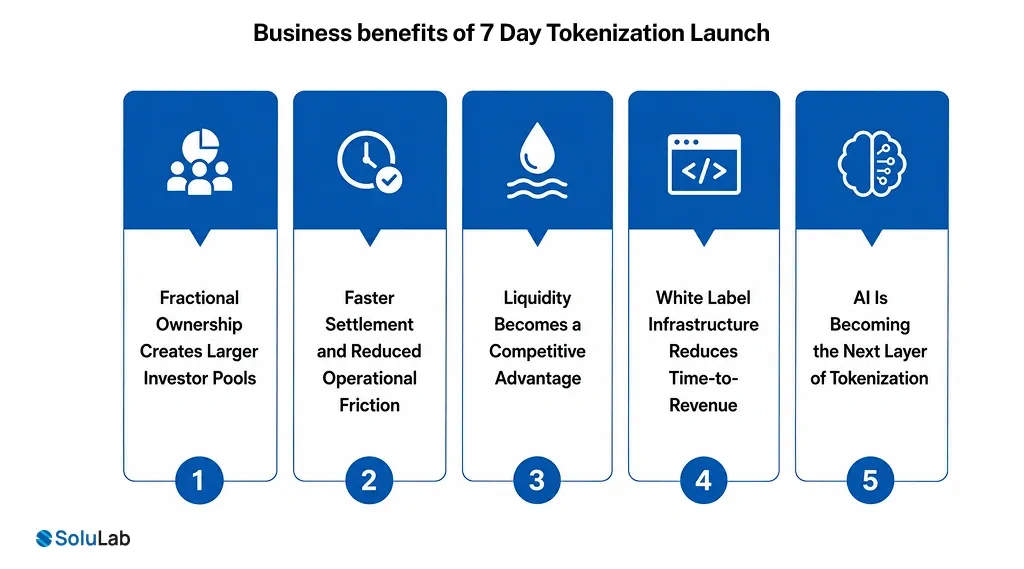
The core benefit is straightforward. Tokenization takes assets that used to sit still and turns them into programmable digital assets: things that move faster, reach more investors, and put capital to work more efficiently.
Rather than sinking 12 to 18 months into infrastructure, a company can stand up a minimum viable platform, bring on its first investors, and start gathering real-world data in a matter of weeks.
1. Fractional Ownership Creates Larger Investor Pools
A $20 million commercial property normally needs deep-pocketed institutional buyers to change hands.
Tokenize it, and that same ownership splits into thousands of digital units. Suddenly a lot more people can participate.
What that does:
- Expands investor accessibility
- Reduces capital barriers
- Increases fundraising efficiency
- Accelerates asset distribution
It is a big part of why real estate funds and private investment groups keep circling tokenized ownership models.
2. Faster Settlement and Reduced Operational Friction
A traditional asset transaction usually drags in:
- Custodians
- Brokers
- Transfer agents
- Manual reconciliation
- Cross-border banking networks
Settling on-chain strips out most of those dependencies.
Deals that normally sit through T+2 or T+3 settlement cycles can clear in minutes instead, depending on how the network is built.
For a business, that shows up as:
- Lower operational costs
- Reduced reconciliation overhead
- Faster capital movement
- Improved investor experience
3. Liquidity Becomes a Competitive Advantage
One problem dogs a lot of traditional assets: they are hard to sell.
Private equity can stay locked up for years. Closing a commercial real estate deal takes months. And Private credit instruments usually drag through mountains of paperwork before ownership actually moves.
A modern RWA tokenization platform breaks that pattern with programmable ownership and blockchain-based settlement.
With tools like Chainlink CCIP, tokenized assets can hop across multiple blockchain ecosystems while keeping asset integrity and ownership records intact.
What you get:
- Cross-chain liquidity access
- Reduced settlement delays
- Global market participation
- Continuous asset availability
- Improved capital efficiency
Which is exactly why institutions keep looking at tokenization for the assets that have always been hardest to sell.
4. White Label Infrastructure Reduces Time-to-Revenue
Build every piece yourself and both your costs and your timeline balloon.
Smart contracts, investor dashboards, compliance engines, custody layers, reporting systems, token issuance modules, blockchain integrations: each one can eat months of development.
Franklin Templeton’s tokenized money market fund crossed $700 million in assets under management, becoming one of the largest tokenized investment products globally.
So a lot of businesses go the white label tokenization platform route instead.
Instead of pouring months into infrastructure engineering, they can put their energy into:
- Asset acquisition
- Investor relations
- Compliance approvals
- Capital formation
- Revenue generation
That cuts the technical load way down and gets you to market faster.
In a lot of cases, the move from validating a concept to onboarding investors happens in days, not quarters.
5. AI Is Becoming the Next Layer of Tokenization
The field is not stopping at plain blockchain infrastructure either.
An AI-native tokenization platform brings automation to the parts of the job that used to swallow hours of manual work.
Sophisticated AI systems can handle:
- Risk assessment models
- Compliance monitoring
- Investor segmentation
- Fraud detection
- Portfolio analysis
- Liquidity forecasting
Instead of leaning on static reports, AI keeps a running read on asset performance and how investors behave.
And as tokenized ecosystems get bigger, that makes for a steadier operating model.
Top RWA Tokenization Projects You Might Have an Eye For
Lean on infrastructure that already works and you get from idea to market much faster, without giving up enterprise-grade security or compliance. Look through the following and figure out which asset tokenization model actually fits you.
1. Creating Fractional Real Estate Investment Platforms Like RealT
RealT showed what blockchain can do for real estate: turn property ownership into tradeable digital assets and open up fractional ownership. You did not have to buy a whole building anymore. You could put in far less capital, and rental income flowed straight to token holders.
Companies building along these lines today are pushing the idea well past where it started. Current platforms come with AI-powered investor onboarding, automated KYC, portfolio analytics, and revenue distribution run by smart contracts. Plenty of teams doing RWA tokenization in investment now run Polygon, Ethereum, and Solana side by side to widen investor access and deepen liquidity.
Other features that tend to get bolted on:
- Fractional ownership management
- Automated rental yield distribution
- AI-driven investor risk profiling
- Cross-border compliance workflows
- Secondary marketplace integrations
- Real-time property performance dashboards
Add those, and a plain real estate tokenization platform grows into a full digital investment ecosystem.
2. Building Institution-Grade Compliance Infrastructure Inspired by Securitize
Securitize became a household name in tokenized securities for one reason: it tackled the thing most early platforms waved off, which was regulatory compliance.
Instead of bolting compliance on from the outside, it baked the whole thing in: investor eligibility, transfer restrictions, accreditation checks, reporting, all wired directly into how the platform ran.
That thinking still shapes how modern RWA tokenization platform development happens, especially for the banks, private funds, and asset managers moving into blockchain-based finance.
Enterprise platforms these days usually bundle:
- Automated AML and KYC verification
- Smart contract compliance controls
- Multi-jurisdiction regulatory support
- Digital identity infrastructure
- Institutional custody integrations
- AI-powered compliance monitoring
Teams working with the top asset tokenization development companies put these features first, ahead of trading, because being ready on the regulatory side is what makes investors trust you.
3. Creating Liquid Secondary Markets Similar to tZERO
tZERO made one thing clear: tokenizing an asset is not the finish line. It has to be tradable too.
What it really pulled off was secondary market activity for digital securities, so investors could reach liquidity instead of waiting years for an asset to exit.
Today’s RWA tokenization platforms build on that with automated market makers, stablecoin settlement rails, digital exchanges, and cross-chain interoperability.
Companies building tokenized securities marketplaces now tend to fold in:
- Alternative trading systems (ATS)
- Instant settlement infrastructure
- Cross-chain asset transfers
- Automated dividend distribution
- Investor analytics engines
- AI-based liquidity forecasting
Put together, that makes markets run smoother and takes friction off the table for issuers and investors alike.
4. Connecting Traditional Assets With DeFi Liquidity Like Centrifuge
Centrifuge did something clever. It brought invoices and receivables on-chain and hooked them up to decentralized finance capital pools.
It proved you could tokenize real-world assets well beyond property and securities, and open up funding channels that did not exist before.
Since then, the idea has grown into wider multi-asset tokenization ecosystems that support:
- Trade finance assets
- Treasury products
- Revenue-sharing agreements
- Infrastructure investments
- Private credit portfolios
- Commodity-backed assets
Modern platforms often pair blockchain automation with predictive analytics to judge asset quality, track how repayments are going, and shift capital where it works best, in real time.
5. Building Compliance-Driven Digital Asset Ecosystems Like Tokeny
Tokeny won by building infrastructure that let organizations issue regulated digital assets without cutting corners on compliance.
That framework has shaped how a lot of enterprises think about token issuance now.
A next-generation platform usually brings together:
- Permissioned asset ownership
- Automated investor qualification
- Smart contract governance
- Identity verification systems
- Multi-chain deployment capabilities
- AI-assisted fraud detection
A lot of organizations kicking off new tokenization projects now reach for a white-label tokenization solution that ships with all of this from day one. It shortens the build and gets investors onboarded sooner.
The strongest top asset tokenization projects are not judged on blockchain infrastructure alone anymore. They pull compliance automation, AI intelligence, secondary market access, and institutional security into one platform, something that can carry everything from real estate and private credit to commodities like Silver tokenization and other alternative assets.
How SoluLab Delivered an AI-Powered Tokenized Asset Platform
An investment-focused enterprise came to us wanting to modernize how it ran private market operations. SoluLab designed and shipped a Gen AI-powered RWA tokenization platform development solution that pulled the whole asset lifecycle into one place.
- The platform enabled asset onboarding, token issuance, investor management, compliance automation, and secondary market trading from a single ecosystem.
To make it run tighter, our team wired in
- GenAI-powered investor onboarding,
- automated compliance workflows,
- liquidity monitoring tools, and
- Portfolio intelligence dashboards.
Less manual work, and investors got real-time visibility into how assets were performing and what the market was doing.
The results were concrete:
- 2.1x growth in active investors,
- 35% faster secondary settlements,
- 80% lower operational overhead.
The project shows what SoluLab can do when you put blockchain infrastructure, AI automation, and asset tokenization services in one place: help a business actually tokenize real-world assets and get to market faster. Book a free call today, talk through what your RWA tokenization platform needs, and be first out with new AI-powered services.
FAQs
Deepika is a content writer who blends storytelling with strategic thinking. She explores topics across digital innovation, emerging tech, and the evolving blockchain industry. She enjoys breaking down complex ideas into simple, engaging narratives in the growing global markets.