
The internet keeps reinventing itself, and every reinvention hands us something new to play with. Think back. Static pages you could only read. Then Web 2, where you could actually talk back, post, share, argue. The Metaverse is what comes next. The word itself is old, older than most people assume: Neal Stephenson coined it in a 1992 science-fiction novel. Engineers across the world have spent years dragging that idea out of fiction and into working code, and now nobody blinks when they hear it.
The concept of Metaverse technology has floated around for more than a decade. What pushed it into the spotlight was money and names: when Facebook and Microsoft announced projects of their own, everyone paid attention. A permanent, shared virtual world is a big promise, and the more people understood what it could actually do, the louder the buzz got. The metaverse platforms caught fire during the pandemic. People were avoiding rooms full of other people. Companies wrote remote-work policies overnight. Digital communication stopped being a backup plan and became the plan. That moment is when curiosity about the Metaverse, and what it was actually good for, really took off.
A business can build either kind of metaverse: one it controls, or a decentralized one. But here’s the pull toward the second option. Companies are already seeing returns from blockchain, so demand for a blockchain-based Metaverse keeps climbing. And the web’s direction of travel is decentralized, which makes blockchain less of an add-on and more of a foundation for Metaverse development. That shift means blockchain use cases like NFTs and cryptocurrencies are going to matter more than they do today, not less. To get a fuller picture of where the real value sits, this blog walks through the top 10 real-world use cases of the Metaverse in 2026.
Read Our Blog: Building Worlds Beyond Reality: A Guide to Metaverse Development

What is Metaverse Technology?
Metaverse technology changes how we deal with digital spaces, and with each other inside them. Strip it back and it’s a shared virtual world, one built from many linked virtual and augmented reality environments stitched together. For years that sat squarely in the science-fiction column. In 2026 it doesn’t anymore. It has concrete, working uses.
Take remote work, one of the clearest applications of Metaverse development. As more teams settle into hybrid and remote setups, the Metaverse gives them somewhere to actually be together: immersive meetings, conferences, shared rooms. Instead of staring at a grid of faces on a flat call, people gather in a 3D space. It sounds like a gimmick until you try it. Presence lands differently when you can turn and look at the person talking.
Education is shifting too. A teacher can hold class inside a virtual classroom, a museum, or a reconstruction of a historical moment, which turns a lecture into something you walk through. Students can drop into a historical event, run a virtual experiment, or sit beside classmates who are physically hundreds of miles away. Put it all together and you get a technology that quietly rewrites how we work, learn, socialize, and kill time in 2026 and after.
Why Does Metaverse Matter in 2026?
In 2026 the Metaverse sits at a hinge point for our digital future. It’s the payoff on years of separate advances finally colliding: augmented and virtual reality, blockchain, artificial intelligence, and plain old social connection, all folded into one place. That matters more than the hype makes it sound. It changes how we see, touch, and put to work the digital side of our lives.
Read Our Blog: Tech Stack of a Metaverse Developer
Metaverse services hand you an immersive, connected space where the line between physical and digital gets fuzzy. You can move through dozens of virtual environments, socialize, work, learn, and be entertained in ways that used to belong only to science fiction. So this section digs into a simple question: why does the Metaverse matter in 2026, and how does that change our lives and society?
- Digital Evolution: In 2026 the Metaverse marks a real jump forward. It pulls together augmented and virtual reality, blockchain technology, and social connection into one immersive online space. That opens doors for how humans and computers meet, and for what a digital experience can even be.
- Reshaping the Workplace: Remote and hybrid work stopped being the exception. The Metaverse follows that shift, giving teams virtual offices, interactive meetings, and training rooms that a video call simply can’t match. Collaboration feels less like a scheduled call and more like being in the room.
- Educational Innovation: Education is getting a rewrite. The Metaverse offers immersive lessons that hold the attention of students at any age. Walk through a historical event. Run a virtual science experiment. Attend a class from a bedroom in another country. Learning becomes more reachable, more engaging, and easier to bend around a single student’s needs.
- Entertainment Hub: In 2026 the Metaverse doubles as an entertainment venue with no real precedent. Gaming, social media, and live events bleed into each other. You can catch a concert, wander a virtual theme park, or step inside a piece of interactive storytelling. Watching turns into taking part.
- Economic Opportunities: A whole new economy is forming here. Virtual real estate, digital assets, businesses that only exist inside the Metaverse, all of it is growing fast. Founders, creators, and investors are staking claims, and the money on offer reaches well past regular online commerce.
The Top 10 Real-World Use Cases of the Metaverse in 2026
The Metaverse doesn’t stay in one lane. Its reach runs across education, gaming, tourism, healthcare, and plenty more. So here are some of the core Metaverse use cases that carry weight across a lot of different sectors in 2026:
- Gaming
Gaming leads the pack of Metaverse examples in 2026. Nowhere else is the immersion this deep. Players cross from one connected virtual world into the next without a loading wall, bring friends along, and even turn what they achieve in-game into real money.
Read Also: Metaverse NFT Marketplace Development
Developers are using the Metaverse to build sprawling worlds that keep running whether you’re logged in or not, worlds full of open-ended play and constant social contact. That does two things at once. It makes the game better, and it opens fresh revenue through virtual item sales and in-game advertising. As the tech matures, gaming only gets more social, more alive, and more profitable.
- Travel and Tourism
Travel and tourism is going through its own Metaverse shakeup in 2026. Before booking anything, travelers can walk a virtual copy of a destination, which makes planning a trip far less of a gamble. And virtual tourism lets people visit far-off places, historic sites, or cultural events without leaving home, which finally opens travel to people who can’t manage the physical trip or the price tag.
Virtual travel agents and concierge services have popped up too, handing out personalized picks and immersive previews that change how we scope out the world digitally. The Metaverse is reworking what travel even means, making it more open, more informed, and honestly more fun.
- Private Digital Space
Private digital spaces matter more every year, and 2026 is no exception. People want secure, personal corners inside the Metaverse development services, places where they set the terms. These spaces give users a sanctuary: they control who gets in, hold private conversations, and host gatherings that stay private.
A locked virtual boardroom for a sensitive deal. A private VR room for a personal chat. The Metaverse lets users shape their surroundings around privacy and security first. The upshot is simple. You get the good parts of the Metaverse without handing over your personal and sensitive information in the process.

- Real Estate
Real estate is in the middle of a real shift in 2026, and the Metaverse is behind a lot of it. Virtual property tours and immersive 3D walkthroughs are now standard, so a buyer or renter in one country can inspect a place in another without booking a flight.
Developers are also buying virtual land inside the Metaverse, creating digital properties they can sell, rent, or build on. That widens the pool of investments, and it smudges the old line between owning something physical and owning something purely digital. Buying, selling, and touring property all look different now. It’s one of the more interesting sectors to keep an eye on.
Read Our Blog Post: Metaverse NFT – Foundation Of Next Blockchain Revolution!
- Industry and Manufacturing
On the factory side, the Metaverse is tightening up operations. Manufacturers run virtual simulations and digital twins inside it to tune production, cut waste, and catch problems before those problems ever show up on a real assembly line.
Remote monitoring and maintenance of industrial gear also got easier through Metaverse-powered interfaces, which trims downtime and lifts output. The Metaverse ecosystem is reshaping how factories run day to day: quicker to adapt, cheaper to operate, and easier on the environment.
- Banking and Finance
Banking and finance in 2026 is putting Metaverse applications to work on new kinds of services. Virtual banks and blockchain-powered platforms handle secure, quick digital transactions right inside the Metaverse. A user can manage digital assets, move money across borders, and look at investments, all in one connected virtual space.
There’s a teaching angle too. Immersive simulations help people learn finance by doing, so their investment calls come from practice rather than guesswork. As the Metaverse keeps growing, it stands to widen access to financial services and change how we handle money altogether.
- Healthcare
In healthcare, the best Metaverse experiences are changing both patient care and how doctors train. Telemedicine has jumped ahead: doctor and patient meet in a virtual clinic for a consult, a diagnosis, a treatment plan. Clinicians also use the Metaverse to rehearse. A surgeon can practice a procedure, or a team can drill an emergency response, all in a place where a mistake costs nothing.
Patient records get safer too, held in secure virtual systems. The Metaverse applications in business are making care more reachable, more efficient, and safer, which reshapes how medicine gets delivered and received.
- Social Media
Social platforms jumped on the Metaverse in 2026 to give people something more immersive to do. Users build their own avatars, hang out in virtual spaces, and show up to virtual events and concerts. The Metaverse projects smudge the borders between separate social networks, so you can connect with friends and followers across platforms without hopping app to app.
It also hands creators new ways to earn. They can host virtual meet-and-greets, sell virtual merch, and talk with their audience in formats that didn’t exist a few years ago. Social media, in this version, is a living, immersive place for both personal ties and professional work.
- Remote Working
Remote work got a facelift from Metaverse development in 2026. Virtual offices, meeting rooms, and shared workspaces are the default now. Rather than another video call, coworkers meet in 3D spaces, which sharpens communication and makes people actually feel present.
The Metaverse also lets people set up their own digital desks and work on projects together in real time, wherever they happen to be sitting. The result: remote work that’s more engaging, and, in practice, more productive with a better work-life balance to go with it.
- Education and Learning
Education is going through a deep change in 2026, courtesy of Metaverse technology. Virtual classrooms, immersive historical reconstructions, and hands-on lessons are ordinary now. A student can take a virtual field trip, run science experiments in a digital lab, and sit with peers and teachers in lifelike virtual rooms.
That does two things. It makes lessons stick, and it opens the classroom to a global audience no matter where anyone lives. The Metaverse is rebuilding education by handing students and teachers real tools for interactive, personalized learning.
Benefits of Metaverse Technology
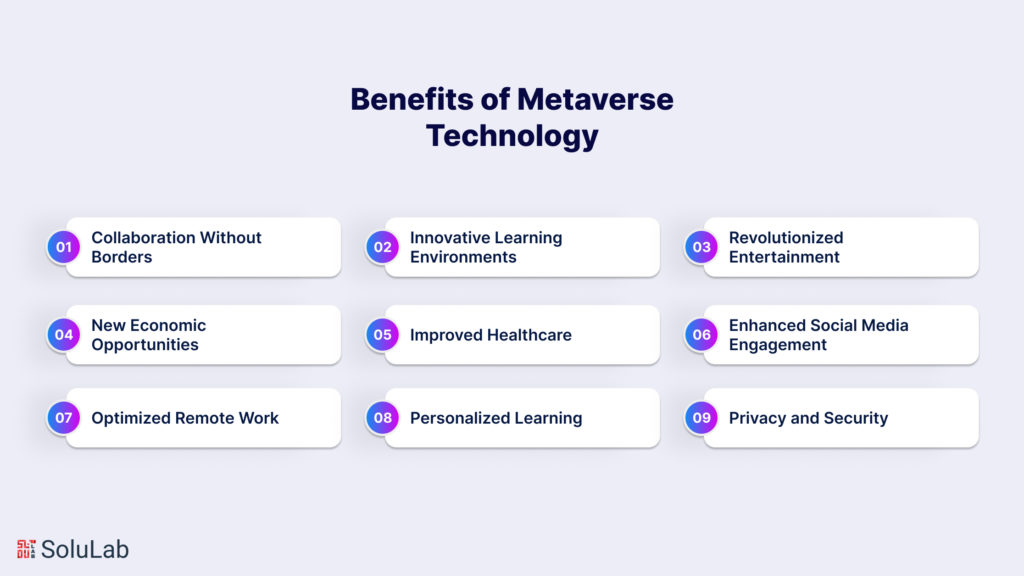
Over the last few years the Metaverse has picked up serious momentum, and it stopped being a science-fiction daydream some time ago. It’s turning into something real, with weight behind it for a long list of industries and for ordinary parts of daily life. This section lays out the of Metaverse benefits and why they’re generating this much excitement.
- Collaboration Without Borders
One of the clearest wins is collaboration that ignores geography. It doesn’t matter where a person sits. For remote work and global partnerships, that changes the math entirely. Virtual offices and meeting rooms inside the Metaverse let colleagues work side by side, close the distance gap, and make remote work run smoother than it ever did before.
Read Our Blog: Top 15 Metaverse Startups to Watch out in 2026
- Innovative Learning Environments
Education is getting reworked from the ground up by the Metaverse. Teachers and students both get immersive, interactive lessons. Explore a historical event. Run a virtual science experiment. Attend class in a lifelike virtual room. Whatever the format, the Metaverse makes learning more engaging and easier to reach.
- Revolutionized Entertainment
Entertainment is shifting hard too. The Metaverse blurs gaming, social media, and live events into one thing, and it hands users experiences they haven’t had before. Attend a virtual concert. Wander a digital theme park. Step inside interactive storytelling. It promises entertainment unlike anything you’ve sat through until now.
- New Economic Opportunities
The Metaverse isn’t only rewiring how we interact. It’s growing a real digital economy underneath all of it. New jobs. Room for digital entrepreneurs. Virtual real estate, digital assets, and Metaverse-focused businesses are booming, and that’s a genuine opening for anyone who wants to build something in this space.
- Improved Healthcare
In healthcare the Metaverse is sharpening telemedicine, medical training, and how patient data gets handled. Care becomes more reachable and more efficient. Doctors and patients meet in virtual clinics. Medical staff rehearse procedures in risk-free digital rooms. And patient records stay under secure management the whole way through.
- Enhanced Social Media Engagement
Social media is changing shape inside the Metaverse. It rethinks how we socialize, offering immersive virtual spaces where people interact, show up to events, and meet creators in genuinely new ways. Social media becomes a more dynamic, more immersive place for both personal connection and professional work.
- Optimized Remote Work
As remote work spreads, the Metaverse steps in to make it better. Virtual offices, shared workspaces, and 3D rooms for meetings make the whole thing more engaging and more productive. It goes past video calls. The point is a virtual workspace that feels like a physical one, which lifts productivity and gives work-life balance some breathing room.
- Personalized Learning
In education the Metaverse makes learning personal. It bends to a single student’s needs and tastes, letting learners explore subjects through virtual field trips, run science experiments in digital labs, and work alongside peers and teachers inside lifelike virtual rooms.
- Privacy and Security
Inside the Metaverse, private digital spaces give users a grip on their own data and their own interactions. That extra layer of privacy and security means people can enjoy what the Metaverse offers while keeping their personal and sensitive information out of the wrong hands.
The Future of Metaverse Technology
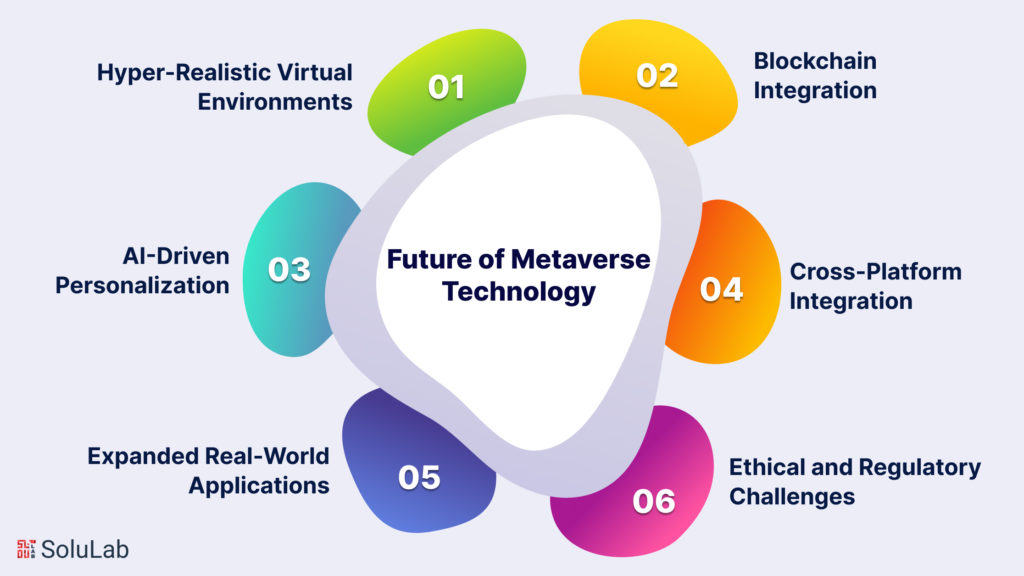
The deeper we get into the digital age, the bigger a part Metaverse applications are set to play in daily life. What it can do today is only a sliver of what’s coming. So let’s look ahead and think through where the Metaverse might actually go.
1. Hyper-Realistic Virtual Environments
Picture stepping into a virtual world you can’t tell apart from the real one. We’re not there yet. But hardware, software, and sensory tech keep pushing the ceiling higher. Before long the Metaverse could serve up hyper-realistic environments that hit every sense: sight, sound, touch, taste, smell. That wouldn’t just change gaming and entertainment. It would change virtual tourism and training simulations right along with them.
2. Blockchain Integration
Blockchain is on track to sit even deeper inside the Metaverse. Decentralized ledgers bring security and transparency that’s hard to beat, which makes them a natural fit for handling digital assets, virtual property, and in-game currencies. Expect the two to converge harder, so users can genuinely own and trade what they hold in a virtual space, from rare virtual collectibles to virtual land.
Read Our Blog Post: A Future Based On Metaverse – A Solulab Take
3. AI-Driven Personalization
Artificial intelligence will do a lot of the shaping here. AI-driven personalization means virtual experiences bend to each person’s preferences and needs. Curating content, tuning learning materials, dreaming up unique gaming challenges, whatever the job, AI turns the Metaverse into a space that feels built for one.
4. Cross-Platform Integration
The walls between separate virtual worlds will keep coming down. Interoperability becomes standard, letting users slide from one Metaverse space into another without friction. Picture leaving a virtual work meeting, dropping into a virtual concert, then heading to a virtual classroom, all under one roof. That kind of stitching-together makes the Metaverse a single, coherent digital universe rather than a pile of walled gardens.
5. Expanded Real-World Applications
The Metaverse won’t stop at work and play. It’ll reach into other real-world jobs: urban planning, architecture, healthcare simulations, disaster-prep drills. Anywhere you need to train, test, or rehearse a real scenario in a safe, controlled digital setting, the Metaverse becomes a tool you’d hate to give up.
6. Ethical and Regulatory Challenges
As it grows up, the Metaverse will run into hard ethical and regulatory questions. Data privacy. Who really owns a digital thing. How you protect a virtual identity. These move to the front of the line. Policymakers, businesses, and users will have to work through them together to keep the Metaverse developing responsibly.
To wrap up, the road ahead for Metaverse technology is a genuinely exciting frontier. It’s a place where reality and imagination overlap, where we get to rethink how we deal with the digital world and with each other. As this keeps moving, it’s worth building and adopting the technology with some foresight, some responsibility, and a real commitment to a digital space that works for everyone. The Metaverse isn’t only the future. It’s a blank canvas we get to paint tomorrow’s ideas onto.

Conclusion
Technology never sits still, and the Metaverse is one of the clearer signs of what human imagination can build when it’s given room. Across this blog we’ve gone through ten real-world Metaverse use cases and applications in 2026 and watched the mark it’s leaving on one industry after another. It reworks remote work. It rebuilds education. It changes how we entertain ourselves, how we socialize, how we touch the digital world at all. Somewhere along the way it became a fixture in daily life.
Here’s the honest read: this isn’t a passing fad. It’s a real shift in how we deal with technology and each other. The upside is hard to argue with, from richer digital experiences to fresh economic openings and better healthcare. But it pays to move carefully, and to take the ethical, privacy, and regulatory questions seriously as we go. The Metaverse is less a destination than a road, and over the coming years its use cases and applications will keep growing, opening new possibilities and bending our reality in ways we’re only starting to work out.
In the busy digital world of 2026, companies are hunting for smart ways to put the Metaverse to work and rethink their online presence. That’s where SoluLab, a leading Metaverse development company, comes in as your trusted partner. Backed by a team of top Metaverse developers, SoluLab brings deep expertise and a proven track record in building immersive, high-impact Metaverse services for businesses.
The Metaverse isn’t just a buzzword. For a company trying to win over customers, sharpen operations, and stay in front in the digital race, it’s a real edge. SoluLab gets that, and it shows in the full range of Metaverse solutions we offer. Whether you need to hire top Metaverse developers to build immersive virtual experiences, fold Metaverse capabilities into platforms you already run, or develop custom Metaverse applications, SoluLab’s team has the skill and the vision to take your ideas and make them real.
And we don’t stop at development. We cover the whole arc: consulting, strategy, design, and maintenance. Our industry knowledge and technical depth mean your Metaverse work lines up with your business goals and actually shows results. So if you want to tap the real potential of the Metaverse for your business, look no further than SoluLab. We aren’t just a service provider. We’re your trusted partner for the whole Metaverse journey.
FAQs
Shipra Garg is a tech-focused content strategist and copywriter specializing in Web3, blockchain, and artificial intelligence. She has worked with startups and enterprise teams to craft high-conversion content that bridges deep tech with business impact. Her work translates complex innovations into clear, credible, and engaging narratives that drive growth and build trust in emerging tech markets.