A new wave of tokenization platforms is emerging at the exact moment when the market is shifting from hype to hard numbers. By 2030, analysts project tokenized real‑world assets could be worth anywhere from around 2 – 4 trillion dollars in a conservative scenario to as much as 9–16 trillion dollars or more under bullish forecasts, potentially representing close to 10% of global GDP. For founders, asset managers, and institutions, that means the real question is no longer “Should we tokenize?” but “What kind of platform will still be relevant when trillions of dollars have moved on‑chain?”
Below is a refreshed, human‑sounding, mobile‑friendly version of your blog that weaves in recent perspectives from the World Economic Forum, Statista, and Forbes‑cited research – while keeping it original in structure and language.
The Trillion‑dollar Shift Behind Tokenization
Over the last few years, tokenization has quietly moved from small pilots into a serious strategic bet for some of the world’s largest financial institutions. McKinsey now estimates that tokenized financial assets (excluding cryptocurrencies and stablecoins) could reach about 2 trillion dollars in market capitalization by 2030, with an upside scenario closer to 4 trillion.
Other forecasts push the ceiling even higher. Boston Consulting Group and follow‑on analyses cited by Forbes and BBVA suggest that tokenized illiquid assets alone could approach 16 trillion dollars by the end of the decade, roughly 10% of global GDP, if adoption accelerates. Against that backdrop, the World Economic Forum has started talking about tokenization less as an experiment and more as a new operating layer for capital markets, emphasizing its role in transparency, efficiency, and broader access.
What “Next‑generation” Tokenization Really Means In 2026?
Early enterprise tokenization platform for digital assets projects often stopped at putting a simple wrapper around an asset – minting tokens, enforcing a few transfer rules, and calling it a day. That kind of setup is fine for a proof‑of‑concept, but it rarely survives contact with real regulators, institutional risk teams, and global liquidity needs.
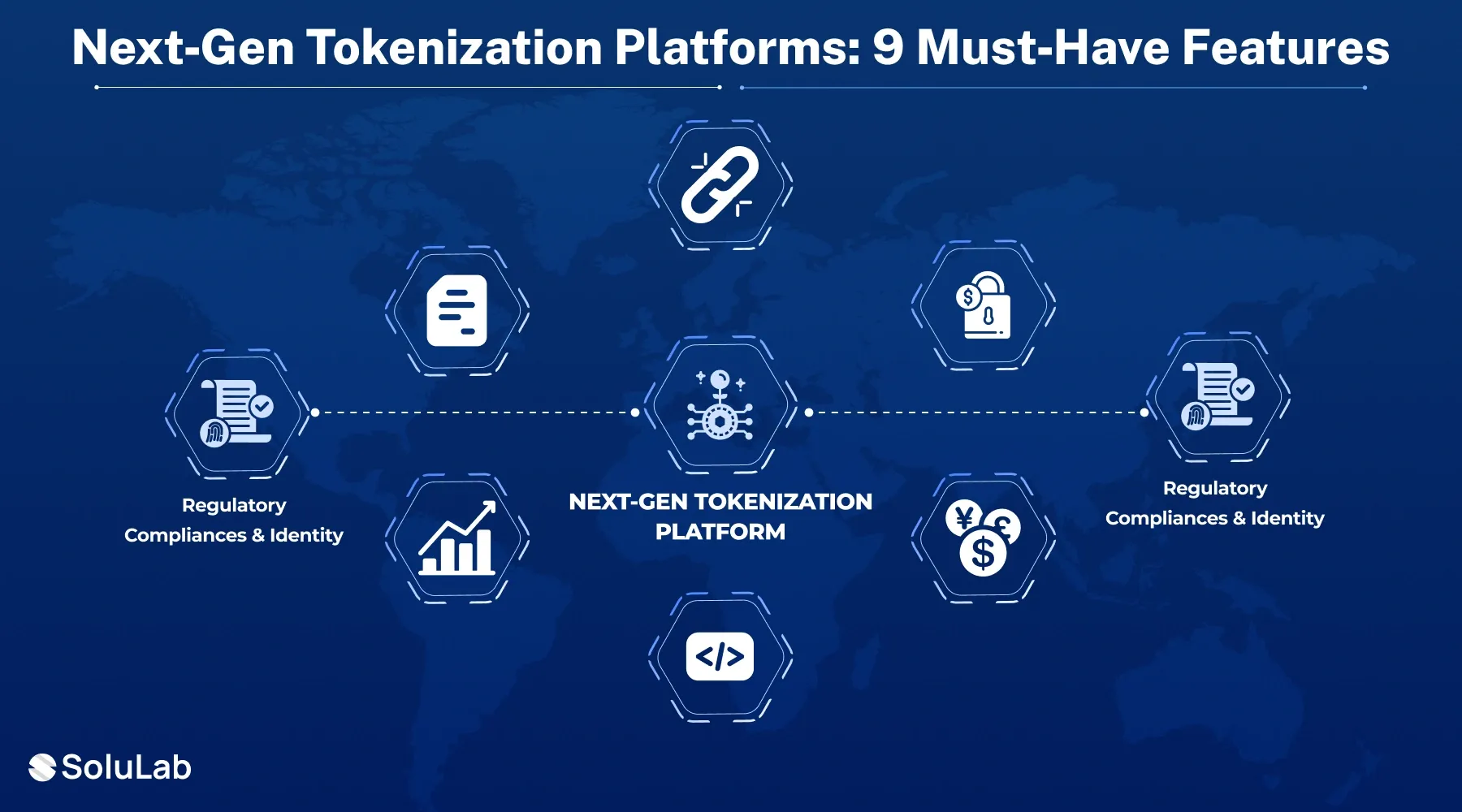
The best tokenization platforms 2026 that are scaling now share a few non‑negotiable traits:
- Compliance is expressed as programmable policy, not just legal text.
- Architectures are multi‑chain and DeFi‑aware from day one, rather than bolted on later.
- Off‑chain and on‑chain states are kept in sync via real‑time data, oracles, and proof‑of‑reserve mechanisms.
For builders partnering with an RWA tokenization development company like SoluLab, this is the difference between building a one‑off experiment and laying the rails for a long‑lived, regulated product line.
1. Turning regulations into code, not bottlenecks
Regulators have become more explicit about wanting end‑to‑end control and transparency, particularly as tokenization touches securities, funds, and loans. The World Economic Forum’s recent work on tokenization in financial markets stresses that scalable implementations typically embed legal and operational rules directly into the digital asset itself.
That translates into a policy engine rather than a pile of documents:
- Configurable rule sets for major regimes (for example, U.S. private placements, cross‑border offerings, or MiCA‑style frameworks) that can be applied per asset or share class.
- On‑chain allowlists, banlists, and transfer‑restriction logic tied to external KYC/AML providers, so only verified and eligible investors hold specific tokens.
- Emergency features such as pause, freeze, and controlled redemption align with how regulators and courts expect to intervene when something goes wrong.
SoluLab typically helps teams capture these policies in a way that lawyers, compliance officers, and engineers can all understand—so you do not end up with conflicting “paper rules” and “code rules.”
2. Multi‑chain, interoperable infrastructure as the new default
One clear pattern in market data is that tokenization is not confined to a single chain or asset type. Statista’s breakdown of tokenization forecasts by asset class highlights bonds, loans, cash‑like instruments, and real estate as major targets, each likely to live across different technical environments.
That reality forces platforms to think multi‑chain and interoperable from the start:
- Issuance frameworks that can deploy tokens to multiple public and enterprise chains (for example, Ethereum mainnet, L2s, and sector‑specific networks) under one logical model.
- Robust bridging or cross‑chain messaging that preserves economic equivalence and liquidity, instead of fragmenting assets into incompatible wrapped versions.
- A control plane that gives risk, treasury, and operations teams a single view of exposures, settlements, and flows across chains.
Here, SoluLab’s architecture work focuses on choosing the right settlement layer, the right liquidity venues, and the right degree of openness for your regulatory footprint and growth plans.
3. Proof‑of‑reserve and data integrity at institutional scale
As more real‑world assets move on-chain – particularly fixed income, real estate, and tokenized fund units – institutions are laser‑focused on one question: “How do I know this token is actually backed?”
Recent market studies show that tokenized real‑world assets could reach a multitrillion‑dollar scale by 2030, but only if investors can trust the linkage between the digital representation and the underlying pool. Advanced platforms handle this through:
- Continuous proof‑of‑reserve mechanisms that reconcile minted supply with custodial accounts, bank deposits, vault holdings, or SPV registers.
- Real‑time alerts and dashboards that flag any mismatch, delayed updates, or suspicious changes in underlying positions.
- Multiple independent oracles for pricing, net asset value, and reference data, to avoid single‑source failure and manipulation.
For SoluLab clients, this becomes part of the platform’s core operating narrative: investors and regulators should be able to verify backing conditions continuously, not just at quarterly intervals.
4. DeFi composability – without losing the plot on risk
Forbes and other industry commentators have pointed out that one of the most powerful benefits of tokenization is the ability to plug those assets into new liquidity and yield mechanisms. At the same time, the RWA sector’s recent growth – expanding from roughly 5 billion dollars in tokenized value in 2022 to around 24 billion by mid‑2025 – shows why risk controls matter as more capital comes in.
Successful platforms strike a balance:
- Token standards are designed so that assets can be used in lending pools, AMMs, and structured products without custom engineering every time.
- Risk frameworks enforce position limits, counterparty whitelists, and exposure caps at the protocol level, not just via spreadsheets.
- Circuit breakers and governance hooks make it possible to halt or reshape flows when market conditions deteriorate or counterparties fail.
SoluLab usually guides teams through phased composability – starting with permissioned or semi‑permissioned venues, then gradually opening up as controls and comfort levels mature.
Read Also: Why XRPL Is the Best Blockchain for Real Estate Tokenization Platforms?
5. Performance and privacy that match real‑world expectations
As more institutional‑grade products move into tokenized form, basic performance constraints – latency, fees, and data visibility become a hard limit. Market research on tokenization infrastructure consistently notes that layering rollups, sidechains, or application‑specific environments is key to delivering enterprise‑class SLAs.
Platforms that handle this well tend to:
- Use Layer‑2 or Layer‑3 rollups to get settlement costs and confirmation times down to user‑friendly levels, especially for active trading or frequent interest distributions.
- Rely on zero‑knowledge or similar privacy techniques to keep sensitive identity and position data out of public view while still proving compliance and solvency.
- Run hybrid architectures where public networks shoulder discovery and settlement, while permissioned layers handle registries, identities, and detailed transaction histories.
SoluLab’s role is to help you decide how much of the system should be public, how much should live in permissioned zones, and how these domains will talk to each other securely.
6. Security and governance that match the size of the prize
If the upper‑bound forecasts – up to 9.4 trillion dollars in tokenized RWAs by 2030 or even 16–30 trillion in some scenarios – prove accurate, the stakes for security and governance are enormous.
Modern platforms respond with:
- MPC‑based key management and institutional custody partnerships so that no single key, machine, or person can move large positions alone.
- Formal verification and rigorous audit practices for smart contracts that manage issuance, treasury functions, and critical control flows.
- Transparent, time‑locked upgrade paths and multi‑sig governance, ensuring that protocol changes cannot surprise investors or be rushed through under pressure.
SoluLab typically treats governance and security as first‑class design topics alongside features and UX, not as an item at the end of the checklist.
7. Lifecycle tooling that operators will actually use
Statista’s work on enterprise-grade tokenization platforms by asset class hints at just how varied the operational reality can be – from cash‑like instruments and bonds to real estate and alternative funds. Each of those asset types brings its own workflows for onboarding, distributions, valuations, and reporting.
The platforms that win adoption tend to give issuers and asset managers:
- A single issuer and operations console to configure offerings, manage share classes, process distributions, and handle redemptions.
- Automation for corporate actions like splits, consolidations, cap‑table updates, and consent processes tied directly to the token state.
- Robust APIs and integration kits so existing fund admin, reporting, and risk systems can plug in without a full core‑system replacement.
This is where SoluLab’s product and UX teams spend time mapping your real‑world operating model to the digital rails, so your back office does not end up fighting the chain.
8. AI‑driven intelligence layered on top of tokenized assets
As tokenization volumes grow, raw data is no longer the constraint; making sense of it is. Analysts and practitioners increasingly talk about AI as the “second layer” on top of tokenized markets, powering valuation, surveillance, and optimization.
Common high‑value capabilities include:
- AI‑assisted valuation and risk models for portfolios of private credit, real estate, or alternative strategies held in tokenized form.
- Dashboards that visualize flows, concentration risks, geographic exposure, and early‑warning indicators for default or liquidity stress.
- Anomaly detection for wash trading, sanctions risk, or suspicious transfer patterns, supporting both compliance and market integrity.
SoluLab, a top AI integration solution provider, can help teams design this analytics layer so it becomes a genuine decision tool for risk and investment committees, not just a pretty chart.
9. UX that feels like finance, not crypto
For most end users, the winning tokenization experience will feel more like a modern brokerage app than a crypto wallet. Recent coverage in Forbes and market surveys underline that broad adoption depends on hiding blockchain complexity behind familiar flows and trustworthy disclosures.
The best implementations focus on:
- Account abstraction, social login, and intuitive navigation so users never have to think about gas, seed phrases, or contract addresses.
- Integrated fiat on‑ and off‑ramps, as well as localized currency, language, and regulatory messaging tailored to specific geographies.
- Clear education and in‑app guidance that explains risks, rights, and processes in plain language, especially for first‑time investors in tokenized products.
This is where SoluLab’s UX practice bridges your compliance obligations with the kind of product experience that actually converts and retains users.
How Solulab Can Help You Build For The Market That’s Coming?
When forecasts from McKinsey, Statista, and Boston Consulting Group all point to multi‑trillion‑dollar tokenization markets within the decade, the cost of building the wrong platform architecture is high. The right question is: “What minimum set of advanced features of asset tokenization platform do we need now—and how do we phase in the rest without locking ourselves into a corner?”
SoluLab usually engages in three steps:
- Architecture and strategy workshop: Clarify your asset classes, target jurisdictions, and user personas, then map them to a multi‑chain, compliant, and DeFi‑aware blueprint.
- MVP and pilot: Launch a focused, audit‑ready product around a priority use case—such as real estate, private credit, or tokenized funds—with clear success metrics.
- Scale and integration: Add chains, asset classes, DeFi integrations, and AI analytics while tightening security, governance, and reporting to institutional standards.
If you’re planning a tokenization initiative or want to upgrade an existing platform, the most effective next move is straightforward:
Schedule a 45‑minute workshop for Tokenization Architecture with SoluLab.
You bring the assets, jurisdictions, and growth goals; SoluLab, a leading name for tokenization platform development, brings the architectural, regulatory, and product expertise to shape a platform that can survive and thrive in a world where tokenized value could represent a meaningful slice of global GDP.
FAQs
Next-gen tokenization platforms go beyond token issuance. They include built-in compliance, identity layers, asset servicing, interoperability, and AI-driven automation, enabling enterprises to operate at institutional scale rather than experimental scale.
There is no single “best” blockchain for tokenization. Ethereum and Ethereum-based Layer-2s are widely used for liquidity and standards, while permissioned and hybrid blockchains are preferred by enterprises for compliance, privacy, and performance. The best choice depends on asset type, regulation, scale, and integration needs.
Enterprises need tokenization platforms now because infrastructure, regulation, and institutional demand are converging. Delaying adoption increases competitive risk as trillions in tokenized assets are expected by 2030, and early movers define market standards.
Global banks, asset managers, and regulated fintech firms are leading tokenization initiatives, including institutions such as BlackRock, JPMorgan, HSBC, and major Web3 infrastructure providers. These players are building Real-World Asset (RWA) tokenization platforms focused on compliance, scalability, and institutional adoption.
AI enhances RWA tokenization platforms by automating asset valuation, detecting fraud, monitoring compliance, and predicting market risk. When combined with blockchain’s transparency, AI enables smarter decision-making and scalable asset management for institutional investors.
SoluLab helps enterprises build secure, compliant, and scalable Real-World Asset tokenization platforms. From architecture design and blockchain selection to smart contracts, compliance integration, and AI-driven automation, SoluLab supports end-to-end tokenization development.