Blockchain changed how we move money and store data online. At its heart, it’s a secure, decentralized system that records and checks information with no middleman in the loop.
Picture a ledger. Now picture that ledger copied across a whole network of computers, with every transaction locked in, visible to everyone, and impossible to quietly edit. That’s blockchain in one sentence, and it’s a big enough idea to change how we deal with each other online. This guide strips it back to the basics, in plain language. We’ll answer the question most people actually have, how does blockchain work, and get into the moving parts behind it. First, though, a quick look at what blockchain is.
What is Blockchain Technology?
Blockchain is a way of storing data so that outsiders find it hard, or flat-out impossible, to alter, hack, or game the system. It’s also called a distributed ledger: a network of computers that copies every transaction and spreads it across all of them.
Under the hood, blockchain uses many databases, known together as the “chain,” linked by peer-to-peer nodes. Those databases hold public transaction records, or blocks. People usually call this setup a “digital ledger.”
Every transaction in that ledger is approved with the owner’s digital signature. That signature proves the transaction is genuine and blocks anyone from tampering with it. Hence the reputation. Data on a digital ledger is extremely safe.
Still abstract? Think of a Google spreadsheet shared by lots of computers, where each row is a real purchase. Here’s the twist. Anyone can read the sheet, but nobody can change what’s already in it.
How Does the Blockchain Technology Work?
You’ve probably noticed more and more companies around the world adopting blockchain over the last few years. So how does the blockchain work in practice? And is it a minor add-on or a real shift? Let’s clear away a few myths first, because this technology is still young, and it may well turn out to be revolutionary.
Blockchain is really three inventions working together:
- Cryptographic keys
- A distributed ledger on a peer-to-peer network
- A kind of computation that stores the network’s records and transactions
Cryptography here means two keys: a public key and a private key. Together they let two parties complete a transaction cleanly. Each person holds both, and the pair forms a secure digital identity. This encrypted identity is arguably the single most important thing blockchain brings to the table. In cryptocurrency circles it goes by another name, the “digital signature,” and it’s what authorizes and controls every transaction.
Now combine that signature with the peer-to-peer network. Many participants act as authorities, and they use digital signatures to agree on transactions and other decisions. Once a mathematical check confirms they’ve approved a contract, the deal goes through, safely, between two parties who may never have met.
Types of Blockchain
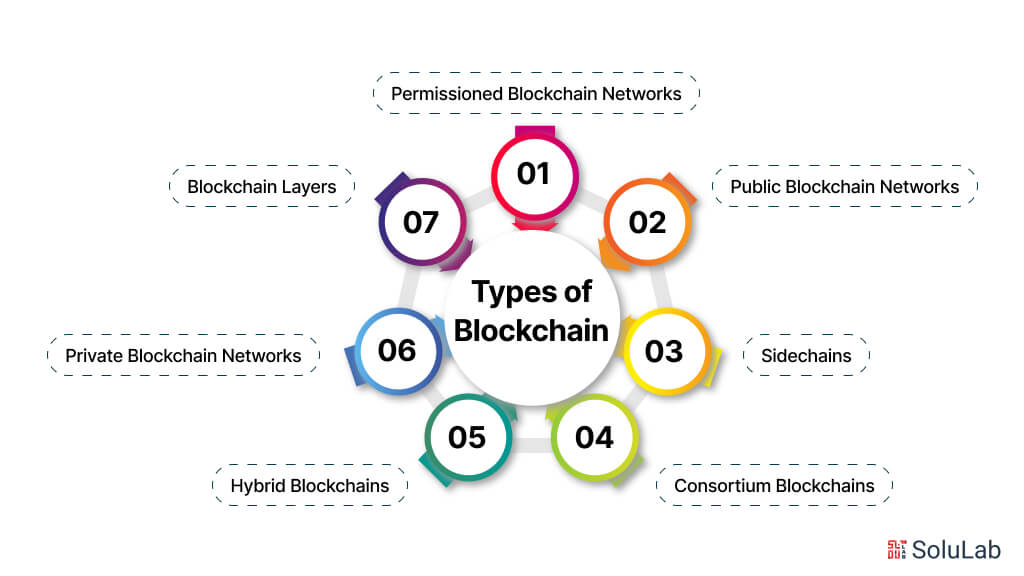
Not every blockchain looks the same. Here are the main types of blockchain you’ll run into.
- Private Blockchain Networks
Private blockchains live on closed networks, which makes them a natural fit for companies and organizations that want control. You set the access rules, the permissions, the network settings, and the key security features yourself. One authority runs the whole thing.
- Public Blockchain Networks
Bitcoin and other cryptocurrencies grew out of public blockchains, and public chains are also what made distributed ledger technology (DLT) famous. They sidestep some familiar problems, like security weak spots and centralized control. Why? Because DLT spreads data across a peer-to-peer network instead of parking it in one place. To check that information is valid, the network runs a consensus method. The two you’ll hear about most are proof of stake (PoS) and proof of work (PoW).
- Permissioned Blockchain Networks
Permissioned blockchains, sometimes called hybrid blockchains, are private chains that only let approved people in. Organizations usually build them to get the best of both worlds. The big draw is control: you decide exactly who can join the network and which transactions they can take part in.
Read Blog: Permissionless Blockchain: An Overview
- Consortium Blockchains
Like permissioned chains, consortium blockchains mix public and private elements. The difference is who’s in charge: several organizations share the management instead of one. They take more work to set up at the start. Once they’re running, though, they can offer stronger security, and they’re a great match when multiple companies need to collaborate on shared data.
- Hybrid Blockchains
A hybrid blockchain blends public and private. Some parts of the chain are open and transparent. Others are locked down, visible only to authorized members. That split is perfect for applications that need openness and secrecy at the same time. Supply chains are the classic case: lots of partners can see some of the information, while the sensitive details stay private.
- Sidechains
Sidechains are blockchains that run alongside a main chain, adding features and extra capacity. For developers, they’re a sandbox. You can experiment with new features and apps without putting the main blockchain’s integrity at risk. Sidechains can also take on some of the main chain’s transactions, which eases congestion and helps the whole system scale.
- Blockchain Layers
“Blockchain layers” means stacking blockchains on top of each other. Each layer can have its own rules, features, and consensus mechanism, and still talk to the layers around it. Because transactions can be processed in parallel across several layers, you get more scalability. The best-known example is the Lightning Network. It’s a second-layer solution built on top of the Bitcoin blockchain, and it makes transactions faster and cheaper by opening payment channels directly between users.
Read Our Blog: Layer-1 Vs. Layer-2: The Blockchain Scaling Solutions
What is Blockchain as a Service?
Blockchain as a Service (BaaS) is a cloud service that lets you build, host, and launch blockchain applications without the headache of building and maintaining the infrastructure underneath. That infrastructure is usually the hardest part of any blockchain project.
If you’ve used Software as a Service (SaaS) or Platform as a Service (PaaS), the model will feel familiar. BaaS gives you blockchain capabilities on a pay-as-you-go or subscription basis. In other words, you get the upside of blockchain, decentralization, transparency, and immutability, without buying hardware, licensing software, or hiring a team of specialists first.

So how does it actually work?
1. Cloud-Based Infrastructure: Blockchain as a Service (BaaS) providers host blockchain infrastructure on their own cloud platforms. Everything you need to deploy, manage, and grow a blockchain network is usually part of the package.
2. Pre-Built Solutions: Many BaaS platforms come with ready-made blockchain solutions and templates for specific jobs, like supply chain management, identity verification, or financial transactions. Smart contracts, consensus mechanisms, and other must-have features are already set up for you.
3. Development Tools: You also get development tools, APIs, and SDKs that make it easy to build, test, and ship blockchain applications. They hide a lot of the messy complexity that normally comes with blockchain development.
4. Scalability and Flexibility: Need more capacity? Most BaaS platforms let you scale your network up or down with demand. You can also choose the underlying blockchain protocol, the consensus mechanism, and other configuration options.
5. Managed Services: The provider takes care of the operational side, including security, maintenance, and upgrades. You stay focused on building and launching your applications, not babysitting servers.
How is Blockchain Used?
Blockchain has moved well beyond crypto. It’s showing up in industry after industry, reworking old processes and adding security and transparency along the way. Here’s what that looks like sector by sector:
1. Finance
Finance was the first big adopter, and it’s still where blockchain is used most for secure, transparent transactions. It has made cross-border payments faster, lowered transaction costs, and cut out many of the intermediaries. Smart contracts built on blockchain automate things like loan approvals and trade settlements, which simplifies operations and lowers the risk of fraud.
2. Healthcare
In healthcare, blockchain is improving how data is managed and how patients are cared for. Electronic health records kept on blockchain platforms stay accurate and confidential, and providers can share them securely. There’s a second benefit, too: blockchain in healthcare makes drug traceability possible, so pharmacies and patients can confirm a medicine is genuine and counterfeit drugs have a harder time reaching the market.
3. Supply Chain Management
Supply chains are being rebuilt around blockchain because it makes goods easier to see and trace. When every step of a product’s journey is recorded on a shared ledger, everyone involved can check the same history. That kind of transparency builds trust among stakeholders and makes the whole supply chain run better.
4. Real Estate
Real estate is getting a shake-up too, in both property deals and ownership records. Smart contracts on blockchain platforms make transactions secure and transparent, and they remove the need for middlemen like brokers and lawyers. Meanwhile, blockchain-based property registries keep ownership records accurate and tamper-proof. Fewer forged deeds. Fewer disputes.
Read Blog: Revolutionizing Real Estate With Blockchain Technology
5. Energy
The energy sector is using blockchain for peer-to-peer energy trading and smarter grid management. On blockchain-based platforms, producers can sell surplus energy straight to consumers, which creates a decentralized energy market. Pair smart meters with blockchain and you can monitor consumption and transactions in real time. That encourages people to use energy more efficiently and more sustainably.
Five sectors, five very different problems. Together they show just how broad the applications of blockchain technology really are, and why so many industries see it as a way to rethink processes, tighten security, and try new ideas.
Features of Blockchain Technology
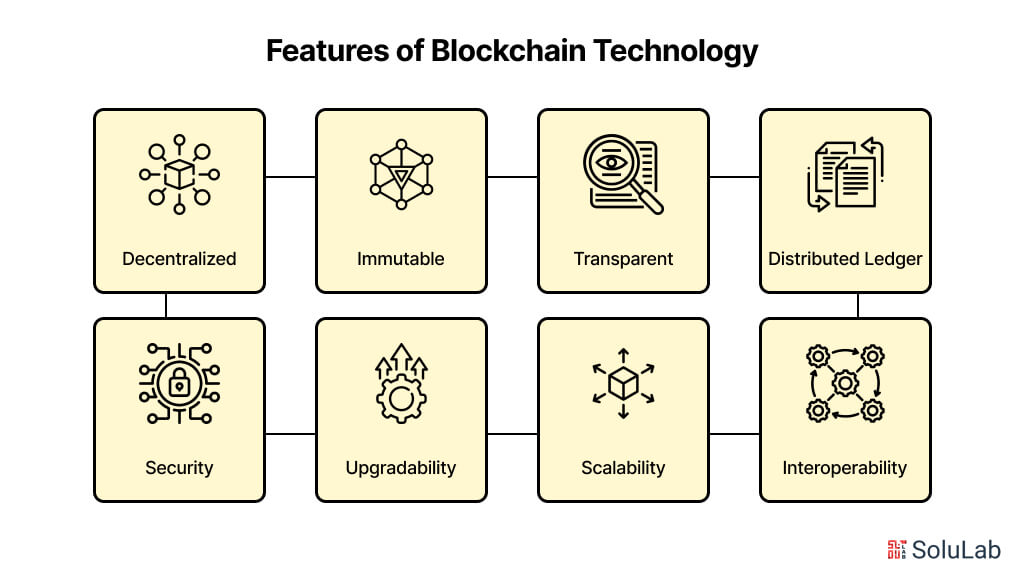
What makes a blockchain a blockchain? These are the core features of blockchain technology:
1. Decentralized: No single central authority runs the network. Instead, a group of nodes (computers) keeps it going, working together to validate each transaction.
2. Immutable: Once a transaction lands on the blockchain, it can’t be changed or deleted. Each block is tied to the one before it by a unique code, so altering the data without breaking the chain is impossible.
3. Transparent: Every transaction is out in the open. Anyone can look at the network’s full transaction history.
4. Distributed Ledger: Many nodes each keep a full copy of the blockchain. That’s what “distributed ledger technology” means in practice, and it’s why every participant sees the same information.
5. Security: Advanced cryptography and encryption keep every transaction secure and tamper-proof.
6. Upgradability: A lot of blockchain networks are designed so the protocol or underlying code can be updated without knocking the network offline.
7. Scalability: This one comes with a caveat. Blockchain has come a long way on scalability, but some networks still hit limits on transaction speed and capacity.
8. Interoperability: Work is underway to let different blockchain networks talk to each other, so data can move smoothly from one network to another.
Bitcoin vs. Blockchain
People mix these two up all the time. Bitcoin launched in 2009 and has since become the best-known, most successful virtual currency around. A big reason for its popularity is that it’s decentralized: there’s no central bank or governing body controlling how much of it exists. The implication: no transaction costs, and transactions that stay anonymous.
Blockchain, on the other hand, is the database underneath: a record of past transactions between two parties. Each time new transactions happen, a block holding their details is added to the chain in time order. The more blocks pile up after a record, the harder that record becomes to change. And because new blocks keep arriving, the blockchain never stops growing.
Applications of Blockchain
Cryptocurrency was only the first use. Because blockchain is decentralized and secure, it could reshape plenty of other industries too. A few of the most promising applications:
- Financial Services: Think smart contracts, digital identities, and decentralized exchanges, all secure and transparent by design. Banks and other financial institutions are testing blockchain to work more efficiently and spend less.
- Voting Systems: Voting on a blockchain could make elections more transparent and harder to tamper with. Countries such as Australia and Switzerland are looking into it.
- Cybersecurity: Blockchain can power secure, decentralized security tools, such as decentralized blockchain identity management and encrypted data storage.
- Intellectual Property: A tamper-proof record of who owns what, and where it came from, gives creators a stronger way to protect their rights.
- Gaming: Decentralized gaming platforms built on blockchain allow secure, transparent transactions, and players actually own their digital assets.
- Identity Verification: Blockchain-based identity tools create secure, decentralized digital IDs. That lowers the risk of identity theft and tightens security overall.
- Food Safety: Tracking where food comes from and how it moves makes contamination easier to catch and the whole chain more transparent.
- Education: Schools and platforms can issue secure, transparent digital credentials on a blockchain. Degree fraud gets harder, and records become easier to access.
- Government Services: Governments could run secure, transparent services on blockchain, including voting, taxation, and identity verification.
Benefits of Blockchain Technology
Why are so many industries paying attention? Because the benefits stack up quickly. Here are the main ones:
1. Increased Transparency: You get a transparent, tamper-proof record of every transaction, so tracking data and checking it’s authentic becomes much easier.
2. Improved Security: Advanced cryptography and encryption keep data secure and tamper-proof. Hackers have a very hard time getting in, let alone changing anything.
3. Reduced Costs: Automate the process, remove the middlemen, and work gets cheaper.
4. Enhanced Efficiency: Blockchain automates steps that used to need a person, and it speeds things up while improving accuracy. That’s a strong fit for any industry where processing has to be fast and reliable.
5. Increased Trust: When both sides can see the same secure, transparent record, trust comes more easily, even in a purely digital deal between strangers.
6. Decentralized Control: Control is spread out, so people and organizations keep more say over their own data and transactions.
7. Improved Data Accuracy: Everyone works from a single source of truth. Fewer errors, fewer mismatched versions.
8. Reduced Risk of Fraud: A secure, transparent transaction record leaves fraudsters very little room to fiddle with the data.
9. Increased Accessibility: Individuals and organizations get a secure, transparent way to reach and share data.
10. Scalability: As industries grow, blockchain can grow with them, handling large volumes of data securely and transparently.
11. Improved Compliance: With a secure, transparent record of every transaction, meeting regulatory requirements gets a lot less painful.
12. Reduced Counterfeiting: Track where goods come from and where they go, and fakes become much harder to slip in.
13. Improved Supply Chain Management: Goods can be followed securely and transparently at every stage of the journey.
14. Enhanced Customer Experience: Customer data and transactions are handled securely and in the open, which customers notice and appreciate.
15. Increased Value: Digital assets, cryptocurrencies included, can be managed securely and transparently, and that adds value.
Put together, that’s a long list: better security and transparency, higher efficiency, wider access. And the technology is still moving. Expect more inventive uses of blockchain to show up as it matures.
Leading Blockchain Platforms
There are plenty of blockchain platforms to choose from. Three names come up more than any others: Ethereum, Hyperledger Fabric, and OpenChain.
1. Ethereum: Ethereum is one of the most widely used and most respected blockchain platforms out there. It’s open source and highly adaptable, which is why so many enterprise applications pick it. Its biggest contribution to the field was bringing in smart contracts and decentralized applications (dApps). Those two ideas pushed blockchain far past simple transactions. Ethereum also has a large, active developer community that keeps building on the platform. Its native cryptocurrency, Ether, is the fuel that pays for every operation on the network.
2. Hyperledger Fabric: Hyperledger Fabric is built with specific industries in mind, especially finance and manufacturing. It’s an open-source platform aimed mainly at permissioned networks. That said, it can also support decentralized hosting and storage for applications that run on smart contracts. Its modular design lets organizations build private blockchains shaped around their own business needs. Flexibility plus smart contract support: that combination is why you see it used in so many different industries.
3. OpenChain: OpenChain is for organizations that need to manage and protect digital assets efficiently. It’s open source, and administrators write the rules that govern the ledger. Users then trade value on that ledger, within those rules. Because it’s customizable and scalable, OpenChain works for everything from supply chain management to issuing and tracking digital assets.

Conclusion
Blockchain is a genuinely new kind of technology, and it could change a lot of industries by making systems secure, transparent, and decentralized. Its foundations, immutability, decentralization, and cryptographic security, make it a dependable place to store and exchange digital assets and information. Financial transactions, supply chains, identity checks, decentralized apps: the list of what you can build on it is long, and it keeps getting longer.
If your business is weighing blockchain, the partner you pick matters a lot, so it pays to work with an experienced blockchain development company. SoluLab is a leading provider of blockchain solutions and builds custom blockchain applications around each client’s specific needs. Our team of skilled developers and blockchain specialists helps businesses get real, practical value out of the technology. Decentralized finance (DeFi) platforms, supply chain tracking systems, secure digital identity tools: SoluLab builds blockchain solutions that are reliable, scalable, and innovative. Got a use case in mind? Contact us today and let’s figure out what blockchain can do for your growth.
FAQs
Shipra Garg is a tech-focused content strategist and copywriter specializing in Web3, blockchain, and artificial intelligence. She has worked with startups and enterprise teams to craft high-conversion content that bridges deep tech with business impact. Her work translates complex innovations into clear, credible, and engaging narratives that drive growth and build trust in emerging tech markets.