AI and blockchain are no longer separate innovation tracks; they are converging into the core infrastructure of the next-generation digital economy. At Davos and in recent World Economic Forum publications, leaders describe this as a shift toward an “intelligent economy” where AI needs verifiable, interoperable, and trusted digital rails to deliver its promised trillions in value.
For Web3 founders and product leaders, that means one thing: the real edge is no longer launching just a protocol or dApp, but launching an intelligent Web3 product– where AI agents, on-chain logic, and data all work together reliably.
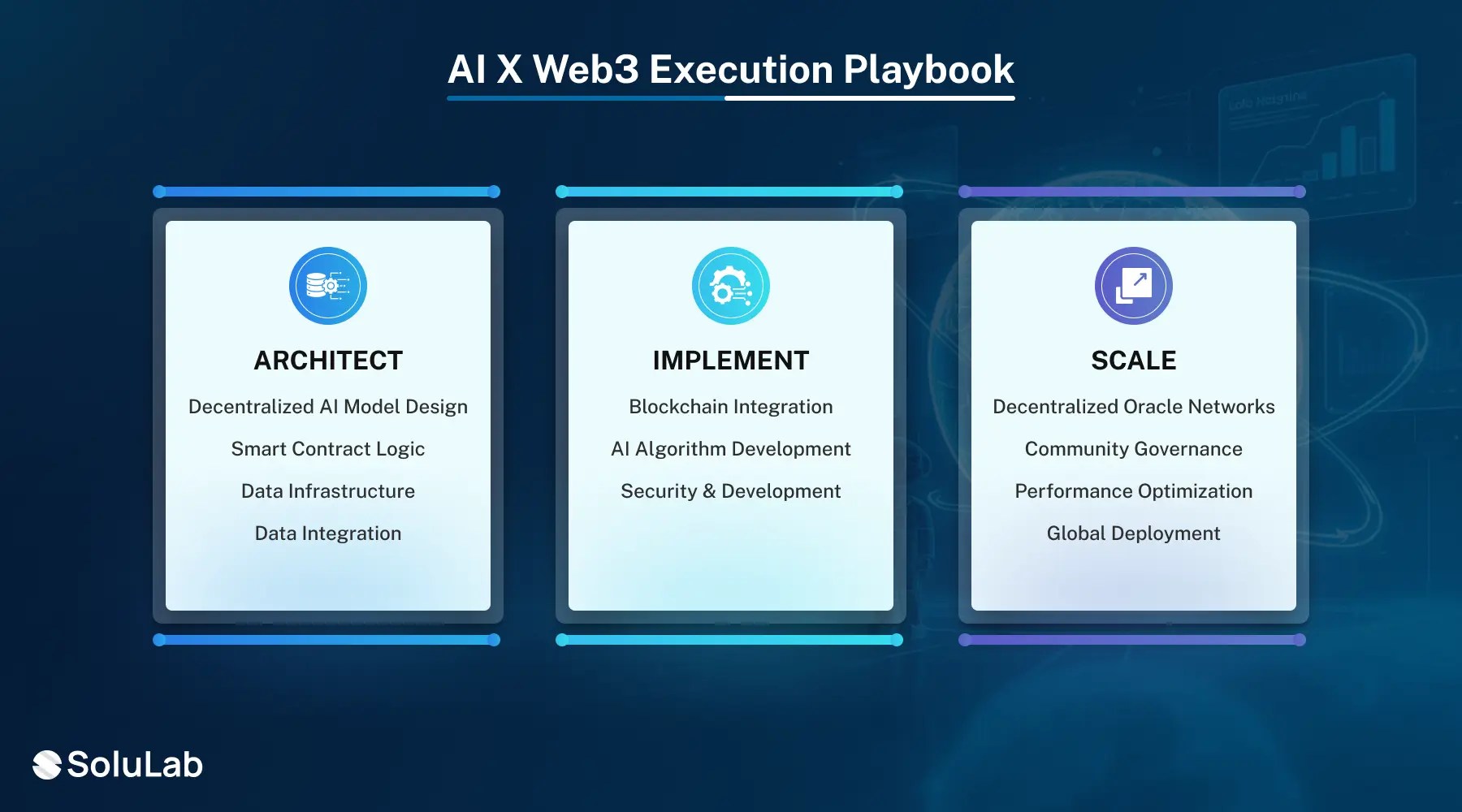
If you are already exploring AI in Web3, your challenge is not “why” but how: how to architect AI into your protocol without breaking trust, tokenomics, UX, or regulatory readiness. This execution playbook demonstrates how to design, implement, and scale an AI-powered Web3 product, and how partnering with SoluLab’s AI-Web3 team de-risks that journey end-to-end.
How to Integrate AI into a Web3 Product?
To integrate AI into a Web3 product, start by mapping high‑value use cases (fraud detection, personalization, risk scoring, dynamic pricing) to your on‑chain flows, then design an architecture where off‑chain AI models ingest both on‑chain and off‑chain data, generate decisions, and anchor critical outputs back on-chain for transparency and auditability.
You then implement this through a phased roadmap– discovery, architecture, PoC, MVP, and scale, while enforcing responsible AI practices, security, governance, and compliance from day one. A partner like SoluLab helps you choose the right models, infra, and protocols, orchestrate AI agents with smart contracts, and manage the full lifecycle from pilot to production.
Market Reality: AI-Blockchain Convergence Is Now An Execution Problem
Leading research bodies are clear: Artificial Intelligence is set to drive massive economic gains, but capturing those gains safely requires robust, interoperable, and trustworthy digital infrastructure. The World Economic Forum’s technology convergence work highlights how AI, blockchain, and related frontier tech are forming a new economic operating system where data provenance, verifiability, and cross‑platform interoperability are non‑negotiable.
On the market side, Web3 and blockchain continue to mature, with reports forecasting strong growth across Web3 infrastructure, DeFi, and gaming, often projecting double‑digit CAGRs into the early 2030s. At the same time, business media and analysts point to the rise of AI agents, decentralized AI networks, and AI‑enhanced financial rails as a defining theme for the next wave of digital business.
This convergence means that if your Web3 product is not planning an AI roadmap, it risks being out‑competed by protocols and dApps that can make smarter, faster, and more personalized decisions.
Architectural Blueprint: Patterns for AI in Web3
Designing an AI‑powered Web3 product starts with the right architecture patterns, not just a model choice. At a high level, most serious implementations follow a pattern where off‑chain AI models or agents process data and interact with on‑chain smart contracts through secure, auditable interfaces.
Typical architecture elements include:
Data pipeline layer
- Ingest on‑chain data (transactions, positions, interactions) and off‑chain data (market feeds, behavioral analytics, IoT signals, enterprise systems).
- Normalize and store data in a privacy‑aware, regulation‑aligned way, often combining decentralized storage with secure off‑chain repositories.
AI/ML model layer
- Run inference for tasks like credit/risk scoring, anomaly detection, recommendation, pricing, and personalization using domain‑appropriate models.
- In advanced setups, orchestrate AI agents that can reason over state, monitor markets, and invoke smart contracts through well‑defined policies.
Smart contract & on-chain verification layer
- Smart contracts consume AI outputs as parameters or triggers (e.g., risk scores, recommended collateral ratios) while preserving on‑chain governance and guardrails.
- Hashes or proofs of AI decisions, model versions, and critical inputs are anchored on‑chain to provide auditability and verifiability for regulators, partners, and the community.
Interface & experience layer
- Front-ends and wallets surface AI‑driven insights (for example, personalized yield strategies, alerts, or game states) in clear UX patterns, with strong disclosure where automated decisions are being made.
3 Implementation Archetypes that actually Work
Different Web3 verticals call for different AI integration service patterns, but most fall into a few repeatable archetypes that SoluLab helps clients implement.
1. AI-enhanced DeFi protocol
- Use cases
- Real‑time risk scoring of positions and counterparties.
- Dynamic collateral factors based on volatility, liquidity, and address behavior.
- Fraud and anomaly detection for suspicious activity.
- How it works
- Off‑chain models continuously monitor markets and on‑chain positions, generating risk metrics.
- Smart contracts use these metrics to apply guardrails (e.g., adjust collateral requirements, flag addresses, trigger soft alerts), with governance defining thresholds and override logic.
2. AI-powered Web3 gaming & metaverse
- Use cases
- Adaptive difficulty and mission design.
- Personalized rewards and item drops based on on‑chain and in‑game behavior.
- AI‑driven NPCs that respond to player history and token-based incentives.
- How it works
- AI models analyze player segments and behaviors; AI agents orchestrate missions and events.
- Game smart contracts read AI‑generated parameters (reward weights, difficulty curves) while preserving fairness and economic balance on-chain.
3. AI-driven NFT, creator, and data networks
- Use cases
- Creator and asset recommendation engines.
- Dynamic pricing or royalty optimization based on market data.
- Community health and sentiment analysis feeding into governance.
- How it works
- AI processes marketplace, social, and on‑chain data to derive rankings, prices, and alerts.
- Outputs inform front‑end surfaces and can also guide treasury allocations or incentive programs via governance‑approved logic.

Risk, governance, and compliance: doing AI in Web3 the right way
Global institutions repeatedly stress that AI at scale must be responsible, governed, and resilient. The World Economic Forum’s risk and technology reports underscore challenges such as model bias, opacity, cyber threats, and systemic fragility if AI is deployed without transparency and oversight. For Web3 projects handling financial flows, governance rights, or critical infrastructure, this is not theoretical—it is existential.
Integrating AI with blockchain can directly address some of these issues. On‑chain anchoring of model versions, decision proofs, and key data events builds audit trails that regulators and partners can examine. Governance modules can codify who can update models, adjust risk thresholds, or change AI policy, reducing key‑person dependency and making the system more predictable for stakeholders. At the same time, privacy‑preserving techniques, careful data minimization, and region-conscious infra choices help align AI-Web3 products with emerging regulatory expectations in the US, EU, Middle East, and India.
This is why serious teams do not treat AI as a bolt‑on; they treat it as a governed subsystem with clear rules, monitoring, and community communication– exactly the kind of architecture SoluLab, a leading Web3 Development Company, helps design and implement end‑to‑end.
Execution Roadmap: From Idea to AI-powered Web3 Product with SoluLab
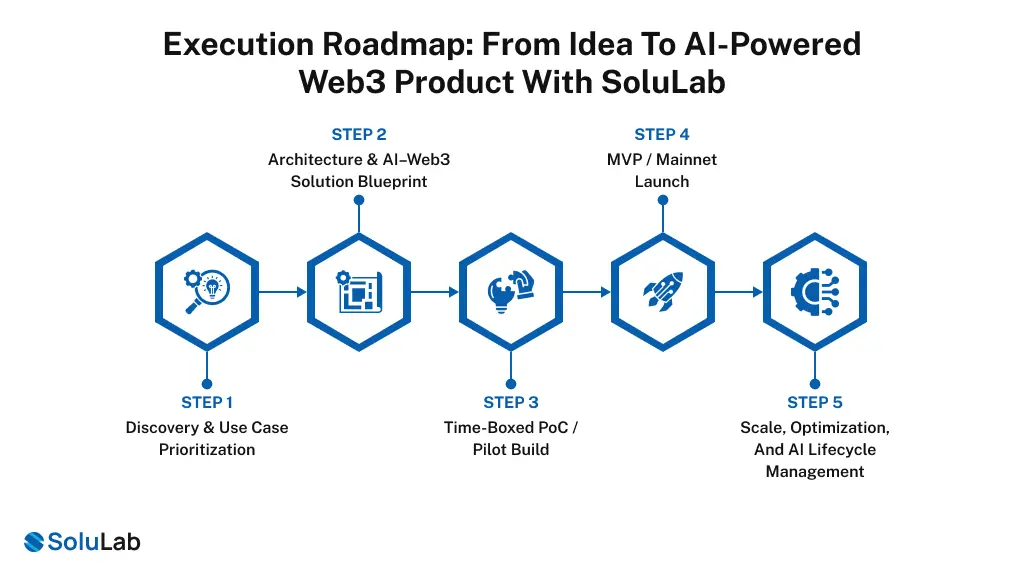
At the bottom of the funnel, what matters is not concepts but a clear path to execution. Below is a practical engagement model that SoluLab uses with Web3 clients.
Step 1: Discovery & use case prioritization
- What happens
- Joint workshops to map your protocol, tokenomics, and existing stack against AI opportunities: risk, growth, personalization, operations.
- Assessment of data readiness, infra maturity, and regulatory context.
- What you get
- A prioritized list of 2–4 high‑impact AI use cases that fit your product stage and budget.
- Early view of feasibility, timelines, and dependencies.
Step 2: Architecture & AI–Web3 solution blueprint
- What happens
- SoluLab’s AI and blockchain architects design the full stack: data flows, AI models or agents, smart contract interfaces, security controls, and governance hooks.
- Selection of cloud, on‑chain, and off‑chain components, as well as any decentralized AI infrastructure if relevant.
- What you get
- A detailed architecture document and implementation blueprint you can take to your board, investors, or internal stakeholders.
- Clear estimates for PoC, MVP, and scale phases.
Step 3: Time-boxed PoC / pilot build
- What happens
- Implementation of a focused pilot around one or two use cases (e.g., risk engine for a DeFi pool, AI recommendations for a marketplace).
- Integration with your testnet or controlled environment, complete with measurement and monitoring.
- What you get
- Working AI+Web3 functionality that demonstrates user or business impact in weeks, not years.
- Evidence to support governance proposals, fundraising conversations, or internal greenlights.
Step 4: MVP / mainnet launch
- What happens
- Hardening of models, infra, and smart contracts based on PoC lessons; expansion to additional user segments or markets.
- Implementation of production-grade observability, security checks, and rollback paths.
- What you get
- A live AI‑powered Web3 product or protocol feature set on mainnet, ready for real users.
- Documentation and runbooks for internal teams, auditors, and partners.
Step 5: Scale, optimization, and AI lifecycle management
- What happens
- Continuous improvement of models, data pipelines, and agent policies using real‑world feedback and performance data.
- Fine‑tuning to new markets, tokens, or regulatory changes, including model retraining and versioning workflows.
- What you get
- A living, evolving AI–Web3 product that stays competitive as markets, tech, and regulations shift.
- Ongoing support options (including dedicated squads) from SoluLab’s multi‑geo engineering and strategy teams.
Mini Scenario Vignettes: What this Looks Like in Practice
While specific client details are typically confidential, the following anonymized scenarios illustrate how an AI x Web3 partnership with SoluLab plays out.
Scenario 1: DeFi Protocol De‑risking with AI
A mid‑size DeFi lending protocol faced volatile liquidation events and community anxiety around risk management. SoluLab designed an AI risk engine that ingested‑chain positions and market feeds, generated granular risk scores, and surfaced early‑warning alerts to governance. Smart contracts were updated to respond to risk bands, while critical decisions and model versions were anchored on‑chain for transparency. The protocol gained more predictable risk behavior and stronger narratives for both users and regulators.
Scenario 2: Web3 Gaming Retention Unlocked by Personalization
A Web3 gaming solution struggled with mid‑funnel drop‑offs, despite strong acquisition. SoluLab helped implement AI‑driven segmentation and in‑game personalization, tuning missions, rewards, and events for each player cluster based on‑chain and in‑game signals. AI‑generated parameters were piped into smart contracts controlling rewards and progression, with limits to preserve fairness. The result was higher engagement and better retention, reinforcing the economic health of the game’s token and NFT economy.
Scenario 3: Enterprise Web3 Infra with AI Operations
An enterprise‑focused Web3 infrastructure provider wanted to differentiate with intelligent monitoring and predictive maintenance. SoluLab, a top AI development company, integrated AI agents that monitored node performance, latency, and anomaly signals across multiple regions, triggering automated, governance‑approved actions on-chain for staking, routing, or resource allocation. This AI-Web3 operations layer became a key selling point with institutional clients who demanded reliability and auditable automation.
FAQs: Real Buyer Questions About AI in Web3
For most teams, a focused AI-Web3 PoC can be delivered in a few weeks, with MVP‑level integration often taking a few months depending on use case complexity, data readiness, and governance needs. A phased roadmap helps you show value early while minimizing risk.
Budgets vary widely by scope, but serious MVPs combining AI models, data pipelines, and smart contract integration typically fall into the “strategic initiative” range rather than small experiments. A discovery and architecture phase with SoluLab clarifies cost, ROI potential, and phasing before major commitments.
Not necessarily. SoluLab can provide end‑to‑end AI and blockchain capabilities from data engineering and model selection to deployment and monitoring while collaborating with your internal product and engineering teams, where you prefer to retain ownership.
By combining on‑chain transparency with privacy‑aware data design, carefully chosen cloud/infra locations, and governance patterns aligned with regulatory expectations in major regions such as the US, EU, Middle East, and India. SoluLab’s architecture work always includes a compliance lens from the start rather than as an afterthought.
Your Next Step: Architect Your AI x Web3 Roadmap with SoluLab
AI-blockchain convergence is no longer a theoretical debate; it is a live execution challenge for any serious Web3 founder, protocol, or product leader. The institutions shaping global tech policy emphasize that the winners will be those who combine AI’s power with verifiable, interoperable, and well‑governed digital infrastructure exactly where Web3 is headed.
If you are ready to move from exploration to execution, the next step is straightforward: book a 45‑minute AI x Web3 Architecture Workshop with SoluLab. In that session, SoluLab’s experts will review your product, surface the best AI opportunities, and outline a tailored roadmap covering architecture, timelines, and risk so you can decide how and when to build your intelligent Web3 product.