Key Takeaways
- AI agents go beyond traditional automation by making decisions, using tools, and executing multi-step workflows with minimal human intervention.
- Businesses are adopting AI agents across customer service, sales, HR, IT, finance, healthcare, and operations to improve efficiency and reduce manual work.
- Successful AI agent implementation depends on clean data, strong governance, system integration, and continuous monitoring, not just on choosing the right AI model.
- 2026 will mark a major shift toward enterprise AI adoption, with organizations embedding AI agents into business applications and everyday workflows.
- The future of AI agents lies in multi-agent collaboration, where specialized agents work together to complete complex business processes end-to-end.
Introduction
For years, businesses have relied on automation that follows fixed rules: if this happens, do that. It works, but only within narrow limits.
The moment a task requires judgment, context, or a multi-step decision, traditional automation breaks down, and a human has to step in.
AI agent development is changing that equation. Instead of reacting to a single trigger, an AI agent can understand a goal, plan the steps needed to reach it, use tools to gather missing information, and take action on its own.
In fact, worldwide AI spending is expected to reach $2.59 trillion in 2026, representing 47% year-over-year growth.
In this guide, we will break down what an AI agent is, how it actually works, why businesses are adopting agentic AI systems so quickly, and where this technology is headed.
What Are AI Agents?
An AI agent is a software system that can perceive its environment, reason about a goal, plan a sequence of actions, and execute those actions with minimal or no human input. Unlike a traditional program that only follows pre-written instructions, an artificial intelligence agent can decide what to do next based on the situation in front of it.
Most modern AI agents are built on top of large language models, which is why they are often called LLM agents. The LLM provides the reasoning and language understanding, while the agent framework around it adds memory, planning, and the ability to call external tools.
How do AI Agents Work?
Every AI agent, regardless of what industry it is built for, tends to follow a similar operating loop made up of a few core components.
- Perception: The agent gathers information from its environment. This could be a user’s message, data from a database, a document, sensor input, or output from another application. Perception is how the agent understands what it is working with.
- Planning: Once the agent understands the goal and the information available, it breaks the goal down into smaller, manageable subtasks. For simple requests, this planning step can be minimal. For complex, multi-part goals, the agent maps out a sequence of actions before doing anything.
- Memory: Memory allows an agent to store past interactions, outcomes, and user preferences. This is what separates a one-off chatbot response from a system that improves over time and personalizes its behavior based on history.
- Reasoning: Reasoning is the process of connecting the dots between what the agent knows, what it still needs, and what action makes the most sense next. When new information comes in from a tool, the agent reassesses its plan and adjusts course if needed.
- Tool Use: Because an LLM alone cannot access live data or take real-world actions, agents rely on tool calling to interact with APIs, databases, search engines, or other software. This is what allows an agent to look up a live shipment status or update a CRM record instead of guessing.
- Action: This is the execution stage, where the agent actually performs the task: sending a message, updating a record, placing an order, or triggering a workflow in another system.
- Learning: Through feedback, whether from a human, another agent, or the outcome of its own actions, the agent refines its future behavior. Over time, this learning loop is what makes an autonomous agent more accurate and more aligned with what the business actually needs.

Why Are Businesses Rapidly Adopting AI Agents?
Deloitte reports that 39% of organizations have already funded agentic AI initiatives and predicts up to 75% of companies will invest in agentic AI. Businesses are moving quickly toward agentic AI because the return on investment shows up fast and across multiple departments. A few reasons stand out:
- Labor and cost pressure: Agents handle repetitive, multi-step work that would otherwise need a growing headcount, letting teams redirect people toward higher-value work.
- Rising customer expectations: Customers expect instant, accurate responses around the clock, and AI agents can maintain that pace without burning out.
- Data overload: Businesses now generate more data than teams can manually review. Agents can continuously monitor, analyze, and act on that data in real time.
- Competitive pressure: As more companies deploy an AI agent platform for enterprises, staying manual becomes a competitive disadvantage rather than a safe choice.
- Maturing tools: Frameworks for building and deploying agents have matured significantly, making it realistic for businesses of most sizes to adopt an AI agent platform without building everything from scratch.
- Measurable outcomes: Unlike broad AI experiments, agentic AI projects tend to have clear, trackable outcomes such as faster resolution times or reduced manual workload, which makes budget approval easier
Read more – AI Agents in Banking
AI Agents vs Chatbots vs AI Assistants
Before choosing a solution, it helps to understand that not every AI tool works the same way, since chatbots, assistants, and agents differ in memory, autonomy, and how much they can act on their own.
| Feature | AI Chatbot | AI Assistant | AI Agent |
| Core Function | Answers questions using scripted or trained responses | Assists with specific tasks like scheduling, reminders, or information retrieval | Plans, reasons, and executes multi-step tasks to achieve a defined goal |
| Autonomy | Very low; requires continuous user input | Moderate; follows user instructions closely | High; independently determines the next steps to complete tasks |
| Memory | Little to no memory; limited context retention | Short-term memory, usually limited to the current session | Retains context, learns from interactions, and maintains long-term task awareness (depending on implementation) |
| Tool Usage | Rarely interacts with external tools | Uses a predefined set of integrated tools | Dynamically selects, coordinates, and uses multiple tools, APIs, and systems as needed |
| Decision-Making | Responds only to user prompts | Makes limited decisions within predefined workflows | Makes autonomous decisions based on goals, context, and available data |
| Workflow Capability | Handles single-turn conversations | Supports task-based interactions | Manages end-to-end workflows involving multiple steps and systems |
| Best Suited For | FAQs, customer support, and basic inquiries | Personal productivity, scheduling, and administrative assistance | Business process automation, enterprise operations, and complex cross-functional workflows |
How Can Businesses Implement AI Agents?
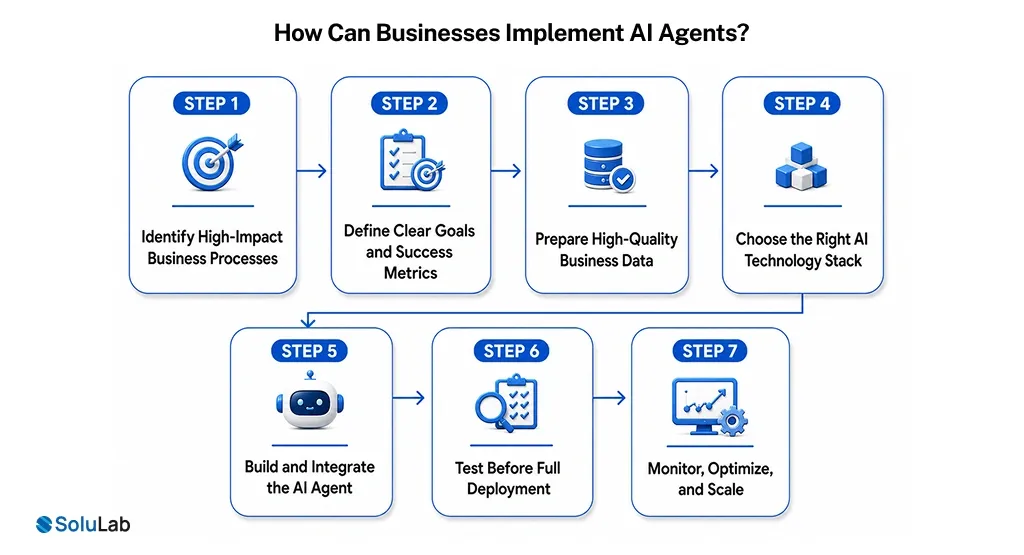
AI agents deliver the best results when they solve specific business problems, integrate with existing workflows, and continuously improve through real-world feedback. A phased implementation reduces risk and speeds up ROI.
1. Identify High-Impact Business Processes
Start by finding repetitive, time-consuming, or data-heavy tasks where AI agents can create immediate value without disrupting core operations.
- Eliminate repetitive manual workflows
- Prioritize measurable business outcomes
- Focus on customer pain points
2. Define Clear Goals and Success Metrics
Set measurable objectives before development. Clear KPIs and types of AI agents help evaluate performance and ensure the AI agent aligns with business priorities.
- Reduce operational costs
- Improve response and resolution time
- Increase employee productivity
3. Prepare High-Quality Business Data
AI agents are only as effective as the data they access. Organize, clean, and secure business information before deployment.
- Remove outdated information
- Centralize business knowledge
- Ensure data privacy compliance
4. Choose the Right AI Technology Stack
Select AI models, automation tools, APIs, and infrastructure that fit your business size, scalability needs, and integration requirements.
- Use scalable AI models
- Integrate existing business systems
- Plan future scalability
5. Build and Integrate the AI Agent
Develop the AI agent around real business workflows and connect it with CRM, ERP, communication, and productivity platforms.
- Connect existing software
- Automate business workflows
- Minimize implementation disruptions
6. Test Before Full Deployment
Launch a pilot program with a limited user group to validate performance, gather feedback, and identify improvement opportunities.
- Test real-world scenarios
- Collect user feedback
- Refine agent responses
7. Monitor, Optimize, and Scale
Continuously monitor AI agent performance, retrain models, and expand use cases as business requirements evolve.
- Track performance metrics
- Improve using feedback
- Expand across departments
Read more—AI Agent for Insurance
How much does it Cost to Build AI Agents?
| Cost Component | Typical Cost (USD) | What’s Included |
| AI Agent Platform / Licensing | $5,000–$40,000/year | Licensing fees for third-party AI agent platforms, frameworks, or enterprise AI solutions. |
| Custom AI Agent Development | $20,000–$50,000+ | Designing and developing custom AI agents with reasoning, planning, memory, and workflow automation capabilities. |
| LLM API & Compute Costs | $500–$15,000/month | Ongoing expenses for AI model inference, API usage, cloud computing, and token consumption. |
| Tool & System Integration | $15,000–$50,000 | Integrating AI agents with CRM, ERP, databases, communication tools, and other enterprise systems. |
| Multi-Agent Orchestration | $30,000–$25,000+ | Building and managing multiple AI agents that collaborate across different business functions and workflows. |
| Testing & Deployment | $10,000–$40,000 | Performance testing, quality assurance, security validation, pilot implementation, and production deployment. |
| Maintenance & Support | 15–20% of total project cost/year | Continuous monitoring, model retraining, performance optimization, bug fixes, security updates, and feature enhancements. |
Read more – AI Agent Development Cost
Top AI Agent Use Cases in Businesses
AI agents are transforming business operations by automating repetitive tasks, improving decision-making, and delivering personalized customer experiences. Here are the most impactful AI agent use cases driving measurable business growth today.
1. AI Sales Agents
An AI sales agent can qualify leads, schedule meetings, personalize outreach, and follow up automatically, freeing sales reps to focus on closing rather than chasing.
2. Customer Support Automation
AI agents for customer support can resolve common tickets end to end, escalate complex cases with full context, and stay available around the clock without added headcount.
3. Lead Qualification and Follow-Ups
Agents can score incoming leads, pull relevant company data, and send timely, personalized follow-ups, keeping deals from going cold while sales teams focus elsewhere.
4. Marketing Workflow Automation
AI agents for marketing can plan campaigns, generate content variations, analyze performance data, and adjust targeting without waiting on manual reporting cycles.
5. Procurement and Finance Support
In finance, agents can flag anomalies, reconcile records, and manage approval workflows, while AI agents for procurement compare vendor quotes, track orders automatically, and streamline purchasing workflows with minimal human intervention.
Future of AI Agents
- Autonomous Workflows: More business processes will run from start to finish without manual checkpoints, with humans reviewing outcomes rather than approving every step.
- Multi-Agent Collaboration: Specialized agents will increasingly work together, each handling a piece of a larger goal, similar to how departments collaborate within a company.
- Enterprise Adoption: Enterprise AI solutions will move from pilot projects to core infrastructure, embedded directly into ERP, CRM, and operations platforms.
- Memory-Enabled Systems: Agents will retain long-term context across sessions, allowing them to build a real understanding of a customer or process over time instead of starting fresh each time.
- Agent Marketplaces: Pre-built, industry-specific agents will become available off the shelf, reducing the need to build every capability from scratch.
- Edge AI Agents: Agents will increasingly run closer to where data is generated, such as on devices or local servers, reducing latency for time-sensitive decisions.
Automate Your Business with AI solutions from SoluLab!
SoluLab is an AI native company that helps businesses design, build, and deploy AI agents tailored to their specific operations. Whether you need a single custom agent or a full multi-agent system, our team brings hands-on experience across industries and use cases.
Our AI development services include:
- Custom AI agent development for specific business workflows
- Enterprise AI agent solutions built for scale and governance
- Multi-agent AI development for complex, cross-departmental automation
- AI agent integration services to connect agents with your existing tech stack
- Custom AI reasoning agents for specialized decision-making tasks
- AI workflow automation solutions across sales, support, finance, and operations
- Support to build custom AI agents for Web3 and blockchain-based platforms
For example, SoluLab built UpdateIA, a multi-agent AI platform for a French startup, enabling 14+ autonomous agents coordinated by Jarvis. It unified enterprise workflows, reduced manual effort, ensured compliance, and improved real-time decision-making across HR, CRM, Finance, and Legal systems.
As a top AI agent development company, SoluLab also offers AI agent consulting services to help you identify where agentic AI will create the most value before writing a single line of code.
If you are ready to hire AI developers who understand both the technology and your industry, our team can guide you from strategy through deployment.

Conclusion
AI agents represent a real shift in how work gets done, moving businesses from rule-based automation to systems that can reason, plan, and act on their own.
The businesses that move early on AI agent implementation services will have a real head start, not just in efficiency, but in how quickly they can adapt as agentic AI continues to evolve.
Whether you are exploring your first pilot or planning an enterprise-wide rollout, working with an experienced AI development company in USA like SoluLab can help you avoid costly missteps and get to value faster.
FAQs
Neha is a curious content writer with a knack for breaking down complex technologies into meaningful, reader-friendly insights. With experience in blockchain, digital assets, and enterprise tech, she focuses on creating content that informs, connects, and supports strategic decision-making.