Artificial Intelligence is not a technology that is being experimented with by governments. It is becoming a required instrument to address the real issues, such as climate change, inefficient government services, and the imbalanced economic growth on a large scale.
This is an important change since AI can make governments more transparent, smarter, and faster. This is the change that MENA is spearheading. The UAE and Saudi Arabia are not only operating small pilots but also supporting the adoption of AI development solutions on the national level, with strategies, substantial investments and significant public-private collaborations. It is all about practical effect, not hype.
This blog will examine how MENA is leveraging AI to match sustainability with government innovation, the factors behind this push, and its potential to provide a viable example of how governments should transform themselves.
Key Takeaways
- AI is emerging as a game-changer of sustainable development, rather than a technology upgrade.
- The governments of MENA are ahead with clear AI strategies and policy backing.
- Public-sector AI in MENA is concerned with the actual benefit, efficiency, inclusion, and sustainability.
- The connection between AI and sustainability is related to the ability of governments to make smarter and long-term decisions.
MENA’s Strategic Vision for AI Adoption
The UAE National AI Strategy 2031 provides a bold vision to establish the UAE as a global leader in artificial intelligence through investing in talent, research, governance, andthe application of AI in the public sector.
It identifies eight strategic goals- creating a reputation as an AI destination and a productive environment for start-ups, implementing AI in government services, and having good governance and ethical regulation.
The objectives facilitate the introduction of AI to such industries as energy, logistics, healthcare, and smart cities and focus on secure data infrastructure and educating future AI experts.
How Governments Are Creating Frameworks For Ethical, Secure Public-Sector AI?
The MENA governments, particularly the UAE, are coming up with comprehensive frameworks to inform ethical and secure adoption of AI. The UAE Charter for Development and Use of Artificial Intelligence and its AI Ethics Principles facilitate equality, transparency, responsibility, protection of privacy, and AI system safety.
These principles can assist in assuring that AI tools used in the services of the population do not violate human values and the law, but they allow innovation. Moreover, the regulatory standards, such as data protection laws, are consistent with international standards to ensure AI integration solutions in the government and industry, to build trust and accountability.
How Does AI Help In Sustainable Development?
With the assistance of AI, governments and cities can manage resources more efficiently through smarter decisions, improved services, and better environmental impact by enhancing environmental performance.
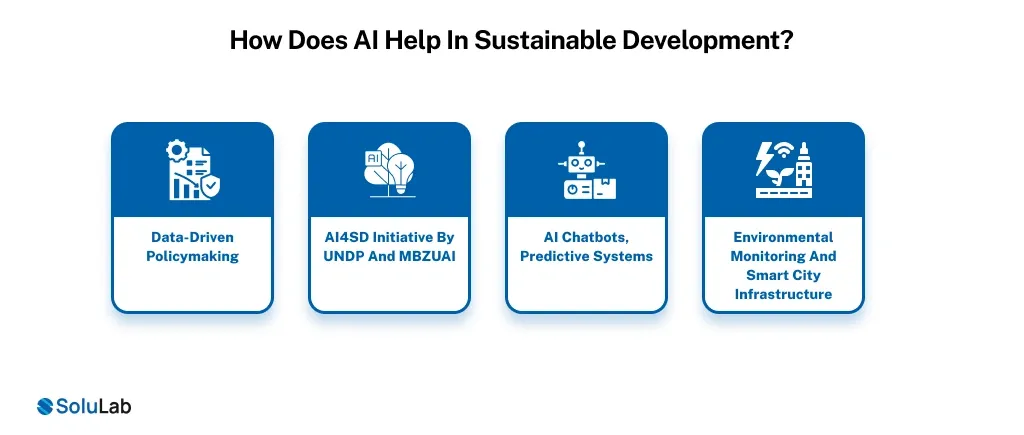
1. Data-driven policymaking: AI analyses big data to give real-time trends and forecasts, which can steer policymakers in a better manner to plan their investments in water, energy, and infrastructure. The insights acquired through data help guide governments to make evidence-based policies that would equate the economic growth and sustainability goals.
2. AI4SD Initiative by UNDP and MBZUAI: The AI4SDP is an initiative by the UNDP and Mohamed bin Zayed University of AI to scale AI tools to tackle such issues as climate adjustment, water, and social equity. This project builds a stronger AI ecosystem in the area to facilitate inclusive growth across the globe.
3. AI chatbots, predictive systems: The citizen services, including environmental questions and complaint resolution, are simplified using AI-based chatbots and automation. The computerized systems minimize the response time, increase the efficiency of the government, and liberate human resources in making important decisions in sustainability programs.
4. Environmental monitoring and smart city infrastructure: AI with IoT sensors can be used to constantly check the air quality, traffic position, and power consumption. Such systems will make the urban environment smarter and more sustainable by maximizing the timing of signals, minimizing congestion, and cutting emissions.
Economic and Social Benefits
AI is changing economies and societies by facilitating smarter investments and empowering workforces, improving sustainable finance and future employment readiness, and sustainable as well as inclusive growth and resilient communities.
1. Movement towards Mobilization of Sustainable Finance: Artificial intelligence has the potential to open up major funds towards sustainability, enhancing risk analysis, ESG analysis, and projections to direct investment into climate-justified, high-impact initiatives and increase investor confidence in sustainable finance.
2. Programs on Workforce Development: Through AI readiness and upskilling programs, the workforce is equipped with future-oriented skills to enhance productivity, establish new jobs, and develop employees with skills to engage the AI-enabled economy.
3. Financial inclusion: AI is also driving more people to access financial services through digital payments, alternative credit scorecards, microfinance solutions that expand economic inclusion of underserved populations, equitable economic growth, and SDG.
4. Sustainable Growth with Innovation: AI enhances the speed with which technology is introduced to improve productivity and economic growth by reducing the cost of operation and enabling smarter resource management, and assisting nations in finding sustainable development directions.

Leading MENA Countries in AI-Driven Public Sector Transformation
The largest MENA nations, such as Bahrain, the UAE, and Morocco, are progressing towards AI-based transformation across the public sector by constructing strategic programs, tools, and regional connections that enhance governance, sustainability, and innovations. The following are examples of MENA countries under the AI Public Sector:
1. Bahrain — AI Workshops & SME SMART Sustainability Tool
Bahrain also conducted cross-government AI workshops as part of finding sustainable policy applications, discovering the high-impact use cases in national sustainability tracking and policymaking.
SME SMART is an AI-based tool that evaluates the maturity of sustainability in small and medium enterprises and provides a personalized report to recommend priority actions and
2. UAE — AI Accelerators & Public-Service Initiatives
The UAE’s national AI strategy in the country infiltrates AI throughout major sectors of the economy, such as government services, using accelerators, startup incubators, and innovation hubs to create local capacity and entrepreneurship.
UAE leadership on AI in the form of ministerial leadership and strategic global collaboration (such as AI research laboratories and data center projects) has aided the incorporation of AI in governmental services, city building, and workforce training.
3. Morocco — AI-for-Growth Strategy & Workforce Development
The Maroc Digital 2030 strategy of Morocco sets AI as a tool of economic revolution, digital infrastructure, and competitiveness by 2030.
The country is incorporating AI in the workflow of the state administration and other sectors to train hundreds of thousands of graduates and create work on AI to stimulate the development of the country.
What’s Next for AI and Sustainable Public Sector Innovation?
Here are some innovations you’ll see in the future for AI for smart cities and the Middle East.
1. Regional Cooperation And Cross-Government Initiatives
Regional cooperation unites governments’ AI strategy to exchange best practices, harmonize policies, and invest in AI infrastructure and skills together. Such partnerships assist small countries in circumventing development obstacles and enhancing shared regional power within the global AI regulation.
2. Integration with global frameworks (WBG, G20, UN)
The alignment of AI strategies with the global structures, including the G20, the United Nations digital agenda, and the World Bank programmes, will guarantee the recognition of uniform ethical practices, data governance standards, and capacity building. Such platforms create a sense of mutual objectives, collaborative task forces, and useful resources to deploy AIs sustainably.
3. Long-term vision for AI in achieving SDGs by 2030
The long-term vision makes AI a strategic enabler to accelerate progress in a wide range of SDGs through better policy making, more effective service delivery, and real-time monitoring, eliminating inequalities, and ensuring that all societies can benefit equally by 2030 due to innovation.

Conclusion
AI as a concept of sustainable development is not a vision of the future anymore; it is already influencing the manner in which governments plan, invest, and serve citizens. In other parts of the world, such as MENA, AI is being used to open up the world of sustainable finance, create talented human resources, and provide smarter government services at scale.
With the governments, startups, and investors working together, AI can become a potent facilitator of sustainable development, in the process of balancing social equity and environmental responsibility with economic progress.
SoluLab, an AI development company, helps enterprises design, build, and scale sustainable AI solutions that deliver real-world results. Book a free discovery call today!
FAQs
The MENA governments view AI as an opportunity to automate governmental services, enhance their efficiency, and facilitate the diversification of the economy beyond oil-based sectors.
AI contributes to monitoring the consumption of energy, minimizing emissions, managing water better, and tracking the progress of the UN Sustainable Development Goals (SDGs).
AI enhances the process of analyzing the ESG, risk assessment and tracking the impacts, which is more convenient to invest in the sustainable and climate-friendly projects.
To achieve transparency, fairness, data privacy, and responsible AI system use, governments are coming up with ethical AI structures.
Governments have scale and policy support, whereas technology and expertise are brought by private companies, which hastens AI-driven innovation.