Key Takeaways
- Dubai is using AI to build urban infrastructure that’s smarter, leaner, and more sustainable.
- AI-powered traffic systems can cut congestion by up to 25% and make getting around the city easier.
- Smart grids and predictive maintenance can bring energy costs down by 30-40%, and they help with sustainability goals too.
- Governance is changing fast, thanks to digital services, automation, and quicker support for citizens.
- Organizations that invest in AI now will have a real say in how Dubai’s smart city takes shape.
Dubai is growing fast. Every new tower and every new neighborhood piles more pressure on transportation, energy, public services, and the rest of the city’s infrastructure.
So here’s the problem:
How do city authorities squeeze out more efficiency, cut operating costs, get greener, and still give millions of residents and visitors a better experience of the city?
A big part of the answer is AI development solutions for smart city projects in Dubai.
Done well, these AI-powered systems can smooth out traffic flow, flag infrastructure problems before they turn into failures, automate public services, manage energy better, strengthen public safety, and put real data behind decisions in every corner of the city.
That’s why government agencies, developers, and enterprises are putting serious money into AI. The aim is urban environments that are smarter and far better connected.
Below, we look at how AI is reshaping Dubai’s smart city vision, and why investing in AI-powered solutions has turned into a strategic priority rather than a nice-to-have.
What Is Dubai’s Smart City Vision and Why Does AI Matter?
Dubai’s smart city vision is about more than putting public services online. The real aim is a connected, intelligent city where infrastructure, transportation, utilities, healthcare, and government services actually talk to each other.
AI innovations in Dubai include Internet of Things (IoT), cloud computing, and big data analytics. Together, they let the city stop reacting to problems and start predicting them.
Dubai has worked hard to be seen as a global leader in urban innovation. Take the Dubai 10X Initiative. Its goal is blunt: keep the city ten years ahead of other global cities in adopting emerging technologies.
Running alongside it, the UAE National AI Strategy 2031 aims to make the UAE a world leader in AI adoption. Projections put AI’s possible contribution to the UAE economy at roughly $96 billion by 2031.

Why Is Dubai Emerging as a Global Leader in Smart City Innovation?
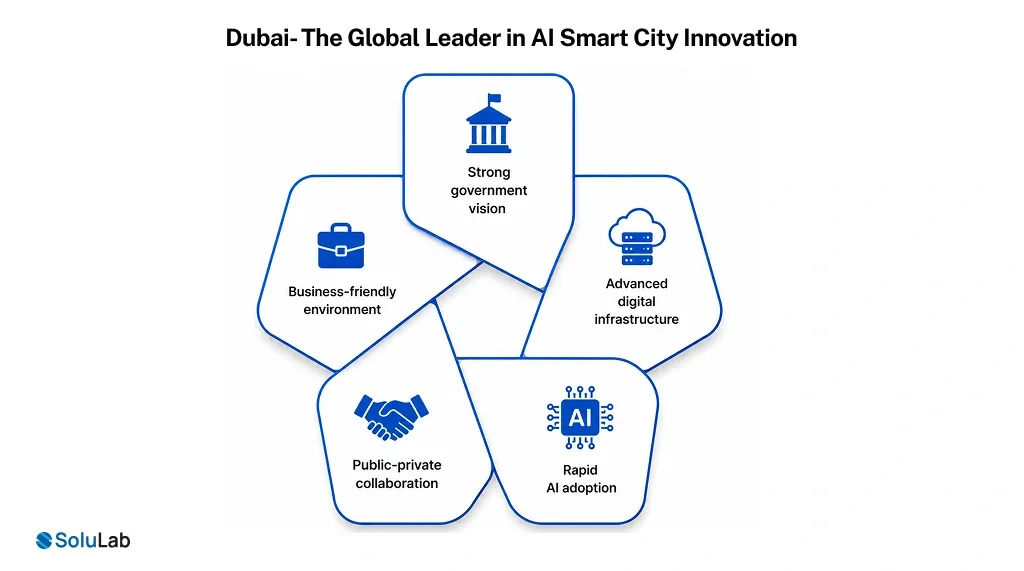
Why Dubai, and not somewhere else? It comes down to a mix: a strong government vision, advanced digital infrastructure, aggressive AI adoption targets, and large-scale innovation programs that speed up urban transformation.
- Strong government vision: Long-term programs like Dubai 10X, the UAE National AI Strategy 2031, and Dubai’s smart city initiatives give technology-led urban development a clear direction, the funding to match, and real accountability.
- Advanced digital infrastructure: High-speed connectivity, cloud platforms, IoT networks, and joined-up government systems lay the groundwork needed to deploy AI solutions at city-wide scale, across transportation, utilities, and public services.
- Rapid AI adoption: AI in Dubai smart city projects keeps spreading, into traffic management, energy optimization, public safety, healthcare, and citizen services. The payoff is decisions backed by data, and city operations that see problems coming.
- Public-private collaboration: Dubai works closely with technology companies, startups, and research institutions. That speeds up innovation, gets new solutions tested sooner, and shrinks the gap between a pilot project and full deployment.
- Business-friendly environment: Supportive regulations, investment incentives, and a hard push on digital transformation draw in global talent, technology providers, and investors, all of whom feed back into Dubai’s smart city plans.
How to Implement AI Solutions in Dubai Smart City Projects?
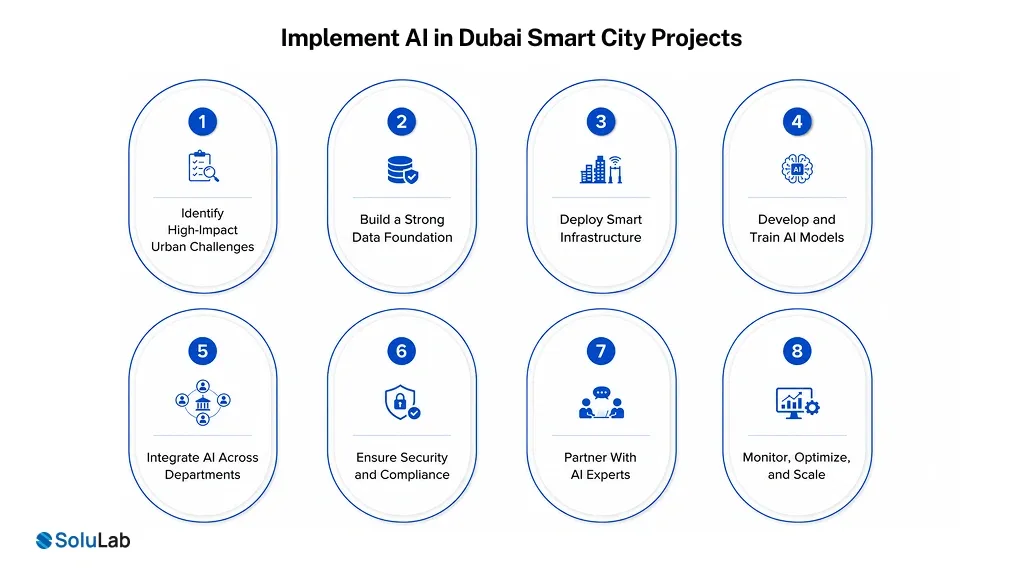
AI integration solutions in smart city projects require a clear strategy, reliable data, infrastructure that can scale, and constant tuning after launch. Get the approach right and cities see gains in efficiency, sustainability, and the everyday experience of citizens.
1. Identify High-Impact Urban Challenges
Don’t start with the technology. Start with the problems where AI use cases can deliver value you can measure, like traffic congestion, energy consumption, public safety, or citizen services.
- Prioritize critical city challenges
- Define measurable success metrics
- Focus on high-value use cases
2. Build a Strong Data Foundation
AI is only as good as the data behind it. That means quality data, pulled from sensors, connected devices, and the city systems already in place.
- Pull data together from every source
- Improve data quality standards
- Collect data in real time
3. Deploy Smart Infrastructure
Smart city technology solutions need connected infrastructure to run on. Without it, departments can’t share information without friction, and every project stays stuck in its own corner.
- Install IoT-enabled systems
- Upgrade digital infrastructure
- Connect city-wide platforms
4. Develop and Train AI Models
Build AI models that can analyze data, automate decisions, and surface insights that city operators can act on.
- Train models with data
- Automate repetitive processes
- Generate predictive insights
5. Integrate AI Across Departments
The smart city AI solutions in Dubai projects that succeed tie transportation, utilities, governance, healthcare, and public safety into one connected system. Think about it: a traffic model that can’t see utility data is only doing half the job.
- Break departmental data silos
- Connect multiple city services
- Get teams working across functions
6. Ensure Security and Compliance
Citizen data needs protecting. Strong governance frameworks do that job, and they keep the path clear for responsible AI deployment.
- Protect sensitive information
- Establish AI governance policies
- Maintain regulatory compliance
7. Partner With AI Experts
Bringing in providers of enterprise AI solutions can speed up deployment, cut risk, and lead to better project outcomes. Why learn every lesson the hard way?
- Access specialized AI expertise
- Speed up implementation timelines
- Build for long-term scale
8. Monitor, Optimize, and Scale
AI implementation never really finishes. Keep monitoring, and performance keeps improving. That’s where the long-term ROI comes from.
- Track performance continuously
- Optimize system efficiency
- Scale successful initiatives
Which AI Solutions Deliver the Biggest Impact for Dubai Smart Cities?
AI solutions for the smart city project in Dubai change how people travel, use energy, reach services, stay safe, and get healthcare. And rather than fixing one problem at a time, AI helps the city make faster, better decisions across several sectors at once.
1. AI-Powered Traffic and Autonomous Mobility
Traffic is where AI is making some of its most visible gains. Dubai’s Roads and Transport Authority (RTA) runs AI-powered traffic signal systems that change signal timings based on live traffic conditions, which helps cut congestion by up to 25%.
The city also wants 25% of all journeys to be autonomous by 2030. The plan leans on self-driving cars, smart public transport, and AI-powered mobility systems.
- Reduces traffic congestion
- Improves travel times
- Supports autonomous vehicles
- Makes public transport more efficient
- Lowers fuel consumption and emissions
2. AI-Optimized Energy and Smart Grids
Dubai is using AI to build a more sustainable urban development. Look at the Mohammed bin Rashid Al Maktoum Solar Park, where AI keeps watch over equipment and predicts maintenance needs before anything breaks.
On the grid side, AI-powered smart grids keep electricity demand and supply in balance.
- Predicts equipment failures early
- Reduces energy waste
- Improves grid reliability
- Supports renewable energy integration
- Lowers operational costs
3. AI-Driven Governance and City Services
Dealing with government is getting simpler, too. The DubaiNow application gives people access to more than 130 government and private sector services in one place.
Then there are AI-powered virtual assistants like Rashid, which help residents get information and support 24/7. And under Dubai’s Zero Bureaucracy initiative, many government processes are being cut down from several steps to just one or two.
- Faster service delivery
- Reduced paperwork
- 24/7 citizen support
- Improved user experience
- Increased government efficiency
4. AI-Powered Public Safety and Smart Policing
Dubai Police are bringing in AI to keep people safer. Facial recognition systems, predictive analytics, and anomaly detection tools help spot potential threats sooner and shorten emergency response times.
Dubai has even introduced robotic police officers. Their job is to handle public interactions in busy, high-traffic areas.
- Faster threat detection
- Improved emergency response
- Stronger public safety
- Better crime prevention
- Continuous city monitoring
5. AI in Healthcare and Precision Medicine
Healthcare providers across Dubai are using AI to improve patient outcomes. In practice, AI helps doctors catch diseases earlier, read medical images, and plan treatment.
Hospitals are also adopting robotic-assisted surgery, telemedicine platforms, and health analytics systems that can pick up disease trends and help predict outbreaks.
- Earlier disease detection
- More accurate diagnoses
- Improved patient care
- Better healthcare accessibility
- Faster public health response
How Much ROI Can You Expect from AI Smart City Investments in Dubai?
AI in smart city projects has moved past the experiment stage. In transportation, energy, governance, and public safety, organizations are seeing returns they can measure: lower operating costs, better use of resources, and better experiences for citizens.
Exact ROI depends on scope. Still, many smart city initiatives in Dubai start with investments of AED 500,000+ and go on to generate significant long-term value.
| Sector | Key Benefit | Estimated Impact |
| Traffic & Mobility | Congestion reduction | Up to 25% improvement |
| Energy & Utilities | Cost optimization | 30-40% savings |
| Governance | Service efficiency | 99% services online |
| Public Safety | Faster threat detection | Improved prevention and response |
| Healthcare | Operational efficiency | Reduced costs and better outcomes |
Where Does the ROI Come From?
- Traffic management: AI-powered transportation systems have helped cut congestion by up to 25%. That means less fuel burned, shorter trips, and less strain on infrastructure.
- Energy optimization: AI-driven smart grids and predictive maintenance can save 30-40% on energy costs, and make operations more efficient in the process.
- Government services: Thanks to Dubai’s digital transformation initiatives, 99% of government services are now available online. The Paperless Strategy alone saves over 300 million paper transactions a year.
- Public safety: Predictive analytics and AI in surveillance help shorten response times and let police get ahead of crime instead of chasing it.
- Healthcare: AI-assisted diagnostics and resource planning lead to better patient outcomes. They also bring operating costs down.
Top 5 Real Dubai Smart City AI Case Studies
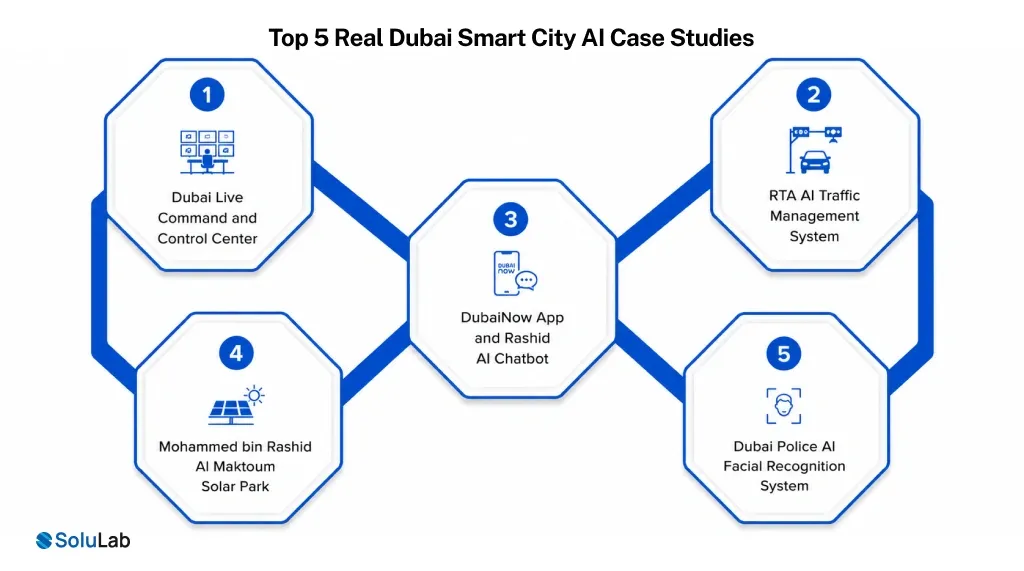
Dubai has turned into a global benchmark for AI in smart cities. The projects below, covering transportation, energy, governance, and public safety, show what that looks like on the ground.
1. Dubai Live Command and Control Center
The Dubai Live Command Hub pulls data from traffic systems, construction projects, sustainability initiatives, emergency services, and city infrastructure onto a single AI-powered platform.
Key Results:
- Real-time city monitoring
- Faster decision-making
- Improved resource allocation
- Predictive issue detection
Citizen Impact: When something goes wrong across the city, residents see faster responses. Public services run more efficiently, too.
2. RTA AI Traffic Management System
Dubai’s Roads and Transport Authority (RTA) uses AI to read traffic patterns, predict congestion, and adjust traffic signal timings automatically.
Key Results:
- Up to 25% congestion reduction in key corridors
- Improved traffic flow
- Reduced travel times
- Lower fuel consumption
Citizen Impact: Commuters spend less time stuck in traffic. Daily travel across the city simply gets smoother.
3. DubaiNow App and Rashid AI Chatbot
DubaiNow pulls more than 130 government and private-sector services into a single platform. Rashid, meanwhile, offers AI-powered help 24/7.
Key Results:
- 130+ services in one app
- 99% of government services available online
- Over 300 million paper transactions eliminated annually
- Faster service delivery
Citizen Impact: Most government tasks can now be finished from a phone. No trip to a service center required.
4. Mohammed bin Rashid Al Maktoum Solar Park
One of the world’s largest solar projects uses AI for predictive maintenance, equipment monitoring, and getting the most out of its energy output. It has become a template: many AI solutions in UAE initiatives in the energy sector borrow from this model.
Key Results:
- Improved energy efficiency
- Reduced maintenance costs
- Early fault detection
- More reliable power generation
Citizen Impact: Residents get a steadier, more sustainable energy supply, and every unit of it feeds Dubai’s clean energy goals.
5. Dubai Police AI Facial Recognition System
Dubai Police use AI-powered facial recognition, predictive analytics, and anomaly detection to strengthen public safety and sharpen law enforcement operations. Plenty of organizations seeking AI development companies in Dubai point to this project as a model of AI done at scale.
Key Results:
- Faster suspect identification
- Improved threat detection
- Stronger crime prevention
- Better emergency response capabilities
Citizen Impact: Safer public spaces and quicker responses make the city feel more secure for residents and visitors alike.
Why Choose SoluLab for AI Solutions for Smart City Projects in Dubai?
Technology alone won’t build a smart city. You also need the right partner, one that knows AI, data, and urban innovation. SoluLab, an AI native company, helps organizations build AI solutions that scale and hold up over time, all in support of Dubai’s smart city vision.
- AI Consulting Services
- Smart Traffic Management Solutions
- Smart Grid and Energy Optimization
- AI-Powered Public Safety Systems
- Predictive Infrastructure Maintenance
- IoT and AI Integration Solutions
- AI-Powered Citizen Service Platforms
- Data Analytics and Predictive Modeling

Conclusion
Dubai isn’t waiting for the future. It’s building smarter, safer, more sustainable cities right now. Less traffic congestion, better energy use, simpler public services, stronger public safety: AI is producing measurable results in almost every part of urban life.
As the city pushes its Smart City and AI 2031 initiatives further, the organizations that invest early will be in the best spot to drive innovation, efficiency, and long-term growth.
Ready to turn your smart city vision into something real? SoluLab, an AI development company in Dubai, can help your business build AI solutions that scale, last, and fit your goals.
FAQs
Neha is a curious content writer with a knack for breaking down complex technologies into meaningful, reader-friendly insights. With experience in blockchain, digital assets, and enterprise tech, she focuses on creating content that informs, connects, and supports strategic decision-making.