From predicting customers’ interest to tailoring user intent adds AI in digital marketing is growing rapidly. It automates manual work, interprets real-time data, and ensures every penny spent gives the maximum impact.
“AI is going to make all the world’s expertise available to everybody at extremely low cost,” Mark Read, the outgoing CEO of British advertising group WPP, said at London Tech Week.
We are also watching how AI is enhancing every industry, and marketing is no exception. AI in advertising, making campaigns smarter, faster, and more cost-effective. As technology evolves, it allows marketers to focus less on repetitive tasks and more on crafting meaningful connections. Let’s see how AI in marketing is changing and evolving businesses.
What Is AI Advertising and How It Work?
AI advertising uses algorithms and machine learning to analyze vast data, automate buying, personalize experiences, and optimize performance. AI in programmatic advertising enables real-time bidding and dynamic ad delivery.
Around 78% of companies are currently leveraging AI, a 23% jump since 2023. Also, experts predict that by 2032, AI-driven advertising will account for nearly 90% of total ad revenue.
Generative AI tools create visuals, text, and videos customized for each audience. These systems learn from engagement data and continuously refine ad strategy. The outcome is a campaign that evolves automatically, improving with every impression.
How AI Makes Ad Campaigns Smarter and Faster?
AI speeds up decisions and scales testing. It replaces manual tuning with continuous learning. Below are the ways AI improves campaigns.
1. Real-time bidding and placement
AI evaluates each impression in milliseconds. It bids only when the expected value exceeds the cost. This lowers wasted spend. It increases ad relevance.
2. Automated creative testing
AI generates hundreds of ad variants quickly. It tracks performance and promotes winners. This raises conversion rates and lowers creative cost.
3. Predictive targeting
AI predicts user intent from behavior. It finds high-value segments earlier. Hence, campaigns reach buyers sooner and cheaply.
Why Businesses and Startups Should Integrate AI in Advertising?
AI gives startups access to enterprise-grade capabilities. It levels the playing field against larger competitors. Moreover, AI reduces manual workload and improves decision speed. It also stretches tight budgets by eliminating waste.
Efficiency and Cost Optimization
AI cuts repetitive tasks and reallocates ad budgets to high-performing areas. This cost reduction in advertising with AI allows startups to scale without overspending.
Precision and Personalization
AI in marketing and advertising enhances targeting precision. It tailors each ad to a customer’s preferences, creating stronger brand connections and loyalty.
Data-Driven Decision Making
AI tools track performance and provide insights that drive smarter strategy and higher ROI. Businesses stay agile and responsive to market trends.
Accessibility for Small Teams
Startups with lean teams gain access to enterprise-grade insights and automation, enabling them to compete effectively in crowded markets.
Examples of Brands Using AI in Marketing
- Vanguard used AI-driven copy from Persado to increase ad conversion rates by 15%.
- RedBalloon, an e-commerce firm, achieved a 3,000% ROAS using the AI platform Albert.
- HOLT CAT leveraged AI ad targeting to reduce hiring costs by 20% while improving campaign reach.
These real-world examples prove that AI in advertising and marketing drives measurable, cost-efficient growth across diverse industries.
Benefits of Using AI in Advertising
Advertising is no longer about spending more; it’s about being smarter with every campaign. Let’s see how industries are benefiting from AI in marketing.
Ecommerce
Online stores today can read the story behind every click. They know when a customer compares products, adds something to their cart, or leaves without buying. This insight helps them show timely offers or personalized recommendations that actually make sense. Dynamic pricing adjusts on its own, showing fair and relevant deals, often increasing engagement rates by nearly 30%.
Finance and Banking
Banks and investment firms now target customers based on intent, not just demographics. They can identify high-value clients and tailor offers that match their goals, while automated compliance keeps campaigns in line with regulations. Chatbots and smart assistants make it easier to answer questions quickly, helping brands build real relationships and long-term loyalty.
Healthcare
Healthcare advertising has shifted from selling to supporting. Hospitals and clinics can now share accurate, useful information when people need. This balance keeps outreach ethical while still reaching the right patients. It also improves trust, which is vital in such a sensitive field.
Travel and Hospitality
Travel brands are learning to predict when people are ready to plan their next trip. By tracking booking trends, weather, and browsing habits, they can share personalized vacation ideas at exactly the right time. Visual tools make these campaigns even more engaging, and because production is partly automated, costs stay under control while bookings rise.
Real Estate
Real estate advertisers no longer waste money reaching the wrong audience. Predictive models now highlight people most likely to buy or rent soon, so campaigns focus on real prospects. This smarter targeting has helped agencies cut wasted ad spend by more than 25%, while improving lead quality and reducing time to close deals.
Entertainment and Media
Streaming services and media studios now know exactly what keeps viewers hooked. They can recommend shows, fine-tune trailers, and schedule promotions to match audience moods. Automated editing tools help produce videos faster, so content hits social feeds while it’s still trending.
Automotive
Car makers are blending technology and creativity to make advertising feel personal. Instead of generic promos, potential buyers see cars that match their taste and lifestyle. Some brands even use 3D or AR visuals so people can “test-drive” cars virtually. The result? More excitement, stronger leads, and a better overall buying experience.
Education
Education platforms and institutes have become more precise about how they reach learners and parents. Campaigns now run when interest is highest, like before admission periods, and messaging changes based on intent. This smarter timing helps schools and EdTech companies lower acquisition costs while boosting visibility and conversions.
How AI Protects Ad Spend and Brand Reputation?
AI ensures safe, transparent, and efficient ad delivery through:
- Fraud detection systems that flag bot traffic and invalid clicks.
- Brand safety filters that block harmful or irrelevant content.
- Sentiment tracking to monitor how audiences perceive campaigns.
- Performance alerts that identify overspending or low engagement early.
- Compliance monitoring to ensure ads follow privacy and data guidelines.
Together, these safeguards protect campaign integrity and trust.
AI in Advertising: Step-by-Step Process
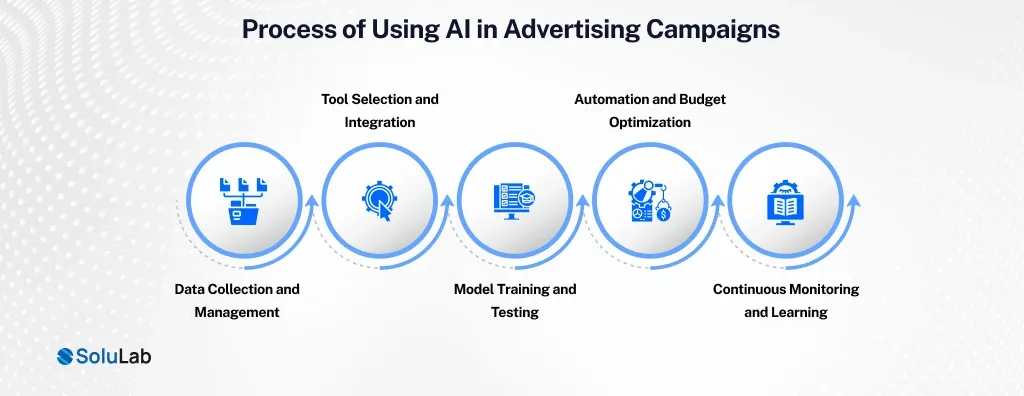
There are different purposes and multiple industries that use and want to adopt AI in marketing and advertising. So, let’s see how to do that in depth.
- Data Collection and Management
Gather customer, social, and website data from multiple sources. Clean and structure it before analysis. Quality data ensures AI in ads performs accurately. This requires $100 based on your requirement.
- Tool Selection and Integration
Choose the right AI advertising tools that align with business goals. Integrate them with existing ad platforms like Google Ads or Meta Ads.
- Model Training and Testing
Train AI models on historical data to predict click-through and conversion rates. Test multiple approaches and fine-tune the algorithms based on your goal and visison.
- Automation and Budget Optimization
Activate automation for bidding, ad creation, and spend allocation. AI monitors the cost per acquisition and automatically reallocates the budget. This automation can cut ad management costs by 25 to 40% while improving ROI.
- Continuous Monitoring and Learning
AI doesn’t stop once live. It keeps learning from new data, refining decisions, and improving results over time. Regular review ensures ethical use and consistent brand tone.
Future of AI Advertising for Businesses and Startups
AI is spreading its wings in all directions, and digital marketing is already adopting it. Let’s see what we can expect in the upcoming days.
- Generative AI-Driven Creative: Tools like Sora and DALL·E will automate video and image production, making generative AI in social media advertising faster and more affordable.
- Predictive Campaign Planning: Advanced analytics will forecast ad success before launch, allowing brands to test concepts virtually and save real budget.
- Hyper-Personalized Experiences: AI will serve ads customized to micro-audiences, factoring in tone, timing, and emotional cues for stronger engagement.
- Voice and Conversational Ads: As voice search grows, AI in programmatic advertising will adapt messages to natural speech and context-aware interactions.
- Ethical and Transparent AI Ads: Regulation will require transparency labels for AI-generated content, reinforcing consumer trust and responsible innovation.
These advancements mark the next era of innovations in AI advertising, where automation and creativity combine to deliver impactful campaigns that scale intelligently.
Conclusion
Now you know why businesses are adopting AI in every aspect; it’s not just about advertising, it’s about global changes. AI is changing the game of digital marketing unexpectedly. If you want to stay ahead of the game, then you have to think ahead in this AI era. Innovations, integrations adoptions play a key role in development.
If you’re ready with your goal or idea and we are here to support your growth. We, at SoluLab, a top AI development company in the USA, help you develop your AI vision. You can check out our case study Mendle, an AI-powered emotional wellness platform. We designed this to foster empathy, improve communication, and resolve conflicts through intelligent interactions. Contact us today to discuss your idea.