What happens when AI stops working in a straight line and starts thinking in parallel?
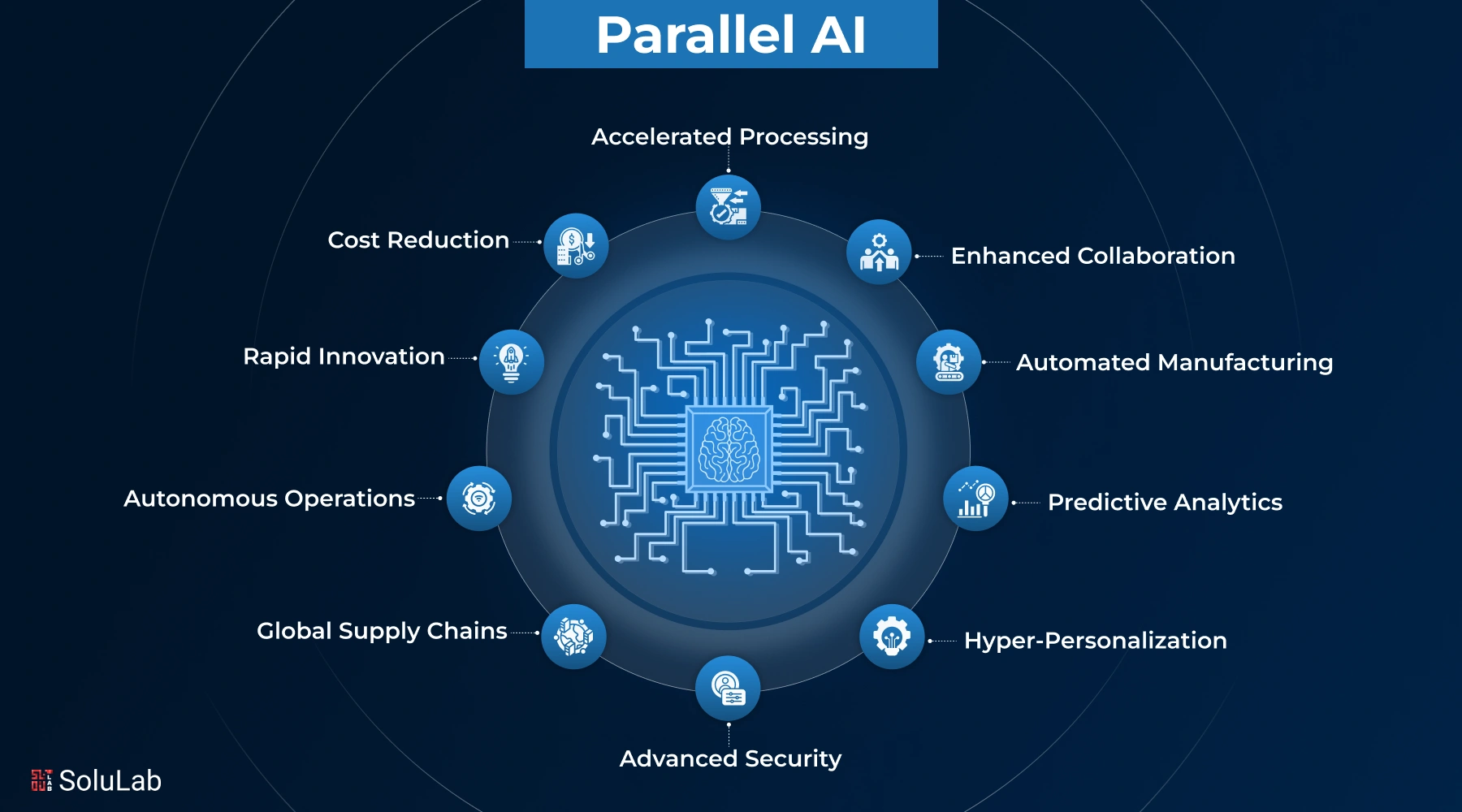
In 2026, businesses won’t just use AI to automate tasks; they’ll run entire operations on parallel AI systems that process data, decisions, and workflows simultaneously. From faster decision-making and real-time optimization to autonomous operations, parallel AI is set to redefine how modern enterprises scale, compete, and innovate.
Companies that adopt parallel AI early will cut costs faster, react to market changes in real time, and operate at speeds humans simply can’t match. Those who don’t risk falling behind in an economy where milliseconds decide profits.
In this blog, we explore 10 powerful ways parallel AI will transform business operations in 2026 and why it’s quickly becoming a competitive necessity, not an upgrade.
Key Takeaways
- Parallel AI will transform operations by allowing businesses to process data, make decisions, and execute actions simultaneously, boosting productivity by up to 40%.
- By 2026, autonomous, self-optimizing workflows will dominate, with 87% of large enterprises adopting AI solutions and the global AI market reaching $638.23 billion, reducing costs by 15–30%.
- Early adopters will gain a competitive edge by unlocking real-time insights and accelerating time-to-market.
- AI agents will handle up to 50% of routine decisions, enabling smarter scaling across all business functions.
- Combining speed, intelligence, and automation, Parallel AI ensures businesses are prepared to lead in 2026 and beyond.
What Is Parallel AI and Why It Matters in 2026?
Parallel AI is a smarter way of using AI. Instead of a single model handling tasks one by one, it uses many AI agents working in parallel, like a full digital team that can research, analyze, and execute.
This matters because businesses get:
- Real-time answers, cutting response times from minutes to seconds, with 92% of leaders now recording over half their interactions for AI insights.
- Enables 10× faster automation on complex tasks like research and reporting.
- Improves accuracy as agents cross-check each other’s work for more reliable results.
- Increases output without hiring, parallel tools turn one agent-hour into team minutes, while the parallel computing market hits $50B in 2025 with 15% yearly growth.
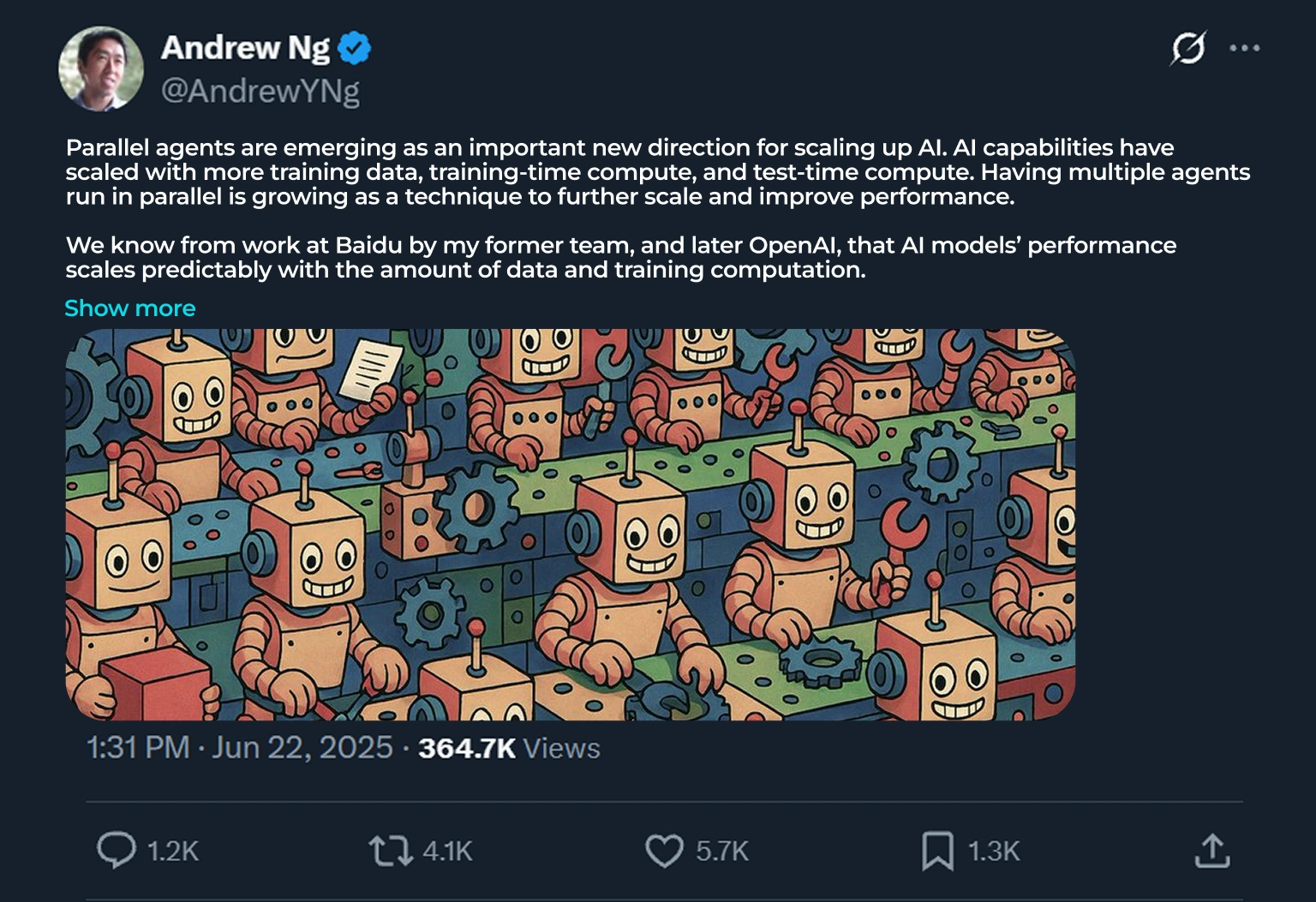
This surge is real as the enterprise AI spending will reach $307B in 2025 and jump to $632B by 2028, with parallel AI driving most of the growth. Over 212,000 active AI companies growing 10% every year, are already adopting multi-agent systems to move faster and cut costs.
By 2026, Parallel AI will be a core business tool helping teams scale, save money, and outpace competitors. The only question now is how fast you adopt it.
Top 10 Ways Parallel AI Will Elevate Enterprise Performance in 2026
These 10 strategies show how businesses can achieve faster, smarter, and more scalable performance with AI working in parallel:
#1. Supercharges Your Operations
Speed is the biggest advantage a startup can have. If your business moves slowly, you lose customers, opportunities, and market share. This is where Parallel AI becomes a game-changer.
Instead of making one system handle everything one step at a time, Parallel AI uses many parallel AI agents working together at the same time. Each agent takes a part of the workflow, runs it instantly, and sends the result forward. This removes the long waits that usually slow teams down.
Modern AI-powered software platform setups make this even stronger by running tasks in parallel across engineering, operations, support, and data teams. Nothing waits. Everything flows. Here’s what that means for your business:
- Faster product releases
- Faster decisions
- Faster customer delivery
- Faster internal execution
Parallel AI removes delays, cuts manual effort, and makes every part of your company move together like a high-speed engine. When everything runs in parallel, speed becomes your normal operating mode, not a special achievement.
#2. Say Goodbye to Repetitive Tasks
Many teams still waste hours doing the same tasks again and again. Parallel AI removes this problem completely.
Instead of depending on one automation bot or script, you use a multi-AI agent system, where several AI agents work at the same time. Each agent handles a specific step of the process, so the whole workflow becomes faster, cleaner, and far more reliable. This makes AI automation solutions much stronger and reduces manual work across your operations.
Parallel AI can automate tasks like:
- Document processing (OCR, data extraction, validation)
- Lead qualification and scoring
- Large-scale data cleaning and error checks
- Complex, multi-step onboarding flows
- Accounting tasks like financial reconciliation
With the help of strong parallel AI development services, businesses can now automate work that once required full teams and do it with higher accuracy, lower cost, and real-time scalability. This is why more businesses are shifting to Parallel AI: it’s simple, efficient, and gives them a clear operational edge.
#3. Real-Time Decisions Made Simple with Parallel AI
Today, every business runs on data. But the real challenge is getting that data fast, clean, and accurate, not minutes or hours later, but right now.
This is where Parallel AI becomes powerful. Parallel AI can process hundreds or even thousands of data streams at the same time. Instead of waiting for one system to finish before another one starts, multiple AI agents work together in parallel. This gives businesses real-time results with almost zero delay.
This helps teams make quick, smart choices in areas like:
- Live dashboards that update every second
- Fraud detection that spots unusual activity instantly
- Operational monitoring to track system health
- High-frequency financial decisions
- Customer behavior tracking and predictions
For companies working in blockchain technology, this becomes even more important. With Parallel AI in crypto platforms, businesses get lightning-fast analysis of market movements, wallet activity, and transaction flows, something normal AI systems cannot handle at scale.
#4. Scaling Your Team with AI Agents
This is one of the biggest reasons companies are shifting to Parallel AI. As your business grows, your work gets more complicated. With Parallel AI, you don’t need to hire more people or rebuild your whole system. The platform simply spins up more agents on its own. These agents work in parallel, handle different tasks at the same time, and keep your operations running smoothly even during peak load or sudden traffic spikes.
This is why many companies now ask for parallel AI development solutions. They want systems that scale the moment their workload increases, without extra cost or delays. For example, if you have 10 tasks coming in at once, the system can launch 10 agents instantly. This allows:
- Higher throughput
- Faster execution
- Better uptime
- Zero manual scaling
In simple words, Scalability means you do more work at the same cost and with better performance. For businesses trying to automate workflows, run real-time operations, or manage heavy data loads, this level of scalability is a competitive advantage.
#5. Transforms Customer Experience
Customer expectations are higher than ever, and speed is no longer optional. AI transforms customer experience by replacing single-threaded chatbots with a multi-AI agent support system that works like a full-scale support team without downtime or fatigue.
With Parallel AI, support becomes:
- Multi-threaded, meaning many questions can be answered at the same time
- Faster because queries get routed instantly
- More accurate with auto-troubleshooting
- More consistent with auto-generated follow-ups
- More personal because each user gets a custom response
Most companies are now replacing old chatbots with a multi-AI agent system that can manage thousands of customer messages in parallel. This setup doesn’t slow down, doesn’t make mistakes from fatigue, and can scale as fast as your business grows.
This is why many brands plan to invest in AI integration services for AI systems to help them build support workflows that run 24/7, handle huge spikes in tickets, and offer a smooth, human-like experience but powered entirely by parallel, coordinated AI agents.
#6. Product Development & Innovation
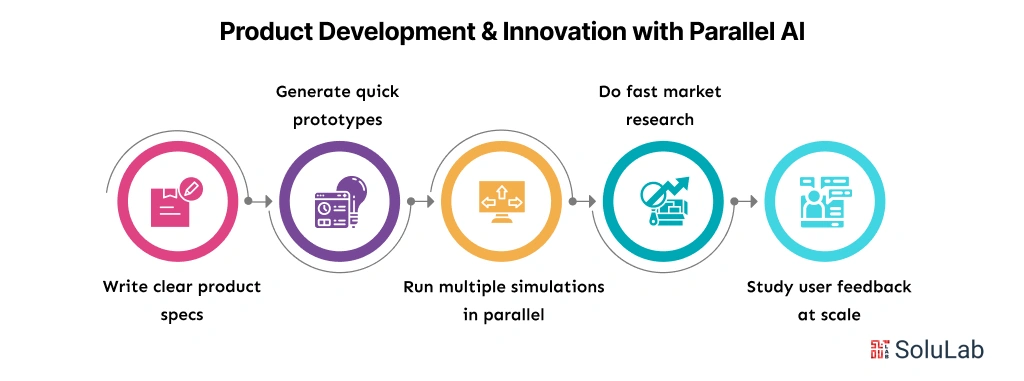
Parallel AI is becoming a powerful tool for product teams because it helps them build faster and make better decisions without wasting time. Instead of doing tasks one by one, Parallel AI lets multiple AI agents work together at the same time. With this, teams can:
- Write clear product specs
- Generate quick prototypes
- Run multiple simulations in parallel
- Do fast market research
- Study user feedback at scale
This makes the whole product cycle smoother and more predictable. Because of this, many companies now choose parallel AI development services to build smarter product systems that can plan, design, and test automatically.
They also use this to connect different tools and data sources, making the workflow even faster. And with generative AI integration services, businesses can plug these AI agents directly into their existing apps, dashboards, or backend systems.
#7. Boosts Efficiency and Cuts Costs
This is one of the areas where business leaders notice real impact. Parallel AI development solutions can transform how companies operate, delivering significant cost savings and efficiency improvements. Here’s how:
- Reducing manpower
- Cutting workflow inefficiencies
- Lowering operational errors
- Scaling with fewer resources
Companies leveraging these AI deployment services report savings of 40% in operational expenses, faster project completion, and higher overall productivity.
#8. Reducing Business Risks
Parallel AI is designed with built-in redundancy, meaning that if one AI agent fails, others seamlessly continue working. This architecture reduces:
- Downtime for critical operations
- System errors caused by single points of failure
- Financial risks tied to operational interruptions
- Operational uncertainty that slows decision-making
By distributing tasks across a multi-AI agent system, businesses can maintain continuous operations even under stress. This level of reliability is one reason why more companies are investing in AI consulting services to strengthen their tech infrastructure.
#9. Enhances Cross-Team Collaboration & Internal Alignment
Parallel AI development solutions allow teams across marketing, product, and operations to work together in real time. By connecting multiple AI agents into a multi AI agent system, businesses can:
- Synchronize tasks automatically between teams without manual handoffs
- Reduce miscommunication errors that slow project timelines
- Provide a single source of truth for data, insights, and action items
- Enable faster feedback loops between departments, improving project velocity
With AI automation solutions handling routine coordination, human teams can focus on strategy and decision-making. This seamless collaboration drives efficiency and ensures that everyone in the organization operates with the same information.
#10. Predict Problems Before They Happen
Most businesses react after something breaks, like a system slows down, a customer drops off, or a process gets stuck. But in 2026, companies using Parallel AI won’t wait for problems. Their systems will predict them.
Parallel AI uses multiple AI agents working in parallel to monitor behavior, track patterns, and detect early warning signals across your entire business. Instead of waiting for an issue, these agents spot the problem before it becomes costly.
With Parallel AI, enterprises can predict:
- Customer churn before it happens
- System failures before downtime
- Cash flow issues before they hit
- Supply chain delays before they become expensive
- Market drops before losses occur
This gives your business a major advantage that you fix things before they break. This is why so many enterprises now invest in predictive AI integration services. They want systems that not only optimize today but help them prepare for tomorrow.
How Parallel AI Will Shape Tomorrow’s Startups?
Over the next 3–5 years, Parallel AI is going to move from experimental pilots to the unseen engine behind most high‑performing teams and products.
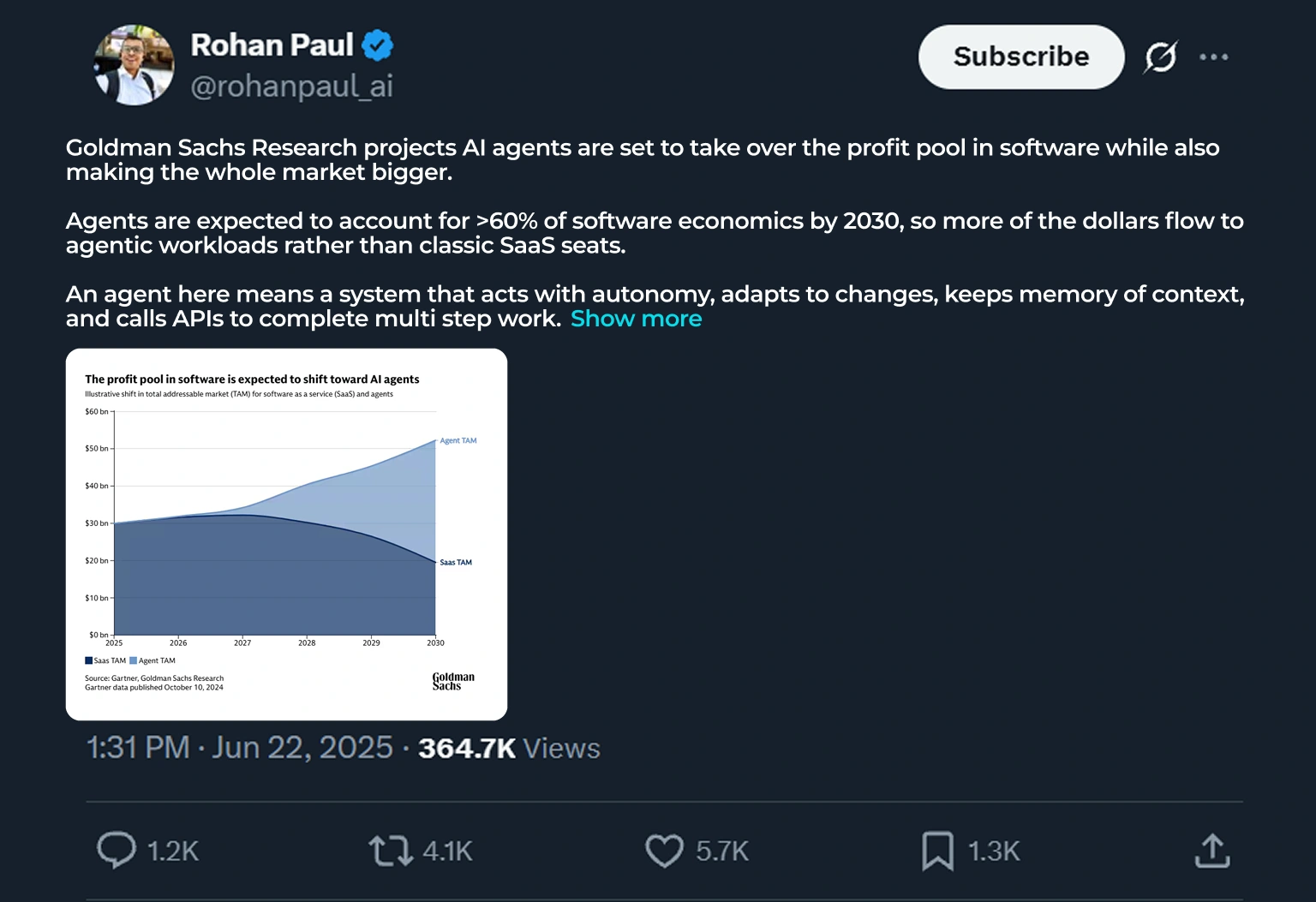
By 2028, analyst forecasts suggest that a large share of enterprise AI software will quietly bake in agentic and multi‑agent capabilities, meaning parallel AI agents will be orchestrating everything from workflows to customer journeys in the background.
As multimodal models (text, images, audio, video) become the default interface, parallel agents will not just process language but also read screens, interpret dashboards, and act across tools in real time.
For startups and mid‑size businesses, this unlocks new playbooks: 24/7 autonomous research teams, multi‑channel growth systems, and internal “digital operators” that execute complex processes end‑to‑end, not just answer questions.

Conclusion
Parallel AI is transforming how modern businesses operate. Instead of relying on a single model to do everything, companies now use many specialized AI agents that act like a high-performing team, but with machine-level speed and near-zero delays. This shift unlocks faster decisions, smoother workflows, and real-time scalability that traditional systems simply cannot match.
As this evolution accelerates, the gap between AI-native enterprises and everyone else will grow quickly. This is where SoluLab stands out as a leading AI development company. We design and deploy advanced Parallel AI platforms that deliver up to 60% faster execution, dramatically lower operational costs, and continuous innovation powered by multi-agent intelligence. With 2026 set to be the breakout year for Parallel AI, the companies that act now will define the next wave of industry leaders.
FAQ
1. Is Parallel AI only for big enterprises, or can startups use it too?
Parallel AI is actually more of a game‑changer for startups than anyone else. Instead of hiring large teams for research, operations, marketing, or support, early‑stage founders can spin up parallel AI agents that act like a flexible, always‑on operations layer.
2. How is Parallel AI different from just using ChatGPT or a single LLM?
Using a single LLM is like having one very smart AI assistant who can only work on one thing at a time. Parallel AI is closer to having a coordinated squad of specialists; each agent has a role, context, and tools, and they run simultaneously to complete multi‑step workflows.
3. What kind of processes benefit the most from parallel AI agents?
Anything multi‑step, repeatable, and cross‑functional is a perfect fit: lead research and enrichment, multi‑channel outbound, customer onboarding, internal documentation, reporting, vendor or market scouting, and even product experimentation.
4. How should a business start with Parallel AI without overcomplicating things?
Start with one or two high‑value workflows that: happen often, are boring for humans, and have clear success criteria. Wrap those in a small system of 2–5 agents, like one to plan, others to execute subtasks, and one to validate or summarize.
5. What skills or team setup do I need to implement Parallel AI?
You don’t need a full research lab, but you do need someone who understands both your processes and how to orchestrate tools. In many teams, this is a product‑minded engineer, a technical founder, or an operations lead who can think in systems.
6. Will Parallel AI replace my team, or just augment it?
In the near term, Parallel AI is far better at augmenting than outright replacing. It excels at grinding through repetitive, structured, or research‑heavy work, which frees humans to focus on strategy, creativity, and relationship‑driven tasks.