While early adopters struggled with legal “gray areas,” 2026 issuers are benefiting from a mature ecosystem. The security token platform of today is a sophisticated blend of high-speed blockchain (like Solana or Hyperliquid) and rigorous, automated compliance engines.
- If you are an enterprise lead, the question isn’t just about “digitizing” an asset; it’s about capital efficiency.
- Today, institutional heavyweights, from BlackRock to Singapore’s sovereign wealth funds, are no longer asking if blockchain is secure; they are racing to migrate trillions in traditional assets onto the chain.
- Launching a security token offering in today’s market is a strategic move to solve the one problem that has plagued private markets for centuries: liquidity.
Whether it is a $500M commercial real estate portfolio in Sydney or a high-yield debt instrument in Seoul, tokenization is the only mechanism that allows for 24/7 global trading with T+0 settlement.
Key Takeaways
- The real profit in STO consulting services comes from replacing 50 manual lawyers/accountants with 1 automated smart contract.
- The SEC’s landmark 2026 joint statement clarified that “tokenization is plumbing.” If your asset was a security off-chain, it is a digital security on-chain.
- To avoid “Ghost Town” syndrome, you must appoint a market maker to provide liquidity on a regulated Alternative Trading System (ATS).
What are Security Tokens’ offerings?
A Security Token Offering (STO) is the regulatory-compliant bridge between traditional finance (TradFi) and decentralized infrastructure. Unlike the “wild west” era of 100% speculative utility tokens, an STO represents a legal, digital claim on a real-world asset (RWA).
When we talk about tokenized securities, we are talking about digital wrappers for:
- Equity: Fractional ownership in a private or public company.
- Debt: Bond instruments with automated interest distributions.
- Real Estate: High-value property divided into tradable “bricks.”
- Revenue Streams: Direct participation in royalty or cash-flow models.
The Institutional Pivot: STOs vs. IPOs
While an Initial Public Offering (IPO) remains the gold standard for massive public listings, the STOs vs IPOs debate is becoming more nuanced for mid-market enterprises. An IPO involves a grueling 12-month roadshow, massive underwriting fees, and a “closed-loop” trading system.
In contrast, a security token offering provides:
- Lower Entry Barriers: You don’t need a $1B valuation to provide liquidity to your shareholders.
- Programmable Compliance: The “rules” of the trade (who can buy, where they live, how long they must hold) are baked into the token’s smart contract.
- Global Reach: Your asset can be traded by an investor in Dubai and a fund in New York simultaneously on a unified security token offering platform.
In 2026, the most successful issuers are those who view an STO not as a “crypto project,” but as a tech-enabled capital raise.
This is why partnering with a proven STO development company is the first step in ensuring that your legal structure and your smart contracts are perfectly synchronized.
The Competitive Matrix: STOs vs. ICOs vs. IPOs
For a CEO, the choice of fundraising is a choice of “Trust vs. Speed.”
| Criteria | Security Token Offering (STO) | Initial Coin Offering (ICO) | Initial Public Offering (IPO) |
| Legal Standing | Full Securities Compliance | High Risk / Often Unregulated | Maximum Regulatory Load |
| Asset Backing | Hard Assets (Real Estate/Equity) | No Tangible Backing (Utility) | Company Equity/Revenue |
| Market Velocity | High (24/7 Global Trading) | Extreme (Highly Volatile) | Low (Market Hours Only) |
| Issuance Partner | Security Token Dev Company | Standard Web3 Dev | Investment Banks/Underwriters |
| Trust Factor | Institutional Grade | Speculative/Retail | Mature/Traditional |
Major Benefits of Security Token Offerings
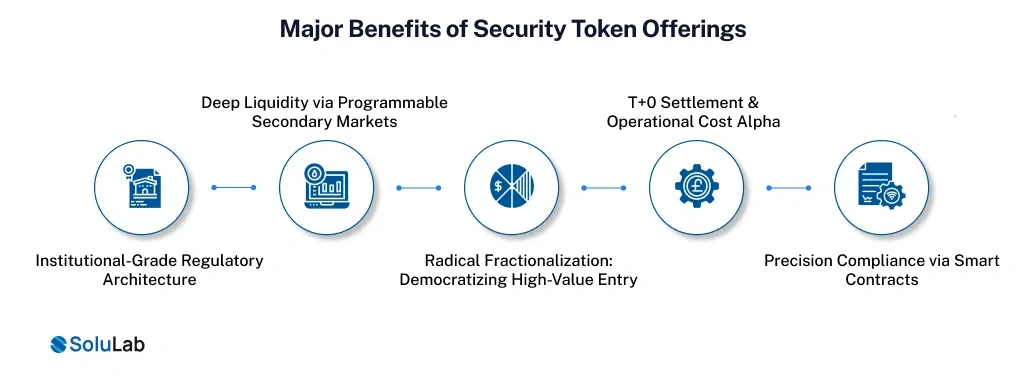
In a high-interest-rate environment, capital efficiency is the only metric that matters. Benefits of Security Token Offerings go beyond “using a blockchain”; they represent a fundamental upgrade to the lifecycle of an asset. For enterprises, this means unlocking value from balance sheets that were previously considered “dead” or illiquid.
1. Institutional-Grade Regulatory Architecture
- Unlike the speculative tokens of the past, tokenized securities are built on a “Compliance-First” logic.
- In 2026, global frameworks like the SEC’s 2026 playbook updated guidance and Europe’s MiCA provide a clear “safe harbor.”
- This ensures that every transaction is legally binding, reducing the “Regulatory Risk Premium” that often scares off institutional desks.
2. Deep Liquidity via Programmable Secondary Markets
- Traditional private equity is often a 7-to-10-year “jail sentence” for capital. By utilizing a security token offering platform, you enable a secondary market that never sleeps.
- Investors can exit positions in minutes, not months, without devaluing the underlying asset.
3. Radical Fractionalization: Democratizing High-Value Entry
- High-yield assets, like Grade-A office spaces or carbon credit portfolios, have historically been reserved for the 1%.
- STO Platform Development allows you to shred these assets into affordable units.
- This doesn’t just “help people invest”; it exponentially expands your buy-side pressure by tapping into global retail and mid-tier institutional demand.
4. T+0 Settlement & Operational Cost Alpha
- The “Back Office” is the biggest silent killer of ROI. Traditional settlement takes days (T+2 or T+3) and involves a dozen intermediaries.
- Blockchain security tokens settle instantly. By removing the need for manual reconciliation, firms are seeing STO development cost offset within the first year through pure operational savings.
5. Precision Compliance via Smart Contracts
Imagine a world where your asset refuses to be sold to a non-validated investor. Through security token offering services, compliance is no longer a manual check—it’s a line of code. Smart contracts automatically enforce “Lock-up” periods, tax withholdings, and jurisdictional restrictions, making “accidental non-compliance” a thing of the past.
Types of Security Tokens Offerings
There are three kinds of security tokens:
- Asset-backed tokens
- Equity tokens
- Debt tokens
1. Aset-backed Tokens
Real-world assets, including commodities, precious metals, or real estate are represented by asset-backed tokens. Depending on the asset it signifies, the token’s price changes in real-time. Investors may use these security tokens to use a variety of asset types to diversify their portfolios. You may divide your money, for instance, and put it into gold, silver, or oil tokens.
2. Equity Tokens
Equity tokens, as the name suggests, are shares of a publicly traded firm. To own a portion of businesses worth billions or trillions of dollars, you may purchase these security tokens. In contrast to conventional stock exchanges, as soon as your payment is verified, the assets will be registered in your name on the blockchain. Additionally, firms can obtain money to grow their operations by selling equity tokens.
3. Debt Tokens
Security tokens known as “debt tokens” stand as substitutes for loans made by investors to businesses. In this case, the investor gets paid interest or a dividend in line with the amount given. Regarding these tokens, the borrower and lender have mutually decided upon the interest rate, interest payout schedule, and other relevant terms and conditions. Purchasers of security tokens also have the choice to select tokens with the best interest rate and features, such as daily interest distributions.
Read more – Tokenization Platform Development in South Korea
Security Tokens vs. Utility Tokens
Here are the differences between security tokens and utility tokens:
| Criteria | Security Tokens | Utility Tokens |
| Definition | Signify ownership stakes in real-world assets | Grant access to specific features within a platform |
| Investment | Investors expect returns based on the asset’s performance | Value is derived from their utility within the platform |
| Regulation | Governed by securities regulations, such as STOs | Regulatory status is often ambiguous and unclear |
| Legal Rights | Provide holders with legal rights, including voting and profit-sharing | Offer access rights and limited governance |
| Stability | Generally, more stable and less speculative in value | Typically, more speculative, influenced by market demand |
| Underlying Asset | Supported by tangible assets with intrinsic value | Value comes from their utility within the platform |
| Issuance | Issued through regulated processes like STOs | Commonly created through ICOs or TGEs |
Why Leading Enterprises are Choosing STO Consulting Services
The technical gap between a “successful launch” and a “security breach” is narrow. This is why the industry has shifted toward STO consulting services. Professional guidance ensures that:
- The Security Token vs Utility Token distinction is legally watertight (to avoid SEC scrutiny).
- The Security Token Development Company you choose uses audited, “Quantum-Resistant” smart contracts.
- The Launch Security Token Offering strategy includes a clear “Market Making” plan to ensure there is actually a buyer on the other side of the trade.
The 2026 Revenue Model: How to Monetize an STO
For an enterprise, an STO isn’t just a fundraising tool… it is a long-term revenue engine. In 2026, the STO development cost is often recouped through four primary streams:
- Primary Issuance Fees: Charging a percentage (typically 2–5%) of the total capital raised during the initial offering.
- AUM / Administration Fees: A recurring fee (0.5–1% annually) for managing the digital cap table, automated dividends, and investor relations on-chain.
- Secondary Trading Royalties: Smart contracts can be programmed to take a small fee (e.g., 0.1%) every time a token is traded between investors on a security token offering platform.
- Asset Performance Success Fees: Taking a “carry” or performance fee based on the underlying asset’s yield (common in STO for Real Estate).
Read more – Top 10 STO Development Companies
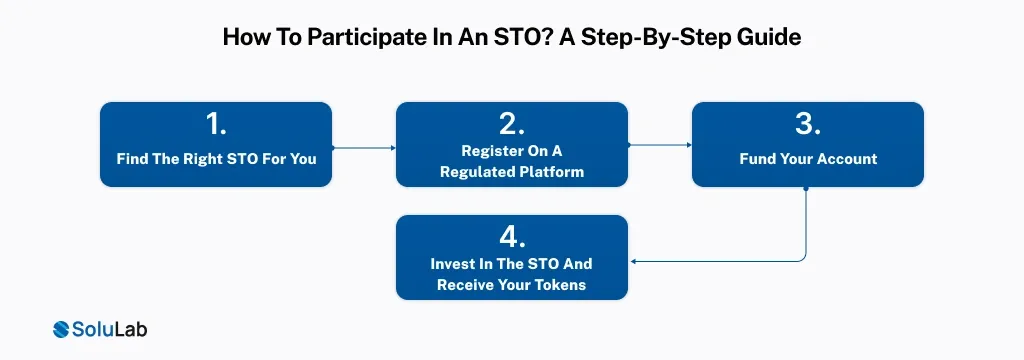
How To Participate In An STO? A Step-By-Step Guide
Purchasing securities is subject to legal restrictions and involves risk. Consult an authorized financial advisor before making investments.
In four easy steps, you may possibly participate in STO:
1. Find the Right STO for You
Investigate sites such as Securitize or STO market to find STOs in different sectors.
Importantly, don’t take shortcuts! Research the STO thoroughly:
- Project Details: Read the whitepaper to understand the project’s goals, the underlying asset, and the token’s utility.
- Team Expertise: Examine the history and experience of the team in related domains.
- Token Economics: Examine the token supply, distribution strategy, and possible profits in token economics.
- Underlying Asset: For asset-backed tokens, understand the asset’s value and potential risks.
- Seek Guidance: To get a second perspective, think about speaking with a financial advisor who specializes in STOs.
2. Register on a Regulated Platform
Look for a platform with a good reputation that hosts the STO you’re interested in. You may compile a list of security token issuing platforms with the use of a website such as The Tokenizer. After locating a platform, finish the registration procedure by giving personal details and accepting the rules. It is required to undergo AML (Anti-Money Laundering) and KYC (Know Your Customer) checks.
3. Fund Your Account
Platforms typically support either fiat currencies (USD, EUR) or cryptocurrencies (ETH, BTC). Check the platform’s options before committing.
Transfer the necessary funds into your platform account based on the STO’s minimum investment amount.
4. Invest in the STO and Receive Your Tokens
When the STO goes live, use the funds in your account to purchase the desired amount of security tokens.
The security tokens will be placed into your platform wallet or an external cryptocurrency wallet that is compatible when your transaction is successful.
Conclusion
Security Token Offerings are redefining how enterprises raise capital through compliant, efficient, and globally accessible blockchain infrastructure. As tokenized markets mature, businesses are shifting from experimentation to execution.
- Unlock liquidity through tokenized securities and fractional ownership
- Reduce operational overhead with automated compliance and faster settlement cycles
- Accelerate fundraising using enterprise-grade STO development solutions
As a trusted tokenization development company, SoluLab supports end-to-end security token offering services. Our team builds from strategy and compliance to security token issuance and platform development.
Contact us today to launch your security token offering with confidence.
FAQs
Deepika is a content writer who blends storytelling with strategic thinking. She explores topics across digital innovation, emerging tech, and the evolving blockchain industry. She enjoys breaking down complex ideas into simple, engaging narratives in the growing global markets.