












Last updated: August 2026

Tokenization Platform Development Company

A tokenization platform development company builds the software that turns real-world assets, such as real estate, funds, gold, private credit, or intellectual property, into blockchain tokens, then runs investor onboarding, KYC/AML, token issuance, and secondary trading. SoluLab builds white-label and custom platforms for asset owners and fund managers. Book a strategy call to scope yours.

  • White-label launch in JUST 14 days
  • Custom, white-label, or Tokenization as a Service
  • AI-assisted compliance and fraud monitoring

AI-Native Tokenization Platform Development Services for Scalable Enterprise Growth

Design, build, and scale tokenization platforms with multi-chain infrastructure, compliance built into the token, and AI where it removes manual work. We help asset owners, fund managers, and fintechs tokenize real-world assets, run investor operations, and reach global liquidity.

Tokenization Consulting

Tokenization Consulting

Gain strategic and technical clarity with our AI-assisted tokenization consulting focused on platform architecture, regulatory alignment, and use-case prioritization across assets, utilities, and financial instruments.

Custom Tokenization Platform Development

Custom Tokenization Platform Development

We build custom tokenization platforms around your asset class and business model: token issuance, investor onboarding, governance, lifecycle management, and compliance rules for each jurisdiction you operate in.

Smart Contract Development

Smart Contract Development

We write and audit the smart contracts behind token issuance, transfers, permissions, distributions, and transfer restrictions, so compliance rules run in the contract, not in a spreadsheet.

Asset Tokenization Platform Development

Asset Tokenization Platform Development

Tokenize real estate, commodities, private equity and fund units, private credit, and intellectual property through token models matched to each asset's legal structure. For asset-level strategy and structuring, see our asset tokenization development services .

Tokenization as a Service

Tokenization as a Service

Enable secure conversion of real-world assets into compliant digital tokens with AI-first Tokenization as a Service (TaaS) , without building complex blockchain infrastructure from scratch.

Multi-Chain Tokenization Platform

Multi-Chain Tokenization Platform

Issue and manage tokens on Ethereum, Polygon, BNB Chain, Solana, and Avalanche from one control panel, so you're not locked into a single network.

White Label Tokenization Platform

White Label Tokenization Platform

Accelerate go-to-market with white label tokenization platform development , offering configurable branding, modular features, and ownership over platform governance and expansion.

AI-Enabled Tokenization

AI-Enabled Tokenization

Enhance tokenization platforms with AI-driven analytics for valuation modeling, compliance monitoring, participant behavior insights, and anomaly detection across token lifecycles.

Investor Wallets and Custody

Investor Wallets and Custody

Give investors the custody model they expect: embedded crypto wallets for retail users, MPC or institutional custody such as Fireblocks for funds, and external wallets through WalletConnect.

Launch a White Label Tokenization Platform in 7 Days

From assets to digital value models, a unified tokenization platform simplifies ownership, governance, and participation. As a tokenization platform development company, we enable multi-chain, configurable, and enterprise-ready token ecosystems.

Multi-Chain Tokenization Enablement
60% Faster ROI Growth
Platform-Level Compliance Controls
Talk to Tokenization Experts

Enterprise-Grade Features Powering Our AI-Native Tokenization Platform Development

Our custom tokenization platforms are built to handle complex asset structures, ensure regulatory compliance, and deliver seamless investor experiences. Designed with an AI-native architecture, they enable scalable operations, intelligent automation, and high-performance digital asset ecosystems.

Token Lifecycle Management Icon

Token Lifecycle Management

Track and control every token from issuance through vesting, transfer, redemption, and burn, all governed by rules encoded in the smart contract itself.

Token Liquidity Management Icon

Token Liquidity Management

Enable secondary trading, market-maker integration, and redemption pools to keep tokenized assets tradable after issuance.

API and System Interoperability Icon

API and System Interoperability

Connect the platform to existing ERP, CRM, custody, and banking systems through REST/GraphQL APIs, allowing tokenization to integrate seamlessly with your existing operations.

Automated KYC/AML Icon

Automated KYC/AML

Verify investor identity and screen transactions against sanctions and watchlists automatically, with jurisdiction-aware rules built into the onboarding flow.

Fiat and Digital Payment Support Icon

Fiat and Digital Payment Support

Accept both traditional payment rails and crypto/stablecoin settlement, so investors can fund and redeem positions in the currency they already hold.

Custom Wallet Integration Icon

Custom Wallet Integration

Support MetaMask, WalletConnect, Fireblocks, and custodial wallet options, giving both retail and institutional investors the custody model they expect.

Platform Analytics Dashboard Icon

Platform Analytics Dashboard

Give operators real-time visibility into token performance, investor activity, and liquidity metrics without exporting data to a separate BI tool.

AI-Based Fraud Detection Icon

AI-Based Fraud Detection

Flag anomalous transaction patterns, wash-trading, and account-takeover risk in real time using models trained on token-transfer behavior.

Platform Branding Configuration Icon

Platform Branding Configuration

White-label the investor portal, dashboards, and communications under your own brand while SoluLab manages the underlying infrastructure.

Download The Development Checklist

How Does a Tokenization Platform Work, From Token Issuance to Secondary Market?

A tokenization platform does far more than mint tokens. It carries an asset from legal structuring to investor payouts, and each stage below is a module you'll need to build, license, or connect.

01

Asset onboarding

The asset is placed in a legal wrapper, usually a special purpose vehicle (SPV) or fund structure, and its documents, valuation, and custody details are recorded on the platform.

02

Investor onboarding with KYC/AML

Investors verify identity, accreditation where required, and sanctions status. Only verified wallets are allowed to hold the token.

03

Token issuance

Smart contracts mint tokens that represent fractional ownership, with transfer rules, holding periods, and investor caps written into the token.

04

Primary sale

Investors buy tokens with fiat, stablecoins, or crypto, and receive them in an embedded crypto wallet, an institutional custodian, or their own wallet.

05

Secondary market trading

Tokens trade on a built-in marketplace, a licensed exchange or ATS, or through redemption pools. This is where increased liquidity actually comes from; without it, a tokenized asset is just a digital certificate.

06

Distributions and reporting

Rent, interest, or dividends are paid to token holders automatically, and the platform keeps the audit trail regulators and investors ask for.

What Assets Can You Tokenize on the Platform?

Each asset class needs a different legal wrapper, token design, and route to liquidity. Here's how we typically set up the most common RWA tokenization projects.

Asset
What investors hold
Typical token standard
Where liquidity comes from

Real estate

What investors hold:

A share of an SPV that owns the property

Typical token standard:

ERC-3643 or ERC-1400

Where liquidity comes from:

Platform marketplace, rental yield, redemption at sale

Private equity and fund units

What investors hold:

Fund interests or LP units

Typical token standard:

ERC-3643

Where liquidity comes from:

Periodic redemption windows, secondary transfers between verified investors

Private credit and bonds

What investors hold:

Debt claims paying interest

Typical token standard:

ERC-1400 or ERC-20 with restrictions

Where liquidity comes from:

Coupon payments, maturity, secondary trading

Gold and commodities

What investors hold:

A claim on vaulted, audited reserves

Typical token standard:

ERC-20

Where liquidity comes from:

Redemption for metal or cash, 24/7 trading

Intellectual property

What investors hold:

A share of royalty or licensing income

Typical token standard:

ERC-20 or ERC-1155

Where liquidity comes from:

Royalty distributions, marketplace trading

Carbon credits

What investors hold:

Verified offset certificates

Typical token standard:

ERC-1155 or ERC-721

Where liquidity comes from:

Retirement for offsetting, marketplace trading

Proven Token Standards Powering Secure, Compliant, and Liquid Tokenization Platforms

Modern tokenization platforms are built on standardized token frameworks that ensure interoperability, regulatory alignment, and seamless asset management. At SoluLab, we implement the right token standards based on your asset type, compliance requirements, and platform objectives, ensuring scalability, security, and long-term liquidity.

Fungible Token Standards

Used for fractional ownership, platform credits, stablecoins, payment flows, reward systems, and financial instruments within tokenization platforms.Supported standards: ERC-20, BEP-20, SPL

Non-Fungible Token Standards

Used to represent unique ownership, identity-linked rights, digital certificates, licenses, collectibles, and asset representations. Supported standards: ERC-721, BEP-721

Multi-Token Standards

Used in platforms that require both fungible and non-fungible tokens under a single framework with shared logic and management. Supported standards: ERC-1155, FA2

Utility Token Frameworks

Used for access control, service usage, memberships, feature activation, platform incentives, and participation rights. Supported models:ERC-20, SPL with custom logic

Governance Token Models

Used to enable voting rights, proposal systems, participation control, and decision-making within tokenized ecosystems. Supported models: ERC-20 governance tokens, custom governance logic

Security Token Architectures

Used for regulated offerings such as equities, debt instruments, funds, and revenue-linked models requiring permissioned transfers. Supported models: ERC-3643 (T-REX), ERC-1400, permissioned token logic

Cross-Chain Token Representations

Used to extend token usability across multiple blockchains while maintaining value consistency and ecosystem interoperability. Supported models: Wrapped tokens, bridge-based representations

Custom Token Logic

Used when business rules, regulatory needs, or economic models require behavior beyond standard token definitions. Examples: Hybrid utility-asset tokens, jurisdiction-aware transfer logic

Industry-Ready Tokenization Platforms Built for Real-World Asset Transformation

SoluLab, a tokenization platform development company, builds AI-native tokenization platforms tailored for diverse industries, enabling secure asset digitization, compliant transactions, and data-driven decision-making. Our solutions help enterprises unlock liquidity, improve transparency, and create scalable digital asset ecosystems across sectors.

Explore How Tokenization Can Transform Your Industry!

Global-Ready Tokenization Platforms with AI-Driven Compliance

Tokenization is only as strong as its compliance framework. We build tokenization platforms that support the rules in each market you operate in, from securities laws to digital asset licensing, so you can go to market without retrofitting controls later.

MiCA (Markets in Crypto-Assets – EU)

MiCA (Markets in Crypto-Assets – EU)

Launch tokenization platforms aligned with MiCA requirements, including asset classification, investor protection standards, and compliant whitepapers for European markets.

SEC Regulations (United States)

SEC Regulations (United States)

Build platforms that support U.S. securities offerings under Regulation D, S, and A+, with investor accreditation, transfer restrictions, and secondary trading through registered venues.

VARA (Dubai Virtual Assets Regulatory Authority)

VARA (Dubai Virtual Assets Regulatory Authority)

Enable tokenization platforms that meet VARA guidelines for asset issuance, custody, and exchange operations in the UAE.

FCA (United Kingdom)

FCA (United Kingdom)

Support compliance with FCA regulations, including security tokens, AML requirements, and financial promotion standards in the UK financial ecosystem.

FINMA (Switzerland)

FINMA (Switzerland)

Implement token classification and compliance frameworks following FINMA guidelines for payment, utility, and asset tokens.

MAS (Monetary Authority of Singapore)

MAS (Monetary Authority of Singapore)

Build platforms under MAS regulations for digital payment token services, capital markets licensing, and cross-border compliance.

ESMA (European Securities and Markets Authority)

ESMA (European Securities and Markets Authority)

Ensure tokenized asset structures align with ESMA guidelines for securities, trading venues, and investor protection mechanisms.

Our Portfolio Of Real-World Asset (RWA) Tokenization Success

Explore how we've transformed tangible assets into scalable, blockchain-powered investment ecosystems. From precious metals to AI-driven tokenized assets, our solutions demonstrate secure architecture, regulatory alignment, and real-world impact by helping enterprises unlock liquidity and expand global investor access.

AI-Powered Tokenized RWA Platform Mockup

AI-Powered Tokenized RWA Platform

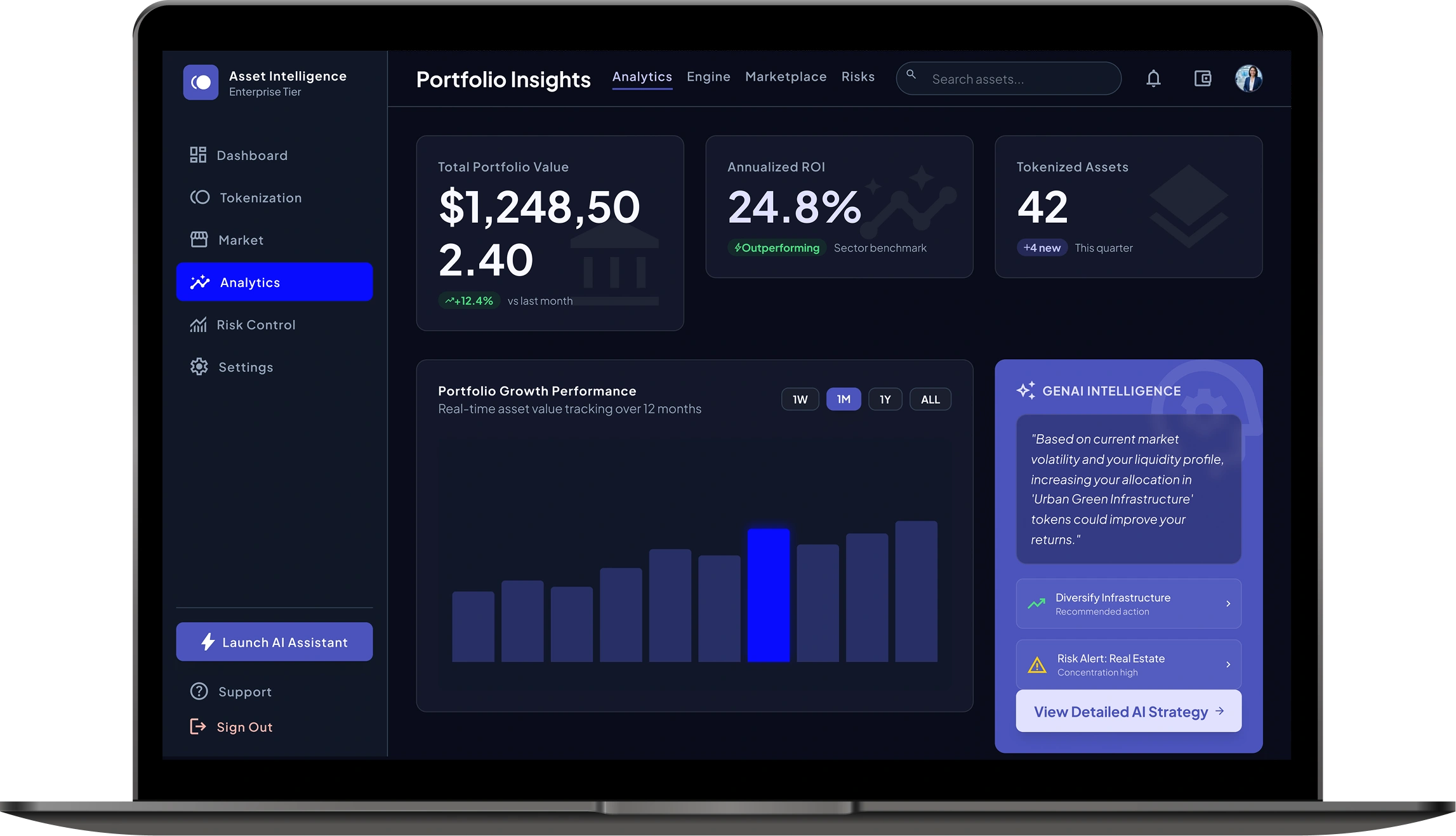
SoluLab delivered an AI-integrated tokenization platform that enhances asset valuation, risk analysis, and investor insights using Generative AI. This solution combines blockchain infrastructure with AI intelligence to optimize decision-making and unlock smarter investment ecosystems.

  • 2.1x Growth In Active Investors
  • 35% Faster Secondary Settlement
  • Compliance Monitoring with Intelligent Automation
View Case Study →
Digitizing Gold & Silver Mockup

Digitizing Gold & Silver

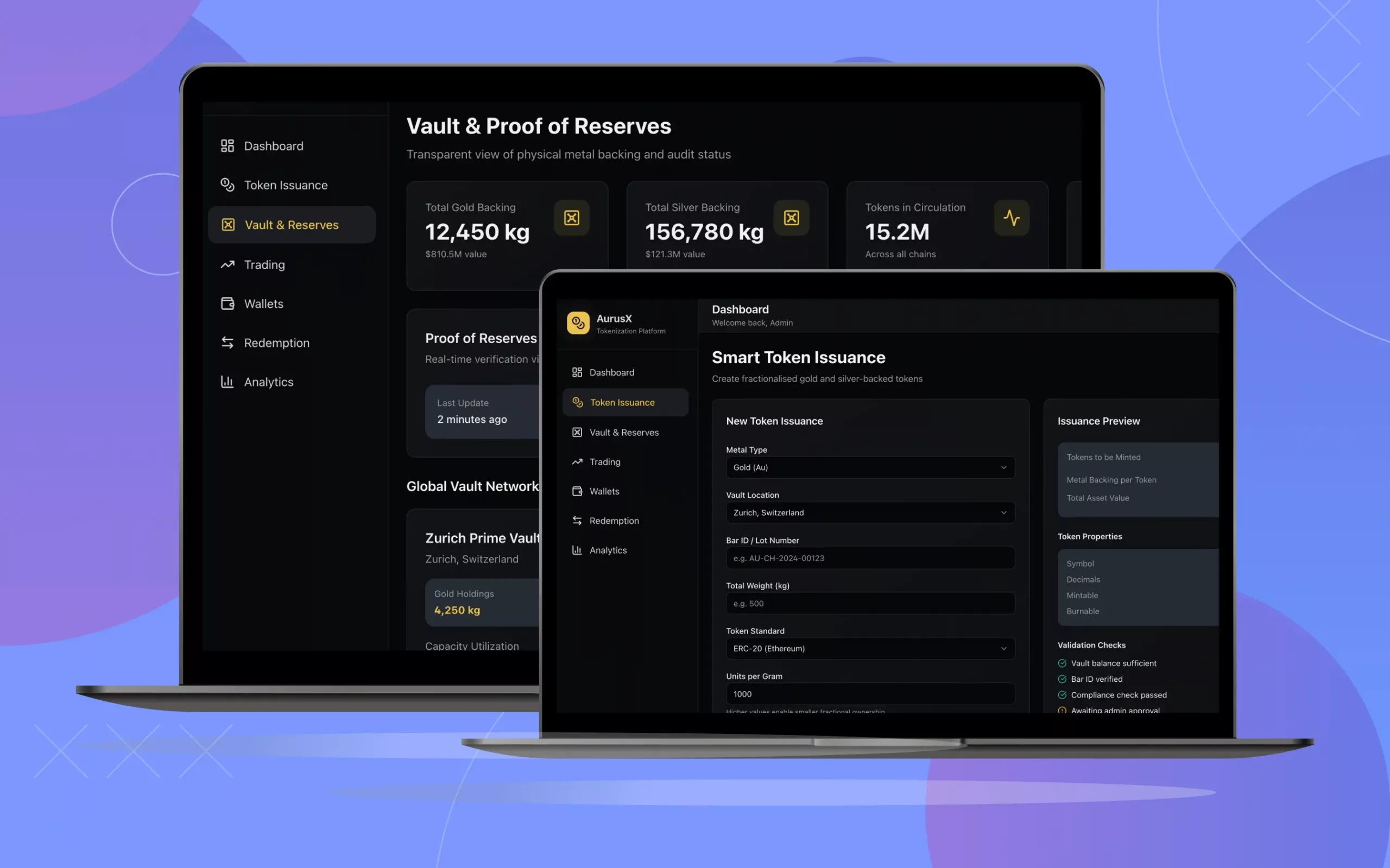
SoluLab built a high-performance tokenization platform enabling fractional ownership of gold and silver, fully backed by physical reserves. The solution supports global trading, multi-chain deployment, and real-time asset verification by bridging traditional commodities with digital liquidity.

  • 100% Asset-Backed with Verifiable Proof-of-Reserves
  • Regulatory-Ready Infrastructure
  • Live Gold & Silver Price Tracking
View Case Study →
Tangible Gold Mockup

Tangible Gold

We developed a compliant and transparent gold tokenization ecosystem where users can buy, trade, and redeem fractional gold tokens. The platform integrates automated audits, investor onboarding, and secure asset management for institutional-grade trust.

  • 100% Gold-Backed Digital Tokens
  • Automated Proof-of-Reserve Audits for Transparency
  • Integrated KYC/AML for Compliant Investor Access
View Case Study →

Modern Tech Stack for AI-Native, Multi-Chain Tokenization Platforms

The stack depends on your asset, investors, and jurisdictions. These are the tools we use most across tokenization platform builds.

Layer
Tools

Blockchains

Tools:
Ethereum Polygon Base Arbitrum Solana BNB Chain Avalanche Hyperledger Besu

Token standards

Tools:
ERC-3643 ERC-1400 ERC-20 ERC-721 ERC-1155 SPL

Smart contracts

Tools:
Solidity Rust OpenZeppelin Hardhat Foundry

Identity and compliance

Tools:
Sumsub Onfido Chainalysis ONCHAINID

Custody and wallets

Tools:
Fireblocks MPC wallets MetaMask WalletConnect

Oracles and proof of reserve

Tools:
Chainlink Price Feeds Chainlink Proof of Reserve

Payments

Tools:
Stripe Bank transfers USDC settlement USDT settlement

Backend and frontend

Tools:
Node.js NestJS React Next.js PostgreSQL

AI layer

Tools:
Python Document parsing for KYC Anomaly detection models

Cloud

Tools:
AWS Microsoft Azure

Our Strategic AI-Powered Tokenization Platform Development Process

We deliver end-to-end tokenization platforms through a proven, AI-led development framework that prioritizes compliance, performance, and liquidity. From asset structuring to platform deployment, our process enables faster execution, reduced operational overhead, and seamless access to global investor markets.

Consultation & Feasibility Analysis

Platform Architecture & Blockchain Selection

Smart Contract & Token Development

Regulatory Compliance Integration

Wallet & Exchange Integration

Platform UI/UX & Dashboard Development

Testing, Audits & Launch

Tokenization Platform Delivery Models, Timelines and Budget Ranges

The fastest route isn't always the cheapest over five years. Pick the delivery model based on how many asset classes you'll run, how much control you need over the code, and how soon you need to issue. These are planning figures, not quotes.

White-Label vs Tokenization as a Service vs Custom

Model
Time to first issuance
What you own
Best for

White-label platform

Time to first issuance:

About 14 days once legal structuring is ready

What you own:

Licensed platform under your brand; extendable

Best for:

A single asset class and a fast launch

Tokenization as a Service (TaaS)

Time to first issuance:

Days to weeks

What you own:

Nothing to host; subscription access

Best for:

Testing demand before investing in a platform

Custom platform

Time to first issuance:

3 to 6 months

What you own:

Full codebase and roadmap

Best for:

Multiple asset classes, unusual compliance rules, deep banking or custody integrations

Dedicated team

Time to first issuance:

Ongoing

What you own:

Code built by the team

Best for:

Platforms adding assets, chains, or markets every quarter

Budget and Timeline by Platform Scope

Scope
What's typically included
Typical timeline
Typical budget

Basic tokenization platform

What's typically included:

One asset class, token issuance, investor portal, KYC integration

Typical timeline:

2 to 8 weeks

Typical budget:

$10,000 to $25,000

MVP tokenization platform

What's typically included:

Adds primary sale, payments, admin console, basic secondary transfers

Typical timeline:

4 to 8 weeks

Typical budget:

$30,000 to $70,000

Enterprise-grade platform

What's typically included:

Multiple asset classes, multi-chain, custody and banking integrations, full audit

Typical timeline:

3 to 6 months

Typical budget:

$120,000 to $250,000+

AI layer (add-on)

What's typically included:

AI-assisted KYC review, valuation models, fraud and anomaly detection

Typical timeline:

Adds 3 to 6 weeks

Typical budget:

$25,000 to $100,000

Why Choose SoluLab For Your Custom Tokenization Platform Development Partner?

SoluLab combines AI-native engineering, deep blockchain expertise, and global regulatory understanding to deliver scalable, compliant, and high-performance tokenization platforms. We enable enterprises to move faster, reduce risk, and unlock new revenue streams, while we handle the complexity of technology, architecture, and compliance.

Launch Fast Icon

Launch in Weeks, Not Months

White-label and modular architecture let most platforms reach a working MVP in weeks.

Retention Rate Icon

97% Client Retention Rate

Most clients return for platform expansion, new chain support, or additional asset classes rather than switching vendors after launch.

Revenue Streams Icon

New Revenue Streams

Tokenization opens fractional-ownership sales, secondary-market fees, and liquidity-pool participation as revenue lines that don't exist in a traditional asset-sale model.

White-Label Platform Icon

Configurable White-Label Platforms

Start with a branded, ready-to-launch platform and extend features, chains, or governance modules as the business scales, without a rebuild.

AI Architecture Icon

AI-Native Tokenization Architecture

Compliance monitoring, fraud detection, and valuation modeling run on the same AI layer as the platform itself, not as a bolted-on add-on tool.

Compliance Shield Icon

Compliance-Ready Frameworks

Platforms are structured against named regimes like MiCA, SEC exemptions, VARA, FINMA, and MAS, so jurisdiction-specific rules are enforced at the smart-contract level.

MEET YOUR ARCHITECT

Taher-Pittalvala Image

"SoluLab Blockchain and tokenization practice lead. 11+ years building asset-backed and RWA infrastructure."

Taher Pittalvala · View full profile

What our clients say

Working with SoluLab was a great experience from start to finish. We wanted to make private-market investing more accessible and efficient, and their team helped us turn that vision into reality. The combination of tokenization, compliance automation, and AI-powered insights has helped us scale faster while delivering a better experience for our investors.

SoluLab immersed itself in understanding our goals and challenges, providing innovative, tailored strategies that made an immediate impact on our gold tokenization development. Their expertise, proactive communication, and unwavering support made the entire process smooth and efficient.

They did extensive research to find the best solution to implement the idea we had envisioned, and their communication process was very smooth. The team understood the complexities of connecting physical gold and silver with blockchain while remaining flexible as the project evolved.

1 / 3
FAQ

Helpful resource to grow your business

A tokenization platform development company builds the software that turns assets into blockchain tokens and manages them afterward: token issuance, investor onboarding with KYC/AML, wallets, a primary sale module, secondary market trading, distributions, and admin dashboards. SoluLab builds these platforms as white-label, custom, or Tokenization as a Service deployments for asset owners, fund managers, and fintechs.

A tokenization platform is the software layer that converts ownership rights in real-world or digital assets into blockchain tokens and manages their full life cycle. It handles investor verification, token issuance, transfers, trading, payouts, and reporting, so assets like real estate or fund units can be owned in fractions and traded digitally.

The asset is placed in a legal structure, such as an SPV, and its details are onboarded. Investors pass KYC/AML checks, smart contracts issue tokens representing their share, and a wallet holds them. After the primary sale, tokens can trade on a secondary market while the platform automates distributions, redemptions, and reporting.

RWA, or real-world asset, tokenization turns ownership of physical or traditional financial assets, such as property, gold, private credit, bonds, or fund shares, into blockchain tokens. Each token represents a legal claim on part of the asset, which enables fractional ownership, faster settlement, and access for investors who could not buy the whole asset.

Almost any asset with clear ownership and a legal structure can be tokenized: real estate, precious metals, commodities, private equity and venture fund units, private credit, bonds and treasuries, carbon credits, art and collectibles, and intellectual property such as music royalties or patents. The deciding factors are legal enforceability and whether investors want the asset.

It can, but only if there is a secondary market. Tokens make assets divisible and transferable around the clock, and they widen the investor pool through fractional ownership. Real liquidity still depends on regulated trading venues, market makers, or redemption pools, which is why we design liquidity into the platform rather than assuming it will appear after issuance.

Choose white-label if you need to launch fast with standard features, such as a single asset class, primary issuance, and an investor portal, and can extend later. Choose custom development when you need unusual compliance logic, multiple asset classes, deep integrations with banking or custody systems, or full control over the codebase and roadmap.

A basic tokenization platform typically costs $10,000 to $25,000, an MVP with investor onboarding and a primary sale $30,000 to $70,000, and an enterprise-grade platform $120,000 to $250,000 or more. Plan another 15% to 25% of the build cost each year for maintenance and audits. Legal structuring and licensing are separate.

A white-label platform for a single asset class can go live in about 14 days once legal structuring is ready. A customized MVP typically takes 4 to 8 weeks, and a fully custom enterprise platform 3 to 6 months. Legal work, custody setup, and regulator approvals usually set the pace, not engineering.

Investors are verified at onboarding through identity and sanctions checks, and the smart contract only allows transfers between verified wallets, using standards such as ERC-3643. Transfer limits, holding periods, and investor caps for each jurisdiction are encoded in the token. The platform keeps an audit trail for regulators under frameworks like SEC Regulation D, MiCA, or VARA.

Most tokenization platforms run on Ethereum or its Layer 2s for institutional credibility and DeFi reach, with Polygon, Solana, BNB Chain, and Avalanche used for lower fees and faster settlement. Permissioned networks such as Hyperledger Besu suit private, bank-led deployments. Multichain platforms issue on several networks from one control panel.

Tokenization as a Service gives you a hosted tokenization platform on a subscription, so you issue and manage tokens without building or running blockchain infrastructure yourself. It is the fastest and cheapest way to start, but you trade away some control over features and hosting. Many clients move from TaaS to a custom deployment as volumes grow.

AI takes on the repetitive, high-volume work: pre-screening investor documents during KYC, flagging unusual transactions, estimating asset values from market data, and forecasting liquidity needs. It reduces manual review for compliance teams, but final approvals on investors and valuations still sit with people, because regulators hold the platform operator accountable.

Yes. A white-label tokenization platform lets you enter the market quickly and extend it as the business grows: add asset classes, new blockchains, secondary trading, or custom governance modules without rebuilding from scratch. We plan the architecture at the start so later additions plug into the same codebase.

A tokenization specialist replies within 48 to 72 hours of your form submission, depending on your time zone. The first call covers your asset class, target investors, and jurisdictions, and ends with a recommended approach, whether white-label, Tokenization as a Service, or a custom build, with an indicative budget and timeline.

Articles

Latest Insights from Experts