

- AI Development
- AI App Development
- AI Consulting
- AI Software Development
- ChatBot Development
- Enterprise AI ChatBot
- AI Chatbot Development
- LLM Development
- Machine Learning Development
- AI Copilot Development
- MLOps Consulting Services
- AI Agent Development
- Deep Learning Development
- AI Deployment Services
- Deep Learning Consulting
- AI Token Development
- AI Development Company
- AI Development Company in Saudi Arabia
- AI Integration Services
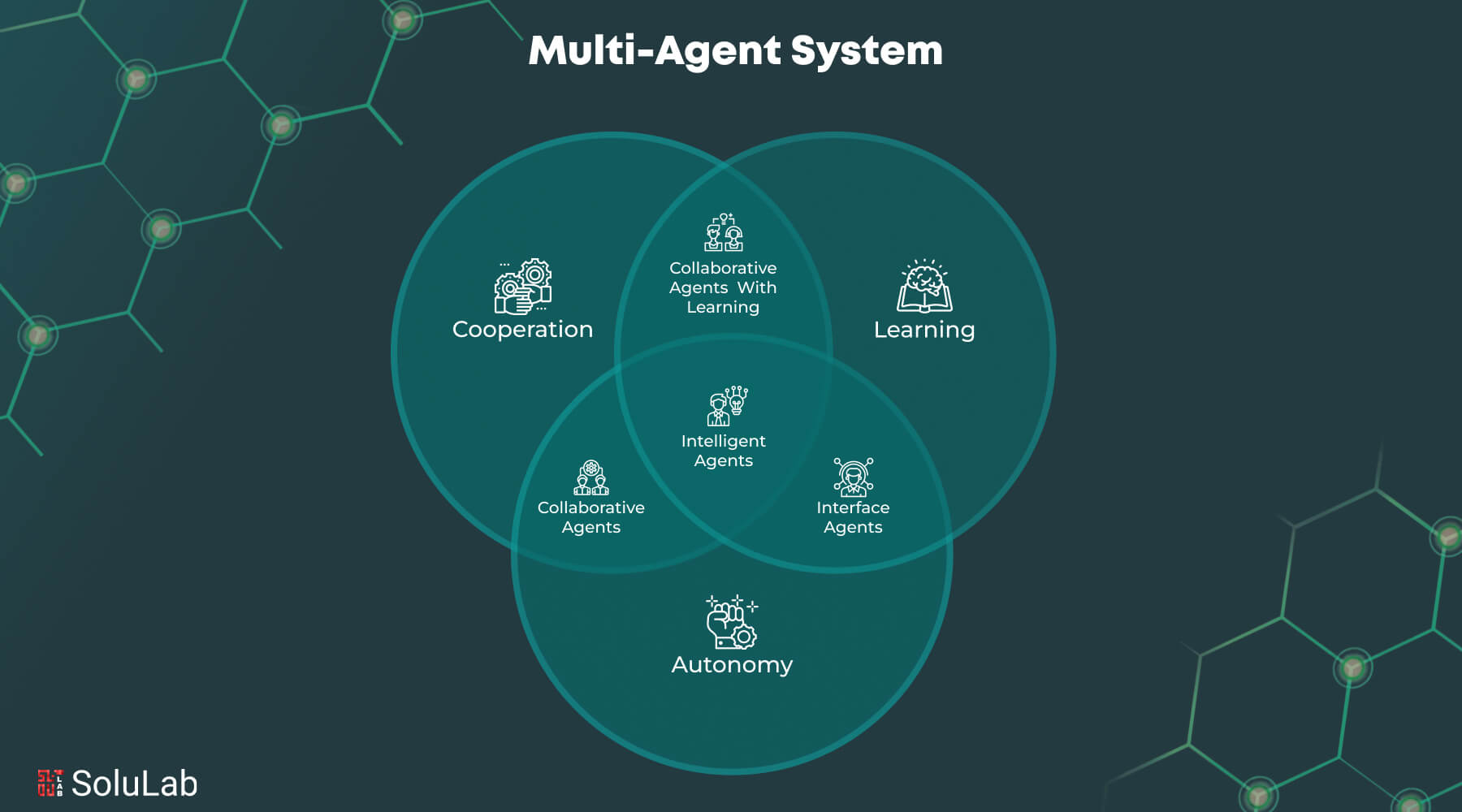
Artificial Intelligence (AI) is reaching greater heights every day with new AI applications emerging across various industries and these multi-agent systems have taken this technology to another level.
A multi-agent system contains several intelligent agents that interact with each other to fulfill particular goals. These agents can solve complex issues in real-time. This multi-agent system is opted for when the tasks assigned are too large, complicated, or decentralized. A single AI agent cannot manage such tasks.
Also, the way businesses address complex problems has changed significantly due to the arrival of this multi-agent system (MAS). Every agent possesses unique skills and knowledge that enable them to interact, negotiate, and adapt in real time.
The agents in this multi-agent system are not dependent on each other. They can function independently, understand the environment, decide, implement their actions, and achieve their goals.
What is a Multi-Agent System?
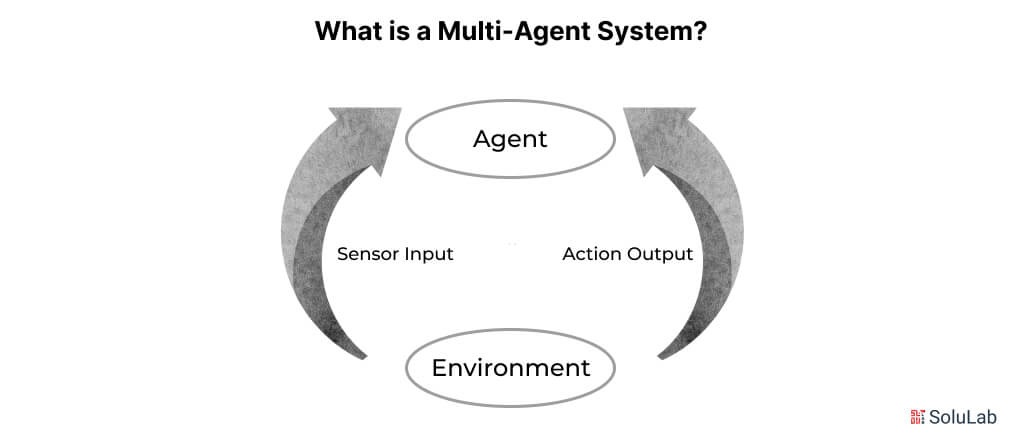
Multi-Agent System (MAS) is nothing but a framework, where you can witness several agents interacting, or collaborating to execute tasks, rectify issues, or fulfill their goals. Every agent in MAS can make decisions and act independently. These agents can either be a software program, or any intelligent entity and operate either autonomously or semi-autonomously. Now, let us consider some important components of a multi-agent system.
Important Components of a Multi-Agent System
A multi-agent system has several key components, and it is important to understand them well. These components are elaborated:
- Agents: The individual entities within the multi-agent system are known as agents. These agents can be software programs, robots, or any intelligent entity, and they act and interact in the system. Every agent can function autonomously and comprises goals, knowledge, and decision-making capabilities.
- Interactions: To fulfill their goals, these agents in a multi-agent system interact and collaborate with each other. Based on the nature of the system, these agents can interchange information, negotiate, and even compete at times.
- Coordination: To work efficiently, these agents must have coordination in their actions. This coordination may be either implicit or explicit. Implicit coordination involves communication via shared environments or indirect communication. Whereas explicit coordination involves direct interaction.
- Collaboration or Competition: The agents in a multi-agent system can either collaborate or compete with each other. When these agents collaborate, they can fulfill common objectives, whereas when they compete, there might be a conflict in their objectives. Both types of these interactions are possible in a multi-agent system.
- Distributed Approach: Distributed multi-agent systems are capable of solving complex issues that a single-agent system cannot. This is possible because the agents in a multi-agent system are distributed and hence can solve these issues collectively.
What are the Features of a Multi-Agent System?
The key features of a multi-agent system are:
1. Decentralization: In this process, every agent in a multi-agent system functions independently with the help of local data. It can make its own decision. A central controller is not required in this case.
2. Local Views: No agent in a multi-agent system knows the full system. The agents are aware of only those components related to the tasks assigned to them. This is what is referred to as a local view.
3. Autonomy: Autonomy is a process where every agent has its rules and goals and they can view information and execute their actions independently based on them. Hence, any input from other agents is not necessary.
4. Adaptability: The agents in a multi-agent system are flexible enough to adjust their behavior according to environmental changes. Due to this adaptive AI nature, if there is any new information or change in conditions, these agents can adapt based on them and this ensures the system functions even in the case of unprecedented scenarios.
5. Concurrent Tasks: Parallel processing is available in multi-agent systems. This means that you can find several agents working simultaneously on various tasks. As a result, the efficiency and responsiveness of the AI agent system are increased.
6. Communication: There are two types of communication possible in a multi-agent system. They are inter-agent and intra-agent communication. Iner-agent communication is where agents interact with each other and intra-agent communication is where agents interact among themselves. These interactions are necessary among agents to attain common objectives.
7. Migrating Between Environments: It is possible for agents in a multi-agent system to migrate between environments or platforms whenever required. This feature helps the agents to execute tasks in different locations within the system.
8. Openness: This feature in a multi-agent system allows the agents to dynamically include new ones or eliminate the existing ones depending on the requirements of the system. Hence, the system can evolve and adjust thereby making it both scalable and flexible.
Multi-Agent System and Its Types
The types of multi-agent systems are as follows:
Cooperative Agents:
These agents have common objectives and they collaborate to attain them. The success of these agents is purely dependent on the joint efforts of all participating agents. Communication and synchronization play an important role. The actions of the agents have to align, and hence they may use predefined rules or strategies.
- Mechanisms of Cooperative Agents: Cooperative agents use teamwork. In this process, agents may divide into teams and each agent will have a dedicated task or role to play that will complement the other agents. Consider the example of a search and rescue mission: One robot may be assigned the task of identifying the victims while the other might be handed the task of providing a first aid kit to the victims. This way they complement one another. Resources, namely data, or energy can be shared to attain common objectives. Consider a network security system, where you can find several agents who share threat intelligence and computational resources. This is done to boost real-time response abilities in case of cyber attacks. As a result, a stringent and unified defense strategy is guaranteed.
- Example of Cooperative Agents: The best example of cooperative agents is the customer service chatbot system. They use large language models and you can find several agents cooperating to tackle complex user queries. Here, you can find one agent is an expert in interpreting user queries, the other an expert in fetching relevant information from the database, and the other ensures that the responses generated are relevant and useful.
Adversarial Agents:
Unlike cooperative agents, adversarial agents have contrasting objectives. They often operate in a manner that hinders the actions of the other agents so that these agents can attain their goals.
- Mechanism of Adversarial Agents: Adversarial agents make strategic decisions, predict, and respond to the actions of their competitive agents. Tactics namely negotiation, and resource allocation are involved in this process. Their interactions are designed based on game theory. This means you can find the agents deciding their actions by anticipating the actions of other agents. A better example to understand this action is to consider the game of chess. Here, every player has competitive goals, and their actions will show their motive to defeat their opponent.
Related: Generative Adversarial Networks
- Example of Adversarial Agents: Consider a debate simulation system. Here, you can find two agents based on LLM models arguing against each other on a given topic. These agents evaluate each other’s arguments, spot the loopholes, and produce counterarguments to solidify their stance while weakening the opponent’s chances.
Mixed-Agent Systems:
As the name suggests, mixed-agent systems possess dual qualities. They cooperate and also compete with each other. These agents collaborate in some aspects while competing in other aspects. You can find the interactions of these agents to be multifaceted, similar to the real-time environment where both collaboration and competition are present.
- Mechanism of Mixed-Agent Systems: Mixed-Agent Systems work together temporarily to attain certain goals and compete with others outside of this alliance. A better example to understand this mechanism is to consider the supply chain industry. Here, the companies might come together to optimize their production or distribution processes. Whereas when it comes to negotiating deals with suppliers, you might find them competing with each other. Since mixed-agent systems are of a dual nature, conflicts may arise between cooperative and competitive goals. So, these systems need mechanisms that can resolve these conflicts.
- Example of Mixed-Agent Systems: Consider a writing platform, where several agents based on LLM models collaborate with each other. They develop a logical story while also competing with each other to provide a strong impact on their contributions. These agents sketch the plots and characters together while aiming for the best innovative twists in the plotline.
Hierarchical Multi-Agent Systems:
In hierarchical multi-agent systems, you can find the agents to be arranged according to hierarchy. Their authority and responsibility also vary. The agents at the higher level supervise and coordinate the actions of the agents at the lower level. As a result, these agents can be assured that the tasks are in sync with broader objectives.
- Mechanism of Hierarchical Multi-Agent Systems: The higher-level agents assign tasks to lower-level agents. These agents are responsible for managing specific tasks. This hierarchy also makes coordination possible across various levels which ensures that the actions of the lower-level agents provide a significant contribution to the overall objectives.
- Example of Hierarchical Multi-Agent Systems: Consider a content creation process. Here, the high-level LLM-based agent is responsible for supervising the whole content creation process. It assigns particular tasks to specialized lower-level agents. These agents are responsible for managing the research, writing, and editing tasks. The supervising agent is responsible for maintaining the continuity and alignment with the entire content strategy.
Heterogeneous Multi-Agent Systems:
In heterogeneous multi-agent systems, the agents possess various skills that make the system flexible and adjustable. Every agent is responsible for executing particular tasks depending on their attributes.
- Mechanism of Heterogeneous Multi-Agent Systems: These agents with their varied skills collaborate with each other to attain complex goals. This feature helps the system to perform various tasks. This system can adjust if there is any change in the requirements by using the various skills of its agents.
- Example of Heterogeneous Multi-Agent Systems: Consider a customer support environment. Here, various LLM-based agents having specialized knowledge in different product areas collaborate with each other. You can find that one agent is responsible for answering technical questions, the other to handle billing issues, and the other to provide product suggestions, thereby offering the best customer support.
Key Variations Between Single and Multi-Agent Systems
| Single-Agent System | Multi-Agent System |
| In a single-agent system, only one autonomous entity is responsible for handling the tasks. | In a multi-agent system, multiple entities communicate within the same environment. |
| A single-agent system does not require coordination as it is the only agent involved. | A multi-agent system requires coordination between agents to resolve conflicts and handle communications between them. |
| A single-agent system does not communicate as it is the sole agent. | A multi-agent system has lots of communications between each other to share information or coordinate their actions to achieve a common goal. |
| A single-agent system lacks robustness. If a single agent fails, the entire system fails. | A multi-agent system is more robust. Even if a few agents fail, there will be no hindrance to the system; it shall continue functioning. |
| A single-agent system makes decisions according to its goals and only a single agent is responsible for decision making. | A multi-agent system involves multiple agents and each may have different goals. |
| A single-agent system cannot adapt well to changes as its capability is dependent on a single agent. | A multi-agent system can tackle changes accurately due to the collective behavior of its multiple agents. |
What are the Building Blocks of Multi-Agent Systems?
The functioning of a multi-agent system is similar to that of a synchronized team activity. In this system, every agent has its own role to play and is responsible for achieving a common goal. The core components of these systems are given below:
1. Large Language Models: These are the core of the multi-agent system. They have a good understanding of human language and generate them appropriately. This step is very important for analyzing extensive datasets and solving complex queries. Large language models ensure that agents have good reasoning and decision-making abilities to manage complicated tasks efficiently. This helps the agents to clearly interpret and respond to complex instructions. They also play a pivotal role in converting human language into information that can be used. This helps the agents to interact meaningfully and make decisions efficiently.
2. Agents: These are the ones responsible for executing particular tasks, and decision-making. They also work collaboratively to attain common goals. Large language models are the reasoning mechanisms for these agents and every agent has its own characteristics and responsibilities. This feature helps the agent to adjust to changing conditions and communicate dynamically within the system. The agents can work independently with other agents and hence the system can manage various tasks.
3. Tools: Agents are responsible for accomplishing tasks and they take the help of tools to do so. Tools are nothing but skills. The tasks may either be simple to challenging. Simple tasks may involve fetching information from API whereas complex tasks may involve performing lengthy analysis.
4. Processes: Processes are the ones responsible for outlining the way tasks are organized and performed within a multi-agent system. They provide the order and coordination of the activities which helps to ensure that there are no issues in task distribution and they align with the overall goals. Processes are mandatory to ensure smooth dynamic interactions and the collaborative working of systems to attain common goals.
How Does a Multi-Agent System Function?
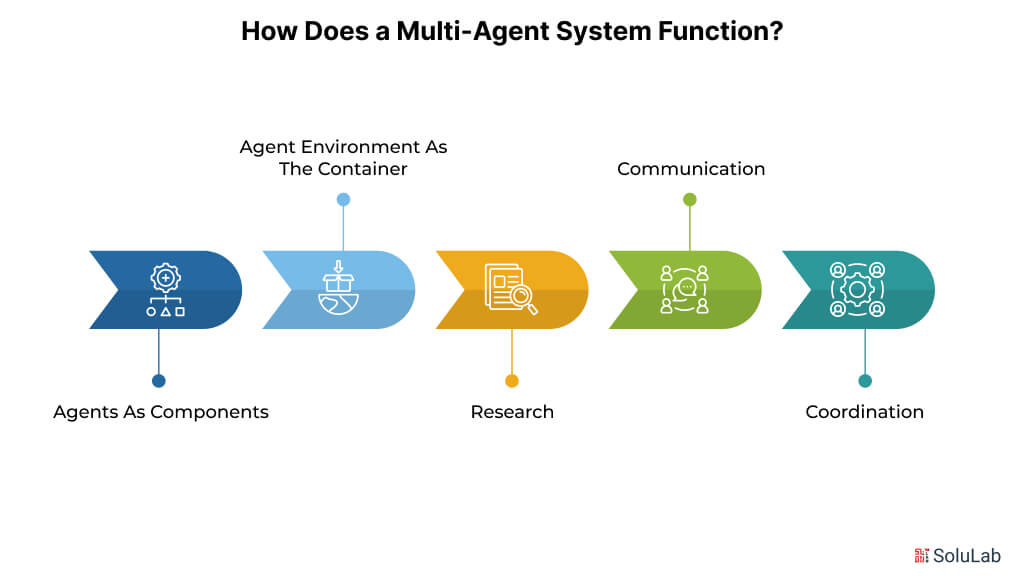
In a multi-agent system architecture, you can visualize the concept of the container-component model where you can consider the components to be individual agents. They have their own roles and responsibilities and work autonomously. They also communicate with other agents to attain common goals. The container can be considered as the agent environment. This environment is the framework within which the agents function. It helps the agents to find each other by providing the necessary services namely identifying, communication, and coordination. These agents interchange information and collaborate efficiently.
Let us explore how these agents act as components:
1. Agents as Components: Every agent operates as a self-contained unit and contains various skills. They can make decisions and have their own objectives. They can execute different tasks and function independently while communicating with other agents.
2. Agent Environment as the Container: The agent environment is the overall system that offers support to the agents. It provides the services required for communication and cooperation between agents.
3. Research: Research guides the agents to spot and recognize other agents in the surrounding area. This ensures that the agents communicate with each other.
4. Communication: Communication involves the procedures and systems with which agents can interact with each other and disclose information. Different types of communication take place including issuing commands, exchanging information, and synchronizing actions.
5. Coordination: To accomplish common objectives, coordination is mandatory to manage the way agents communicate with each other and also ensure that their actions are synchronized and move towards the common objectives.
Interaction of Multi-Agent Systems With Their Environment
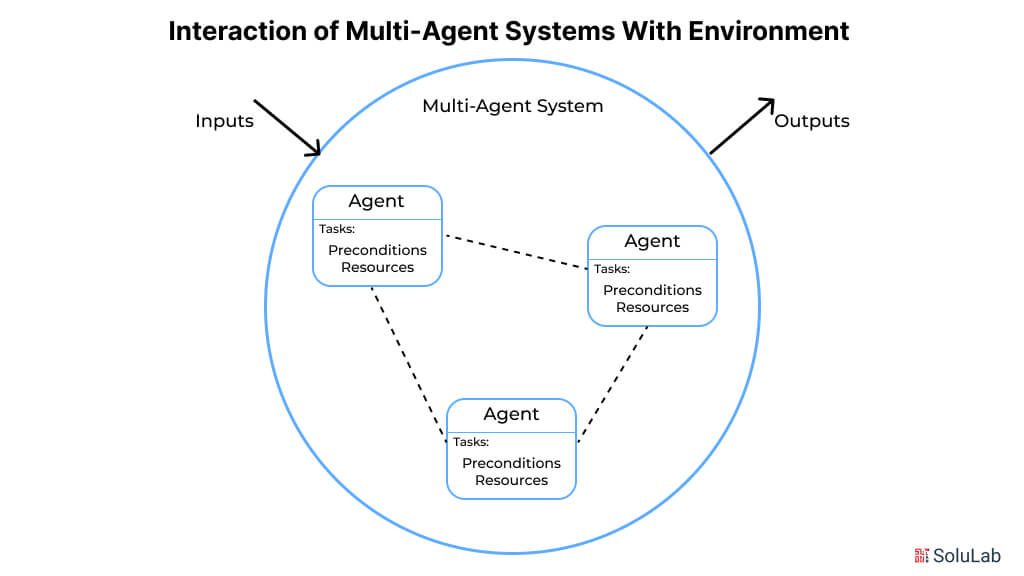
The communication of multi-agent systems with their environment happens through constant cycles of perception, decision-making, and action.
Let us examine a few.
- Environment: It is the surroundings with which the agents interact. The environment can be either a physical, a digital environment, or an interaction context. The physical environment is the actual physical world where the agents are at work. In the digital environment, the agents work in the digital context which may be digital platforms or virtual environments. Interaction context is where the agents operate in a particular situation. If a user enquires about a restaurant, the interaction context would be about giving the required details.
- Perception: Agents gather information about their environment. Sensors or data inputs are responsible for providing these data. This is done so that the agents can understand if there are any changes in the environment related to their tasks.
- Brain: The brain of the LLM (Large language models) based agent is responsible for managing important functions namely knowledge storage, processing of information, and planning and reasoning.
- Action: The agents act according to their decisions. As a result, the environment can change or the actions of other agents may change. These changes must allow the agent to attain its goals or enhance the performance of the system.
- Rules and Algorithms: These are the key factors for the multi-agent system to perform well. Rules suggest the way agents should communicate, and solve conflicts. The algorithm helps the agent to make informed decisions.
Building Multi-Agent Systems (MAS)
Building multi-agent systems involves the following steps. Let us consider them.
- Select the Appropriate Solution: There are two choices available for building MAS. You can either build a new MAS or choose an existing AI platform that supports MAS. If you develop a new MAS, you can customize it. However, it requires huge development resources.
- Goal Setting: Set specific goals for your MAS to achieve. These may include interactions, scalability, and tasks. To achieve your goals, choose the appropriate agents and define their roles within the system.
- Create an Architecture For Your Agents: Develop an architecture for every agent in your system. These should include decision-making, data processing, and adaptability. You can customize this architecture based on the way your agents will interact with the environment and other agents.
- Choose Communication Methods: You should implement communication protocols so that agents can share and coordinate data. Message passing or shared repositories are a few methods you can choose based on the frequency of the interaction of your agents.
- Configure the Environment: Choose an appropriate environment where your agent can function effectively. Ensure the environment is suitable for communications, and data flow so that your agent can operate without any issues.
- Simulation: Simulate your agent to test their behavior, interactions, and scalability. Monitor their response under different scenarios and ensure they collaborate accordingly. This will also let you know if they are capable of handling the workload of the system under various conditions.
- Optimize and Deploy: Once you get the test results, refine the behavior of your agents, performance, or communication protocols if required. After the required changes, deploy your MAS in the required environment and monitor it closely to ensure that it meets your intended objectives.
Applications of Multi-Agent Systems
Multi-agent systems are used in various industries due to their ability to solve complex issues. Some of the industries in which MAS is employed are given below:
1. Healthcare: MAS is used in healthcare to improve patient monitoring, resource allotment, and customized treatment planning. These agents collaborate to observe patient health in real-time, allot resources, and provide customized treatment plans according to individual patient history.
2. Finance: MAS is used in finance to handle complex tasks namely fraud detection, and risk assessment. Every agent functions autonomously based on its rules and goals. They share and analyze data to spot suspicious activities and financial risks.
3. Customer Service: MAS is used in customer care, where multiple agents collaborate and offer excellent customer support. Every agent specializes in their own area. One agent may process orders, and the other might respond to customer queries. To provide efficient answers to customer queries, these agents collaborate and share information.
4. E-Commerce: MAS is used in e-commerce, wherein multiple agents track the preferences, and behavior of users, and provide customized recommendations and messages. These agents specialize in different areas namely data analysis, tailoring contents, and user profiling. They collaborate and offer a rich customized shopping experience through these specializations. This also helps in increasing customer satisfaction and boosting sales.
5. Gaming: MAS is used to develop games and simulations to make the environment more creative and complex. Every agent can be considered a character with particular traits and goals in games. These agents communicate with each other and also with the environment, thereby providing the users with a dynamic and addictive gameplay experience.
Related: AI in Gaming
6. Simulations: MAS simulates real-world situations, where you can find multiple agents communicating with each other according to preset protocols. Hence, a realistic and compelling simulation environment is created which can be used for training, research, and entertainment.
Multi-Agent System Examples
Some multi-agent system examples are explained below:
- Warehouse Robotics: In warehouse robotics, every AI agent can be considered a different robot that executes tasks namely picking, arranging, and packing. These robots can navigate the warehouse autonomously and interact with each other to fulfill orders and eliminate hurdles, thereby adjusting to the change in order volumes.
- AI-Driven Marketplaces: Here, the AI agents act as buyers and sellers respectively. They bargain and handle inventories according to the supplies and demands. All these agents can operate independently and also interact with others which results in a dynamic environment.
- Rescue Operations: Swarm robots can be used for rescue operations. They act as a multi-agent system, where every agent independently navigates the area, scans various portions, and shares information to map terrain and identify people in distress.
- Transportation: MAS can coordinate complex transportation systems through interaction, collaboration, strategizing, and real-time information access. Railroad systems and marine vessels ending up at the same ports are a few systems where MAS can be exploited well.
- Defense Systems: MAS can help to bolster the defense systems. They can help in simulating potential threats. Consider a maritime attack simulation. Here, agents can collaborate as a team and detect the communications between the intruding enemy boats and defense vessels.
Advantages of Multi-Agent Systems
There are numerous advantages to using multi-agent systems. Let us explore a few:
1. Offers More Robustness: In MAS, if one agent fails, you need not worry that the entire system will stop functioning. There will be other agents which might adapt and help the system to operate without hindrance. Hence MAS is more robust compared to single-agent systems.
2. Addresses Complex Issues: In MAS, multiple agents take care of various tasks. Hence they can address complex issues with ease in distributed environments.
3. Offers More Flexibility: Every agent in MAS can respond to changes independently. This helps the system to adapt to the changes without delays.
4. Provides Scalability: In MAS, when multiple agents cooperate, information can be shared to a greater extent. Hence, multi-agent systems can resolve more complicated issues.
5. Enhances Decision-Making: MAS collects insights from several agents. These agents have their own specializations and perspectives. Hence, this can improve the decision-making process as various views and strategies are taken into account.
6. Safeguards Agents: In MAS, implementing agents that can observe and examine the behavior of other agents can ensure ethical standards and responsible AI practices are fulfilled.
Deciding if a Multi-Agent System is the Appropriate Choice For Your Business
Depending on the complexity and adaptability of your business needs, you can opt for either a multi-agent system or a single-agent system. You can consider the following factors and decide if MAS is the one for you.
- Does your business require handling multiple components simultaneously?
- Does your environment change frequently and need real-time adjustments?
- Do your components require effective collaboration or interaction?
- Do you require a more robust system wherein if one agent fails, the system can still function?
Considering these factors, you can decide on the appropriate system.
The Bottom Line
Multi-agent systems can help solve complex problems due to their collaborative nature. They can operate in environments where every agent has their roles and actions carved out, and can communicate, collaborate, and make real-time decisions. Due to their distributive nature, MAS can prove advantageous in various domains. As the technology continues to evolve, more innovative AI agent use cases may arrive which makes the multi-agent systems play an important role in the future.
SoluLab, a leading AI agent development company offers pioneering solutions that are tailored to meet the requirements and challenges of its customers. A team of dedicated AI experts helps customers achieve their objectives; whether it is optimizing the business processes or providing innovative solutions, SoluLab always delivers the best. Contact us now to experience the best services offered by SoluLab.
FAQs
1. What is a Multi-Agent System?
Multi-Agent System (MAS) is nothing but a framework, where you can witness several agents interacting, or collaborating to execute tasks, rectify issues, or fulfill their goals. Every agent in MAS can make decisions and act independently. This multi-agent system is opted for when the tasks assigned are too large, complicated, or decentralized. A single AI agent cannot manage such tasks.
2. How Do Multi-Agent Systems Work?
Multi-agent systems contain multiple agents that operate autonomously. They have decentralized control to attain overall goals. In a multi-agent system architecture, visualize the container-component model concept, where you can regard the components to be individual agents. It helps the agents to find each other by providing the necessary services namely identifying, communication, and coordination. These agents interchange information and collaborate efficiently.
3. Where are Multi-Agent Systems Used?
Multi-agent systems are used in various industries including healthcare, finance, customer service, and e-commerce. In every industry, MAS has an important role to play. In healthcare, MAS can improve patient monitoring, provide resource allotment, and offer customized treatment planning. In finance, they are used to handle complex tasks namely fraud detection, and risk assessment. In customer care, they are used to offer excellent customer support. In e-commerce, they are used to track the preferences, and behavior of users, and provide customized recommendations and messages.
4. Why Use a Multi-Agent System Instead of a Single System?
A multi-agent system is more advantageous than a single-agent system. MAS offers more robustness due to which the system can continue operating even if any of the agents fail. The system can address more complex issues, improve decision-making, and provide scalability. Based on all these factors, MAS is widely sought after than a single-agent system.
5. What is an agent in MAS?
Agents are simply the individual entities within MAS. These agents can be software programs, robots, or any intelligent entity, and they act and interact in the system. Every agent can function autonomously and comprises goals, knowledge, and decision-making capabilities.

