

- AI Development
- AI App Development
- AI Consulting
- AI Software Development
- ChatBot Development
- Enterprise AI ChatBot
- AI Chatbot Development
- LLM Development
- Machine Learning Development
- AI Copilot Development
- MLOps Consulting Services
- AI Agent Development
- Deep Learning Development
- AI Deployment Services
- Deep Learning Consulting
- AI Token Development
- AI Development Company
- AI Development Company in Saudi Arabia
- AI Integration Services
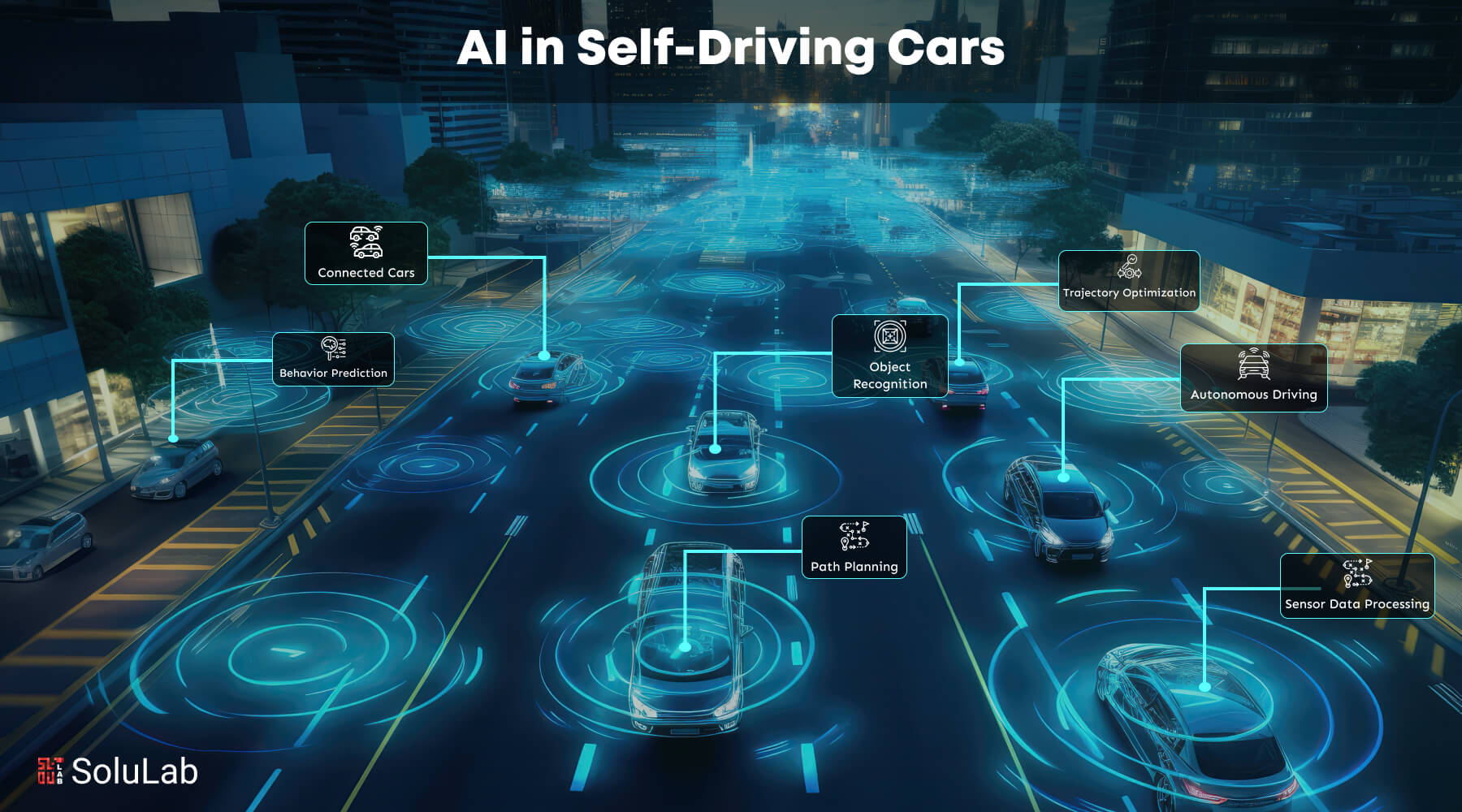
What if your next car could think, decide, and drive — all by itself?
No steering wheel, no pedals, just pure machine intelligence navigating the chaos of real-world roads. It’s not sci-fi anymore. With Artificial Intelligence (AI) powering self-driving cars, we’re entering an era where traffic jams could vanish, accidents could reduce, and commuting becomes smarter and safer.
The self-driving cars market was valued at USD 1.7 trillion in 2024, and is projected to reach USD 3.9 trillion by 2034, rising at a CAGR of 8.6%.
The addition of AI into automobiles enables them to see their surroundings and exercise critical thought. AI can interpret massive volumes of data by fusing sensors with processing capacity, allowing self-driving cars to negotiate challenging roadways and adapt to constantly shifting conditions.
In this blog, we’ll cover the various ways artificial intelligence is affecting self-driving technology and potential directions for transportation in the future. Let’s begin!
The Must-Know Features of AI in Self-Driving Cars
Self-driving cars are becoming a major focus for automotive brands. Technologies like responsible AI and ML are the way for these autonomous vehicles to lead the future of transportation.
Here are some key trends that highlight how AI in autonomous vehicle technology will shape the future of driverless cars:
1. Enhancing Connectivity with 5G: Self-driving cars are set to deliver an unmatched driving experience, offering connectivity for better communication and performance.
2. Improving Safety: With the help of sophisticated systems, AI-powered self-driving cars will keep learning from large amounts of data. These systems can detect traffic patterns and anticipate possible dangers, making roads safer for everyone.
3. Increasing Personalization: Brands like Porsche are stepping up personalization with features like the “Recommended Engine” system, which customizes vehicle options based on the driver’s preferences, creating a more tailored experience.
4. Transcending Limitations: AI in driverless cars is now advanced enough to suggest ideal configurations for various vehicle components, from body parts to engines and design, taking customization to the next level.
5. Semiconductors and OEM-based AI Chips: Semiconductors have already made a huge impact on automotive cars. When paired with AI in self-driving cars, these chips, along with OEM-based AI systems, enhance everything from autonomous driving to cruise control.
Role of AI in Self-Driving Cars
AI enables driverless cars to operate autonomously and safely. By combining AI with advanced sensors and algorithms, these vehicles can understand the environment around them. Here’s how AI contributes to the core functions of self-driving cars:
1. Predictive Modeling
AI-powered predictive modeling allows self-driving cars to anticipate and respond to various road conditions, traffic patterns, and potential hazards. By analyzing historical data and real-time inputs, these models help vehicles make accurate predictions, ensuring smooth and safe journeys.
2. Sensing and Perception
AI enhances the sensing and perception capabilities of self-driving cars by processing data from cameras, radar, and LiDAR sensors. This helps the vehicle detect obstacles, lane markings, pedestrians, and other vehicles, ensuring it can complex environments without human intervention.
3. Natural Language Processing
With the NLP application, self-driving cars can communicate more effectively with passengers. AI can understand voice commands, enabling hands-free control over vehicle settings and even real-time information about the trip.
4. Decision Making
AI in self-driving cars is crucial for decision-making, allowing them to assess situations, make informed choices, and take appropriate actions. Whether it’s adjusting speed, changing lanes, or responding to unexpected road conditions, AI algorithms ensure that the car makes quick, accurate decisions for maximum safety and efficiency.
With AI integration in these areas, self-driving cars are transforming how we approach mobility, making transportation safer, smarter, and more efficient.
Real-Life Examples of AI in Driverless Cars

Here’s a look at some of the leading brands that have leveraged AI to improve self-driving technology, enhancing transportation and delivering a better user experience:
1. Waymo
Google’s Waymo stands out as a leader in autonomous vehicle technology, thanks to its AI-powered system. It excels at tackling complex route planning, showcasing smart and adaptive reactions. Waymo’s use of cutting-edge AI has cemented its position as a pioneer in driverless car innovation.
2. Tesla Autopilot
Tesla’s Autopilot relies on advanced AI algorithms to make highly accurate decisions and maintain precise vehicle control. Beyond its technological prowess, Tesla’s relatively low Supercharger costs make it an appealing and eco-friendly transportation choice for users aiming for sustainability.
3. Cruise
Owned by General Motors, Cruise represents a significant advancement in autonomous driving technology. The Cruise AV employs a combination of Lidar, radar, and cameras, with nearly 40% of its hardware specifically for self-driving functionalities, making it a standout example in the field.
4. NVIDIA
NVIDIA has carved out a niche by developing sophisticated AI computing platforms for the automotive industry. Its Drive platform serves as a prime example of how advanced AI features can be integrated into self-driving car systems, setting a benchmark for innovation.
How AI in Self-Driving Cars Is Changing Travel?
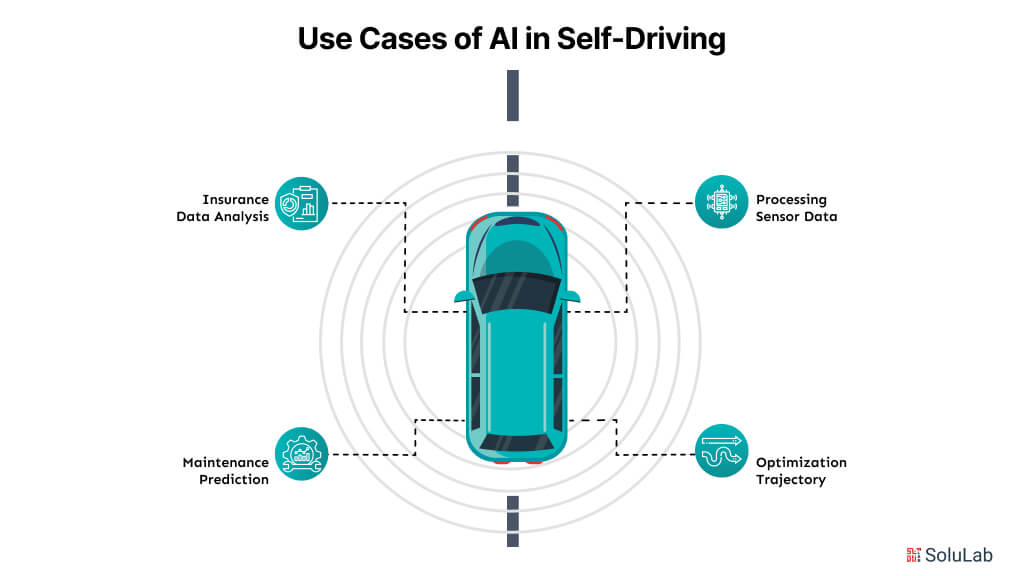
AI has made Self-driving cars safer, smarter, and more efficient. AI use cases let autonomous vehicles process massive volumes of data and make real-time judgments that humans cannot. AI in self-driving cars offers modern use cases:
- Processing Sensor Data: The blend of AI and automobile technology senses their environment utilizing cameras, radar, and LiDAR. The car recognizes barriers, pedestrians, other vehicles, and traffic signals in real-time using AI, ensuring safe driving in complex surroundings.
- Optimization Trajectory: Car trajectory is predicted and optimized by self-driving cars with AI systems. The AI and autonomous vehicles can compute the best route based on speed, distance, and traffic patterns, altering the car’s course to minimize collisions and enhance fuel efficiency.
- Maintenance Prediction: AI in self-driving cars predicts when vehicle parts may wear out or need maintenance. Over time, these can predict vehicle performance difficulties, minimizing breakdowns and extending vehicle life.
- Insurance Data Analysis: By analyzing self-driving car data, AI helps the insurance business estimate risk. It can assess driving behavior, accident patterns, and vehicle performance to help users set premiums and process claims more accurately, resulting in more customized insurance solutions.
How AI Algorithms Power Self-Driving Cars on the Road?
AI is one of the most important parts of making self-driving cars better and safer. Using different AI application solutions algorithms, these cars can process huge amounts of data. They can then make quick choices about how to guide roads, identify objects, and guess how people will act. These are some of the most important AI systems that make self-driving cars work:
1. Supervised Algorithms
- Object Recognition: Self-driving cars are taught to spot things in their environment, like people, other cars, traffic lights, and obstacles, using supervised learning algorithms. These systems label data ahead of time, which helps the car figure out what’s in its way and how to react.
- Modeling: Modeling algorithms that are driven by AI help simulate real-world driving conditions. This lets the car guess and model how different things and events might act on the road. This helps you make choices when driving in tricky situations.
- Behavior Prediction: AI algorithms also help self-driving cars guess what other people will do on the road, like figuring out what a pedestrian will do next or how a car will change directions. This ability to predict the future makes guidance safer and more accurate.
2. Unsupervised Algorithms
- Anomaly Detection: Unsupervised algorithms are used to find behaviors in the car’s surroundings that aren’t normal. In this case, the system might have to find things like obstacles or irregularities that it wasn’t taught directly but are necessary for safe travel.
- Clustering: Clustering algorithms help the self-driving car put together data points that are related. For example, they help the car figure out the different kinds of road signs or the patterns of traffic. This lets the car quickly figure out what to do in different cases.
- Feature Extraction: Feature extraction algorithms help self-driving cars find their way by figuring out important things about items and their surroundings. These programs can look at data from sensors like cameras and LiDAR and pull out useful information that can help you make better choices.
Self-driving cars can adapt to different driving situations, make the ride safer, and make things run more smoothly and quickly for passengers by using both supervised and unsupervised AI algorithms.
Future Trends of AI in Self-Driving Cars
As artificial intelligence and self-driving cars continue to evolve, the future of transportation is shifting rapidly. Here are the top trends shaping the next generation of AI in autonomous vehicle technology:
1. Hyper-Personalized Driving Experience
AI self-driving cars will use real-time data and predictive models to adapt to passenger preferences—climate control, music, and even driving style—making every ride personalized and seamless.
2. Advanced Decision-Making
The next wave of AI in driverless cars will integrate more powerful deep learning models to handle rare road scenarios, improve prediction accuracy, and reduce human intervention.
3. V2X Communication (Vehicle-to-Everything)
Self-driving car AI will increasingly connect with traffic signals, pedestrians, and other vehicles using V2X technology, making AI autonomous vehicles safer and more efficient in city environments.
4. Swarm Intelligence for Fleet Learning
Fleets of AI autonomous vehicles will learn collectively. What one vehicle experiences will be uploaded, shared, and used to upgrade algorithms across the network.
5. Human-AI Collaboration for Level 3/4 Automation
Transitional models will focus on AI in self-driving cars that can collaborate with humans for partial autonomy, enabling smoother adoption before full autonomy becomes mainstream.
6. Neural Networks with Edge AI
AI in autonomous vehicle technology is moving toward real-time decision-making on the edge (in-car systems), reducing reliance on cloud computing and improving reaction speed.
How Do Self-Driving Cars Make Decisions?
AI in self-driving cars relies on a combination of sensors, algorithms, and real-time data to make smart and safe decisions. Here’s how the process works in AI autonomous vehicles:
- Gathering Information through Sensors: Cameras, LiDAR, radar, and ultrasonic sensors help self-driving car AI understand the surroundings, detecting pedestrians, vehicles, traffic lights, and road signs.
- Creating a 360-Degree Environment Map: AI systems in driverless cars build a real-time 3D map of the road environment to track every moving and static object around the vehicle.
- Predicting the Behavior of Other Road Users: With machine learning models, AI in driverless cars forecasts what nearby drivers, cyclists, or pedestrians might do next, like turning or crossing the road.
- Path Planning and Route Selection: The car’s AI calculates the best route while adjusting for traffic, construction, and other road conditions—an essential feature of AI in autonomous vehicle technology.
- Handling Uncertain Situations: In fog, snow, or unexpected obstacles, artificial intelligence and self-driving cars use deep learning to weigh all possibilities and pick the safest action.

Conclusion
With intelligent decision-making, real-time responsiveness, and advanced autonomous vehicle sensors, AI in self-driving cars is set to make roads safer and businesses more efficient.
Still, fully autonomous operations require continuous and complex AI training. As AI in autonomous vehicle technology evolves, it will play a major role in reshaping the automotive industry.
At SoluLab, a leading AI development company in USA, we’re already helping businesses embrace this AI-driven future. Recently, we helped a travel company integrate an AI-powered chatbot to manage high query volumes, reduce response time, and deliver personalized travel recommendations, enhancing the user journey from start to finish.
If you’re exploring how AI and autonomous vehicles can elevate your business, SoluLab is here to help. Let’s connect and drive your innovation forward—get in touch today!
FAQs
1. What types of AI are used in driverless cars?
Self-driving car AI includes deep learning, computer vision, sensor fusion, and natural language processing to simulate human driving behavior.
2. Can AI in autonomous vehicle technology prevent accidents?
Yes, AI in driverless cars can detect potential collisions and hazards faster than human drivers, helping prevent accidents through automatic braking, lane corrections, and adaptive cruise control.
3. What are the key components of artificial intelligence and self-driving cars?
Key components include perception (identifying surroundings), prediction (estimating behavior of other road users), and planning (deciding on the best driving path).
4. Will AI in driverless cars replace human drivers?
While AI and autonomous vehicles are advancing rapidly, they’re more likely to assist or augment human drivers for the foreseeable future, especially in commercial and logistic sectors.
5. How can businesses benefit from AI in self-driving cars?
Companies can enhance logistics, reduce delivery times, and improve safety by adopting AI self-driving car technologies, especially in fleet and transportation operations.

