

- AI Development
- AI App Development
- AI Consulting
- AI Software Development
- ChatBot Development
- Enterprise AI ChatBot
- AI Chatbot Development
- LLM Development
- Machine Learning Development
- AI Copilot Development
- MLOps Consulting Services
- AI Agent Development
- Deep Learning Development
- AI Deployment Services
- Deep Learning Consulting
- AI Token Development
- AI Development Company
- AI Development Company in Saudi Arabia
- AI Integration Services
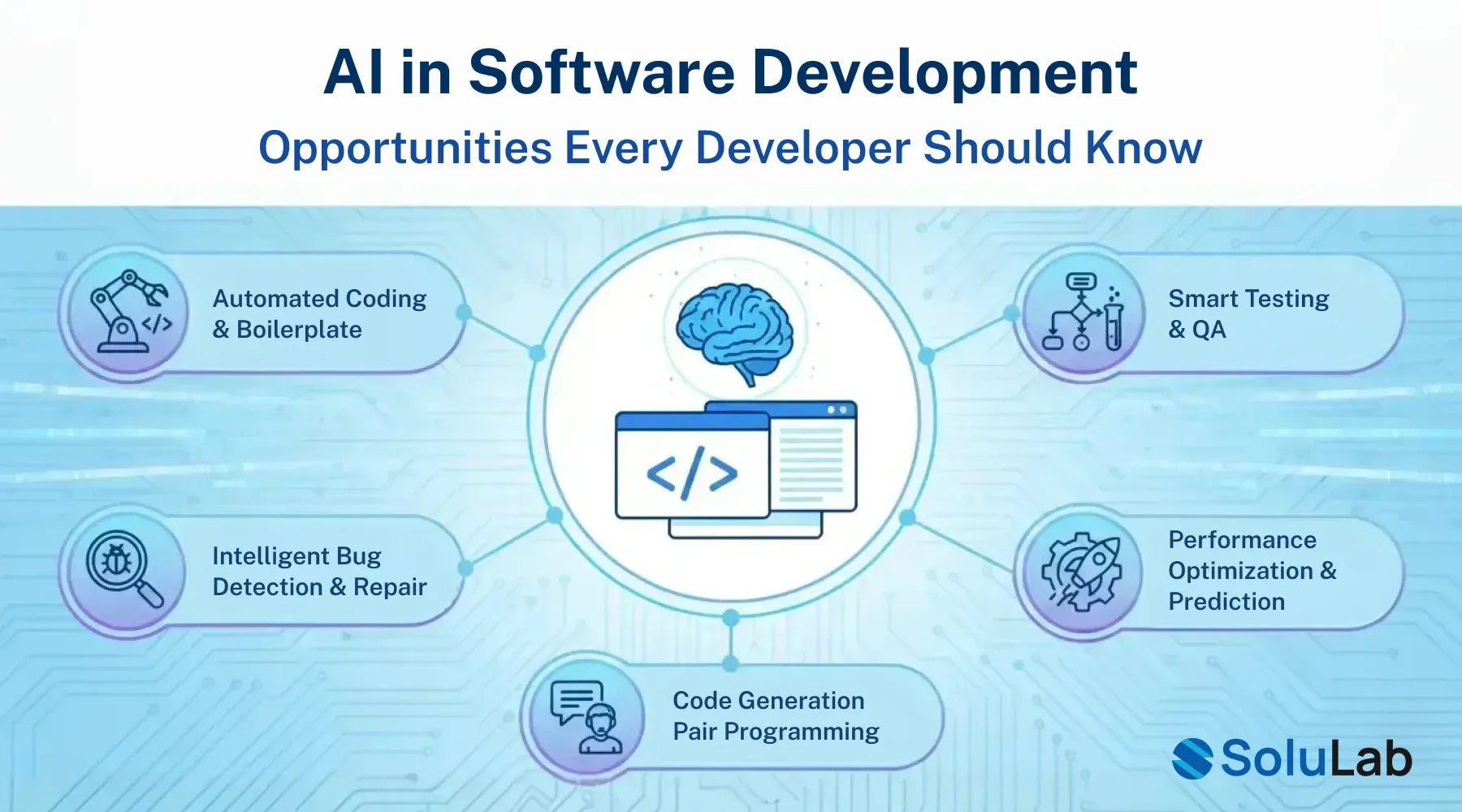
AI is changing the way software gets built. Developers no longer need to spend hours writing code from scratch, scanning for bugs, or manually detecting errors. With AI tools, everything from coding to debugging to testing becomes faster, smarter, and far more efficient.
However, developers who use AI will move ahead, and those who don’t will slowly fall behind. As new tools are coming, using AI isn’t just an advantage anymore; it’s becoming a necessity. Moreover, it brings real concerns around data privacy, high infrastructure costs, skill gaps within teams, and the unpredictable “black box” nature of AI decisions.
In this blog, we’ll explore what AI software development offers and the challenges you must be aware of. By the end, you’ll know exactly how to use AI responsibly and effectively in your workflow.
What Is AI for Developers?
AI in software development means the application of AI technology, software models, and algorithms to create software more quickly, intellectually, and with a reduced number of repetitive processes. Developers can create and modify code, debug, analyse data, test an application, and even optimise performance without manually typing each line of code; developers can use artificial intelligence to do this.
84% of developers have already or intend to use AI-based tools in their development process. To sum up, AI can be a beneficial productivity assistant, eliminating mistakes and enabling developers to spend more time on problem-solving and creativity instead of routine tasks.
How AI is Changing Software Development?
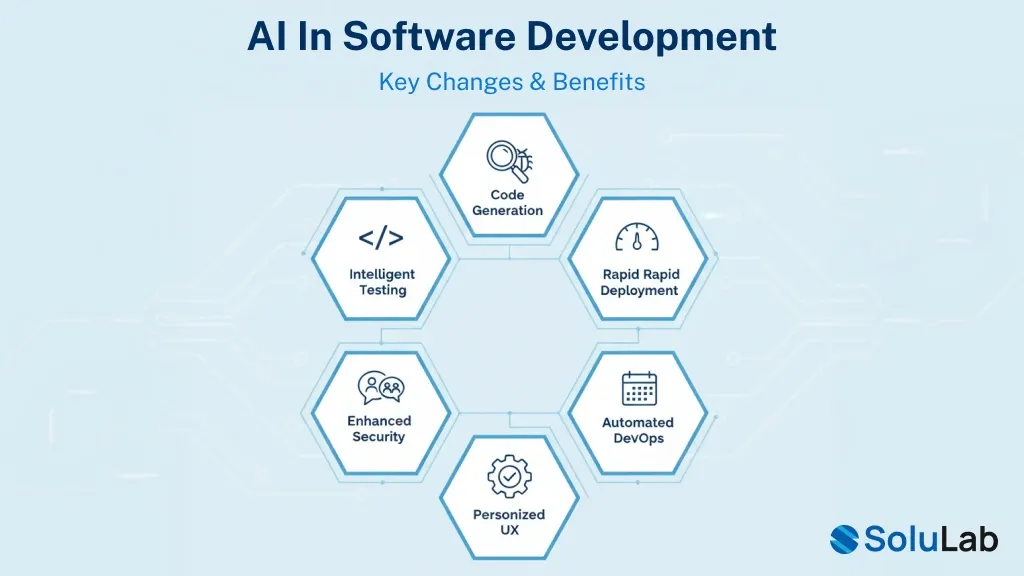
With the use of AI software development tools, developers no longer need to spend hours on repetitive tasks. Here are some ways AI is changing software development:
- Development of Code: AI-based development tools can generate code as well as provide function suggestions and complete logic automatically. This results in a substantial reduction in the manual labor required to perform these tasks and enables developers to spend more time on high-level problem-solving activities.
- Improved Development Testing: AI-based tools identify errors in the application early and identify potential bug patterns in the code through pattern analysis. The AI tool will also recommend solutions to bugs and will help significantly reduce the time developers spend debugging, and improve the overall quality of their application.
- Rapid Automated Application Testing: AI-based tools create test cases, run the test cases, and highlight any areas where the application does not meet the defined requirements of the application much quicker than traditional manual testing methods.
- More efficient Project Planning: AI forecasts schedules, determines workload trends, and estimates the resource requirements. This contributes to better planning of teams and the elimination of unnecessary delays.
- Improved Security: AI identifies holes, suspicious patterns, and weak areas in the code. It aids in cyberattack prevention because it detects the risks in advance before they become severe.
- Enhanced User Experience: AI assists the developers in personalizing an application, reviewing user behavior, and streamlining interfaces. The result is smoother and more user-friendly user experiences.
- Automated DevOps: AI automation can replace manual processes throughout the deployment and monitoring procedures in the development pipeline, decreasing human labor and enhancing its efficiency.

Benefits of AI in software development
Artificial intelligence (AI) is creating new ways for software developers to get their jobs done by doing it quicker, smarter, and more efficiently. It’s changing how developers write code; improve the quality of that code, boosting their productivity, and creating better software products using less effort.
- Coding Development: AI can provide a developer with pre-written code blocks, suggest possible fixes to coding problems, or automate repetitive coding tasks, allowing the developer to develop software features much faster than before the use of AI; as well as reduce the total amount of time required to complete the development of all software features.
- Higher Quality Software: AI will scan for bugs, weaknesses, and potential errors in software that has been developed, before those potential issues become serious problems for the end-users of that software; thereby providing a higher quality product at the end of the development cycle.
- Data Driven Decisions: AI can analyze large amounts of data from multiple sources, such as user activity, software performance metrics, and other data, to help developers make good business decisions regarding which software features to add, what changes to make to the software, etc.
- More Efficient Testing: AI can automate testing of software, find defects in software that were previously missed during testing, and improve test coverage; thereby reducing the amount of time and resources needed to ensure that software is properly tested.
- Improved Project Management: AI can predict when delays may occur; assist in allocating resources more effectively; and provide developers with the ability to monitor the progress of projects, thereby assisting in managing the overall efficiency of the project development life-cycle.
- Reduced Costs: By performing many of the repetitive tasks associated with developing software and reducing the number of errors made by humans, AI can reduce the cost of developing software while also increasing the overall productivity of the development team.
Read More: What is Custom Software Development?
Opportunities of AI in Software Development
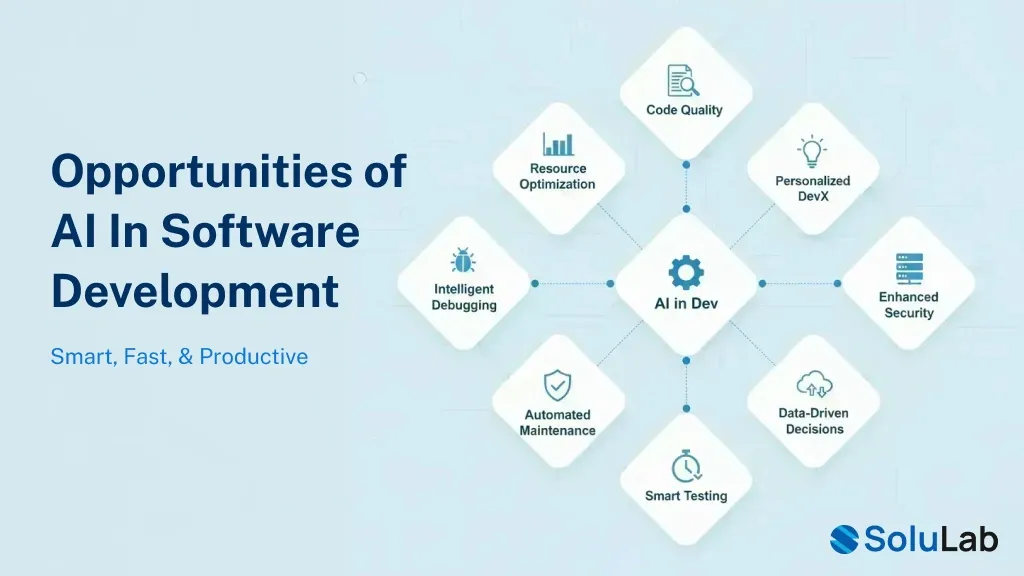
AI is also creating huge possibilities in the field of software development by making the code smarter, faster, and more productive. AI is now reshaping the way developers create and scale applications, whether it’s by improving their quality in code or increasing the level of security.
1. Increased Code Quality and Reliability
AI tools automatically read your code, find the mistakes, propose new ways to improve it, and keep it consistent. This assists the developers to write better code, minimize bugs early, and produce more assured software without having to spend extra hours doing manual reviews.
2. Constant Debugging and Problem Remedy
AI keeps track of applications, identifies problems immediately, and even suggests solutions. This will minimize the downtime, accelerate the debugging process, and allow developers to have more time to work on features rather than debugging and fixing problems.
3. Effective Distribution of Resources
The AI is used to analyze workloads and optimize the utilization of resources among servers, cloud platforms, and development environments. This assists teams to save on cost, eliminate over-provisioning, and have their applications run to their optimum.
4. Individualized Development Experiences
Intelligent programming assistants learn the personal style of the developer, provide customised recommendations, shortcuts, and learning hints. This improves productivity and makes even the junior developers work like professionals with intelligent assistance.
5. Smart Testing and Quality Assurance
AI automates the creation of test cases, determines the problematic areas of code, and performs testing at a higher rate. It minimizes the labor used in manual testing, accelerates the release process, and guarantees the quality of products.
6. Automated Maintenance and Optimization
AI ensures software is kept up-to-date through the detection of performance problems, the removal of non-functional code, and algorithm optimization. This makes it long-term stable, and the routine maintenance tasks are minimized.
7. Data-Driven Decision Making
AI analyzes high volumes of development and user data to assist the teams with making smarter decisions. It brings out trends, projects bottlenecks, and proposes the most optimal actions to make necessary improvements on the product.
8. Security Detection and Prevention
AI is able to detect vulnerabilities, abnormal activities, and possible attacks before they inflict harm. It keeps learning the new threats and assists the developers in creating more secure and safer applications.
Read More: Top 10 Questions to Ask Before Outsourcing AI Development
Challenges of AI in Software Development
The benefits of AI in software development are enormous, and new difficulties are being introduced. Regarding data privacy concerns to addiction to the system, developers have to learn about these shortcomings and correct them using appropriate measures.
1. Data Privacy & Security Risks
The AI models rely greatly on user information and are prone to leaks and abuse. Sensitive information may be compromised without the right protection. To make AI safe, developers can fix it by encrypting data, limiting access, and anonymizing inputs.
2. Large Dependence on Training Data
The AI will provide inaccurate findings in case the training data is biased or of low quality. To address it, developers need to constantly update datasets, eliminate biases, and test the information to make the AI stable and just.
3. Transparency Lack (Black Box Issue)
Complex AI models resemble black boxes, and they are difficult to learn how to work internally. This reduces trust. The cure is to apply XAI tools showing decision pathways, which allows transparency and increased debugging.
4. Integration Problems with Current Systems
The old systems were not constructed to support AI, the result being a compatibility factor. This can be addressed by the developers through API-based integration, modular design, and adding AI features slowly rather than replacing everything at once.
5. Expensive AI Infrastructure
The costs of training and maintaining AI models may be high because of the need for a GPU and storage. Teams are able to save money through moving to scalable cloud services, open-source frameworks, and unwarranted complexity in models.
6. Critical Skills in Development Teams
AI requires the emergence of new technical skills that a significant number of developers might not possess. As a solution, it is possible to offer companies upskilling, implement low-code AI, and recruit experts who can lead the team.
7. Ethical & Bias Concerns
Artificial intelligence is biased when it is trained on unjust sources. This can be corrected by developers through introducing fairness tests, scrutinizing ethical risks, and developing rules that prohibit discrimination when using AI-based functionality.

Conclusion
AI is enhancing software development by automating workflows, improving code quality, strengthening security, and enabling smarter decision-making. While the opportunities are massive, from automation to predictive analytics, the challenges are equally important to acknowledge.
Data privacy, integration complexity, and expensive infrastructure costs demand strategic planning. Early adopters of AI will build faster, innovate fearlessly, and remain ahead. Digital Quest, a travel business, partnered with SoluLab to develop an AI-powered chatbot using Generative AI. The chatbot enhanced customer engagement by offering real-time, personalized travel recommendations and hassle-free reservations. SoluLab is an AI development company that helps you make smart, safe, and scalable solutions that fit your demands. Book a free discovery call!
FAQs
1. Do developers need new skills for AI?
Yes, understanding ML basics, data handling, and AI tools helps a lot. But low-code AI tools make it easier for beginners.
2. How does AI help in software testing?
AI generates test cases, finds risky code areas, predicts failures, and automates repetitive tests, reducing manual workload and improving accuracy.
3. Does AI reduce development costs?
Yes. AI cuts costs by reducing bugs early, optimizing resources, and automating tasks. However, initial setup and training may require some investment.
4. What is custom AI software development?
It refers to building AI-powered software specifically tailored to a company’s needs, including custom models, automation workflows, and intelligent features.
5. Which is the best AI for software development?
Tools like GitHub Copilot, Tabnine, and CodeWhisperer are widely used. The “best” depends on your budget, programming language, and workflow.
6. What is AI-based software development used for?
It is used for code generation, bug prediction, performance optimization, automation, and smart security detection to build scalable and intelligent applications.

