Talk to an Expert

How AI Agents Are Personalizing Insurance for Smarter Decisions?

AI Agents in Insurance

Insurance as an industry works on data and risk evaluation. Functions like underwriting, claims processing, and customer service– all depend on how accurately insurers can assess and manage risk. 

Wherein traditional methods struggle to keep up with the growing complexity and volume of data, resulting in slow processes, impersonal policy recommendations, and a less-than-ideal customer experience. Artificial Intelligence (AI) is improving it all. AI is crucial in helping insurers move from a reactive to a proactive model. Its ability to process and analyze vast amounts of data in real time enables insurance providers to deliver more accurate, personalized, and timely services.

Insurers utilizing AI for personalized services have observed a 15–30% increase in customer satisfaction, owing to more accurate risk profiling and tailored policy offerings. In this blog, we’ll explore how AI agents are personalizing and shaping the future of insurance and what this means for insurers and policyholders.

Let’s begin!

What are AI Agents in Insurance?

AI Agents in Insurance are intelligent systems often powered by machine learning, natural language processing (NLP), and automation that perform tasks traditionally handled by human insurance agents. These AI agents can operate independently or assist human agents in tasks across the entire insurance lifecycle. AI agents are constantly learning, evolving, and becoming capable over time.

AI can recognize trends in large datasets and anticipate possible hazards before they materialize. Their customer service, claims processing, risk assessment, and fraud detection functions make them essential tools to improve insurance industry efficiency, accuracy, and consumer satisfaction. AI in the insurance industry with AI chatbots can now provide basic answers around the clock, walk you through policy specifics, and even handle basic transactions.

How AI Agents in Insurance Work?

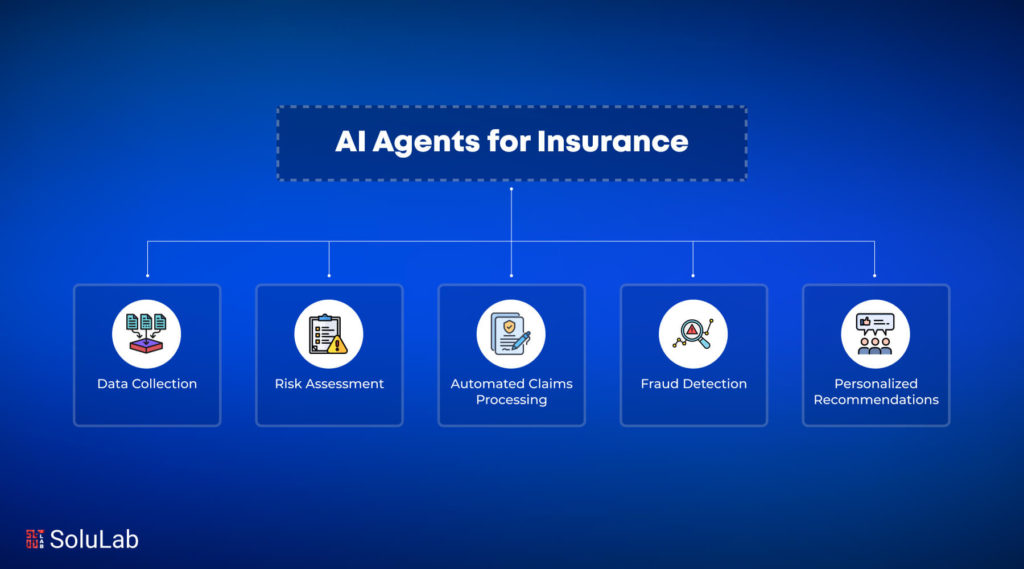
AI Agents work by automating and enhancing key processes, leading to more accurate risk assessments, pricing, and improved experiences. Here’s how AI Agents in Insurance work:

1. Data Collection

AI Insurance agents can gather information using data from various sources, this includes customer applications, medical records, public records, and history. AI Agents for Insurance algorithms analyze this data to identify patterns, correlations, and risk factors that humans might miss this includes predictive modeling, clustering, and natural language processing.

2. Risk Assessment

Insurance Agents with Artificial Intelligence can work on the analysis of a vast amount of data and can work on creating more accurate risk profiles for customers. This enables insurers to offer personalized premiums, identify high-risk individuals, and reduce underwriting bias.

3. Automated Claims Processing 

AI for insurance agents can automate tasks like initial claim assessment, document verification, and payment processing. This has its benefits like reduced waste times, improved customer satisfaction, minimized automation, fewer errors, and consistent application of policies 

4. Fraud Detection

It is easy for AI for life insurance agents to detect fraudulent claims by analyzing patterns in data, such as inconsistencies in claim narratives or unusual claims. AI Agents in Insurance help insurers reduce losses and protect their bottom line. These suspicious patterns can be frequent claims for the same individual or group and discrepancies between claim descriptions and supporting.

5. Personalized Recommendations 

AI tools for insurance agents help with customer data analysis to recommend insurance products that best suit their individual needs and circumstances. This assists insurers to improve customer satisfaction and loyalty. Understanding customer needs based on analysis can help AI for customizing insurance policies, and personalizing communication resulting in improved customer loyalty.

AI Solutions

Benefits of Using AI Agents for Insurance

Adopting AI in the insurance industry brings a variety of benefits not alone for insurers but also for policyholders:

1. Improved Accuracy and Efficiency

AI is great for automating repetitive tasks that take a toll on such agents. Usually, it is seen in intro clerical jobs that entail digit entry, documentation, and responding to basic consumer inquiries, artificial intelligence insurance also allows human agents to spend more time-solving complex issues and providing customers with specific attention. capable of processing massive amounts of data to identify patterns and trends to enhance traditional insurance processes.

2. Customized consumer Experience

An example of a business process that can be provided by AI agents in finance is insurance policies tailored to meet the customer’s needs and how much s/he is willing to take. This has the double benefits of happier customers and better risk selection for the insurance company. The insurance company can provide 24/7 help, answering common questions and helping clients with their insurance.

3. Cost Reduction and Fraud Detection

It can be noted that AI for life insurance agents algorithms can be trained in an even better way to detect false claims. Such AI systems can shave millions of dollars off insurance companies’ costs as they help to evaluate previous information on fraudulent claims and suspicious trends.

4. Innovation and Product Development

This might help insurance agent AI to analyze enormous amounts of data and provide insightful observations about trends and demands of the markets. This allows insurers to develop new products and services that are innovative and geared toward some segments. For instance, AI can be applied, for example, usage-based insurance where one will be charged depending on how safe.

Applications of AI Agents in Insurance
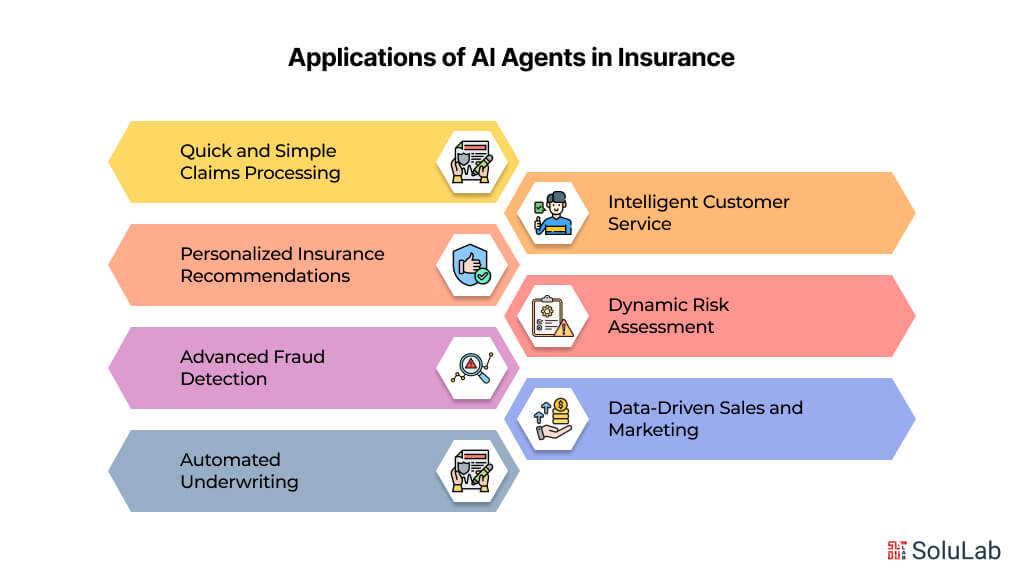
Application of AI Agents in Insurance

AI Agents for Insurance are shaking things up by automating tasks, and building intelligent services. Here are use cases of AI and insurance:  

1. Quick and Simple Claims Processing

Technology plays a crucial role and with the applications in the insurance industry, it is possible to offer clients a chance to file claims in an instant, collation of other important details including the verification of the claims and even the beginning of the repair estimates.

2. Personalized Insurance Recommendations

AI Agents in Insurance are used to analyze customer data, including demographics, driving history, health records, and lifestyle choices to assess risk more accurately. This allows insurers to offer personalized premiums based on individual risk profiles, leading to fairer pricing and improved customer perception. This enables customers to receive valuable options for specific needs.

3. Intelligent Customer Service

It could be termed that with the use of AI-powered chatbots, clients can get quick assistance in answering some basic insurance queries, locating particulars related to policies, and undertaking basic solved procedures and self-serving facilities at any time and from any location that the client may opt for.

4. Advanced Fraud Detection

Cautiously, the same database analysis can be presented as an attempt to find specific trends or inconsistencies that may point to the fact that the case is filled with false statements. The use cases of AI agents insurers by pointing out the activities on which they should or could concentrate more.

5. Dynamic Risk Assessment

The features, traffic, and climate of several automobiles can be considered by the real-time data to result in lively risk analysis with the help of artificial intelligence insurance. It allows insurers to set rather reasonable tariffs and will most probably stimulate safe behavior.

6. Automated Underwriting

Using insurance agent AI in underwriting can ease the underwriters’ burden and make the underwriting process quicker, assisting in delivering answers sooner so that these personnel can concentrate on more complicated issues.

7. Data-Driven Sales and Marketing

AI Agents for Insurance may use customer details to determine the place where the insurance products may be advertised and sold alongside the appropriate marketing texts that will reach the correct persons at appropriate times.

Changes AI Agents are Bringing in Insurance 

There are sophisticated solutions known as Artificial Intelligence (AI) that are changing not only the bureaucratic insurance companies’ processes and methods of interacting with customers. These are some of the main adjustments that AI agents are bringing about:

1. Transitioning from Reactive to Proactive

Insurance has been mostly claim-based which means that it goes into action when events happen and claims are filed. Due to the interventions offered by AI Insurance agents, one can take a more proactive approach. AI can monitor all the signs in a system that may be associated with potential threats before these threats become detectable. Think of getting specific recommendations on your health depending on the wearable data that you have or a reminder to alert you of the need to service your car depending on the trends in your driving.

2. Customized Insurance

Chances Insurance that fits all people well is starting to fade away. To create a unique risk score for each consumer, the AI for life insurance agents can analyze specific pieces of information like driving history, passenger’s health, and even data from the smart house. This evolves into individual insurance solutions that meet specific needs, or ensure that you are not being overcharged for the insurance.

3. Frictionless Claims Processing

Endless questionnaires and hours-long talks on the phone are no longer a thing of the future. Other Appropriate Insurance Agents with Artificial Intelligence is revolutionizing that procedure. Of course, the use of a smartphone camera may let one instantly file a claim with the app, and the underlying AI would gather information, verify a claim, and even launch the repair estimate. Contained herein are the key changes that make it easier to manage and work or operate the company, free from bureaucratic intervention, paperwork, delay in payments or settlements, and tough situations.

4. AI-powered Customer Support

It can be annoying to wait on hold for a customer support agent. Chatbots with AI are altering that. These virtual assistants can manage simple transactions, walk you through the terms of your policy, and respond to your basic insurance questions around the clock. In addition to offering prompt assistance, this frees up human agents for more intricate client engagements.

5. Improved Fraud Detection

Insurance companies face a major obstacle as a result of fraudulent claims. In this battle, AI has the potential to be quite effective. AI for life insurance agents algorithms can detect suspicious patterns and warning signs with remarkable accuracy by examining past data on fraudulent claims. This saves insurers millions of dollars by enabling them to flag questionable claims for additional examination.

What Does the Future of AI Agents Look Like in Insurance?

It is expected that AI agents in the insurance sector will develop and broaden their skills and uses in the future. The following are some possible future trends:

1. Explainable AI: The need for explainable AI models will grow as AI agents grow in crucial decision-making procedures such as claims processing and underwriting. 

2. Custom Insurance Solutions: AI agents will use machine learning and advanced analytics to provide highly customized insurance services and products based on the requirements, preferences, and risk profiles of each consumer.

3. Telematics and Internet of Things (IoT): AI agents will easily interface with telematics systems and IoT devices to collect real-time information about insured assets, including equipment, homes, and cars. 

4. Natural Language Processing (NLP): As AI agents develop their natural language processing skills, they will be able to engage with clients in more conversational and organic ways. 

5. Collaborative intelligence: AI agents will work with human specialists like analysts, claims adjusters, and underwriters. By combining the advantages of AI and human experience, this collaborative intelligence will provide more precise and informed decisions.

6. Ethical AI: There will be an increasing focus on creating ethical AI frameworks and adherence to legal requirements for dealing with concerns about algorithmic bias, data privacy, and accountability.

These upcoming developments show how AI agents can alter the insurance sector by improving risk assessment, client satisfaction, operational effectiveness, and decision-making procedures in general.

Connect Now

Take Away

AI agents are set to redefine personalized risk evaluation in insurance by making assessments smarter, faster, and more accurate. With access to real-time data, behavioral patterns, and advanced analytics, insurers can now tailor policies to individual needs rather than relying on broad risk categories. 

This shift not only improves customer experience but also enhances underwriting precision and fraud detection. While human oversight remains crucial, AI agents will continue to handle complex tasks with greater autonomy. SoluLab, a leading AI agent development company in USA, is a dedicated team of expert professionals backed by years of experience and technical prowess. Even though we got a chance to develop a project on health insurance powered by AI , resultingly processing time was reduced by 70% and held financial benefits also.

SoluLab is a dedicated team of AI and finance experts ready to help you with all your queries. Get in touch with us today!

FAQs

1. What roles do AI agents play in improving the client satisfaction of insurance services?

AI-enabled chatbots attempt to supplement consumer support 24/7 to respond to most of the queries and help users with policy-related information. In addition, insurance as a service can be advised and claims processed by AI through AI apps hence enhancing the general flow of insurance.

2. In what ways can Artificial Intelligence help insurance risk management?

AI brings the advantage of real-time risk evaluation since it can consider big volumes of data, current traffic, and weather conditions, for instance. This makes it efficient for insurance firms to afford fair tariffs and possibly promote effective conduct such as safe driving.

3. Will AI replace insurance agents?

No. They will work like more of smart companions, AI agents perform repetitive work and provide the first contact. This means freeing up the human agent’s time for tackling complex problems, personal one-on-one correspondence, and enhancing their relations with clients on average.

4. What may be the possibilities of applying AI in insurance risk management?

Hence, AI offers a more multifaceted risk analysis, one that is capable of deploying not only in raw data but also in the actual real-time inflow of data such as traffic and weather conditions. This in turn allows insurance organizations to offer more fair tariffs and in the future – safe behaviors such as proper driving.

5. How can SoluLab help insurance companies with AI Agents?

At SoluLab we design efficient insurance solutions, These solutions will help you identify potential fields that require the integration of the best AI for insurance agents with your company’s operations, create new products, and gradually apply to liberalize the insurance market for your enterprise.

How to Build an AI Agent System?

Build AI Agent System

The combination of work and technology is growing, driven by advancements in artificial intelligence. As businesses and organizations seek to harness the power of AI to increase productivity and efficiency, the development of AI agent systems has become a crucial focus. With the potential to automate a significant portion of tasks—indeed, two-thirds of jobs could be partially automated by AI—these systems are set to transform industries. However, rather than completely replacing human roles, many of these jobs will be complemented by AI, allowing human workers to focus on more complex and creative aspects of their work.

In recent years, the AI industry has witnessed explosive growth. The global AI market size, which was close to $208 billion in 2023, is projected to surge to nearly $2 trillion by 2030. This expansion reflects the increasing integration of AI technologies across various sectors. This shift highlights the importance of developing AI agent systems that can seamlessly work alongside human teams, optimizing performance and driving innovation.

In this blog, we will learn the process of building an AI agent system, exploring key considerations that can help you experience this technology to its fullest potential.

What is an AI Agent?

Artificial Intelligence (AI) agents are software systems programmed to execute tasks autonomously. They make decisions based on their programming and the data they ingest. AI agents can be as simple as repetitive task-performing programs or as sophisticated as machine learning systems that learn and adapt over time through the application of machine learning algorithms.

AI agents find applications in various sectors. In customer service, they manage chat interfaces, providing automated responses. In healthcare, they assist in patient management by scheduling appointments and reminding patients about medication intake. In finance, AI agents monitor markets, execute trades at optimal times, and maximize profits. 

In the corporate context, agents in AI are now considered the most reliable helping hand that businesses can use to perform mundane jobs that consume 62% of a workday. 

Artificial agents offer businesses a valuable opportunity to optimize their workforce by handling tasks such as customer inquiries, data analysis, and standardized actions, thereby freeing up human employees for more complex and creative tasks.

The effectiveness of AI agents depends on their design, the quality of accessible data, and the efficiency of employed algorithms. Their versatility and value make them indispensable in different industries, enhancing efficiency and aiding in sound decision-making. A Twitter user named Patrick Dougherty has defined AI agents like:

It is equally important to highlight that an AI agent is not:

  • Scripted: Agents do not follow a pre-defined sequence of steps or tool calls. Instead, they are responsible for choosing the right tool call to make next.
  • Artificial General Intelligence (AGI): Agents are not AGI. An AGI would not need agents for specific types of work because it would be a single entity with access to all possible inputs, outputs, and tools. Current technology is far from reaching this level of intelligence.
  • Black Box: Agents should demonstrate their work in a manner similar to how a human would if delegated tasks. Transparency and accountability are crucial in understanding and evaluating agents’ actions.

Types Of AI Agents

Types Of AI Agents

Artificial Intelligence (AI) agents have came up as game-changers in various industries, automating repetitive tasks, optimizing workforce efficiency, and enhancing decision-making. These software systems are designed to execute tasks autonomously based on their programming and data ingestion. AI agents can range from simple task-performing programs to sophisticated machine learning systems that learn and adapt over time.

1. Simple Reflex or SR AI Agents 

Artificial intelligence (AI) agents are computer programs that can perform tasks typically requiring human intelligence. AI agents are becoming increasingly prevalent in various industries, including business, healthcare, and finance. Among the different types of AI agents, Simple Reflex (SR) agents are some of the most common and widely used.

SR agents operate based on condition-action rules, which means they take a specific action when a certain condition is met. These rules are typically defined by human experts or derived from data. SR agents are relatively easy to develop and implement, making them accessible to businesses of all sizes.

An SR agent consists of several components:

  • Agents: These are the responsible AI entities for making decisions and taking actions.
  • Actuators: These are the components that allow the agent to interact with its environment, such as motors, wheels, or speakers.
  • Sensors: These are the components that allow the agent to perceive its environment, such as cameras, microphones, or temperature sensors.
  • Environment: This is the physical or virtual world in which the agent operates.

One of the key advantages of SR agents is their ability to discard historic precepts while making decisions. This means that they can make decisions based solely on the current situation, without being influenced by past events. This can be particularly useful in dynamic environments where the conditions can change rapidly.

Here are some examples of how SR agents are being used in businesses today:

  • Customer service chatbots: These chatbots can answer customer questions, provide product recommendations, and resolve complaints. They are typically trained on a large dataset of customer interactions.
  • Fraud detection systems: These systems can identify potentially fraudulent transactions by analyzing purchase patterns and other data. They are often used by banks and credit card companies.
  • Inventory management systems: These systems can track inventory levels and reorder products when necessary. They are used by businesses of all sizes to ensure they have the products their customers want in stock.

Read Also: AI Agent Development on Azure

2. Model-Based AI Agents

Model-based AI agents are a type of AI agent that is known for making quick, rules-driven decisions by incorporating a deeper understanding of the surroundings. These agents are able to do this because they maintain a model of the world in their memory, which they use to reason about the best course of action. One of the key advantages of model-based AI agents is that they are able to learn from their experiences. As they encounter new situations, they update their model of the world to reflect the new information. This allows them to make better decisions in the future, as they are able to take into account the lessons they have learned from the past.

Another advantage of model-based AI agents is that they are able to handle complex tasks. This is because they are able to use their model of the world to reason about the different ways that a task can be completed. This allows them to choose the best course of action, even when the task is complex or unfamiliar. However, One disadvantage is that they can be computationally expensive to run. This is because they need to maintain a model of the world in their memory, which can be a large and complex data structure. Another disadvantage is that model-based AI agents can be brittle. This means that they can make poor decisions if their model of the world is inaccurate.

Here are some specific examples of how model-based AI agents can be used:

  • Self-driving cars: Model-based AI agents can be used to help self-driving cars navigate their environment. The agents can use their model of the world to identify obstacles, such as other cars, pedestrians, and traffic signs. They can then use this information to make decisions about how to navigate around the obstacles safely.
  • Robotics: Model-based AI agents can be used to help robots perform complex tasks, such as assembling products or cleaning up a room. The agents can use their model of the world to understand the environment and the task that needs to be completed. They can then use this information to plan and execute a sequence of actions that will complete the task.
  • Healthcare: Model-based AI agents can be used to help doctors diagnose diseases and develop treatment plans. The agents can use their model of the human body to understand the symptoms of a disease and the different ways that it can be treated. They can then use this information to make recommendations about the best course of treatment for a patient.

3. Goal-Based AI Agents

Goal-based agents are a type of artificial intelligence (AI) that businesses can develop to meet specific objectives. These agents use decision-making algorithms to understand the best course of action based on the information they have learned from their surroundings. One of the best use cases for goal-based agents is to predict future trends. These agents can analyze large amounts of data to identify patterns and relationships that may indicate future events. This information can be used to make informed decisions about product development, marketing, and other business strategies.

Another use case for goal-based agents is to promote optimized resource allocation. These agents can help businesses identify the most efficient way to use their resources, such as time, money, and personnel. This can lead to significant cost savings and improved productivity.

Goal-based agents can also be used for automated designing. These agents can generate creative and innovative designs based on the input they receive. This can save businesses time and money by eliminating the need for human designers. Goal-based agents can be used for personalized marketing. These agents can track individual customer behavior and preferences to create targeted marketing campaigns. This can lead to increased sales and improved customer satisfaction.

Examples of Goal-based agents:

  • Virtual Personal Assistant: A virtual personal assistant, like Amazon’s Alexa or Google Assistant, is a goal-based agent that aims to assist users with their daily tasks. Its goals include; Answering user queries, Setting reminders and calendar events, Controlling smart home devices, Playing music or videos
  • Autonomous Vehicle: An autonomous vehicle, like Waymo or Tesla’s Autopilot, is a goal-based agent that aims to transport passengers safely and efficiently. Its goals include; Reaching the destination, Avoiding obstacles and collisions, Following traffic rules and regulations, Optimizing route planning
  • Customer Service Chatbot: A customer service chatbot, like those used in e-commerce or banking, is a goal-based agent that aims to resolve customer inquiries and issues. Its goals include; Answering customer questions, Resolving customer complaints, Providing product recommendations, Routing complex issues to human representatives

4. Utility-based AI Agents

Utility-based AI agents are highly sophisticated artificial intelligence agents capable of making decisions based on a specific value or utility function. They are designed to make the most advantageous choices for predefined tasks or utilities, such as resource allocation and strategic planning. Their unique ability to ensure optimal decision-making at each repeated step sets them apart from other AI agents. One of the key strengths of utility-based AI agents is their ability to handle a wide range of problems. They can be applied to various domains, including finance, healthcare, and manufacturing. In each of these domains, utility-based AI agents can provide valuable insights and recommendations to help humans make better decisions.

Another advantage of utility-based AI agents is that they offer an objective framework for decision-making. Unlike human decision-makers, utility-based AI agents are not influenced by personal biases or emotions. This objectivity can lead to more rational and consistent decisions. However, it’s important to note that utility-based AI agents are not without limitations. One of the main challenges with utility-based AI agents is that they require additional oversight. This is because utility-based AI agents can only make decisions based on the information they are given. If the information is incomplete or inaccurate, the agent’s decisions may not be optimal. Additionally, utility-based AI agents can be computationally expensive. This is because they often require a large amount of data and processing power to make decisions. This can make them impractical for use in real-time applications.

Here are examples of utility-based agents:

  • Recommendation System: A recommendation system, like Netflix or Amazon’s product recommendations, is a utility-based agent that aims to suggest items that maximize the user’s satisfaction. Its utility function includes; User preferences and ratings, Item attributes and features, and Contextual information (e.g., time of day, location).
  • Resource Allocation Agent: A resource allocation agent, like a cloud computing resource manager, is a utility-based agent that aims to allocate resources to maximize efficiency and minimize costs. Its utility function includes; Resource availability and demand, Task priorities and deadlines, and Cost and performance metrics.
  • Portfolio Optimization Agent: A portfolio optimization agent, like a financial investment manager, is a utility-based agent that aims to optimize investment portfolios to maximize returns and minimize risk. Its utility function includes; Asset prices and returns, Risk tolerance and constraints, Diversification, and portfolio metrics

CTA1

5. Learning AI Agent

In artificial intelligence (AI), learning AI agents have emerged as powerful tools for knowledge acquisition and feedback provision. Equipped with sensors that enable them to observe their surroundings, these agents employ advanced algorithms to analyze collected data and make informed decisions. The four fundamental components of a learning agent in AI are:

  • Learning: This component is responsible for acquiring new knowledge and updating the agent’s existing knowledge base. It enables the agent to continuously improve its performance over time.
  • Critic: The critic component evaluates the agent’s performance and provides feedback. This feedback helps the agent identify areas for improvement and refine its strategies.
  • Performance: The performance component is responsible for executing actions based on the knowledge acquired by the learning component and the feedback provided by the critic component.
  • Problem Generator: This component generates new problems or challenges for the agent to solve. This helps the agent develop a more robust and versatile knowledge base.

Learning artificial intelligence agents offer significant benefits to businesses. As they can evolve with time and effortlessly convert ideas into actions, they can be leveraged to gain valuable insights into customers’ past experiences and evaluate past performance. This information can be instrumental in making informed decisions and developing effective strategies. However, developing and maintaining learning AI agents can be a resource-intensive endeavor. It requires specialized expertise, advanced infrastructure, and significant investment. To mitigate these challenges, businesses can seek the assistance of AI agents consulting services. These services offer a range of expertise, from software development to deployment and maintenance, enabling businesses to optimize their AI agent development costs.

Here are examples of intelligent agents:

  • AlphaGo: A computer program that learned to play the game of Go at a world-class level by using a combination of machine learning and tree search algorithms. AlphaGo learned from a large dataset of human games and improved its performance through self-play and reinforcement learning.
  • Netflix Recommendation System: A learning agent that uses collaborative filtering and machine learning algorithms to recommend movies and TV shows to users based on their viewing history and preferences. The system learns from user behavior and adapts its recommendations over time.
  • Autonomous Vehicle: A self-driving car that uses a combination of sensors, mapping data, and machine learning algorithms to navigate roads and avoid obstacles. The vehicle learns from experience and adapts to new situations through reinforcement learning and deep learning techniques.

Read Also: How Businesses in Every Industry Are Benefiting from AI Agents?

6. Hierarchical AI Agent

Hierarchical agents in AI represent a sophisticated approach to creating intelligent systems capable of handling complex tasks and making informed decisions. These agents are not merely individual AI entities but rather a structured network of multiple AI agents working together in a hierarchical manner. At the core of hierarchical agents is the concept of a top-level AI agent. This agent serves as the central authority, overseeing the operations of other AI agents within the hierarchy. Its primary responsibility is to coordinate and manage the overall workflow, ensuring that all subtasks are executed efficiently and effectively. The lower-level AI agents, on the other hand, are specialized in specific tasks or domains. They operate under the guidance of the top-level agent, carrying out assigned tasks and reporting their progress. 

This division of labor allows hierarchical agents to handle complex problems by breaking them down into smaller, manageable subtasks. One of the key benefits of hierarchical agents is their ability to coordinate between different interlinked departments or modules within a system. Each department or module can be represented by an AI agent, and the top-level agent acts as a central hub for communication and coordination. This enables seamless information exchange and decision-making across various functional areas. Additionally, hierarchical agents are equipped with the ability to identify and address operational bottlenecks. By analyzing data and monitoring the performance of lower-level agents, the top-level agent can detect potential issues that could hinder the overall efficiency of the system. It can then take appropriate actions, such as reallocating tasks or adjusting resource allocation, to mitigate these bottlenecks.

  • Autonomous Robot: A robot that uses a hierarchical control system to perform tasks such as assembly, navigation, and manipulation. The hierarchy consists of; Low-level control: sensorimotor control, and motor control, Mid-level control: task planning, and motion planning, High-level control: goal planning, decision-making
  • Smart Home System: A smart home system that uses a hierarchical AI agent to control and optimize various subsystems such as; Low-level control: temperature control, lighting control, Mid-level control: energy management, security monitoring, High-level control: user preference learning, smart automation
  • Drones for Search and Rescue: A drone that uses a hierarchical artificial intelligence agent to perform search and rescue operations in disaster scenarios. The hierarchy consists of; Low-level control: sensor processing, flight control, Mid-level control: obstacle avoidance, path planning, High-level control: mission planning, decision-making

Forms of AI Agents 

In this section, we will discuss the three primary categories of AI agents:

  • Single AI Agent: Designed to handle specific task scenarios tailored to user needs.
  • Multi-AI Agents: Collaborate with other AI agents, making decisions and taking actions based on mutual communication.
  • Hybrid AI Agent: A high-end category that combines human and computer interaction for decision-making. These agents are capable of performing complex professional activities.

How Does An Agent Work?

Tool call

To create autonomous agents, it’s essential to imitate human cognitive functions and plan task execution strategically. LLM agents can break down complex and intricate tasks into smaller, more manageable parts during this phase. Additionally, these agents can reflect on themselves and learn from previous actions and errors, leading to improved future performance and outcomes.

Let’s start by defining an agent as a software program that carries out tasks on behalf of a user. The ability of Large Language Models (LLMs) to emulate human-like cognitive processes opens up new possibilities for tasks that were previously difficult or impossible.

At its core, an LLM-based agent is a program that combines ChatGPT with a text interface capable of executing tasks like document summarization.

The concept of “agent orchestration” introduces a higher level of complexity. For example, two specialized agents could work together on your code—one focusing on code generation and the other on code review. Alternatively, you could enhance an agent with a tool like an API that provides access to internet search. Or you could improve an agent’s intelligence and reliability by providing additional context through techniques like Retrieval Augmented Generation (RAG).

The most advanced agents are called “autonomous.” These are programs capable of handling sequential tasks, iterating, or pursuing objectives with minimal or no human intervention. Consider fraud detection—an autonomous agent can adapt its behavior to identify intricate and evolving patterns of fraud, significantly reducing false positives and ensuring legitimate transactions are not mistakenly flagged as fraudulent. It can also detect and prevent fraud in real time by determining the appropriate actions to take, thereby saving both time and resources.

The included diagram illustrates a basic framework of an autonomous agent that processes inputs from users or triggers from applications.

The autonomous agent consists of specialized agents that work together. The observer agent assesses incoming information, adds context, and stores it in memory or adds it to a task queue. A task to investigate potential fraud is created when a second transaction within a short time frame and across different continents occurs. The prioritization agent evaluates and ranks the task, and the execution agent carries out the tasks. The execution agent can access additional context and utilize tools to access external services and interact with the customer.

Read Also: x402 Protocol for Building Next-Gen AI Agents

Environments Where AI Agents Can Work Seamlessly 

Prior to hire AI developer and entrusting them with the task of constructing fully customized AI-powered agents, it’s crucial to gain an understanding of the operational environments in which these agents can excel.

1. AI agents can seamlessly operate in virtual environments that mimic real-world scenarios, making them ideal for training and testing tasks.

2. Equipped with sensors, microphones, lidar, and actuators, AI agents excel in physical settings like warehouses, hospitals, airports, and factories.

3. In the retail sector, AI agents can monitor sales, adjust product prices, personalize promotions, notify customers, and analyze customer purchasing patterns.

4. AI agents in the travel industry can assist with trip planning, suggest destinations, optimize itineraries based on budget, and interact with customers in virtual and text-based environments.

5. Advanced AI development techniques enable businesses to create AI agents that perform accurately in various in-game environments, including video games, casino games, and mobile games. They can design game rules, assess player performance, and create diverse game objectives.

6. Social media platforms, such as dating apps, online communities, Facebook, and Twitter, can utilize AI agents to interact and collaborate with humans and other agents.

The finance industry can use autonomous AI agents to analyze stock prices, customer transactions, market risks, and investments, and identify potential threats.

Related: AI Agent in Legal Document Management

How To Build An AI Agent System?

In artificial intelligence, agents are software entities designed to perceive their surroundings and make decisions and actions based on defined rules or algorithms. These agents encompass a spectrum of complexity, from simple reflex agents that respond to immediate inputs to goal-based agents that plan and act toward future outcomes. The most advanced, learning agents, possess the ability to adapt their behavior based on past experiences, akin to how humans learn from mistakes.

The power of agents lies in their capability to automate intricate tasks, make intelligent choices, and interact with their environment in a manner that mirrors human intelligence. The remarkable aspect is that anyone has the potential to create these agents. By harnessing AI agents, a world of possibilities unfolds, allowing for the development of systems that are not only efficient and effective but also capable of continuous learning, adaptation, and evolution.

While creating complex agents might require specialized knowledge, starting on the journey with simple agents provides an excellent opportunity to grasp and progress in this captivating field. The advent of Large Language Models (LLMs) has significantly propelled the development of autonomous agents, leading to the introduction of numerous technologies and frameworks based on this concept. Among these advancements, We hope you’ve gained a solid understanding of the capabilities and potential of artificial agents in AI. As you progress on your journey, it’s crucial to grasp the fundamentals of creating an AI agent tailored to your specific tasks and requirements. Here is a quick overview of building an AI agent:

1. Establish Your Objective 

To commence the development of AI agents, it is crucial for businesses to have a clear understanding of the purpose and objectives behind their implementation. Before embarking on the journey, it is essential to determine the specific needs and requirements of the AI agent.

Consider the following questions:

a. What are the key tasks that you need the AI agent to perform? 

Do you need it to sort and categorize documents, handle customer queries, generate insights from data, or perform other specific functions? Identifying the core responsibilities of the AI agent will help guide the development process.

b. What is the desired outcome or goal of using an AI agent? 

Do you aim to enhance efficiency, improve customer satisfaction, automate repetitive tasks, or achieve other specific objectives? Clearly defining the desired outcome will help measure the success of the AI agent.

c. What data sources will the AI agent leverage? 

Identify the sources of data that the AI agent will use to learn and make decisions. This could include structured data from databases, unstructured data from emails and documents, or real-time data from sensors and IoT devices.

d. What level of autonomy is required? 

Determine the extent to which the AI agent should operate independently. Will it make decisions and take actions on its own, or will it require human oversight and approval?

e. What are the ethical considerations and regulatory requirements? 

Consider the ethical implications and regulatory requirements associated with the use of AI agents. Ensure that the AI agent is designed and developed in a responsible and compliant manner.

If you are having difficulty clarifying the purpose and objectives of the AI agent, it is advisable to seek the assistance of an AI consulting company. These services can provide valuable guidance and expertise, helping you define the scope, identify potential challenges, and develop a comprehensive strategy for the successful implementation of your AI agent.

2. Select the Right Frameworks and Libraries

Training a fundamental AI model to process data and make decisions is a complex task that requires careful consideration of the framework and libraries used. The right tools can streamline the development process, enable faster prototyping, and improve the overall efficiency of the AI model. One of the leading technologies for AI development is TensorFlow. TensorFlow is an open-source machine learning framework developed by Google Brain. It is widely used for a variety of AI tasks, including natural language processing, computer vision, and reinforcement learning. TensorFlow provides a comprehensive set of tools and features that make it easy to build and train AI models.

Another popular technology for AI development is PyTorch. PyTorch is an open-source machine learning framework developed by Facebook AI Research. PyTorch is known for its flexibility and ease of use. It is often used for research and prototyping AI models. PyTorch provides a dynamic computational graph that allows for easy experimentation and debugging. Keras is a high-level neural networks API, written in Python, that can run on top of TensorFlow or Theano. It is designed to make building and training deep learning models easier and faster. Keras provides a user-friendly interface and a wide range of features for building and evaluating neural networks. These tools and frameworks are essential for developing different types of AI agents, including reactive agents, goal-based agents, and learning agents, each suited for various AI applications.

3. Select a Programming Language

Programming languages play a vital role in the development of artificial intelligence (AI) agents. They provide the means to implement complex algorithms and leverage specialized libraries and frameworks that facilitate the creation of AI models. One of the most popular programming languages for AI development is Python. Python’s popularity can be attributed to several factors. Firstly, it is a high-level language, which means that it is easy to read and write, making it accessible to developers of all skill levels. Secondly, Python is highly versatile and can be used for a wide range of AI applications, including natural language processing, machine learning, and computer vision.

Python has a large and active community, which contributes to its extensive library of open-source tools and frameworks. This makes it easier for AI developers to find and use pre-built components, saving time and effort. Additionally, Python is compatible with popular AI libraries such as TensorFlow, PyTorch, and Keras, enabling seamless integration and collaboration with these frameworks. The simplicity and ease of use of Python make it an ideal choice for rapid prototyping and experimentation. This allows AI developers to quickly test and validate their ideas and iterate on them efficiently. Additionally, Python’s extensive documentation and tutorials make it easy for developers to learn and apply the language effectively. When exploring AI agents use cases, Python’s versatility becomes even more evident, as it supports various applications, from chatbots to autonomous systems, highlighting its crucial role in AI development.

4. Collect Data for Training 

In artificial intelligence (AI), your agents rely heavily on data for processing and analysis. The quality of this data plays a pivotal role in effectively training machine learning models, ultimately determining the accuracy and dependability of your AI agents. Therefore, collecting high-quality data is of paramount importance. There are various methods you can employ to gather suitable data. Crowdsourcing, for instance, involves obtaining data from a large group of people, often through online platforms. This approach can yield a diverse and extensive dataset but may come with challenges related to data consistency and reliability. Alternatively, you can utilize off-the-shelf datasets, which are readily available and often well-curated. However, it’s crucial to assess the quality and relevance of such datasets to your specific AI application. AI agents use cases highlight how these data-driven systems excel in tasks such as fraud detection, personalized recommendations, and autonomous vehicle navigation, all of which depend on high-quality data inputs.

Regardless of the data collection method, ensuring the data’s quality is paramount. Here are some key characteristics of high-quality data:

  • High Quality: The data should be accurate, complete, and consistent. This means it should be free from errors, missing values, and inconsistencies. High-quality data leads to more accurate and reliable AI models.
  • Unbiased: The data should not be biased towards any particular outcome or group. Unbiased data ensures that your AI models are fair and equitable.
  • Error-free and Well-cleaned: The data should be cleaned and processed to remove any errors or inconsistencies. This process involves identifying and correcting data entry mistakes, removing duplicate data points, and handling missing values. Clean and error-free data leads to more efficient and effective AI models.

Achieving high-quality data can be a tedious and highly skill-demanding task. If you lack the resources or expertise to handle this process effectively, consider outsourcing to professional data science services. These service providers specialize in collecting, cleaning, and preparing data for AI and machine learning applications.

5. Design the Fundamental Architecture 

Designing a powerful AI Agent Architecture involves key considerations such as scalability, modularity, performance optimization, openness for integration, resilience, security, privacy, and ethical considerations. Scalability enables handling increasing data and computational demands. Modularity allows for easy maintenance and updates. Performance optimization involves leveraging parallel processing and specialized hardware. Openness for integration ensures seamless communication between components. Resilience protects against failures and errors. Security safeguards against unauthorized access and data breaches. Privacy mechanisms protect sensitive data and user information. Ethical considerations ensure responsible and transparent AI operations. For better understanding, AI agents examples include autonomous drones, intelligent virtual assistants, and predictive analytics tools, all designed to operate efficiently within robust architectures that account for these considerations.

6. Start the Model Training

Once adequate data is collected and the basic architecture of the AI agent application is ready, the next crucial step is to train the model. This training process is where the AI agent learns to make decisions and perform tasks. AI developers engage in various activities during this stage to ensure the model’s effectiveness. One key task is data feeding, where the model is provided with labeled data from which to learn. The data should be carefully curated and preprocessed to ensure its quality and relevance. The AI agent’s environment is also created, which defines the context in which the model will operate. This environment can be simulated or real-world, depending on the application. Implementing the learning experience involves selecting appropriate algorithms and techniques to train the model. Common methods include supervised learning, unsupervised learning, and reinforcement learning. The model’s decision-making abilities are optimized by adjusting hyperparameters and fine-tuning the model’s architecture. For more clarity, AI agents examples can include virtual assistants, autonomous systems, and recommendation engines across industries like finance, healthcare, and retail.

To achieve perfection at this stage, several considerations are essential:

1. Model Selection: Choosing the right model architecture is crucial. Options such as random forests, neural networks, and decision trees have different strengths and weaknesses. Factors like data type, problem complexity, and desired accuracy influence the selection.

2. Model Validation: Once the model is trained, its performance is evaluated using validation data. This data is distinct from the training data and helps identify any overfitting or underfitting issues. The model’s accuracy, precision, recall, and other metrics are analyzed to assess its effectiveness.

3. Continuous Learning: Ensuring the model can learn continuously is vital for adapting to changing environments and improving performance over time. Techniques like transfer learning and online learning allow the model to incorporate new data and knowledge as they become available. This is especially important for AI agents in Healthcare, where evolving data and medical advancements require the system to adapt continuously to ensure accurate diagnosis and treatment plans.

7. Deployment of AI Agent Model 

After successfully training an AI model, the next step is to deploy it into production so that it can be used by end-users. There are several tools and platforms available for deploying AI models, including serverless platforms, Docker, WebAssembly, and Kubernetes. The choice of deployment ecosystem depends on factors such as the scale of the application, the required level of security, and the desired level of control. One of the key steps in deploying an AI model is containerization. Containerization involves packaging the model and its associated components into a container, which is a lightweight and portable execution environment. Containers make it easier to deploy and manage AI models across different environments, such as on-premises servers, cloud platforms, and edge devices. This is particularly beneficial for AI agents in supply chain applications, where real-time data processing and scalability are crucial for optimizing operations and improving efficiency.

In addition to containerization, AI developers need to perform several other tasks to prepare a model for deployment. These tasks include refining and optimizing the model to improve its performance and efficiency, creating APIs to facilitate communication between the model and other components of the application, and ensuring that the deployment environment is secure and compliant with privacy regulations. AI developers also need to set up the user interfaces and interaction mechanisms that will allow users to interact with the deployed model. This may involve creating web applications, mobile apps, or other interfaces that are tailored to the specific use case, including what are AI agents to help streamline user interaction.

CTA2

8. Test The Model 

To achieve optimal performance and decision-making capabilities in your AI agents, it’s imperative to ensure the functional model is flawless and operates as intended. This involves rigorous testing to identify and eliminate any bugs, errors, or inappropriate behaviors that could compromise the model’s integrity. One crucial step in this process is unit testing, where individual components of the model are tested in isolation to verify their functionality and adherence to specifications. This helps to pinpoint specific issues early on and enables prompt resolution. Additionally, integration testing is essential to assess how different components interact and work together as a cohesive system. This ensures that the model’s overall behavior aligns with its intended design and that there are no unintended consequences or conflicts arising from the integration of various components.

Conducting system testing is vital to evaluate the model’s performance under real-world conditions. This involves simulating user interactions and scenarios to assess how the model responds and makes decisions in different contexts. System testing helps to identify potential issues that may not be apparent during unit or integration testing. To ensure that the model meets user needs and expectations, user acceptance testing is crucial. This involves involving actual users or user representatives in the testing process to gather feedback on the model’s usability, functionality, and overall satisfaction. This step helps to validate that the model aligns with user requirements and that it delivers a positive user experience. you can build confidence in the functional model’s reliability, accuracy, and appropriateness, laying the foundation for successful AI agent performance and decision-making. 

9. Monitoring and Optimization 

After deploying your artificial intelligence (AI) agents, it is crucial to continuously monitor their performance to ensure they operate optimally. Regular observation allows you to identify any potential issues or areas for improvement and make necessary adjustments. One way to enhance the performance of your AI agents is by feeding them new data. This data can come from various sources such as sensors, user interactions, or external databases. By incorporating new data, you can help your agents learn and adapt to changing environments, making them more effective in their tasks. Additionally, creating extra user interaction points can provide valuable feedback for your AI agents. This feedback can help them understand user needs and preferences better, leading to more personalized and efficient interactions. For example, you could incorporate chatbots, voice assistants, or other interactive elements to facilitate communication between users and what are AI agents.

Regularly updating the underlying structure of your AI agents is essential. AI technology is constantly evolving, and new advancements can significantly impact your agents’ performance. By staying up-to-date with the latest developments, you can ensure that your agents leverage the most advanced techniques and algorithms. Scaling your AI agents according to your business needs is also crucial. As your business grows and changes, the demands on your AI agents may also evolve. By scaling your agents, you can ensure they have the resources to handle increased workloads and maintain optimal performance. Following these steps will help you establish a smooth AI agent development process and create fully customized AI agents tailored to your specific business requirements. These agents can support your operations on multiple fronts, enhancing efficiency, productivity, and customer satisfaction. By continually observing, updating, and scaling your AI agents, you can ensure that they remain effective and valuable assets to your organization.

Start Your AI Agent Development Journey With SoluLab

Building an AI agent application requires a strategic approach, from integrating the right AI models to ensuring data security and seamless workflows. Recently, we published a case study on InfuseNet, which uses AI for data-driven decision-making and operational efficiency. It utilizes advanced AI models like GPT-4 and FLAN, enabling real-time data processing from multiple sources while ensuring data security. Businesses can fine-tune AI models with their own data, driving innovation and process optimization. InfuseNet demonstrates how AI can transform industries.SoluLab is the perfect partner to help you kickstart your AI agent development journey.

With years of experience in AI and machine learning, SoluLab offers solutions that guide you through the entire AI agent development process, from ideation to deployment. AI Agent Development Company has a team of experts who utilize tools and platforms like Microsoft Azure, GPT models, and custom machine learning frameworks to design AI agents for your needs. You Should Hire AI Developers because SoluLab focuses on delivering scalable, secure, and efficient AI solutions that integrate seamlessly with your existing systems. SoluLab aligns AI agents with strategic objectives to provide a competitive advantage. With a client-centric approach and success across various industries, they harness the full potential of AI and automation for businesses.

FAQs

1. What is an AI agent system?

An AI agent system is a combination of algorithms and data-driven models that enable machines to perform tasks autonomously, making decisions based on the data they process.

2. How do AI agents work in different industries?

AI agents can be applied across various sectors, such as healthcare, retail, and manufacturing, to automate tasks, improve efficiency, and enhance decision-making.

3. How can AI agents improve business operations?

AI agents help businesses streamline operations, from optimizing supply chain processes to improving customer service interactions and automating HR tasks.

4. What are the benefits of using AI agents?

AI agents improve accuracy, reduce human error, and provide valuable insights in industries like healthcare, finance, retail, and manufacturing by analyzing large volumes of data in real time.

5. How can AI agents be used in customer service?

AI agents for customer service can handle repetitive tasks, answer common queries, and provide personalized recommendations, improving response times and customer satisfaction.

6. How do AI agents help in industries like sales and marketing?

AI agents in sales and marketing can analyze customer behavior, predict trends, and assist with lead generation, helping businesses create targeted campaigns and close deals more efficiently.

7. What is the future of AI agents in enterprises?

AI agents will continue to transform enterprises by automating processes in areas like finance, HR, and supply chain management, driving innovation and operational efficiency.

AI Agents for Manufacturing: Boost Efficiency with Smart Automation

AI Agent in Manufacturing

Modern manufacturers are going through numerous problems including the need to optimize production workflows, reduce downtime, uphold strict quality, and effectively manage costs. Conventional methods frequently require assistance to meet these expectations, which results in inefficiencies, higher expenses, and lost growth potential. This is where Artificial intelligence (AI) agents come in and provide an unprecedented solution that expands manufacturing processes. 

Manufacturers can ensure excellent product quality, reach previously unheard-of levels of production, and react quickly to changes in the market by utilizing AI. AI agents in manufacturing integration are a strategic necessity in today’s competitive manufacturing dynamics, not just an option. The new era of effectiveness and imagination is ushered in by these sophisticated systems, enabling manufactures to manufacturers to meet changing industry demands and maintain their competitiveness. 

Around 35% of manufacturers ought to adopt AI for performing tasks in the manufacturing industry in the coming 5 yeras.  This article explores the main features of AI agents for manufacturing, including their types, benefits, top use cases, and major components. 

What is an AI Agent and Its Types?

Types of Agents in AI

Business technology is evolving and AI agents are becoming the main component of this process. So let’s get to know what are AI agents. Artificial intelligence agents are electronic programs that can operate independently by making choices depending on their surroundings, inputs, and predetermined objectives. These agents are a significant advance above the typical automation because they are made to reason, adapt, and act on their own in addition to the following instructions.

Envision a digital entity that is constantly scanning its environment, gains knowledge via encounters, and makes decisions for accomplishing particular goals. This is what an AI agent is all about. It is similar to having a digital assistant who completes duties, recognizes context, modifies tactics, and even comes up with new ideas to accomplish goals. Manufacturers must comprehend these differences to choose the best AI agent for their unique requirements. Let’s examine AI agent types:

  • Simple Reflex Agents

The condition-action agent rules ideas underlie the operation of these agents. They do not have an internal representation of the world; instead, they react directly to their current perceptions. In circumstances where the agent’s next action is determined just by its current perception, simple reflex agents are easy to use and very effective. 

  • Model-Based Reflx Agents

As these agents have an internal representation of the world, they can easily monitor aspects of it that are not immediately apparent. By assuming incomplete data, this approach assists the agent in navigating partially visible settings. Compared to basic reflex agents, they are more flexible since they make decisions about what to do depending on their internal model and present perception. 

  • Goal-Based Agents 

Agents with gaols take things, a step further by thinking about how their actions will affect the future. They make decisions based on the likelihood that certain will lead to the achievement of their goals. They can plan to select actions that result in desired outcomes because of their foresight, which qualifies them for difficult decision-making duties. 

  • Utility-Based Agents

These agents use a utility function function to determine how desirable stats are. Based on specified utility measures, they aim to maximize their performance and accomplish a goal. This method works well in situations where there are several possible courses of action or results and the agent must choose the best one based on desire. 

  • Learning Agents

With time, these agents become more proficient because of their experience. They are especially in changing situations where they can modify and advance their tactics. For example, to maximize ad placements, a learning agent could constantly, improve its comprehension of consumer preferences. 

  • Multi-Agent Systems

Several agents collaborate and cooperate for shared personal objectives in MAS. When coordination is essential for complicated activities requiring numerous agents to work together, MAS is utilized. Supply chain management is one use of these systems, where numerous agents represent different supply chain components and collaborate to optimize the process as a whole. 

How Does AI Agents Work?

Techniques and information inputs are combined to power AI Agents. To understand and respond to their surroundings, they process information using machine learning models. Here is the breakdown of how AI agents work:

1. AI agents use data intake mechanisms or sensors for obtaining data. All processes that come after this data are built on it.

2. The agents look through the data and extract insights by using artificial intelligence and machine learning models for processing and analysis

3. They base their decisions on analysis, which may include the use of sophisticated algorithms, logic based on rules, or predictive models.

Following a choice, the agent carries out an action, which may involve anything from manipulating a physical robot to updating a database. 

Read Blog: Top 15 Use Cases Of AI Agents 2024

How do AI agents work if often organized as:

1. Receiving data: Getting new information from the sources or receiving data from the user 

2. Assess Data: Use AI models to contextualize and evaluate data.

3. Decision-Making: Choosing the best action. 

4. Act: Execute the decision by a response or some change in the environment. 

Major Components of AI Agents in Manufacturing

Input

The component is responsible for retrieving and managing several types of inputs into machines, sensors, and operators. This would include data but not limited to operational logs, production metrics, and sensor readings. These inputs drive the decisions and actions of the agent and provide real-time insights into the manufacturing process. The input can be anything such as: 

  • Text
  • Audio 
  • Image 

Brain

The brain is composed of many modules and is highly essential in the cognitive functions of manufacturing operations.

  • Profiling: This would define the role and objectives of the agent and its position within the production environment.
  • Memory: The ability to learn from previous production cycles and operation settings through stored history and interactions.
  • Knowledge: Domain-specific information for planning and decision-making comprising information on production processes, quality standards, equipment, and tool specifications.
  • Planning: Considering demand and stock on hand, the system should, based on current demand and stock level, come up with an optimum production schedule, resource investment, and process investment at the best time.

Action

To that note, this section implements planned activities by applying the modules of the brain in the automation and optimization of manufacturing processes. This ensures efficiency in the manufacturing functions since complex tasks will be subdivided into feasible stages.

With a sophisticated set of capabilities for analysis and decision-making, AI agents can help optimize production line results, prevent production line downtime, or enhance operational efficiency in the manufacturing industry. This step makes use of various tools that include: 

  • NLP Tools
  • Info Search and Retrieval Tools
  • Data Analytics Tools

Role of AI Agents in Manufacturing 

AI agents are bound to assume a very important role in contemporary manufacturing as competitiveness boosters, efficiency enhancers, and innovation promoters. AI agents can serve potential transformative roles in manufacturing processes, right from supply chain optimization to predictive maintenance.

1. Improving Predictive Upkeep

Equipped with proper advanced predictive analytics onboard, AI agents provide proactive maintenance solutions to manufacturers. AI agents can predict the problems in equipment in advance by analyzing the records of its maintenance and current data from sensors in real time. The predictive ability of AI agents enables optimized operational efficiency and lowered costs for maintenance by reducing wear and tear of machinery and minimizing unscheduled downtime.

2. Transforming Quality Assurance

Manufacturing gives a lot of importance to quality control, while AI agents raise this bar even higher by automating tasks and doing them with precision. AI agents for manufacturing use machine vision combined with deep learning algorithms to identify product flaws with unparalleled accuracy, while only top-notch products are forwarded to the market. The detection skills of AI agents are enhanced continuously through learning from inspection data.

3. Supply Chain Management Optimization

AI agents will not hesitate to optimize supply chain operations, making improvements in the sphere of resilience and efficiency with data-driven insights. That would imply assessing the efficiency of suppliers, levels of stock, and projections of market demand with the aim of logistics and inventory optimization. Lower lead times, stock-outs, and, in general, supply chain agility will permit changing market trends and consumer needs.

4. Energy Efficiency Promotion

Since energy consumption is one of the major components of costs, AI agents become necessary for improving energy utilization within manufacturing processes. It becomes quite easy for AI agents to detect areas where production operations can save energy, considering that it assists in real-time monitoring and predictive analytics. By optimizing equipment scheduling and utilization, Artificial Intelligence agents lower energy costs and environmental effects, coordinating industrial processes with sustainability objectives and legal requirements.

Key Benefits of AI Agents in Manufacturing

Benefits of AI Agents in Manufacturing

AI agents are bringing a revolution to every field, and manufacturing is an exception. The advantages of the AI applications in manufacturing are as follows:

  • Improved Safety of Workers

It would be with proper analysis of past safety data, spotting patterns in hazards, and compilation of knowledge strictly based on best practices. Agents of the language learning model assist initiatives in making workplaces even safer and more ergonomic through insightful analyses and dialogues about safety-related issues.

  • Coordinated Modifications

AI systems monitor the tastes of customers and make changes to the production process to efficiently place personalized requests. Considering such potential, the producers can offer customized items without compromising productivity and reasonable prices.

  • Constant Improvement and Adaptation

The agents undergo constant improvements over time as their algorithms are fine-tuned with new insights from continuous data feeds. Due to constant improvements, despite fluctuating market conditions and technological breakthroughs, truly effective and efficient processes for production can be achieved.

  • Input-Directed Decisions

These frequent data inputs are like learning and evolving the AI automation continuously, which helps in enhancing the algorithms and overall performance over some time. With continuous improvement in technologies and changing market conditions, manufacturing processes remain effective and efficient.

  • Competitive Advantage

With the integration of AI agents in manufacturing, manufacturers can realize greater operational efficiencies and quality of the product. A faster growth cycle and better market accountability result from this, which provides the company with a greater advantage against the competition. 

How Do AI Agents Improve Customer Experiences?

1. Tailored Customer Experiences

This is a one-to-one marketing tactic that not only provides each unique customer with highly relevant but also customized experiences by utilizing machine learning and intelligent artificial intelligence. Customers want manufacturers to be aware of their needs and preferences and the latest market trends.

AI can analyze customer data both past and present to produce a comprehensive picture of each individual, including social media activity browsing patterns, and past purchases.

For example, Netflix uses AI to adjust its suggestions as per each user depending on their past watch.

2. 24/7 Customer Support

Chatbots are now a necessary tool for companies trying to offer at all times, immediate customer service. These chatbots can respond to standard inquiries, offer pertinent responses, and point users in the direction of the right resources. They can also help by pointing clients in the direction of live agents for more complicated issues and queries Client queries are handled in much better ways when you leverage chatbots. 

Various customer inquiries even on the product, order status, and troubleshooting can all be handled quite easily by these AI-powered chatbots.

For example, H&M uses chatbots to answer questions about order monitoring and other relevant details of the order or products.

3. Anticipate the Needs of the Customers

Predictive analysis is used to improve customer satisfaction by anticipating the needs of the customers and boosting customer retention by providing meaningful insights into customer behavior, preferences, and purchasing patterns. Additionally, you can use this for spotting possible customer attrition. 

For instance, telecom firms use predictive analysis for the identification of clients who are more likely to discontinue the service and provide them with special offers to keep them hooked.

4. Understanding Customer Feedback

Sentiment analysis is the practice of analyzing customer evaluations and feedback with AI algorithms to learn about the attitudes, feelings, and opinions of the customers. This AI-driven feature can be used to examine consumer input from a variety of sources such as social media, online reviews, and customer surveys. You can find areas for development and take appropriate action to resolve consumer problems by examining this feedback. 

Top 5 Use Cases of AI Agents in Manufacturing 

Use Cases of AI Agents in Manufacturing

Artificial intelligence (AI) agents are transforming with GenAI in manufacturing by improving productivity, precision, and creativity in a range of production-related areas. The following are the top 5 use cases of AI agents in manufacturing:

  • Planning Production 

Large volumes of production data like demand projects, level of stocks, and availability of machines are analyzed by LLM agents to find patterns and offer insightful analysis that helps with production planning decisions. 

  • Generative design to Develop Product

Based on generative design algorithms that employ AI, generative design produces numerous design propositions in line with certain specifications like cost, dimensions, weight, materials, and fabrication methods among others. This makes product innovation easier in terms of design and shortens the time taken in product development, especially when combined with access to a 3D printing service for fabricating complex shapes and structures.

  • Improving Autonomous Processes

Industrial processes are studied by artificial intelligence (AI) bots who look for the aspects that can be improved. It requires the use of machine learning algorithms to adjust temperature, pressure, and speed so that production is optimized, cost is reduced and the quality of the product is enhanced.

  • Safety and Workforce Management

 Mobile technologies and computer vision monitor workers’ movement and activities as well as allow the identification of risky behaviors and triggering of alarms together with indicating the necessary preventive actions. The use of AI in this area can be helpful to manufacturers in assessing the workload needed and avoid overloading the employees, and the duties to be assigned to specific employees for better performance and efficiency.

  • Quality control and Anomaly Detection 

Automated inspection systems powered by artificial intelligence (AI) technology analyze sensor data and visual inspection results in real-time mode to detect defective part features, anomalies, and other quality issues in the manufacturing process. Thus, producers can reduce wastages, detect faults at the initial stage, and ensure quality products are produced.

Future Trends in AI Agents

Trends Impact
Ethics-Based and Reliable With the increase in the strengths of AI agents, more focus will be given to establishing these AI agents in an ethical, open, and reliable way. There are plans to ensure that AI agents would not encroach on the privacy of human beings, they do not have any bias and act rightly like human beings.
Increased Physical Abilities There will be more and more instances of artificial intelligence agents being embodied as robots, drones, self-driving cars, and such other forms. This will allow people to further work within and interact with the real-world environment along with the virtual environments.
More Autonomy and Sophistication AI agents in the future will be capable of understanding language, reasoning ability as well as decision-making tendencies. However, with more autonomy the level of automation increases they will be capable of handling more complex tasks more practical and general, and less human intercession.
Seamless Integration Within Systems Each of, the bots, and software programs will have close ties with AI agents to be well-informed about our existence and more importantly, provide real value. It will be possible to switch from our telephones, automobiles, smart homes, and workplaces without any hitch.

How Can SoluLab Help in Building Customer Experience Using AI Agents?

SoluLab specializes in AI Agent development service provision and sets itself apart by implementing AI agents that bring impressive transformations in customer experience. SoluLab is a team of experts that gathers professionals in the field of AI and offers applicative solutions that are tailored to companies’ specifics of various industries. As AI is bound with the most up-to-date machine learning algorithms thus AI agents will be providing interaction as well as progressive learning that is likely to improve service standards at some point.

This is why working with SoluLab can become the beginning of new opportunities for growth and customer relations amid the growth of competition in the digital space. Why lose the chance to revolutionize the way your clients engage with your business; contact SoluLab today to learn how we can assist your business.

FAQs

1. How do AI Agents work?

AI agents work on various complex algorithms and constantly learn from the data provided within sources for making informed decisions and providing users with up-to-the-mark outcomes to their inputs. 

2. How can I use AI agents for my business?

Be the business in any field AI agents have the potential to perform several time-consuming tasks for you which include monitoring your sales, automating your processes, and even tailoring the outreach according to customer preferences and needs. 

3. What is the most common real-life AI agent example?

The most common and majorly equipped by businesses of all kinds by now real-life examples of AI agents are chatbots and voice assistance. Every business requires a 24/7 approach to solve customer inquiries which in turn improves their satisfaction. 

4. What is the manufacturing industry using AI agents for?

The major benefits AI agents are providing to the manufacturing industry are proactive monitoring of production, predicting possible failures of the equipment, and automation of repetitive tasks. 

5. Can SoluLab help with the integration of AI agents?

Yes, SoluLab can help with the integration of AI agents by thorough optimization of data flow making use of tactics such as API architecture. This integration will help you with your task automation, customer service, and complex workflows. 

The Role of AI Agents in Enhancing Customer Service

AI Agents in Customer Service

The sound of the two words together probably has you thinking of boring propositions, long waits, and being just another customer with no face. But what if it was possible to get the help you needed quickly, and remain very personal? Enter AI Agents in Customer Service.

All that is changing is how businesses and customers interact with each other. Once clumsy chatbots are being replaced by today’s modern AI agents. 91% of businesses are positive about using AI for consumer engagement. Built on state-of-the-art technology, they can quickly grasp the human language, adopt new skills through interactions, and even engage in small talk. We are going to explore Customer Service AI Agent.

What are AI Agents?

Behold a hardworking assistant, available 24/7 at your calling, instantly answering consumer queries. That is the power of AI agents! These smart programs are changing customer service. Essentially, the AI agents transform into your software superheroes, trained to understand the needs of the user. AI agent use cases can do more than just help with frequently asked questions and solutions to problems; they will curate that experience.

Think of it as friendly bots working behind the scenes to give clients satisfaction agents never sleep; they automate boring administration work, leaving human representatives free for the cooler challenges. They are the perfect sidekick and make client service faster, more efficient, and a bit more fun. 84% of executives use the technology to interact with clients

Understanding Customer Service

Consider working for an organization where all whom you are in touch with feel right, where questions are answered without any delay and with a smile, and issues get seamlessly resolved. That is simple customer service at its best.

Customer care agent is the provision of an organization to its customers before, during, and after the organizational products or services are used. The staff of a customer provides the ability to offer services like answering questions about products, fixing a wide range of issues, and at times, providing returns.

But for customer service agents offering help is more than just problem-solving. It’s about making connections. Companies can transform customers into loyal advocates by offering relevant advice, responding promptly to problems, and showing real interest.

Think of it as a journey. To ensure the consumer has a good experience, customer service has to anticipate and help with directions, and sometimes even provide more services than the customer anticipated. Excellent customer service is fast becoming a necessity rather than a luxury in the competitive world of today. The enchanted one comes back for more; he is led all the way.

Contact Us

What is AI in Customer Service?

It’s after business hours, and you have some questions about your order. Instead of waiting patiently until the next morning, you chat with a virtual assistant who understands your request and is always ready to answer your question, troubleshoot an issue, or even set you on the right path. That’s the magic of AI in customer service at work. The customer service artificial intelligence is changing the way business-consumer interactions take place, all through intelligent programming. Such AI agent-powered customer service helpers are capable of:

Read Blog: Generative AI in Customer Service Experience

  • Recognize the questions you asked: No more canned responses. Natural language processing is used by AI in customer service to understand your intent and provide a logical response.
  • Learn and Adapt: Artificial Intelligence learns new things from various experiences all the time, which helps it gain knowledge and increase its problem-solving capacity.
  • Work uninterruptedly: AI assistants are available throughout and do not have human agents. With AI and customer service, you can be certain that you will get the assistance you want at any time.

Biggest Challenges Faced Using AI in Customer Service 

Biggest Challenges Faced by Using AI in Customer Service

Using AI for customer service comes with numerous benefits for businesses and enterprises, but it can also face some potential challenges while making use of it, which are as follows:

  • Maintaining Personalized Experience: Leveraging AI agents for Customer Service struggled to uphold the personalized touch, irrespective of the processed data which keeps creating original connections a potential challenge. 
  •  Inaccurate Information: With the use of AI tools the information generated could be inaccurate, which leads to misconceptions and errors in customer communication. To ensure precision with AI-powered responses it becomes more important to preserve trust and dependability for customer interactions. 
  • Complexity with Tools in Existing Systems: While integrating AI tools with existing data and systems, trouble with compatibility emerges and it becomes necessary to modify systems for seamless assimilation of AI into established processes. Effective integration and technical support harness AI tools concerning the current structure. 

In What Ways Are AI Agents Used in Customer Service?

The days of impersonal dealings with customers are fast fading. AI is dramatically reshaping how companies are reaching out to their clientele for more efficient, customized, and even proactive customer support. But how exactly is AI customer care being applied? Let’s look at the several ways these talking assistants are shifting the way customers interact with brands.

  •  Self-Service with a Human Touch

Over are the days of thumbing through endless phone menus or scrolling down hundreds of FAQs. With customer support artificial intelligence, chatbots and virtual assistants will begin to understand natural language—allowing customers to ask questions and find quick answers. These types of smart algorithms can make things as complex as providing product specifications or troubleshooting simple technical issues.

  • Always On Never Wait Again

Business hours are a thing of the past with AI agents. One of the most thrilling outcomes that can come from AI in customer support agents is their availability 24/7/365 for clients. That means clients can get help when they need it, whether it’s a holiday or because of different time zones. AI is at your disposal either with a fast question to know the order status or with any other important technical issue. This significantly improves customer satisfaction.

  • Intelligent Routing for Faster Resolution

Not all customer inquiries are created equal. Some require specialized knowledge or human touch. Agent customer service can help greatly in intelligent routing, which entails matching customer requests to the appropriate agent or resource. This is based on the type of inquiry and customer history, even down to the tone of their writing. AI agents‘ examples ensure it directs clients to the most appropriate agents so that resolution is faster and more effective.

  • Voice-Activated Help for Smooth Experience

Voice-enabled customer care is increasingly becoming popular with the advent of voice assistants such as Alexa and Siri. AI agent-powered customer service chatbots can now understand spoken queries and respond to them, hence allowing users to engage in comfortable and natural ways while interacting with them. More specifically, this comes in handy in situations where one needs to interact hands-free, for instance, when one is driving or cooking.

  • Data-driven understandings for continuous improvement

AI does not just manage interactions but learns from them as well. Trend analysis, conversation analysis, and areas where customer service operations can be improved are some of the things that could be done with customer service artificial intelligence. This data-driven strategy will aid businesses in the enhancement of their support systems, handling reoccurring problems, and honing AI models for longer-term performance.

Benefits of AI Agents in Customer Service

Customer service artificial intelligence is not only working for the betterment of the customer support sector but also providing many benefits which are as follows:

1. Greater Productivity

  • Always Available: AI agent-powered customer service chatbots and virtual assistants are capable of providing clients with service 24/7.
  • Faster Response Times: Automation of routine inquiries translates to reduced wait times and faster resolution times
  • Greater Productivity: With a focus on complex issues, human agents are better productive overall.
  • Data analysis: AI and customer service can identify trends and patterns in data to anticipate customer problems and help forestall them.

2. Improved Client Relationship

  • Personalization: AI can personalize activities and recommendations, according to a user’s preferences and behaviors.
  • Higher Satisfaction: More satisfaction is obtained through personalized experiences and quicker solutions.
  •  Higher Retention: Customers begin to trust and display loyalty to a reliably good service.

3. Cost Reduction

  • Lower Labor Costs: Automating regular tasks could reduce operational expenses.
  • Optimal Resource Allocation: AI-driven insight will help in the proper and optimal allocation of resources.

4. Data-Based Viewpoints

  • Enhanced Understanding of Customers: AI utilizes analysis of customers’ data to find insightful information.
  • Well-Informed Decision Making: Strategic business decisions are based on data-driven insight.

5. Consistency

  • Uniform Reactions: Artificial Intelligence ensures reliable information and services
  • Errors Are Trimmed: Automation reduces human error in dealing with customers.

Examples of AI in Customer Service

The domain of customer service is changing fast with the help of artificial intelligence. Here are a few examples of AI in Customer Service to enhance customer experience, including:

1. Virtual Assistants and Chatbots

AI-powered chatbots and virtual assistants are increasingly complex. They may deal with a variety of customer inquiries concerning processing orders, debugging common issues, and answering frequently asked questions. These AI-based solutions are always available, saving customers’ time from waiting and increasing their satisfaction levels.

2. Sentiment Analysis

AI-driven sentiment analysis systems process customer input through social media postings, reviews, and survey replies to garner information on customer sentiment. Results from it can be both positive—capitalizing on customer praises—and negative—addressing negative feedback to improve areas of business operations.

3. Analytical Forecasting

Because AI use cases can predict consumer behavior and preferences through the examination of customer data, with this data, you can anticipate needs, recommend on a tailored basis, and take early measures to solve possible problems. For instance, AI can predict when a product will malfunction or recommend products according to a customer’s past purchases.

Read Blog: How to Utilize AI in Demand Forecasting?

4. Computerized Customer Support

Routine operations, such as order tracking, reset passwords, and fixing of appointments, can be automated with the help of AI-driven automation. This would enhance overall efficiency and customer satisfaction since now more time is available to human agents to concentrate on the more challenging and complex queries of the consumers.

5. AI-Powered Email Automation

This includes handling a large number of customer emails which may be overwhelming for humans. AI for email automation checks and responds to the mail at the same time enhancing customer experience. Using AI for email can also sort your emails into different datasets.  

6. Optimized Customer Service

AI has the potential to leverage customer service interactions for the identification of areas in which development is required. Firms can use call logs, chat transcripts, and other such data to get insights into common problems, smoothen workflows, and train employees.

7. Targeted Advertisement

AI, per customer information, can be applied in the development of very focused marketing strategies. After analyzing the interests, behavior, and past purchases of the clients, firms can send out offers and communication tailored to the specific client.

Future of AI Agents in Customer Service

As much as the utilization of customer care AI  is nascent, there is much to expect. Artificial intelligence will be the most significant issue in customer relationships moving forward.

The future of AI in Customer Service lies in the field of developing hyper-personalized client experiences. Analyzing huge amounts of client data enables businesses to create very personalized interactions with the use of powerful AI in customer support algorithms. With breathtaking speed, artificial intelligence will give enterprises the capability to predict a client’s demand with unprecedented accuracy in product and service solutions, from product recommendations to service offerings.

The agent customer service will continue to advance the capabilities of consumer self-service. Chatbots and virtual agents are increasing in sophistication, making it possible to handle more complex requests and find a solution without human interference, which satisfies the customer and increases efficiency as well.

It is important that going forward, there should be seamless integration between artificial and human intelligence as AI matures for the future of customer service. In so doing, the AI development company just augments this human and moves them to high-value interactions, providing more thought-provoking kind of activities while the AI assumes repetitive duties. The result will be a much more effective, empathetic, and efficient customer service touch.

In conclusion, the Future of AI in Customer Service does look promising. If technology continues to move on an upswing, we could certainly see a time when AI serves as a strong collaborator in creating great experiences for customers to drive business success.

AI Agents Services

Take Away

In a nutshell, AI Agents for Customer Service are indeed redefining the ease of customer support. It is this competency that enables them to handle usual requests and respond quickly time, hence offering customized experiences. We can only hope for ever-more complex and human-like interactions with AI Agent Development Company.

Draw on competitive advantage, reduce operational costs, and significantly enhance customer satisfaction—there’s much in it for a business to implement AI. SoluLab has expertise in developing the latest AI agent-powered customer service solutions. Allow us the opportunity to help you power your business with AI. Want to know how to enhance customer experience? Hire an AI developer.

FAQs

1. What is an AI chatbot?

The AI chatbot is based on natural language processing, enabling it to understand and respond to the various queries from the user and integrated into a website, messaging application, or any other platform of this nature to handle customer service and even sales-related activities.

2. How can AI enhance the level of satisfaction among clients?

AI can enable the delivery of higher customer satisfaction by providing 24/7 availability, personalized interactions, and faster response times. It can also read consumer data for trends and preferences so that a company can make its products and services more bespoke.

3. What are some challenges in implementing AI in customer service?

Despite the numerous benefits, here are a few caveats to note: technical issues resolution, data privacy, and security, and striking a balance between AI and human interaction. To beat such challenges, you will need to have a clear strategy for implementation, coupled with the right resources.  

4. Will AI replace human representatives in customer service?

Even though AI does so many things related to customer service, human operators will always be irreplaceable. It is through the fusion of AI and human knowledge that a more effective and satisfying consumer experience will be born.

5. How can SoluLab help me integrate AI into my customer support?

SoluLab has been a forerunner in the development and implementation of AI-driven customer support solutions. Our team of experts in AI will work closely to first understand the requirements of your business and then come up with customized solutions. For more information on how we can help you transform your customer service, contact us today.

How are AI Agents Redefining Sales and Marketing

AI Agents in Sales and Marketing

Can you imagine a world where your sales never miss a beat, your marketing campaigns are always on point with your customers, and your business thrives on data-driven insights? Well, don’t just imagine, with the emergence of artificial intelligence (AI) you can make this happen with accuracy and efficiency. AI Agents in Sales and Marketing are evolving with the development of better customer involvement and higher conversion rates. AI is more than automation and virtual assistants, it can transform your future where every interaction is tailored to an individual’s needs.

In the present fast-paced world, the attention span is shrinking, and information overloading, making it even more important for businesses to focus on data-driven campaigns and offer values that resonate with existing customers and attract new ones. This blog will help you understand what AI Agents for Sales and Marketing are, how they enhance the traditional ways of sales and marketing, and how to use AI in sales.

What are AI Agents and What Do They Do?

AI Agents are intelligent software programs designed to automate and enhance tasks in sales and marketing particularly relevant for Gen AI in sales. They leverage artificial intelligence (AI) to analyze data, learn from patterns, and make decisions, ultimately improving efficiency and effectiveness which is crucial. AI gives insights they’d miss otherwise to 73% of consumers and dealers. 

Think of AI Agents in marketing as your virtual assistants, working tirelessly behind the scenes to streamline your processes and handle repetitive tasks like scheduling appointments, sending emails, and qualifying leads. In particular, AI SDR (Sales Development Representative) agents can elevate the early stages of customer engagement by automating lead qualification and outreach, ensuring that potential clients are properly identified and engaged.

AI agents’ examples go beyond simple automation. They can also help you to manage the complexities of and ensure a smooth launch. For example, they can automate outreach to potential investors, analyze market trends to identify ideal launch timing and personalize communication to maximize engagement. By leveraging AI in sales, you can streamline your sales process, optimize your marketing efforts, and increase your chances of success. 

Role of AI Agents in Sales and Marketing

Role of AI Agents in Sales and Marketing

The relationship managers between consumers and businesses are becoming more associated with the touch of AI agents, which are prominent assets to artificial intelligence and sales. Essentially, AI use cases and applications show these agents play a complex role in today’s sales and marketing industries.

1. Enhanced Personalization

AI for startups can analyze a large turnover of consumer information such as; their demographic data, interconnect internet usage, and past orders. Since they can collect information about the customers, they can advise how to work and sell their products to every customer uniquely. Imagine how such a Generative AI in E-Commerce can benefit the overall relevancy and efficiency of a campaign by creating a stream of emails with products that correspond to the client’s purchase history.

2. Streamlined Sales Automation

For sales AI agents can be used to drive many of those time-wasting activities such as appointment making, follow-up e-mails, and even the qualification of prospects. This makes it gives the human salespeople more time to dedicate their time in brewing relationships, closing the sales, and coming up with more projects such as projects. Organizations can also manage the marketing AI agent because options for cost savings are nearly endless in terms of automation.

Read Our Blog: Role of AI Agents in Supply Chain and Logistics

3. Better Lead Scoring and Generation

The field of Cognitive Sciences can engage web and consumer data to detail possible customers with buying intentions. The qualified prospects are thus eagerly out there waiting to be contacted by the salespeople to enhance the chances of converting these leads into customers. By this marketing, AI agent makes it possible to get the right messenger to the most probable leads with the help of this efficient lead-scoring system to support outreach.

4. Data-Driven Insights and Forecasting

Another AI agent use cases is in the aspects of data analysis especially when dealing with large chunks of data to look for, patterns and trends beyond the reach of human perception and with the help of given data, be in a position to predict what will be ahead. This makes it possible for firms to invest in the right locations and channels, coordinate and develop the proper type of campaigns, and sometimes even concoct new products from information.

Benefits of AI Agents in Sales and Marketing

What directly pertains to business organizations is that such abilities of AI Agents for Sales and Marketing, which challenge business houses to huge strides are possibly the most fulfilling when explored. This is an insightful look at how agents AI helps sales and marketing teams:

Improved Targeting and Customer Insights:

  • They enable better targeting and a better understanding of the customer.
  • There is another area where artificial intelligence is very effective; it is for the examination of the clients’ larger data, their demographic data, past purchase data, World Wide Web use social media account data, etc.
  • With these realizations, marketers might design potent advertisements that have the motivation of pro-trial sentiments within particular client segments.
  • It can also translate to organizations ensuring that IOTs do not fail in meeting the client’s needs and wants because there are solutions available informing the clients what IOTs can offer.

Tailored Customer Experiences

  • Information and content are personalized, and Artificial Intelligence (AI) modifies the given choice and proposal.
  • This enhances the results of the relationship that the firm has with its clients as well as customer loyalty ultimately enhancing sales conversion rates.
  • The main stand of fortune of chatbots is the round-the-clock customer service and immediate personal response.

Simplified Procedures for Sales

  • Thus, AI frees the sales representatives’ time to engage in more productive activities instead of spending their time on lead scoring, lead qualification, and appointment scheduling.
  • More benefits can also be seen in the use of the AI sales intelligence system by the brokers since it provides information on the prospect and competitors.
  • This in turn will have higher possibilities of sale production and can also identify predictive difficulties before altering the revenue techniques.

Contact Us

Large-Scale Content Creation

  • By applying the Artificial Intelligence technique, firms would be confident that the messages that they post through the blogging websites, the interaction through social sites, and even on any products’ descriptions are identical.
  • This one may be favorable for the search engines and the generation of leads for a target client thus boosting site traffic.

Check Out Our Blog Post: Impact of AI on Copywriting

Advantage of Competition

  • Introducing AI into the strategic management system enables an organization to have an edge over a rival in business deals.
  • Therefore, adopting AI in the areas of marketing and sales leads to coming up with more potential customers, more chances of developing conversion rates, and enhanced relationships between the business and the customer.

In addition to the benefits, nearly 6 in 10 users believe they are on their way to mastering the technology. The importance of AI Agents in Sales provides and AI marketing agent insights to 34% of salespeople and helps 31% of sales reps write sales messaging.

Examples of AI Agents in Sales and Marketing

AI for startups is transforming sales and marketing through various means such as automating tasks, analyzing data, and personalizing interactions. Here are a few examples of AI agents in sales and marketing:

1. Chatbots

The latter is to greet the users of particular websites, answer their questions or inquiries, and filter leads 24/7. Also, they can schedule demos, make suggestions on what product they think the client should purchase, and handle simple sales.

2. Intelligent Content Engines

Targeted advertising involves the use of the user’s information and the pattern at which he or she surfs the internet to modify emails, social media posts, and web content. Due to this, customers shall be exposed to content that is relevant to them hence improving interaction.

3. Lead Prioritization and Scoring

This means that AI assesses talk sequences regarding prospects and assigns them a score based on their ability to sell. By focusing on strong leads, a sales representative can increase their productivity and impact positively on the system.

4. Market Trend Prediction

 AI involves a massive amount of data processing and utilizes it in the prediction of the consumers’ behavior and development of the market. This also makes marketers future-ready and prepares them for change, they can predict the market and its demands to alter marketing efforts.

Read Blog: AI Agents in Retail and E-Commerce

Importance of AI Agents in Sales and Marketing

Independent intelligent agents are a major force that is revolutionizing the methods of selling and marketing, speaking of agent artificial intelligence is no longer a fantasy. Here are the reasons behind the Importance of AI Agents in Sales and marketing AI agent:

1. Enhancing Human Capabilities: Currently, managers will hire AI developers to assist with the sales and marketing duties but they won’t replace the sales and marketing personnel. Instead, it is just smart helpers that automate some of the tedious work and provide immediate information. This makes human knowledge for doing business, relationship creation, and contract closure and thinking available.

2. Unlocking the Power of Personalization: Consumers require tangible personalization in the current age of big data. AI agents can therefore generate highly specific content, recommended services/products, and promotional messages based on the client’s behavior and past choices. Such laser-like focus is well appreciated by customers, improving the relations and boosting the actual conversions.

3. Predicting Customer Needs: The application of AI in sales and marketing gives those departments a type of ‘ peek’ into the future. Here, AI can predict what the consumers would want, and what they are most likely to purchase, forecasted from records and trend analysis of sales. This makes companies to be a step ahead ensuring they offer the right service to customers at the right time.

4. Encouraging Constant Customer Engagement: Customers Shift The rigid work schedules or what used to be called a 9-5 working week do not exist again. AI bots can provide support 24/7 and answer questions. This way client satisfaction and hence loyalty are achieved since a client gets the required information at the right time.

5. Optimal Resource Allocation: To say this, AI is beneficial for work on sales and marketing for employees as it makes this work more intelligent rather than increasing the load. AI optimizes everyone’s resource utilization since it provides accurate data and minimizes the amount of manual labor. He has put much effort into elaborating how teams can work to guarantee that they get the most out of their investment resources, specifically by focusing more on activities that produce a big impact.

Read Also: Voice AI Agents In Conversions and Sales

Sales and Marketing in the Future with AI

One can therefore be very sure that the increasing development and integration of AI Agents in Sales and Marketing will greatly affect sales and marketing in the future. Thus, as AI technology continues to improve,  we may expect to have even more sophisticated features that intertwine the relationship between humans and machines. Chatbots will evolve into comprehensive communicational companions that understand complex questions and respond accordingly. AI agent use case engines shall become even more anticipatory to envision the clients’ needs before they are identified. These frictionless consumer journey maps to be generated from this hyper-personalization will make customers happier they will buy like never before. These frictionless consumer journey maps to be generated from this hyper-personalization will make customers happier they will buy like never before.

AI use cases and applications will shift the traditional marketing and sales team to that of a consultation agency. For marketing, AI agents will give strategic insights into the consumers’ attitudes, competitors’ expectations, and market expectations, by analyzing large volumes of data in real time. In turn, the teams will be more prepared to adapt campaigns toward better performance, use data to their advantage, and stay relevant to occurrences. Sales and marketing is a field that will see a beautiful dance between AI’s unsurpassed analytical prowess and human hard-won knowledge shortly hence a level of consumer interaction that could barely be imagined.

AI Agent Solutions

The Final Word

It has to be recognized that AI Agents in Sales and Marketing are currently redefining the historical concept of ‘consumer connection’ at its most basic levels. It is possible to expect the day when intelligent automation delivers seamless, personalized, intelligent client experiences due to the existing AI advancements. Companies have huge opportunities in the future to grow sustainably, spike up their sales, and align more with their customers.

However, the factors that are required for the implementation of AI are the skill and the right approach. can help companies unleash their potential with the help of AI. Given the fact that they possess innovative strategies in developing applications that tackle key concerns, intending and committed consumers can seek the aid of an AI agent development company or hire an AI developer like SoluLab to comprehend the potential of the extensive area of application entailing AI in sales and marketing.

FAQs

1. What are the major advantages of using AI agents in marketing and sales functions?

The benefits that come with the use of AI agents include; persistent customer interaction, personalization of clients’ experiences, removal of monotonous tasks, insights, and increased efficiency for the marketing and selling teams.

2. How might the customer come across these AI agents’ presence and how might the agents adapt the experience?

One of the most important advantages is the possibility to adapt the information, the recommendation as well as the marketing and sale messages according to the client’s preferences and even behavioral characteristics that have been collected regarding him/ her. Due to the unique customer focus this creates, the level of engagement and possible conversions rises.

3. Will we see bots that will work more like real marketers and real salespeople?

AI bots are in no way intended to replace human experts. Instead, they are intelligent assistants, sparing the true knowledge for deal-making, relationship-closing, and strategic thinking.

4. What must be considered when using AI agents?

Note that structured and clean data is critical in successfully feeding it to the AI algorithms Integrating AI could lead to certain distortions to the existing organizational processes. Thus, there ought to be guidelines that companies must adhere to about the safeguarding of the identity and rights of their clients, especially in AI selection and operation.

5. How can SoluLab help firms that want to utilize AI for marketing and selling?

We can help define the demands and then recommend the right instruments. The data should not be created through integrating AI. The main benefit that can be mentioned here is that current CRM, marketing automation, as well as other company systems, can be integrated into the new system with the help of solutions providers.