Talk to an Expert

How AI Agents Are Personalizing Insurance for Smarter Decisions?

AI Agents in Insurance

Insurance as an industry works on data and risk evaluation. Functions like underwriting, claims processing, and customer service– all depend on how accurately insurers can assess and manage risk. 

Wherein traditional methods struggle to keep up with the growing complexity and volume of data, resulting in slow processes, impersonal policy recommendations, and a less-than-ideal customer experience. Artificial Intelligence (AI) is improving it all. AI is crucial in helping insurers move from a reactive to a proactive model. Its ability to process and analyze vast amounts of data in real time enables insurance providers to deliver more accurate, personalized, and timely services.

Insurers utilizing AI for personalized services have observed a 15–30% increase in customer satisfaction, owing to more accurate risk profiling and tailored policy offerings. In this blog, we’ll explore how AI agents are personalizing and shaping the future of insurance and what this means for insurers and policyholders.

Let’s begin!

What are AI Agents in Insurance?

AI Agents in Insurance are intelligent systems often powered by machine learning, natural language processing (NLP), and automation that perform tasks traditionally handled by human insurance agents. These AI agents can operate independently or assist human agents in tasks across the entire insurance lifecycle. AI agents are constantly learning, evolving, and becoming capable over time.

AI can recognize trends in large datasets and anticipate possible hazards before they materialize. Their customer service, claims processing, risk assessment, and fraud detection functions make them essential tools to improve insurance industry efficiency, accuracy, and consumer satisfaction. AI in the insurance industry with AI chatbots can now provide basic answers around the clock, walk you through policy specifics, and even handle basic transactions.

How AI Agents in Insurance Work?

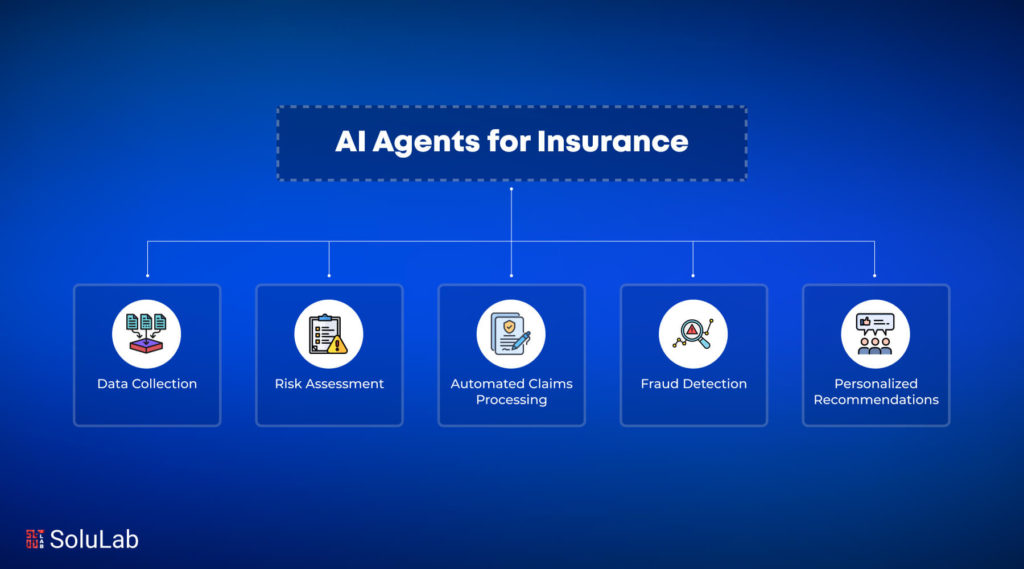
AI Agents work by automating and enhancing key processes, leading to more accurate risk assessments, pricing, and improved experiences. Here’s how AI Agents in Insurance work:

1. Data Collection

AI Insurance agents can gather information using data from various sources, this includes customer applications, medical records, public records, and history. AI Agents for Insurance algorithms analyze this data to identify patterns, correlations, and risk factors that humans might miss this includes predictive modeling, clustering, and natural language processing.

2. Risk Assessment

Insurance Agents with Artificial Intelligence can work on the analysis of a vast amount of data and can work on creating more accurate risk profiles for customers. This enables insurers to offer personalized premiums, identify high-risk individuals, and reduce underwriting bias.

3. Automated Claims Processing 

AI for insurance agents can automate tasks like initial claim assessment, document verification, and payment processing. This has its benefits like reduced waste times, improved customer satisfaction, minimized automation, fewer errors, and consistent application of policies 

4. Fraud Detection

It is easy for AI for life insurance agents to detect fraudulent claims by analyzing patterns in data, such as inconsistencies in claim narratives or unusual claims. AI Agents in Insurance help insurers reduce losses and protect their bottom line. These suspicious patterns can be frequent claims for the same individual or group and discrepancies between claim descriptions and supporting.

5. Personalized Recommendations 

AI tools for insurance agents help with customer data analysis to recommend insurance products that best suit their individual needs and circumstances. This assists insurers to improve customer satisfaction and loyalty. Understanding customer needs based on analysis can help AI for customizing insurance policies, and personalizing communication resulting in improved customer loyalty.

AI Solutions

Benefits of Using AI Agents for Insurance

Adopting AI in the insurance industry brings a variety of benefits not alone for insurers but also for policyholders:

1. Improved Accuracy and Efficiency

AI is great for automating repetitive tasks that take a toll on such agents. Usually, it is seen in intro clerical jobs that entail digit entry, documentation, and responding to basic consumer inquiries, artificial intelligence insurance also allows human agents to spend more time-solving complex issues and providing customers with specific attention. capable of processing massive amounts of data to identify patterns and trends to enhance traditional insurance processes.

2. Customized consumer Experience

An example of a business process that can be provided by AI agents in finance is insurance policies tailored to meet the customer’s needs and how much s/he is willing to take. This has the double benefits of happier customers and better risk selection for the insurance company. The insurance company can provide 24/7 help, answering common questions and helping clients with their insurance.

3. Cost Reduction and Fraud Detection

It can be noted that AI for life insurance agents algorithms can be trained in an even better way to detect false claims. Such AI systems can shave millions of dollars off insurance companies’ costs as they help to evaluate previous information on fraudulent claims and suspicious trends.

4. Innovation and Product Development

This might help insurance agent AI to analyze enormous amounts of data and provide insightful observations about trends and demands of the markets. This allows insurers to develop new products and services that are innovative and geared toward some segments. For instance, AI can be applied, for example, usage-based insurance where one will be charged depending on how safe.

Applications of AI Agents in Insurance
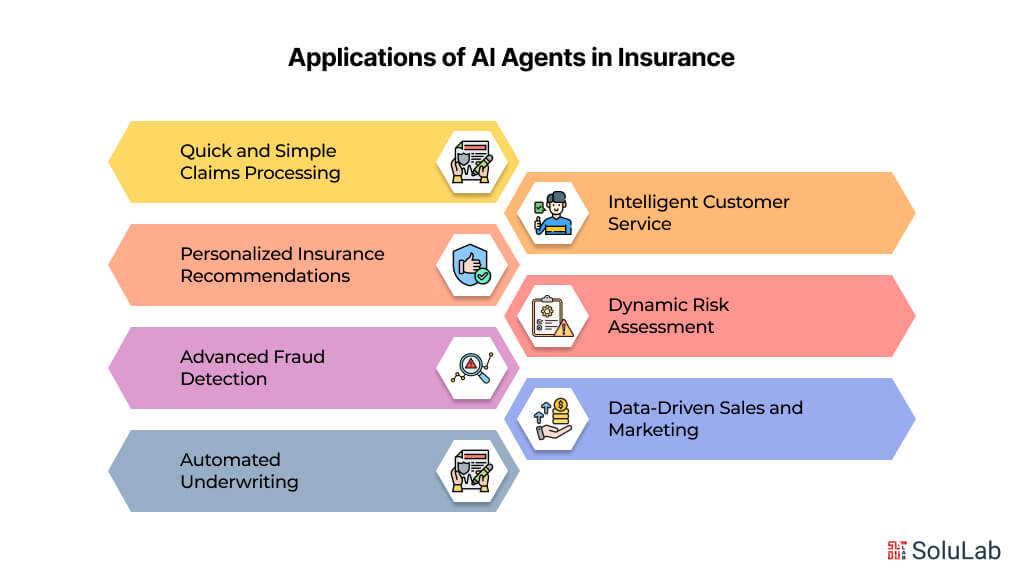
Application of AI Agents in Insurance

AI Agents for Insurance are shaking things up by automating tasks, and building intelligent services. Here are use cases of AI and insurance:  

1. Quick and Simple Claims Processing

Technology plays a crucial role and with the applications in the insurance industry, it is possible to offer clients a chance to file claims in an instant, collation of other important details including the verification of the claims and even the beginning of the repair estimates.

2. Personalized Insurance Recommendations

AI Agents in Insurance are used to analyze customer data, including demographics, driving history, health records, and lifestyle choices to assess risk more accurately. This allows insurers to offer personalized premiums based on individual risk profiles, leading to fairer pricing and improved customer perception. This enables customers to receive valuable options for specific needs.

3. Intelligent Customer Service

It could be termed that with the use of AI-powered chatbots, clients can get quick assistance in answering some basic insurance queries, locating particulars related to policies, and undertaking basic solved procedures and self-serving facilities at any time and from any location that the client may opt for.

4. Advanced Fraud Detection

Cautiously, the same database analysis can be presented as an attempt to find specific trends or inconsistencies that may point to the fact that the case is filled with false statements. The use cases of AI agents insurers by pointing out the activities on which they should or could concentrate more.

5. Dynamic Risk Assessment

The features, traffic, and climate of several automobiles can be considered by the real-time data to result in lively risk analysis with the help of artificial intelligence insurance. It allows insurers to set rather reasonable tariffs and will most probably stimulate safe behavior.

6. Automated Underwriting

Using insurance agent AI in underwriting can ease the underwriters’ burden and make the underwriting process quicker, assisting in delivering answers sooner so that these personnel can concentrate on more complicated issues.

7. Data-Driven Sales and Marketing

AI Agents for Insurance may use customer details to determine the place where the insurance products may be advertised and sold alongside the appropriate marketing texts that will reach the correct persons at appropriate times.

Changes AI Agents are Bringing in Insurance 

There are sophisticated solutions known as Artificial Intelligence (AI) that are changing not only the bureaucratic insurance companies’ processes and methods of interacting with customers. These are some of the main adjustments that AI agents are bringing about:

1. Transitioning from Reactive to Proactive

Insurance has been mostly claim-based which means that it goes into action when events happen and claims are filed. Due to the interventions offered by AI Insurance agents, one can take a more proactive approach. AI can monitor all the signs in a system that may be associated with potential threats before these threats become detectable. Think of getting specific recommendations on your health depending on the wearable data that you have or a reminder to alert you of the need to service your car depending on the trends in your driving.

2. Customized Insurance

Chances Insurance that fits all people well is starting to fade away. To create a unique risk score for each consumer, the AI for life insurance agents can analyze specific pieces of information like driving history, passenger’s health, and even data from the smart house. This evolves into individual insurance solutions that meet specific needs, or ensure that you are not being overcharged for the insurance.

3. Frictionless Claims Processing

Endless questionnaires and hours-long talks on the phone are no longer a thing of the future. Other Appropriate Insurance Agents with Artificial Intelligence is revolutionizing that procedure. Of course, the use of a smartphone camera may let one instantly file a claim with the app, and the underlying AI would gather information, verify a claim, and even launch the repair estimate. Contained herein are the key changes that make it easier to manage and work or operate the company, free from bureaucratic intervention, paperwork, delay in payments or settlements, and tough situations.

4. AI-powered Customer Support

It can be annoying to wait on hold for a customer support agent. Chatbots with AI are altering that. These virtual assistants can manage simple transactions, walk you through the terms of your policy, and respond to your basic insurance questions around the clock. In addition to offering prompt assistance, this frees up human agents for more intricate client engagements.

5. Improved Fraud Detection

Insurance companies face a major obstacle as a result of fraudulent claims. In this battle, AI has the potential to be quite effective. AI for life insurance agents algorithms can detect suspicious patterns and warning signs with remarkable accuracy by examining past data on fraudulent claims. This saves insurers millions of dollars by enabling them to flag questionable claims for additional examination.

What Does the Future of AI Agents Look Like in Insurance?

It is expected that AI agents in the insurance sector will develop and broaden their skills and uses in the future. The following are some possible future trends:

1. Explainable AI: The need for explainable AI models will grow as AI agents grow in crucial decision-making procedures such as claims processing and underwriting. 

2. Custom Insurance Solutions: AI agents will use machine learning and advanced analytics to provide highly customized insurance services and products based on the requirements, preferences, and risk profiles of each consumer.

3. Telematics and Internet of Things (IoT): AI agents will easily interface with telematics systems and IoT devices to collect real-time information about insured assets, including equipment, homes, and cars. 

4. Natural Language Processing (NLP): As AI agents develop their natural language processing skills, they will be able to engage with clients in more conversational and organic ways. 

5. Collaborative intelligence: AI agents will work with human specialists like analysts, claims adjusters, and underwriters. By combining the advantages of AI and human experience, this collaborative intelligence will provide more precise and informed decisions.

6. Ethical AI: There will be an increasing focus on creating ethical AI frameworks and adherence to legal requirements for dealing with concerns about algorithmic bias, data privacy, and accountability.

These upcoming developments show how AI agents can alter the insurance sector by improving risk assessment, client satisfaction, operational effectiveness, and decision-making procedures in general.

Connect Now

Take Away

AI agents are set to redefine personalized risk evaluation in insurance by making assessments smarter, faster, and more accurate. With access to real-time data, behavioral patterns, and advanced analytics, insurers can now tailor policies to individual needs rather than relying on broad risk categories. 

This shift not only improves customer experience but also enhances underwriting precision and fraud detection. While human oversight remains crucial, AI agents will continue to handle complex tasks with greater autonomy. SoluLab, a leading AI agent development company in USA, is a dedicated team of expert professionals backed by years of experience and technical prowess. Even though we got a chance to develop a project on health insurance powered by AI , resultingly processing time was reduced by 70% and held financial benefits also.

SoluLab is a dedicated team of AI and finance experts ready to help you with all your queries. Get in touch with us today!

FAQs

1. What roles do AI agents play in improving the client satisfaction of insurance services?

AI-enabled chatbots attempt to supplement consumer support 24/7 to respond to most of the queries and help users with policy-related information. In addition, insurance as a service can be advised and claims processed by AI through AI apps hence enhancing the general flow of insurance.

2. In what ways can Artificial Intelligence help insurance risk management?

AI brings the advantage of real-time risk evaluation since it can consider big volumes of data, current traffic, and weather conditions, for instance. This makes it efficient for insurance firms to afford fair tariffs and possibly promote effective conduct such as safe driving.

3. Will AI replace insurance agents?

No. They will work like more of smart companions, AI agents perform repetitive work and provide the first contact. This means freeing up the human agent’s time for tackling complex problems, personal one-on-one correspondence, and enhancing their relations with clients on average.

4. What may be the possibilities of applying AI in insurance risk management?

Hence, AI offers a more multifaceted risk analysis, one that is capable of deploying not only in raw data but also in the actual real-time inflow of data such as traffic and weather conditions. This in turn allows insurance organizations to offer more fair tariffs and in the future – safe behaviors such as proper driving.

5. How can SoluLab help insurance companies with AI Agents?

At SoluLab we design efficient insurance solutions, These solutions will help you identify potential fields that require the integration of the best AI for insurance agents with your company’s operations, create new products, and gradually apply to liberalize the insurance market for your enterprise.

AI Agents for Manufacturing: Boost Efficiency with Smart Automation

AI Agent in Manufacturing

Modern manufacturers are going through numerous problems including the need to optimize production workflows, reduce downtime, uphold strict quality, and effectively manage costs. Conventional methods frequently require assistance to meet these expectations, which results in inefficiencies, higher expenses, and lost growth potential. This is where Artificial intelligence (AI) agents come in and provide an unprecedented solution that expands manufacturing processes. 

Manufacturers can ensure excellent product quality, reach previously unheard-of levels of production, and react quickly to changes in the market by utilizing AI. AI agents in manufacturing integration are a strategic necessity in today’s competitive manufacturing dynamics, not just an option. The new era of effectiveness and imagination is ushered in by these sophisticated systems, enabling manufactures to manufacturers to meet changing industry demands and maintain their competitiveness. 

Around 35% of manufacturers ought to adopt AI for performing tasks in the manufacturing industry in the coming 5 yeras.  This article explores the main features of AI agents for manufacturing, including their types, benefits, top use cases, and major components. 

What is an AI Agent and Its Types?

Types of Agents in AI

Business technology is evolving and AI agents are becoming the main component of this process. So let’s get to know what are AI agents. Artificial intelligence agents are electronic programs that can operate independently by making choices depending on their surroundings, inputs, and predetermined objectives. These agents are a significant advance above the typical automation because they are made to reason, adapt, and act on their own in addition to the following instructions.

Envision a digital entity that is constantly scanning its environment, gains knowledge via encounters, and makes decisions for accomplishing particular goals. This is what an AI agent is all about. It is similar to having a digital assistant who completes duties, recognizes context, modifies tactics, and even comes up with new ideas to accomplish goals. Manufacturers must comprehend these differences to choose the best AI agent for their unique requirements. Let’s examine AI agent types:

  • Simple Reflex Agents

The condition-action agent rules ideas underlie the operation of these agents. They do not have an internal representation of the world; instead, they react directly to their current perceptions. In circumstances where the agent’s next action is determined just by its current perception, simple reflex agents are easy to use and very effective. 

  • Model-Based Reflx Agents

As these agents have an internal representation of the world, they can easily monitor aspects of it that are not immediately apparent. By assuming incomplete data, this approach assists the agent in navigating partially visible settings. Compared to basic reflex agents, they are more flexible since they make decisions about what to do depending on their internal model and present perception. 

  • Goal-Based Agents 

Agents with gaols take things, a step further by thinking about how their actions will affect the future. They make decisions based on the likelihood that certain will lead to the achievement of their goals. They can plan to select actions that result in desired outcomes because of their foresight, which qualifies them for difficult decision-making duties. 

  • Utility-Based Agents

These agents use a utility function function to determine how desirable stats are. Based on specified utility measures, they aim to maximize their performance and accomplish a goal. This method works well in situations where there are several possible courses of action or results and the agent must choose the best one based on desire. 

  • Learning Agents

With time, these agents become more proficient because of their experience. They are especially in changing situations where they can modify and advance their tactics. For example, to maximize ad placements, a learning agent could constantly, improve its comprehension of consumer preferences. 

  • Multi-Agent Systems

Several agents collaborate and cooperate for shared personal objectives in MAS. When coordination is essential for complicated activities requiring numerous agents to work together, MAS is utilized. Supply chain management is one use of these systems, where numerous agents represent different supply chain components and collaborate to optimize the process as a whole. 

How Does AI Agents Work?

Techniques and information inputs are combined to power AI Agents. To understand and respond to their surroundings, they process information using machine learning models. Here is the breakdown of how AI agents work:

1. AI agents use data intake mechanisms or sensors for obtaining data. All processes that come after this data are built on it.

2. The agents look through the data and extract insights by using artificial intelligence and machine learning models for processing and analysis

3. They base their decisions on analysis, which may include the use of sophisticated algorithms, logic based on rules, or predictive models.

Following a choice, the agent carries out an action, which may involve anything from manipulating a physical robot to updating a database. 

Read Blog: Top 15 Use Cases Of AI Agents 2024

How do AI agents work if often organized as:

1. Receiving data: Getting new information from the sources or receiving data from the user 

2. Assess Data: Use AI models to contextualize and evaluate data.

3. Decision-Making: Choosing the best action. 

4. Act: Execute the decision by a response or some change in the environment. 

Major Components of AI Agents in Manufacturing

Input

The component is responsible for retrieving and managing several types of inputs into machines, sensors, and operators. This would include data but not limited to operational logs, production metrics, and sensor readings. These inputs drive the decisions and actions of the agent and provide real-time insights into the manufacturing process. The input can be anything such as: 

  • Text
  • Audio 
  • Image 

Brain

The brain is composed of many modules and is highly essential in the cognitive functions of manufacturing operations.

  • Profiling: This would define the role and objectives of the agent and its position within the production environment.
  • Memory: The ability to learn from previous production cycles and operation settings through stored history and interactions.
  • Knowledge: Domain-specific information for planning and decision-making comprising information on production processes, quality standards, equipment, and tool specifications.
  • Planning: Considering demand and stock on hand, the system should, based on current demand and stock level, come up with an optimum production schedule, resource investment, and process investment at the best time.

Action

To that note, this section implements planned activities by applying the modules of the brain in the automation and optimization of manufacturing processes. This ensures efficiency in the manufacturing functions since complex tasks will be subdivided into feasible stages.

With a sophisticated set of capabilities for analysis and decision-making, AI agents can help optimize production line results, prevent production line downtime, or enhance operational efficiency in the manufacturing industry. This step makes use of various tools that include: 

  • NLP Tools
  • Info Search and Retrieval Tools
  • Data Analytics Tools

Role of AI Agents in Manufacturing 

AI agents are bound to assume a very important role in contemporary manufacturing as competitiveness boosters, efficiency enhancers, and innovation promoters. AI agents can serve potential transformative roles in manufacturing processes, right from supply chain optimization to predictive maintenance.

1. Improving Predictive Upkeep

Equipped with proper advanced predictive analytics onboard, AI agents provide proactive maintenance solutions to manufacturers. AI agents can predict the problems in equipment in advance by analyzing the records of its maintenance and current data from sensors in real time. The predictive ability of AI agents enables optimized operational efficiency and lowered costs for maintenance by reducing wear and tear of machinery and minimizing unscheduled downtime.

2. Transforming Quality Assurance

Manufacturing gives a lot of importance to quality control, while AI agents raise this bar even higher by automating tasks and doing them with precision. AI agents for manufacturing use machine vision combined with deep learning algorithms to identify product flaws with unparalleled accuracy, while only top-notch products are forwarded to the market. The detection skills of AI agents are enhanced continuously through learning from inspection data.

3. Supply Chain Management Optimization

AI agents will not hesitate to optimize supply chain operations, making improvements in the sphere of resilience and efficiency with data-driven insights. That would imply assessing the efficiency of suppliers, levels of stock, and projections of market demand with the aim of logistics and inventory optimization. Lower lead times, stock-outs, and, in general, supply chain agility will permit changing market trends and consumer needs.

4. Energy Efficiency Promotion

Since energy consumption is one of the major components of costs, AI agents become necessary for improving energy utilization within manufacturing processes. It becomes quite easy for AI agents to detect areas where production operations can save energy, considering that it assists in real-time monitoring and predictive analytics. By optimizing equipment scheduling and utilization, Artificial Intelligence agents lower energy costs and environmental effects, coordinating industrial processes with sustainability objectives and legal requirements.

Key Benefits of AI Agents in Manufacturing

Benefits of AI Agents in Manufacturing

AI agents are bringing a revolution to every field, and manufacturing is an exception. The advantages of the AI applications in manufacturing are as follows:

  • Improved Safety of Workers

It would be with proper analysis of past safety data, spotting patterns in hazards, and compilation of knowledge strictly based on best practices. Agents of the language learning model assist initiatives in making workplaces even safer and more ergonomic through insightful analyses and dialogues about safety-related issues.

  • Coordinated Modifications

AI systems monitor the tastes of customers and make changes to the production process to efficiently place personalized requests. Considering such potential, the producers can offer customized items without compromising productivity and reasonable prices.

  • Constant Improvement and Adaptation

The agents undergo constant improvements over time as their algorithms are fine-tuned with new insights from continuous data feeds. Due to constant improvements, despite fluctuating market conditions and technological breakthroughs, truly effective and efficient processes for production can be achieved.

  • Input-Directed Decisions

These frequent data inputs are like learning and evolving the AI automation continuously, which helps in enhancing the algorithms and overall performance over some time. With continuous improvement in technologies and changing market conditions, manufacturing processes remain effective and efficient.

  • Competitive Advantage

With the integration of AI agents in manufacturing, manufacturers can realize greater operational efficiencies and quality of the product. A faster growth cycle and better market accountability result from this, which provides the company with a greater advantage against the competition. 

How Do AI Agents Improve Customer Experiences?

1. Tailored Customer Experiences

This is a one-to-one marketing tactic that not only provides each unique customer with highly relevant but also customized experiences by utilizing machine learning and intelligent artificial intelligence. Customers want manufacturers to be aware of their needs and preferences and the latest market trends.

AI can analyze customer data both past and present to produce a comprehensive picture of each individual, including social media activity browsing patterns, and past purchases.

For example, Netflix uses AI to adjust its suggestions as per each user depending on their past watch.

2. 24/7 Customer Support

Chatbots are now a necessary tool for companies trying to offer at all times, immediate customer service. These chatbots can respond to standard inquiries, offer pertinent responses, and point users in the direction of the right resources. They can also help by pointing clients in the direction of live agents for more complicated issues and queries Client queries are handled in much better ways when you leverage chatbots. 

Various customer inquiries even on the product, order status, and troubleshooting can all be handled quite easily by these AI-powered chatbots.

For example, H&M uses chatbots to answer questions about order monitoring and other relevant details of the order or products.

3. Anticipate the Needs of the Customers

Predictive analysis is used to improve customer satisfaction by anticipating the needs of the customers and boosting customer retention by providing meaningful insights into customer behavior, preferences, and purchasing patterns. Additionally, you can use this for spotting possible customer attrition. 

For instance, telecom firms use predictive analysis for the identification of clients who are more likely to discontinue the service and provide them with special offers to keep them hooked.

4. Understanding Customer Feedback

Sentiment analysis is the practice of analyzing customer evaluations and feedback with AI algorithms to learn about the attitudes, feelings, and opinions of the customers. This AI-driven feature can be used to examine consumer input from a variety of sources such as social media, online reviews, and customer surveys. You can find areas for development and take appropriate action to resolve consumer problems by examining this feedback. 

Top 5 Use Cases of AI Agents in Manufacturing 

Use Cases of AI Agents in Manufacturing

Artificial intelligence (AI) agents are transforming with GenAI in manufacturing by improving productivity, precision, and creativity in a range of production-related areas. The following are the top 5 use cases of AI agents in manufacturing:

  • Planning Production 

Large volumes of production data like demand projects, level of stocks, and availability of machines are analyzed by LLM agents to find patterns and offer insightful analysis that helps with production planning decisions. 

  • Generative design to Develop Product

Based on generative design algorithms that employ AI, generative design produces numerous design propositions in line with certain specifications like cost, dimensions, weight, materials, and fabrication methods among others. This makes product innovation easier in terms of design and shortens the time taken in product development, especially when combined with access to a 3D printing service for fabricating complex shapes and structures.

  • Improving Autonomous Processes

Industrial processes are studied by artificial intelligence (AI) bots who look for the aspects that can be improved. It requires the use of machine learning algorithms to adjust temperature, pressure, and speed so that production is optimized, cost is reduced and the quality of the product is enhanced.

  • Safety and Workforce Management

 Mobile technologies and computer vision monitor workers’ movement and activities as well as allow the identification of risky behaviors and triggering of alarms together with indicating the necessary preventive actions. The use of AI in this area can be helpful to manufacturers in assessing the workload needed and avoid overloading the employees, and the duties to be assigned to specific employees for better performance and efficiency.

  • Quality control and Anomaly Detection 

Automated inspection systems powered by artificial intelligence (AI) technology analyze sensor data and visual inspection results in real-time mode to detect defective part features, anomalies, and other quality issues in the manufacturing process. Thus, producers can reduce wastages, detect faults at the initial stage, and ensure quality products are produced.

Future Trends in AI Agents

Trends Impact
Ethics-Based and Reliable With the increase in the strengths of AI agents, more focus will be given to establishing these AI agents in an ethical, open, and reliable way. There are plans to ensure that AI agents would not encroach on the privacy of human beings, they do not have any bias and act rightly like human beings.
Increased Physical Abilities There will be more and more instances of artificial intelligence agents being embodied as robots, drones, self-driving cars, and such other forms. This will allow people to further work within and interact with the real-world environment along with the virtual environments.
More Autonomy and Sophistication AI agents in the future will be capable of understanding language, reasoning ability as well as decision-making tendencies. However, with more autonomy the level of automation increases they will be capable of handling more complex tasks more practical and general, and less human intercession.
Seamless Integration Within Systems Each of, the bots, and software programs will have close ties with AI agents to be well-informed about our existence and more importantly, provide real value. It will be possible to switch from our telephones, automobiles, smart homes, and workplaces without any hitch.

How Can SoluLab Help in Building Customer Experience Using AI Agents?

SoluLab specializes in AI Agent development service provision and sets itself apart by implementing AI agents that bring impressive transformations in customer experience. SoluLab is a team of experts that gathers professionals in the field of AI and offers applicative solutions that are tailored to companies’ specifics of various industries. As AI is bound with the most up-to-date machine learning algorithms thus AI agents will be providing interaction as well as progressive learning that is likely to improve service standards at some point.

This is why working with SoluLab can become the beginning of new opportunities for growth and customer relations amid the growth of competition in the digital space. Why lose the chance to revolutionize the way your clients engage with your business; contact SoluLab today to learn how we can assist your business.

FAQs

1. How do AI Agents work?

AI agents work on various complex algorithms and constantly learn from the data provided within sources for making informed decisions and providing users with up-to-the-mark outcomes to their inputs. 

2. How can I use AI agents for my business?

Be the business in any field AI agents have the potential to perform several time-consuming tasks for you which include monitoring your sales, automating your processes, and even tailoring the outreach according to customer preferences and needs. 

3. What is the most common real-life AI agent example?

The most common and majorly equipped by businesses of all kinds by now real-life examples of AI agents are chatbots and voice assistance. Every business requires a 24/7 approach to solve customer inquiries which in turn improves their satisfaction. 

4. What is the manufacturing industry using AI agents for?

The major benefits AI agents are providing to the manufacturing industry are proactive monitoring of production, predicting possible failures of the equipment, and automation of repetitive tasks. 

5. Can SoluLab help with the integration of AI agents?

Yes, SoluLab can help with the integration of AI agents by thorough optimization of data flow making use of tactics such as API architecture. This integration will help you with your task automation, customer service, and complex workflows. 

Diving Into the Power of Intelligent Agents for Finance

AI Agents in Finance

Welcome to the future of finance where artificial intelligence is constantly working on transforming the way you manage money and invest for a brighter future. Understand the dynamic world of AI Agents for finance by exploring how are they reshaping the industry from algorithmic trading to personalized customer service, AI agents in finance are driving unprecedented efficiency and creativity in financial decision-making.

Explore the technologies that are propelling the finance industry into a new era of intelligent automation and data-driven insights. 

Understanding AI Agents

The agents of artificial intelligence represent cleverly designed computer programs to perceive the environment, carry out free-decision analyses, and act for themselves, achieving the desirable goal. Unlike the usual software, AI agents are developed to have the property of learning, adaptation, and, with time, improvement, unlike the conventional software, which is bound by stringent constraints.

Think of AI agents as a supercharged virtual assistant that understands your demands, secure data, and accomplish tasks on your behalf. An AI agent could schedule meetings, draft emails, or even conduct research. But their talents reach far beyond being just helpful. AI agents find applications in many areas. They can be used to effectively look after customer service experience because they can respond to questions and resolve problems. In the financial industry, they study market trends and can offer investment advice. Businesses extract critical insights from data to optimize their operations or for automating tasks.  The basic components of AI agents are as follows:

  • Perception: The agent should have the ability to receive information from the environment, which can be obtained through sensors or other types of data inputs.
  • Reasoning: It involves gathering information, examining the data, and arriving at conclusions. 
  • Action: Performing the actions in a virtual or physical environment. 
  • Learning: Gradually improving performance based on feedback and experiences.

It is expected with the advancement of AI technology, the capability of agent artificial intelligence will increase constantly, and so with time novelties are expected to be employed increasingly, therefore evolving ways the human is related to technology. AI agents are tremendous automation that helps improve productivity, efficiency, innovation, and other related fields of people and companies.

AI Agent Services

Role of AI Agents in Finance

Through process automation, better decision-making, and improved consumer experience, AI Agents in Accounting are pacing up tremendous changes in the way finance industries do business. In operations, their uses span immensely across the financial industry, ranging from wealth management and investment banking to accounting and risk management.

1. Operational Finance and Accounting

Financial operations management is changing with Accounting AI agents intervening and turning around the systems. They accomplish this by taking over human resources for use in other more significant projects, relieving them of repetitive processes of inputting data, processing invoices, and reporting expenses. The efficiency and accuracy of financial data analysis can further be enhanced by AI-driven systems, which can also identify trends, abnormalities, and even fraud in financial reporting.

2. Risk Assessment

AI Agents powered finance is necessary for the reduction of financial risk. They can analyze current market situations and past data to detect potential risks that may cause an upset to the stability of the financial system. These agents can develop prediction models that will help to predict a change in markets, hence guiding the risk management techniques using complex algorithms. AI-driven systems can help keep an eye on cases related to identity theft and money laundering so that financial institutions are always safeguarded against any sort of negative activities, ensuring their customers’ interests are protected.

3. Trading and Investment Banking

Finance AI agents are used to make the decision-making process in investment more enhanced. They can forecast asset values and find investment opportunities, besides improving trading techniques, by analyzing enormous volumes of market data. In that aspect, artificial intelligence agents could get the advantage of extracting insightful data regarding web information, social media, financial reports, and newspaper articles using the mechanisms provided by natural language processing. Even further, by employing AI agents-powered finance systems, trade automation is made easy to free human errors.

4. Asset Allocation

AI financial advisors are going to make a massive difference in the wealth management sector due to the delivery of personalized financial advice. To provide personalized investment portfolios, they may consider their client’s risk tolerance, investing preference, and financial goals. The agent in artificial intelligence can provide suggestions, answer to customer queries, and provide live financial advice. The AI bots monitor the market trends as well, for the best performance of portfolios.

5. Customer Support

AI chatbots and virtual assistants better client experiences across the banking industry. The representatives are capable of answering consumer requests instantly, solving problems, and developing tailor-made advice. AI use cases can offer more engaging and more rewarding consumer experiences by learning what makes their clients tick.

Considerations of AI for Finance

GenAI in Financial Service Market Size

Although AI agents hold a great deal of promise for the financial sector, there are a few things that need to be taken into careful consideration before their adaptation.

  • Privacy and Data Quality

AI agents in hr are based on high-quality data. Consistency, correctness, and completeness should be ensured in their data by a financial institution if it wants to come up with trustworthy AI agents. Sensitive financial data must be kept safe. Relevant security measures, together with adequate data privacy legislation, should guarantee the protection of client information and thus help to maintain trust.

  • Moral Considerations 

These biases can be directly transferred to the AI algorithm from the training datasets and thus lead to discriminating results. AI in finance decision-making needs to be ensured, and bias needs to be reduced by financial institutions. It needs to be explainable, and transparent. On themes as far-reaching as credit scoring or investment advice, for example, users have to be positioned to know how an AI bot derives its conclusions.

  • Compliance with Regulations

The financial sector is heavily regulated. Applications of Generative AI in Banking and Finance need to meet existing legal obligations and keep pace with evolving regulatory landscapes. Financial institutions have to put investments in compliance programs, conduct regular audits, and remain current with the law as it changes.

  • Common Control of Risks

AI in accounting models are complex, supersensitive systems that can surprise users. To that end, financial organizations must incorporate robust processes for model risk management. This would involve prolonged testing, validation, and monitoring for AI models to detect and repair such issues. The retraining of the models at required intervals to maintain performance and frequent model updates also become essential.

  • Human-AI Collaboration

Though many tasks can now be automated by AI agents, human skill is in no way less important. For best results, AI in bfsi shall have to work with humans, and humans with AI. Until humans can still make decisions and exercise oversight, AI agents may support human talents through the provision of insight and advice.

Although AI agents bring a lot of potential value to the financial sector, their successful deployment will require elaborate testing of data quality, ethical considerations, regulatory compliance, model risk, and human-AI collaboration. If taken into consideration, these things can help financial institutions realize the power of AI while minimizing the risks associated with this technology.

Real-world Use Cases of AI for Finance

Use Cases of AI for Finance

The financial industry is changing very fast with AI agents automating procedures, improving decision-making, and improving the experience for consumers. A few of the AI agent use cases:

1. Fraud Prevention and Identification

Fraud detection and prevention are among the most important and useful AI applications in banking. AI Agents in Accounting can instantaneously analyze enormous transaction data, thereby identifying trends and anomalies indicative of potential fraud. An AI system in this regard may enable the detection of unusual spending patterns, identify probable identity theft cases, or put up red flags on suspicious activity over an account. Such a proactive approach will therefore help financial institutions reduce potential financial losses and protect their customers.

2. Personalized Advisory

It is due to Finance AI agents that financial advisory itself is changing. AI systems can make customized recommendations based on analyzing consumer data to determine investment preferences, tolerance towards risk, and financial goals. AI-driven robo-advisors offer automated investment management and financial planning. These platforms construct diversified portfolios in keeping with the specific investor profile and rebalance them as and when appropriate.

3. Virtual assistant – chatbots

AI agents-powered finance chatbots and virtual assistants work wonders for customer experience across the financial sector. The representatives respond to consumer queries within a second, provide personalized suggestions, and work on account management tasks. For example, a chatbot can walk an end-user through resetting passwords, transferring funds, and checking an account balance. This enhances client satisfaction and relieves human representatives to focus on more complex issues.

4. Trading Algorithms

AI-driven algorithms are making a revolution in the trading industry. Agent in artificial intelligence play their role in HFT, assessing market data, recognizing trade opportunities, and providing swift transaction execution. Such algorithms allow for snap judgments on trade to be made from huge volumes of data, ranging from market data through social media sentiment and news feeds. Although this forms a niche in its entirety, it is a sophisticated realm of HFT, foreshadowing the very powerful role AI can play within the trading industry.

Benefits of AI Agents for Finance

AI agents are ushering in an age of effectiveness, precision, and creativity within the financial sector. Here are some of the Benefits of AI Agents in Finance:

1. Increased Productivity and Efficiency

AI Agents in Accounting are good at the automation of repetitive jobs, hence freeing human resources to work on higher-valued jobs. Such agents increase overall productivity, reduce errors, and smoothen operations from data entry and reconciliation to fraud detection and compliance checks. AI-powered chatbots can also nicely handle the queries of consumers by providing quick answers and freeing human agents to concentrate on more complex problems. 

2. Bigger Ability in Decision Making

AI Agents in finance can process large volumes of data quickly, thereby noticing patterns and trends pretty hard for a human to notice. With this in mind, financial professionals are more placed to make educated and data-driven decisions. AI agents provide insightful analyses of consumer behavior, market trends, and risk factors that help in investment and strategic planning. 

3. Risk Mitigation

AI agents for finance perform two of their most critical functions for the identification and mitigation of financial risk. These agents reduce financial crime, such as money laundering and fraud, by recognizing trends and anomalies in data. For managing portfolios and making better loan decisions, AI-based systems aid in assessing creditworthiness and market volatility.

Read Blog: AI in Fintech: Top 4 Use Cases and Case Study

4. Personalized Experience of Clients

Finance AI agents can analyze consumer data to determine preferences, wants, and behaviors, and, hence, financial institutions can provide very personalized products and services. Chatbots and virtual assistants improve customer happiness and loyalty through the provision of personalized financial advice, customer question answering, and the speedy redressal of grievances. 

5. Lower Costs

The benefits of AI Agents in Finance can drastically bring down costs for any financial organization through process automation and efficiency enhancement. In addition, the AI-driven solution discovers opportunities for cost savings and is involved in the optimization of resource allocation, further boosting profitability.

From the perspective of efficiency, judgment, risk management, customer experience, and saving money, AI Agents in Accounting will never stop remodeling the face of financial sectors with provable benefits. We may well foresee even more innovative applications of AI technology and a greater impact on the financial industry as it matures.

Future Outlook with AI for Finance

AI is about to make a huge difference in the financial industry. One can only expect that AI will be at the core of deciding the way forward for finance with progressing technology. One such most promising area of all is that of hyper-personalized financial services. Generative AI for Data Analysis and Modeling will be empowered to offer highly personalized products and services that meet the needs, preferences, and financial goals of every individual customer. Customer loyalty and satisfaction, given this level of personalization, will skyrocket.

Investment management will also see dramatic changes with the advent of AI. Advanced algorithms will dig through terabytes of data—much of which comes from non-traditional sources—to analyze for investment opportunities and better ways of portfolio management. This could give rise to a greater number of AI agents-powered finance robo-advisors concerning investment management and holistic financial planning services. Artificial intelligence will also play a key role when it comes to fraud prevention. The role of artificial intelligence-driven solutions would be imperative in fraud detection and prevention, given the sophistication cyber threats are prone to take. Financial organizations will be able to identify suspicious patterns from transaction data analyzed in real-time, thereby preventing customers’ financial losses if they hire an AI developer.

Even with the huge potential of AI Agents in finance for the field of finance, the challenges it poses to data privacy, ethical considerations, and regulatory compliance need to be sorted out. Against the backdrop of such challenges, which the sector is bargaining with, we can certainly look ahead and visualize AI playing a very important role in innovation thus leading to superior financial outcomes for both individuals and corporations.

Contact Us

SoluLab Transforms Banking and Finance with Gen AI

Challenge

The banking industry struggles with meeting rising customer expectations, streamlining manual processes, managing risks, adapting to evolving regulations, and protecting data from increasing cyber threats.

Solution

SoluLab used Gen AI to automate tasks, deliver personalized customer experiences, and improve cybersecurity, helping banks operate more efficiently.

Impact

  • 3x increase in customer satisfaction with personalized services.
  • 70% faster processes, cutting operational costs.
  • 98% fewer cyber threats, ensuring data safety.

The Final Word

The financial sector is changing at an unprecedented rate just because of artificial intelligence. The benefits of AI Agents in Finance from automation of all kinds of functions to improved decision-making and reduced risks, including improved consumer experiences. We can only expect more revolutionary applications of AI technology as it grows and evolves.

What the organizations need is an AI agent development company to support the full promise that AI holds for finance. SoluLab brings deep expertise in both financial services and artificial intelligence to help in overseeing the challenges in the use of AI. Our experts can help you design custom AI solutions to foster the productivity and growth of our clients’ businesses.

Are you ready for it? Want to start harnessing AI’s potential for your finance company? Reach out to SoluLab now.

FAQs

1. What are some of the major benefits that AI agents can bring to the financial sector? 

Among others, the following are the benefits AI agents can offer: offering a personalized experience for clients, risk management, increased efficiency, better decision-making, and reduced costs.

2. What do you think is the role that AI can play in avoiding financial fraud?

AI-driven systems can analyze massive transaction data for trends and odd behaviors that might indicate fraud. Since this will be a proactive stance, it makes it easier for FIs to protect their assets and clientele.

3. What are some of the challenges of implementing AI in finance?

Although AI is vastly promising, it comes with a host of challenges regarding qualified people who can design and govern AI systems, privacy issues, ethical dilemmas, and compliance issues. 

4. How can AI improve client experience for the financial sector?

The AI-driven chatbot and virtual assistant may, in their interactions with customers, offer them personalized financial advice, answer their queries related to account management, and thus raise customer satisfaction and loyalty.

5. How can Solulab leverage AI to help my bank?

Since SoluLab is experienced in both AI and financial services, we can develop customized solutions concerning the needs of your case. We will be glad to help you achieve your business goals, develop robust models, and look for practical implementation of AI initiatives.


AI Agents for Enterprise: Transform Business Operations

AI Agents For Enterprises

In today’s business dynamic, using artificial intelligence via intelligent agents is becoming profound within enterprises. These AI Agents for Enterprises are powered by advanced algorithms and machine-learning abilities that are transforming the traditional ways of business operations with even more efficiency, productivity, and informed decision-making. With the use of AI agents, 85% of customer service representatives working for companies use AI reports it helps them save time, organizations can automate routine tasks, analyze vast amounts of data at once, and provide valuable insights.

This blog will provide with you a brief introduction to what are AI Agents, how are they quickly transforming the ways enterprises operate, and the impact of AI agents on enterprises. Using these intelligent agents is bringing changes to systems and helping organizations adapt to the challenges of the digital era.

What are AI Agents?

AI Agent

Artificial intelligence agents are a class of intelligent software systems constructed to sense their environments, decide independently, and act on their own to accomplish certain set objectives. AI use cases have variable intelligences that make them adapt and learn from experiences, unlike traditional software that is characterized by strict adherence to instructions. AI agents may collect information from several sources and analyze it, understand, and act on natural language input, and even conduct some tasks on your behalf. For instance, an AI agent will make reservations for travel, schedule meetings, and recommend things that might interest you.

The real powers of AI agents lie in their learning abilities. With machine learning algorithms, the agents can review data, identify trends, and henceforth improve, little by little, what they do. In that sense, as a result of continuous learning, they become proficient at their jobs.

AI agents show great business potential. They can drive innovation, enhance user experience, and drive efficiencies. AI bots, for example, answer standard questions in customer support, making human agents focus on trickier problems. They do data-driven investment judgments and market trend analysis in the domain of finance. 

Artificial intelligence agents of infinite possibilities continue to increase. We can anticipate that the more powerful and more intelligent agents will progressively keep revolutionizing how human beings will interact with technology and the physical environment in the future.

Role of AI Agents for Enterprises

AI agents are fast proving to be very essential tools for any business keen on improving customer experience, increasing decision-making, and enhancing processes. These enterprise AI agents are fast changing quite some corporate processes since they can sense, learn, and act on their own. Here are some of the major roles played by enterprise AI agent solutions. AI will generate between $1.4 trillion and $2.6 trillion of value in marketing and sales globally.

Increased Operational Efficiency

  • Repetitive jobs become automated: AI agents can increase the speed of operations by handling routine jobs like data entry, invoice processing, and customer service calls. Workers now have more time to dedicate to strategic activities.
  • Predictive maintenance: AI agents in Enterprises can detect potential equipment failures with the analysis of the data provided by the equipment. This allows for proactive maintenance and minimizes costly downtime.
  • Supply Chain Optimization: AI Agents for Enterprises can help enhance supply chain operations with the use of agents in predicting demand, managing various levels of inventory, and identifying likely disruptions.
  • Process Automation: Automation of end-to-end corporate processes using AI agents ensures no errors occur and boosts productivity.

enterprise AI market

Driving Growth and Better Ideas

  • Data-Drive Decisions: A huge amount of data can be analyzed by the AI enterprise to find patterns, trends, and insights that help in making strategic decisions. This is known as data-driven decision-making.
  • Product Development: AI agents in Enterprises can support an increase in time-to-market, design optimization, and the development of new product ideas.
  • Customer Segmentation: AI agents will contribute to the discovery of clear customer categories by analyzing consumer data and enabling the development of tailored marketing campaigns and products for AI enterprises.
  • Market research: In the quest to discover new opportunities, artificial intelligence research can be applied to trends in the market, competition, and consumer choices.

Enhancing the Client Experience

  • Personalized Customer Interactions: AI-driven chatbots and virtual support agents will be able to provide customized customer handling, answer queries, and solve problems more effectively. 
  • Customer Sentiment Analysis: AI agents in Enterprises detect the improvement areas and define the satisfactory parameters through customer feedback analysis. 
  • Recommendation engines: AI, on customer behavior and preference data, can be used to create personalized product recommendations.
  • Fraud Detection: AI agents can help with detecting fraud and protect the company and its clients.

Challenges

  • Data Quality and Privacy: For the implementation of AI agents in Enterprises, data quality and privacy need to be ensured.
  • Talent Acquisition: The success of the AI Agents for Enterprises initiatives is based on talent acquisition and retention in AI.
  • Ethical Considerations: Business entities should develop some ethical guidelines relating to their AI usage in order not to damage reputation and trust.
  • Change Management: Proper planning and change management are required so that the AI agent can be accepted by the employees.

Operational excellence, creativity, and extraordinary customer experience are some of the things that can be achieved in businesses with the help of AI Agents for Enterprises. Enterprises can leverage AI agents in the supply chain by solving the problems connected with them and taking a competitive lead.

Technologies Behind AI Agents 

It is not only the specific capabilities of AI agents that make them genuinely disruptive, rather it is how these capabilities collaborate to find solutions to actual problems faced by businesses. Let’s have a look at the most important capabilities that modern AI agents possess: 

  • Large Language Models (LLMs)

Intelligence is built on the foundation of large language models also known as LLMs. Agents can have meaningful and fruitful discussions with clients with the abilities of LLMS, which constitutes an enormous improvement in artificial intelligence skills. These sophisticated models interpret language in the same way as experienced human agents, which means that they understand context, remember facts, and provide pertinent responses for the result, intelligent agents not only respond to the questions but also provide customers with smart nuance communication is supported and engaged by LLMs. 

  • Natural Language Processing 

Keyword matching and strict commands are no longer an issue for AI agents of today. I have a complete understanding of human language in all of its complexities. They can recognize the minor distinction between phrases such as I can’t log in and my password isn’t working and they can analyze context and intent in the same way that a person would. If a consumer has a question that is compromised of multiple parts or explains a complicated issue, this agency seamlessly, follows along and keeps the context intact for the entirety of the interaction

  • Machine Learning 

Learning is becoming more intelligent daily on the other hand, AI agents evolve with each encounter on their own in contrast to traditional systems, which remain static in time without considerable human intervention. Continuously gaining knowledge from talks, assessing the results, and improving their response are all things that they do. Whenever they come across new situations or demands that are out of the ordinary, they modify their approach, mainly based on what has been successful in the past. 

  • Networks of Neural Networks

The engine that makes decisions in neural networks can be thought of as a brain that is responsible for the operation. They can process an infinite number of data points, concurrently, gaining a grasp of how various bits of information are connected and influence one another. AI agents can make Decisions that are based on complex criteria with the help of a superior processing capability that the process, just like an experienced professional would neural networks give the intelligence that enables AI agents to be truly effective. This intelligence can also be used to recognize trends in the behavior of customers to solve problems that involve multiple steps.

Benefits of AI Agents for Enterprises

Benefits of enterprise AI Agents

The AI agent use cases are tremendous assets for any business house in quest of increasing productivity, making better decisions, and improving customer experiences under their capability to reason, learn, and act on their own. Here are some benefits of the AI Agent for Enterprises:

  • Higher Operational Efficiency: By automating repeated procedures, streamlining processes, and allocating resources optimally, save on costs and boost productivity.
  • Decision Making: Convert huge reams of data into useful insights to make strategic decisions that get better than competition.
  • Customer Experience: Using AI-powered technologies, provide personalized interactions, improve customer support, and raise customer satisfaction levels.
  • Innovation Catalyst: Drive innovation in new products with AI-driven insights, explore untapped markets, and drive innovation culture.
  • Risk Management and Compliance: Make use of AI-powered solutions to discover potential risks and assure compliance, all the while protecting sensitive data.
  • Employee Empowerment: Augment human capability with AI-driven technologies, create new roles at work, and enhance the satisfaction of employees.
  • Revenue Generation: Unleash new revenue streams using AI-powered analytics, enhance pricing strategies, and maximize sales.

CTA1

Challenges of Using AI for Enterprises

While incorporating AI into businesses and enterprises, it becomes necessary to meticulously plan and execute. Speaking of this here are a few challenges that you may face by leveraging AI for Enterprises:

  • Compatibility: Older systems use outdated technologies, patterns, and structures that are unable to keep up with modern technologies like cloud and AI. This disparity leads to the integration of barriers, impending with the smooth flow of data and communication between systems.  Therefore, it is required to conduct a thorough system assessment to pinpoint compatibility issues before considering leveraging AI integration.
  • Data Accessibility and Quality: The effectiveness of any AI application is dependent on their access to pertinent, and high-quality data. This data silos within legal systems for driving valuable insights. Hence, it has become important to implement data cleansing procedures to enhance the quality of data that already exists. 
  • Security: Data Security poses a universal challenge, which makes it crucial to deploy strong cybersecurity measures to identify and address any possible irregularities. 
  • Ethics and Regulation: Scalability can make ensuring the adherence of AI systems to ethical systems and legal regulations a difficult task. Therefore, opting for the adoption of explainable AI methods can improve transparency in the AI decision-making process.

Generative AI for Enterprises

Generative AI for enterprises is allowing businesses to innovate, increase productivity, and fuel growth by generating new formats for content such as text, graphics, and code from existing data. Probably one of the most important gen AI use cases in the workplace is content generation. On the one hand, producing high-quality content can be done by AI-powered systems, which help to create blog posts, entries, product descriptions, social media content, and even marketing text. By 2025, AI software will grow 50% faster than the overall software market, In that sense, this will allow organizations to increase their content output and reach larger audiences while saving time and resources.

Moreover, Generative AI for enterprises will play a very significant role in revolutionizing new product development. AI can reduce the time scale involved in developing a product and bring down expenses by coming up with design concepts, prototypes, or even simulations. For example, generative AI can be used in the automotive industry to develop new automobile models that are optimized for performance, safety, and aesthetics.

Customer experience is another huge area of impact for generative AI for enterprises. On the linguistic end, more complex AI-powered chatbots or virtual assistants could solve personalized customer service, questions, and even troubleshooting. This lightens the burden on human reps while raising customer satisfaction and loyalty. Difficulties, however, are not devoid of the general adoption of generative AI. Voluminous amounts of data are needed to train generative models; hence, data security and privacy are very important. Gaining and keeping trust will involve making sure that quality and accuracy are ensured in content generated by AI.

Notwithstanding these difficulties, Generative AI for enterprises has enormous potential advantages for businesses. Businesses that use this technology can increase productivity, create new revenue sources, and obtain a competitive edge. In the upcoming years, we should anticipate seeing even more cutting-edge applications arise as generative AI develops.

Real-World Uses of AI Agents for Enterprises 

Uses of AI Agents for Enterprises

AI agents in retail are no longer a science fiction idea but have quickly become integral to business operations in many industries. They bring real value and transformation along with them since they can reason, learn, and act autonomously. 

1. Customer Assistance and Support

These agents in artificial intelligence are responsive to the consumer’s request, handle a huge number of requests, and have challenge-solving capabilities. Via analysis of consumer data, AI agents can recommend more personalized services, increasing customer happiness and loyalty. AI agents track client feedback across multiple channels to spot trends and areas for development.

2. Supply Chain and Operations

AI agents can perform demand forecasting, inventory level management, and improvement of logistics, which will help reduce costs while enhancing productivity. AI for startups uses evaluation equipment data to forecast possible problems, enabling preventive maintenance and thus minimizing downtime. AI-powered tools could check products for flaws to make sure quality requirements are satisfied.

3. Accounting and Finance

The Finance AI agents can analyze financial data for any suspicious activity and suspend fraudulent transactions. AI agents can help companies in predicting their financial success by analyzing historical data for better decision-making. AI agents can automate routine procedures such as expenditure reporting, reconciliation, and invoice processing to free other resources to increase productivity.

4. Human Resource

HR AI agents can rank applicants against the job requirements, schedule interviews, and review applications. The agent artificial intelligence that examines data about employees can recommend ways to improve employee satisfaction and point out potential problems. Employers may be able to use the data-driven insights provided by AI agents to find areas for improvement and strengths in their workforce.

Related: AI Agents in HR Industry

Future Trends in AI Agents

The future of AI agents will be developing quickly and have the potential to change radically in most industries and interactions of humans with machines. Increased intelligence and autonomy are a major wave. 

The agent in artificial intelligence of the future will come endowed with sophisticated self-learning skills which would make them able to adjust to new situations without constant human supervision. These agents will also be multimodal, allowing them to process and understand data from diverse sources, be they in the form of audio, images, or text. This creates more comprehensive and natural interactions that take place between humans and machines. Another school of thought emphasizes more interactions with the physical world. To incorporate physical-world interactions with AI agents for Enterprises, embodying AI will work with available robotics and other devices. It will unlock a large number of new application areas for AI in general, including logistics, manufacturing, and healthcare. 

Moreover, the trend will be toward enabling entirely seamless collaboration between humans and AI agents—where the AI complements and supports but does not replace human labor as enterprise AI agent solutions. Then, within the AI agent ecosystem, industry-specific agents, tailored to work more for industries with specific needs, will also flourish. For example, AI agents in medicine will help in patient care, medication discoveries, and diagnosis or diagnostics. Within finance, AI agents in healthcare may be possibly used in algorithmic trading, risk assessment, and fraud detection. Such specialization in each of the sectors will lead to waves of innovation and efficiency.

The amount of money spent on artificial intelligence software is expected to climb from $33 billion in 2021 to $64 billion in 2025. This development is a result of the rapid adoption of AI during the pandemic as well as the rise in the number of businesses that provide AI software. Although AI agents hold a lot of potential benefits, these issues regarding prejudice, data privacy, and ethical considerations all must be properly taken care of. Strong frameworks shall be created as AI technology develops to ensure AI is applied for good and in an ethical way toward society.

It is the time for AI agents in sales —full of new possibilities and enormous potential. These intelligent technologies will cause a change in our lives and workplaces, bring up economic expansion, and spur creativity as never before with their sophistication.

CTA2

Conclusion

The fast transition of AI agents in Enterprises from theoretical ideas to business-critical tools seems more and more imminent across diverse sectors. It has the potential to automate tasks, analyze data, and make intelligent decisions that transform the business process and accelerate innovation. As seen in the previous discussion, AI agents have had so much applications in a host of industries, including marketing, operation, and finance. Enormous potential lies ahead for AI bots. The next-generation, more powerful, smart agents will turn into a reality through advances in robotics, machine learning, and natural language processing. But all this has to be done with an emphasis on privacy, ethics, and human-centered design in the creation and application of AI with the help of an AI agent development company

Perhaps the most valuable resource that any business has when it comes to the complicated process of AI and to hire an AI developer for collaboration with experienced AI experts. With its deep knowledge of AI and machine learning, SoluLab helps businesses harness AI agents to meet their objectives. SoluLab offers tailored, full-stack AI solutions compatible with variable needs, ranging from strategy formulation to implementation and ongoing support.

Let SoluLab help you unleash the power of utilizing AI agents for your company. Contact us now to discuss your AI projects and find out how we can assist you in meeting your goals.

FAQs

1. What are the major benefits of AI agents to businesses? 

Enterprises can utilize AI agents in several ways to develop a better customer experience, reduce costs, and have the capability of recognizing untapped markets. AI agents can significantly boost corporate growth by process automation of repetitive tasks, data evaluation in huge volumes, and facilitation of personalized interactions.

2. How can operational efficiency be improved with the help of AI agents?

AI agents improve operations by smoothing workflows, predicting maintenance needs, and automating tasks hitherto repeated by human beings. It can analyze equipment data and predict possible failures, thus preventing expensive downtime.

3. What are some of the challenges to the implementation of AI agents in a business environment?

Implementation of AI agents may be associated with problems related to data quality, privacy, and the need for qualified staff. Careful planning at all levels of work implementation will be needed to overcome these problems, along with investment in infrastructure and a clear understanding of what results the surveyor is trying to achieve. 

4. How can artificial intelligence agents create innovation?

It may facilitate innovation through analyzing the market trends, recognizing client demands, and thus coming up with new product ideas. They help in increasing a product’s performance, accelerating development times, or simply optimizing its design.

5. How does SoluLab help in implementing AI agents in my business?

SoluLab provides clients with end-to-end AI solutions for the needs of every business. Our experts can help in AI strategy development, data analysis, model formation, and deployment. We can enable you to leverage the power of AI agents to achieve your business goals by tapping into our extensive understanding of AI and machine learning.

The Role of AI Agents in Enhancing Customer Service

AI Agents in Customer Service

The sound of the two words together probably has you thinking of boring propositions, long waits, and being just another customer with no face. But what if it was possible to get the help you needed quickly, and remain very personal? Enter AI Agents in Customer Service.

All that is changing is how businesses and customers interact with each other. Once clumsy chatbots are being replaced by today’s modern AI agents. 91% of businesses are positive about using AI for consumer engagement. Built on state-of-the-art technology, they can quickly grasp the human language, adopt new skills through interactions, and even engage in small talk. We are going to explore Customer Service AI Agent.

What are AI Agents?

Behold a hardworking assistant, available 24/7 at your calling, instantly answering consumer queries. That is the power of AI agents! These smart programs are changing customer service. Essentially, the AI agents transform into your software superheroes, trained to understand the needs of the user. AI agent use cases can do more than just help with frequently asked questions and solutions to problems; they will curate that experience.

Think of it as friendly bots working behind the scenes to give clients satisfaction agents never sleep; they automate boring administration work, leaving human representatives free for the cooler challenges. They are the perfect sidekick and make client service faster, more efficient, and a bit more fun. 84% of executives use the technology to interact with clients

Understanding Customer Service

Consider working for an organization where all whom you are in touch with feel right, where questions are answered without any delay and with a smile, and issues get seamlessly resolved. That is simple customer service at its best.

Customer care agent is the provision of an organization to its customers before, during, and after the organizational products or services are used. The staff of a customer provides the ability to offer services like answering questions about products, fixing a wide range of issues, and at times, providing returns.

But for customer service agents offering help is more than just problem-solving. It’s about making connections. Companies can transform customers into loyal advocates by offering relevant advice, responding promptly to problems, and showing real interest.

Think of it as a journey. To ensure the consumer has a good experience, customer service has to anticipate and help with directions, and sometimes even provide more services than the customer anticipated. Excellent customer service is fast becoming a necessity rather than a luxury in the competitive world of today. The enchanted one comes back for more; he is led all the way.

Contact Us

What is AI in Customer Service?

It’s after business hours, and you have some questions about your order. Instead of waiting patiently until the next morning, you chat with a virtual assistant who understands your request and is always ready to answer your question, troubleshoot an issue, or even set you on the right path. That’s the magic of AI in customer service at work. The customer service artificial intelligence is changing the way business-consumer interactions take place, all through intelligent programming. Such AI agent-powered customer service helpers are capable of:

Read Blog: Generative AI in Customer Service Experience

  • Recognize the questions you asked: No more canned responses. Natural language processing is used by AI in customer service to understand your intent and provide a logical response.
  • Learn and Adapt: Artificial Intelligence learns new things from various experiences all the time, which helps it gain knowledge and increase its problem-solving capacity.
  • Work uninterruptedly: AI assistants are available throughout and do not have human agents. With AI and customer service, you can be certain that you will get the assistance you want at any time.

Biggest Challenges Faced Using AI in Customer Service 

Biggest Challenges Faced by Using AI in Customer Service

Using AI for customer service comes with numerous benefits for businesses and enterprises, but it can also face some potential challenges while making use of it, which are as follows:

  • Maintaining Personalized Experience: Leveraging AI agents for Customer Service struggled to uphold the personalized touch, irrespective of the processed data which keeps creating original connections a potential challenge. 
  •  Inaccurate Information: With the use of AI tools the information generated could be inaccurate, which leads to misconceptions and errors in customer communication. To ensure precision with AI-powered responses it becomes more important to preserve trust and dependability for customer interactions. 
  • Complexity with Tools in Existing Systems: While integrating AI tools with existing data and systems, trouble with compatibility emerges and it becomes necessary to modify systems for seamless assimilation of AI into established processes. Effective integration and technical support harness AI tools concerning the current structure. 

In What Ways Are AI Agents Used in Customer Service?

The days of impersonal dealings with customers are fast fading. AI is dramatically reshaping how companies are reaching out to their clientele for more efficient, customized, and even proactive customer support. But how exactly is AI customer care being applied? Let’s look at the several ways these talking assistants are shifting the way customers interact with brands.

  •  Self-Service with a Human Touch

Over are the days of thumbing through endless phone menus or scrolling down hundreds of FAQs. With customer support artificial intelligence, chatbots and virtual assistants will begin to understand natural language—allowing customers to ask questions and find quick answers. These types of smart algorithms can make things as complex as providing product specifications or troubleshooting simple technical issues.

  • Always On Never Wait Again

Business hours are a thing of the past with AI agents. One of the most thrilling outcomes that can come from AI in customer support agents is their availability 24/7/365 for clients. That means clients can get help when they need it, whether it’s a holiday or because of different time zones. AI is at your disposal either with a fast question to know the order status or with any other important technical issue. This significantly improves customer satisfaction.

  • Intelligent Routing for Faster Resolution

Not all customer inquiries are created equal. Some require specialized knowledge or human touch. Agent customer service can help greatly in intelligent routing, which entails matching customer requests to the appropriate agent or resource. This is based on the type of inquiry and customer history, even down to the tone of their writing. AI agents‘ examples ensure it directs clients to the most appropriate agents so that resolution is faster and more effective.

  • Voice-Activated Help for Smooth Experience

Voice-enabled customer care is increasingly becoming popular with the advent of voice assistants such as Alexa and Siri. AI agent-powered customer service chatbots can now understand spoken queries and respond to them, hence allowing users to engage in comfortable and natural ways while interacting with them. More specifically, this comes in handy in situations where one needs to interact hands-free, for instance, when one is driving or cooking.

  • Data-driven understandings for continuous improvement

AI does not just manage interactions but learns from them as well. Trend analysis, conversation analysis, and areas where customer service operations can be improved are some of the things that could be done with customer service artificial intelligence. This data-driven strategy will aid businesses in the enhancement of their support systems, handling reoccurring problems, and honing AI models for longer-term performance.

Benefits of AI Agents in Customer Service

Customer service artificial intelligence is not only working for the betterment of the customer support sector but also providing many benefits which are as follows:

1. Greater Productivity

  • Always Available: AI agent-powered customer service chatbots and virtual assistants are capable of providing clients with service 24/7.
  • Faster Response Times: Automation of routine inquiries translates to reduced wait times and faster resolution times
  • Greater Productivity: With a focus on complex issues, human agents are better productive overall.
  • Data analysis: AI and customer service can identify trends and patterns in data to anticipate customer problems and help forestall them.

2. Improved Client Relationship

  • Personalization: AI can personalize activities and recommendations, according to a user’s preferences and behaviors.
  • Higher Satisfaction: More satisfaction is obtained through personalized experiences and quicker solutions.
  •  Higher Retention: Customers begin to trust and display loyalty to a reliably good service.

3. Cost Reduction

  • Lower Labor Costs: Automating regular tasks could reduce operational expenses.
  • Optimal Resource Allocation: AI-driven insight will help in the proper and optimal allocation of resources.

4. Data-Based Viewpoints

  • Enhanced Understanding of Customers: AI utilizes analysis of customers’ data to find insightful information.
  • Well-Informed Decision Making: Strategic business decisions are based on data-driven insight.

5. Consistency

  • Uniform Reactions: Artificial Intelligence ensures reliable information and services
  • Errors Are Trimmed: Automation reduces human error in dealing with customers.

Examples of AI in Customer Service

The domain of customer service is changing fast with the help of artificial intelligence. Here are a few examples of AI in Customer Service to enhance customer experience, including:

1. Virtual Assistants and Chatbots

AI-powered chatbots and virtual assistants are increasingly complex. They may deal with a variety of customer inquiries concerning processing orders, debugging common issues, and answering frequently asked questions. These AI-based solutions are always available, saving customers’ time from waiting and increasing their satisfaction levels.

2. Sentiment Analysis

AI-driven sentiment analysis systems process customer input through social media postings, reviews, and survey replies to garner information on customer sentiment. Results from it can be both positive—capitalizing on customer praises—and negative—addressing negative feedback to improve areas of business operations.

3. Analytical Forecasting

Because AI use cases can predict consumer behavior and preferences through the examination of customer data, with this data, you can anticipate needs, recommend on a tailored basis, and take early measures to solve possible problems. For instance, AI can predict when a product will malfunction or recommend products according to a customer’s past purchases.

Read Blog: How to Utilize AI in Demand Forecasting?

4. Computerized Customer Support

Routine operations, such as order tracking, reset passwords, and fixing of appointments, can be automated with the help of AI-driven automation. This would enhance overall efficiency and customer satisfaction since now more time is available to human agents to concentrate on the more challenging and complex queries of the consumers.

5. AI-Powered Email Automation

This includes handling a large number of customer emails which may be overwhelming for humans. AI for email automation checks and responds to the mail at the same time enhancing customer experience. Using AI for email can also sort your emails into different datasets.  

6. Optimized Customer Service

AI has the potential to leverage customer service interactions for the identification of areas in which development is required. Firms can use call logs, chat transcripts, and other such data to get insights into common problems, smoothen workflows, and train employees.

7. Targeted Advertisement

AI, per customer information, can be applied in the development of very focused marketing strategies. After analyzing the interests, behavior, and past purchases of the clients, firms can send out offers and communication tailored to the specific client.

Future of AI Agents in Customer Service

As much as the utilization of customer care AI  is nascent, there is much to expect. Artificial intelligence will be the most significant issue in customer relationships moving forward.

The future of AI in Customer Service lies in the field of developing hyper-personalized client experiences. Analyzing huge amounts of client data enables businesses to create very personalized interactions with the use of powerful AI in customer support algorithms. With breathtaking speed, artificial intelligence will give enterprises the capability to predict a client’s demand with unprecedented accuracy in product and service solutions, from product recommendations to service offerings.

The agent customer service will continue to advance the capabilities of consumer self-service. Chatbots and virtual agents are increasing in sophistication, making it possible to handle more complex requests and find a solution without human interference, which satisfies the customer and increases efficiency as well.

It is important that going forward, there should be seamless integration between artificial and human intelligence as AI matures for the future of customer service. In so doing, the AI development company just augments this human and moves them to high-value interactions, providing more thought-provoking kind of activities while the AI assumes repetitive duties. The result will be a much more effective, empathetic, and efficient customer service touch.

In conclusion, the Future of AI in Customer Service does look promising. If technology continues to move on an upswing, we could certainly see a time when AI serves as a strong collaborator in creating great experiences for customers to drive business success.

AI Agents Services

Take Away

In a nutshell, AI Agents for Customer Service are indeed redefining the ease of customer support. It is this competency that enables them to handle usual requests and respond quickly time, hence offering customized experiences. We can only hope for ever-more complex and human-like interactions with AI Agent Development Company.

Draw on competitive advantage, reduce operational costs, and significantly enhance customer satisfaction—there’s much in it for a business to implement AI. SoluLab has expertise in developing the latest AI agent-powered customer service solutions. Allow us the opportunity to help you power your business with AI. Want to know how to enhance customer experience? Hire an AI developer.

FAQs

1. What is an AI chatbot?

The AI chatbot is based on natural language processing, enabling it to understand and respond to the various queries from the user and integrated into a website, messaging application, or any other platform of this nature to handle customer service and even sales-related activities.

2. How can AI enhance the level of satisfaction among clients?

AI can enable the delivery of higher customer satisfaction by providing 24/7 availability, personalized interactions, and faster response times. It can also read consumer data for trends and preferences so that a company can make its products and services more bespoke.

3. What are some challenges in implementing AI in customer service?

Despite the numerous benefits, here are a few caveats to note: technical issues resolution, data privacy, and security, and striking a balance between AI and human interaction. To beat such challenges, you will need to have a clear strategy for implementation, coupled with the right resources.  

4. Will AI replace human representatives in customer service?

Even though AI does so many things related to customer service, human operators will always be irreplaceable. It is through the fusion of AI and human knowledge that a more effective and satisfying consumer experience will be born.

5. How can SoluLab help me integrate AI into my customer support?

SoluLab has been a forerunner in the development and implementation of AI-driven customer support solutions. Our team of experts in AI will work closely to first understand the requirements of your business and then come up with customized solutions. For more information on how we can help you transform your customer service, contact us today.

How are AI Agents Redefining Sales and Marketing

AI Agents in Sales and Marketing

Can you imagine a world where your sales never miss a beat, your marketing campaigns are always on point with your customers, and your business thrives on data-driven insights? Well, don’t just imagine, with the emergence of artificial intelligence (AI) you can make this happen with accuracy and efficiency. AI Agents in Sales and Marketing are evolving with the development of better customer involvement and higher conversion rates. AI is more than automation and virtual assistants, it can transform your future where every interaction is tailored to an individual’s needs.

In the present fast-paced world, the attention span is shrinking, and information overloading, making it even more important for businesses to focus on data-driven campaigns and offer values that resonate with existing customers and attract new ones. This blog will help you understand what AI Agents for Sales and Marketing are, how they enhance the traditional ways of sales and marketing, and how to use AI in sales.

What are AI Agents and What Do They Do?

AI Agents are intelligent software programs designed to automate and enhance tasks in sales and marketing particularly relevant for Gen AI in sales. They leverage artificial intelligence (AI) to analyze data, learn from patterns, and make decisions, ultimately improving efficiency and effectiveness which is crucial. AI gives insights they’d miss otherwise to 73% of consumers and dealers. 

Think of AI Agents in marketing as your virtual assistants, working tirelessly behind the scenes to streamline your processes and handle repetitive tasks like scheduling appointments, sending emails, and qualifying leads. In particular, AI SDR (Sales Development Representative) agents can elevate the early stages of customer engagement by automating lead qualification and outreach, ensuring that potential clients are properly identified and engaged.

AI agents’ examples go beyond simple automation. They can also help you to manage the complexities of and ensure a smooth launch. For example, they can automate outreach to potential investors, analyze market trends to identify ideal launch timing and personalize communication to maximize engagement. By leveraging AI in sales, you can streamline your sales process, optimize your marketing efforts, and increase your chances of success. 

Role of AI Agents in Sales and Marketing

Role of AI Agents in Sales and Marketing

The relationship managers between consumers and businesses are becoming more associated with the touch of AI agents, which are prominent assets to artificial intelligence and sales. Essentially, AI use cases and applications show these agents play a complex role in today’s sales and marketing industries.

1. Enhanced Personalization

AI for startups can analyze a large turnover of consumer information such as; their demographic data, interconnect internet usage, and past orders. Since they can collect information about the customers, they can advise how to work and sell their products to every customer uniquely. Imagine how such a Generative AI in E-Commerce can benefit the overall relevancy and efficiency of a campaign by creating a stream of emails with products that correspond to the client’s purchase history.

2. Streamlined Sales Automation

For sales AI agents can be used to drive many of those time-wasting activities such as appointment making, follow-up e-mails, and even the qualification of prospects. This makes it gives the human salespeople more time to dedicate their time in brewing relationships, closing the sales, and coming up with more projects such as projects. Organizations can also manage the marketing AI agent because options for cost savings are nearly endless in terms of automation.

Read Our Blog: Role of AI Agents in Supply Chain and Logistics

3. Better Lead Scoring and Generation

The field of Cognitive Sciences can engage web and consumer data to detail possible customers with buying intentions. The qualified prospects are thus eagerly out there waiting to be contacted by the salespeople to enhance the chances of converting these leads into customers. By this marketing, AI agent makes it possible to get the right messenger to the most probable leads with the help of this efficient lead-scoring system to support outreach.

4. Data-Driven Insights and Forecasting

Another AI agent use cases is in the aspects of data analysis especially when dealing with large chunks of data to look for, patterns and trends beyond the reach of human perception and with the help of given data, be in a position to predict what will be ahead. This makes it possible for firms to invest in the right locations and channels, coordinate and develop the proper type of campaigns, and sometimes even concoct new products from information.

Benefits of AI Agents in Sales and Marketing

What directly pertains to business organizations is that such abilities of AI Agents for Sales and Marketing, which challenge business houses to huge strides are possibly the most fulfilling when explored. This is an insightful look at how agents AI helps sales and marketing teams:

Improved Targeting and Customer Insights:

  • They enable better targeting and a better understanding of the customer.
  • There is another area where artificial intelligence is very effective; it is for the examination of the clients’ larger data, their demographic data, past purchase data, World Wide Web use social media account data, etc.
  • With these realizations, marketers might design potent advertisements that have the motivation of pro-trial sentiments within particular client segments.
  • It can also translate to organizations ensuring that IOTs do not fail in meeting the client’s needs and wants because there are solutions available informing the clients what IOTs can offer.

Tailored Customer Experiences

  • Information and content are personalized, and Artificial Intelligence (AI) modifies the given choice and proposal.
  • This enhances the results of the relationship that the firm has with its clients as well as customer loyalty ultimately enhancing sales conversion rates.
  • The main stand of fortune of chatbots is the round-the-clock customer service and immediate personal response.

Simplified Procedures for Sales

  • Thus, AI frees the sales representatives’ time to engage in more productive activities instead of spending their time on lead scoring, lead qualification, and appointment scheduling.
  • More benefits can also be seen in the use of the AI sales intelligence system by the brokers since it provides information on the prospect and competitors.
  • This in turn will have higher possibilities of sale production and can also identify predictive difficulties before altering the revenue techniques.

Contact Us

Large-Scale Content Creation

  • By applying the Artificial Intelligence technique, firms would be confident that the messages that they post through the blogging websites, the interaction through social sites, and even on any products’ descriptions are identical.
  • This one may be favorable for the search engines and the generation of leads for a target client thus boosting site traffic.

Check Out Our Blog Post: Impact of AI on Copywriting

Advantage of Competition

  • Introducing AI into the strategic management system enables an organization to have an edge over a rival in business deals.
  • Therefore, adopting AI in the areas of marketing and sales leads to coming up with more potential customers, more chances of developing conversion rates, and enhanced relationships between the business and the customer.

In addition to the benefits, nearly 6 in 10 users believe they are on their way to mastering the technology. The importance of AI Agents in Sales provides and AI marketing agent insights to 34% of salespeople and helps 31% of sales reps write sales messaging.

Examples of AI Agents in Sales and Marketing

AI for startups is transforming sales and marketing through various means such as automating tasks, analyzing data, and personalizing interactions. Here are a few examples of AI agents in sales and marketing:

1. Chatbots

The latter is to greet the users of particular websites, answer their questions or inquiries, and filter leads 24/7. Also, they can schedule demos, make suggestions on what product they think the client should purchase, and handle simple sales.

2. Intelligent Content Engines

Targeted advertising involves the use of the user’s information and the pattern at which he or she surfs the internet to modify emails, social media posts, and web content. Due to this, customers shall be exposed to content that is relevant to them hence improving interaction.

3. Lead Prioritization and Scoring

This means that AI assesses talk sequences regarding prospects and assigns them a score based on their ability to sell. By focusing on strong leads, a sales representative can increase their productivity and impact positively on the system.

4. Market Trend Prediction

 AI involves a massive amount of data processing and utilizes it in the prediction of the consumers’ behavior and development of the market. This also makes marketers future-ready and prepares them for change, they can predict the market and its demands to alter marketing efforts.

Read Blog: AI Agents in Retail and E-Commerce

Importance of AI Agents in Sales and Marketing

Independent intelligent agents are a major force that is revolutionizing the methods of selling and marketing, speaking of agent artificial intelligence is no longer a fantasy. Here are the reasons behind the Importance of AI Agents in Sales and marketing AI agent:

1. Enhancing Human Capabilities: Currently, managers will hire AI developers to assist with the sales and marketing duties but they won’t replace the sales and marketing personnel. Instead, it is just smart helpers that automate some of the tedious work and provide immediate information. This makes human knowledge for doing business, relationship creation, and contract closure and thinking available.

2. Unlocking the Power of Personalization: Consumers require tangible personalization in the current age of big data. AI agents can therefore generate highly specific content, recommended services/products, and promotional messages based on the client’s behavior and past choices. Such laser-like focus is well appreciated by customers, improving the relations and boosting the actual conversions.

3. Predicting Customer Needs: The application of AI in sales and marketing gives those departments a type of ‘ peek’ into the future. Here, AI can predict what the consumers would want, and what they are most likely to purchase, forecasted from records and trend analysis of sales. This makes companies to be a step ahead ensuring they offer the right service to customers at the right time.

4. Encouraging Constant Customer Engagement: Customers Shift The rigid work schedules or what used to be called a 9-5 working week do not exist again. AI bots can provide support 24/7 and answer questions. This way client satisfaction and hence loyalty are achieved since a client gets the required information at the right time.

5. Optimal Resource Allocation: To say this, AI is beneficial for work on sales and marketing for employees as it makes this work more intelligent rather than increasing the load. AI optimizes everyone’s resource utilization since it provides accurate data and minimizes the amount of manual labor. He has put much effort into elaborating how teams can work to guarantee that they get the most out of their investment resources, specifically by focusing more on activities that produce a big impact.

Read Also: Voice AI Agents In Conversions and Sales

Sales and Marketing in the Future with AI

One can therefore be very sure that the increasing development and integration of AI Agents in Sales and Marketing will greatly affect sales and marketing in the future. Thus, as AI technology continues to improve,  we may expect to have even more sophisticated features that intertwine the relationship between humans and machines. Chatbots will evolve into comprehensive communicational companions that understand complex questions and respond accordingly. AI agent use case engines shall become even more anticipatory to envision the clients’ needs before they are identified. These frictionless consumer journey maps to be generated from this hyper-personalization will make customers happier they will buy like never before. These frictionless consumer journey maps to be generated from this hyper-personalization will make customers happier they will buy like never before.

AI use cases and applications will shift the traditional marketing and sales team to that of a consultation agency. For marketing, AI agents will give strategic insights into the consumers’ attitudes, competitors’ expectations, and market expectations, by analyzing large volumes of data in real time. In turn, the teams will be more prepared to adapt campaigns toward better performance, use data to their advantage, and stay relevant to occurrences. Sales and marketing is a field that will see a beautiful dance between AI’s unsurpassed analytical prowess and human hard-won knowledge shortly hence a level of consumer interaction that could barely be imagined.

AI Agent Solutions

The Final Word

It has to be recognized that AI Agents in Sales and Marketing are currently redefining the historical concept of ‘consumer connection’ at its most basic levels. It is possible to expect the day when intelligent automation delivers seamless, personalized, intelligent client experiences due to the existing AI advancements. Companies have huge opportunities in the future to grow sustainably, spike up their sales, and align more with their customers.

However, the factors that are required for the implementation of AI are the skill and the right approach. can help companies unleash their potential with the help of AI. Given the fact that they possess innovative strategies in developing applications that tackle key concerns, intending and committed consumers can seek the aid of an AI agent development company or hire an AI developer like SoluLab to comprehend the potential of the extensive area of application entailing AI in sales and marketing.

FAQs

1. What are the major advantages of using AI agents in marketing and sales functions?

The benefits that come with the use of AI agents include; persistent customer interaction, personalization of clients’ experiences, removal of monotonous tasks, insights, and increased efficiency for the marketing and selling teams.

2. How might the customer come across these AI agents’ presence and how might the agents adapt the experience?

One of the most important advantages is the possibility to adapt the information, the recommendation as well as the marketing and sale messages according to the client’s preferences and even behavioral characteristics that have been collected regarding him/ her. Due to the unique customer focus this creates, the level of engagement and possible conversions rises.

3. Will we see bots that will work more like real marketers and real salespeople?

AI bots are in no way intended to replace human experts. Instead, they are intelligent assistants, sparing the true knowledge for deal-making, relationship-closing, and strategic thinking.

4. What must be considered when using AI agents?

Note that structured and clean data is critical in successfully feeding it to the AI algorithms Integrating AI could lead to certain distortions to the existing organizational processes. Thus, there ought to be guidelines that companies must adhere to about the safeguarding of the identity and rights of their clients, especially in AI selection and operation.

5. How can SoluLab help firms that want to utilize AI for marketing and selling?

We can help define the demands and then recommend the right instruments. The data should not be created through integrating AI. The main benefit that can be mentioned here is that current CRM, marketing automation, as well as other company systems, can be integrated into the new system with the help of solutions providers.

How AI Agents are Transforming the Healthcare Sector?

AI agent In healthcare

When you hear healthcare, doctors are the first thought on your mind, right? But what if you learn that AI agents are entering the healthcare sector? 

Yes… AI agents in healthcare have been transforming today’s dynamic environment collaboratively with humans. These AI-powered virtual assistants help doctors diagnose diseases, streamline hospital operations, provide 24/7 patient support, and much more.

With machine learning (ML) and natural language processing (NLP), these intelligent systems are reducing human errors while improving treatment accuracy. AI agents are all set to play a crucial role in delivering personalized, data-driven healthcare solutions that benefit both providers and patients.

In this blog, there is everything you need to know about AI Agents in healthcare from its applications, key components, and benefits to the future.

What are AI Agents in Healthcare?

AI agents are working on transforming the healthcare sector by taking up multiple roles from form consulting to doctors with diagnoses and treatments for more personalized support towards every patient. They act as intelligent software that works by studying loads of data, identifying the patterns, predicting any health risks, improving early intervention, and providing more effective treatment strategies.

Apart from diagnosis and treatment, AI agents in healthcare also play a pivotal role in taking care of patients and providing support. They can easily offer personalized information and answers to questions about their conditions. Going through patient records, genetic information, and medical images is easier for AI-powered healthcare agents allowing doctors to make more informed decisions. 

AI chatbots are available 24/7 to give people access to medical advice, reduce the burden on healthcare professionals, and increase patient satisfaction. These agents possess the ability to remotely monitor patient health and detect possible risks early to alert when medical attention is required. 

Key Statistics on Artificial Intelligence in Healthcare 

Market Growth: The global AI in healthcare market is projected to reach $188 billion by 2030, growing at a CAGR of 37% from 2022 to 2030.

Adoption: Around 20% of healthcare organizations have already integrated AI models, and 90% of hospitals are expected to use AI for early diagnosis and remote patient monitoring by 2025.

Efficiency: AI has helped reduce 20% of physicians’ time spent on administrative tasks and is estimated to save healthcare organizations $3.6 billion worldwide through AI-driven chatbots.

Regional Impact: North America dominates the AI healthcare market with a 59.1% market share, while the European Union is the second-highest contributor, expected to generate $50.24 billion by 2028.

AI in Medical Advancements: AI-powered tools successfully detected 68% of COVID-19 cases that were misdiagnosed as negative, and AI played a crucial role in helping Moderna optimize its COVID-19 vaccine.

Core Elements of AI Agents in Healthcare

Components of AI Agents in Healthcare

AI agents are transforming healthcare through various functions like improving diagnosis, personalizing care, and automating tasks. Here are key components of agent artificial intelligence that help with its functioning:

  • Machine Learning

AI agents work on the information they are trained with using patient records and medical images which helps them with identifying patterns to predict outcomes. The application of AI agents also allows them to personalize treatment, detect any early or existing disease, and predict possible risk factors. 

  • Natural Language Processing 

Natural Language Processing(NLP) enables AI agents to develop a better understanding and interpret human-like language. This allows them to analyze patient queries, take out information from medical records, and even generate reports accurately.

  • Computer Vision

AI agents can easily understand and even interpret medical images such as X-rays and other concerned scans, the benefits of AI agents in healthcare are better analyzing diseases at an early stage, identifying tumors, and also assist surgeons during procedures. 

  • Planning and Decision-Making

AI agents in healthcare can analyze data and make decisions according to their knowledge about the environment and the patient. This helps them in recommending treatments, predicting potential complications, and planning a regime of patient care.

  • Collaborative Interaction

AI agent in healthcare is designed to interact with humans in a user-friendly way. This will help in providing clear explanations, responding to questions, and adapting to individual user preferences.

CTA1

Applications of AI Agents in Healthcare

AI Agents powered by machine learning, natural language processing, and computer vision are being deployed in healthcare domains. Take a look at the application of AI agents in healthcare: 

  • Disease Detection and Diagnosis

The ability of AI-powered healthcare agents to read medical images like X-rays, mammograms, and MRIs to detect any abnormality possible at the earliest to improve survival rates and treatment outcomes. AI agents can also analyze patient data, medical history, symptoms, and genetic information to provide diagnosis based on patient history. 

  • Treatment Planning

AI agents in healthcare algorithms can understand patient data and medical history to create personalized treatment plans that are tailored according to the patient’s needs and risks associated with health with the procedure. AI can also accelerate discovery by identifying potential drug candidates, predicting drug efficacy, and even optimizing drug development processes.

  • Monitoring of Patients 

Another application of AI agents is seen in managing and monitoring patients via AI wearables such as sensors. Using sensors vital signs, activity levels, and medication adherence in a patient can easily be monitored, enabling remote patient care and intervention at times. 

  • Administrative Efficiency 

AI agents in healthcare play an important role in automating medical billing and coding processes, lowering administrative burdens, and increasing efficiency. This enables AI-powered healthcare agents to optimize appointment scheduling, reduce wait times, and enhance patient experiences.

  • Medical Research and Development

It is easier for AI bots to examine vast amounts of data from medical records and research articles than it is for humans, which aids in spotting trends and developing insights that could lead to therapeutic discoveries. AI agents in healthcare can assist with clinical trial design and recruiting, hence expediting the development of new medicines.

  • Personalized Medicine

AI agents in healthcare have been used to identify genetic predispositions, predict drug responses, and tailor treatment according to patient data. This personalized approach can result in the improvement of treatment effectiveness and reduction of possible side effects. 

  • Mental Health Support

Another essential use of AI-powered healthcare agents is chatbots or virtual assistants. They are involved to help with mental health issues some may face and provide support for the same. Resources and support are made accessible to patients as a necessary care. It can also read data to know if the patient has required mental health support in the past and provide early intervention. 

Related: Chatbots in Healthcare

  • Surgical Assistance

AI-powered systems can assist surgeons in performing complex procedures with precision and accuracy. It can also use real-time data during the surgery to provide support and guidance to surgeons. 

Advantages of Using AI Agents in Healthcare

Advantages of AI Agents in Healthcare

AI agents in healthcare are of many uses from disease detection to surgical assistance. Here are some benefits of aI agents in healthcare:

  • Improved Accuracy

With the use of AI agents in healthcare analyzing vast amounts of data at once has become much easier with greater speed and accuracy than humans ever could. This not only results in leading to more precise diagnoses but also better treatment plans and predictions. 

  • Prior Prevention and Detection 

AI agents can identify health risks at a much faster pace, you can think of it as AI agents can sense the disease. This allows timely treatment and interventions to prevent or cure the disease. 

  • Simplified Administrative Tasks

Many of the tasks that healthcare workers have to perform can be done by AI agents to free the workers’ time. Allows them to allocate more of their time to other essential activities such as diagnosing and treating patients, this could help to enhance healthcare services

  • Around-the-Clock Patient Support

Chatbots can schedule appointments, direct tens of patients to relevant information, and give simple medical advice. Thus, patient satisfaction might be increased since patients are more engaged and prepared for their health conditions.

Read Our Blog: Top Use Cases Of AI Agents

  • Remote Patient Monitoring

Using big data analysis, AI agents can look for signs that the patient is in decline, or that they are experiencing some health issues. This is beneficial to patients who have undergone surgery since they can be constantly monitored remotely thus actions taken timely.

  • Decreased Healthcare Costs

With the help of AI agents, total expenses for healthcare can be significantly reduced due to improved performance, reduced prevalence of errors, and earlier diagnosis of illnesses. Through automation, early identification of costly issues can prevent their growth when solutions are implemented on time.

How to Build an AI Agent for Healthcare?

Building an AI agent for healthcare necessitates a well-structured approach that incorporates the most recent advances in artificial intelligence, machine learning, and healthcare technology.  The following are the essential phases in creating an efficient AI-powered healthcare agent.

Step 1. Define the Purpose and Use Case

Before development begins, it’s crucial to identify the specific problem the AI agent will solve. Some common use cases include:

  • Virtual health assistants for patient engagement
  • AI-powered diagnostics and disease detection
  • Automated administrative support (billing, scheduling, etc.)
  • Personalized treatment recommendations based on patient history

Step 2. Gather and Process Medical Data

AI agents require large amounts of high-quality healthcare data to function effectively. This includes:

  • Electronic Health Records (EHRs)
  • Medical imaging data (X-rays, MRIs, CT scans)
  • Genomic and clinical trial data
  • Real-time patient monitoring data from wearables and IoT devices

Data preprocessing, cleaning, and anonymization are essential to comply with regulations like HIPAA and GDPR while ensuring accuracy.

Step 3. Choose the Right AI Model and Algorithms

The choice of AI model depends on the agent’s intended function:

  • Machine Learning (ML) for predictive analytics for patient outcomes
  • Natural Language Processing (NLP) for chatbots and voice assistants
  • Computer Vision for medical image analysis for disease detection
  • Deep Learning for drug discovery and precision medicine

Popular frameworks like TensorFlow, PyTorch, and Scikit-learn help develop robust AI models for healthcare applications.

Step 4. Train and Test the AI Model

The AI agent must be trained using labeled healthcare datasets. This involves:

  • Supervised Learning: Training with annotated medical images or patient records
  • Unsupervised Learning: Identifying hidden patterns in patient data
  • Reinforcement Learning: Improving decision-making in real-world scenarios

The model is then validated and tested against real-world medical cases to ensure accuracy and reliability.

Step 5. Ensure Compliance and Security

Since healthcare data is sensitive, the AI agent must adhere to strict security and compliance protocols, including:

  • HIPAA (Health Insurance Portability and Accountability Act)
  • GDPR (General Data Protection Regulation)
  • FDA and CE approvals for AI-powered medical devices

Data encryption, access control, and ethical AI principles must be implemented to ensure trust and security.

Step 6. Deploy and Integrate with Healthcare Systems

Once tested, the AI agent is deployed and integrated into existing healthcare IT infrastructures, such as:

  • Electronic Health Record (EHR) systems
  • Telemedicine platforms
  • Hospital management software
  • Wearable health monitoring devices

Cloud-based and edge AI solutions ensure scalability, allowing healthcare providers to implement AI seamlessly across different locations.CTA2

Future of AI Agents in Healthcare

With time, AI technology will undergo more advancements which raises the possibility that we will have increasingly sophisticated bots capable of handling challenging tasks in the near future. There will be AI bots that can converse with patients and adjust to achieve the best possible results—all while analyzing data about the patient. 

Artificial intelligence in drug discovery has the potential to revolutionize the world on a scale never seen before, allowing new life-saving treatments to be developed faster. It can also improve the process of approaching health identity by allowing agents to deliver concrete, specific treatment options based on a person’s genetic profile, habits, and medical history.  Overall, it is up to AI agents to transform the healthcare sector in a way that is proactive, preventative, and patient-centered.

The most efficient method of fostering trust between AI and doctors is through the transparency of AI healthcare agents’ decision-making and their dependency. This will further provide the groundwork for a future in which artificial intelligence will assist doctors in providing high-quality treatment to patients.

The Final Word

AI agents are no longer just futuristic concepts—they are actively transforming healthcare by improving diagnostics, optimizing operations, and enhancing patient care. But to create an endurable AI agent, it is necessary to spend a lot of time on preparation and to follow moral principles. 

SoluLab, a trusted AI agent development company, specializes in creating intelligent healthcare AI solutions that meet your business needs. Whether you’re looking to develop AI-driven diagnostics, automate administrative tasks, or enhance patient engagement with AI chatbots, our experts ensure holistic development with compliance and security at the core. 

SoluLab was approached by a mental health non-profit organization to create a chatbot-powered platform that may offer mental health assistance services. With that people with limited digital literacy can now receive mental health support services. If you have a similar business idea, our team of experts is always ready to render the best solutions possible. Get in touch with us now!

FAQs

1. What can be achieved for AI agents in healthcare?

AI agents in the healthcare industry are capable of many different jobs including Scheduling appointments and regulating re-fill, frequently asked medical questions, general health information, patient health records are updated and personal advice to different patients and adding value to the work of physicians, for example, in treatment and data processing.

2. Is the usage of AI agents liberated for the application in the medical field?

In the context of AI in the healthcare industry, the issues of data security and privacy are paramount. AL agents are designed to be secure; nonetheless, it is advisable to choose a solution from a trustworthy supplier who prioritizes such aspects.

3. In what ways does the patient experience improve with the introduction of AI agents?

AI agents offer consulting and support 24/7. They can schedule appointments, reply to inquiries, and remind a patient about the prescription, which means that getting healthcare is even more manageable and can be proactive.

4. Will AI agents be able to provide emotional support someday?

Still, it is challenging to offer profound spiritual support even though AI agents are always in the process of evolution. However, the AI language algorithms can determine language features and simple ideas of how to provide emotional support such as writing down one’s feelings or recommending certain thoughts.

5. How can Solulab help with AI Agents? 

Solulab will help you integrate AI agents into your healthcare practice if you so wish. Our areas of specialization are the development of AI agents to ensure that they meet all the planned and expected needs of a client who has contracted out for a service at a certain specification, combined with current systems integration with other applications and systems and your electronic health records, and effective management of the increasing patient records and protection from loss, misuse, and unauthorized access.