According to studies, 70% of organisations implemented AI call centre agent customer support, such as chatbots and voice agents, to process calls and assist interactions more effectively.
With the rise of conversational AI use, businesses with AI agents in their call centres report faster response to issues, lower operational expenses, and 24/7 connectivity – all of which make them relevant and competitive in an experience-driven market.
The AI agent development allows modern businesses to reduce regular handling time, raise the first-contact-resolution ratio, and liberate human agents to concentrate on more intricate and valuable interactions.
In this blog, you will learn how to build an AI call centre agent, the architecture, tools, and more. Let’s get started!
Key Takeaways
- The AI call centre representatives make voice customer assistance automated with speech recognition, conversational AI, and integrations with systems.
- Effective AI call centre agents demand effective conversation design, speech model accuracy, and uninterrupted CRM integrations.
- Complex or sensitive calls must be dealt with using human-in-the-loop escalation.
What Is an AI Call Centre Agent?
An AI call centre agent is an AI-based voice assistant that manages the communication with the customer via telephone by automatically processing the speech with the help of speech recognition, conversational AI, and system integrations.
It listens to callers, interprets their intent, and is able to respond in natural language and can even perform real actions such as creating support tickets, checking order status, and directing calls to human agents. In comparison with the conventional IVR systems, AI call centre agents provide human-like conversations, 24/7 availability, instant scalability when demand is high, and lower operational costs by a large margin to businesses in any industry.
How an AI Call Centre Agent Works?
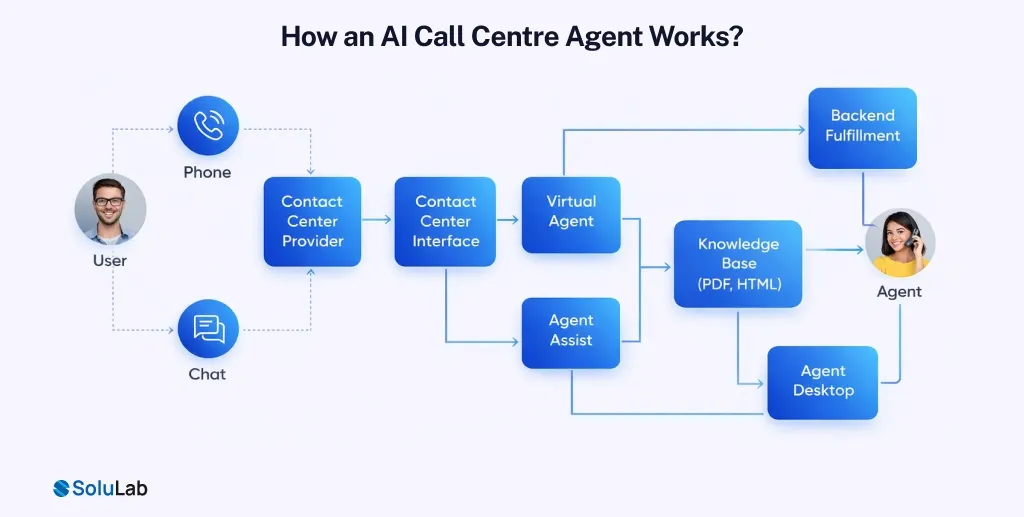
An AI call centre agent functions by listening to customers, interpreting intent, making smart decisions, and acting in the real world – scalable, high-quality, human voice support.
- Voice Input / Speech Recognition: The agent receives live voice calls and translates them into written form with the help of the advanced speech recognition system, including accents, background noise, and real-time dialogues.
- Conversational AI & Reasoning Engine: The AI interprets intent, context and makes decisions using multi-step queries to determine the most appropriate response or action, and achieve natural and relevant conversations.
- Action Implementation and System Response: According to the choice, the agent carries out the tasks, such as the creation of the tickets or data retrieval, then the system reacts with speech output in a natural voice in real-time.

Features of an AI Call Centre Agent
AI call centre agents assist companies in managing customer calls productively by providing 24-hour service, natural language, and automated intelligence to enhance the quality of response, scalability, and the customer experience.
1. 24/7 Voice Availability: AI call centre agents can work 24/7, meaning that any customer call will be answered immediately, even during holidays or weekends, during peak times, without raising the staffing expenses and business overhead.
2. Natural, Human-Like Conversations: With advanced speech recognition and conversational AI, the agents can understand intent, context, and tone, thereby enabling smooth and natural conversations which are less robotic and more like talking to a human-trained agent.
3. Call Routing and Escalation: AI agents can smartly allocate calls to the appropriate department or escalate to the human agents when necessary, save on wait times, and make sure difficult or delicate problems are managed properly.
4. Multilingual and Regional Language Support: AI agents call centre assist in several languages and regional accents and can be used by businesses to provide services to a wide range of customers, enhance access, and offer uniform voice support across different geographic locations.
5. Real-Time Analytics and Call Insights: These agents can give businesses real-time dashboards, call summaries, and performance measurement that can help them understand customer sentiment, diagnose common problems, and continually streamline call centre activity.
How to Build an AI Call Centre Agent?
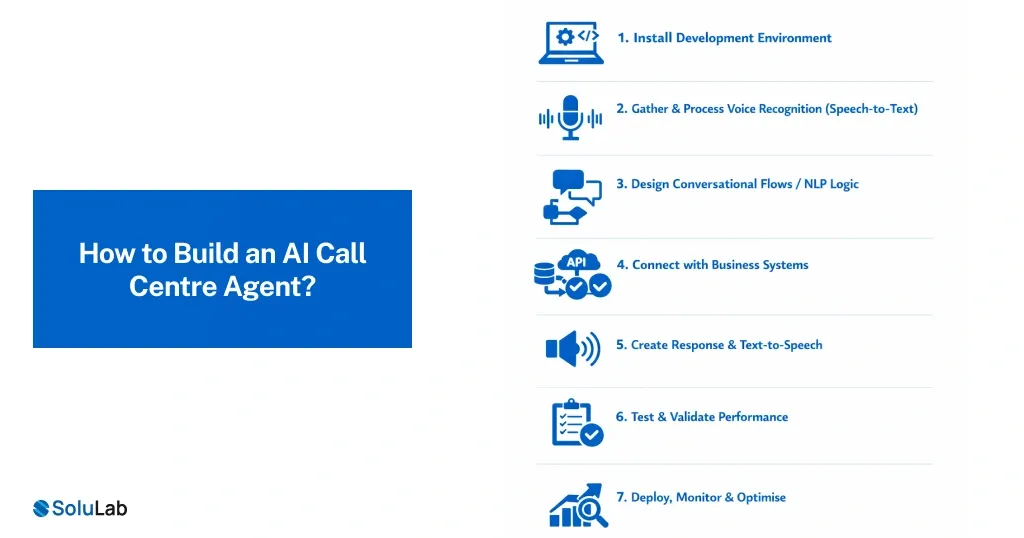
To develop an AI call centre agent, a combination of real-time voice processing, natural language understanding, integrations to the back-end and ongoing optimization is put in place to automate customer support and increase satisfaction in any industry.
Step 1. Install your Development Environment.
Get ready your tools, languages and APIs before development. Install necessary SDKs and create secure API keys, so that your project can be able to run speech processing, AI models and telephony integrations.
Step 2. Gather & Process Voice Recognition (Speech-to-text)
Turn inbound verbal calls into text using the Automatic Speech Recognition (ASR). This will allow your AI to process what you are saying in real time, and it will help an agent know properly what the customer intends to get.
Step 3. Design Conversational Flows/ NLP Logic
Identify all large and edge-case call situations, and specify the response of the agent to questions or requests. Develop Natural Language Understanding(NLU) and an unidentified fallback.
Step 4. Connect with Business Systems
Integrate your AI with CRMs, ticketing systems, and billing software and databases through APIs. This allows the AI to retrieve, refresh and process actual customer information instead of just chatting.
Step 5. Create Response and Text-to-Speech (TTS)
After the AI identifies the correct response, TTS technology can be used to make the textual responses sound logical. This gives a natural, smooth, and human customer experience.
Step 6. Test and Validate Performance
To make sure it works well in real call situations, rehearse before going online, and adjust accuracy, minimise misunderstandings and enhance intent recognition. Track such indicators as customer satisfaction and call resolution.
Step 7. Deploy, Monitor and Optimise
Start production using real callers, and track the performance using analytics dashboards. Periodically refresh training information and dialogue streams to keep in line with new products, modifications to policies and client feedback.
AI Call Centre Agent vs Traditional Call Centres
Here’s a complete comparison overview on ai virtual agent call centre and a traditional call centre you should know:
| Factor | Human Agents (Traditional Call Centre) | AI Call Centre Agents |
| Cost Comparison | High recurring costs due to salaries, training, infrastructure, and attrition management. | Lower operational costs after setup, with minimal marginal cost per additional call. |
| Scalability | Scaling requires hiring, training, and onboarding new agents, which takes time. | Scales instantly to handle thousands of calls simultaneously without extra staffing. |
| Response Time | Call wait times increase during peak hours and high demand. | Responds instantly with no waiting time, even during call surges. |
| Availability | Limited to shifts, holidays, and regional working hours. | Available 24/7, including weekends and holidays, without downtime. |
| Consistency | Response quality varies based on agent experience and workload. | Delivers consistent, policy-aligned responses on every call. |
Future of AI Call Centre Agents
AI agents of the call centre will continue to develop on a rapid scale, going beyond simple automation into intelligent, human-like systems capable of operating conversations independently, emotionally aware, and working across multimedia communication channels harmoniously.
1. Fully Autonomous Voice Agents: The agents will accept end-to-end calls without any human interventions, comprehending intent to problem-solving, actions, and escalation of complex and sensitive cases only where necessary.
2. Emotion-Aware Voice AI: Emotion-aware voice AI agents will identify the customer tone, stress, and sentiment in real-time and enable agents to modify their response, empathise, and refer callers to human support more quickly when they are frustrated.
Read More: Why Multimodal Models Are the Future of AI?
3. Agents Multimodal (Voice + Chat + CRM): Multimodal agents will integrate voice and chat calls, and CRM information, which will allow consistent and personal customer experiences and preserve all context across channels and business systems.

Conclusion
The development of an AI call centre agent is no longer a decision that would only help save money, but it is a move that would upgrade modern businesses. With the right design, AI voice agents may serve large volumes of calls, provide consistent support, and be integrated into the current systems. Speech recognition and conversational intelligence, to real-time integrations and constant optimization all of them are very important to the success.
With the growing customer demands, companies implementing AI call centre agents are gaining quicker response time, improved scalability, and insights through each interaction. By collaborating with the right AI development team, you can be sure that the AI development solution is not going to fail.
SoluLab, an AI agent development company, can help you build an AI call centre agent to automate your business workflows. Book a free consultation call today to discuss further.
FAQs
AI call centre agents are most useful with businesses that support high call volumes, such as e-commerce, BFSI, healthcare, telecom, logistics, and customer support teams.
Yes, AI call centre agents can serve various languages and regional accents, and thus are applicable to the global and multilingual customers.
Prices are dependent on complexities and integrations. An entry-level AI call centre agent can cost approximately 15000 dollars, whereas the enterprise systems cost more to invest in.
If you partner with the right AI application development services company, then it can be developed within 6-8 weeks, and 3-4 months are needed to develop and implement enterprise-level AI call centre agents.
Yes, AI call centre agents are enterprise secure when constructed with encryption, access controls, call logs, and compliance requirements.