


Crypto went global fast. More than 300 million people in close to 150 countries now use it. Why the rush? It is more convenient than a traditional bank, it can save you money by cutting out transaction fees, and it is open to almost anyone who wants to invest.
But no financial system is flawless, and crypto is no exception. Real security threats exist, and they hit people the moment they start handling digital assets. This guide is about keeping you safe in crypto. We cover crypto wallet security, the scams that catch people most often, the upsides and downsides of digital currencies, and the practical security steps that protect your cryptocurrency wallets.
Let’s get started.
What Exactly is a Cryptocurrency?
Cryptocurrency is digital money protected by advanced encryption, which makes it extremely hard to counterfeit. Ordinary currencies run through banks and governments. Cryptocurrencies run on a blockchain instead: picture a virtual ledger that keeps itself, outside the control of governments and traditional banks.
It started with Bitcoin (BTC) in 2009. The name “cryptocurrency” comes from the way it uses encryption to verify transactions. Since then others have followed, Ether (ETH), Binance Coin (BNB), Tether (USDT) and plenty more, and interest in these new digital assets has only grown.
Read Our Blog Also: Top 10 Decentralized Crypto Exchanges to Consider
Cryptocurrency Theft Is Almost Always Avoidable
Cryptocurrency wallet theft is, most of the time, preventable. A bit of foresight and some careful habits go a long way. Crypto investors already have the tools to shield themselves from the breaches that keep making headlines. Put the right security protocols in place, stay alert, keep clear of risky situations, and you can take part in one of the fastest-growing industries in the world without lying awake worrying about your digital assets.
Yes, cybercriminals are always hunting for weak spots. Yet for the average investor, the simple moves usually matter most. Keep your cryptocurrencies in a wallet that is yours and properly secured. And, this one is big, don’t connect that wallet to sketchy platforms.
9 Cryptocurrency Security Measures You Should Know About!
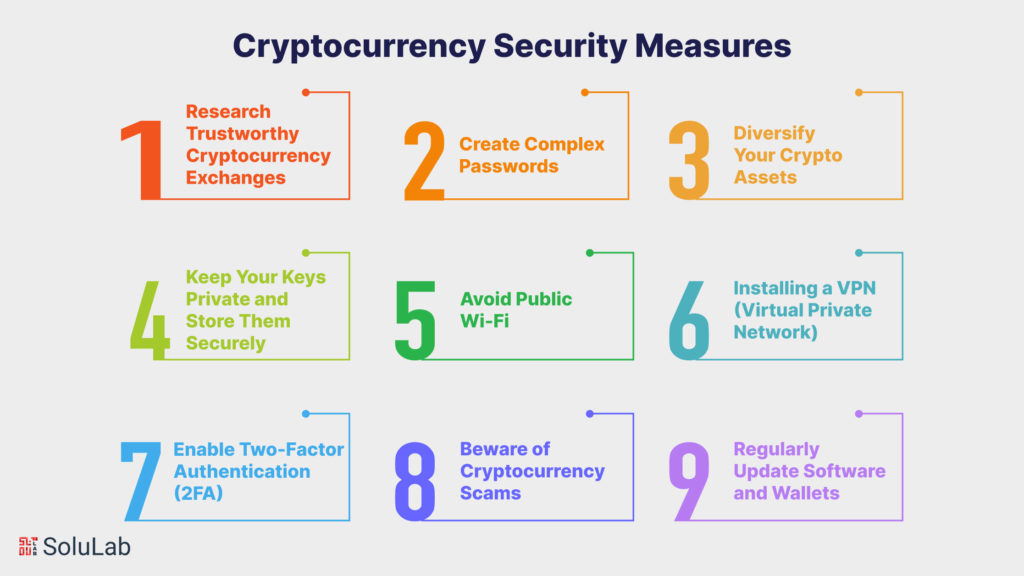
Use these security habits to keep your crypto wallets out of reach of the many kinds of hackers out there.
Research Trustworthy Cryptocurrency Exchanges
Picking an exchange? Do your homework first. Research is the best protection you have. Here’s where to look:
- Begin with the exchange’s reputation.
- Read user reviews and testimonials, and see what people say on social media and forums. Find out whether the exchange follows the regulations that apply where you live, since regulatory oversight tends to make an exchange safer.
- Next, look hard at the exchange’s own security.
- Good exchanges keep most user funds offline in cold storage, away from online attacks. They also run regular security audits to catch weak spots.
- And ask whether the exchange insures digital assets against theft or hacks.
Be wary of exchanges that are new or unregulated. They may have no track record on security at all. How safe your investment is depends heavily on the exchange you pick, so slow down and choose with your eyes open.

Create Complex Passwords
Your password is the first thing standing in front of your cryptographic operations. Make it a strong one:
- Mix uppercase and lowercase letters, numbers and special characters.
- Skip anything easy to guess, like names, birthdays or common phrases.
- Go long, and use a different password for every online account.
- To create complex passwords and keep them safe, try a trustworthy open-source team password manager.
Change your passwords often, too. Never reuse one across accounts. Stick to these habits and you make it much harder for anyone to get into your crypto accounts without permission.
Read Also: The Ultimate Guide for Asset Tokenization on Blockchain
Diversify Your Crypto Assets
Diversification is plain risk management: you spread your holdings across several cryptocurrencies. If one of them tanks, it drags down less of your portfolio. In practice:
- Hold a mix: established coins like Bitcoin (BTC) and Ethereum (ETH), plus some promising projects fewer people know about.
- Split your assets based on how much risk you can stomach and what you want long term.
- Check your portfolio on a regular basis and rebalance when it makes sense.
Spreading out your crypto assets softens the swings that come with the crypto market and keeps possible losses smaller.
Keep Your Keys Private and Store Them Securely
Your keyphrase, which you may also hear called your private key or recovery phrase, is the master key to your cryptocurrency wallet development. Protect it above everything else. Here’s how:
- Never share your key phrase. Not with anyone. It stays private.
- Keep it offline somewhere safe, such as a physical safe or a hidden, tamper-proof container.
- Think about a hardware wallet or a paper wallet. Both keep your keyphrase offline, where online attacks can’t touch it.
- Don’t save digital copies of your keyphrase in cloud storage, email accounts or on devices that aren’t secured.
Lose the keyphrase and you can lose access to your crypto for good. There is no reset button. Treat it that way.
Avoid Public Wi-Fi
Public Wi-Fi has a bad reputation for security, and it has earned it. Hackers on the same network can intercept what you do online. To keep your crypto safe:
- Don’t open your crypto accounts or send transactions while you’re on public Wi-Fi.
- Need to check your holdings while you’re out? Use mobile data, or set up a personal hotspot, so the connection is secure.
- If you must use public Wi-Fi, turn on a VPN (Virtual Private Network). It encrypts your traffic and keeps your activity more private.
Stay off public Wi-Fi and you cut the risk of someone getting into your crypto accounts and transactions.
Check Out Our Blog: Binance Business Model and Revenue Sources Explained
Installing a VPN (Virtual Private Network)
A VPN does a lot for your online security and privacy, and even more once crypto is involved. Here is what it actually gives you:
- It wraps your internet connection in advanced encryption techniques. That makes it very hard for attackers to intercept your data, let alone read it.
- It hides your real IP address behind the address of the VPN server you connect to. You get more privacy and a layer of anonymity, so it is much harder for anyone watching to trace what you do online back to you.
- You can pick servers in different locations around the world. Handy when a crypto service has geographic restrictions.
- Choose a reputable VPN provider with strong encryption and a no-logs policy. Run it whenever you manage your crypto, and your transactions and messages are better protected from threats.
Enable Two-Factor Authentication (2FA)
Two-factor authentication (2FA) means your crypto accounts ask for two proofs of identity, not one. A password alone won’t open the door. To get the most out of it:
- Switch on 2FA for every exchange account and wallet that supports it. Usually you get a one-time code on your phone or a hardware token, and you type it in along with your password.
- Keep your 2FA method locked down so other people can’t get to it. Then, even if someone gets hold of your password, they still can’t log in without the second code.
- Behind the scenes, 2FA uses cryptographic keys and codes that expire quickly to confirm it’s really you, one more barrier around your crypto.
Beware of Cryptocurrency Scams
Crypto scams come in many shapes. Spotting them early is how you protect what you’ve invested. The usual suspects:
- Phishing Scams: You get an email or message that looks real. It nudges you to click a link, the link goes to a fake site, and the fake site collects your login details.
- Ponzi Schemes: Fake investment programs that promise returns far too high to be real, paying earlier investors with money from newer ones.
- Impersonation Scams: Scammers pose as well-known people or projects in crypto and ask you to contribute or invest.
How do you stay out of their net?
- Confirm any investment opportunity is legitimate, and double-check URLs and sender email addresses.
- Treat unsolicited offers with suspicion, especially deals that sound too good to be true.
- Not sure? Ask people you trust in the crypto community before you act.
Read Also: What are the Benefits of Using Digital Identity with Blockchain in the Future?
Regularly Update Software and Wallets
Outdated software is an open window. Developers keep shipping updates that fix weak spots and add better security features, so staying current is part of staying safe. Here’s why updates deserve to go to the top of your list:
- Security patches: Many updates close known holes, so attackers have fewer ways in.
- Improved features: An update can bring new security layers or security settings that are easier to use.
- Compatibility: Current software keeps working smoothly with the newest security protocols.
Emerging Technologies in Enhancing Security in Cryptocurrency Wallets
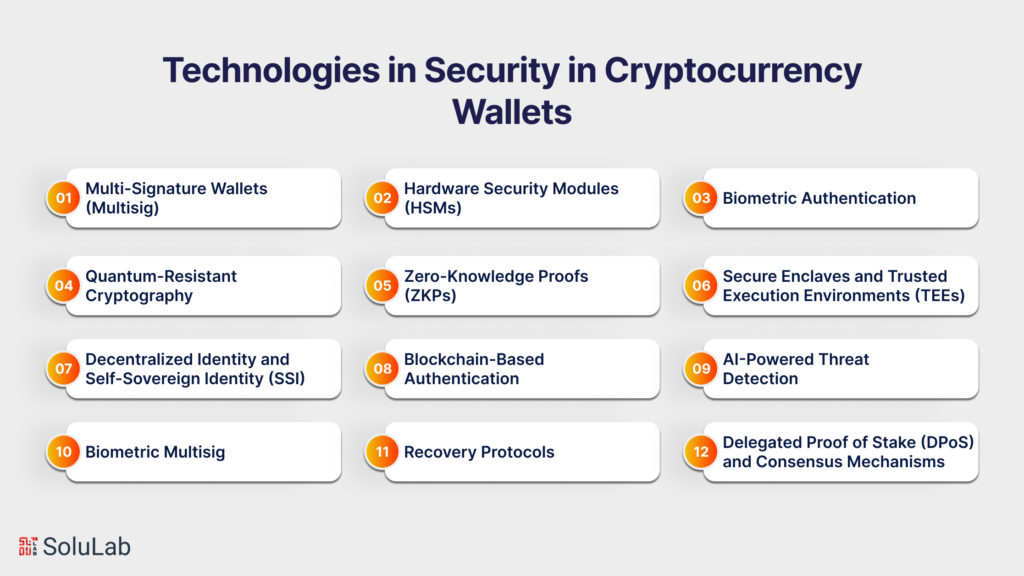
Emergent technologies keep raising the bar for crypto wallet security. Each one targets a different kind of threat or weak spot. These are the technologies and trends worth watching:
Read Our Blog: 8 Best NFT Wallets
Multi-Signature Wallets (Multisig)
A multisig wallet won’t approve a transaction until it has several cryptographic signatures, usually from private keys held by different people. No single key can move the funds. That removes the single point of failure.
Hardware Security Modules (HSMs)
HSMs are dedicated hardware devices built to protect and manage cryptographic keys. More and more wallets, hot and cold, use them to guard private keys. They resist tampering, both for the keys and for the cryptographic operations that use them.
Biometric Authentication
Fingerprints, faces, irises. Wallets are building these biometric checks in so users can prove who they are. On mobile devices especially, this makes opening a wallet safer.
Know more: Blockchain Verification Process: Explained
Quantum-Resistant Cryptography
Quantum computing could one day break the cryptographic algorithms we rely on today. That is why quantum-resistant cryptography matters more each year, and why wallets are experimenting with post-quantum techniques to hold off quantum attacks down the road.
Zero-Knowledge Proofs (ZKPs)
ZKPs let you prove a piece of data is valid without showing the data. Privacy-focused cryptocurrencies and wallets use them to keep transactions private without giving up security.
Secure Enclaves and Trusted Execution Environments (TEEs)
Secure enclaves such as Intel’s SGX and ARM TrustZone carve out an isolated execution space inside a device’s CPU. Cryptographic keys are stored and protected there, so the keys stay safe even if the rest of the device is compromised.
Decentralized Identity and Self-Sovereign Identity (SSI)
The idea here is simple: you own your digital identity and the cryptographic keys tied to it, fully. SSI technologies try to cut out the central identity providers, which is good news for your privacy and your security.
Blockchain-Based Authentication
Some wallets are testing authentication built on the blockchain itself, where your identity is tied to your wallet address on-chain. That lowers the risk of phishing and of anyone getting in without permission.
AI-Powered Threat Detection
Artificial intelligence and machine learning now watch crypto wallets for suspicious activity and likely threats. They pick up anomalies and warn users when something looks off.
Biometric Multisig
Put biometrics and multisig together and you get another layer on top. Users approve transactions with their biometric data, which makes a wallet much harder for attackers to break into.
Recovery Protocols
Lost your device? Had it stolen? Newer recovery protocols, social recovery and threshold schemes for instance, let you get back into your wallet. They rely on trusted contacts or on several key holders.
Delegated Proof of Stake (DPoS) and Consensus Mechanisms+
DPoS and other consensus mechanisms are built to make blockchain networks more secure. Indirectly, that makes the wallets running on those networks safer too.
Final Words
Crypto has huge potential. It also has its own set of problems, and security sits at the top of that list. Cyberattacks and scams aimed at crypto holders have not gone away. Still, investors who know what to look for and follow good practice can move through all of this with confidence.
The basics carry most of the weight: pick reputable exchanges, use strong passwords, turn on two-factor authentication, guard your private keys, and keep your guard up against scams. Do that and your risk drops sharply. On top of it, newer technologies such as multi-signature wallets, hardware security modules, biometric authentication and quantum-resistant cryptography are pushing wallet security further.
The crypto space keeps changing. Users, developers and security experts, working together, keep shoring up the base for a safer digital financial future. Follow these practices, keep up with new security trends, and you can enjoy what this technology offers without handing your digital assets to the next attacker.
SoluLab, one of the leading cryptocurrency companies, is a trusted partner in a field that never sits still, offering cryptocurrency wallet development services built to a very high standard. We are committed to the best cryptocurrency key security, and we specialize in building secure, hardened cryptocurrency wallet applications. Our team pairs modern technology with a deep grasp of how crypto really works, and delivers custom solutions that meet the highest bar for both security and user experience. Building a new cryptocurrency wallet app development project from scratch? Tightening the security of a wallet you already run? Either way, SoluLab’s experience and commitment can get you there. Contact SoluLab today to start your crypto project with confidence.
FAQs
Shipra Garg is a tech-focused content strategist and copywriter specializing in Web3, blockchain, and artificial intelligence. She has worked with startups and enterprise teams to craft high-conversion content that bridges deep tech with business impact. Her work translates complex innovations into clear, credible, and engaging narratives that drive growth and build trust in emerging tech markets.
![How to Build a Japan-Ready Crypto Wallet: Must-Have Features [2026]](https://www.solulab.com/wp-content/uploads/2026/02/Build-Japan-Ready-Crypto-Wallet.webp)