
Want proof that crypto is growing? Look at the numbers. By 2024, more than $10.6 trillion crypto transactions had moved through wallets and exchanges worldwide. That is not a fringe crowd anymore. People, banks, and whole governments are rethinking how money works, and they are doing it in public. Countries keep opening the door to crypto while still holding the line on security and tax rules, because they are betting on where this goes next.
Switzerland, Singapore, El Salvador. Three very different places, all writing the legal rules and building the plumbing crypto needs to run. Even the U.S., the biggest crypto market on the planet, is growing its bitcoin reserve. Right now more than 560 million people hold or use crypto somewhere in the world. So it makes sense that investors keep asking the same question: which countries are actually the best to set up in?
If that question is yours too, or you are just curious where the smart money is looking, this one is for you. Let’s get into it.
Why Are Countries Becoming Cryptocurrency-Friendly in 2026?
The short answer: growth. Countries are warming up to crypto because they see decentralization, new tech, and fresh economic activity riding along with it. Over the past few years, investors have kept an eye on the crypto-friendly nations, and the pull is usually two things: tax breaks and real blockchain infrastructure. But it goes past that. Clear rules and solid protection over customer transactions matter just as much, and traders notice which countries take that seriously.
Governments help crypto investment firms by giving them room to operate and a sense that the rules won’t flip overnight. Security requirements stay tight, no question. Yet the appetite for building crypto companies keeps getting encouraged. The payoff they are chasing? Jobs, more people brought into the financial system, a growing blockchain sector, and a digital economy that reaches across borders.
Top 12 Countries That Are Crypto-Friendly in 2026
Below are twelve countries worth a serious look if you run, or plan to run, a digital assets business. No two are alike. Each brings its own strengths and its own way of playing the long game.
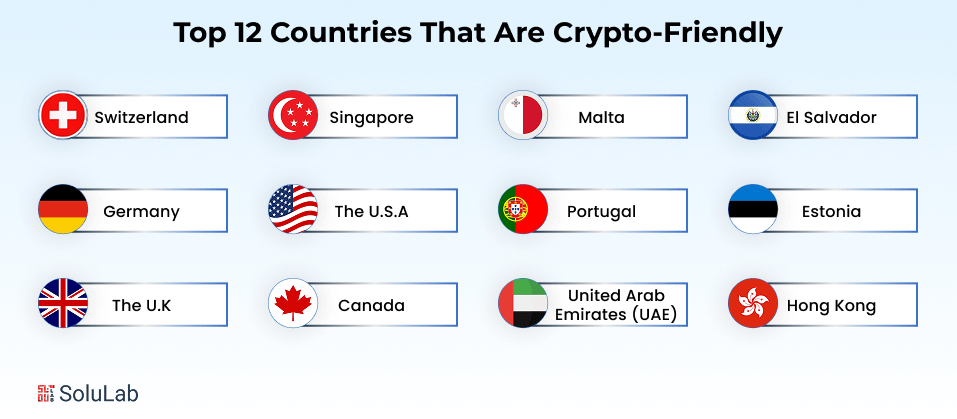
1. Switzerland
2. Singapore
3. El Salvador
4. United Arab Emirates (UAE)
5. Portugal
6. Estonia
7. Germany
8. Malta
9. The U.S.A
10. The U.K
11. Canada
12. Hong Kong
Switzerland: Europe’s Crypto Valley
Switzerland runs on precision and trust, and it shows. Tight, well-written laws paired with a builder’s mindset give traders a place where digital assets feel safe rather than sketchy. No surprise, then, that the country has picked up a real wave of crypto companies over the last stretch.
- The Crypto Valley in Zug hosts 1,000+ blockchain startups as of early 2026.
- FINMA provides licensing clarity for ICOs, custody services, and digital exchanges.
- No capital gains tax on personal crypto holdings supports long-term investors.
- Swiss banks have offered integrated crypto trading and wallet services since 2023.
- Switzerland supports Web3 with AI-powered crypto wallet development hubs, attracting crypto investment firms.
Singapore: Asia’s Fintech Beacon
Singapore keeps earning its spot on these lists for a plain reason: it protects investors and runs secure crypto exchange platforms. Rules first, then everything else.
- The Monetary Authority of Singapore (MAS) introduced legal licensing regulations for crypto exchange firms in 2024.
- However, in 2026, MAS made it mandatory for every cryptocurrency dealer.
- Corporate tax remains low at 17%, attracting blockchain startups from across Asia.
- Over 400 fintech firms support flash loan bots and MPC wallet tech in 2026.
- Government-backed sandbox programs help scale AI-integrated crypto wallets.
El Salvador: The Bitcoin Nation
El Salvador got there first. It was the first country to make Bitcoin legal tender, full stop. From there the government wrote policy around it, hoping to steady a shaky financial picture and give the currency a real footing at home.
- Bitcoin has been accepted nationwide since 2021; Chivo Wallet has 4.5 million users in 2026.
- Bitcoin City offers no capital gains, property, or income taxes on crypto earnings.
- Government bonds are backed by Bitcoin, funding infrastructure, and attracting global capital.
- The national blockchain curriculum has been taught in public universities since 2023.
- El Salvador ranks in the top 5 for crypto wallet downloads in Latin America.
United Arab Emirates: The Middle East’s Digital Finance Hub
Dubai and Abu Dhabi are doing the heavy lifting here. Between them, the UAE has pushed Web3 adoption hard, mostly by making it easy to do business.
- VARA licenses over 50 crypto firms as of Q1 2026 in Dubai alone.
- DMCC hosts over 600 crypto-related businesses in its free zone.
- Zero income tax and customs duties draw in exchange platforms and wallet developers.
- UAE’s National AI Strategy integrates smart crypto payment systems in public services.
- Blockchain tech is used actively in the property, logistics, and finance sectors.
Portugal: A European Crypto Haven
Portugal’s tax rules are famously easy on people holding digital assets, which is exactly why investors and freelancers keep landing there.
- No VAT or capital gains tax for individual crypto investors (non-professional traders).
- Lisbon’s blockchain community has grown 40% year-over-year by mid-2026.
- Digital nomad visa boosts crypto freelancing and remote blockchain work.
- The government is exploring e-Euro stablecoin pilots through private partnerships.
- Blockchain associations offer education, wallet development support, and investor programs.
Estonia: Digital-First and Blockchain-Ready
Estonia went digital before most of Europe caught on. Its e-residency program and digital-first habits turned it into a magnet for crypto exchange registrations.
- Over 3,500 crypto firms have registered via the e-residency platform since 2020.
- Transparent crypto licenses have been issued under updated AML laws since late 2023.
- Local firms develop AI Copilot tools to assist with crypto compliance.
- National e-wallet ID program supports multicurrency wallet integration.
- Blockchain solutions are used in government e-services, from land records to e-voting.
Germany: Regulated Yet Forward-Looking
Germany strikes a balance a lot of countries struggle with. It is one of the most structured crypto setups in the EU, and still one of the friendliest to new ideas.
- Long-term crypto holdings (over one year) are exempt from capital gains tax.
- BaFin has licensed banks for digital custody services since 2021.
- Frankfurt is home to multiple blockchain research labs funded by EU grants.
- The national blockchain strategy includes use cases in identity, finance, and logistics.
- Web3 educational programs are now included in 25+ universities across the country.
Malta: The Blockchain Island
Malta wrote its crypto laws early and wrote them clearly. That head start gives ventures real transparency and protection, which is a big part of why the island earned its nickname.
- VFAA offers a three-tier licensing system based on service type, including exchanges, custody, and ICOs.
- MDIA supports blockchain platform audits and certifications to reduce fraud.
- Tax exemptions on long-term digital asset holdings promote a holding culture.
- Partnerships with universities help develop talent for crypto wallet security roles.
- Over 100 blockchain and crypto startups registered between 2022 and 2024.
United States of America: Strategic Crypto Reserve
The U.S. is home to more than 50 million crypto users and a huge investor base. The SEC and CFTC keep watch over the market here, and between them they hand down the rules and guidance that govern how digital assets get traded.
- States like Texas, New York, and Wyoming are leading in regulatory clarity, crypto reserve, and tax incentives.
- Access to deep venture capital markets boosts the success of crypto exchanges.
- Prominent U.S. crypto exchange companies like Coinbase, Kraken, and Gemini shape global trading trends.
- Advanced AI integration supports smart crypto wallets and arbitrage tools.
- Regulatory frameworks allow ICOs and asset-backed token offerings under SEC oversight.
United Kingdom: Regulatory Framework
The UK plays it much like the U.S. Its Financial Conduct Authority (FCA) keeps tabs on crypto activity, and since 2023 more than 250 crypto firms have signed up for digital asset licensing.
- The UK introduced a new rule, from January 1, 2026, crypto companies must collect detailed reports. That should contain the company user’s crypto transaction data.
- The FCA Sandbox enables testing of AI-powered crypto wallets and fintech apps.
- UK initiatives like the Cryptoassets Taskforce focus on long-term blockchain integration.
- Favorable legal conditions allow crypto investment firms to scale securely.
- Firms like eToro, Revolut, and Bitstamp thrive under the UK’s flexible licensing norms.
Canada: Uprising Crypto Country
Canada made a move recently, building out a stablecoin reserve and putting itself squarely among the crypto-friendly countries of 2026. More than six crypto ETFs now trade publicly there, all under a framework that keeps regulation and security front and center.
- All crypto exchanges must register with the Canadian Securities Administrators (CSA) and IIROC.
- Crypto transactions are taxed as capital gains, bringing clarity to investors.
- Provinces like British Columbia and Ontario lead in blockchain development and AI wallet innovations.
- Canada’s cold climate and low-cost electricity attract crypto mining firms from across the globe.
- Crypto investment firms actively operate in Toronto and Montreal due to regulatory transparency.
Hong Kong: Asia Crypto Riser
Hong Kong keeps its crypto market in check through the Securities and Futures Commission (SFC). Licensing for crypto firms runs through the Virtual Asset Service Providers (VASPs) regime.
- Hong Kong’s recent stablecoin bill introduced a regulatory framework to enhance the security and growth.
- Low taxation policies and ease of business attract international blockchain startups.
- Strategic location between East and West enhances market access across Asia.
- Initiatives like the FinTech Innovation Hub drive collaboration in crypto R&D.
- Success stories like Bitfinex and ANX International showcase strong operational growth in the region.
How to Choose the Right Crypto-Friendly Country?
Where you plant your crypto operation comes down to a handful of things pulling in different directions. Here is a quick side-by-side to weigh them:
| Factor | Description |
| Regulatory Clarity | Countries like Switzerland, Malta, Singapore, the U.S., and Hong Kong offer well-defined frameworks. |
| Tax Benefits | El Salvador and Portugal offer zero tax on capital gains for individuals. |
| Government Support | UAE, Canada, and Estonia promote crypto through national AI and digital agendas. |
| Business Setup Ease | Estonia allows full remote setup via e-residency. |
| Financial Infrastructure | Germany, Canada, and Switzerland integrate banking with crypto services. |
| Tech Innovation | Singapore, UAE, and Hong Kong push AI-powered wallets and flash bots. |
| Market Potential | El Salvador, the UK, and the UAE offer high adoption rates and institutional interest. |

Final Thoughts
2026 feels like a hinge year for anyone in crypto. More and more countries are easing taxes and folding crypto into everyday digital payments. The twelve above are each laying real groundwork for a digital economy, built out of blockchain, AI, and cryptocurrency. And if you had to name a front-runner? Switzerland, thanks to how far its tax relief goes.
The UK and Canada also hold Bitcoin, and they have even worked it into employee pensions. But both still need a bigger, clearer plan to match that ambition. The takeaway for investors is simple enough: pick the right country and the profits, openings, and long-run upside in crypto get a lot easier to reach.
Building a long-term Bitcoin strategy? It pays to talk it through with The Bitcoin Way, a trusted Bitcoin consultancy that helps people and organizations bring Bitcoin into the picture safely and with a plan.
SoluLab, a leading cryptocurrency development company, is here for that. We build reliable, secure solutions for crypto businesses around the world, the U.S. and Europe included. Curious about crypto-friendly options for your own venture? Reach out today.
FAQs
Shipra Garg is a tech-focused content strategist and copywriter specializing in Web3, blockchain, and artificial intelligence. She has worked with startups and enterprise teams to craft high-conversion content that bridges deep tech with business impact. Her work translates complex innovations into clear, credible, and engaging narratives that drive growth and build trust in emerging tech markets.