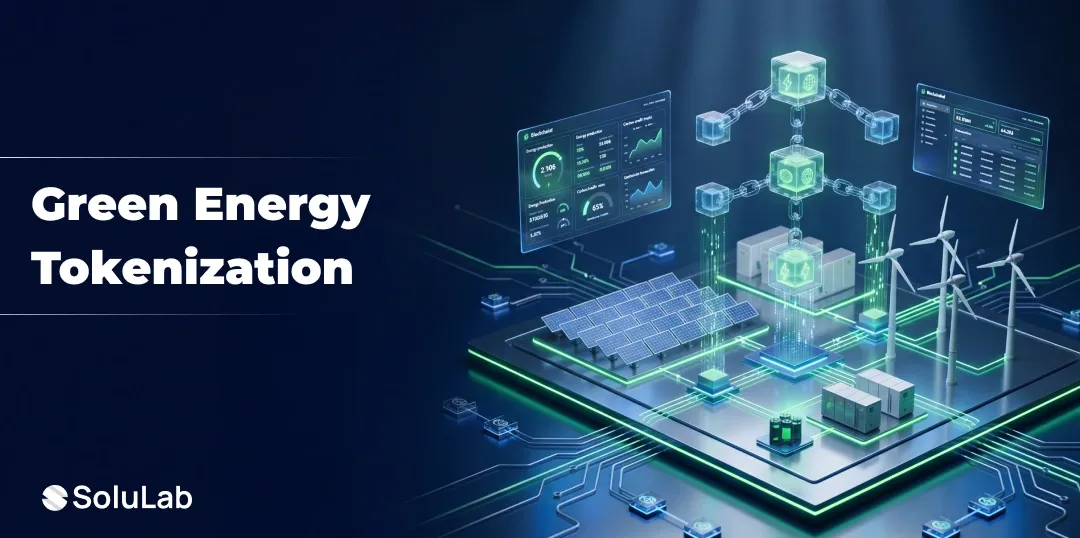
Renewable energy pulled in record money in 2026 $3 trillion. The old way of financing those projects, though, still jams up.
- The tech isn’t what stops most enterprises. Liquidity is.
- Green Energy Tokenization fixes that. It turns physical assets into programmable digital securities, and that opens up a $16 trillion pool of global institutional capital.
Tie a utility-scale project to a blockchain and developers get to recycle
- CAPEX mid-construction,
- automate ESG compliance through real-time “Green Oracles,” and
- Enable Atomic Settlement for investor payouts.
Once RWA tokenization turns into a core treasury tool, bringing in an expert blockchain development firm gives you growth you can actually count on.
Key Takeaways
- Old-school energy financing moves too slow for 2030 Net-Zero goals. Tokenization cuts the capital-raising cycle from months down to weeks.
- Turn an illiquid solar or wind asset into a tradeable token and developers can exit early, then pour that money into new projects. Portfolios grow faster.
- Smart contracts do more than move money. They automate PPA (Power Purchase Agreement) payouts and carbon credit issuance, wiping out roughly 90% of the admin overhead.
How Solar and Wind Assets are Digitized in 2026?
Green energy tokenization takes a real renewable asset, a solar panel array, a wind farm, a bioenergy plant, and mints it into digital tokens using blockchain technology. Think of the tokens as shares. Each one hands an investor partial ownership plus a transparent record of the underlying asset.
Companies are chasing net-zero targets right now, and tokenized renewable energy has become one of the cleaner ways to widen green investment. Businesses and investors anywhere can buy a slice, sell it, or trade it, and the record stays open for anyone to check.
Example
Picture a big solar project in Arizona, or an offshore wind farm off the UK or UAE coast. Split it into thousands of tokens.
Each token represents:
- A share of the project
- Ownership rights
- A portion of revenue from energy generation
And those tokens then trade on digital platforms.
You can see it in Real World Asset Tokenization across the UAE, where blockchain work in the energy market keeps picking up speed.
The upshot: tokenizing renewable energy builds a fairer, more open market for clean energy investment, letting industries grow sustainably while they stay on the right side of ESG standards.
How Blockchain Powers Renewable Energy Markets
Put solar asset tokenization on a blockchain and you get a secure, see-through system for managing energy assets.
With smart contracts, the ownership transfers and the energy trades run on their own. No middleman in between.
For a business, that means working with a:
- Blockchain development company
- A smart contract development company
is not optional. These are the teams that build the systems handling transactions safely, and without wasted motion.
Blockchain also improves:
- Asset traceability
- Compliance management
- Transparent financial reporting
Those three things clear up the worst pain points in old energy financing, and they make green energy tokenization investments in the USA and other regions far more dependable, and frankly more appealing.
Why Institutional Investors are Bending to Tokenized ESG Assets?
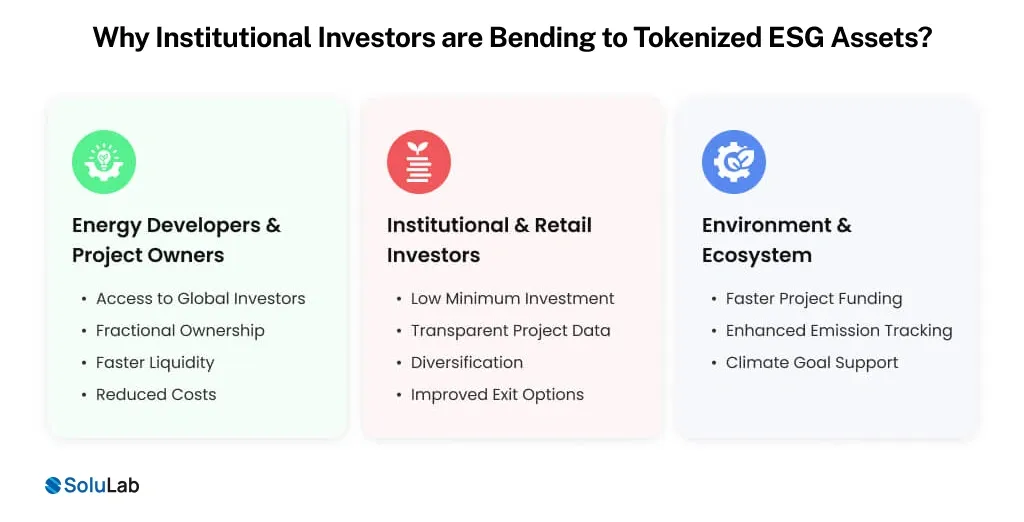
For Energy Developers and Project Owners
- Access to a global pool of investors
- Easier project financing through tokenizing clean energy
- Faster liquidity via tradable energy tokens
- Reduced costs and delays using blockchain-powered solar asset tokenization
For Institutional and Retail Investors
- Lower minimum investment in tokenized clean energy
- Transparent project data through smart contracts
- Ability to diversify into ESG-aligned assets
- Improved exit options through secondary market liquidity
For the Environment and Ecosystem
- Faster funding for renewable energy projects
- Better emission tracking
- Creation of tokenized carbon credits
- Support for global climate goals
So the short version: tokenizing renewable energy closes the funding gap, lets more people in, and gives clean energy a path it can actually scale on.
Businesses that lean on blockchain solutions to tokenize renewable energy assets pick up a few more wins:
- Faster time-to-market
- Lower operational risk
- Better financial transparency
The model slots in cleanly with the decentralized Web3 ecosystem too, which nudges different industries to work together.
Use Cases and Real-World Examples
This is live already. Real projects, real numbers.
1. USA
One solar energy project raised $5 million by tokenizing 10% of its infrastructure, which let more than 2,000 micro-investors buy in.
That is the point: tokenized renewable energy can free up capital even for the smaller projects.
Large-scale solar centers in Fresno and Kern County are now running tokenized Power Purchase Agreements (PPAs).
2. EU & Germany
Germany has moved past the local cooperative stage. With MiCA (Markets in Crypto-Assets) now fully in force, community wind farms are issuing regulated security tokens.
- The Result: Residents don’t just “fund” projects. They trade their “Energy Yield” shares on licensed European digital exchanges.
- The Tech: Smart grids in North Rhine-Westphalia auto-calculate dividends off real-time wind output, then pay them out in Euro-stablecoins straight to investor wallets.
3. Middle East
The UAE steps out of the “sandbox” phase in 2026. VARA (Dubai) and ADGM (Abu Dhabi) have rolled out formal license categories for Asset-Referenced Virtual Assets (ARVAs).
- Live Deployment: Leading UAE developers are tokenizing “Green Hydrogen” and utility-scale solar arrays as Tier-1 collateral.
- Global Access: Under these regulated frameworks, a sovereign fund in Singapore can push liquidity into a solar park in Abu Dhabi on the spot, with zero cross-border banking friction
These aren’t hypotheticals. Renewable energy tokenization is already redrawing how clean energy gets financed.
It stopped being a fringe experiment. In 2026 it holds up utility-scale infrastructure financing.
Worth a look, too: how other countries are picking up green energy tokenization to make renewable investment easier to get into.
| Country | 2026 Market Status | The “Latest” Alpha |
| Nether Land | MiCA Compliant | Fully regulated peer-to-peer (P2P) energy trading is live. Smart grids now auto-distribute dividends via the Euro-Stablecoin. |
| Singapore | Cross-Border Hub | MAS “Project Guardian” now includes green energy as a Tier-1 RWA (Real World Asset) for institutional collateral. |
| Australia | Grid Edge Reality | Virtual Power Plants (VPPs) are now 100% tokenized, allowing neighbors to trade solar energy with zero bank intermediaries. |
| India | Scale Operations | Reliance and Adani are piloting on-chain RECs (Renewable Energy Certificates) to hit 2030 ESG targets transparently. |
Read More: Why Is Real-World Asset Tokenization Gaining Global Popularity?
Bridging Physical Hardware with On-Chain Smart Contracts
Smart Contracts
Smart contracts run how tokenized clean energy assets behave on the blockchain.
They automatically:
- Distribute investor payments
- Track energy production
- Enforce regulatory compliance
Energy Tokens
An energy token stands for a unit of renewable energy. For example:
- 1 kWh of solar power
- 1 kWh of wind energy
Each one ties straight back to real renewable output, and it can be traded digitally.
AI Integration
The more advanced setups also wire tokens into AI agents for energy management.
AI can help:
- Forecast energy demand
- Balance grid loads
- Optimize energy distribution
That matters a lot in places like the UAE, where RWA tokenization backs solar and hydrogen energy projects.
Take a wind farm. It can:
- Tokenize energy production
- Use smart contracts to distribute profits
- Use AI systems to forecast energy demand
Add it up and renewable energy tokenization is turning into a genuine global model for clean energy investment.
Read Also: Key Green Finance Trends
Top Green Energy Tokenization Platforms
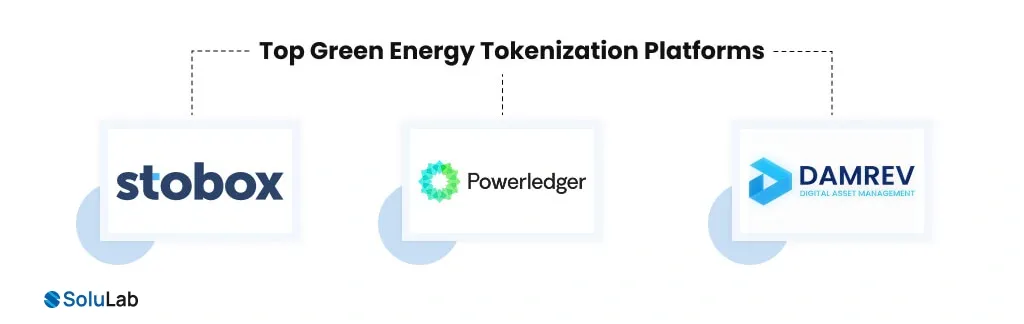
1. DAMREV
DAMREV works on tokenizing renewable energy assets: solar, wind, and hydro projects.
Key benefits include:
- Fractional ownership
- Global investor participation
- Increased liquidity
- Secure blockchain infrastructure
2. Powerledger
Powerledger runs peer-to-peer energy trading.
Consumers and producers buy and sell renewable energy tokens directly, no go-between.
The platform operates in:
- Australia
- India
- USA
3. Stobox
Stobox offers a regulation-compliant tokenization framework (STV3).
Features include:
- KYC / AML compliance
- Legal asset tokenization structure
- Governance automation
It lets companies tokenize renewable assets inside regulated markets like the Middle East.
Planning to launch your own tokenization platform? Team up with a trusted blockchain development company or hiring blockchain developers, and your system stays secure, scalable, and compliant.
How Your Business Can Get Started With Green Tokenization
Getting into the green energy tokenization market is not as tangled as it sounds, as long as you go about it in the right order.
Step 1: Identify Renewable Assets
Solar farms, wind turbines, hydroelectric plants. That kind of thing.
Step 2: Partner with a Blockchain Development Company
They put your renewable energy assets on the blockchain.
Step 3: Build Smart Contracts
A smart contract development company writes the automated rules that govern the tokens.
Step 4: Launch Tokens Securely
A tokenization platform development company issues and manages your tokens.
Step 5: Enable Investment and Trading
Let investors buy and trade tokens on regulated platforms, or through DeFi lending protocols.
With the right technology partners, a business can ship features like:
- Automated compliance reporting
- Investor dashboards
- Real-time analytics

Conclusion
Green energy tokenization is a fresh way to fund, build, and scale renewable energy infrastructure.
Turn renewable assets into digital tokens and a business can:
- Unlock global capital
- Increase transparency
- Achieve ESG targets faster
Interest keeps climbing in RWA tokenization in the UAE, in blockchain across energy markets, and in tokenized carbon credits. That gives companies a real shot at leading the transition.
We at SoluLab, a leading real-world asset tokenization company, help businesses turn renewable projects into investable digital assets on the blockchain.
The future of energy is clean, digital, and borderless. So here’s the real question: are you ready to lead the shift? If yes, then contact us today!
FAQs
Deepika is a content writer who blends storytelling with strategic thinking. She explores topics across digital innovation, emerging tech, and the evolving blockchain industry. She enjoys breaking down complex ideas into simple, engaging narratives in the growing global markets.