In this era, AI is spreading its roots to numerous industries, and blockchain is not a new concept for developers and entrepreneurs. However, the concept of AI integration in asset tokenization can make you think deeper. From small chatbots to smart contracts, AI has shifted the workflows. Now, another innovation towards asset tokenization is gathering attention from several researchers.
Deloitte also mentioned in its Q4 2025 report that the tokenization market is projected to grow from $300 billion to $4 trillion in the future. This is the signal that AI-powered asset tokenization is set to make a unique entry into the market. Therefore, to stay ahead of the racing market, you must know how this adoption is going to affect your niche.
The following discussion will give you clear details on how different industries are affected by AI-driven asset tokenization use cases.
Key Takeaways
- AI-powered asset tokenization helps you reduce 40% of operational costs across multiple asset classes.
- Combining AI development solutions with tokenization improves fraud detection, investor onboarding, and real-time risk management for enterprises.
- By 2026, AI asset tokenization platforms will become core enterprise infrastructure, enabling faster settlement, compliance automation, and smarter capital allocation.
Why are AI Development Solutions Crucial for Scalable Asset Tokenization Across Several Industries?
Tokenization without intelligence quickly hits operational limits. Enterprises managing thousands of assets, investors, and compliance rules cannot rely on manual processes or static smart contracts alone.
AI solutions enable enterprises to build enterprise asset tokenization platforms that scale smoothly across geographies, asset classes, and regulatory environments.
Key reasons AI is becoming foundational include:
- Artificial intelligence automates asset valuation, risk profiling, and compliance checks, reducing operational overhead by nearly 40%.
- Predictive models help enterprises forecast liquidity demand and investor behavior before market stress occurs.
- Machine learning improves fraud detection accuracy by analyzing transaction patterns across tokenized ecosystems.
- Natural language processing simplifies onboarding, documentation, and regulatory reporting for enterprise users.
As a result, AI-driven systems transform your asset tokenization services from a technical deployment into a long-term business capability.
Industrial Market Trends Driving AI-Powered Tokenization Adoption
It’s not just a one-day process to adopt customer-friendly AI development services into an asset tokenization platform. However, once the process starts, you can see the shift in your dynamics. Let’s see some key market shifts that showcase futuristic initiatives.
- Deloitte projects tokenized debt securities to reach $2.39 trillion by 2035, becoming the largest asset class.
- Tokenized private real estate funds are expected to approach $1 trillion in market capitalization.
- Underdeveloped land tokenization could exceed $500 billion as fractional ownership models mature.
Furthermore, real estate tokenization adoption is accelerating globally. Governments in Japan, Israel, and parts of Asia are actively exploring tokenized property frameworks. These initiatives are driven by faster settlement cycles, reduced intermediaries, and programmable financing structures. AI plays a critical role here by enabling dynamic pricing, automated compliance checks, and portfolio-level risk optimization.
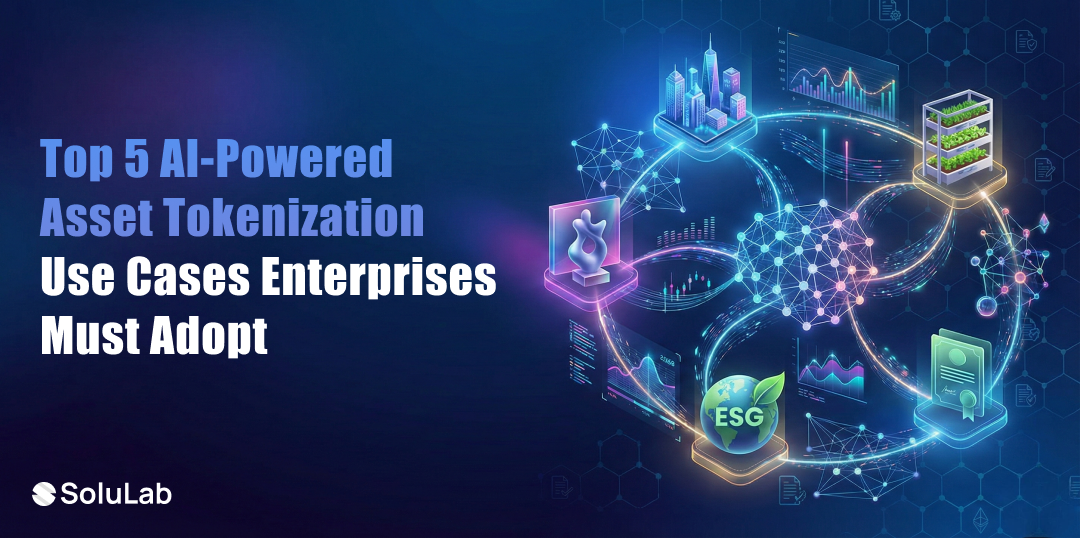
Top 5 AI-Driven Asset Tokenization Use Cases to Consider in 2026
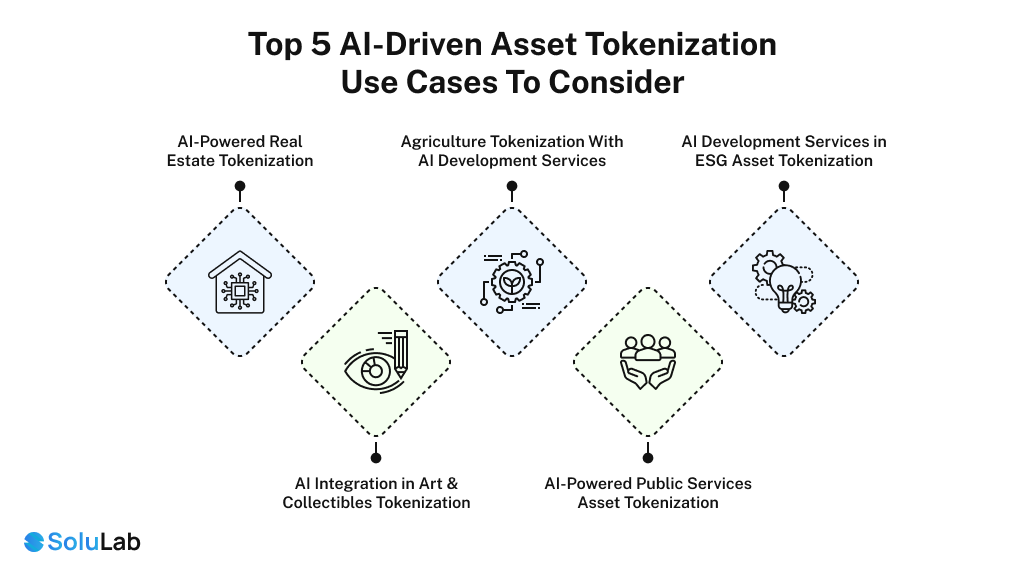
There are numerous industries, but the currently hyped and fast-adapting AI services in asset tokenization are given below:
1. AI-Powered Real Estate Tokenization
Real estate remains the largest and fastest-growing tokenized asset category. AI enhances both operational efficiency and investment intelligence.
Read More: Top 10 Countries to Launch a Real Estate Tokenization Platform in 2026
a. AI-Driven Portfolio Structuring
AI models analyze asset performance, location data, tenant behavior, and macroeconomic indicators to structure optimized tokenized portfolios.
- Institutional investors achieve up to 30% better diversification through AI-generated portfolio simulations.
- Token pricing dynamically adjusts using predictive demand modeling instead of static valuations.
- Risk exposure is continuously recalibrated based on rental yields, vacancy rates, and regional trends.
b. Automated Compliance and Investor Management
AI simplifies complex regulatory workflows across jurisdictions.
- KYC and AML verification times reduce by nearly 55% using AI-driven identity screening.
- Smart compliance engines flag jurisdiction-specific violations before token issuance occurs.
- Investor onboarding processes improve conversion rates by 25% through personalized workflows.
2. AI Integration in Art & Collectibles Tokenization
Art and collectibles represent a high-value yet illiquid market. AI enables transparency, pricing confidence, and broader participation.
a. Intelligent Asset Valuation and Authentication
AI analyzes auction histories, provenance records, and market sentiment to support pricing accuracy.
- Valuation accuracy improves by nearly 35% using AI-assisted historical pricing analysis.
- Fraud risk reduces significantly through AI-based provenance verification models.
- Fractional ownership enables investors to access artworks valued above $2 million.
b. Liquidity and Market Access Optimization
AI improves liquidity planning for traditionally illiquid assets.
- Tokenized art markets show up to 3x liquidity improvement compared to traditional sales cycles.
- Investor discovery improves through AI-driven recommendation engines.
- Market participation expands globally without relying on physical galleries or intermediaries.
3. Agriculture Tokenization With AI Development Service
Agriculture tokenization transforms illiquid farming assets into tradeable digital instruments while supporting farmers directly.
a. AI-Enabled Financial Inclusion Model
AI creates verifiable financial identities for farmers using transaction histories and yield data.
- Microloan approval rates increase by nearly 40% due to transparent digital records.
- Transaction costs are reduced by up to 55% through automated smart contract settlements.
- Farmers access global markets without relying on regional intermediaries.
b. Supply Chain Transparency and Yield Optimization
AI provides end-to-end visibility across agricultural supply chains.
- Transaction times are reduced by nearly 60% using automated verification workflows.
- Investors gain real-time visibility into crop performance and delivery milestones.
- Yield forecasting improves return predictability by 20–25% in pilot projects.
4. AI-Powered Public Services Asset Tokenization
Financial assets, including debt instruments and stablecoins, benefit significantly from AI-driven risk and liquidity management.
a. Intelligent Risk Modeling and Pricing
AI analyzes market volatility, creditworthiness, and liquidity signals continuously.
- Tokenized debt instruments achieve faster settlement cycles by nearly 70%.
- Default risk prediction accuracy improves by over 30% using machine learning models.
- Portfolio stress testing becomes automated and scenario-driven.
b. Stablecoin and Capital Stack Optimization
AI supports multi-layer capital structures across equity, debt, and hybrid instruments.
- Capital allocation efficiency improves by nearly 25% across enterprise portfolios.
- Stablecoin liquidity planning reduces exposure to sudden market shocks.
- Treasury operations gain predictive insights into funding requirements.
5. AI Development Services in ESG Asset Tokenization
ESG-focused tokenization requires accurate data, transparency, and accountability, areas where AI excels.
a. ESG Data Quality and Standardization
AI resolves inconsistencies across ESG data sources.
- Data alignment improves by nearly 40% across rating providers.
- Emissions forecasting accuracy increases through scenario-based AI models.
- ESG compliance reporting time reduces by over 50%.
b. Sustainable Investment Optimization
AI helps investors align returns with measurable impact.
- Green portfolios achieve improved risk-adjusted returns by nearly 20%.
- Carbon credit tokenization enables farmers and enterprises to access new revenue streams.
- Transparency builds investor trust through immutable ESG reporting trails.
Enterprises Must Know: How AI Development in Asset Tokenization Shapes 2026
By 2026, asset tokenization will no longer be experimental. It will be embedded into enterprise financial and operational systems.
What forward-looking enterprises are preparing for:
- AI-first enterprise asset tokenization platforms as standard infrastructure
- Tokenized public works and municipal financing are expanding retail participation
- Integrated stablecoin rails enabling instant settlement
- AI-driven compliance engines replacing manual workflows
However, challenges remain. Not all assets generate revenue, digital literacy gaps persist, and blockchain infrastructure requires upfront investment. Enterprises that succeed will be those that treat tokenization as a long-term system, not a one-off product.
An experienced asset tokenization development company helps enterprises design compliant, scalable, and AI-driven architectures that evolve with regulation and market demand.
Conclusion
Every industry is gaining benefits through AI-powered asset tokenization. This is where real growth starts. Once you start integrating AI services into the tokenization platform, you can see the customer engagement. To achieve this, a potential AI development company that has strong experience and a strong team is a must. We, at SoluLab, with
- 250+ in-house developers that help you boost your platform growth.
- Served 500+ global clients and enhanced their efficiency by 45%.
- You can also adopt Gen AI solutions for your system’s advanced transformation.
If you are also ready to build an AI-integrated asset tokenization platform, contact us today. Make your future vision come true with our 24/7 support.
FAQs
The cost of AI development services for healthcare asset tokenization typically starts from $10,000 and can scale higher. Pricing depends on data complexity, compliance requirements, AI-powered asset tokenization features, and enterprise-grade security integrations.
Developing an AI-powered real estate tokenization platform usually takes 3 to 4 months. Timelines depend on asset volume, regulatory scope, AI model complexity, and whether you are building a custom enterprise asset tokenization platform or upgrading an existing system.
Yes, AI can be integrated into an existing art tokenization system without rebuilding everything. AI-powered asset tokenization improves valuation accuracy, fraud detection, investor insights, and liquidity management while strengthening enterprise tokenization use cases for art assets.
You can contact SoluLab directly through their website to discuss AI-powered asset tokenization needs. Their team provides consultation, architecture planning, and end-to-end asset tokenization development services for enterprises and startups.
Yes, SoluLab actively works with clients in Dubai and the Middle East. They deliver AI development solutions, enterprise asset tokenization platforms, and compliance-ready tokenization applications tailored to UAE regulations and regional enterprise requirements.