A student can be intelligent, curious, and motivated yet still struggle in a classroom designed for everyone else. That’s the reality for learners with dyslexia, ADHD, and dyscalculia.
Traditional education systems rely on fixed formats and text-heavy content that unintentionally leave these students behind. This is where generative AI can help students with dyslexia. Instead of forcing learners to adapt to the system, AI enables the system to adapt to the learner.
From personalized reading assistance to focus-aware study support and visual-first math explanations, generative AI makes inclusive education scalable. In this guide, we’ll explore how to build generative AI solutions that help institutions design smarter, more accessible learning experiences for students with learning differences.
Key Takeaways
- Generative AI can allow personalized learning at scale through customizing the format, pace, and complexity of learning content.
- Reading assistants, study coaches, and visual math engines are AI-driven tools that are used to enhance understanding, concentration, and self-confidence.
- Designing effective AI solutions should be inclusive, carefully designed, and explainable to the instructors and learners, and should rely on feedback.
Understanding Learning Disabilities in Education
Gen AI in education is to realize that there are students who do not process information in the same way as other students. And that does not mean that they are not intelligent or incapable.
The AI in education market, which estimates the market valuation for AI in education will cross US $20 billion by 2027.
Learning disabilities such as dyslexia, ADHD, and dyscalculia influence the ability of students to read, concentrate, memorize, or operate numbers. Such issues are not always noticeable within a traditional classroom, as the teaching method remains the same for all. Consequently, the ability students can be unable to follow the pace, feel lost, or lose confidence.
When applied to education, the purpose of this is not to remedy the student but to make the learning process fit the student. Inclusive education aims at offering adaptable instruction, customized guidance, and user-friendly tools to ensure that all learners have equal opportunity to learn, engage, and attain academic performance.
Why Generative AI Is a Game-Changer for Inclusive Education?
With generative AI tools, inclusive education is becoming a new reality, as opposed to fixed, one-size-fits-all teaching; long-serving systems can be used to meet the needs of different learners and enable institutions to offer personalized guidance at scale.
- Adaptive learning: Generative AI tailors content, speed, and format to the specific learning style of students of varying capabilities, so that they learn in the best way they can absorb information.
- Works as per student behavior and progress: The AI systems can analyze engagement, performance, and interaction patterns in real time, making lesson, degree of difficulty, and assistance adjustments without having to wait until a human takes control.
- Facilitates scalable personalization of institutions: By using generative AI, schools and EdTech platforms can give a personalized learning experience to thousands of students at once without making their operations more complex and expensive.
- Eliminates reliance on teacher intervention: Through content adaptation and feedback automation, AI liberates teachers to concentrate on mentorship, emotional support, and high-impact pedagogical jobs instead of making constant adaptations.
Generative AI Use Cases for Students With Disabilities
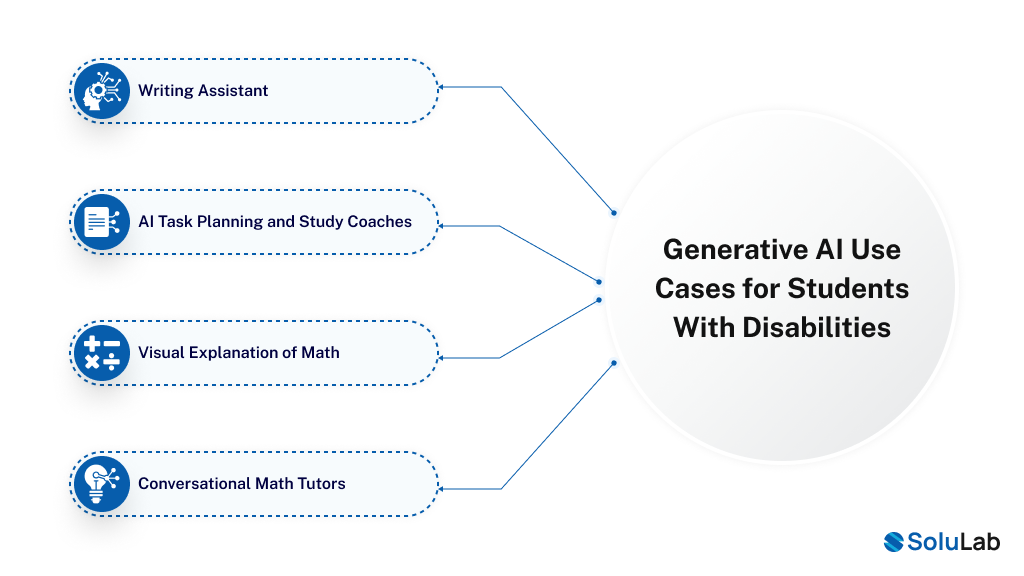
Generative AI is reshaping the inclusion and education of students with disabilities, enabling the individualization of learning, practice, and progress. This assists institutions in providing accessible, adaptive, and scalable learning assistance tailored to a wide range of educational requirements. Here are the Gen AI applications for students with disabilities:
1. Writing Assistant
These resources make text easier, speech can be converted into writing, and a student can get immediate feedback, which will allow him or her to comprehend the information and convey ideas more easily and confidently.
2. AI Task Planning and Study Coaches
The AI study coaches divide tasks into smaller steps, create smart reminders, and adjust the schedule, assisting students to be more efficient and focused on their work.
3. Visual Explanation of Math
Rather than numbers, AI creates visual, step-by-step explanations with real-life examples, which simplify the understanding of math concepts in students with poor ability in numerical reasoning.
4. Conversational Math Tutors
AI tutors describe the math problems using basic vocabulary, reply to follow-ups, and provide multiple ways to find solutions, so students can study math at their own pace without being pressured into it.
How Businesses & Institutions Can Build AI Solutions for Neurodiverse Students?
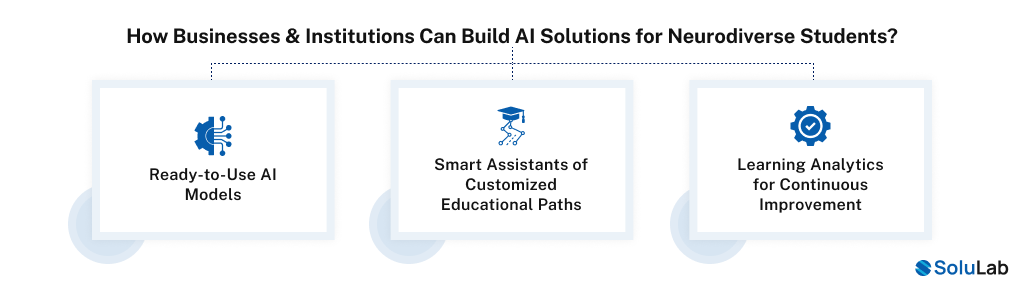
Businesses and institutions can support neurodiverse students by building AI solutions that are flexible to individual learning requirements, enhance accessibility, and expand personalized education to schools, platforms, and training environments.
1. Ready-to-Use AI Models: Train AI models on curriculum-based and inclusive educational data to produce learning content that is consistent across learning styles, reading levels, and cognitive requirements, without losing accuracy, relevance, or compliance.
2. Smart Assistants of Customized Educational Paths: AI agents monitor student behaviour, progress, and preferences as they happen to present customised lessons, pacing, and formats, designing real-time personalised learning trajectories of neurodiverse students.
3. Learning Analytics for Continuous Improvement: The learning analytics can assist institutions in assessing engagement, understanding, and results, and AI systems can be based on actual student data to keep refining content, recommendations, and support strategies.
Future of Generative AI in Special & Inclusive Education
Generative AI is changing the future of special and inclusive education and is allowing institutions to serve students with diverse learning needs by providing personalized learning, increased access, and making wiser decisions.
- Personal learning companions: AI agents serve as always-on tutors, which means that they adjust the speed, style, and complexity in real-time to assist students with learning disabilities and enhance engagement, confidence, and learning consistency.
- Multimodal (text, voice, graphics), learning: Generative AI can provide lessons in the form of text, audio, and visual to enable students to study the content in their desired format and minimise the cognitive load to understand better.
- Inclusive education on a global scale: Smart learning systems enable institutions to provide inclusive education to students in different parts of the region without depending on well-trained personnel or physical facilities to a large extent.
- Policy and curriculum decisions: Generative AI can use student learning data to extract gaps and patterns and aid in institutions’ development of evidence-based policies and curricula that can better meet the needs of neurodiverse students.
Conclusion
Creating generative AI solutions that support students with learning disabilities is not a technological update, but rather a part of the way toward fully inclusive education. Organizing the delivery, practice, and reinforcement of content to match the strengths of students with dyslexia, ADHD, and dyscalculia.
A MedTech company partnered with a SoluLab team to build a clinical decision support platform that analyzes fragmented patient data. Integrated with EHR systems, the solution delivers accurate diagnostics, guideline-based treatment recommendations, and automated clinical documentation, helping clinicians reduce errors and improve patient outcomes.
SoluLab, a generative AI development company, can help your institution to build a platform for students with disabilities to learn at their own pace. Book a free discovery call today!
FAQs
Custom solutions align with curriculum, ensure data privacy, support accessibility standards, and integrate smoothly with existing learning systems.
AI agents track the student progress, change the difficulty levels, and take the students through individualized learning without manual oversight.
Yes, with a privacy-first design, encryption, and adherence to education data protection laws, such as GDPR or FERPA.
AI-based inclusive learning systems can be of use to schools, universities, EdTech companies, training platforms, and government education bodies.
The development cycles are not the same, and the majority of MVPs can be developed within 8-12 weeks, depending on features, integrations, and the availability of data.