The smart home market has moved beyond basic gadgets. Today, AI-powered smart homes and IoT systems help enterprises manage energy, security, and operations at scale. In 2025, the AI and IoT smart home market is worth nearly $150 billion and is expected to reach $389.8 billion by 2035. This growth creates strong opportunities for enterprises that build systems the right way.
However, most smart home projects fail within 18 months. The problem is not the devices but weak smart home architecture, poor IoT system design, and fragmented platforms. Many solutions are built for single homes, not enterprise smart home environments. As systems scale, costs rise, integrations break, and security risks grow.
This guide explains how enterprise smart home architecture is built differently, using secure AI development services and IoT frameworks, scalable systems, and clear ROI planning. It is not about consumer tools like Alexa or Google Home. It focuses on enterprise-grade smart home solutions that work across multiple properties. At SoluLab, this is how we design and build production-ready platforms for businesses.
Key Takeaways
- The AI and IoT smart home market reached $150B in 2025 because well-built enterprise smart home solutions deliver 8–36% energy savings.
- Most smart homes fail due to poor smart home architecture, not devices. Consumer platforms fail 60% of the time at scale, while enterprise IoT system design succeeds.
- Security is critical in AI-powered smart homes. As 73% of IoT deployments face API or data risks without a secure enterprise smart home architecture.
- ROI is predictable and fast with the right setup. A $4,000–$7,500 smart home delivers payback in 12–25 months through energy savings.
- Custom smart home development is a strategic choice for enterprises because most businesses outgrow off-the-shelf platforms within 18 months.
Why AI and IoT Smart Home Systems Fail Without the Right Architecture?
Over the last few years, SoluLab has designed AI-powered smart home systems for single homes, apartments, and large multi-property portfolios. One thing is clear that most smart home projects do not fail by accident. They fail because the smart home architecture was never designed for scale, security, or long-term use.
In many cases, teams rush into using ready-made tools without planning the IoT system design properly. At first, everything works but as devices grow, users increase, and data flows expand, the system starts to break. These problems are not technical surprises, they are architecture mistakes that could have been avoided early.
Common problems enterprises face include poor device compatibility, limited API support, weak security controls, no central device management, rising cloud costs, and systems that cannot scale beyond a few properties. For enterprises, real estate groups, and facility owners, enterprise smart home systems must be treated like critical infrastructure, not as consumer gadgets.
Enterprise Smart Home Architecture and IoT System Design Explained
Now that we understand why many AI and IoT smart home projects fail, it is important to focus on what actually works in real-world, enterprise environments. Successful enterprise smart home solutions are not created by adding more devices or apps. They are built by designing the right smart home architecture and IoT system design from the beginning.
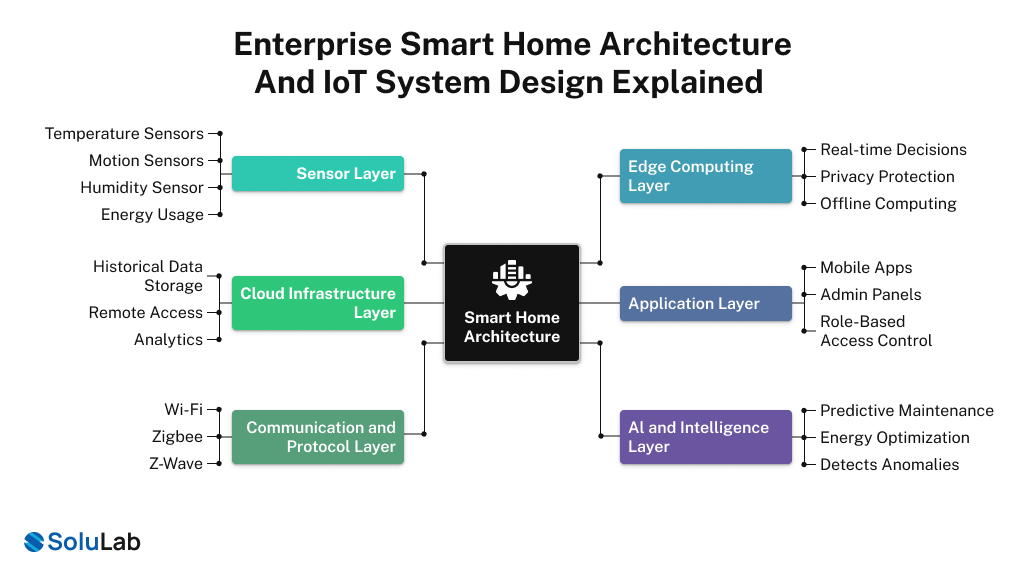
So we follow a 6-layer architecture. Each layer plays a specific role and has its own technology needs, security risks, and performance limits. When teams skip or mix these layers, systems become unstable, expensive to maintain, and difficult to scale across multiple properties.
Layer 1: Sensor Layer
At the foundation are the sensors. These devices measure temperature, humidity, motion, energy use, and access points like doors and windows. Every decision the system makes comes from this data, so accuracy is critical. Poor sensors lead to faulty readings, higher maintenance, and wasted costs. Enterprise smart home success begins with choosing sensors that are reliable, compatible, and built for long-term performance.
Layer 2: Edge Computing Layer
Once the data is collected, it’s processed at the edge. Instead of sending everything to the cloud, local hubs handle real-time decisions. This keeps the system fast, protects sensitive data, and ensures it continues working even during internet outages. For enterprises, edge computing also reduces cloud costs and ensures a more stable, responsive system.
Layer 3: Cloud Infrastructure Layer
While edge computing handles immediate decisions, the cloud provides long-term intelligence. It stores historical data, supports remote access, and enables analytics across multiple properties. The cloud is essential for training AI models and turning raw data into actionable insights. Choosing the right platform like AWS, Azure, or Google Cloud, which affects scalability, compliance, and integration with other enterprise systems.
Layer 4: Application Layer
The application layer is what users interact with like apps, dashboards, and admin panels. In enterprise smart homes, applications must support multiple roles and access levels. A well-designed app simplifies operations, improves adoption, and reduces support workload. When users can easily understand and control the system, the smart home truly delivers value.
Layer 5: Communication and Protocol Layer
All of this depends on how devices communicate. Wi-Fi, Zigbee, and Z-Wave are common protocols, but they don’t work together by default. A central communication layer ensures every device speaks the same language, creating a fully integrated ecosystem. Without it, devices operate in silos, and the system becomes fragmented and inefficient.
Layer 6: AI and Intelligence Layer
The final layer turns the system into an intelligent, self-learning platform. AI predicts equipment failures before they happen, optimizes energy based on building patterns, and detects anomalies like unusual energy spikes. Over time, the system learns occupancy patterns and adjusts automatically. This layer delivers measurable energy savings, efficiency, and ROI, transforming a smart home from reactive to proactive.
SoluLab’s Step-by-Step Framework for Secure Enterprise Smart Homes
By now, you understand why most AI-powered smart homes fail at scale. The problem is not the devices. The problem is poor smart home architecture and weak IoT system design.
This is the exact process we follow, as a top IOT development company, when designing large-scale, reliable, and secure IoT smart home solutions for enterprises, real estate developers, and multi-property owners. This section explains how it works step by step.
Step 1: Security Modeling for Enterprise Smart Home Architecture
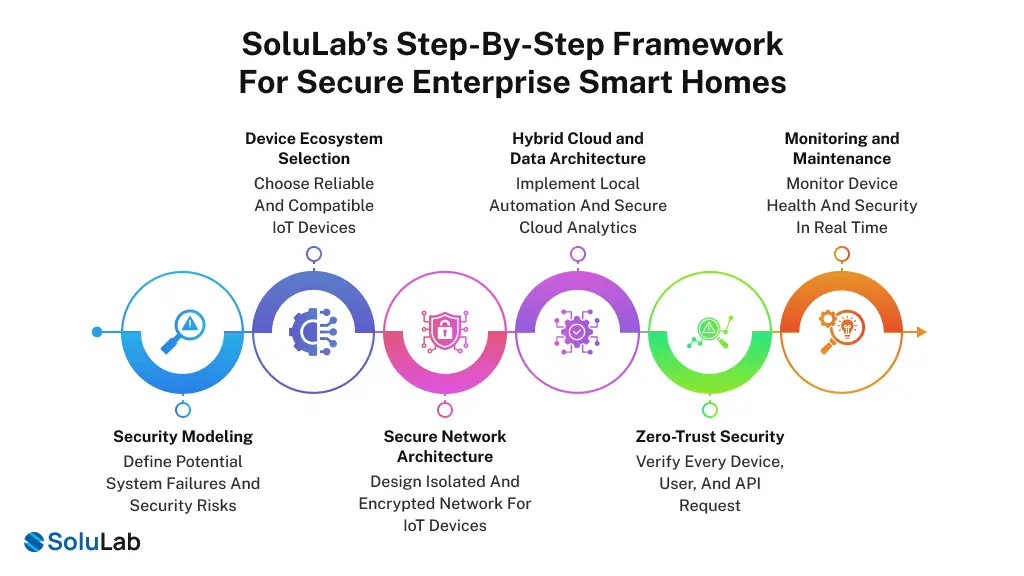
We begin by defining how the system could fail or be attacked. This includes evaluating security risks, data privacy laws, system downtime tolerance, and offline operation needs. This security model directly shapes the enterprise smart home architecture, ensuring the system is designed correctly from day one.
Step 2: Device Ecosystem Selection Based on Business Needs
Devices are selected based on reliability, compatibility, and business goals, not consumer trends. Smart thermostats, energy meters, Zigbee-based lighting, and occupancy sensors connect to a local hub, forming a stable and controllable IoT smart home architecture.
Step 3: Secure Network Architecture for IoT Smart Homes
We design isolated networks using VLANs and firewall rules to protect IoT devices. Local device communication uses Zigbee or Z-Wave, while cloud traffic is encrypted. The system continues working during internet outages, which is critical for enterprise IoT system design.
Step 4: Hybrid Cloud and Data Architecture for AI and IoT Systems
Real-time automation runs locally, while cloud infrastructure handles analytics and AI models. Sensitive data stays local, and only essential insights are synced to the cloud, balancing performance, privacy, and scale.
Step 5: Zero-Trust Security Implementation
Every device, user, and API request is verified using zero-trust security. Unique device credentials, secure APIs, and limited-access integrations protect the enterprise smart home system from internal and external threats.
Step 6: Monitoring, Alerts, and Predictive Maintenance
We monitor device health, performance, and security events in real time. This enables early issue detection, predictive maintenance, and long-term optimization of the enterprise smart home platform.
How Advanced AI Improves Smart Home Architecture and Performance?
Once the core smart home architecture and IoT system design are in place, the system can move beyond basic automation. This is where AI-powered smart homes start delivering real business value. Instead of simply reacting to rules, the system begins learning, predicting, and optimizing on its own. For enterprises, this intelligence layer is what turns a smart home system into a long-term cost-saving and performance-driven asset.
Machine Learning for Predictive Energy Optimization
In a properly designed AI and IoT smart home system, machine learning models are trained using data from the actual building rather than generic assumptions. The system learns key characteristics of the building, including how quickly it heats and cools, how sunlight affects indoor temperatures at different times, occupancy patterns, and the efficiency of HVAC and other equipment. By understanding these building-specific patterns, the system can make smarter decisions that standard automation systems cannot achieve.
Using advanced techniques like deep reinforcement learning (DRL), the AI continuously adjusts heating and cooling to maintain comfort while minimizing energy use. It can anticipate changes before they occur, such as weather shifts or occupancy changes. In real enterprise deployments, this method achieves 25–36% energy savings, compared to only 8–15% with traditional rule-based systems. This is why enterprises increasingly invest in custom enterprise smart home architecture.
Predictive Maintenance and Anomaly Detection
Beyond energy savings, AI enables predictive maintenance. Over time, the system learns what “normal” looks like for a building, and any deviations become early warnings. Examples include:
- HVAC runs longer than usual without affecting temperature, indicating efficiency loss.
- Equipment cycling too frequently, pointing to airflow or refrigerant issues.
- Unexpected water usage at night, which may signal a leak or equipment failure.
With proper AI and IoT system design, these anomalies are detected 2–4 weeks before failure, giving enterprises time to schedule maintenance on their timeline rather than handling costly emergencies. Considering a single furnace failure can cost $3,000–$5,000, predictive maintenance is a major cost-saving advantage for enterprise smart homes.
Cross-Property Benchmarking for Enterprise Portfolios
For enterprises managing multiple buildings, cross-property benchmarking is one of the most powerful capabilities of AI-enabled smart homes. By comparing energy use, maintenance needs, and operating schedules across properties, AI and IoT systems reveal patterns that are impossible to see in a single building. This allows enterprises to identify underperforming buildings, replicate best practices from high-performing sites, and standardize efficient operations across the portfolio.
The result is portfolio-wide optimization, leading to $50,000–$200,000+ in annual savings from smarter management alone, without the need for additional hardware. This demonstrates why enterprises benefit most from a robust AI-driven smart home architecture combined with intelligent IoT system design.

Real Enterprise Smart Home Case Studies That Show Results
Many enterprise smart home projects fail because buyers cannot clearly see how the system works end to end. Good smart home architecture and IoT system design solve this problem. Below are two real examples that show how strong architecture turns complexity into business value.
1: Portable Smart Home Demo for Enterprise Buyers
Non-technical stakeholders struggled to understand smart home architecture, real-time data flow, and multi-device control.
Solution
A portable smart home demo showed live IoT data flow from mobile app to cloud to devices. It connected sensors, smart devices, access control, and automation on one enterprise IoT platform.
Impact
- Explained full smart home systems in minutes
- Proved scalability, security, and cross-device automation
- Helped close B2B IoT and smart home deals
2: Real Home IoT Smart Home Automation
A real home lacked automation, remote control, and energy monitoring, leading to high power usage.
Solution
A centralized IoT-based smart home system with sensors, controller, and mobile app enabled automation and remote access.
Impact
- Lower energy use and bills
- Better comfort and control
- Architecture validated for larger enterprise smart home deployments
Should You Choose Custom or Off-the-Shelf Smart Home Platforms?
| Factor | Off-the-Shelf Platforms | Custom Smart Home Platforms |
| Deployment Speed | Very fast | Moderate |
| Upfront Cost | Low | Higher |
| Scalability | Limited | High |
| Smart Home Architecture Control | Low | Full |
| IoT System Design Flexibility | Restricted | Fully customizable |
| Security Customization | Minimal | Enterprise-grade |
| Multi-Property Support | Weak | Native |
| AI & ML Optimization | Basic | Advanced |
| Vendor Lock-in Risk | High | Low |
| Long-Term ROI | Limited | Strong |
When building an enterprise smart home system, teams must choose between off-the-shelf platforms and custom smart home architecture. The right choice depends on scale, security needs, and long-term ROI.
Off-the-shelf platforms like Amazon Alexa, Google Home, and SmartThings are quick to deploy and cost-effective. They offer ready-made features such as voice control, mobile apps, and basic automation, with updates and security handled by the provider. This works well for single properties, pilots, or basic AI smart home use cases.
However, these platforms struggle at scale. They limit API access, force rigid data models, add latency, and lack enterprise-grade security and multi-tenant support. Most teams hit constraints at 5–10 properties, and migrating later to custom systems often costs $50,000–$150,000+.
A custom IoT system design becomes essential when managing 20+ properties, integrating legacy building systems, enforcing strict security controls, or building proprietary AI optimization. If annual energy savings exceed $500,000, custom development delivers strong ROI.
For most enterprises, the best approach is hybrid—using consumer platforms for user experience while running custom AI, analytics, and automation in the backend via a secure API layer.

Conclusion
Most smart home projects fail because businesses treat AI and IoT smart homes as features, not platforms. The real decision is not Alexa vs Google Home, it is your smart home architecture and IoT system design. With the right setup, you can scale across properties, secure your systems, measure ROI, and avoid costly rebuilds. Done right, smart home solutions pay for themselves and deliver long-term value.
SoluLab is an AI application development company that builds secure, scalable enterprise smart home platforms. We help businesses design AI-powered smart homes, plan security, and align technology with real business outcomes. If you are investing in smart homes at scale, the right architecture today decides your returns tomorrow.
FAQs
Regular home automation reacts to commands. IoT in smart homes with AI smart home architecture learns patterns and predicts needs like adjusting lights, temperature, or security automatically based on occupancy, time, and daylight. It turns raw data into intelligence.
Most agencies treat smart homes as a product integration problem. At SoluLab, we treat it as an enterprise smart home infrastructure problem. We design systems that scale to 100+ properties, ensure security with zero-trust models, and reduce operational costs while improving reliability.
For single homes, payback is 3-5 years. For 10-20 properties, it drops to 2-3 years. For 50+ properties, payback can be 12-18 months. Custom smart home architecture usually becomes worthwhile at 20-30 properties, where operational efficiency gains outweigh development costs.
Security is built in from day one. We perform threat modeling, implement zero-trust IoT system design, and continuously monitor devices and APIs. This ensures enterprise smart homes are secure, not just secure-sounding.
ROI depends on scale and energy costs. Single homes save $180-$330/month; payback in 18-24 months. For 50+ properties, payback drops to 12-15 months. Energy savings are often seen in the first month thanks to AI-powered efficiency optimization.
Yes. Our IoT system design allows retrofitting legacy HVAC, electrical, and security systems, costing 30-40% less than full replacements while keeping your existing investments intact.