When building a new digital product, many businesses struggle with one basic question: Should we start with a POC, a prototype, or an MVP? These phrases are frequently used interchangeably, despite the fact that they fulfill completely different functions. This uncertainty is frequent among startups, product teams, and even major corporations considering innovation efforts.
Choosing the wrong starting point can lead to wasted time, higher costs, and unnecessary rework. For example, MVP development for enterprises, when the technology itself is unproven, can drain budgets quickly. On the other hand, spending months on a POC when user validation is needed can slow down progress and make it harder to get into the market.
This guide helps clear that confusion. It explains
- The real difference between a POC, prototype, and MVP
- When each one makes sense?
- How to choose the right approach based on your business goals, risk level, and stage of development?
By the end, you’ll be able to make a confident decision—and invest your time and resources where they matter most. Let’s get started!
What Is a POC (Proof of Concept)?
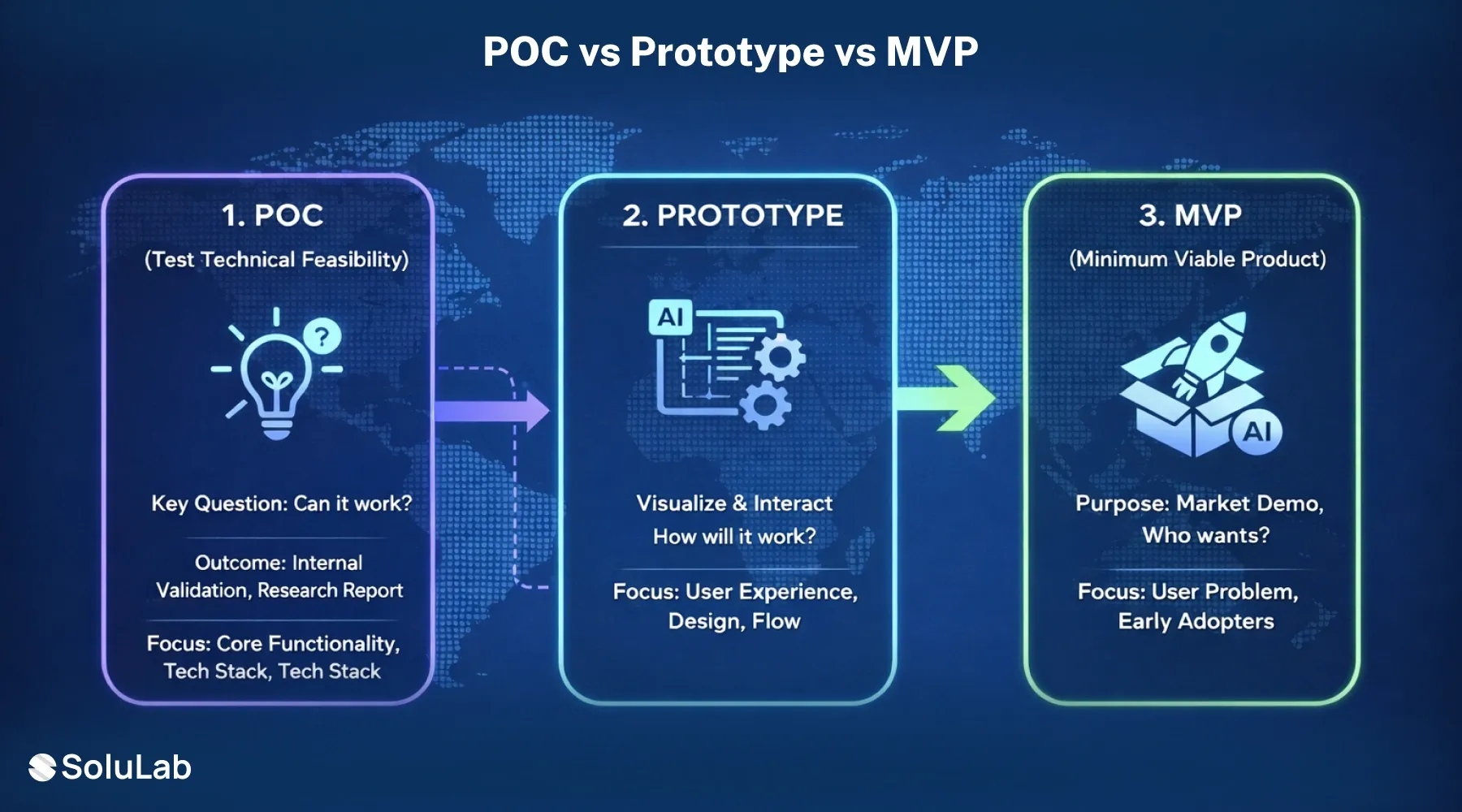
A Proof of Concept (POC) is an early-stage validation step used to check whether an idea is technically feasible. It answers one critical question: Can this idea actually work in the real world? A POC is not built for users or the market; it is built to reduce technical risk before investing more time and money.
Businesses often create a POC when they are working with new technologies, complex integrations, or untested ideas, such as AI models, blockchain solutions, or advanced system architectures.
Key Characteristics of a POC
A POC acts as a go/no-go checkpoint, ensuring you don’t invest heavily in an idea that isn’t technically viable. Some of its main characteristics are:
1. Focuses on feasibility, not usability
A POC tests whether the core idea or technology works, not how it looks or feels to users.
2. Limited scope and functionality
It includes only the minimum components needed to validate the concept.
3. Internal-facing
Usually shared with internal teams, stakeholders, or investors– not end users.
4. Short development time
Built quickly to get early technical answers and avoid large upfront investment.
5. Not production-ready
Code quality, scalability, and design are not priorities at this stage.
6. Used to reduce risk early
Helps decide whether to move forward, pivot, or stop before building a prototype or MVP.
What Is a Prototype?
A prototype is a visual or interactive model of a product used to validate design, user experience, and functionality flow before full development begins. Unlike a POC, which focuses on technical feasibility, a prototype answers a different question: Will users understand and want to use this product?
Prototypes are especially useful when user experience plays a major role in success, such as consumer apps, dashboards, fintech platforms, or Web3 products, where usability directly impacts adoption.
Key Characteristics of a Prototype
A prototype helps you validate usability before investing in full development, reducing the risk of building a product that users don’t enjoy or understand. Its key characteristics are:
1. User-focused, not market-ready
A prototype is built to gather feedback from users, stakeholders, or investors– not for real-world deployment.
2. Emphasizes design and user flow
Focuses on screens, navigation, and interactions rather than backend logic or scalability.
3. Can be low-fidelity or high-fidelity
Ranges from simple wireframes to clickable, near-real product simulations.
4. Limited or no backend functionality
Often uses mock data or basic logic instead of real integrations.
5. Fast to iterate and improve
Easy to modify based on user feedback, making it ideal for early validation.
6. Helps align stakeholders
Gives teams, founders, and investors a shared understanding of the product vision.

What Is an MVP (Minimum Viable Product)?
A Minimum Viable Product (MVP) is the first functional version of a product released to real users with just enough features to solve a core problem. Its main goal is to validate market demand and collect real-world feedback while keeping development time and cost under control.
Unlike a POC or prototype, an MVP is a live, usable product. It helps answer the most important question: Will users actually use and pay for this solution?
Key Characteristics of an MVP
An MVP allows businesses to enter the market faster, reduce risk, and make data-driven decisions before committing to large-scale product development.
1. Market-ready, but feature-light
Includes only the core features required to deliver value to users.
2. Built for real users
Deployed in a live environment to test adoption, engagement, and retention.
3. Focuses on learning and iteration
User feedback and analytics guide future improvements and feature additions.
4. Production-quality code
Built with scalability, security, and performance in mind.
5. Balances speed and quality
Faster than a full product launch but robust enough to support real usage.
6. Supports business validation
Helps test pricing, business models, and go-to-market strategies.
POC vs Prototype vs MVP: Key Differences at a Glance
While POC, Prototype, and MVP may seem similar, they serve very different purposes at different stages of product development. The table below clearly highlights how they compare, helping you quickly decide which one fits your current business goal.
| Aspect | POC (Proof of Concept) | Prototype | MVP (Minimum Viable Product) |
| Primary Goal | Validate technical feasibility | Validate design and user experience | Validate market demand |
| Target Audience | Internal teams, stakeholders | Users, investors, stakeholders | Real customers |
| Feature Scope | Very limited, core logic only | Core flows and interactions | Essential features only |
| Design Focus | Minimal or none | High focus on UI/UX | Functional, usable design |
| Backend & Integrations | Basic or experimental | Often mocked or limited | Real backend and integrations |
| Production-Ready | ❌ No | ❌ No | ✅ Yes (minimal but stable) |
| Time to Build | Short (days to weeks) | Short to moderate (weeks) | Moderate (weeks to months) |
| Typical Outcome | Feasibility validation | Usability feedback and clarity | Market traction and learning |
| Investment Level | Low | Low to medium | Medium |
How to Decide What to Build for Your Business?
Choosing between a POC, prototype, or MVP becomes much easier when you ask the right questions upfront. These questions help align your product decision with your business goals, budget, timeline, and risk tolerance.
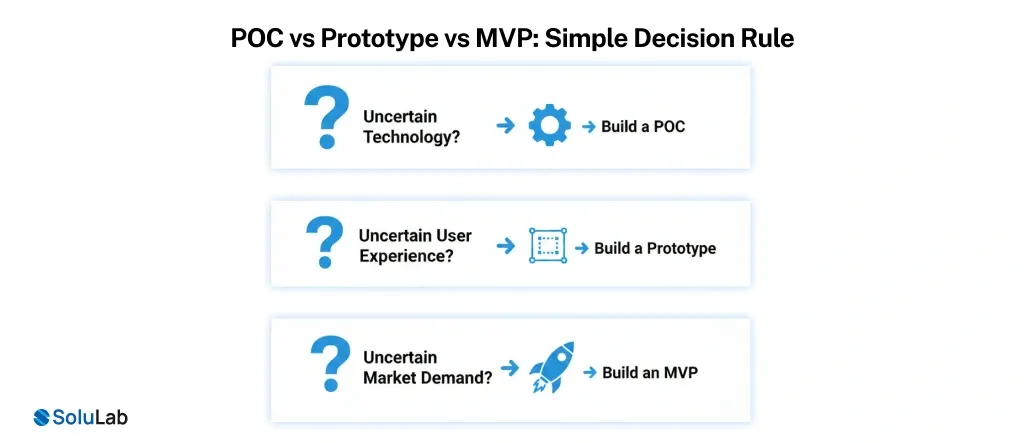
- Is the technology proven or new to us?
If you are working with untested tech (AI models, blockchain protocols, complex integrations), start with a POC to reduce technical uncertainty.
- Do we understand our users’ needs clearly?
If user flows, design, or usability are unclear, a prototype helps validate the experience before writing production code.
- Are we ready to launch something to real users?
If you want real feedback, traction, or early revenue, an MVP is the right choice.
- What is our primary business goal right now?
- Technical validation → POC
- User experience validation → Prototype
- Market validation and growth → MVP
- How much time and budget can we invest initially?
Limited budgets often benefit from starting small and progressing step by step, rather than jumping straight into a full MVP.
- What happens if this idea fails?
If failure would be costly, begin with a POC or prototype to learn faster and safer.
- Do we need stakeholder or investor buy-in?
Prototypes work well for pitching ideas visually, while MVPs prove traction with real data.
Why Many Businesses Fail By Building The Wrong First Version?
Many product failures don’t happen because the idea is bad—but because businesses build the wrong thing at the wrong time. Jumping into development without clarity often leads to wasted budgets, delayed launches, and poor adoption.
Here are the most common reasons this happens:
1. Skipping validation to move fast
In the rush to launch, teams often skip POCs or prototypes and go straight to an MVP. If the technology or user flow is untested, this results in costly rework and unstable products.
2. Confusing features with value
Adding more features early doesn’t guarantee success. Without understanding what users actually need, products become overcomplicated and hard to use.
3. Building for assumptions, not users
Many teams rely on internal opinions instead of real user feedback. This leads to products that solve imagined problems, not real ones.
4. Overspending too early
Developing a full MVP when only feasibility or design validation is needed quickly drains budgets—especially for startups and innovation teams.
5. Poor alignment between teams
Without a clear first step, product, tech, and business teams often work in silos. This causes misaligned priorities, delays, and scope creep.
6. No clear success criteria
When teams don’t define what success looks like at each stage, they struggle to measure progress or decide when to move forward.
POC vs Prototype vs MVP: Cost, Time, and ROI Impact
Understanding how cost, development time, and return on investment (ROI) differ across POC, prototype, and MVP helps businesses plan smarter and avoid overbuilding. The comparison below gives a quick, practical snapshot.
| Factor | POC | Prototype | MVP |
| Development Cost | Low | Low to Medium | Medium |
| Timeline | Days to a few weeks | 2–4 weeks | 1–3 months |
| Initial ROI | Indirect (risk reduction) | Indirect (user insights) | Direct (users, revenue, traction) |
| Business Value | Technical validation | UX clarity and alignment | Market validation and growth |
| Rework Risk | Very low | Low | Medium (based on feedback) |
| Scalability Focus | ❌ No | ❌ No | ✅ Yes (phased) |
Which Approach Works Best for Startups vs Enterprises?
Startups and enterprises operate under very different constraints. What works for one can be risky for the other. This checklist helps you quickly identify the right starting approach based on your business type and goals.
For Startups: Choose Speed and Validation
> Start with a POC if:
- You are using new or unproven technology (AI, blockchain, Web3)
- Technical feasibility is uncertain
- You need to validate an idea before pitching investors
> Start with a Prototype if:
- User experience is critical to adoption
- You need feedback to refine the product idea
- You want to present a clear vision to investors or partners
> Move to an MVP when:
- The core idea is validated
- You want early users and market feedback
- You are testing pricing or monetization models
Startup priority: Learn fast, spend less, and reach the market quickly.
For Enterprises: Choose Risk Control and Scalability
> Start with a POC if:
- The solution impacts critical systems or data
- New technology must integrate with legacy systems
- Compliance, security, or performance is uncertain
> Start with a Prototype if:
- Multiple stakeholders need alignment
- User workflows are complex
- Internal adoption matters as much as external users
> Move to an MVP when:
- Business and technical risks are minimized
- There is leadership buy-in
- The product is ready for a controlled market or internal rollout
Enterprise priority: Reduce risk, ensure alignment, and build for long-term scale.
How to Move From POC to Prototype to MVP?
Transitioning from a POC to a prototype and then to an MVP is a strategic journey. Each stage builds on the previous one, reducing risk while ensuring that your product meets both technical and market needs. Here’s a step-by-step approach:
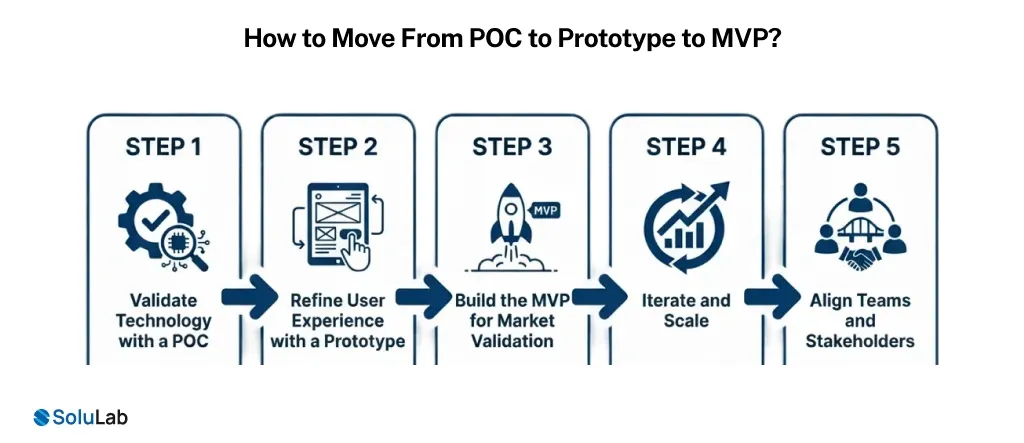
Step 1: Validate Technology with a POC
Start by testing whether your idea or technology is feasible. Focus on solving the core technical challenge without worrying about design or user experience. Document the results carefully and identify any limitations or bottlenecks. A successful POC gives you confidence to move to the next stage.
Step 2: Refine User Experience with a Prototype
Once the technology works, create a prototype to validate how users will interact with your product. This could be a clickable mockup or a high-fidelity design. Use this stage to gather feedback from stakeholders, potential users, or investors. Iteratively improve the design and flows until the product feels intuitive and valuable.
Step 3: Build the MVP for Market Validation
After confirming technical feasibility and user acceptance, develop an MVP with core features that solve the main problem. Launch it to real users to collect data, validate assumptions, and measure engagement. Keep it lean and focus on functionality that delivers value immediately. Early feedback from the MVP will guide further development and scaling.
Step 4: Iterate and Scale
Use the insights from each stage to refine, add features, and improve performance. The journey from POC → Prototype → MVP is iterative: each step reduces uncertainty and sets a solid foundation for a full-scale product launch.
Step 5: Align Teams and Stakeholders
Throughout the process, ensure that product, tech, and business teams are aligned. Clear communication of goals, timelines, and success metrics at each stage minimizes rework and accelerates decision-making.
Validating AI and Web3 Products: POC, Prototype, and MVP Approach
AI and Web3 projects are inherently complex, involving new technologies, decentralized architectures, and evolving user expectations. Applying the right development stage– POC, prototype, or MVP– can reduce risk, save costs, and accelerate market entry.
POC for AI & Web3
- Test whether your AI model can deliver accurate predictions or insights.
- Verify blockchain integration, smart contract functionality, or token mechanics.
- Identify technical limitations before investing heavily.
Prototype for AI & Web3
- Create interactive interfaces for users to test dashboards, wallets, or NFT marketplaces.
- Simulate blockchain flows or AI-driven features to collect usability feedback.
- Align stakeholders on look, feel, and interaction patterns before coding full functionality.
MVP for AI & Web3
- Launch a live product with essential features: AI-powered recommendations, crypto transactions, or tokenized services.
- Collect real-world data on performance, adoption, and scalability.
- Use insights to iteratively expand features, improve UX, and optimize smart contracts or AI models.
How SoluLab Helps You Build the Right Version?
Building the right product at the right stage requires experience, strategy, and technical expertise. SoluLab guides businesses through every step, ensuring your idea turns into a successful, market-ready solution.
Strategic Consultation to Choose the Right Approach
Before writing a single line of code, SoluLab works closely with your team to understand your business goals, technical challenges, and market needs. We help you decide whether a POC, prototype, or MVP is the most effective first step, minimizing risk and optimizing resources. Our consultation includes:
- Technical feasibility analysis
- User experience and workflow assessment
- Market readiness evaluation
- Stage-wise roadmap and success metrics
End-to-End Delivery
Once the strategy is set, SoluLab takes care of the full product lifecycle. From concept to launch, we ensure your product is scalable, secure, and aligned with your business objectives. Our delivery services include:
- Architecture and technology selection for AI, Web3, and blockchain projects
- Rapid development of POCs, prototypes, or MVPs
- UX/UI design and interactive prototyping
- Compliance, testing, and quality assurance
- Deployment, monitoring, and iterative improvements

Final Thoughts: Building Smart, Not Fast
In product development, speed alone doesn’t guarantee success. Many businesses fail not because their ideas are weak, but because they rushed into building the wrong version– skipping critical validation steps or misjudging user needs.
By taking a strategic, stage-wise approach, starting with a POC, refining with a prototype, and validating with an MVP, you can:
- Reduce technical and business risks
- Save time and development costs
- Gather actionable insights from real users
- Build a product that truly fits the market
Want a technical edge with expert assistance? Connect with us today!
FAQs
Ask yourself: Is the technology unproven? → Start with a POC. Are the user flows unclear? → Start with a prototype. Do you need market feedback or early adoption? → Start with an MVP.
While possible, skipping validation increases risk. POCs and prototypes help uncover technical issues and UX problems early, saving time and cost before building an MVP.
Yes, in some cases—but skipping a prototype can risk poor user experience. A prototype helps refine flows, improve usability, and reduce iterations after the MVP launch.
Choose the right stage for your product, validate assumptions early, collect feedback iteratively, and focus on essential features that solve real user problems. Strategic planning and expert guidance maximize ROI.
SoluLab provides end-to-end product development services, including strategic consultation, architecture design, rapid development of POCs, prototypes, and MVPs, UX/UI design, compliance testing, and deployment. We specialize in AI, Web3, blockchain, and enterprise-grade solutions.