If you’ve spent any time exploring Web3 this year, you’ve probably noticed one theme: automation is no longer a “future” idea. It’s here, and enterprises are racing to build Web3 AI agents that can act on-chain, across networks, and inside real business workflows.
“AI agents will run most Web3 operations by 2030. The winners will be the companies that learn how to build, deploy, and govern them today.”
These Web 3 AI agent platforms negotiate, monitor risks, automate tasks, and trigger decisions faster than any human team. And with Web3 moving at lightning speed, companies now rely on specialised AI agent builders to deploy these systems safely and at scale.
Why Modern Businesses Need Web3 Custom AI Agent Builders?
Most enterprises already know that web3 development solutions can transform their operations, but the gap between interest and actual deployment is still massive, which AI agents can narrow down.
Studies show that AI agents could generate $450 billion in economic value by 2028. Yet in 2026, only 2% of organisations have deployed AI agents at full scale. Also, just 12% have them running even at a partial level.
- Production reliability is a major blocker
More than 70% of enterprise AI pilots fail to reach production because they lack evaluations, monitoring, and safe deployment pipelines. Agent builders bake these into the workflow.
- Workload automation reduces operational cost by 30–50%
Autonomous agents can watch systems 24/7, execute actions, and coordinate across apps and chains, cutting manual work dramatically.
- Growing multi-system complexity
Enterprises today use an average of 130+ SaaS tools and multiple blockchain networks. Agents simplify this complexity by acting as the connective layer between fragmented systems.
- Compliance pressure is rising
With data regulations tightening every year, enterprises need audit trails, RBAC, sandboxed environments, and policy guardrails. Agent builders provide these controls natively.
- Scaling agents across departments requires governance
A company might start with one agent. But large enterprises will need dozens of agents managing tasks across finance, HR, compliance, product, and customer operations. Builders make this scale possible without chaos.
What to Look for When Choosing an AI Agent Builder Platform and Company?
Choosing the right Web3 AI agent builders is more important than choosing the right model. The best builders balance speed, reliability, governance, and flexibility.
1. Bi-Directional Building Experience
Your non-technical teams should be able to design workflows visually, while your engineers customise logic using SDKs or APIs. This keeps the entire organisation aligned while reducing development time.
2. Strong Evaluation and Versioning
Every release should be testable, comparable, and reversible. You should be able to run evaluation sets, review behaviour changes, and roll back with confidence.
3. Deep Observability
Look for builders that show clear traces, logs, dashboards, and performance metrics. Without observability, diagnosing incidents or improving performance becomes guesswork.
4. Governance and Security
Enterprises need RBAC, audit trails, approval steps, isolated environments, and policy guardrails. These features keep workflows safe and compliant.
5. AI-Native Capabilities
The builder should support retrieval, semantic routing, memory, contextual reasoning, and multi-agent orchestration without requiring fragile glue code.
6. Flexible Deployment
You should be able to deploy in cloud, VPC, or on-prem setups depending on your data policies. Sensitive workloads should never be forced to leave your environment.
7. Ecosystem and Integrations
Platforms with strong connector libraries and a healthy developer community give you a head start and accelerate real adoption.
8. Data Control and Portability
You must be able to export your workflows, datasets, and logic to avoid long-term vendor lock-in.
Best Web3 Custom AI Agent Builders and Companies in 2026
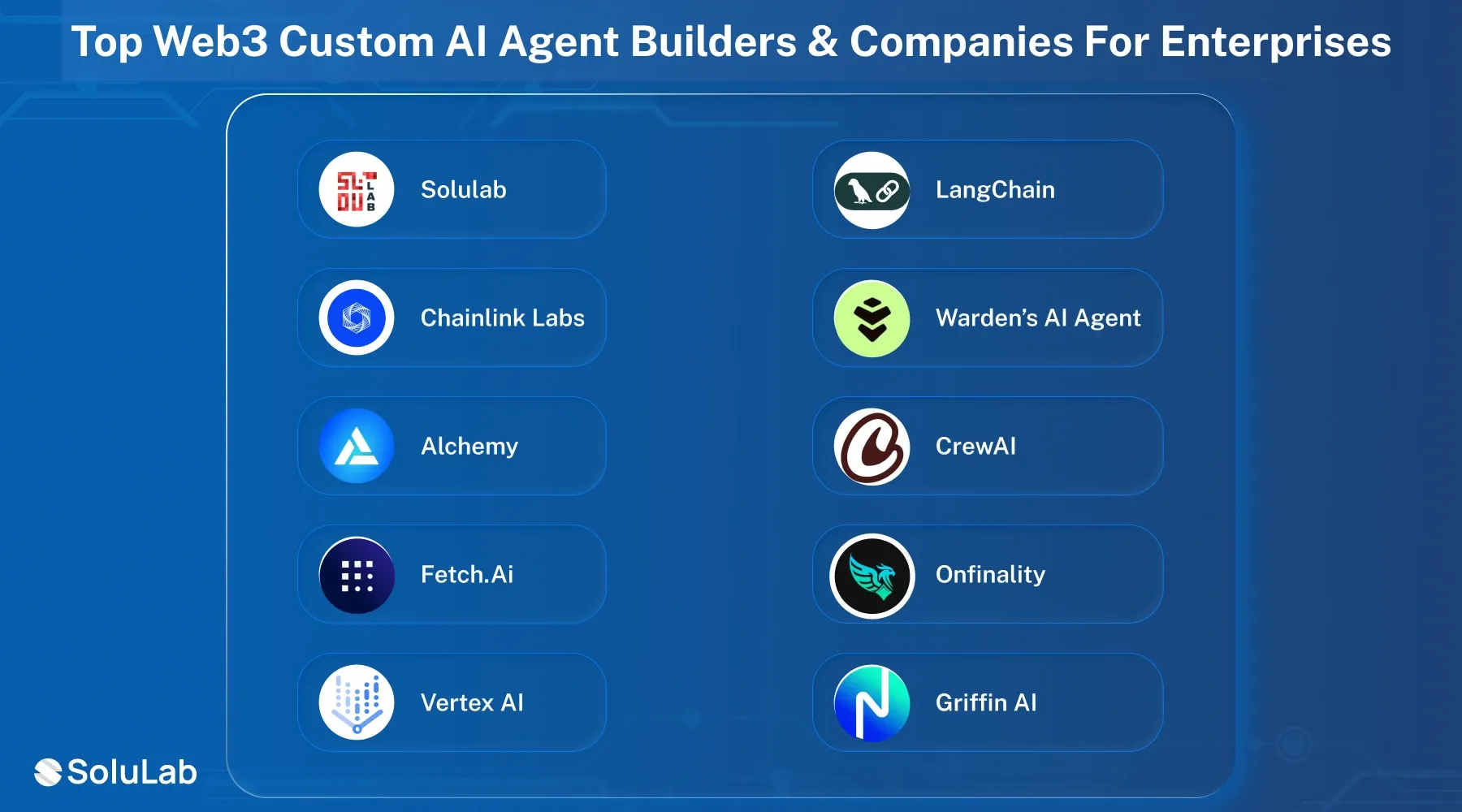
Below is a curated list of top Web3 custom AI agent builders and companies that help enterprises grow in modern technology. Each description is balanced in length to match the listicle style your readers expect.
1. SoluLab
SoluLab helps enterprises build custom AI agents for Web3 and DeFi workflows with reliable automation and secure execution. It supports advanced agent architectures that deliver strong governance and high performance. The company focuses on scalable, action-driven Web3 Custom AI Agent systems for regulated business environments.
Key Features
- Custom enterprise-grade agents designed for sectors needing advanced automation and strong compliance.
- Web3 and blockchain expertise covering EVM, L2 networks, and cross-chain execution.
- Deployment control across cloud, VPC setups, and secure on-prem environments.
2. Chainlink Labs
Chainlink Labs helps enterprises build secure Web3 AI agents that interact with real-world data and on-chain systems. It focuses on creating dependable, action-ready Web3 AI Agent integrations for financial, enterprise, and infrastructure environments.
Key Features
- Custom enterprise-grade agents designed for workflows needing trusted data and secure automation.
- Web3 and blockchain expertise covering oracles, cross-chain messaging, and on-chain computation.
- Deployment control through dedicated networks, permissioned environments, and enterprise-grade security.
3. Alchemy
Alchemy helps teams develop Web3 AI agents that monitor networks, trigger smart actions, and manage blockchain operations. The company focuses on performance-driven Web3 AI Agent systems.
Key Features
- Custom enterprise-grade agents built for networks needing fast event tracking and automated responses.
- Web3 and blockchain expertise covering node services, multi-chain APIs, and scalable infrastructure.
- Deployment control with private endpoints, secure environments, and advanced monitoring tools.
4. Fetch.ai
Fetch.ai provides a Web3 AI agent platform for autonomous workflows across networks. It enables developers to build Web3 AI Agents that negotiate, collaborate, and complete tasks with minimal oversight.
Key Features
- Autonomous economic agents capable of negotiation, discovery, and independent multistep execution.
- Decentralised agent registry enabling discovery, interaction, and coordination among deployed agents.
- Interoperable communication through uAgents for cross-network messaging and agent connectivity.
5. Vertex AI
Vertex AI supports low-code AI agent builder workflows with strong testing and governance. It helps enterprises deploy stable agent systems that combine cloud data and Web3 integrations.
Key Features
- Unified ML platform supporting training, fine-tuning, optimisation, and managed deployments.
- Governance layers supporting RBAC control, environment rules, and team-based permissions.
- Integrations covering APIs, cloud databases, enterprise apps, and controlled workflows.
6. LangChain
LangChain offers flexible tooling for teams building custom AI agent frameworks. It supports best AI agent builders who need modular components, retrieval tools, orchestration layers, and memory systems.
Key Features
- Model-agnostic architecture supporting OpenAI, Anthropic, self-hosted LLMs, and custom models.
- Tool and chain framework enabling structured thinking, deep reasoning, and task routing.
- Retrieval pipelines connecting vector stores, databases, indexes, and contextual memory.
7. Onfinality
Onfinality supports Web3 companies needing support agents that automate community queries and deliver blockchain insights. It acts as a Web3 AI Agent layer that connects networks, documentation, and live data.
Key Features
- Real-time blockchain insights covering staking, balances, transactions, and validator activity.
- Customisable knowledge bases built from project documentation, FAQs, and ecosystem content.
- Cross-platform deployment across Telegram, Discord, websites, and embedded interfaces.
8. Warden’s AI Agent
Warden enables secure Web3 agent deployment with cryptographic verification. It supports AI agent development services for compliance-focused use cases. Warden is recognised as a top AI agent builder for DeFi transactions and governance workflows.
Key Features
- On-chain identity and reputation system controls actions, visibility, and interaction rules.
- SPEX verification stack enabling validated AI outputs for contracts and DeFi protocols.
- Low-code agent development kit providing templates, logic blocks, and reusable modules.
9. CrewAI
CrewAI helps teams build AI Agent System architectures with multiple coordinated agents. It supports AI Agents use cases where planning, research, and execution must be split across specialised roles.
Key Features
- Role-based multi-agent system enabling focused responsibilities and coordinated outputs.
- Declarative configuration through Python scripts or structured YAML-based definitions.
- Pluggable tools enabling controlled usage of APIs, functions, and task-specific utilities.
10. Griffin AI
Griffin AI provides no-code AI agent builders for rapid Web3 automation. It supports teams needing the best web3 custom AI agent builders with both simplified creation tools and low-code upgrade paths.
Key Features
- No-code builder enabling drag-and-drop assembly of workflows, triggers, and logic.
- Live data integrations offering token prices, liquidity information, and market signals.
- Agent registry enabling publishing, discovery, monetisation, and user adoption.

Conclusion
AI agents in Web3 will keep expanding as businesses push for automation and secure digital workflows. This shift will shape how companies manage data, customers, and operations. If you need a trusted partner to build advanced agent systems, SoluLab can support your journey.
We are the top-most reliable Web3 custom AI agent companies delivering practical, secure, and scalable solutions. Our team also ranks among the leading Web3 AI agent services for enterprise-grade automation. Connect with us to create a dependable AI agent ecosystem that grows with your business.
FAQs
Most enterprise Web3 AI agents take four to twelve weeks, depending on complexity, integrations, workflows, compliance needs, and testing requirements.
Costs usually depend on agent logic, integrations, security layers, data pipelines, testing cycles, and the number of automated workflows you require.
Yes, modern agents integrate with CRMs, APIs, data warehouses, dashboards, authentication systems, and other enterprise tools without heavy architectural changes.
You can contact SoluLab through their website form or book a quick call to discuss goals, timelines, budgets, and solution requirements.
Yes, they support strict compliance requirements with access control, audit logs, sandboxed environments, and secure data handling for sensitive enterprise operations.