![Top 20 Industries Leveraging Blockchain Development Services [2026 Edition]](https://www.solulab.com/wp-content/uploads/2026/04/Powering-20-Industries-with-Blockchain-Solutions.webp)
When blockchain first appeared on the enterprise radar, most decision-makers treated it as a Bitcoin side story, a ledger technology for crypto enthusiasts and not much else. That perception has aged poorly.
In 2026, the real-world blockchain app development reshaping finance, healthcare, logistics, and government are running at production scale, not in pilot mode.
If you’re evaluating where blockchain fits in your stack or trying to explain the ROI to a skeptical board, this article covers the ground you need. According to Deloitte’s Global Blockchain Survey, over 84% of Fortune 500 companies are actively integrating blockchain into core operations.
Global blockchain spending is projected to cross $28 billion by the end of 2026. Those aren’t vanity numbers; they reflect an enterprise shift that’s been building for years. Here’s a direct, sector-by-sector look at the blockchain use cases that are generating real returns.
Key Takeaways
- Status Quo: Many enterprises still rely on centralized legacy systems that create data silos, trust gaps, and reliance on intermediaries. With tightening regulations and rising expectations, this setup has become a business risk, and all the sectors know it now.
- What to Do: Enterprise Web3 development enables programmable trust, automated compliance, and peer-to-peer workflows through smart contracts and decentralized architecture by reducing costs and improving transparency.
- Why SoluLab: SoluLab serves as a full-stack Web3 development partner, handling architecture, smart contracts, deployment, auditing, and scaling to efficiently take you from strategy to production and build solutions for all sectors.
Why Blockchain Technology Matters in 2026 for Enterprises and Businesses?
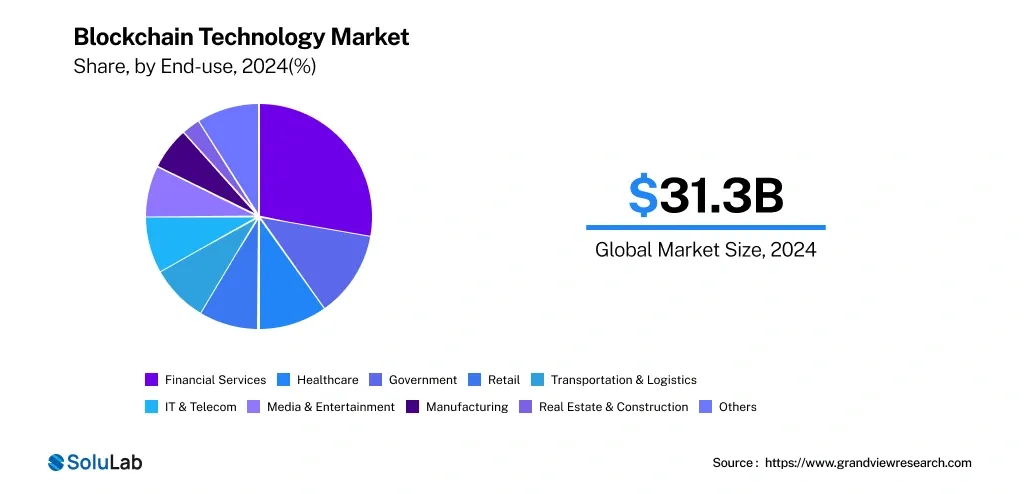
Blockchain technology has become a core digital infrastructure. The global blockchain market is projected to grow from roughly $30–33 billion in 2025 to over $390 billion by 2030, with long-term estimates exceeding $1 trillion as adoption accelerates across finance, supply chains, and enterprise systems, according to Grand View Research.
From a market perspective, blockchain is expanding at an exceptional pace, with an estimated CAGR ranging between 53% and 90% through 2030. North America currently leads adoption with over one-third of global market share, while Asia-Pacific is the fastest-growing region as enterprises leapfrog legacy systems.
On the use-case side, financial services remain dominant, but supply chain, identity, and enterprise automation are seeing the fastest uptake.
Technically, 2026 marks the point where blockchain infrastructure has matured, scalable Layer-2 blockchain, permissioned enterprise chains, and privacy-preserving cryptography have made real-world deployment practical, compliant, and cost-efficient.
For businesses, blockchain has become a competitive advantage, operational efficiency, and future-proofing core systems.
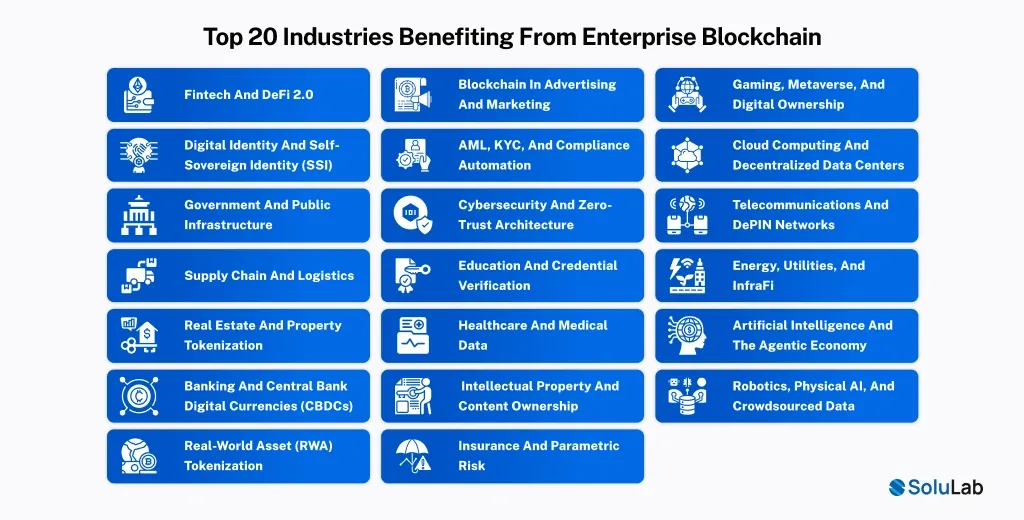
Top 20 Industries Benefiting From Enterprise Blockchain Use Cases in 2026
These applications represent where top blockchain trends delivers real, measurable value in 2026, not hype. From financial infrastructure and supply chain automation to identity, gaming, and enterprise workflows, these use cases show how blockchain is reshaping industries, unlocking efficiency, and enabling entirely new business models.
1. Fintech and DeFi 2.0
Finance is still where blockchain earns its clearest ROI. What started as a movement to eliminate intermediaries has grown into a full financial infrastructure, one supporting instant settlement, programmable money, and institutional-grade compliance.
The enterprise blockchain use cases for the fintech industry are gaining traction here in 2026:
1. Cross-border payments
Stablecoins and central bank digital currencies (CBDCs) now power near-zero-fee international transfers. For companies running high-volume remittances, the operational savings alone justify adoption. Ripple, Stellar, and Circle’s USDC infrastructure dominate this segment.
2. DeFi–TradFi integration
Regulated institutions are no longer avoiding DeFi. Hybrid architectures using Aave Arc and Chainlink CCIP let banks participate in decentralized liquidity pools while staying inside compliance guardrails.
3. On-chain credit scoring
Smart contracts connected to verifiable credential systems assess creditworthiness in real time, without the opacity that makes traditional credit processes slow and expensive.
4. Automated asset management
Tokenized portfolios and algorithmic funds run on self-executing contracts — no fund administrator overhead, and no settlement lag.
In parallel, institutions are utilizing corporate Layer-1 blockchains and tokenized deposits to move beyond pilot programs into production-scale, instant atomic settlement, by tokenizing traditional assets, banks are enabling 24/7 trading of equities, money market funds, and bonds, significantly reducing idle capital.
2. Digital Identity and Self-Sovereign Identity (SSI)
Data breaches aren’t slowing down. AI-generated deepfakes have made identity verification harder than ever. Blockchain-based identity management for self-sovereign identity (SSI) is the structural answer by putting credential control in the hands of the individual rather than scattered across dozens of corporate databases.
In 2026, SSI powers:
- Single-wallet identity verification across banks, healthcare portals, universities, and metaverse platforms
- Tamper-proof government and institutional credentials, like degrees, licenses, certifications, are issued on-chain
- Decentralized reputation scoring for Web3 platforms, freelance networks, and gig economy applications
Worldcoin, Polygon ID, and Microsoft Entra Verified ID are the leading implementations. For enterprises that operate in regulated environments with KYC obligations, SSI dramatically reduces onboarding friction and compliance overhead.
Even global fintech giants and remittance platforms (such as Stripe, PayPal, Western Union, and MoneyGram) are embedding stablecoins as the internet’s foundational settlement layer. This architecture enables instantaneous, low-cost, cross-border value transfers that bypass the delays and pre-funding requirements of legacy correspondent banking
3. Government and Public Infrastructure
Governments aren’t waiting for enterprise adoption to set the pace. Several countries are already running production blockchain deployments for civic services.
Estonia and South Korea are piloting tamper-proof election systems. India, Sweden, and the UAE have moved property titles and public records to distributed ledgers. Smart contracts now automate tax calculation and remittance in select jurisdictions by removing manual processing and the errors that come with it.
The CBDC rollout is the most visible signal of government commitment. Over 130 central banks were actively exploring or piloting digital currencies as of early 2026. This is programmable public money like government-issued, blockchain-settled, and increasingly interoperable across borders through initiatives like BIS’s mBridge project.
For vendors and service providers working with public sector clients, understanding where government blockchain development is heading directly impacts contract opportunities and compliance positioning.
4. Supply Chain and Logistics
By 2026, the supply chain is arguably the most mature non-financial vertical for real-world blockchain use cases with examples you can point to by name.
IBM Food Trust tracks produce from farm to retail shelf. VeChain monitors pharmaceutical cold chains. OriginTrail powers decentralized data exchange across logistics networks. These aren’t experiments; they’re operational systems processing real transactions.
What industries benefit from blockchain in the supply chain specifically?
The strongest ROI appears in:
- Perishable goods — End-to-end temperature and handling records reduce spoilage liability and accelerate recalls
- Pharmaceuticals — Anti-counterfeiting via digital product passports (NFTs functioning as certificates of authenticity)
- Luxury goods — Brands like LVMH use blockchain to authenticate products at point of sale
- Trade finance — Smart contracts release payment upon confirmed delivery, removing the float period that ties up working capital
For procurement and operations teams: blockchain for supply chain use cases reducing operational costs here run into the tens of millions annually for companies at meaningful scale. The traceability argument alone tends to close the investment case.
Also in 2026, logistics operators and autonomous vehicle developers are connecting IoT sensors, asset trackers, and vehicle telematics to open networks. These DePIN deployments incentivize drivers to map roads and share real-time mobility data, significantly accelerating the intelligence required for autonomous routing and global supply chain visibility.

5. Real Estate and Property Tokenization
Property tokenization has moved from concept to commercial reality. In 2026, tokenized real estate allows investors to buy fractional ownership in high-value assets like commercial properties, data centers, and residential developments without the minimum ticket sizes or liquidity constraints that traditionally restricted the market.
Key mechanics:
- Fractional ownership tokens — Retail and institutional investors participate in the same assets through blockchain-issued securities
- Smart contract settlements — KYC clears, payment confirms, title transfers automatically — no escrow delays, no title company middlemen
- Property-backed stablecoins — Tokens collateralized by real estate maintain value while offering on-chain liquidity
Platforms like Brickken, RealT, and Propchain are processing real transactions. Tokenization also allows for the fractionalization of commercial and residential properties, increasing liquidity in traditionally illiquid markets
Even national-scale initiatives, such as the migration of Georgia’s real estate registry onto the Hedera network, are utilizing distributed ledgers to replace manual verification with near-instant, immutable settlement.
6. Banking and Central Bank Digital Currencies (CBDCs)
Major banks have moved beyond evaluation. Blockchain now runs as both a backend settlement layer and a Central Bank Digital Currency (CBDC) issuance platform across dozens of financial institutions globally.
The enterprise value drivers:
- Instant securities settlement — T+2 is becoming T+0 for institutions running on private blockchain rails
- Cross-border CBDC interoperability — mBridge links national digital currencies in real time, reducing FX friction for multinational transactions
- Privacy-preserving compliance — Zero-knowledge proofs allow banks to meet regulatory reporting requirements without exposing client data to counterparties
For financial services companies evaluating blockchain business models, banking infrastructure is the most thoroughly documented vertical. There are established frameworks, regulatory guidance in most major jurisdictions, and proven reference architectures from R3 Corda and Hyperledger Fabric.
7. Real-World Asset (RWA) Tokenization
Real-World Asset (RWA) Tokenization is the category generating the most institutional excitement heading into 2026. Goldman Sachs estimates the tokenized RWA market at over $600 billion globally and that number is still accelerating.
What’s being tokenized: private equity, carbon credits, commodities, infrastructure debt, art, and receivables. The appeal is structural, like fractional ownership unlocks retail participation, on-chain settlement removes intermediary cost, and proof-of-reserve functionality gives institutional investors the transparency they require.
Centrifuge and Ondo Finance are the leading protocol-layer providers, turning tangible assets into yield-bearing digital instruments that sit inside regulated investment structures.
Even the multi-billion-dollar physical trading card (e.g., Pokémon, sports cards) and luxury goods markets are being tokenized to solve fragmentation and high friction. Platforms are keeping the physical items in secure vaults while issuing tradeable NFTs via highly liquid gacha-style digital pack openings, creating a massive new consumer market
8. Blockchain in Advertising and Marketing
Digital advertising has a fraud problem that traditional ad tech hasn’t solved. Blockchain’s transparent, immutable record-keeping addresses it structurally.
What’s working in 2026:
- Verified impression tracking — Smart contracts confirm delivery before triggering payment, removing click fraud from the billing equation
- Permissioned data exchange — Users control what behavioral data they share and with whom, satisfying GDPR and emerging data sovereignty regulations
- NFT-based loyalty programs — Brands issue verifiable loyalty tokens that retain value across campaigns and platforms
- AI + blockchain synergy — Verified training data provenance supports responsible AI-driven ad targeting without the black-box opacity that draws regulatory scrutiny
As traditional advertising and subscription revenue models face exhaustion, media firms are adopting prediction markets as a core survival strategy. By integrating event contracts into news ecosystems, publishers can transition readers from passive consumers into active participants who stake capital on news outcomes, deepening engagement
9. AML, KYC, and Compliance Automation
Compliance is expensive. Manual KYC processes cost global financial institutions an estimated $56 billion annually in operational overhead. Blockchain-based digital KYC hubs change the economics fundamentally.
How it works in practice:
- A customer completes KYC once, where credentials are stored on a permissioned blockchain
- Any participating institution can verify without re-running the full process
- Regulators access a standardized, real-time view of transaction data
- AI risk detection models flag suspicious patterns across the shared ledger
For compliance officers: this is one of the clearest blockchain use cases reducing operational costs available today. The technology is mature, the regulatory frameworks are catching up, and the cost reduction case is arithmetic, not aspirational.
10. Cybersecurity and Zero-Trust Architecture
The World Economic Forum estimates cybercrime costs the global economy over $12 trillion annually. Blockchain has become a structural component of zero-trust security frameworks, not because it replaces existing security tools, but because it removes centralized points of failure. Thats why the role of blockchain in cybersecurity is quite easy to adopt.
Enterprise applications:
- Decentralized data storage — Distributed storage via Filecoin, Arweave, or Aleph.im eliminates single-point breach exposure
- Software integrity verification — Code signatures stored on-chain detect tampering in the software supply chain
- IoT device authentication — Devices register and authenticate through blockchain registries without centralized credential management
- ZK encryption — Zero-knowledge proofs verify access rights without exposing the underlying credentials
For CISOs creating high-quality blockchain solutions for security, these features work with current identity and access management systems instead of taking their place.
With the proliferation of deepfakes and AI-generated misinformation, blockchain protocols are being heavily utilized to solve AI’s trust problem.
11. Education and Credential Verification
Credential fraud is a billion-dollar problem globally. Blockchain-verified certifications are making fake degrees increasingly difficult to produce and impossible to sustain under verification.
University adoption in 2026:
- Institutions issue diplomas and transcripts as publicly verifiable blockchain records
- Students carry portable learning credentials across MOOC platforms and employer verification systems
- Research funding and grant disbursement run on smart contracts with transparent auditability
Blockcerts, OpenCampus, and Learning Economy Foundation are the leading implementations. For HR teams and professional licensing bodies, blockchain credential verification reduces background check costs and closes the fraud gap entirely.
12. Healthcare and Medical Data
Healthcare’s blockchain adoption is driven by three persistent pain points: interoperability failures, counterfeit pharmaceuticals, and the liability exposure of opaque clinical AI systems.
Where it’s working:
- Patient-controlled health records — Individuals store medical data on blockchain wallets, granting selective access to providers and insurers
- Pharmaceutical track-and-trace — MediLedger has moved from pilot to production for major pharma manufacturers, reducing counterfeit drug penetration in distribution networks
- Clinical trial integrity — Patient consent, data collection, and outcome reporting on smart contracts removes the data manipulation risk that has plagued traditional trial management
- AI accountability — Blockchain logs the provenance and audit history of clinical AI models, providing the documentation that regulators increasingly require before approving AI-assisted diagnostics.
For healthcare systems executives: the combination of blockchain use cases in AI-driven applications and patient data sovereignty is becoming a regulatory compliance requirement, not just a best practice.

13. Intellectual Property and Content Ownership
The explosion of AI-generated content has made original ownership harder to establish and easier to dispute. Blockchain is the infrastructure layer that resolves this.
2026 applications:
- Digital Authentication Tokens (DATs) — Evolved from NFTs, these function as immutable proof of authorship rather than speculative collectibles
- Automated royalty distribution — Smart contracts distribute revenue to rights holders at the point of consumption — no collection society overhead, no payment delays
- Anti-plagiarism registry — Works are logged on-chain at creation, establishing a timestamped ownership record that holds up in disputes
The music, publishing, film, and software industries are all moving toward blockchain-based rights management. For content-dependent businesses, this approach directly addresses the revenue leakage that intermediaries currently extract.
Cryptographic ledgers are used to distinguish human activity from synthetic bots via Proof of Personhood, transparently trace AI model outputs, and enforce traceable intellectual property rights
14. Insurance and Parametric Risk
Insurance has traditionally been slow to process claims, slow to settle, and slow to adapt products to emerging risks. Parametric smart contracts change this.
How parametric blockchain insurance works:
A policy contract is written on-chain with defined trigger conditions: flight delayed by more than two hours, rainfall below a threshold, or temperature exceeding a limit. When an oracle confirms the trigger event, the contract settles automatically. No claims adjuster, dispute, or float period.
Leading blockchain use cases for insurance industry:
- Travel disruption coverage — Instant compensation triggered by real-time flight data
- Agricultural risk — Weather-indexed crop insurance settling on satellite data without manual claims
- Decentralized reinsurance — DAOs pool and price risk collaboratively, reducing the capital concentration that creates fragility in traditional reinsurance markets
Etherisc and Chainlink functions are the primary infrastructure providers. For insurers and risk managers, parametric blockchain products are both a cost reduction mechanism and a new product category.
15. Gaming, Metaverse, and Digital Ownership
Web3 gaming has matured considerably since the 2021–2022 speculation cycle. In 2026, the sustainable implementations are the ones built on genuine ownership mechanics rather than yield-farming tokenomics.
What’s working now:
- True asset ownership — In-game items exist as blockchain tokens that players own independently of the game publisher which are tradable, transferable, and persistent across platform updates
- Cross-ecosystem interoperability — NFT standards allow items to function across compatible platforms and game worlds
- Player governance — DAOs give active players direct input into development roadmaps and economic parameters
- AI-driven game worlds — Autonomous AI characters and NPCs operate via on-chain logic, creating dynamic environments that don’t require centralized server management
Immutable X, Ronin Network, and Aptos Gaming Layer are the infrastructure providers with the most volume. High-performance blockchains are powering fully on-chain gaming ecosystems and entertainment applications. This infrastructure supports real-time gaming loops, tokenized in-game economies (such as MapleStory N), and decentralized daily fantasy sports or leveraged sports betting, handling millions of users without degrading user experience
For entertainment companies and game developers, blockchain ownership mechanics are a customer retention tool as much as a technology upgrade.
16. Cloud Computing and Decentralized Data Centers
The cloud computing market is undergoing a structural shift that most enterprise buyers haven’t fully registered yet. Decentralized compute networks, once positioned as retail GPU marketplaces for individual developers, are now being evaluated as wholesale infrastructure
What makes blockchain essential to this infrastructure:
- Verifiable inference — When a company runs AI inference across a distributed GPU fleet it doesn’t own, it needs cryptographic proof that the computation was executed correctly and hasn’t been tampered with. Trusted Execution Environments (TEEs) and zero-knowledge virtual machines (zkVMs) provide that guarantee on-chain, making distributed compute trustworthy at enterprise scale.
- On-chain compute derivatives — A developing market allows companies to hedge against AI hardware price volatility and availability risk using on-chain derivative contracts — essentially futures markets for compute capacity. For enterprises with large AI infrastructure commitments, this is a meaningful financial risk management tool.
- Decentralized storage as backbone — Projects like Filecoin and Arweave provide the persistent, censorship-resistant storage layer that complements distributed compute, ensuring data availability across the network without a single point of failure.
For CTOs and infrastructure leads: this is one of the blockchain use cases for enterprises with the fastest-moving commercial landscape right now. The companies getting ahead of it are locking in compute capacity agreements while pricing is still favorable.
17. Telecommunications and DePIN Networks
Telecom carriers are dealing with a capital efficiency problem that traditional tower-buildout economics can’t solve at the pace 5G and rural coverage expansion require. Decentralized Physical Infrastructure Networks [DePINs] are offering a structurally different model.
Rather than financing and deploying proprietary infrastructure, carriers can incentivize users and local operators to host decentralized wireless hardware like small cells, hotspots, bandwidth relays and compensate them through on-chain token mechanisms. The network scales from the edges inward, rather than from centralized tower investments outward.
The operational mechanics:
- Last-mile bandwidth deployment — Community-hosted nodes deliver last-mile connectivity in areas where tower economics don’t work. Carriers offload the capital cost while users earn for contributing bandwidth.
- Cellular traffic offloading — During peak demand, traffic routes through decentralized nodes, reducing congestion on core network infrastructure without requiring additional licensed spectrum.
- Coverage extension at scale — Coverage gaps that would take years and significant capital to close through traditional buildout can be addressed in months through DePIN incentive structures.
Helium remains the most recognized implementation. Carriers including Deutsche Telekom have begun formally partnering with DePIN networks rather than treating them as competitive threats. For telecom operators evaluating infrastructure modernization, this is both a cost reduction path and a new revenue participation model; carriers can stake in the networks they help anchor.
18. Energy, Utilities, and InfraFi
A category called InfraFi – infrastructure finance on-chain is emerging as one of the most consequential real world blockchain use cases with examples crossing from concept into production capital allocation.
The core idea: physical energy infrastructure like residential solar arrays, battery storage systems, virtual power plants, EV charging networks generates predictable, yield-bearing cash flows. These assets are difficult to finance on a small scale through traditional capital markets.
Blockchain-powered tokenization changes that by fractionalizing ownership, pooling assets into on-chain investment vehicles, and enabling global retail and institutional participation in distributed energy resources (DERs).
How InfraFi works in practice:
- A residential solar operator tokenizes a portfolio of rooftop installations. Investors purchase yield-bearing tokens backed by the energy revenue those panels generate.
- A virtual power plant — a network of coordinated battery storage units — issues on-chain tokens representing capacity rights. Grid operators pay for dispatch, and proceeds flow back to token holders via a smart contract.
- EV charging network buildout is financed through decentralized capital pools rather than centralized project finance, allowing faster deployment in underserved markets.
The blockchain layers provide settlement transparency, automated revenue distribution, and provable asset performance data, all of which reduce the due diligence cost for investors and increase the addressable capital pool for project developers.
19. Artificial Intelligence and the Agentic Economy
This is the frontier where blockchain use cases in AI-driven applications stop being theoretical and start generating real transaction volume. Autonomous AI agents are the systems that execute tasks, manage budgets, and interact with external services without human intervention, and need a financial infrastructure that operates at machine speed and machine scale.
Traditional banking rails don’t work for this. An AI agent that needs to purchase API access, pay for compute time, or acquire a dataset mid-task can’t wait for a bank transfer to clear. It needs payment infrastructure that settles in milliseconds, operates without a human account holder, and functions across borders without currency conversion friction.
Blockchain provides exactly that:
- On-chain agent identity — Protocols like ERC-8004 allow AI agents to maintain persistent, verifiable on-chain identities — wallet addresses that hold funds, sign transactions, and establish reputation without requiring a human legal entity behind them.
- Machine-to-machine micropayments — Emerging standards like x402 (HTTP 402 payment channels) allow agents to execute instant payments for data, compute access, and API calls as part of normal workflow execution — no billing cycles, no invoices, no accounts receivable.
- Autonomous budget management — Agents operating within predefined spending parameters can allocate resources dynamically across tasks, with all expenditure recorded transparently on-chain for audit and accountability purposes.
The scale implication here is significant. If enterprise AI deployments move toward agentic architectures and the trajectory strongly suggests they will, the underlying payment and identity infrastructure those agents rely on will be blockchain-native. Companies building agentic AI workflows today should be designing with crypto rails in mind, not retrofitting them later.
20. Robotics, Physical AI, and Crowdsourced Data
Training competitive robotics and physical AI systems requires something that no single company has enough of: high-quality, diverse, real-world sensor data. The data needed to train a robot to navigate a warehouse in Osaka is different from what’s needed for one operating in a Mumbai distribution center. Scale and geographic diversity are the constraints.
DePIN networks are solving this with crypto-economic incentives like paying contributors globally to capture and submit the localized, multimodal data that makes physical AI training possible.
What contributors provide:
- Sensor data from IoT devices in industrial and residential environments
- Dashcam and camera footage from vehicles operating across varied road conditions, geographies, and weather environments
- Teleoperation logs — recordings of humans remotely operating robots in real tasks, which serve as high-value training demonstrations for imitation learning models
What blockchain provides:
- Verifiable provenance — every data submission is cryptographically attributed to its source, making training datasets auditable and tamper-evident
- Automated compensation — contributors receive token payments when their data is used in training, with no intermediary processing the payout
- Data quality enforcement — on-chain validation mechanisms filter submissions against quality standards before they enter the training pool
For robotics companies and AI labs: this is a new data acquisition channel that scales globally without requiring employment relationships, data licensing negotiations, or centralized collection infrastructure.
Protocols like Grass, DIMO, and Hivemapper are running production implementations today. The applications of blockchain technology in physical AI represent one of the clearest cases where decentralized coordination solves a problem that is centralized.

Where Blockchain Use Cases Are Heading for Real-World Applications
The question enterprises were asking in 2018: Should we be looking at blockchain? has been replaced by a more practical one: Which blockchain use cases for enterprises apply to our specific operations, and what does implementation actually cost?
The applications of blockchain technology in 2026 span every vertical that moves data, value, or credentials between parties who don’t fully trust each other. That’s a description of most enterprise operations.
The organizations generating the best returns are the ones that started with a specific, high-friction process, a reconciliation workflow, a compliance bottleneck, or a supply chain visibility gap rather than trying to build a platform first and find use cases later.
Understanding the cost to develop a blockchain solution depends heavily on architecture choices (public vs. permissioned), integration complexity with existing systems, and compliance requirements by jurisdiction. A properly scoped enterprise implementation typically ranges from $150K for a focused MVP to $2M+ for a full-stack, multi-party network.
The ROI case is strongest where the problem being solved has a measurable annual cost with fraud losses, settlement delays, compliance overhead, or counterparty reconciliation expense.
If you’re at the evaluation stage, the first move is identifying where blockchain use cases and applications align with your highest-cost operational friction. The second is finding a blockchain solution provider who can scope the implementation honestly rather than overselling the platform.
Why Enterprises Choose SoluLab to Build Real-World Blockchain Solutions?
SoluLab is a leading blockchain software development company with a track record across DeFi infrastructure, supply chain networks, digital identity frameworks, and enterprise blockchain solutions for mid-market and Fortune 500 clients.
We build custom blockchain development solutions tailored to your infrastructure, compliance environment, and scale requirements, not off-the-shelf products rebranded for your industry. Our approach is phased: start with the use case that delivers measurable ROI, prove the model, then expand.
Whether you need architecture consulting, a full build, or help evaluating enterprise-grade blockchain solutions for a specific use case, we have the team and the delivery track record to get it done.
Conclusion
Blockchain in 2026 is no longer about experimentation, pilots, or theoretical disruption. It is infrastructure. Enterprises that are still evaluating are already behind competitors who have moved settlement, identity, compliance, and asset management on-chain and are compounding efficiency gains every quarter, with the support of expert blockchain consulting services.
The data is clear: blockchain reduces costs, removes intermediaries, accelerates execution, and unlocks entirely new revenue models. At this stage, choosing not to adopt blockchain is not a conservative decision—it is an explicit acceptance of structural inefficiency.
The next wave of winners will not be the companies talking about Web3 strategy decks but the ones shipping production systems: tokenized assets, automated compliance, programmable payments, and verifiable data pipelines built by those who choose to hire blockchain developers with real-world expertise.
Blockchain is becoming the operating layer beneath finance, AI, infrastructure, and digital ownership. If your organization is not building or integrating now, it will be forced to adopt later, on worse terms, with higher costs, and under competitive pressure.
In 2026, blockchain is no longer optional, it is the baseline!
FAQs
Shipra Garg is a tech-focused content strategist and copywriter specializing in Web3, blockchain, and artificial intelligence. She has worked with startups and enterprise teams to craft high-conversion content that bridges deep tech with business impact. Her work translates complex innovations into clear, credible, and engaging narratives that drive growth and build trust in emerging tech markets.