
Key Takeaways
- AI systems struggle with trust, ownership verification, payment execution, and governance, limiting enterprise adoption and scalability.
- Ethereum blockchain and AI combine identity, automation, tokenization, and verification to create intelligent economic systems.
- Ethereum blockchain development services enable AI-driven blockchain solutions with autonomous agents, secure transactions, and verifiable operations.
$3.8 billion. That is the current size of the decentralized AI market, and analysts expect it to reach $9.2 billion by 2034.
At the same time, the Web3 infrastructure market is projected to expand from $10.2 billion to nearly $56.9 billion by 2031. These numbers reflect the AI capability of
- Decision making,
- Workflow management,
- Content generation, and
- Analyzing massive datasets,
However, it still struggles with trust, ownership, identity, and verification. This is why now combining AI application to Ethereum blockchain.
From autonomous AI agents and smart contracts to tokenized infrastructure and verifiable computation, Ethereum is emerging as the execution layer for intelligent systems.
Businesses investing in Ethereum blockchain development services today are not preparing for the future. They are actively building it.
Why Is Ethereum Blockchain and AI Suddenly the Main Character in Enterprise Development?
Most AI conversations begin with models.
- GPT models.
- Reasoning models.
- Industry-specific models.
Yet very few discussions focus on what happens after a model produces an output.
- Who verifies the result?
- Who owns the data?
- Who pays for services?
- Who tracks the decision trail?
The answer increasingly points toward Ethereum blockchain technology.
This is precisely why the role of Ethereum blockchain in AI has become a major discussion among enterprises, startups, and developers alike.
While centralized AI platforms continue to dominate model training, Ethereum provides the trust layer that allows intelligence to operate inside economic systems.
1. AI Needs More Than Intelligence
Modern AI can:
- Generate software code
- Create content
- Analyze financial markets
- Detect fraud
- Recommend actions
However, artificial intelligence alone cannot establish ownership, execute payments, prove authenticity, or create immutable audit trails.
Ethereum blockchain development services solve these challenges through:
- Smart contracts
- Decentralized identity
- Stablecoin settlement
- Tokenization frameworks
- Cryptographic verification
This combination represents one of the most important benefits of the Ethereum blockchain for AI.
Instead of operating inside isolated systems, AI can function within transparent, programmable, and economically active environments.
2. The Numbers Behind the Momentum
The demand for AI-driven blockchain solutions is not being fueled by hype. It is being fueled by economics.
For organizations evaluating Ethereum for AI applications, the opportunity extends beyond automation. It involves creating entirely new business models.
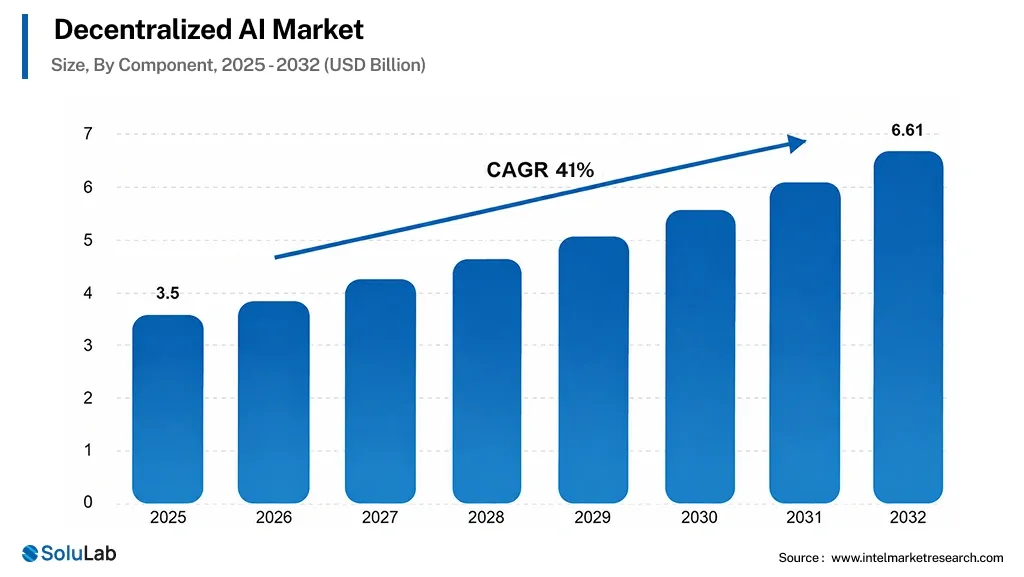
Consider the current landscape:
- Decentralized AI market: $3.8 billion
- Projected decentralized AI market by 2032: $6.61 billion
- Current Web3 infrastructure market: $10.2 billion
- Projected Web3 market by 2031: $56.93 billion
- AI and machine learning contribution to Web3: 25%
Those figures show that AI is already becoming one of the largest growth engines within blockchain ecosystems.
Are AI Agents Cooking the Future or Already Running It on Ethereum?
The biggest opportunity in AI is not another chatbot. It is autonomous AI agents.
The market is rapidly moving from AI that responds to questions toward AI that performs actions. Ethereum is becoming the infrastructure that makes those actions possible.
1. From Chat Interfaces to Economic Participants
Traditional AI systems wait for instructions.
Next-generation AI systems execute tasks independently.
Ethereum allows AI agents to:
- Hold digital assets
- Manage wallets
- Receive payments
- Purchase services
- Hire other AI agents
- Interact with decentralized applications
This capability is creating what many developers call the machine economy.
Unlike traditional software, autonomous agents can become active participants inside financial ecosystems.
2. ERC-8004 Is Building Digital Identity for Machines
One of the most fascinating developments is ERC-8004. This emerging standard enables verifiable on-chain identities for AI systems.
For blockchain developers pursuing AI-powered blockchain development initiatives, this solves several long-standing problems:
- Reputation tracking
- Sybil resistance
- Accountability
- Trust establishment
- Cross-platform identity
Instead of operating anonymously, AI agents can build verifiable histories that follow them across applications. And trust remains one of the most valuable assets in AI.
3. Why Circle Is Betting Big on Autonomous Agents
Rather than viewing stablecoins solely as payment tools for humans, Circle sees them as the financial rails for AI agents.
The company has already introduced Autonomous Agent Developer Toolkits that enable developers to build AI agents capable of holding, spending, and receiving USDC directly through smart contract wallets.
Circle CEO Jeremy Allaire summarized the opportunity perfectly:
“AI agents can do more things, they can add more economic value, but they need the rails of a digital-native currency. An AI agent doesn’t have a credit card, it doesn’t have a bank account. It has a cryptographic key.”
This statement captures exactly why Ethereum for AI applications is attracting so much attention.
- Traditional payment infrastructure was designed for people.
- Ethereum was designed for programmable transactions.
- An AI agent managing supply chain procurement cannot wait for banking hours.
- An AI trading system cannot depend on credit card networks.
- An AI-powered compliance platform cannot manually request approvals every few minutes.
- Ethereum removes those limitations.
4. The Future Is Machine-to-Machine Commerce
Allaire also made another prediction that developers should pay attention to:
“We are moving into an era where the largest users of stablecoins won’t be humans—they will be autonomous AI agents.”
Think about what that means.
AI agents paying:
- Data providers
- Storage networks
- Compute platforms
- Security services
- Other AI agents
All automatically.
The result is a new economic model where software becomes a customer, vendor, contractor, and service provider simultaneously.
For organizations investing in Blockchain consulting services, this is one of the most compelling reasons to build AI Applications on Ethereum.
Why Are Smart Contracts Finally Getting a Brain Upgrade Instead of Acting Like NPCs?
For years, smart contracts have followed a simple rule: If X happens, execute Y.
That approach works. But it lacks context. Modern AI applications combined with blockchain technologies change the equation. It’s not just about Ethereum, other alternatives like Solana also give you high-end opportunities. However, choosing between Ethereum and Solana is under your requirement.
1. Context-Aware Automation Changes Everything
AI can evaluate information that traditional smart contracts cannot.
Examples include:
- Market sentiment
- Customer behavior
- Risk scores
- Regulatory updates
- Fraud indicators
- Operational anomalies
When these insights feed Ethereum smart contracts, businesses gain adaptive automation rather than static automation.
This is where AI-powered solutions begin delivering measurable business value.
For example:
- A lending protocol can adjust collateral requirements based on market conditions.
- A supply chain platform can detect suspicious vendor activity.
- An insurance workflow can analyze fraud signals before releasing payments.
- The smart contract still executes the transaction.
- The AI determines whether execution makes sense.
2. Security Monitoring Becomes Continuous
Security remains one of the strongest Ethereum blockchain use cases for enterprises.
AI agents can continuously monitor:
- Reentrancy vulnerabilities
- Logic errors
- Suspicious wallets
- Transaction anomalies
- Money laundering patterns
Rather than waiting for manual audits, organizations receive proactive threat detection.
This capability is becoming one of the most practical Blockchain development use cases being implemented today.
3. AI Is Increasing DeFi Productivity
The integration of AI into decentralized applications is already producing measurable outcomes.
Current industry estimates suggest AI optimization layers can improve platform productivity by approximately 30%.
That improvement comes from:
- Faster risk analysis
- Automated treasury management
- Intelligent portfolio balancing
- Fraud prevention
- Operational efficiency
For developers building Blockchain projects, AI is increasingly becoming a core layer within the AI Tech Stack rather than an optional feature.
4. What Coinbase Is Teaching the Industry
Coinbase offers one of the clearest examples of practical implementation.
The company combined generative AI with blockchain infrastructure to improve customer operations at scale.
“Using advanced language models and agentic workflows, Coinbase created systems capable of handling customer requests, analyzing complex documents, supporting text-to-SQL workflows, and improving overall productivity.”
These implementations reduced handling times while improving customer experience and operational efficiency.
What makes this example valuable is not the chatbot.
- Coinbase demonstrated how AI-powered blockchain development can solve operational problems while maintaining the transparency and accountability that blockchain infrastructure provides.
For enterprises evaluating Ethereum blockchain development services, this represents a blueprint rather than an isolated success story.

Is zkVM the Quiet Hero Saving AI From a Trust Crisis?
Artificial intelligence solutions has become incredibly good at generating answers. The challenge is proving those answers can be trusted.
As generative AI expands across industries, concerns around hallucinations, deepfakes, manipulated outputs, and unverified training data continue to grow. Enterprises no longer want intelligence alone. They want proof.
This is where Ethereum introduces one of its most underrated capabilities.
1. Verifiable Compute Is Becoming a Business Requirement
Most AI systems operate like black boxes.
Organizations often cannot answer questions such as:
- Where did the training data come from?
- Was the model modified?
- How was the output generated?
- Can the result be independently verified?
Ethereum’s growing zkVM ecosystem addresses these concerns through Zero-Knowledge proofs.
- Rather than executing every AI computation on-chain, zkVM architectures allow machine learning inference to occur off-chain while generating cryptographic proofs that are verified on-chain.
- The result is a system where enterprises gain transparency without sacrificing performance.
- For businesses building AI Applications on Ethereum, this capability creates a powerful trust layer that traditional AI infrastructure struggles to deliver.
2. Why Data Provenance Is Becoming a Competitive Advantage
Ownership is becoming one of the most valuable assets in AI.
- Training datasets.
- Prompt histories.
- Model updates.
- Generated outputs.
Every one of these elements may become the subject of regulatory scrutiny, compliance reviews, or intellectual property disputes.
Ethereum’s immutable ledger creates an audit trail that follows the entire lifecycle of AI systems.
This is quickly becoming one of the strongest benefits of the Ethereum blockchain for AI because it addresses a problem that every enterprise eventually faces.
3. Prove AI Is Showing What Enterprise Governance Looks Like
Among emerging companies, Prove AI stands out as one of the strongest examples of practical governance infrastructure.
Its blockchain-powered platform tracks:
- AI training datasets
- Model metadata
- Prompt session history
- Model context information
- Machine learning outputs
Through blockchain verification, organizations gain complete visibility into how AI systems operate. The company’s approach has been recognized by NIST as a practical framework for generative AI risk management.
The development story becomes even more interesting.
- Instead of building key management infrastructure from scratch, Prove AI leveraged AWS Key Management Service.
- The company reportedly reduced development timelines by more than nine months while avoiding nearly five times the ongoing operational costs associated with building its own key management infrastructure.
For enterprises evaluating Blockchain consulting services, this demonstrates how blockchain can strengthen governance while reducing operational complexity.
Why Are DePIN Networks Quietly Giving GPU Monopolies Competition?
Every AI company eventually encounters the same bottleneck. Computational speed.
Training advanced models requires enormous GPU resources, and access remains concentrated among a small group of cloud providers. Ethereum is enabling a different approach.
1. Turning Compute Into an Asset Class
Through Decentralized Physical Infrastructure Networks (DePIN), GPU infrastructure can be tokenized, financed, and shared through blockchain ecosystems.
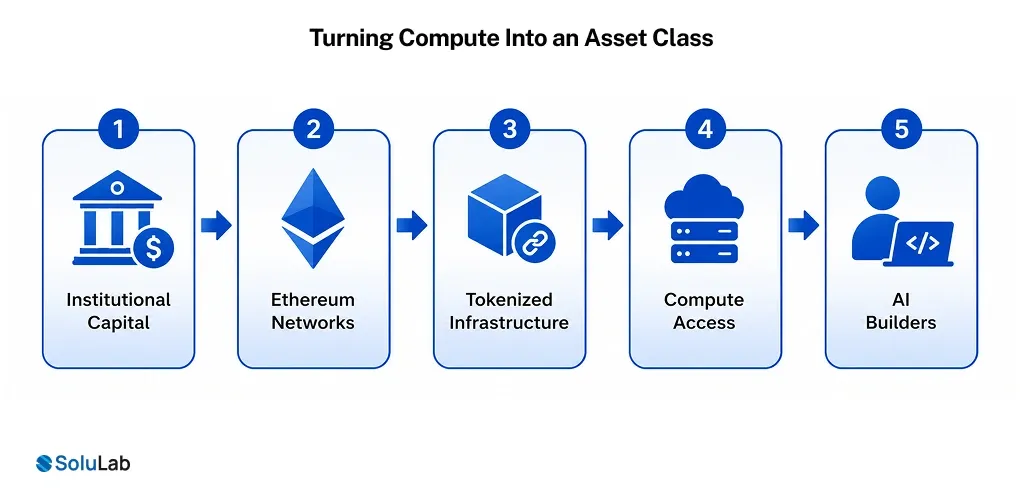
The model creates a new flow of value:
Institutional Capital → Ethereum Networks → Tokenized Infrastructure → Compute Access → AI Builders
Instead of depending entirely on centralized providers, developers gain access to distributed computing marketplaces.
This is becoming one of the most interesting Blockchain development trends influencing AI infrastructure.
2. The Economics Are Getting Attention
The appeal is not philosophical. But it is your financial asset.
Industry estimates suggest decentralized GPU infrastructure can reduce compute costs by 40% to 70% compared with traditional centralized architectures.
For startups embracing AI-led development, these savings can determine whether a product reaches market profitably.
DAO Treasuries Are Funding AI Infrastructure
Another overlooked trend involves decentralized capital allocation.
More than 12,000 DAOs currently manage approximately $25 billion in treasury assets.
A growing portion of this capital is being directed toward:
- Compute networks
- GPU infrastructure
- Data marketplaces
- AI ecosystems
Ethereum is not simply supporting applications.
It is becoming the coordination layer for funding the infrastructure behind those applications.
Are Data Marketplaces Becoming the New Gold Rush for AI Builders?
Most AI discussions focus on models. The next wave may focus on data. Large language models are only as valuable as the information they learn from.
Today, vast amounts of enterprise data remain inaccessible, underutilized, or trapped inside organizational silos. Ethereum creates a different model.
1. Data Becomes a Monetizable Asset
Blockchain infrastructure allows organizations to:
- License proprietary datasets
- Sell access permissions
- Track ownership rights
- Control usage conditions
- Receive automated compensation
This creates entirely new Applications of AI while maintaining transparency and accountability.
Instead of giving data away, communities can monetize it.
Instead of relying solely on public information, AI systems gain access to higher-quality datasets.
2. Why KiteAI Is Worth Watching
KiteAI (formerly ZettaBlock) is building infrastructure around this exact concept.
The company has access to more than 100 million domain-specific queries, creating opportunities to improve AI accuracy while preserving data provenance and ownership rights.
Its ecosystem focuses on:
- AI data providers
- AI model builders
- AI infrastructure operators
- Autonomous AI agents
This approach demonstrates how Ethereum blockchain and AI can create economic systems where contributors are rewarded rather than excluded.
Why Are Visa, JPMorgan, Citi, BBVA, and HSBC Suddenly Building on Ethereum Rails?
Institutional adoption often reveals where technology is heading before headlines catch up.
When global payment providers and major banks begin building on Ethereum-compatible infrastructure, it signals something important.
They see programmable finance becoming unavoidable.
1. Visa Wants Money to Move Like Information
Visa’s involvement with Ethereum has expanded dramatically.
After settling USDC transactions on Ethereum, the company moved deeper into blockchain infrastructure through its Visa Tokenized Asset Platform (VTAP).
The objective is simple.
- Enable commercial banks to issue tokenized assets while supporting programmable financial interactions.
Visa CEO Ryan McInerney explained:
“Public ledgers like Ethereum offer a layer of programmability that traditional banking infrastructure lacks.”
That statement alone validates much of the enterprise demand surrounding Ethereum for AI app development.
The second quote is even more revealing:
“Smart contracts and automated AI agents will require money to move like data—seamlessly, instantly, and across borders without friction.”
This is precisely the environment AI systems require.
- Not delayed settlement.
- Not regional restrictions.
- Not manual approvals.
- Programmable money.
2. Layer-2 Networks Are Making AI Payments Practical
Ethereum Layer-2 blockchain networks now process more than $10 billion in monthly transaction volume.
At the same time, stablecoins account for more than 70% of total DeFi transaction volume.
These numbers matter because autonomous agents operate differently from humans.
An AI system may execute:
- Thousands of micro-payments
- Real-time API purchases
- Dynamic compute rentals
- Data licensing transactions
Traditional financial infrastructure was never designed for this behavior.
3. JPMorgan’s Onyx Platform Is Already Operating at Scale
JPMorgan’s Onyx platform processes more than $1 billion in daily transaction volume using Ethereum-derived infrastructure.
The bank is actively exploring programmable payments where AI-driven treasury systems automatically trigger:
- Liquidity management
- Margin calls
- Asset collateralization
- Treasury rebalancing
Jamie Dimon summarized the opportunity:
“The actual technology layer—the ledger, the smart contract, the ability to tokenize a real-world financial asset and move it instantaneously—is completely real.”
This represents one of the strongest Ethereum blockchain use cases for enterprises currently operating at scale.
4. Citi, BBVA, and HSBC Are Expanding the Playbook
Citi’s Token Services platform allows institutional deposits to operate through EVM-compatible smart contract frameworks.
The result is always-on capital movement rather than banking-hour limitations.
Citi leadership described the direction clearly:
“The future of institutional banking isn’t just digital; it’s programmable.”
Meanwhile, BBVA and HSBC are participating in tokenized asset initiatives and EVM-compatible settlement systems designed to support modern financial infrastructure.
Together, these institutions are proving that Ethereum is becoming an operating layer for programmable finance.
For enterprises comparing Top blockchain platforms, this level of institutional participation is difficult to ignore.
How Can Businesses Actually Build AI Applications on Ethereum Step by Step?
The convergence of Ethereum blockchain and AI is no longer a concept reserved for research papers. Circle, Visa, Coinbase, JPMorgan, Prove AI, and KiteAI are already building production-grade systems that combine intelligent automation with programmable finance. The real question is how businesses can follow a similar path.
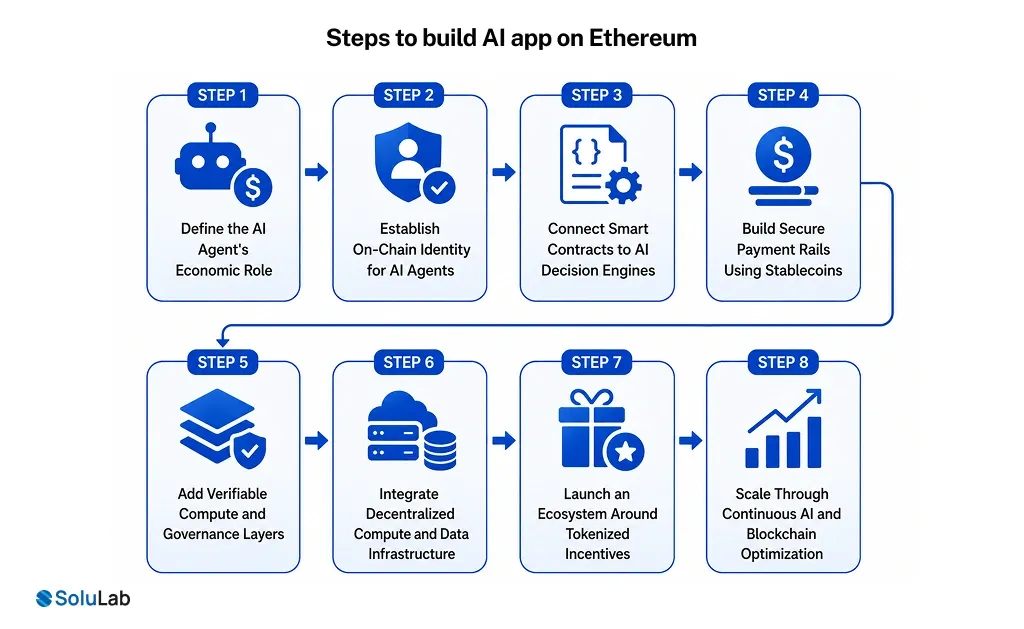
Step 1: Define the AI Agent’s Economic Role
Before selecting models or infrastructure, identify what the AI system will do.
Some common examples include:
- AI treasury management
- AI-powered compliance monitoring
- AI customer support agents
- AI trading assistants
- AI procurement systems
- AI governance assistants
The most successful AI Applications on Ethereum are designed around economic actions rather than simple conversations.
For example, instead of building a chatbot that answers treasury questions, enterprises are developing AI agents that can analyze liquidity positions and automatically trigger treasury actions.
Step 2: Establish On-Chain Identity for AI Agents
Trust becomes critical once AI begins handling assets and transactions.
Using Ethereum identity frameworks and emerging standards such as ERC-8004, developers can create verifiable identities for autonomous agents.
This allows AI systems to:
- Build reputation
- Maintain transaction history
- Establish trust
- Prevent malicious duplication
- Operate across multiple applications
Identity is becoming one of the most important layers in AI-powered blockchain development.
Step 3: Connect Smart Contracts to AI Decision Engines
Traditional smart contracts execute predefined instructions.
The next generation combines AI reasoning with blockchain execution.
A typical architecture looks like this:
AI Model → Decision Layer → Smart Contract → On-Chain Action
For example:
- AI analyzes market conditions
- AI identifies risk exposure
- Smart contract receives the decision
- Smart contract executes rebalancing automatically
This model is becoming increasingly common across DeFi, insurance, supply chains, and enterprise finance.
Step 4: Build Secure Payment Rails Using Stablecoins
Multi AI agents need the ability to transact autonomously.
Ethereum’s stablecoin ecosystem provides that capability.
Many organizations use:
- USDC
- Tokenized deposits
- EVM-compatible payment infrastructure
Circle’s Autonomous Agent Toolkit demonstrates how AI agents can hold, spend, and receive digital assets through programmable wallets.
This removes dependence on traditional banking infrastructure and enables machine-to-machine commerce.
Step 5: Add Verifiable Compute and Governance Layers
As AI systems become more influential, transparency becomes essential.
Organizations should implement:
- zk-proof verification
- Audit trails
- Model lineage tracking
- Prompt history monitoring
- Data provenance controls
Companies such as Prove AI are already demonstrating how blockchain-backed governance can improve accountability while supporting regulatory compliance.
This remains one of the strongest benefits of the Ethereum blockchain for AI.
Step 6: Integrate Decentralized Compute and Data Infrastructure
Infrastructure costs often become the biggest challenge for AI products.
To reduce dependence on centralized providers, many organizations are integrating:
- DePIN compute networks
- Decentralized GPU marketplaces
- Tokenized infrastructure
- Blockchain-based data exchanges
With decentralized infrastructure reducing compute expenses by as much as 40% to 70%, this step can significantly improve long-term scalability.
Step 7: Launch an Ecosystem Around Tokenized Incentives
Once the core platform is operational, businesses can introduce tokenized incentive structures.
Common approaches include:
- ERC20 token rewards
- ERC20 token development solutions for contributors
- Data contribution incentives
- Validator rewards
- Compute provider incentives
- Governance participation rewards
This creates sustainable DeFi ecosystems where users, developers, AI agents, and infrastructure providers all contribute to growth.
Step 8: Scale Through Continuous AI and Blockchain Optimization
The final stage involves ongoing optimization.
Leading enterprises continuously improve:
- AI model performance
- Smart contract efficiency
- Transaction costs
- Security monitoring
- Governance frameworks
- User incentives
This approach allows organizations to evolve alongside emerging Blockchain development trends while maintaining long-term competitiveness.

Conclusion
From autonomous AI agents and verifiable governance frameworks to tokenized infrastructure and machine-to-machine payments, the opportunities continue to expand as organizations search for scalable AI-driven blockchain solutions.
At SoluLab, our team of 250+ blockchain, AI, and Web3 experts has delivered 1,500+ digital solutions across AI, enterprise blockchain, tokenization, DeFi, and intelligent automation.
If you’re looking to partner with a trusted AI development company and hire experts with deep experience in both AI and blockchain technologies, now is the time to build.
Contact us today to discuss how SoluLab can help you develop secure, scalable, and future-ready AI-powered blockchain solutions tailored to your business goals.
FAQs
Deepika is a content writer who blends storytelling with strategic thinking. She explores topics across digital innovation, emerging tech, and the evolving blockchain industry. She enjoys breaking down complex ideas into simple, engaging narratives in the growing global markets.