Key Takeaways
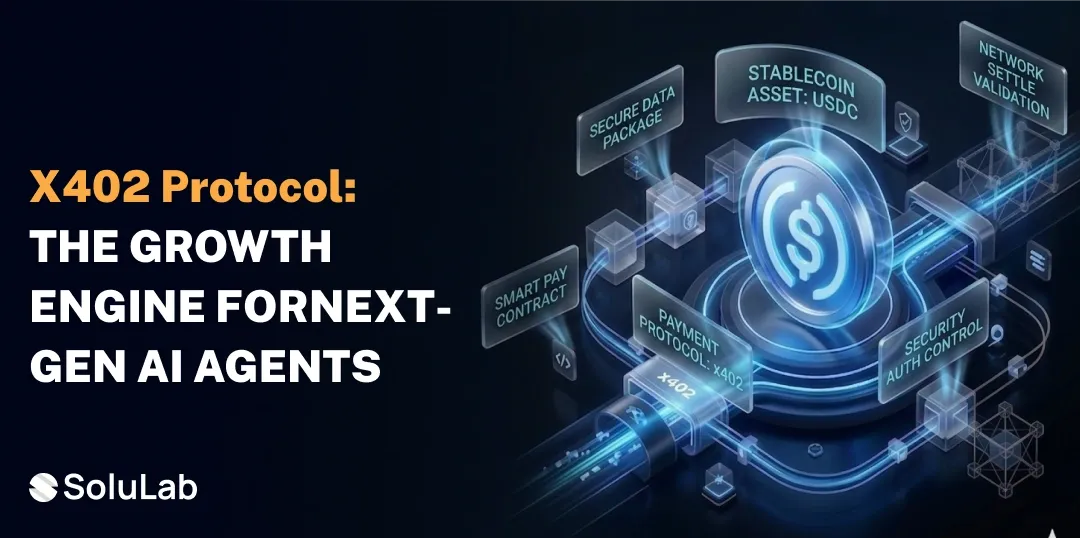
- X402 upgrades the old HTTP 402 code into instant crypto payments, letting AI agents and apps pay per API call with zero manual steps.
- AI agents can now handle payments automatically for compute, data, APIs, and content, unlocking real micro-billing.
- The protocol uses stablecoins on fast chains like Base and Solana, enabling sub-cent fees and near-instant settlement.
- Works across key workflows like pay-per-inference, agent-to-agent billing, and micro-access to data or compute.
- Adoption is exploding as Solana, Coinbase, Cloudflare, and thousands of builders shift to X402 as the new AI payment standard.
Have you ever wondered how AI agents will independently buy services, access APIs, or exchange data without relying on credit cards, subscriptions, or human approvals?
As autonomous systems continue evolving, the internet needs a payment framework designed specifically for machine-driven interactions. That is exactly where the x402 protocol solves the gap. X402 protocol revives HTTP 402 payments and combines blockchain development infrastructure with programmable internet commerce.
It opens new possibilities for AI micropayments, real-time API monetization, and scalable machine-to-machine payments. In fact, machine customers could account for up to 20% of revenue by 2030.
Understanding x402 is becoming important for businesses, developers, and platforms preparing for the next generation of AI-native digital ecosystems.
The History of the HTTP 402 Status Code
Back in the late 90s, when Tim Berners-Lee and his team were shaping the early internet, they added a status code called HTTP 402: Payment Required. The idea was ahead of its time, to let websites request a small payment before giving access to content. Basically, native payments inside the web itself.
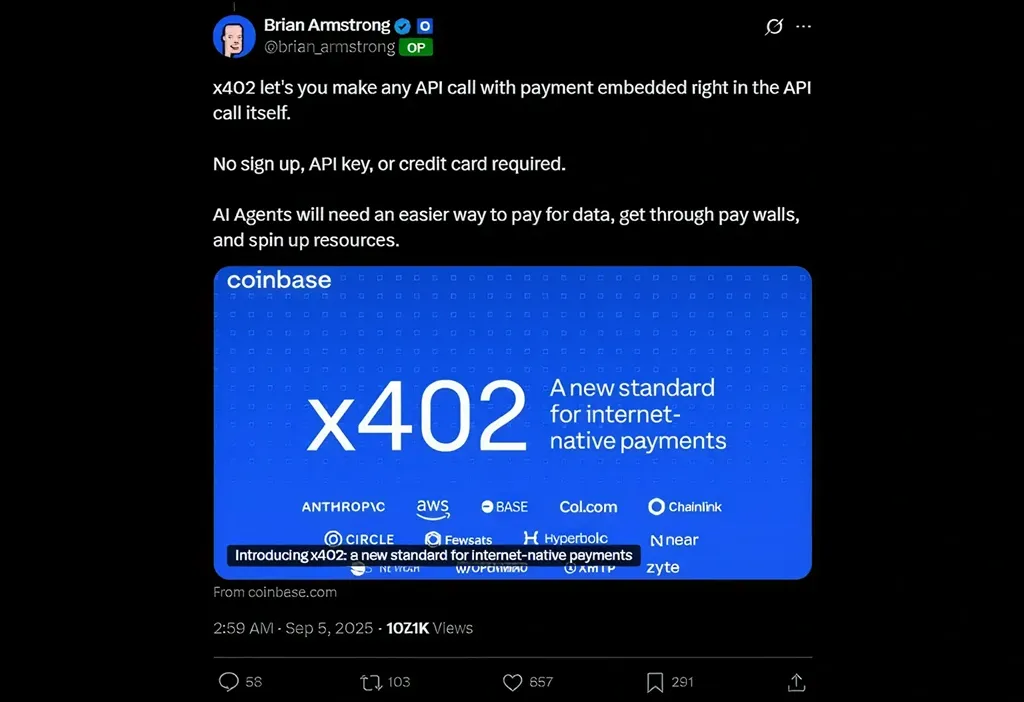
But the world wasn’t ready. No fast payments, crypto rails, or any automated tiny fees. So HTTP 402 sat unused for almost 30 years. Fast-forward to 2025. Coinbase revived this forgotten code and turned it into what we now know as the X402 Payment Protocol – an open, blockchain-based payment standard for AI agents.
What is the x402 Protocol?
The x402 protocol is an open payment standard that enables native payments directly over HTTP using stablecoins and blockchain infrastructure. It revives the long-unused HTTP status code “402 Payment Required” and turns it into a real payment mechanism for APIs, websites, AI agents, and machine-to-machine commerce.
Coinbase Developer Platform introduced x402 in 2025 as an open protocol for internet-native payments. The goal was to enable APIs, apps, and AI agents to transact instantly using stablecoins over standard web requests.
The protocol later evolved into an open-source initiative under the Linux Foundation with support from companies across AI, payments, and cloud infrastructure ecosystems.

x402 vs Traditional API Billing Systems
x402 modernizes API monetization by enabling blockchain-based, instant, and AI-ready payments, while traditional billing systems still depend on subscriptions, invoices, and centralized financial infrastructure.
| Feature | x402 Protocol | Traditional API Billing |
| Payments | Blockchain-based stablecoin payments | Credit cards and invoices |
| Settlement | Instant transactions | Delayed processing |
| Micropayments | Supports low-cost microtransactions | High fee limitations |
| AI Compatibility | Enables autonomous payments | Requires human involvement |
| Accessibility | Global and borderless | Banking dependent |
| Infrastructure | Decentralized networks | Centralized gateways |
| Monetization | Pay-per-use models | Subscription-based models |
Key Features of x402 Protocol
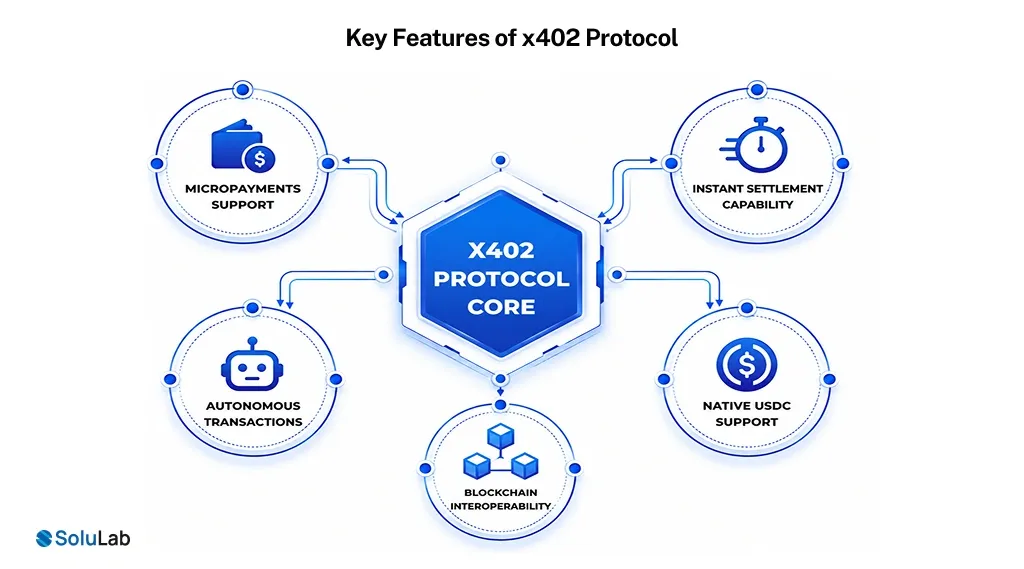
A major reason behind the growing adoption of x402 is its ability to enable machine-driven blockchain payments. It supports AI agents, APIs, and real-time digital commerce without traditional financial intermediaries.
- Micropayments support: x402 enables low-cost microtransactions for APIs, AI tools, and digital services, making pay-per-use models practical without expensive banking or card processing infrastructure.
- Instant settlement capability: Transactions settle in real time through blockchain networks, reducing delays associated with traditional payment systems and improving efficiency for digital businesses and autonomous applications.
- Autonomous transactions: The protocol allows AI agents and software systems to complete payments automatically, enabling machine-to-machine commerce without requiring continuous human involvement or manual approvals.
- Native USDC support: x402 primarily supports USDC stablecoin payments, helping businesses and developers leverage price-stable digital transactions for internet-native financial interactions and API monetization models.
- Blockchain interoperability: The protocol is designed to work across multiple blockchain ecosystems, improving flexibility, scalability, and accessibility for developers building decentralized payment-enabled applications and services.
How x402 Works for AI Agents?
x402 simplifies blockchain-based internet payments by allowing applications, APIs, and AI agents to request, authorize, process, and verify stablecoin payments directly through standard HTTP interactions without traditional payment gateways or subscriptions.
- The Challenge (HTTP 402): When a user or AI agent requests a paid resource, the server returns an HTTP 402 Payment Required response containing pricing details, payment instructions, and supported blockchain networks.
- Authorization (EIP-712): The client signs a structured blockchain payment authorization using the EIP-712 standard, enabling secure, verifiable, and gas-efficient transaction approvals without exposing private wallet credentials.
- The Retry (X-PAYMENT): After signing the payment request, the client retries the original HTTP request with an X-PAYMENT header containing cryptographic proof of payment authorization and transaction metadata.
- The Facilitator: A facilitator service validates signatures, checks blockchain payment status, confirms stablecoin settlement, and ensures the payment request complies with the protocol’s verification and security standards.
- Fulfillment: Once payment verification succeeds, the server instantly grants access to the requested API, digital asset, AI service, or protected resource without requiring manual checkout or subscription management.
How to Integrate X402-Powered Payment Logic Into Your AI Agents?
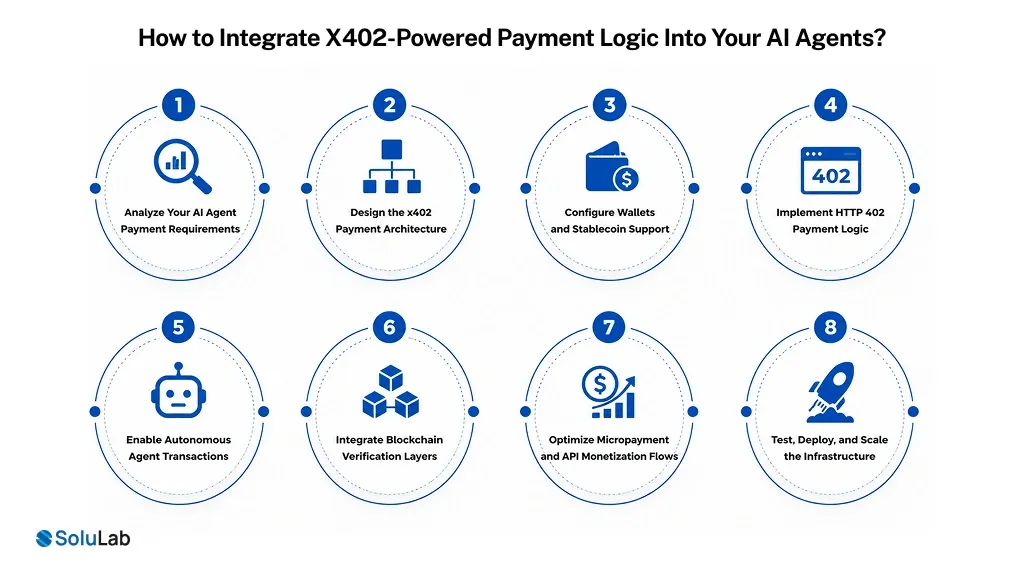
Businesses exploring AI-native commerce are realizing that autonomous agents need more than intelligence. They need secure, programmable payment capabilities that work across APIs, services, and blockchain ecosystems without disrupting user experience.
1. Analyze Your AI Agent Payment Requirements
We begin by understanding how your AI agents interact with APIs, services, marketplaces, or digital assets. This helps define payment triggers, transaction logic, supported networks, and operational workflows for autonomous execution.
2. Design the x402 Payment Architecture
Our team creates a scalable x402-powered architecture that connects AI agents with blockchain payment rails, stablecoin settlement layers, and HTTP 402 response handling for seamless machine-driven transactions.
3. Configure Wallets and Stablecoin Support
We integrate secure wallet infrastructure with support for stablecoins like USDC, enabling AI agents to initiate, receive, and validate programmable payments across decentralized payment ecosystems in real time.
4. Implement HTTP 402 Payment Logic
The core x402 workflow is integrated directly into APIs and agent systems, allowing services to trigger payment requests automatically before granting access to premium resources or paid functionalities.
5. Enable Autonomous Agent Transactions
We develop transaction rules that allow AI agents to independently purchase APIs, datasets, compute resources, or digital services while maintaining predefined spending controls and operational transparency.
6. Integrate Blockchain Verification Layers
Blockchain-based verification mechanisms are implemented to validate payments instantly, reduce fraud risks, and ensure every AI-driven transaction remains traceable, secure, and auditable across decentralized networks.
7. Optimize Micropayment and API Monetization Flows
We configure efficient micropayment structures that support pay-per-use models, helping businesses monetize APIs, AI tools, and digital services without relying on subscriptions or centralized billing systems.
8. Test, Deploy, and Scale the Infrastructure
Before deployment, we thoroughly test transaction reliability, payment latency, security layers, and interoperability to ensure your x402-enabled AI agents operate smoothly at enterprise scale.
Key Benefits of x402 Protocol
A modern internet payment protocol, x402, enables instant blockchain-based transactions directly through web requests, helping APIs, platforms, and AI agents process seamless micropayments without intermediaries, banking delays, or complex integrations.
- Instant Settlement: Blockchain-based payment processing enables real-time transaction confirmation, reducing delays and improving transaction efficiency across APIs, platforms, and autonomous AI-driven services.
- Native Internet Payments: x402 integrates payments directly into HTTP requests, enabling seamless digital transactions without relying on traditional gateways, subscriptions, or external payment processors.
- No Chargebacks: Stablecoin-based blockchain transactions are irreversible after settlement, minimizing fraud risks, payment disputes, and operational overhead associated with refund management processes.
- Zero Protocol Fees: The protocol itself does not impose additional transaction fees, allowing businesses and developers to optimize revenue from micropayments and API monetization models.
The Future of the x402 Protocol for AI Agents
The future of the x402 protocol for AI agents centers on enabling autonomous, real-time digital commerce, in which intelligent systems can independently discover, access, and pay for online services without relying on traditional financial infrastructure.
- Autonomous AI transactions: AI agents will independently purchase APIs, datasets, compute resources, and digital services using x402, removing manual approvals and enabling faster machine-to-machine economic interactions.
- Micropayment infrastructure: x402 supports instant blockchain-based micropayments, allowing AI agents to pay only for consumed resources instead of relying on subscriptions, prepaid credits, or billing cycles.
- Frictionless API monetization: Developers and platforms can monetize APIs directly through HTTP requests, enabling seamless pay-per-call models that simplify access control and reduce operational overhead.
- Stablecoin-powered internet commerce: By integrating stablecoins like USDC, x402 enables borderless digital payments with predictable value transfer, lower transaction costs, and reduced dependency on banking infrastructure.
Conclusion
As AI agents become more capable of handling tasks independently, the need for digital transactions is becoming impossible to ignore. By reviving HTTP 402 payments and combining them with blockchain infrastructure, x402 creates a practical framework for AI micropayments and machine-to-machine payments across the internet.
More importantly, it gives developers, platforms, and AI systems a standardized way to exchange value without relying on traditional billing systems. If the future internet is driven by autonomous AI interactions, x402 may become a core protocol.
SoluLab, an AI agent development company, can help your business build scalable AI-powered payment ecosystems using x402 infrastructure.
FAQs
Neha is a curious content writer with a knack for breaking down complex technologies into meaningful, reader-friendly insights. With experience in blockchain, digital assets, and enterprise tech, she focuses on creating content that informs, connects, and supports strategic decision-making.