
Blockchain stopped being a buzzword a while ago. What’s interesting now is what it does to the bottom line. In 2024, an enterprise-level ROI study showed something hard to ignore: companies that rebuilt their workflows around blockchain saw, on average, a 41% higher positive ROI than businesses running traditional app-only models.
Not because the tech was flashy, but because it quietly removed middlemen, automated things humans were still babysitting, and opened up revenue streams that simply don’t exist in conventional apps – tokens, protocol fees, on-chain incentives, and ownership-driven growth.
And this is where the shift really happens. Smart operators aren’t just adding blockchain technology to an existing product. They’re stepping back and rethinking how value moves through their business – how users pay, how trust is established, how money flows, and who actually owns what.
Apps still matter, of course, but the profit isn’t coming from the interface anymore. It’s coming from the underlying model, which is why more teams are rebuilding the engine, not repainting the dashboard.
Key Takeaways
- The problem: Most traditional apps quietly bleed money. Between cloud costs, payment processors, compliance layers, and manual ops, it’s normal to lose 20–40% of revenue before it even shows up on the balance sheet, and settlements still take days, which slows everything down.
- The solution: Blockchain flips that math. When trust is automated with smart contracts and incentives live on-chain, costs drop by as much as 50–60%, settlements happen in minutes, and revenue doesn’t stop at subscriptions; it grows with usage through fees, tokens, and network activity.
- How SoluLab helps: SoluLab focuses on building blockchain products that make money in the real world. From DeFi protocols to enterprise DLT systems, the work is designed around capital efficiency, compliance, and profit from day one, not demos or hype.
What Sets Blockchain Business Models Apart from Traditional Apps?
A blockchain business model isn’t just a normal app with crypto solutions added on top. It changes how value moves through the product, who controls it, and where trust actually lives, which is why the economics feel different once real users show up.
- Instead of everything running through one company’s servers, trust is handled by cryptography and a network that agrees on outcomes together, so things execute because the system says so, not because a team manually approves it.
- Ownership is built directly into the product using tokens or NFTs, which means value can move, be locked, rewarded, or reused without asking permission, and that opens the door to liquidity and incentives that traditional apps don’t really have.
- Most core processes run automatically through smart contracts, so payouts, governance, and even compliance logic happen in code, not spreadsheets, emails, or long approval chains.
Over time, users stop being just users. They hold a piece of the system, benefit when it grows, and stick around longer, which creates the kind of network effects that app-only businesses usually chase but rarely reach.
How Blockchain Business Models Generate Revenue Unlike Traditional Apps?
Traditional apps mostly make money through subscriptions, ads, or in-app purchases, and those models work, but they flatten out faster than founders expect. Blockchain app development adds more ways to earn as activity increases.
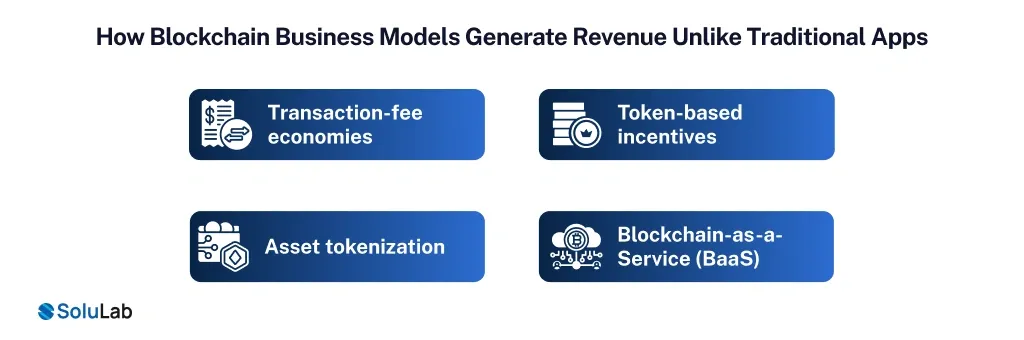
1. Transaction-fee economies:
Protocols like Uniswap or Aave take a small cut every time someone trades or borrows, so revenue grows naturally with usage instead of relying on constant marketing spend.
2. Token-based incentives:
Issuing a native token lets you align users, partners, and investors in one system, where staking, governance, and rewards keep people engaged because they have real upside, not just points or badges.
3. Asset tokenization:
When real-world assets move on-chain, companies can create liquidity and secondary markets while still keeping control over rules and governance, which unlocks revenue that didn’t exist before.
4. Blockchain-as-a-Service (BaaS):
Some teams skip the consumer layer entirely and sell private networks or infrastructure in the form of Blockchain-as-a-Service to other businesses, creating steady, subscription-like income without running a full marketplace.
As these networks grow, revenue compounds almost by default, because more activity means more fees, more locked value, and more incentives in motion, which is something traditional app models struggle to achieve even at scale.
Cost Benefits of Blockchain Business Models Over Traditional App Models
Blockchain apps might cost more to get started, but after a few months, they usually run cheaper than normal apps. Cutting out middlemen and automating stuff means you spend less on operations, and that quickly pays off.
1. Fewer intermediaries:
When you remove third-party processors, notaries, and manual checks, transaction costs drop a lot, often 30–50%, which adds up fast if you’re handling a lot of volume.
2. Automation via smart contracts:
Smart contracts do the work for you, so there’s less admin, fewer reconciliations, and reporting becomes way simpler. In insurance or supply chains, this alone can cut process labor by up to 80%.
3. Reduced fraud and disputes:
Everything’s transparent and unchangeable, so disputes almost vanish and fraud drops, which saves money on recovery and compliance over time.
Put all that together, and most companies start seeing ROI within a year or so.
Industry Case Studies Showing the Benefits of Blockchain Business Models
1. DeFi: Uniswap & Aave
Uniswap makes money every time someone swaps tokens, and as more people trade, revenue keeps climbing. Aave earns from interest spreads, protocol fees, and staking incentives. It’s a system where activity is actual money, unlike traditional apps that need constant updates or marketing to make a profit.
2. Gaming DApps: Axie Infinity & Gods Unchained
Axie Infinity lets players earn crypto while playing, so the platform grows as users do. Gods Unchained sells cards as NFTs, and the platform makes money on every secondary sale; every trade adds to the revenue.
3. NFT Marketplaces: OpenSea & Rarible
These platforms take a cut from listings and every resale, so the more people trade, the more money comes in without having to launch a new feature every week.
4. Enterprise-grade use cases
Supply-chain tracking, like Walmart’s food traceability, saves millions by cutting fraud, recalls, and losses. Trade-finance apps that used to take days now settle in minutes, freeing up cash and improving flow.
At the end of the day, blockchain applications are business networks designed to make money, and they keep getting more profitable as more people use them.
Why Traditional Apps Fall Behind Compared to Blockchain Business Models
Traditional apps get stuck in ways most people don’t even notice until it hits the bottom line.
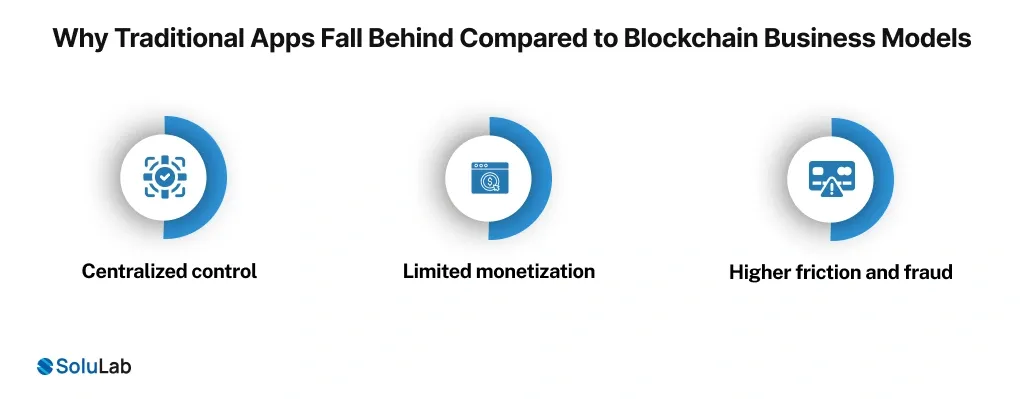
Centralized control:
- Everything’s in one company’s hands.
- You might think that’s safe, but it also means you pay more for compliance, security, and disputes, and things slow down.
Limited monetization:
- Mostly downloads, subscriptions, clicks.
- To grow profits, you need more users, spend more on marketing, and it just eats margins.
Higher friction and fraud:
- KYC done by hand, reconciliations, and third-party checks.
- Mistakes and Fraud happen.
- It’s slow and expensive.
Blockchain apps dodge a lot of that. Here, trust is baked in, middlemen are gone, and you can scale faster without piling costs.
Understanding Challenges in Blockchain Business Models Without Affecting ROI
Blockchain development isn’t magic. There are bumps, but the smart way turns them into profit levers.
Regulatory uncertainty:
- Know your jurisdictions, build compliant systems.
- You’re safe, and competitors get blocked.
Volatility and token design risk:
- Design tokens right, do vesting, align incentives.
- Then profits track actual engagement, not hype.
Integration complexity:
- Get a partner who’s done it before.
- Launch is faster, scaling is easier, and rookie mistakes don’t tank margins.
Handled right, these things don’t cap profits, they make you smarter, leaner, and margins actually go up.
Why Partnering with SoluLab Boosts Profits Through Blockchain Business Models?
SoluLab sits at the top of the global enterprise blockchain development game, helping companies actually build stuff that makes money, not just look fancy.
They work on:
- Custom blockchain apps like DeFi platforms, real-world asset tokenization, NFT marketplaces, and other token-driven ecosystems
- Enterprise-grade DLT networks that are ready for compliance, scale, and security without slowing you down
- Smart contracts and full-stack dApps using Ethereum, Polygon, Avalanche, Solana, and similar frameworks
Their team mixes deep blockchain know-how with AI, IoT, and enterprise architecture, so you don’t just get a blockchain layer, you get one that plugs right into what you already run and actually drives profits.

Conclusion
Blockchain business models aren’t just more secure apps; they’re built to make more money. Automation, fewer middlemen, and tokenized economies mean profits can grow faster than with traditional apps.
When you stack lower operating costs, new revenue streams, and network effects, it’s obvious why companies are moving from app-first to blockchain-first.
If you’re curious how a blockchain model could out-earn your current setup, the right blockchain consulting partner like SoluLab can turn that curiosity into a real profit plan, not just a proof of concept.
FAQs
With over 3 years of experience, I specialize in breaking down complex Web3 and crypto concepts into clear, actionable content. From deep-dive technical explainers to project documentation, I help brands educate and engage their audience through well-researched, developer-friendly writing.